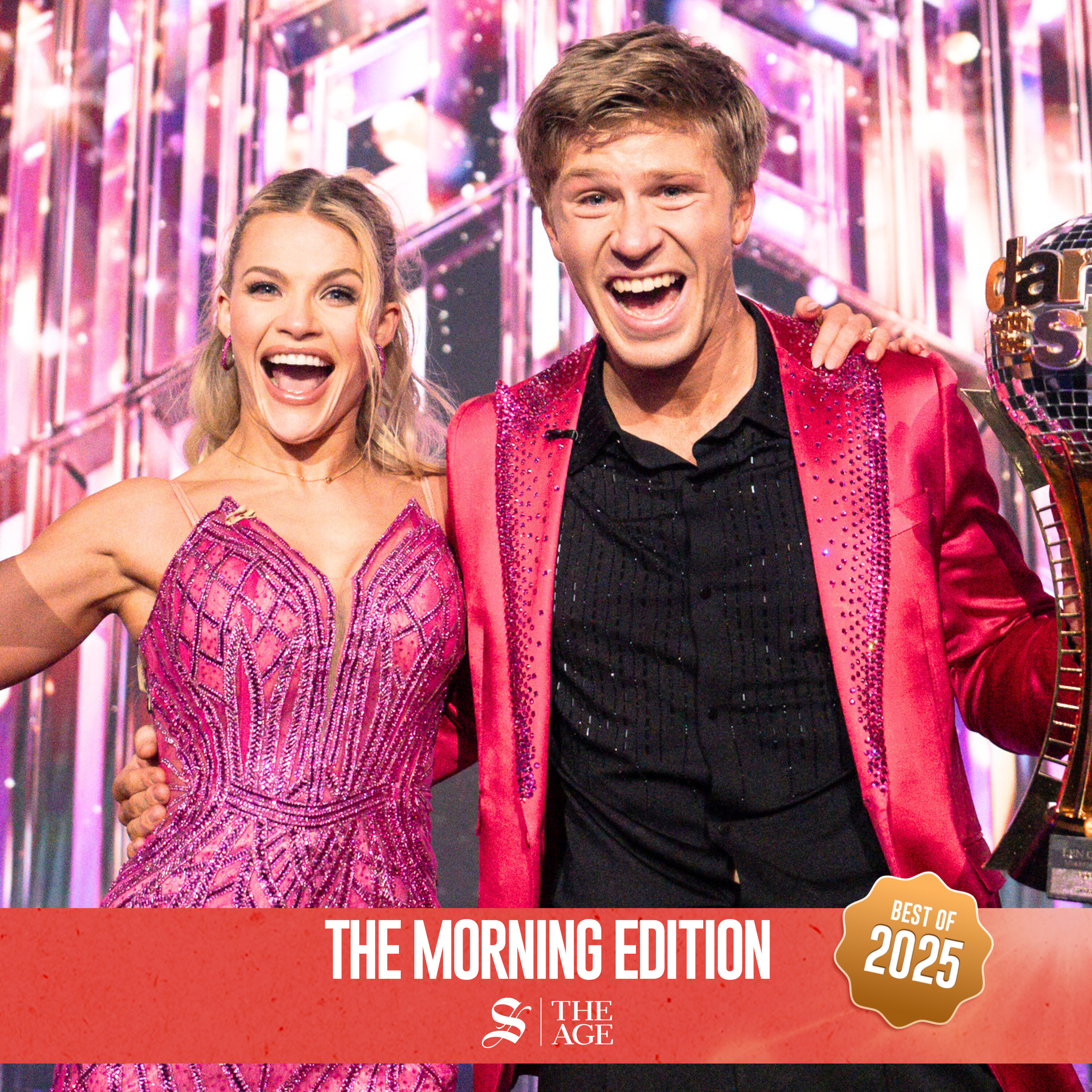
Best of 2025: How a dancing Robert Irwin became America’s antidote
Episode Transcript
Hi, it's Samantha Selinger Morris here.
And I'm the host of the Morning edition.
We're bringing you the best episodes of 2025 before your Morning Edition team returns mid-January.
Today we return to a good news story as we kick off a new year.
The fame of Robert Irwin, the son of crocodile Hunter Steve Irwin, was supercharged recently when he won one of America's top reality television shows, dancing with the stars.
Our culture editor at large, Michael Odato, delves into the Irwin family empire and how Robert Irwin's brand of nice won over America.
And we hope that you have a safe and happy New Year.
So, Michael, welcome to the Morning Edition.
Or should I say good evening?
Because of course it's evening where you are in LA.
S2It is good evening and good morning.
Wherever you are, wherever you're listening.
S1All the things.
Okay, let's get into it.
Can you tell us a bit about Robert Irwin and why we're talking about him now?
S2So Robert Irwin is the son of Steve Irwin?
The Australian TV personality.
S3G'day.
I'm Steve Irwin.
S2Environmentalist, conservationist, The crocodile Hunter, as he is popularly known.
S3It doesn't get any tenser than this.
Here's a huge croc in a very confined space.
S2This is a boy that we've grown up watching as a nation.
We shared with him the loss of his father.
S4Queensland adventurer Steve Irwin, who won fans around the world for his love of dangerous animals, has been killed in a freak accident.
The croc hunter was on the Great Barrier Reef.
S2And I think that triggers collectively a great sense of I think we all feel a measure of shared custody of of Steve's kids.
We've watched them grow up, so they have a very specific emotional kind of resonance with the audience.
In the United States, the family is incredibly well known.
We're talking about him because he has featured in this season of the American Dancing with the stars, the 34th season.
He's performed incredibly well.
S5Robert Irwin has got hearts racing again in his latest dancing With the stars performance, earning his highest scores of the season with a tantalising tango.
S2And around him there has been this kind of cyclone of marketing momentum noise discussion.
People are tuning in.
S6America has well and truly fallen in love with our golden boy, Robert Irwin.
This boy is in his element, and I think the Americans have really seen that and have just fallen in love with his positivity and just absolute zest for life.
S2The show is reporting basically kind of audience numbers that it hasn't seen certainly in more than a decade.
I would say probably about 12 or 13 years since it's seen kind of this scale of not just audience capture, but also kind of, you know, media stickiness, the fact that it's kind of on every website, its leading Morning news broadcast on Wednesday mornings here after the Tuesday Night Live shows, so there's an incredible amount of energy around it at the moment.
S1Yeah, it's pretty amazing.
He's actually a fantastic dancer for someone who, as I understand it, had no dancing experience prior to this.
We'll get into that.
But first, can you just give us an idea about the scale of the Irwin family empire?
Like what does it consist of?
S2So essentially the center of that empire is the Australia Zoo.
It's located in BYU in Queensland.
It's basically 700 acres.
There's about 500 staff.
There's about a million, I think about a million people a year go through the turnstiles.
So it's a kind of it's a private zoo in, you know, in, in the sense of being a straight business.
But the Irwin's are as a family, they have a really big, um, they have a large amount of conservation land holdings.
So for example, they have a there's a Steve Irwin reserve, which is in Cape York.
There's a conservation properties, um, elsewhere in Queensland.
Essentially, I think all up they basically have about half a million acres of what amount to private national parks.
They are kind of they are conserved wildlife areas.
So they are environmentalists in an enterprise sense.
They have, um, a really, really big kind of TV business.
They have a deal with Warner Brothers in America for content for the Animal Planet show.
They have big social profiles.
Those profiles obviously get monetized with products.
And they essentially out of all of that, they spin a licensing business, which is essentially, you know, the phrase is the crocodile Hunter and Australia Zoo.
Steve Irwin, the Irwin family, there are products.
There are, you know, everything from sort of, I guess, like Funko dolls to, you know, sort of t shirts or kind of, you know, merchandise.
There's a big kind of business enterprise that sort of spins out of it all.
But I think the centrepiece of that business is the zoo.
S1Okay.
In Australians, of course, have been familiar with Robert virtually since the day he was born.
We all remember his father, Steve, sort of holding him in his arms.
I think he was wearing nappies, you know, while his father was feeding crocodiles.
But now Americans have fallen in love with Robert.
So what is it about him that they're sort of latching on to?
S2Certainly the heart of particularly for Australians, the heart of that brand is about the fact that we grew up watching him.
We all feel a tremendous emotional connection to his loss and to kind of the family's triumph against that loss in lots of ways to Americans.
He sort of springs out of that story, the Steve Irwin story.
And when Steve Irwin died, it was a gigantic news event here.
I think what's so powerful about what's happening in 2025 is that Robert Irwin kind of lands in this moment as a really, really upbeat story and an incredibly downbeat news cycle.
Everything we have, there's 100 channels of misery available to you.
Pick a news channel anywhere and you'll be really unhappy, just kind of trying to consume it all.
And what Robert Irwin is, he's a feel good story.
And him personally, I know that's a really hard thing to do.
I don't know him.
I've met him peripherally.
I'm very good friends with Julia Morris, who is his co-host on I'm a celebrity.
He's a nice guy.
Nobody on Earth seems to have a bad word to say.
Everyone who knows him says 100% of what you see on the camera is 100% of him.
So there's no artifice, there's no pretense, there's nothing.
There's no false kind of motive in him.
He's just a really wonderfully genuine young man doing incredibly well.
And there's there's also that thing I think that, you know, success smells really good.
We're all drawn to the smell of it.
The fact that he's not just a really lovely guy, but he's scoring perfect 30 because in Dancing With the stars, three judges each have paddles to score.
You know, up to ten points for performance.
And when you get three tens, that's all you can get.
That's the perfect score for Dancing With the stars.
And he's scoring 30s.
So this boy has kind of conquered the game.
He's conquered the dance, he's conquered the audience.
I just feel like we're kind of we're kind of all there emotionally.
S1And do you think that Dancing With the Stars is, I don't know, perhaps a perfect vehicle to sort of channel, I guess, his authenticity or this story, even about his loss and how he has sort of lived through that, because you wrote really movingly about a moment on Dancing with the stars with his mom, Terry, that probably would have won even cynics over.
So perhaps tell us about that moment.
S2So essentially, they were there's a week in the competition they call dedication week, where all the choices are made and kind of dedicated to an idea or to someone or to something.
He dedicated the performance to his mother.
S7Dancing contemporary with his partner, Witney Carson.
It's Robert Irwin.
S2They performed a contemporary dance.
It was all very beautiful.
It had lots of shadow.
And there's, of course, this incredibly beautiful moment at the end where he sort of spins Witney, his dance partner, into the shadow, and as she spins out of the shadow, the camera's traveling around him and they've they've done this incredible camera switcheroo, basically to put Terri Irwin, his mother, into the dance.
He obviously just can't even deal with it.
And it sort of breaks down in tears in that moment.
So there's there's a huge amount of human emotion there.
S8This dance is for my mum.
It's for all of the mums out there who don't get the recognition they deserve.
This is for the single parents who work so hard every day to put one foot in front of the other.
It's for anyone who's lost.
Someone who feels lost.
Keep going.
S2There's two key things I think going on.
One of them is it's obviously very deliberate.
It's a very specific act.
That moment is scripted and produced and everyone in it is a participant.
So even Robert and Terri themselves know they're kind of emotionally putting their emotions as a product into a moment and knowing that television will gobble that up in a really crazy personal way at the same time, because I think I'm a great believer in life, that when people are struggling to find answers, the answer is often all things can simultaneously be true at the same time.
It's an incredibly genuine moment.
There's no false motive.
It really is him dedicating the song to his mother.
It really is her willing to kind of share a moment with him on that show.
His sister won the show ten years ago, so the family has a bit of weird, emotional, kind of, you know, skin in the game as well, collectively and the moments incredibly beautiful.
It's really hard not to be affected by it.
S8And I'm so grateful.
I never thought that this would be the place, that this would be the avenue that I finally get to fully express my gratitude.
To the to the person who shaped me into who I am today.
And I'm so grateful for that.
Thank you.
S2The inescapable truth of Robert Owen is that he is a boy, that we as a nation.
We grieved with him when he lost his father, and we've all kept a national maternalistic paternalistic eye on him ever since.
Basically just checking that he's okay and wanting the best for him.
Because as a young man and as a family, they suffered such incredible public loss that it's hard not to be drawn into the the real power of that.
S1Perhaps that's why I'm going to quote from your story here.
You wrote Even Love Island hardened TV critics were left sobbing and clutching their Kleenex boxes.
Is that you, Michael Adato?
S2It was me, I was it's really it's such an emotional moment.
I mean, I lost my mother in 2019, and I think that I don't think you need to have experienced losing your mother to understand that moment, but it certainly helps.
It gives.
There's a I think for me and for anyone who has felt very personal loss, there's an easy window to step through in that moment to understand the power of it.
Because here's the thing.
You know, Steve Irwin died at a point in the lives of those children.
Terri Irwin was a single mum.
Those kids were really raised by her, and they were raised into the memory of their father, and they were raised in an environment that was dedicated to their father.
But she you know, it's I don't know how anybody could fail to give her the extraordinary credit of not just building a business around them and around his legacy.
It's a story of her hardship and all the sacrifices she made as a mother to make sure the kids were okay.
And it's a story of, you know, the kids in this wild and very beautiful dedication they have to their dad.
S9We'll be right back.
S1Can you track Robert Irwin's rise for us?
Like, where did it start?
Was it the bonds add?
Because I know that many listeners, I imagine they might be like myself that you know.
Of course.
Yeah.
For a long time, you know, we had this fixed idea of Robert as a toddler, you know, hanging out with his dad, and then, boom, there he is with his six pack.
Like, I want to know whose idea that that was.
S2I mean, look, I think obviously he was, um, always well known in the sense that the family was famous.
There probably are some sort of headline touchstones over the years.
There's no question the bonds campaign, particularly for America, not only kind of put him into the middle of the media ecosystem here, but also taps into the fact that he's a very good looking young man.
And, you know, the media ecosystem everywhere really loves very good looking young people of all ages.
You know, of all ages and kind of designs.
So he he steps into that frame, you know, with kind of matinee idol, you know, movie looks.
And the camera loves him.
The media love him.
He has all of that natural charm.
And I think that's where it all starts to ignite.
The most interesting thing to me, not just the bonds campaign, but I think also whoever had the idea to put him on Dancing With the Stars, obviously, I think because it was the 10th, I think it's the 10th anniversary of Bindi's win.
Someone at the American ABC network has obviously consciously thought, oh, here's the connection.
You know, ten years later, let's approach her brother.
He's obviously everywhere right now in this, this kind of American media campaign.
Maybe, you know, maybe he'll be into this.
And I think also there's a very clear focus from the enterprise itself, which is Australia Zoo and the marketing machinery that goes around it to to market him into America.
He was just on the cover of the New York Times Magazine.
He's in people magazine a lot.
There's he has a strong American media presence.
Um, and obviously the connection through the Earthshot Prize to Prince William.
There's a, you know, there's a couple of things.
There's a couple of kind of touchstones here that have basically served to amplify his brand at a time where I think we will now see dancing with the stars amplify the brand, um, at a to a much, much more heightened level.
S1And do you think his rise, you know, from toddler sort of obsessed with crocodiles to to budding heartthrob like was this deliberate, I guess, you know, or even inevitable a next step for him?
Because we know that he's literally been in the spotlight since the day he was born.
I was just reading today that a camera crew filmed him as a newborn in the delivery room.
S2Yeah, I mean, look, it's an interesting question.
I mean, obviously all of this is deliberate.
No one, you know, does a bonds commercial accidentally.
No one falls out a window and lands on dancing with the stars.
All of this is by design, so I think it would be, you know, it would be false to suggest that it's the sort of that it's all happened unexpectedly.
Of course, this is all.
This is all incredibly by design.
Um, the key thing, and this is a bit random, but I happen to be very good friends with Lorna Luft, who is Judy Garland's daughter, um, in LA.
And one thing that I remember talking to her about was when I asked her about growing up in that family and in that kind of spotlight, she sort of was like her answer was always.
It was all very normal to me, like I didn't know any different.
So I think the key thing that question of did, let's say, did Robert Irwin have a normal childhood?
The answer is what's a normal childhood?
I mean, a normal childhood is whatever you have with your mother, your father and your siblings.
And in that sense, I think Robert Irwin had a really normal childhood.
I just think he had it in the shadow of his father's loss.
But in the family zoo, with his mother and his sister surrounded by wildlife.
And that to a boy in that situation is a really normal childhood.
S1Okay, but let's get into why Robert and Bindi spend so much time courting America.
I mean, is it just is it just to sort of amplify the business?
Is it something else?
S2Well, it is, of course it is.
I mean, it's America is the heart of the business.
It's the heart of the television business.
It's the heart of the global pop culture ecosystem.
It's where the money is big.
And also to be fair as well, if again, if we go back to what the sense of the Irwins and Steve Irwin was, you know, 25 or 30 years ago in Australia, they were almost an American thing.
Anyway, my sense as a TV, I was a very young TV writer at the time.
I was in my 20s.
I was working for the Daily Telegraph.
Um, I wrote about Steve Irwin.
I met him a bunch of times.
He was the world's nicest man.
Terry was very lovely.
I think what my sense of it then was in America, they, uh, had this big TV life.
They were on Animal Planet.
There was sort of.
There was this.
They were documentaries and TV shows and all of this stuff.
Australia never had it at that volume.
At that time, we didn't even have pay television.
It was still in its infancy in the 1990s, the idea of cable TV.
So what we had was periodically channel ten would air one of the documentaries as a special.
So we might have only had Steve Irwin on the TV, you know, on channel ten in the 90s, 3 or 4 times a year.
That was it.
He was still a well known kind of media personality, but the TV imprint was very small.
The American TV imprint was gigantic from the beginning.
So to some extent, the reason I think they focus on America is that's where the big business is.
It's where the big money is that there's a whole lot of things, but it is also where their father found his biggest fame, and it's where their name is kind of universally known.
And it's where, as an Australian in America, if I meet Americans on the street and we talk about stuff or they ask about Australia, they were often I remember being asked what I was Steve Irwin really famous in Australia, and I'd have to sort of explain going, well, he is, but probably not quite in the same way that you guys go completely bananas for him.
S1It's very interesting.
And of course, the mother, Terry, of course, is American.
But but about Australia, you know, Robert was the face of a big Tourism Australia campaign before Dancing With the Stars.
And he was just this week plugging Australia Zoo on his social media.
So is there some kind of net benefit for us, like is this going to benefit the Australian economy somehow.
S2Of course.
Gigantically I think they're well, I mean, I think that they're connected.
So it's almost like tourism generally and tourism specifically in the end.
Um, lots of Americans come to Australia wanting to go to Australia Zoo.
It's a as an entity.
You know, growing up in Sydney, I grew up knowing the Taronga Zoo.
It's the only zoo I kind of knew as a zoo.
To Americans, Australia Zoo is a much bigger, more centrally understood place, and they often come to Australia wanting to go there, and they do in large numbers.
So um, and obviously because, you know, the air traffic from the United States to far north Queensland is not direct.
There is a flow on benefit really for everybody, because essentially many of those tourists will come through the eastern capitals from America to get to the Australia Zoo.
So there is a kind of collective benefit.
There's a very specific benefit to the family's enterprise.
And again, this is again, it's this stuff is very careful and deliberate.
Absolutely.
He knows what he's doing on his socials, and absolutely he understands how all the touch points land to market the zoo and the idea of coming there.
But collectively, as a country, it's a very positive brand to represent us.
And I think also there is a logical follow on where, you know, those tourist dollars.
In order to get to to that location, you pretty much have to flow through, you know, the eastern capital cities of Australia to get there.
S1Okay.
And Michael, just to wrap up on that note of positivity, your piece about Robert Irwin, it is resoundingly positive.
I mean, this is the vibe that surrounds him, right?
Like, I was doing a little bit of a deep dive and I saw that the New York Times, the headline on their feature from about a week ago was Robert Irwin is actually that nice?
I mean, that's that's just what he is, right?
But I this might be the Australian tall poppy syndrome sort of peeking through.
But I just want to ask you, you know, is there a chance the public might overdose on his sort of, like, unrelenting positivity and upbeat ness?
And this could just be me projecting my feelings of inadequacy that perhaps I'm not as nice as Robert Irwin is all the time.
S2So, look, the answer is, I don't know.
I doubt it.
I feel like nice is nice, and nice is a really easy brand to sell.
I will give you one controversial thought.
I'm not a big believer in the tall poppy syndrome because I think in order to fall prey to it, you have to trigger it.
And to my mind, the tall poppy syndrome only ever really got thrown at people who went overseas or went somewhere and somehow turned their back.
Kylie Minogue could argue there was a period where people had a go at her, but it would also happen to be a period where, you know what felt like seconds after leaving Australia, she suddenly manifested a kind of transglobal British accent.
And I think when people perceive any sense of falsehood in those moments, that's where they react angrily.
And that's where the patrol puppy syndrome occurs in Robert Irwin's case.
I think it's really hard for that to happen.
Nice is nice and I don't know how you argue with nice, and I think that in a context where everything else is a real like the emotional kind of palette of the moment is frustration, depression, fear, anger, all these things are kind of being pushed out into the wider culture and we're consuming them.
And it frustrates us.
And I think, you know, there was a piece I wrote a couple of years ago about Christmas where essentially I'd articulated an idea to one of our editors who said, you need to capture that, which was we got to the end of the year, and there are just moments where you think it's just a relief that we got here, like we it was a success just getting here.
And I think in contrast to that, when Robert Irwin comes into the room and he lights up the TV screen because he's lighting up the room and he dances up a storm and he gives you something to cheer for.
And not only that, you have even the cynical idea that all of this is to make money for the Australia Zoo somehow through tourism and profile and celebrity.
The answer the kind of postscript to that becomes, that's true.
And do you know what they do with all that money?
They actually buy land and turn them into conserved wilderness and conserved wilderness.
Costs money to conserve and protect.
And it's not revenue generating.
So there's a sort of the story.
And in the Steve Irwin story, as much as the Robert and Terri and Bindi Irwin story, there's an extraordinary nobility at the heart of the commerce, which is yeah, this is a business.
And yeah, it makes money.
But look what they do with this money.
And look what this conservation foundation has done to preserve Australian wilderness.
I don't know how people argue with that.
I don't see any negatives for the brand.
And I think for him in America, the experience of dancing with the stars will amplify that substantially and in ways that we're probably still yet to see.
S1Well, Michael, thank you so much for your time.
S2My pleasure.
Always a pleasure.
S1Today's episode of The Morning Edition was produced by myself and Kai Wong.
Our executive producer is Tammy Mills.
Our head of audio is Tom McKendrick.
The Morning Edition is a production of The Age and The Sydney Morning Herald.
If you enjoy the show and want more of our journalism, subscribe to our newspapers today.
It's the best way to support what we do.
Search the Age or Smh.com.au.
Subscribe and sign up for our newsletter to receive a comprehensive summary of the day's most important news, analysis and insights in your inbox every day.
Links are in the show.
Notes.
I'm Samantha Selinger.
Morris.
This is the morning edition.
Thanks for listening.