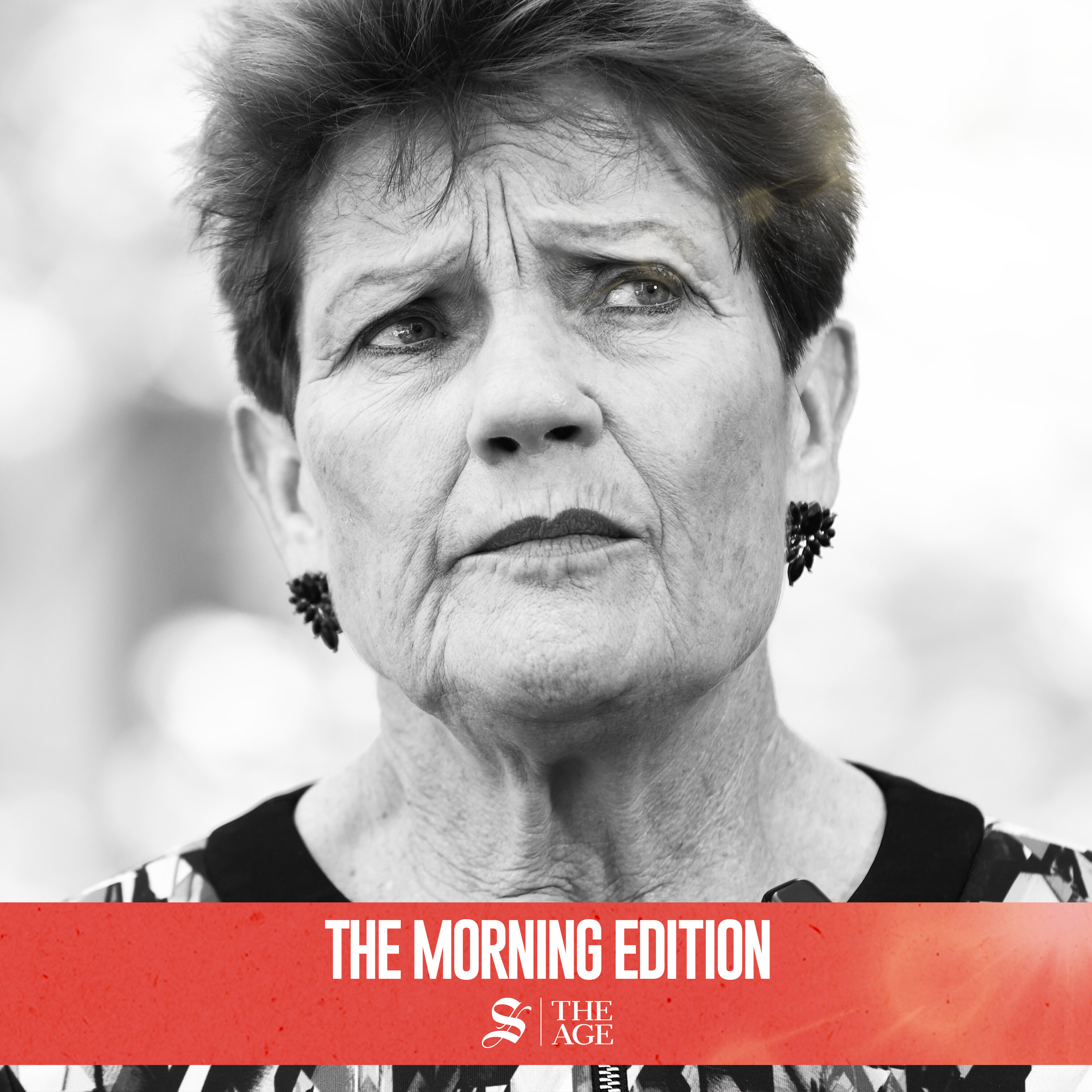
How real is the rise of One Nation?
Episode Transcript
From the newsrooms of the Sydney Morning Herald and The Age.
This is the morning edition.
I'm Samantha Sellinger Morris.
It's Monday, December 1st.
When Pauline Hanson marched into the Senate last week wearing a burqa.
It felt for a moment like we were back in the 1990s.
S2She is disrespecting a faith.
She is disrespecting the Muslims out there, Muslim Australians.
It's absolutely unconstitutional.
S1Those were the sorts of stunts and anti-immigration rhetoric that the former fish and chip shop owner from Ipswich used to pull when she first swept into power.
But with a high profile member of parliament on the verge of defecting to her party and polling placing support for One Nation at its highest level since 1998, it appears that we are witnessing the second coming of One Nation today.
Columnist and former associate editor of The Age, Shaun Carney, on what a rise in support for One Nation says about Australia.
Welcome to the podcast.
S3Hi, Samantha.
S1So, Sean, we are talking to you on the afternoon that Barnaby Joyce formally announced his defection from the National Party, which we know clears his way to join One Nation.
I guess it symbolizes perhaps the increasing power that One Nation has right now.
I mean, you and I discussed before recording that polling just this month put support for the party at its highest levels in 27 years.
So is this surprising to you?
S4It is surprising, really, Samantha, I think one of the drivers of it is the terrible state in which the Liberal Party and the National Party, but particularly the Liberal Party, find themselves in.
So it's sort of driving a lot of this support.
But there's probably something else at work there as well, a general rearranging of political sympathies and, um, views of the old parties and the newer parties across the Australian electorate.
S1And before we get into what's behind this rise in support of the party, can you just help us rewind to the beginning for a moment to give us a sense of where Pauline Hanson and this party actually came from.
So tell us about when she established this party and how she got her start.
Like what was her platform?
S4Come next March, it'll be 30 years since Pauline Hanson was first elected to the federal parliament as the member for the seat of Oxley.
So she's been around politics as an elected politician.
That's how she started, anyway.
There's been a long period there in the middle where she wasn't a member of Parliament, but of course she is now.
She's been around as long as Anthony Albanese.
That was his first election, too.
So she's very much a known quantity.
Very, very few people have been around any longer than her.
She was the endorsed Liberal candidate for the safe labor seat of Oxley in 1996.
S5Six weeks ago, hardly anyone had ever heard of Pauline Hanson.
Now she's the name in just about every radio bulletin, every television newscast and newspaper.
But did you expect this many people?
S2No.
S5Did you expect to be on the front page of the newspaper practically every day?
S2No.
S4This relatively new member, who was aged 41, called Pauline Hanson in owned a fish and chip shop in a part of Ipswich in Queensland.
She vaulted to national fame even before the election because she made some remarks about the undesirability of so much welfare for Aboriginals.
S6With you, I'm indigenous.
I was born here.
I'm native to the land.
S7She's indigenous.
S6Yes I am.
Do you know the word indigenous?
Yes I do.
Native to the land.
I was born here.
Where's my land if it's not Australia?
S7Oh, England.
S4Some anti-Asian rhetoric as well.
The Liberal Party sort of, in a little bit of a panic, disendorsed her, but she went on to win the seat with a swing of almost 20%.
That gave her a place in Australian political history then and there.
S8I call the honourable member for Oxley.
S6I come here not as a polished politician, but as a woman who has her fair share of night life's knocks.
S4The following year she formed a party, One Nation.
It had a very much a philosophical stances which were really about turning the clock back.
S9Your website says that many consider Pauline Hanson to be an outspoken soul that is simply ahead of her time.
Is that time 1950 ending multiculturalism.
S4Going back to economic protection, unwinding economically liberal reforms, and very much a sort of going back to a monoculture.
What was the appeal with, uh, Pauline Hanson to a lot of people?
Well, she was an unmediated figure.
Authentic.
Not in any way middle class, not, uh, articulate in the way that we people in the media like to see Articulacy.
S5Are you xenophobic?
S6Please explain.
S5Xenophobia means a fear of all things foreign.
S6No, I don't think I am.
No I'm not.
S4She said what she thought, and it had resonance with a lot of people who were uncomfortable with all the changes that had been going on in the 70s, the 80s and the early 90s.
S1I mean, she sure was unvarnished.
I think many of us remember her maiden speech.
Uh, and it you know, it shocked a lot of people, I think at the time, uh, you know, she spoke about Australia being overrun by Asians.
She said she wanted to abolish multiculturalism.
And, you know, I think she wasn't a polished politician and she had experienced a fair bit of hard knocks, you know.
So I'm just wondering, I guess, how much is there or was there a cult of personality around Pauline Hanson at the time that she was establishing herself?
Because we often talk about that cult of personality when we talk about Donald Trump.
Um, you know, a system which is like, really centered around this charismatic leader.
Is that what was happening with Pauline Hanson?
S4Yes, yes it was.
She was a charismatic figure to a lot of people, especially men and women, but especially men, um, people who felt disconnected from the economic system.
Men who'd also felt a little bit unmoored by, uh, the feminist wave, you know, positive discrimination, the decline of traditional Manufacturing and blue collar jobs.
Paradoxically, because it was a woman that they sort of attached themselves to politically.
But in that 1998 election, One Nation's first election, they got amazing numbers.
I think they got, uh, 8.4% of the the lower house vote.
That's the second.
In fact, that's the highest they've ever scored.
Again, sort of counterintuitively, Hanson lost her seat or lost her place in Parliament because she because of a redistribution, she opted for another seat to stand in.
Looked like she would win it.
She didn't.
So she was out of Parliament.
And then she spent a long time out of any parliament.
S1That's right.
But it was A11.
It was about a million votes.
I think that One Nation won in that 1998 federal election.
And it's interesting that you mentioned there that she, of course, lost her own seat in the national parliament, because I think that sort of foreshadows something that we'll talk a bit about later, which is, uh, the long standing chaos.
I think that has sort of always marked this party.
But I guess what I wanted to ask you is One Nation.
So it had this real explosion onto the political scene not long ago.
ABC election watcher Antony Green called it the most extraordinary emergence of a party in modern Australian political history.
So can you tell us a bit about how the party really threatened the power of the coalition, even back then?
S4Well, uh, what happened in the vote in 1998 was that the the Howard government held on, but they held on with a majority of the lower house seats, but not a majority of the vote.
The Labor Party secured 51% of the vote.
And in fact, what had happened was that large One Nation vote acted as a sort of transmission belt of conservative votes to the Labor Party.
So they were very much a threat to the coalition back then.
Basically, all of the established parties refused to direct preferences to One Nation.
John Howard at the time was a little reluctant to do it, but he was pushed into doing it by his deputy, Peter Costello, although at the time Howard could see that he didn't want to completely put all of those One Nation supporters offside.
So he took credit in a way for allowing people to say what they thought more easily.
He saw the electoral potency of One Nation and didn't want to completely declare it beyond the pale, and that sort of became the orthodoxy for quite a while.
It's less so of the orthodoxy now, which we might talk about a bit later.
S1And so what happened after that?
Because Pauline Hanson experienced a long time in the political wilderness.
Right.
S3Mhm.
Mhm.
S4Yes.
So there's so many divisions, arguments, court cases involving one nation.
S10Off the hustings and into court.
Pauline Hanson and her advisers interrupted the campaign to hear the judgment against the ABC.
The song I'm a Back Door Man was first played on triple J last August, using the voice of Miss Hansen, her words digitally rearranged.
S6Two.
Three.
Four.
Five.
Six.
Seven.
Eight.
Racist.
Rubbish.
Racist.
Hate.
One.
Two.
S10Queensland's Court of Appeal dismissed the ABC's case, declaring the song exposed Miss Hanson to ridicule and contempt.
S4Eventually, Pauline Hanson was expelled from One Nation in 2002, and in the following year she was convicted of electoral fraud and spent 11 weeks in jail while her appeal was being heard, and she won that appeal and the the conviction was overturned.
I mean, she's really she has been through the wars.
You could say she's an incredibly durable, not just durable, but you would have to say resilient person to have gone through all of that.
And her positions haven't changed.
There's no flip flopping from Pauline Hanson, but One Nation really was on its uppers.
Now she ended up rejoining One Nation in 2013.
And yet that 2013 election, the party was really on its uppers.
It secured 0.1 of one percentage point that election.
But since she rejoined, the party's numbers have gone up and at the last election, I think they got somewhere in the order of 6.5%, which is their second best outing.
And she, of course, entered the parliament in 2016 and then was re-elected in 2022, in the Senate.
S1Incredible.
And you mentioned just there that, you know, with Pauline Hanson, she hasn't been flip flopping, but has her focus on immigration and race changed or softened at all, or is she just as strident and really extreme as she's always been?
S4She's gone heavier on the Muslims, um, on being anti-Muslim, as evidenced by the burka stunt that she's done twice now.
It's still the same menu of grievances.
Yeah, it hasn't changed.
S1We'll be back in a minute.
Well, this is really what I wanted to ask you.
I wanted to talk a bit about, I guess, what are the sort of cultural factors that have been happening that perhaps, you know, were a part of her rise then we've spoken about that.
And then now, because we know back in the 90s, indigenous rights were hotly being debated.
You know, the prime minister at the time, John Howard, was refusing to issue an apology to the Stolen Generation.
That was massive.
There was, of course, a lot of discussion about native Title, but just bringing it forward to now, does the rise that we're seeing in support for One Nation reflect a surge in racism in Australia, or is it more that issues have arisen, you know, that expose what was already there?
S4I think at all times there there is a, um, a hard cohort within the society, within the electorate who will have the views that she has.
It's a matter of how much a politician or a political organization wants to harness them and move them forward, uh, to, uh, sort of attract and then solidify support.
I do think there are economic and social and practical circumstances that favor simple solutions to complex problems, right?
Um, we do have a substantial intake of migrants or, you know, our migration numbers are still relatively high.
We have, uh, enormous segments of the community who are priced out of home ownership.
Uh, there are in sort of the growing parts of our major cities, all sorts of infrastructure pressures.
And so the easiest way of explaining that away is that too many people are coming in.
Uh, the problem in reality is that if we were to just cut migration, Zero migration, which is their basically their proposition.
The economy would tank because we we import growth.
We import demand by bringing those people in.
That's really, I think one of the reasons, aside from the sort of, uh, awful shambles that the liberals are in, um, I think that actually is another explanation for the rise in the polls, I think.
I think it's worth checking ourselves a little bit.
Um, Samantha, not just you and me, but all of us.
These are just poll numbers.
You know, a poll is a snapshot in time.
And we tend sometimes because we get used to polls and we read them, we sort of think, oh, their vote is 18%, which is what it was in the Red bridge or, you know, 12 in the, in the poll.
But that's just what people are suggesting in the surveys, whether on Election Day they would do that.
It's a different thing.
However, those numbers are very substantial for what was very much a fringe party.
Uh, so it's definitely it's a real thing we're talking about.
Yeah, that's for sure.
That's for.
S1Sure.
It's it's an important point.
I mean, we're not having a federal election for years, so.
Yes, like.
S4Thank heaven for that.
S1Yeah.
That's right.
We've been through enough.
S4Yeah, I think so.
S1And just a bit further on what we're seeing, you know, on the streets of our cities, really, because we've had these marches for Australia where I think we saw a lot of real anti-Indian sentiment in in particular, of course, we saw neo-Nazis gathering, uh, for protest on the steps of parliament in both New South Wales and Victoria.
And like you say, we hear a lot of mainstream political debate, you know, that links the housing crisis to the number of immigrants here.
So does this help one nation?
S4One nation believes so because the Canberra, uh, March for Australia is the rubric under which these, um, these marches and demonstrations were held.
both Pauline Hanson and her fellow Senator Malcolm Roberts spoke.
So they have attached themselves to these demonstrations.
Uh, these marches.
And, um, looks like they're part of a movement, a larger movement.
S1Yeah.
I mean, it's it's definitely an astonishing moment.
And you have to wonder, you know, is the environment in Australia right now ripe then, for One Nation's support just to continue to increase.
And like, what do you think that means for our multicultural communities?
Like do you have any sense of wariness amongst some communities.
You know, that they're feeling sort of on notice that they might be targeted, I guess.
S4Well, that seems to be the feedback from, uh, a number of different groups and communities.
But I think there's also something else going on here, um, which is there's a bit of a tussle between One Nation and elements of the Liberal Party and the National Party to grab that cohort of voters who feel that way about some of these issues.
Um, and you can see it with some of the things, not so much the race thing with Andrew Hastie.
I wouldn't suggest that, but a more populist, this idea of getting on the populist train, trying to get people who were disaffected with the way life is going in mid 2020s Australia and coming up with some good old fashioned solutions.
You know that this is something that isn't just exclusive to one nation.
I'll give you the example of what happened in the seat of Hunter back in this year's election.
Uh, a labor seat in a coal area that ended up being after preferences were distributed that became a labor versus one nation seat.
Now labor ended up with a almost a ten point margin.
But all of these minor parties, the march of Patriots, or whatever they're called, the the family first.
Palmer.
Yeah.
S1All parties.
S4Yeah.
They all.
They all preferenced.
And the National Party, too, are National party voters would have preferenced the One Nation candidate so that they were they were the opponent, the other likely winner of that seat.
So this is how it sort of feeds in.
So there's something larger going on on the non-Labor side of politics, I think.
S1Well, John, this takes me to where I wanted to wrap up, which is that, you know, this is really broad.
Arguably, this is really something that we're seeing in global politics.
You know, the rise in populism.
You see that with the Donald Trump presidency.
And we see that with the rise in popularity of Nigel Farage and his right far right reform UK party.
So what's happening there, do you think?
Is this just a reflection of a broader global trend towards the right, this rise of one nation, or is what's happening globally perhaps influencing Australians to support a similar stance here?
S4There are definitely I think sometimes we we tend to undervalue the economic drivers of whatever change this is the commonalities there.
That was a that's been a big driver for the Make America Great again.
The whole Trump thing was Rust Belt people in the Rust Belt or people in the rural areas feeling completely closed off from prosperity and a sense of hope.
So there's some of that going on in Australia, a little less, I think, because and I know this is a very it's almost like you almost need to put this on a business card and just hand it out to everyone.
It's it's becoming a bit too predictable.
But it needs to be said.
Our system of compulsory voting and preferential voting provides some safeguards to this happening to a substantial extent at this stage anyway, because there's a buy in that's built into our system where people do actually have to engage and to some degree willingly, in large proportion compared with those other countries.
So I think that's something that we've got that might stave off what's going on there.
I don't think the I don't want to use the term pejorative term contagion, but whatever you want to call it, that trend might not necessarily find its way here.
In some ways, it's up to the Liberal Party to get its act together and become a sort of mainstream party for a larger cohort of people, and that that can stave it off for two.
S1Which is a real if at the moment, isn't it?
S4But things can change.
This time last year, not many people in the Labor Party thought Labor Party could win a majority of the seats in the lower house and hold government that way.
Five, six months later, they won in a landslide.
You know, things can change pretty quickly.
You know, it depends on performance, foresight and just having the right energy, saying the right things at the right time.
So it's always interesting, isn't it?
S1Yeah.
It is never a foregone conclusion, always an interesting space to watch.
So we're so lucky to have your insights.
Thank you so much for your time.
S4Thank you Samantha I appreciate it.
S1Today's episode of The Morning Edition was produced by Tammy Mills.
Tom McKendrick is our head of audio.
To listen to our episodes as soon as they drop, follow the Morning Edition on Apple, Spotify, or wherever you listen to podcasts.
Our newsrooms are powered by subscriptions, so to support independent journalism, visit the page or smh.com.au.
Subscribe.
And to stay up to date, sign up to our Morning Edition newsletter to receive a summary of the day's most important news in your inbox every morning.
Links are in the show.
Notes.
I'm Samantha Selinger.
Morris, thanks for listening.