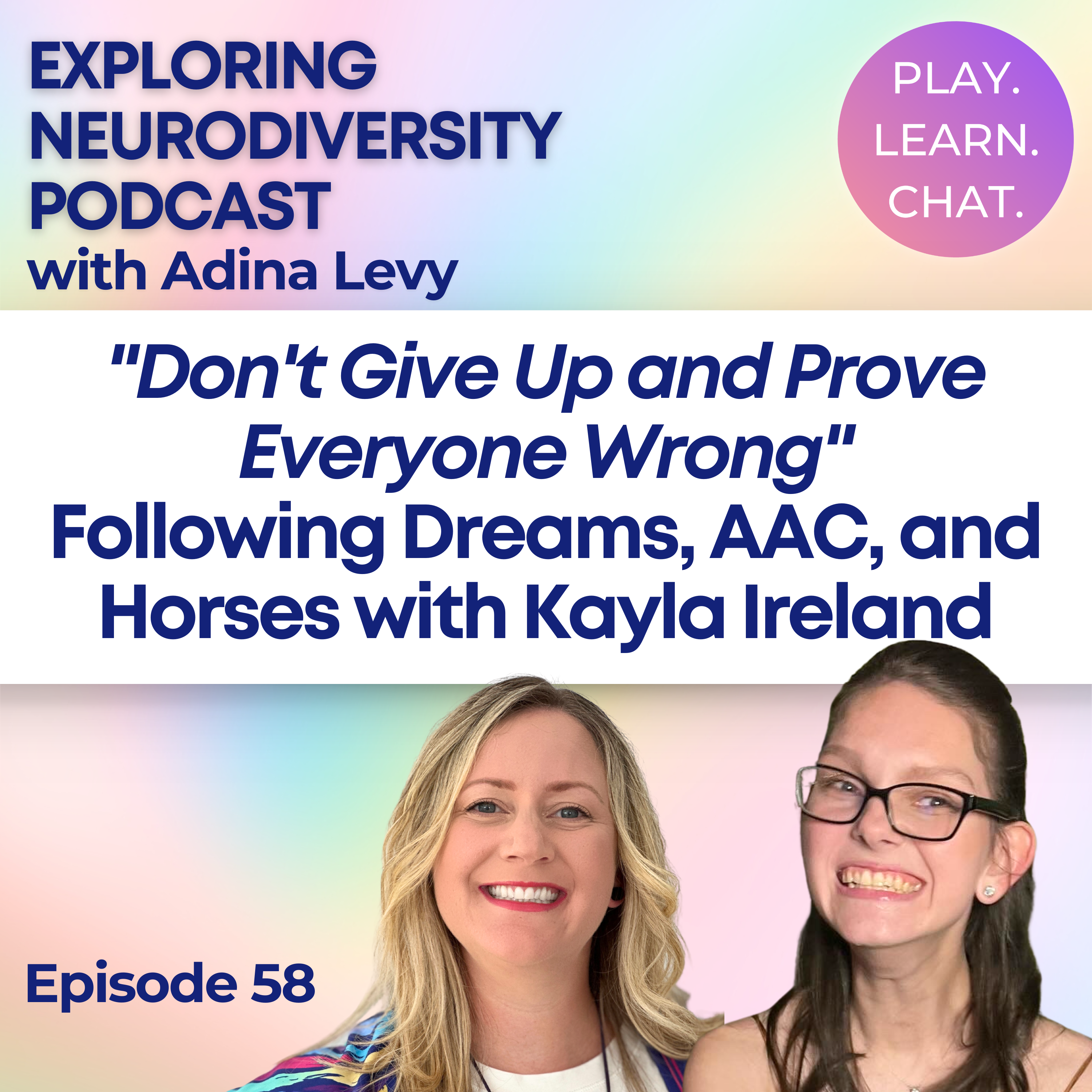
"Don't Give Up and Prove Everyone Wrong" Following Dreams, AAC, and Horses with Kayla Ireland
Episode Transcript
Kayla: It is hard to find a therapeutic activity that doesn't feel like a medical appointment.
Also, I can interact more with a horse rather than a dog
AdinaAdina: Welcome to the Exploring Neurodiversity Podcast for adults who support Neurodivergent children.
I'm Adina from Play.
Learn.
Chat.
I'm an Autistic ADHDer, a speech therapist, professional educator, speaker, and I also support Neurodivergent Business owners in my other business, Neurodivergent Business Coaching and Consulting.
I'm obsessed with creating a world when Neurodivergent people are understood, , embraced, supported, and can thrive in a life aligned with our individual strengths, wants and needs.
I bring a Neurodiversity Affirming approach and indeed a human affirming approach to the support that we all provide for Neurodivergent kids in our lives.
This podcast is recorded on the Aboriginal lands of the Gadigal and Bidjigal people.
Welcome Kayla.
Hi.
So Kayla and I have just been chatting as she is recorded a show for her YouTube channel, which I'll introduce in a moment where she interviewed me and now it's my turn to interview you.
Let me introduce Kayla if you haven't met her yet.
I'm so excited to share with you Kayla's fabulous story and self and human.
Like what?
Yeah.
I'm so, I'm just so excited for our chats.
We've been waiting and talking over email for a while and, um.
So KayIa Ireland is the host of Kindly Neurodivergent with Kay, a show that raises awareness about Neurodivergence.
She's an office manager at Silver Speech and she co-hosts the inside scoop of Living with Cerebral Palsy, which highlights CP awareness.
Kayla is also a co-author of Living with Cerebral Palsy, A powerful collection of personal stories led by Kyle Scott, she co-host.
You do a lot of things.
You do a lot, Kayla.
I love that.
Sounds a bit like me.
She, yeah.
She co-hosts Rock the World with Kay and Michelle, a podcast dedicated to amplifying voices, breaking barriers, and celebrating resilience.
And I love it, by the way.
It's fabulous.
So all of the things I mentioned, I'm going to make as links in the show notes and wherever you're watching or listening, so you can follow Kay, wherever you, wherever you are.
Um, also, Kayla is a communication assistant and dedicated member of many committees for Little Britches therapeutic riding, where she's an avid and experienced horseback rider.
She's a college student at community college, and as you can see, and you're gonna hear and learn, she's a happy, motivated, active, vibrant female with cerebral palsy and epilepsy.
A powerful force advocating for inclusion, representation, and a limitless potential within each individual.
Welcome.
Oh, and Kayla shared at the start of her, um, recording with me.
So I'll, I'll share it now.
Unless, do you wanna share, um, your communication prompt around, um, pausing while you're writing something?
KaylaKayla: Before we begin?
I respectfully request that if you witness any pauses during this show, please continue watching.
I'm composing a spontaneous comment or question, someone processing their thoughts in addition to repeating something that was unintelligible or misunderstood.
It is natural discourse and we can choose not to say anything while this is occurring.
AdinaAdina: Thank you.
And I love the clarity and self-advocacy of that message.
And I'll share usually.
With my interviews, um, I record and then I remove the big gaps in words.
You know, if there's a big pause, like if I'm thinking or whatever, I usually remove word gaps, so someone listening to my podcast is going to have a different experience.
This episode, I'm not removing word gaps because I really want people to understand that communication with an A a C user is at a different pace.
KaylaKayla: Thank you for that choice.
AdinaAdina: You're welcome.
And so, yeah, anyone listening, if you hear a pause, it's not that the podcast has gone quite, you just wait it out because this is how our communication is going to go.
So, uh, Kayla, how are you?
How are you?
Body, mind, soul answer, how you choose.
KaylaKayla: I'm good today.
Thank you for inviting me on and for the introduction.
I look forward to discussing my journey.
AdinaAdina: It's, um, yeah, there's, there's so much to chat about.
And you shared with me your, uh, book chapter.
Was that, can I just check?
Was that the chapter from, uh, the book Living with Cerebral Palsy?
Mm, yeah.
Yeah.
Cool.
It's, it's a really fantastic, um, read and I actually really wanna read the rest of that book, so I'm gonna seek it out.
So thank you for that.
And it helped me.
Get really like really good background about you.
Can you share with podcast listeners your journey to where you are now?
KaylaKayla: I have spastic quadriplegia, cerebral palsy, and epilepsy.
Cerebral palsy affects all my motor skills, so I need physical help doing everything.
I am a power wheelchair user.
However, I can take some independent steps and small transfers like from my bed to wheelchair or my wheelchair to the couch.
I use an adaptive joystick to operate my laptop.
In addition to having to be fed, I have a swallowing disorder.
My mealtimes are complicated because I have to take small bites and sips, make sure that food is on my teeth and not stuck on the roof of my mouth.
AdinaAdina: Thank you for sharing that.
And I'll do like a video description.
By the way, anyone can watch this on YouTube because I will put it on YouTube, but, um, Kayla showed her adaptive joystick as well to operate the laptop.
So, um, you know, it sounds like you've got, would've had a lot of, uh, journey to finding out all of these supports to get you where you are now, but you are more than just, you know, your diagnoses and the, the things you use every day to help you.
Also, you have so many special interests and glimmers, and I'd love to hear what are your lifelong special interests?
KaylaKayla: I like riding quads and snowmobiles, playing games, and spending time with family and friends.
My favorite subject is math.
I love to be organized.
AdinaAdina: That's awesome.
I think you and I have a lot of, uh, similarities.
I can't see the math thing.
That's not me.
But I love being organized.
I've never ridden a snowmobile.
You do, you ride the cords and snowmobiles on your property.
That's awesome.
Um, I, I love that you just have such a, a busy life.
I wonder we didn't, um, prepare this question, but I'm curious, what are some of your favorite games that you love to play?
I.
KaylaKayla: And part games.
AdinaAdina: Nice.
Do you know, do you play Uno?
Not usually.
That one was on my mind 'cause my daughter is getting good at it and she keeps winning.
KaylaKayla: Yahtzee, Treble, golf.
AdinaAdina: I love Yahtzee I haven't played it for ages.
KaylaKayla: They have to meet my fine motor skills.
AdinaAdina: Yeah, for sure.
That would, that would make a difference.
What's doable and what's fun as well.
Thank you for that.
Yeah.
You've reminded me about Yahtzee.
I'm gonna find it.
Thank you.
Let's chat about communication.
Now, a lot of my listeners are speech therapists.
A lot are allied health professionals or teachers, and also a lot of parents of neurodivergent kids.
And, um, you know, I, I'm a speech therapist and, and that's why I think many of my listeners are as well.
So I think this is useful not just for speech therapists, but for anyone who is supporting or connecting with people with diverse communication, um, needs and, uh, and with a, a c usage as well.
So if that's not a familiar term, a, a c for listeners, it stands for Augmentative and Alternative Communication.
And it just talks about, I think people sometimes use a, a c.
And assume we're talking about like a device, like an iPad, for example, for communication.
But actually technically the term talks about any form of communication that is not speaking, including sign writing, um, you know, visuals, anything else, and behaviors as well.
KaylaKayla: I was immediately labeled nonverbal.
The speech therapist introduced sign language to jumpstart my expressive communication.
It was determined that finger spilling was easier physically for me and more universal to teach others.
I later learned how to communicate with the world through an augmentative and alternative communication device.
Initially, I had a communication device called Dynavox.
It had pre-programmed greats filled with picture vocabulary buttons to formulate sentences and a keyboard with word prediction.
Perfect.
Right.
No.
While it taught me the value of technology for activated communication and more diversity and my vocabulary, I experienced a lot of intense feelings towards my big, bulky and expensive dynavox.
My biggest complaint was that it constantly kept freezing, especially when I had something important to say.
AdinaAdina: That sounds frustrating.
Thank you for sharing that, and you reminded me when I was in university to be a speech therapist.
It was around 2010 and iPads were probably only just.
I don't actually remember when they, they were first released, but all the AAC classes I took in university were about specific dedicated devices like Dynavox and, yeah, very expensive and very old technology that was very slow to update.
Um, I, yeah, that's what you've experienced.
So many barriers, you know, and then iPads came out and while they're not right for everyone and there's many different apps, it was a real shift in the possibilities for a Yeah.
Girl.
So do you wanna share, um, I guess a little bit about what, what you're using now as your main communication channels?
We didn't put this as a question, we kind of went to your history, but I'd love to hear what's your main way of communicating these days or different ways?
KaylaKayla: High school.
It was suggested that I bring in my 9.4 and iPad.
Low and behold, I finally found a reliable communication application called Prolo or two Go.
I actually prefer not to utilize the pre-program grids that automatically are provided on Prolo or two Go.
I find that it is too limiting and reminds me of the dinosaur I had.
However, I take advantage of pre-programming my own thoughts for any presentations, interviews, and or conversations I participate in.
After graduation, I have another AAC evaluation where I switched to the device that I still have now a 12.9 inched Pro.
AdinaAdina: It's so cool to hear that you found these more accessible ways of meeting your.
Communication needs.
I love that.
Can you share anything more about like the frustrations that you've experienced when the tools that you have to communicate aren't matching the things that you want to share with people?
KaylaKayla: I don't like forcing a hierarchy of communication styles.
I don't categorize people as unfamiliar communication partners.
I use whatever comes natural in the moment, finger spelling, verbalizing letters and words, body language, or my device.
At times, I preferred signing over using my device, especially when it could take longer to find the right picture than to finger spell.
Now that my device is fully text-based, it can still sometimes be quicker for me to finger spell instead of pecking out words letter by letter.
Even with predictive text, I say I'm non-verbal because to me that means I use non-verbal communication.
I don't fully understand the shift to calling it non-speaking and personally I question why my spoken language sometimes gets labeled as approximations if I have to work so hard to get those out and intelligible.
AdinaAdina: Thanks for sharing that.
Is there anything else that you wanted to add about how can people best support or communicate with AAC users in a general way?
KaylaKayla: Be patient and look for all ways of communication.
AdinaAdina: I love that.
Thank you.
That's such an important message.
KaylaKayla: If my shirt has lettering on it, I use it.
AdinaAdina: That's smart.
Like pointing.
Uh, cool.
I love that.
That's such a good idea.
You can wear your AAC or you just use what you've got anyway.
Even if it's not dedicated communication clothing.
Yeah.
Thanks Kayla.
Very innovative.
Um, and, you know, resourceful, I guess as well.
KaylaKayla: Well, if pictures can say a thousand words, then why not?
AdinaAdina: That's really beautiful.
Thank you.
So, so good to, you know, hear from you rather than talking about what AAC users, like, and your experience where, you know, we all need to listen more to lived experience, which is what I try to share and I'm so, yeah.
Yeah.
No, we're both doing it, aren't we?
In our world?
So thank you for that.
But, and again, you know, you're not, um, you know, you're not an AAC user and that's, that's you, you're many, many things.
And one thing that I know you and I are both passionate about is horses and horse riding.
I'll admit, it's like a, a lapsed part of my life, as in, I haven't done horse riding for years, but now that you and I have been emailing and I'm thinking about it more, I'm like, I need to get back to it.
Can you tell me about horse riding in your life?
KaylaKayla: Injunction with traditional therapies.
I started participating in alternative therapies, therapeutic riding and aquatic therapy.
I began therapeutic riding at a local professional association of therapeutic horsemanship certified center.
Therapeutic riding is an activity that improves physical strength, facilitates sensory reintegration, and promotes emotional wellbeing through use of the horse's movements combined with simple exercises and games.
When I started riding, I needed the help of a leader and two side walkers, one of which was an occupational therapist assisting me with my poor head, neck control, and weak core strength.
After 13 years, I transitioned to the elite discipline of dressage.
It is when the horse and rider perform the test in a 20 meter by 60 meter arena that is ridden from memory and follows the prescribed pattern of movements.
Besides giving me the therapeutic benefits of riding, this challenges me to learn massage vocabulary and patterns as well as autonomy, as I control and equine on my own off lead.
When this amazing program turned 40 years old, we celebrated with the horse show.
It was my first opportunity to officially ride the per dressage test in front of a judge At that event, I was surprised by my sister's dance team.
I am always on the sidelines watching them.
So instead I was the sports star of the show.
A reporter interviewed us.
I even received the founder's award.
Writing is still the most beneficial, rewarding, and adventurous activity I participate in.
Now that I am an adult, I am active on many committees for this organization, mostly related to fundraising and communication.
I have helped with public relations over the internet and in person.
I have spent many hours helping plan events, attaining events, sponsorships, applying for grants for the organization, and being interviewed by the media.
I am preparing for my second horse show in October.
AdinaAdina: That's awesome.
I hope it goes so well for you.
And I found the article, or maybe one of the articles about, um.
Yeah, about this anniversary event, uh, there was a photo, I'm gonna find it.
I think it's a photo of little you on a horse.
So anyone watching YouTube, um, should be able to see this on the screen.
Share?
Is that little Kayla?
Yeah.
That's so cool.
How old were you in that photo, do you think?
Uh, three age three.
Maybe, maybe age three.
You look, I'm just, you know, going by this one little photo, but you look so happy.
You know, I can, I can feel it.
I can feel it there with you.
KaylaKayla: I will be riding in the morning.
AdinaAdina: That's awesome.
You've really got me thinking about getting back to horse riding and I will let you know when I do.
So thank you.
And I wonder then what, what do you love about horses?
Why do you find this enjoyable?
Horse riding para dressage.
KaylaKayla: It is hard to find a therapeutic activity that doesn't feel like a medical appointment.
Also, I can interact more with a horse rather than a dog.
AdinaAdina: That's really interesting.
Yeah, I love that point that so much of the support that we give people with disabilities, neurodivergent people might feel like a medical appointment, and I'm sure you've had too many of those in your life.
So isn't that beautiful?
Can you talk?
KaylaKayla: The horse replaces my wheelchair, walker and leg braces allowing me to be free Also, I am completely independently steering.
AdinaAdina: That's awesome.
So to give you a, a different way of moving must feel really powerful.
Thank you for sharing that.
I've been wondering about this for myself and, and for you as well and others, but.
You seem to be following a lot of your dreams and you're doing a lot of different things.
You know, for work, for study, for Interests, what's enabled you to have your dreams and make them a reality?
Do you, I dunno if you can say that.
Do you feel that it's more your mindset, more the support you've received or something else?
KaylaKayla: Both.
I don't let anything stop me.
AdinaAdina: I love that.
What would you say to younger you if you could, you can pick the age or whatever.
KaylaKayla: Don't give up and prove everyone wrong in your unique way.
They didn't know if I would pee on the potty or drink through a straw and look
AdinaAdina: at
KaylaKayla: you
AdinaAdina: now.
Mm.
Kayla it is.
Been such a pleasure to chat with you.
Thank you so, so much for coming on and chatting and having me on your show as well, which I'll be linking in the show notes too.
Um, and thank you for the beautiful, amazing work you are doing in the world and the advocacy and the fabulous example of, you know, somebody who is neurodivergent, disabled and many other things and doing many things and support.
KaylaKayla: Thank you Adina, for doing this with me.
It was great to be on your show.
AdinaAdina: So nice to chat and I hope we keep in touch.
I'm definitely gonna let you know when I get on a horse again.
KaylaKayla: yeah.
AdinaAdina: Thank you for being open to learning and unlearning and to listening to the perspectives and experiences of Neurodivergent folks.
If you found this episode helpful, please share it with a friend, share a screenshot on Instagram, pop a five star rating and a review in your favorite app.
And join me on Instagram and Facebook.
I'm @play.Learn.chat.
Have a beautiful day.