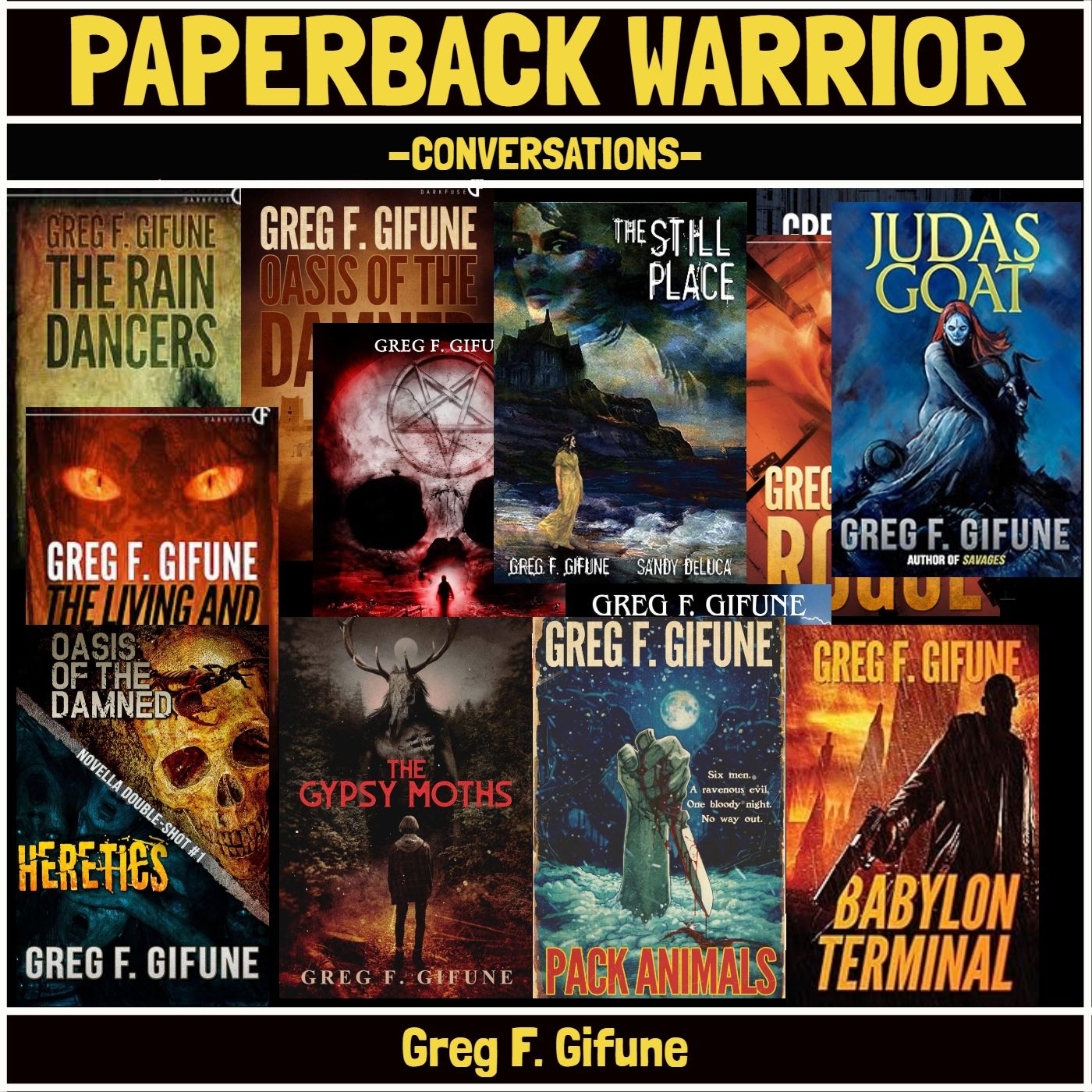
Conversations - Greg F. Gifune
Episode Transcript
Hello, Hello, Hello, This is Eric with the Paperback Warrior blog, YouTube channel and podcast, and it's a dream come true for me.
One of my favorite writers really ever is Greg Greg Gefune seeing that name right, Yeah, yeah, get Fune.
Have you ever heard anybody say it out loud, you know, in terms of broadcasts or.
Speaker 2Anything you did, They probably said it wrong?
Speaker 1Yeah, right, But yeah, you're my guest today and you're a tremendous writer.
I've been a fan of yours probably since the early two thousands, and you've you've you've been kind of commenting on paperback were your posts and comments and and things like that on the on the on the Facebook channel, and then also you've been following me on TikTok too, So I know reviewed a couple of your books maybe last year or maybe earlier this year, and so we've kind of connected a little bit through social media.
But it's great to have to have you on here.
Speaker 2Well, thank you, I appreciate it.
It's nice, nice for you to have me.
Speaker 1Yeah, I was I was poking around a little bit over the last couple of days.
I was poking around a little bit online because my reviews, most of my reviews are on Paperback Warrior dot com.
But prior to twenty eighteen, man, I had them all over the place, like on Amazon and Goodreads and places like that, So I was trying to I was trying to comb through them to try to figure out when I first started reading your work.
But as far as reviews go, I think I can go back as far as twenty thirteen.
So twelve twelve years of dabbling in your in your books in the Dallas.
Speaker 2Well, I'm glad you're stuck around.
Speaker 1Thanks, yeah, most definitely.
Yeah.
I mean you really need no introduction, but just in case someone out there isn't too familiar with your literary work, I'm going to do my very best in saying you've been professionally published since the nineteen nineties, Is that right?
Speaker 2Well, yeah, if you count yeah, late the late on late nineteen nineties, I had my first short stories started to get published, but I didn't really I didn't really get going until about two thousand and two thousand and one.
Speaker 1Yeah, okay, yeah, yeah, I see that you had.
Your short stories were in magazines like Night Terrors, Dread, Outer Darkness, and then in the magazine that you edited as well, called The Edge.
So you kind of broke in.
You broke into the business kind of like the old pulpsters did back in the day.
Speaker 2And writing for the polls, well, yeah, we had.
What was interesting was when I first came into the business, there was the whole zine culture, which was was really cool, and it was most of the people that you know today who are being published started there.
Yeah, it's especially if they've been published for a while.
And it was kind of like a I was called it was kind of like the AHL, you know, it wasn't quite the NHL, but it was a good place to learn the business and to learn your craft.
And it was an amazingly supportive group of people that were involved in that.
And and there were a lot of zines and they were just these sort of independent, you know magazines.
I edited two of them.
One was The Edge, which was like a suspense horror, uh magazine, and the other one was called Burning Sky, which was a science fiction horror magazine.
And they got you know, I mean, we were in we were in Borders and when Borders was around, and uh, you know, we had a distribution and all that, but it was but it was really kind of a a place for where people could get seen and you could you know, you could, you could learn and and you sort of hone your skills there and you got better and then eventually if you were if you could do it, you moved up from there.
But but yeah, that's where I got my start.
That was the that was how when I first came into the business.
That's where everybody was.
That was I mean, Brian Keane came up through that culture.
You know, guys like westn Oaks, you know, everybody basically everybody that you know, Michael Iamo, all the guys that were and I'm forgetting tons of people too, and I haven't mentioned any of Sandy de Luca.
You know a lot of people came up through that.
So yeah, that's how I that's how I started.
Speaker 1It's great that that everyone was, you know, encouraging each other.
There was a camaraderie there and not a not a cut through a business at the time, you know.
Speaker 2I mean there's always that element, you know what I mean, there's always one or two that are you know, but this was pre it wasn't pre Internet, but it was pre social media, yeah, and it was you know, there were these things called email lists.
I don't know if you remember those oh yeah, remember wherever you'd have these groups and that you'd talk through these emails.
So a lot of it was like that, and and so there wasn't as much.
It wasn't I don't know, it like a lot of the the poisonous stuff was kind of came with social media that like before that.
Yeah, there were still people who didn't get along and didn't like each other, you know, had their moments, but I mean it was a lot more civil, you know, which was nice.
And really we were all kind of in the same boat.
You know.
We were all new.
We were trying to get somewhere, we were trying to get noticed, we were trying to be you know, moved to that next level.
We wanted to do something.
And you know sometimes when somebody from that culture sort of hit it, you kind of felt, you know, like we all hit you know, well, okay, you know, so you know, it was a nice it was a nice time.
It was There's always been that element to the business and there there always will be exposed, right yeah, but it was nice to It's funny like today people talk so much about you know, the horror community or this community, which I don't even Honestly, I don't believe exists myself, but I think there's just a series of clicks essentially that are you know that you put them all together, you've got a community, I guess, but that's not my bag.
But yeah, this was different back then.
It was it was different.
It was a lot more It was just a lot more supportive, and it was genuine, you know, because like I said, we were all kind of in the same boat.
It was like we were in the minors that we wanted to get to the majors, you know.
Yeah, so yeah, you did what you could do, you know.
Speaker 1Yeah, that's right.
Well you're uh, I'm trying to think you're I was looking your your story collection Heretics was your first published work, Is that right?
Speaker 2Well?
It was my first book.
I had stories published.
All the stories in there had been published except for the novella Heretics.
Speaker 1Yeah, and this would have been two thousand and one.
Speaker 2With the two two thousand and one, I think, yeah, yeah, it was funny.
It was a funny story with that because I Shane Staley was at that time part of the Zene culture and I didn't know him at that point, and I sent him a bunch of short stories, and you know, because he was he had let people know he was looking for he wanted to do some short story collections.
So I sent him a bunch of stories, and Shane was is a very kind of low key guy.
He doesn't rattle easily.
He's very even and his letter back to me was this was a I don't see anything here I have any interest then, and I was like, okay, well, well, so what I did is I kind of put together I did a little more research into what he was accepting m and I.
So I sent them some of the stories that were I thought were maybe a little bit more, and he loved those and he said, if you can write, he said.
The problem is there's not enough here for a book, he said, but if you can write a novella, and we'll make that the anchor.
He said, if that's as good as these stories, I'll publish it.
So I went back to the drawing board and I wrote, heretics, yeah, and I said that he loved it, and he was like, and yeah, that was the first time.
It was funny because it was a limited hardcover paperback.
Both were limited, and but it it got me a lot of attention.
I got it, got like stellar reviews and it and it sort of got me on.
It got me going.
It got me on my way because then I followed up with the Bleeding Season, and then then I was off the basis.
Speaker 1Yeah, yeah, yeah.
Counting Novella's novels collections, I think you're floating around fifty published books.
I'm not mistaken.
Speaker 2Yeah, it's quite a few.
I thought it was twenty something, but there might be.
There might be.
Speaker 1I think you had forty, like maybe early last year.
Kind of what's coming.
Speaker 2Out, I know there's a lot.
My poor agent has to keep, you know, files on all the different where they are, what's happening are they?
You know?
Yeah, that took a while for to put out the Gala.
Speaker 1Yeah, I'm sure.
Well you're uh, you're extremely productive and you've got you've got a lot of stuff going on.
That's one of the reasons why I want to reach out to you, because you've got so many things in the works, and we're going to get into sort of the past, the President of the future and and sort of kind of dive into everything.
But anybody who who watches my channel and listens to my podcasts, I tend to go chronologically and always start at the beginning.
I want to talk about writers and bibliography.
So are you cool if we kicked this thing back to like the nineteen seventies, we'll go back.
Speaker 2We'll go a way, whatever you want to.
Speaker 1Do, take the mystery machine back in time.
Here.
So you you grew up in Massachusetts, but but you like New York City, Peru, Boston.
You've been kind of all over the place.
Speaker 2Yeah, yeah, well, I well there was two parts of that.
One one is as a kid, because we've lived in some different places.
And my family's originally from New York, from the Utica, from Utica and uh in the New Hartford, Utica area.
And I lived in New York City as an adult briefly, Peru, I lived.
We lived there for a year as when I was a kid, because my dad was the principal of the American school there for a year, which was essentially the school system that catered to the the diplomats and the you know, all the Americans that were there.
Yeah, because he was a teacher and a principal and a superintendent at one point and head master of a couple of schools.
And my mom was a teacher and an elementary school principal.
Mhm, so we you know, they we basically we didn't really move around much after the PERUEK.
We moved around a lot, but it was mostly in Massachusetts.
Speaker 1Okay, yeah, but I was an adult.
Speaker 2I've lived in I lived in Boston for a while, I lived in New York.
And you know, I've predominantly, predominantly I've I've lived in Massachusetts.
Speaker 1So I'll put you on the spot for a second and to ask you a tough one here.
You're I read somewhere online that you've attended five high schools.
You attended five high schools, you were thrown out of four and one of them twice, and you're you're your parents are in our educator.
So what's going on?
Speaker 2Man?
Speaker 1What happened?
Speaker 2Yeah?
I don't know it was, but they were thrilled.
I was just a very rebellious kid I had.
I had a lot of anger and a lot of you know, I was just rebellious.
I was.
I was kind of like Brando in the Wild whatever the hell that movie?
That old movie is the Wild One, whatever the hell it is.
When they went and ask him, what are you rebelling against?
These says, what do you got?
That was kind of me like, whatever you have, I'm down.
Yeah, I just didn't.
I just I never really liked school.
I felt like I had like my own way of doing things, which was kind of, you know, counter to what they wanted me to do, you know, Like I'd get a textbook and I'd just read it.
So then I was like, well, you know, let me know when the tests are, you know, and I'll come back, you know, but why should I sit through this.
I've already read it.
I've you know, we're going to take four months of my life doing this.
I already read it.
I already know everything and what's with it, So that a lot of the times I didn't even show up, you know.
So and I just I was one of those kids that I wanted to get my life going.
I wanted to, you know, and I didn't.
It was funny.
I just I was one of those kids who I kind of moved between a lot of different groups, you know, Like I was an athlete, and so the jocks, you know, they accepted me because they respected me as an athlete, but we weren't friends.
We didn't like hang out, you know.
But I was also into theater, so I would do theater stuff, so, you know, the theater kids, like I was with them, but I wasn't one of them, you know what I mean.
So, and you know, I liked partying and rock and rolling all this.
I was a lot a lot of times I was with the burnouts, you know, so I could move all around these groups, but but I was never really of any of them, you know.
Yeah, So it kind of led to me, like, you know, just being kind of doing my own thing, which is what I've always done.
And you know, some people, some people and some institutions react well to that, and some don't, you know.
And you know, when you're in school, it's not you can't just you know, you can't just do what you want to do.
And that was kind of my mos, like I'm going to do my own thing.
And and I at school.
I was bored most of the time at school.
You know, I didn't.
I just I just didn't, you know, it just didn't.
It just it just wasn't.
I think had I been a little older, you know, if I had, if I had been able to do high school in my twenties or thirties, I'd have done a lot better yeah.
Yeah, but at that point in my life, I just just wasn't of any I felt like I could just do, you know, learn what I wanted to learn then, and I didn't like being hassled.
I still don't have.
I have a huge problem of authority.
I always have.
It's gotten a lot better now, you know, because I'm getting older, I'm mellowing out a little bit.
But I had serious issues with it back then and that led to a lot of problems.
So yeah, it just kind of was the way it just kind of happened.
It's not something I'm terribly proud of, but it's uh.
I don't really apologize for it either, because I you know, I felt like a lot of the a lot of the stuff that I tried to call out too was I thought was legit, you know, and it just you can't fight the system like that when you're that age.
You know, he can, but you're not going to win.
So, you know, it didn't It didn't work out great.
The one that I got thrown out of twice, the principal there was actually a friend of my father's, and so he went to him after I'd gotten thrown I got thrown out of there and I went to another school and I got thrown out of there.
So he went back to his buddy and said, please take him back, because you know, I can't get this kid into any anywhere, And so he did, and then I only lasted a couple of months and then I I got into a thing with it.
I had a physical confrontation with a teacher and that didn't go well for him, and so ultimately didn't go well for me.
So, you know, it was a tough time.
But I don't know that i'd change it, because I think all the things you do lead you up to you know.
Yeah, but you know that I went my my life has gone in a lot of different directions, you know, And until I corrected it, you know, it was I had moments where I had it, but it was years later before I really turned things around.
Speaker 1Yeah, it's gonna say you, uh, you were a trained actor, broadcaster, You worked at radio and and I guess you maybe did some TV writing producing.
Was this is the gateway into into writing?
Speaker 2Well, the writing for me was always part of me.
I I was one of those kids that knew what he wanted.
I knew what I wanted to do.
My whole life.
I I wanted to write and I wanted to be an actor.
Those are my my main things, and I just didn't you know, I didn't know how to get there.
But that's what I wanted to do.
And then when I was was I thirteen, fourteen something like that, I started in summer stock theater and did very well there.
But it was tough for me because then I'd have to I'd have to go back to school and do like high school productions, which were fine, but I mean compared to what I'd been doing.
They were like amateur hour stuff, you know what I mean.
So that didn't go well either.
But the writing part was always there.
I wrote before I literally before I knew how to write.
I have a sister who's almost seven years older than I am, and I would dictate these stories to her as a little boy and she would write them down and she went on to be a nurse, but she was She's also a very good artist.
She never pursued it, but and she would.
She would draw, she would like illustrate the stories and yeah, so and my mom was like adamant that I know how to read before I started school, So I was always kind of ahead of the curve on on on reading, and I've always been a voracious reader and that kind of always went hand in hand with me with writing, you know.
So writing was always there.
It was always a part of me.
And when I came back from New York and that didn't really go as well as I had hoped, I kind of shifted from the the acting thing and thought, you know, it's the writing that I want to do, and but I just I didn't I couldn't really focus on it because not long after was it maybe was three years, about three years after I came back from New York, I got married, okay to the woman I'm still married to, and uh so I had to, you know, I had to get a job, you know.
So I worked in I worked in sales for a while, I was.
I did some radio I did.
I was trained in that, so I mean I went, I did some radio, I did some I produced an overnight show for a little bit, that kind of thing, did a lot of copywriting, that kind of thing.
That was a very unstable business.
Remember, I remember I went for an interview one time because I had the station.
I had been working at Change Formats, and so they when they would do that.
I don't know.
They still do it in those days.
When they would change formats, they fire everybody m and bringing a whole new crew, whether you could do what they were changing to or not.
Yeah, And so I had gone.
I went for this interview to a uh it was a talk radio station, and I went.
They were looking for an overnight host, so I went, I went, and I interviewed that and I remember I walked into the program director's office and there were all these rock and roll posters all over the wall and they looked like brand new.
And he must have seen me looking at him, and he said, listen, I know it looks weird because we're a talk radio station.
It looks like we might be switching over to rock and roll.
But we're not.
I promise you we're not.
And I'm thinking, why the hell all these why does it look like you are?
Speaker 1Ye.
Speaker 2So we had a good interview and he hired me.
And this was this.
This was on a Friday, Okay, Saturday.
I was supposed to start the following Monday, Saturday.
I get a call from the new program director.
We're switching over the rock and roll.
You fired.
When I said I'm fired, I haven't even started yet, as I'm supposed to start Monday, and so I just thought at that point, I can't do this is too unstable.
I can't do this.
So I went into UH.
I went into sales, actually, and I worked in retail for a few years and I managed a couple of stereo stores when those things existed, and you know, it did well with that, and and then I moved into I was I was unhappy though doing that.
It wasn't what I wanted to do, and so I moved into doing promotion, which I had also been trained in.
And I started off like managing you know, local dands and things like that, moved up to regional talent and eventually national talent, and then I went into I opened a business, UH promotions business with a friend of mine at the time, and and we we went into that, and then that branched into UH we we uh we bought into a a an existing UH independent wrestling company at the time.
Speaker 1Okay, yeah, uh.
Speaker 2And so we owned that for a while and that was in the That was interesting because that was in the k FAB days.
That was it was before you know, you had to you had to toe the line, and it was a closed business, and it was it was very difficult to get into.
Nobody trusted any buddy, it was, and it was it was a lot of there were a lot of other in those days, a lot of other things tied up in.
Speaker 1It was this early nineties or late eighties.
Speaker 2This would have been, yeah, early nineties, okay, Yeah, And uh, you know, it was a it was a different kind of a life, I mean, and I was it just wasn't really conducive to being married.
Oh yeah.
I was on the road a lot, you know, working with all kinds of crazy ass people, you know, and just you know, it was just you know, it was like a circus, you know.
Yeah, And I mean we had a lot of fun.
It was cool, but it just wasn't And as I said, I don't want to get there.
There were like elements that I was involved with that I had to be involved with, and a couple of incidents happened and I realized I was at kind of a fork in the road where you know, either that was going to be my life or I was going to do something else.
And I lived to my wife and who works in like a corporate job, and I said, you know, I'm gonna stop doing this.
I'm gonna I'm getting out because if I don't get out now, I will be able to And she was thrilled with that because she was about had enough of that.
And so I said, well, I really want to try to write.
And I said, I just I don't think I can do it if I have like some job.
I've got to like focus, if you if I can, we can just figure out a way that I can just focus on that, I think I can make it.
Yeah.
And so she was like, you know, we had a little we had some money from what I had made and you know, and she she had a job, but we knew it was going to be you know, probably a little tight for a while.
And so she said, well, how about how about if I give you five years?
Oh wow, said if you promised me.
If after five years you haven't done anything, you haven't gotten anywhere, you know, you got to go get a job.
You get a job.
And I was like, okay.
And for four and a half years, I got nothing but rejections.
Yeah, you know, and back this was back in the day when a lot of it was still snail mail mhm.
And you know, I'd go to I had a p O box in the town next to me and I I'd go there every day and there'd be a stack of letters and you'd think one of these has to be an acceptance, and they'd all be rejections, you know, and it was hard.
Speaker 1That deal that you're what your wife gave you is the same deal that Dean Koons got from his wife.
Interesting I think she gave him.
I think it maybe in five years.
It was something small like that, and she's like, if if you can make it great, If not, then you know, we're throwing this whole idea out and you.
Speaker 2Gotta do something else.
And I you know, that was fair, you know, But and so what I mean, I literally I worked seven literally I worked seven days a week for like almost five straight years.
Yeah, and all that's all I did.
I lived in all day.
That's all I did.
And I was lucky to meet some people who were mentored me.
Guys like Ed Gorman, Terry Wright was very very good to me.
Anthony Bruno, who wrote the Iceman Books, book about the Ice Man and a lot of other really good crime stuff.
He was wonderful to me, and I remember him telling me, he said, and I've told I now tell this to younger writers because it's true.
And he said, to me, it was some of the best advice I ever got.
He said, younger writers tend to newer writers tend to focus too much on being published.
He said, don't worry about being published.
He said, worry about being good.
He said, learn, learn your craft, and hone that.
And he said, get so good that they can't reject you.
And like I said, it was the best advice I ever got.
And he followed it up with because he was kind of a funny guy, he followed up with, and remember that, you know, of the big shots in this business, no one, I don't know what the hell they're doing.
Speaker 1Well, I noticed, you know, with a lot of authors today, a lot of them are well, it's it's like they just they're writing for money.
They just they think that they can just write for money and then that that's all there is to it is.
That's their drive, and there's some motivation is just to get a paycheck, right, and they don't put any any time and effort into honing their craft and getting better.
And and and I can always tell when you know, I can always tell when there's an inexperienced writer or a young writer that they don't they don't write like they talk and I and I could pick it out immediately, and I'm like, well, this is they're not gonna make it.
It's not gonna work.
And people don't talk like this, you know.
And it's just I can always pick those things out and I and typically don't read those.
I can put them down after the first chapter and see, you know.
Speaker 2Yeah, you know, I want to be careful here because I don't want to I don't want to hurt people that don't deserve that.
But there's there are some people that are self publishing that are good.
Yeah, I think the problem, the thing that I think is not good, The thing that bothers me about that is I think you remove that that element, you remove the rejection and you know, I know there's a thing oh well you know there's a whole thought.
Now, well that's you know, old school, Well okay, it's old school.
You call it whatever the hell you want.
Rejection makes you better.
Rejection does one of two things.
Either it either ends you or it makes you better.
And that's up to you.
But without any kind of if you never have any pushback, you know, I don't think that helps you artistically.
I don't think that helps you as a as a writer.
It's good to have pushback, it's good to have it's you know it it's not and nor should it be the end of the world when somebody says no, yeah, you know, that should motivate you to and like I said, like Bruno told me, you know, just just let that, you know, make it, make it a motivator.
Yeah, and that's that's you know.
I think sometimes some some of the writers that self publish are lacking that, you know.
I think it's different if you've established yourself a little bit and then you may be self published a little bit.
But I think to never have gone through that process, you might still be okay, you might still be good, but I can guarantee you with that, if you go through that process, you'll be better.
Yeah, because you don't have any choice.
Yeah, you know.
But but when I started, the whole self publishing thing was really frowned upon, and it wasn't it was extensive, and it was you know, it was you know, it was totally vanity stuff.
It wasn't you know, taken seriously at all.
Yeah, Nor should it have been at the time.
But yeah, I think I think the focus is what it is.
If you're going and if you want to be a writer because you want to make a bunch of money, you should probably pick another profession because most most most people aren't making a whole hel of aut of money.
If you can make a living in this business, you're doing something.
That's why I'm grateful.
But I can at least make a living.
But you know, you want to go into this business because you've got something to say, Yeah, you know, and you want to you know, whatever it is.
You want to entertain people, you want to get some message out to people.
You want whatever it is, whatever it is you're trying to do, you know.
But I but I think there's a it's it's kind of sad.
I think when you don't when you never have any I don't know, when when you like you can just hit a button and do whatever you want.
Yeah, you know, I don't know that that's really.
Speaker 1I think there has to be a I think there has to be gatekeepers in a way.
I think there has to.
Speaker 2Be I guess, yeah, I'm not thrilled with that word, but I know what you mean.
Speaker 1Yeah, I know, I mean, I come from the insurance industry.
I've been doing insurance for like seventeen years, and we do medical insurance.
And I always tell people, you know, it's an HMO plan.
So you have to have a gatekeeper because you have to go to the you have to go to your primary care position and stay healthy.
The doctor sends you out to the specialists.
But the gatekeeper is there for a reason.
Are the people they always push back, Well, I don't want to go to that doctor.
I want to have my own choices to go wherever I want to go.
Like, yeah, but you need to have that that one doctor that that kind of keeps track of everything and sends you off to all the best places.
So I kind of think of that way.
I was in music journalism for a while and you know, sifting through all the demos and the indie tapes and all this stuff, and like, these guys just need some direction here.
They just need something, whether it's an agent or a label or something.
Speaker 2That's generally what it is, you hit it right on the head, that's usually what it does.
They just need.
Even you know guys that are like people that are super talented, a lot of times that's just what they're lacking.
They just need somebody to help them get some the direction.
Speaker 1You know, yeah somewhere, but you but you know, one.
Speaker 2Of the fascinating things to me about this is that I have never seen a business like this.
I've never seen a business where so many people just come into it and have no idea how the business works.
They know nothing about it and just come kind of wandering in and like expect everything, you know, the world to stop spinning because their air now.
And it's just it's astounding to me.
I don't really get that.
It's like, you know, like I said, I think that's why I feel bad for the writers coming up today that because they don't have that structure that we had.
They don't that zine culture was awesome because it provided a real structure, you know, and it really taught you the business.
This is how you do it, yeah, this is how you deal with people, this is how you you know, how you work this, and it was it was really invaluable.
And I think it's too bad that so many, you know, writers coming up today don't don't have that.
I wish there was something like that today, some equivalent, you know, because I'll bet you I don't know, but I mean my bet would be if you talked to twenty people that were in that culture that came up through that, they're all going to tell you the same thing.
Speaker 1Yeah.
Yeah, Well, when you came out really early on, you had Gosh Bleeding Season, Deep Night Dominion, so forth, and they were published by you know, a small house called Delirium Books, which we touched on earlier.
You were really a staple of that publisher.
How did you even get involved with him early on?
Like, how did that even get set up?
Speaker 2Well, like I said, with Shane with those short stories in the collection, but then from there did he own?
He did?
And after after heretics, he said, you know, you need to write a novel.
And I had sort of I had written.
I'd written night Work, which is a crime novel.
I'd written that, but it hadn't gotten published, and I I felt like I need I I didn't write another novel because I didn't feel like I was ready yet.
But I had the Bleeding Season in my head for many years before I wrote it, and so I thought, Okay, it's maybe it's time.
Let me try and see if I can pull this off.
And I so I wrote the bleeding season, and then that that kind of you know, that really hit you know, and then it became like this kind of like this cold thing, you know, and and still is to this day.
It's like I'm amazing.
But that kind of led to a kind of snowball effect, you know.
And after a few books, they were all they all did well.
I mean, Deep Night was I remember.
I remember Deep Night was reviewed by Library Journal and they called it they said it was classic, and all of a sudden sales went, like I remember, like the company was so small, they weren't like Shane wasn't prepared for it.
He was like box of books for you know, weeks.
So they did well and things were going, you know, pretty well, and then he asked me if I would The company was kind of expanding and getting bigger, and he said, you know, would you want to maybe come in as a as an associate editor, you know, because I had editing experience, and I kind of thought about it.
I thought, well, sure, why not, you know, it's an extra paycheck.
Yeah, And so I did that for a while while in that and then when when Delirium became dark Use and he told me what his plan was.
He said, you know, I want to I want to keep doing the limiteds and the and the smaller runs, he said, but I want to I want to do like you know.
He he was way ahead of the curve on the whole ebook thing.
Yeah, he knew that was coming and it was going to be big.
And he said, I want to do that, and I want to back it up with paperbacks, and I want to be able to hit you know, I want to be everywhere.
I want to just you know.
And he really had a really uh good plan and a good you know, idea of what he wanted and he said, I want you to be the acquisitions guy.
Speaker 1Mm hm.
Speaker 2And so uh that's what I did.
I ran the novel line and I supervised the novella line, which was run by a guy named Dave Thomas who's part of the business now but unfortunately but uh, you know, and then that that just sort of went from there.
I mean I always worked other places too, but I that was predominantly where I was for several years.
Speaker 1Yeah.
And you know those watching at home and listeners, you know, we're talking about you're talking about talent at dark views.
We're talking about guys like Ron Malfie Jeff Strand, Alan Riiker, Tim Koran, Gary Frye.
Speaker 2There's at least three of those that I discovered.
Yeah, and Ron and I are friends to this day.
He's a great guy.
And run was funny.
I remember he had what the hell was the name of the book Passenger I think it was, Yeah, Yeah, And I found that in the like the slush pile really yeah, And I read it and I was like, it was about halfway through it and I'm like, Jesus, this is you know, it really stood out, you know, yeah, And I finished it and the minute I finished it, I'm like, I'm taking this.
And so what I used to do was when I accepted something, I would call the person.
If I had a number, I would call him.
And so I called Ron, and I you know, I told him I was going to take it, and you know, I worked with him.
We edited it and it was you know, it did well, and he he just you know, kept sort of going and when we just got to be friends.
And Tim Kern's another one.
I discovered him when I was doing The Edge Interesting and he said to me, I do a lot of sci fi and so I'm going to be starting this other magazine and he became a staple in that he was he may have been in every issue if he wasn't, he was in almost all of them.
So I I helped to give him his start.
I'm proud of that.
I'm proud that I you know, I think some of these are guys that are Look, they're very talented guys.
They would have gotten there anyway, but I'm glad that I had the chance to maybe help them, you know, at least get their foot in the door and uh then start.
So Yeah, there were a lot of guys like that, and several several female authors as well.
Speaker 1It seemed like it was it was you should be.
It was for me as as a horror fan.
It was a great stepping stone off of the all the stuff that had happened with Gosh and drawn a blink on Leisure and the Dorchester publishing that folded.
I think a lot of us were looking for the next publisher to kind of support and kind of rally around and find new authors and new books.
And Dark Fuse was there, and like you said, they were, they were cutting edge on a lot of stuff.
Yeah, with their ebooks and and the way that they packaged their novellas and some of their hardcovers and things like that.
They they catered to readers, but they also cater to collectors as well, and it was really great.
It was a great hybrid, and that.
Speaker 2Was that was the plan initially, it was to do that.
That was to both yeah, you know, to be like kind of his idea initially was to be sort of more mass market, but but to retain that collectors, yeah market too, and you know, they he pulled it off.
I mean, it's it's unfortunate a lot of people.
There are some people that are still angry with Shane, and I think if they, if they really knew what happened there, they would understand that that's there's there's no reason for that.
I can't really get into why Dark Viuse ended up folding, but I can tell you this, it was not through his It was nothing to do with what he did.
He didn't do anything wrong.
He didn't he didn't tank the business.
He you know, I'm not going to get into his personal business.
But Shane lost a lot of oh he lost a lot, yeah, trying to make sure that everybody got paid towards the end when he was getting screwed on the other end, And you know, I think the business is worse off without him in it, I think.
And it's a shame because there's a handful of people who who have a you know, an issue with him, and he kind of you know, I want to speak for him, but like my conversations with him, you know, he's a lot healthier since he's left the business, which is not not surprising, but there are people that kind of lie and wait and like, well, if he tries to come back, I'm gonna you know, and you know, he really doesn't deserve that.
And if you knew, what if you really knew what the hell you were talking about, and you don't trust me, you don't you know nothing about what went on behind the scenes, and if you did, you know, you'd think differently about him.
So it was unfortunate.
But you know, we were kind of like a I don't know, man, we burned pretty bright there for a while.
We just didn't we just it was great something some things were done that crippled that company, and it was done purposely and there was nothing he could do about it.
Speaker 1Do you still have a relationship with him, I do.
Speaker 2We're friends.
Yeah, you know, I love Shane.
He's a he's a good guy, and he's a despite what a couple of people might tell you, he's a genuine guy and he's an honest guy that all the years I worked with him, he never there was never a single thing he that man ever told me that he didn't do.
And I can't.
I don't know if I can.
I mean, maybe one or two other people, Rich Chismar is like that, which is a Again, Rich takes some ship.
I'm sorry.
I don't know if I was supposed to be.
But you know, he's a good guy, and he's he's always been a genuine guy to me.
He's always been very good to me.
Speaker 1Yeah.
Speaker 2So you know, it's you know, it's the business.
People are going to have, you know, their issues, and I'm not saying nobody's you know, we're also in an era now where everybody's got to be perfect, you know, which is absurd.
Yeah, you know, so as much as a lot of these people like to, you know, ran and rave all day about how perfect and righteous they are, you know, none of us are perfect.
We all have bad days, we all say stupid things.
Sometimes, we all say stuff we didn't mean, you know, And but you know, in this in this business, and particularly in the horror genre.
I don't find it as much in the crime genre, but in the horror genre, man, I mean, you miss step Man, there's going to be like pitchforks and you know they're coming for you, and it's yeah, I think it's ridiculous.
I don't really care.
So it's like they're not going to do anything to may But I don't really But I don't, you know, I don't antagonize anybody, but but I'm not I'm not gonna tiptoe around people either, you know what I mean.
I've been doing this too long for that nonsense.
Speaker 1Yeah, I've never really had any any major conflicts in doing the channel and doing the blog and doing the podcast over the last seven eight years.
The only time I really had any kind of hiccups at all is I had Brian Barry on just to get his side of things when he was accused of domestic abuse or whatever, and I just I heard her side of it.
I just wanted to hear his side of it.
Speaker 2But yeah, I don't know what that is.
So okay.
Speaker 1Yeah, he's a he's a hard writer, and and his publisher dropped him he wrote the novelization for Chopping Mall the old uh the old horror movie for Encyclopocalypse Publications, and I like his stuff.
He's he's a decent writer.
I like his stuff.
And uh his I guess his ex girlfriend or something came out and said that she that he had beat her up or something, and I was like, well, I just want to hear his side of it, you know, just have him on and have him talk about it.
And once, once he did, it came on, he defended himself and then I was like, tear down paperback, worrier for life, like it was coming out of the woodwork.
But I think should be heard.
And I wasn't there to judge either side of it.
I just I was in the middle.
As a journalist, they tell me your side of it and then people can make their own decisions.
Speaker 2But well that's what journalists used to do, right them all.
You'd present the evidence or whatever, you know, Yeah, you present the story and then people could make up their own minds about it.
But that's tough.
I mean, domestic abuse is never easy.
It's a thing.
It's a thing with me that you know brings out the worst than me.
If that if I hear about that stuff is not Yeah, brings up the violent in me.
Speaker 1But yeah, well you you had you jumped over from you know, when Dark Fuse, when they kind of folded, you jumped over to journals Stone, which I'm not familiar with.
Journal Stone publishers.
Speaker 2With quite a bit of my stuff.
Yeah, yeah, actually that was that was Ron again.
Ron and I talking one day and he said, uh uh, he had mentioned he had he had some stuff with them, and he said, you know, maybe you should, you know, bring some of your backlists over there.
Yeah, And so I talked to the I had a chat with the owner and uh yeah, we we we put together.
I have quite a few things with them.
Speaker 1Yeah.
They reprinted a lot of old titles and then they put out a couple of new things too as well.
Are you still being with them?
Speaker 2I I haven't done anything new with them for a while.
I think the last new novel I did with them was The Gypsy Moths, I think.
Yeah, my last book came out from Cemetery Dance.
And they also picked up Savages too.
Speaker 1Yeah.
Yeah, that's uh, that's one of that I reviewed earlier this year.
We'll talk about that one, but that's that's a good one.
Uh thanks, I want to I want to put you on the spot for a second.
There again, I'll put you on the spot again.
So he did an interview back in twenty eleven for a blog called This is Horror, and you said, I'll read what you said to them.
You said, I've always been a fan of horror, but I never set out to be a horror writer.
And I don't consider myself a horror writer, just a writer.
And you still hold that statement.
Speaker 2I didn't.
I started off to be a crime I wanted to write crime.
I wanted to be I wanted to be Jim Thompson.
Speaker 1Okay, and you know.
Speaker 2They're at the time there's still, unfortunately not as big a market as there should be for that stuff.
But when I was starting, it was almost non existent.
Everything was like mysteries and you know, cozy stuff, and it just was they just weren't a lot of markets for it.
And I always liked horror, you know, I read.
I read a lot of horror stuff, But I never set out to be a horror writer.
I don't.
I still don't describe myself.
If somebody asks me what I do, I don't say I'm a horror writer or sam a writer because I write.
I don't write just horror.
I predominantly write horror, but I but I write crime too, and I try to.
I try to do like a cross, you know, like I'm better known for more literary type horror, but I also like to do the you know, the pulp stuff too.
I like to do stuff like savages and stuff like pack animals that's coming out.
That's kind of a it's my homage to like the you know, the paperbacks and the seventies and eighties and the exploitation movies and the drive in movies and the seventies and eighties and which that's stuff.
I just, you know, I love that stuff.
So I try to do across, you know.
But I don't ever really like when I sit down to when I have a novel idea, when I sit on I don't.
I don't.
I don't think of it in those terms.
I just it's whatever it is.
It is.
Yeah, you know, I don't mean anything against people that say there are I don't.
I don't.
I'm not saying that in a superior air, in a critical air, and it's just I just don't.
I just don't consider mine.
I don't.
I don't want to.
I don't want to box myself in like that.
Yeah, you know.
Yeah, so I'm I write dark fiction, and you know, I kind of leave it at that.
I let readers decide whatever the hell it is.
I don't they want to say it's horror.
That's fine, it's horror.
They want to say it's something else.
That don't matter me.
Speaker 1Yeah, And you know, I've read tons of horror from you know, a lot of different authors and the horror you know, for ever since high school or middle school.
But and I'll say this and again not pandering or anything like that, but just being really honest with you.
You're You've got a certain voice.
It's very unique you're writing.
Is I can?
I can?
I can onrmly nail it within like the first chapter.
I can normally since it's you, you know, and early in your career.
And one of the reasons why I was drawn to you so much is you you would use weather elements to capture a type of isolation, and you kind of force these characters to live in this world of you know, whether it's rain like gosh, like the rain Dancers, for example, or a snow or a coming Storm, like Lords of Twilight view from the Lake Winter Sleep.
I think, uh, there's another one.
But how important is it to create atmosphere within these stories you've always had, You've got a brooding, isolated sort of act with these characters to dwell in.
Speaker 2For me, it's it's hugely important because that's what kind of drives it for me.
Usually I try not to get too caught up in the weather part of it, But it depends on the work.
Like Deep Night for example, you know, the snow is almost like a character, yes, you know, the elements are almost like other characters.
So it depends on what the piece is.
Other times it just helps to kind of establish a mood or you know, like you said, a sort of sense of isolation or that kind of thing.
But I think weather is a good tool, you know.
I you know, you don't want to you don't want to rely on it too heavily, But I think if you can, if you can use it as a as a tool and a means to to do what I just said, then I think it can be effective.
Speaker 1Yeah.
I think with your with your type of horror writing, things like the Boogeyman, the Monster and of the Bed you know, the so called stereotypical horror elements, they aren't really in your face in your books.
Instead, there's there's like like real world themes that are actually the horror.
Like You've got you know, regret, lost dependency, marital abrasion, You've got a host of struggles that your character is dealing with, and when you're writing, you you put that first and foremost in most of your books.
And sometimes when I'm reading your stories, at the very end, I'll say, was there really anything supernatural here?
Because you you kind of leave it open ended.
Speaker 2Sometimes with a lot of my stuff, I do.
Yeah.
The only stuff where I'm really kind of you know what my what my friend and colleague Robert Dunbar would say is subtle as a sledgehammer, is with the pulp stuff, because you have to be more in your face with that stuff, because that's what that's what it is.
Yeah.
But yeah, generally my stuff I try to be I try to leave a lot to the reader because I think when you when you do that, I think you leave yourself.
You leave room for the reader to kind of experience things in a different way.
Yeah, And I don't like, I don't like to to dictate to readers, like in other words, I don't I I want you to figure it out, and I want I want you to have the answer, and your answer might be different from somebody else's answer, because you bring what you bring to the table, you know, And so I think that's what I try to go for.
I try not to well was it this?
Was it that?
Well?
I don't know, you tell me, you know.
Speaker 1I don't like that, I really do.
Speaker 2How did it?
How did it affect you?
What do you think?
And so I think that's I think sometimes that's a lot more effective in terms of reaching people because you're you're kind of you're letting them get to it rather than you know, forcing people in a certain direction or something.
Yeah, a lot of times people will ask me, you know, well can you explain this book?
Or what what did you mean by?
And I try to not do that, not because I'm you know, trying to be cutty or whatever.
It's just if I do that, to me, it's the equivalent of like if you went to an art gallery, right, and you're looking at this painting and you're experiencing it, and you're you're looking at it and it's however, it's speaking to you.
It's speaking to you, right, Yeah.
And then the artist comes up and says, well, what do you think?
Can you tell him?
And he goes, now, no, no, this is what you should think.
Speaker 1Yeah.
Speaker 2See, I think that's countered art.
Like, I just want people to experience what I do.
However you experience it, that's up to you.
Yeah, because I feel like my job's done when the book's done once, once you're once it's out in the world, I I have I have no more control over it.
Yeah, you know, And I don't want to control what people think or how they react to it, or how it affects them.
I mean, listen, I'm trying to I'm no different than any other I'm of course I'm manipulating the reader to a degree, but I want you to maybe go in certain directions or to see certain things, or to but the manner in which you experience it and ultimately what you take away from it, I want that to be yours.
That's got that's not that at that point, it's yours, that's not mine.
Speaker 1Yeah.
I love that, and I think it's it makes it really unique.
It's a unique reading experience.
Yeah, when I'm reading your stuff, I don't try to do anything else.
I want to discompletely drown myself in that in that story.
Other stuff I can.
I can read like one handed and then do other things because I'm always reading.
Oh but yeah, with you, it's more of an experience than reading.
Speaker 2Well, that's one thing I do try to do.
I do consciously do that as I want.
I want you to pay attention.
Yeah, because with my stuff a lot of it.
If you don't, you're gonna miss.
Like, like, one of the best compliments I ever had was is when people say to me, when I reread your work, I pick up all kinds of stuff I missed the first time, you know.
And that's believe me, that's by design.
That's not a mistake I do.
You know, there's nothing I can tell you this.
There's nothing that I do in my in my stuff that isn't on purpose.
Speaker 1Yeah.
Speaker 2You know.
I even have a book I won't tell you which one it is where I purposely was wrong.
I did something that I knew was not I knew it wasn't the correct information, but I had the character present it that way anyway.
Okay, And what's really interesting is I've never been called on it, and it blows my mind because I'm like, once you realize that, you'll understand maybe more about what the book's really about, you know, but you know that's part of the that's part of the experience.
To me, I think it's I just want people to I feel like too.
One of the things I try to stay away from is this whole concept of whenever I can you know, well, I suspended my disbelief.
I feel like, if you have to do that with what I've written, then I've failed.
I hate to hear that because I want you to buy what I'm selling, you know what I mean.
I want you to believe what I'm telling you.
I want you to I want you in.
I want you to be like you like, like so deep into this that you're buying it.
You don't have to you don't have to remind yourself that this is impossible, because I try to make it.
I try to make you question, as a reader, is this possible?
Could this be happening?
Just like it' said?
You know, it says if you can get the reader to experience it along with the character, you know, then there's there's a million ways that that can go.
And that's that's what makes it interesting in the first place.
Speaker 1To me, Yes, it kind of reminds me of some of the things that The Twilight Zone did so well, just putting these weird situations out there, just letting you come up with your own conclusion.
Speaker 2And David Lynch, who's like, yeah, nobody did it better than him.
Speaker 1Yeah.
Speaker 2Great.
Whenever anybody asked, you know what, can you explain it, he'd always just saying, no.
Speaker 1I've seen some descriptions of your work compared to David Lynch.
Speaker 2Yeah, it's an honor.
Believe me.
I'm always throwing whenever I am that.
Speaker 1Yeah.
Is there anything that that you've written a novel, novella or anything like that that you kind of stepped back from and said, like, whoa, that's that's really dark, Like if you ever caught yourself stepping back for a moment.
Speaker 2Yeah, yeah, it's happened.
I have a personal connection to everything I write.
It's just a matter of degrees.
So some of the stuff that was that's usually my really dark stuff is I have a pretty strong connection to it, and I'm I'm trying to work something out.
I'm trying to you know.
It's cathartic for me in some ways.
But yeah, there's been time.
Deep Night was tough.
Deep Deep Night.
It was funny for a couple of reasons, because one I had the Bleeding Season came out and it was it was a big hit, and you know, everybody was, you know, kind of waiting for what I was, you know, gonna do next.
Was I like a one hit wonder or was that going to be?
You know?
And I was thinking about myself, you know, I knew I was going to follow it with Deep Night, but I didn't realize how hard that novel was going to be to write because it took me.
Would it take me two years?
I think two years to write that?
And I revised it so many times, and I just I couldn't get it where I wanted.
I just kept I kept missing with it.
And I was talking to my sister one day.
We were just having coffee and I was we were chatting, you know, and I told her she had housed the new book coming and I said, I'm it's killing me, you know, I can't seem to And after we talked for a few minutes, she said, well, I think what you need to do, She said, You're you're trying too hard to top the bleeding season.
You know, you have to you have to look at it like the bleeding season is the bleeding season, this is its own thing.
And I thought, yeah, I need to that's that's exactly what I need to do.
And and so I kind of, you know, approached it again that way, and and then I was able to finish it.
But that was a tough book to write, because, uh, there was a lot of truth in that book, like the bleeding Season.
You know, as a kid I suffered from I've I've since come to know that they weren't actually night terrors.
In in therapy, I've come to learn this, they were probably more like flashbacks.
But yeah, I suffered from that kind of thing as a little boy, and and it, you know, it was my way of kind of trying to work through that, what what the hell happened?
And so there was a lot of There was a lot of that, you know, and it was it was a it was a very it was a difficult book to write, even once I had a handle on it, you know.
Yeah, but then once that once I had it, you know, I felt I'm pretty happy with it now, but it was it was tough.
Those are those are the tough ones.
That was that was tough.
They're all tough, but yeah, like smoking Crimson was another one that that might came out about a year ago.
That one, Jesus, that one like that really beat the hell out of me.
But because I tend to do again, I'm goen to quote.
Rob Dunbar was a dear friend of mine and a tremendous, terrific writer.
Brought the pines h among you know, many other things, and he said, you do what I do, he said.
We were talking one day and he said, you do what I do.
Your method right, And I said, yeah, I think it's from my time as an actor, you know.
I you do the method, you know, and but there's a truth to that.
So it's kind of unless it's a novel.
Like you know, the pulp stuff was a little bit easier to do.
The rest of the stuff, it takes a lot out of me.
It's it's a you know, I get in there pretty deep, and I'm usually in there trying to figure something out for myself too, you know.
Speaker 1Yeah, yeah, I just I just reread The rain Dancers the other day, and you know, it's.
Speaker 2A short books, but that's a dark one.
Speaker 1I was gonna say that one guts you every time.
Yeah, yeah, yeah, that's that's fillaid.
Speaker 2Yeah, you know, well that you know, I think that has one of the great villains too.
I think, yeah, I could figure out how to use him again, I would, but I can't.
Very charismatic, yeah, but just crazy.
And it was that he was actually based on a guy that I met one time.
Speaker 1Oh shit, yeah.
Speaker 2And I was just like he was just one of those guys that you would just like and believe me, I've I've been around.
Speaker 3Some some people, but this guy was just one of those guys where you were like, at first, you thought he was kind of is he is?
Speaker 2He is this guy genuine?
Is he really that night?
He just is he putting me on?
Or what was this?
You know?
I didn't trust him at first.
I thought he was this guy's deal, and then I realized it's kind of like when you're talking to do you ever talk to somebody that you don't know and at first they just say, oh, they just seem kind of eccentric or whatever, and then they say something with like a completely straight face and you go, oh, okay, you're nuts.
You're like, this guy's crazy, right.
It was kind of like one of those moments where it was like, all right, this guy is by the devil, What the hell is the deal with this guy?
Jesus got?
You know, it was just like he just all of a sudden hit it with something.
You'd be like okay, and I just remembered thinking, I got to use this sometime, you know, I gotta I gotta use this.
And that's how he was born.
But that's a yeah, that's a pretty dark I'd say that's about as dark as as my stuff gets.
Speaker 1But yeah, yeah, so you know, speaking of you know, the dark stuff and you know the scary stuff.
You know, we as a culture, I mean we turned on the news, you got, you know, just this train train stabbing thing that they showed yesterday, and then we're in Europe you get the school shootings, all this crazy stuff.
I mean, can we really be scared anymore?
Is there anything that really scares us?
Speaker 2I think he can, I think, But I think it's it's different than it was years ago because there's not that there's not really that level of Even when I started, there was still there wasn't much, but there was still some semblance of innocence.
I guess.
Yeah.
But Yeah.
Now I think it's more I mean ideal in mostly in psychological stuff.
So I feel like I can it doesn't matter what's going on, because I can if I can get in your head, you know, I gotcha, you know.
Yeah, But I know what you mean.
It's it's it's more of a challenge in the kind of nuts and bolts part of it.
And I think that's sad.
I think it's sad that we're so desensitized.
I think I think it's I don't want to get into politics and stuff, but I think it's horror.
You want to talk about horror that we are We've got children being slaughtered and we're like nobody, We're just like, oh, well, I guess you know, I guess that's right.
That's just you know, that's a whole new that's a whole new animal.
You know.
Speaker 1Yeah, yeah it is.
Speaker 2I don't know, I don't know what.
I don't know what the hell you do with that.
Yeah, but I think you can.
I kind of deal more in what's going on in people's heads than than, you know, than what's going on outside.
And I try to blend the two.
But yeah, it's certainly it's getting harder.
I mean not wrong.
I mean, yeah, you know, sadly.
Speaker 1Yeah, I think it's a difference of horror versus gore.
You know, I see the kids going to see these terrifier movies and you know, they're pulling on entrails and setting them on fire and everything else, and I'm like, you really had to dig down deep in the in the eighties and nineties to find that stuff because yeah, whatever, Yeah, it wasn't just readily available.
Speaker 2You know, you were no, and it was more of a different It was more of like an exotic thing.
You know.
It was like you know, because it was you did have to look for it, and you had to, you know, if you're into that kind of thing.
I've never been a big gore guy.
Not not that my I mean, look, I'm a huge Argento fan.
I'm a huge Italian.
You know, I'm Italian.
I'm a huge Italian.
Send him a fan and stuff, so I can get into the gory stuff sometimes.
But yeah, in terms of books, I've never been like, I'm not really into the whole splatterpunk thing and all that.
I don't.
I don't.
I have nothing against it.
You know, there's some very good writers that work in that in that area, but it's just not my thing.
I'd rather get to you, Like I said, I'd rather get in your head.
And I still contend that if what you'll come up with, if I give you enough, what you will conjure in your own mind will be worse than anything I can come up with if I if I do it right, yeah, we'll go.
I don't have to do it.
And I think there comes a point that there's also a point I do respect the writers that do that stuff.
There.
There are some that I respect, but I because they're good writers and they could do whatever they wanted.
They happen to do that.
But I do think sometimes there are some writers that are into that stuff that it reminds me of porn in a way.
Yeah, that's not that's not you know, I don't I don't want to, you know, be a be a jerk.
But like, that's not hard to do that.
Anybody can.
Anybody can write pornography.
Anybody.
You know, if you've had sex, you can write pornography.
You know what I mean?
Pretty much, that's here, there's your qualify.
Yeah, So to me, that's not a challenge to just sit there and write for twenty pages about some guys entrails being pulled out.
I don't.
I don't have a problem writing graphic stuff.
And if you've read my stuff, a lot of my stuff is very graphic, or it can be.
But I just I try not to go on and on with it because I just that's not really the point of what I'm doing.
Yeah, I just think it's I just think there's there's a point with that where it gets to to me, it just gets kind of like, you know, that's true.
Anybody can do that stuff, you know what I mean.
But if you can do it well and you're really good at it, and there are there's there's a there's a there's several people that are very good at that.
It's just not my thing.
But you know that's cool.
I mean not everything has to be everybody's thing, you know what I mean.
Speaker 1There's plenty to choose from, that's for sure.
Speaker 3Yeah.
Speaker 2Yeah, I mean if that's your if that's your deal, man, then you know rock up.
Speaker 1So, you announced recently that you had a three or four book deal with Crossbroads Press, their imprints macab Inc.
Man, you've got novels being released, I guess as early as next month through them which books.
Speaker 2Are like December, well, December.
Speaker 1Actually, oh December, okay, December.
Speaker 2Yeah, Pack Animals will be out December.
I believe it's December sixteenth, if I remember correctly, December sixteenth.
Speaker 1They I'm sorry, I'm sorry, Ruff, you are they reprinting some of your books?
Speaker 2Uh?
They've I've got a couple of my back list pieces with them.
Yeah.
Plus they do a really cool series of my novella's where they put two in a in a in one book and they're called double Shots.
There's three of those out right now, and next year there's going to be a fourth that's going to have a sorry I need a cheat shooter.
Uh my.
My novella Dreams the rag Man is going to come back into print, okay, and it's going to be put together with another novella called Sam Sarah, which was in a an anthology.
It has not been published only one time, and it was in a limited anthology with Dark Regions, which is I think they're closed now.
It was a limited paperback and a limited hard cover and so that's going to be re released and that's going to get to a wider audience, which is cool.
That's coming out early next year, and I also have a standalone novella that's coming out next year with them called The Standing Dead.
Speaker 1Okay, yeah, I've heard that title.
I was curious about that.
He tell us anything about it or you want to keep your keep it hushuts.
Speaker 2For the Standing Dead.
That one's about, Yeah, it's it's it's loosely based on a short story that I wrote years ago that was published a bunch of times, and it was in one of my short story collections.
It's now out of print, but it was it was a concept that I always wanted to do more with, and so I decided to do that.
It's it's basically about a guy who his wife.
His wife goes for the hikes in the woods, and on one of these times, she doesn't come back, and so they search for her, and they have this whole this whole town looks for her, and they go through all of this and they can't find her.
And then one day she just sort of wanders back and she appears back and her hair is turned white and she's acting peculiarly, and so he sort of tries everything he can think of, and she every night she leaves and he has to go find her.
And bring her back, and he can't figure out what the hell she's doing or what's wrong.
There's something wrong, something that's happened out there, and he hires a psychic or you know, a clairvoyant basically to come in and try to find out what's going on, and you know, things ensue from there.
Speaker 1So awesome.
I'm looking forward to that.
Yeah, that's great.
You well, let's let's talk about what you've got coming up in December.
You mentioned earlier Pack Animals, Yeah, and uh yeah, thankfully we had a special treat for fans and your fans and horror fans in general, for Pack Animals, your publisher and uh, I guess you and your agent whoever allowed us to uh everybody.
Yeah, so we could reveal the cover on social media and put it out on the Babyback Warrior dot com blog.
At the time of this recording of this interview, it's set to come out this week on our social media channel, but for this interview, I wanted to reveal it here as well, because people come in from all kinds of different different areas.
Now, social media, the blog, the podcast, the YouTube channel, we're kind of all over the place.
So some people, some people may not have seen it on the on social media.
So let's go ahead and break this thing out.
I'm gonna preface it by saying that Zach McCain did this one, and uh, he worked with you back in twenty two with your Savages book.
Speaker 2He did.
He also worked with us and he worked with us at Dark Views.
Oh did he Okay, he did several of the Dark Viuse covers.
Speaker 1Okay, well, so yeah he did this one here.
Speaker 2Yeah, that was actually interesting story with that.
That was actually the original book.
That was actually an interior the original Savages when it was first published, that was that was an interior illustration because initially they were concerned that maybe it gave a little too much away, and so they put it on the inside of the book and they just had the woman running, you know, for the cover.
But when we when it was re released, we decided to go with this because it's it was how do you how do you not love that?
How do you not love that cover?
But I mean, Zach is just a he's the he's just a sweetheart.
He's such a nice guy, and he's he's a he's a very talented guy, and he's he's he's just an absolute joy to work with.
And and he's got the whole uh you know, uh retro cover thing like you.
He's just he's amazing.
Because when we when I when I when we did, when we got this deal, they said, well, you know, do you have any preference, you know, because we we all kind of agreed that, I mean, the covers are always important, but with these kind of books, the pulp kind of books, that they're really important.
And and I said, you know, they asked me who who they want me to?
Was there anyone I wanted?
And I said, if you can get Zach McCain, man, get him.
You know, he'll nail it, you know.
Speaker 1And he did, Yeah, Well, let's take a look here at pack animals.
There it is, and it's it's amazing.
It is amazing these uh these uh wolf creatures here in the back where wolves I guess uh are in the back, got the snow with the fists, with the bloody knife.
Uh kind of when I saw it, it reminded me a little bit of oh gosh, was ith the island by?
Is it Peter Bentley?
Speaker 2I think that oh yeah, yeah, there isn't that something coming up out of the water, something like that Yeah.
Speaker 1That's kind of what it reminded me of.
But it's it's pretty awesome.
Let's take a look at the wrap around.
Uh, I got the whole wrap around here that you sent me.
It's amazing as well.
Speaker 2It's yeah, I mean just he just does incredible work, man.
Speaker 1Yeah.
So I'm gonna have pre order links in the description of this video so you can pre order that one.
Speaker 2Yeah, and be able to pre order the ebook and the paperback.
Speaker 1Yeah.
Yeah.
And this one is it a is it a werewolves hunts the Hunter kind of thing?
Speaker 2More well kind of it's you know, like I said, I I had I've had the ideas of doing these kind of books, and I I've never really there's a couple of werewolf novels that are kind of fun, but I kind of like I just I essentially just said, you know, I'm gonna write a book that like I would want to read about about this kind of thing.
And it's essentially about a group of guys who have who have been friends since like high school, and they're middle age now and have families and you know, the whole dead and one of them gets divorced and a kind of really messy divorce and he he decides to leave and he moves up to this town in the mountains up in New Hampshire and where there's this you know, property that's kind of a steal and EP buys it.
But not long after moving there, he realizes there's something's wrong.
There's something you know, moving around out there that's that shouldn't be.
And his friends all sort of coordinate to take vacations and go up and see him because they're worried about him, and so they go up and then it, uh, it kind of goes from there, you know, and there's a there's a blizzard, and you know, they're they're in the they're kind of in the middle of nowhere, and there's this this pack of animals that are that are like stalking them.
And the whole thing takes place in like one night and when they they have to kind of it's it's kind of an homage to the the the survival horror novels of like the seventies and eighties and you know, like I say, the driving movies and the exploitation movies of the seventies, and because it's just like savages, it's that same kind of you know, One of the one of the best compliments I had was somebody said to me when they were reading Savages, was like watching a drive in movie back in the day, you know, which is just what I was going for.
So hopefully this does the same thing, you know.
Speaker 1Yeah, yeah, I mean I people enjoy it.
I love like the nineteen seventies when they were putting out like the nature of Tacks movies like yeah, like Grizzly, Day of the Animals, Night of the Leap, as n a Squirrel, that stuff.
Speaker 2Man, I like some of those.
I'm kind of iffy on, like like I don't like a lot of animal violence.
I'm not really I don't like that kind of stuff.
But but if it's like a monstrous kind of thing, then I'm okay with it, you know.
And I just I never I think the closest thing I've ever seen, like Dog Soldiers was was cool.
Speaker 1Oh yeah, yeah, you know.
Speaker 2But I just, like I said, they just I just didn't.
I can't.
I did.
I didn't see a lot of novels that kind of captured that sort of thing, and I thought, well, you know, let me try it, and it and it kind of came together pretty well.
These are a little bit different.
They're they're they're definitely wear wolves, but they're uh, they're more animal than than you know how most were wolves and lore or like kind of a they're there.
It's it's they're wolves, but they're they're human hybrid.
You know, it's like a hybrid.
These are more when they when they change, they're more animals.
They're like they're like they're like more of a of an animal.
And it's it's there's a whole culture that's going on.
It's a whole I don't want to give too much away, but there's a whole there's a whole thing going on up there, and these guys are pretty much you know, they're they're in some serious trouble.
Speaker 1One of my favorite stories that's kind of like this one is, uh, maybe once you even edited.
I think maybe it was Michael McBride's Snowbound, which came out on Dark Use to Believe.
Speaker 2Mike's another guy.
Yeah, he's done very well for himself.
Too good for Mike, you know, because he's a he's a very nice guy.
Was like Mike, he's a good guy, and Mike's I you know, it was it was hard for Mike and he was.
He was a good guy about it, but he you know, it was hard sometimes for him because I think Mike wanted to to get more attention and he deserved it quite frankly, and you know, we tried to get him as much of that as we could at Dark Fuse, but I think he sometimes felt like like he was like the third or fourth Feddle and wanted to be and he deserved to be higher up.
You know he did.
Yeah, and uh, he did some great stuff and he's still doing good stuff.
Yeah, he's he's really good at that kind of stuff though.
That's kind of his thing.
He always was good at that.
Speaker 1I did a podcast episode and uh, if you haven't heard it, all Sindol linked to it.
It's where I deemed the term deer hunter horror and yeah, but it was it was a thing.
It was like in the seventies and eighties.
There's a lot of a lot of books that came out where it was people hunting other people, and you know, it was really cool.
But I like the hunter aspect of it and being hunted and that kind of things with that that appeals to me.
Speaker 2Yeah, these guys aren't really so much hunters they're they're just kind of regular guys, like, you know, one of them is an accountant and one of them is you know, you know, they're they're just kind of when guy's a bartender one guys you know, uh, you know, they're just kind of regular guys that are just up there trying to help their friend and all hell breaks lose, you know.
Speaker 1Yeah.
Speaker 2Yeah, And it's really a lot about that too.
It's about their relationships and and I write about that a lot.
I write a lot about the relationship like friendships between a lot of times between men and and and and this is that's a huge part of this is there because they have a history and they have a it's not just guys that don't know each other.
These are guys that love each other and are really super close.
And yeah, you know, it's it's it's pretty it's pretty horrific stuff going on.
Speaker 1So yeah, well, the last thing I wanted to talk with you about was something else you've got in the works.
Is one of your your books is being adapted to a film.
If I'm not mistaken, it's long Long after Dark.
Yeah, long after I'm gonna say deep night, but yeah, Long after Dark.
That one and that, I'll be honest with you, that kind of surprised me because that's very intimate work.
I mean that's very intimate.
Speaker 2Uh and and I think it almost killed me.
Speaker 1Yeah, that's like, it can't be this because there's you know, when you're reading it, there isn't a whole lot of stuff visual.
I mean, it's all very very psychological.
Yeah, you're really living in this guy's head.
It's I was like, how do you get a movie out of this?
But it's almost like it could be a one camera movie kind of thing.
Speaker 2Well, it kind of part it's partially going to kind of be like that.
It's not gonna be like that through the whole thing, but there's it's going to be a very kind of intimate film too.
There's really not a lot of characters and and you know, the main character is pretty much in everything.
So but it's it's I will say this, it's based on Long After Dark.
It is not a complete movie version of the book, but it's elements of the book.
It's it's it's the essence of the book.
I guess it's the same concept.
He's in the house, he's you know, he's alone, he doesn't feel well he's all these crazy things are happening, or are they.
Eric Shapiro who's another very good friend of mine, and incredibly just like he's one of these guys that's like there are people that are talented and then there's people that are like scary talented.
You know, he's just one of these guys that can do Like he's an amazing writer first of all, never known anybody.
Well, you can just give the officially the screenwriting.
I mean he's a good novelist too, but I mean, you give this guy a concept and he'll give you a script that's like will blow the top of your head off.
He does it.
It's just like, yeah, he's a great writer, and he's a he's a he's a very good director.
He's got several uh uh features under his belt now and a lot of shorts, and and he's also like a really gifted actor and I think he's like born to play that part.
And there's already a teaser.
It hasn't actually gone into production yet, but it will be soon.
But they did do a teaser which is uh you can see on my my Facebook page.
It's pinned at the top, and you know it's just just even that.
It's just like, all right, this is gonna be as bounding, This is gonna be great.
So yeah, it's it's uh, it's going to be a little bit different from the book, but like I say, the essence of the book is going to be there.
So I'm excited about it.
I think it's going to be I think it's going to be very effective and I think if anybody can can can make this thing pop, it's it's Eric.
Speaker 1Yeah, I'm looking forward to it as well.
What's the what's the ETA on it?
Speaker 2I don't know, sometime next year probably.
I know it's going to go into production soon.
There, it's right now.
It's like in the financing stage, so it kind of that you got to wait for.
I don't know if it's going to be a I don't know yet if it's going to be fully funded by investors, or if it's going to be partial like a partial uh what do they call it, like a crowd source thing or what.
I don't know how that's going to go yet.
Speaker 1But any of your other any of your other work options.
Speaker 2Oh, I've had lots of stuff optioned.
I mean the Leading season was optioned like three or four times.
Yeah, but they just couldn't.
They couldn't.
Nobody could ever figure out how the hell to make it right, which you know, I kind of get, but I kind of don't, you know.
But yeah, that one made the rounds initially and it went nowhere.
And then the funny story there was some producer who was in the bathroom at some studio I can't run in the studio, and I guess they had books there and he picked up The Bleeding Season and was reading it while he was in the bathroom and ended up going to somebody and saying that we own this, like what's the deal with this?
Is really good?
And so I got optioned again, and then again they couldn't figure out what the hell to do with it.
So I've got option I've had several that have been optioned.
None of them have ever come to fruition.
This is the first one that's going to actually go into production.
I got another one that's going to be optioned soon on one of my crime novels.
I can't really say anything about it yet, but that'll be coming up soon too.
So and that looks pretty good.
So, Okay, you know, the movie stuff is hard.
It's children and chaos is another one.
That one was, that one's been there's a there's a brilliant script that and that one is like the book, that's the book.
It was even most of the dialogue is even the same.
But it's a brilliant script.
And that's been going.
That's been bouncing around Hollywood for several years.
And at one point there was a director when I was when I was with Paradigm for a while, uh, that there was a director attached.
There was you know, it looked like it was going to go, and it just it's a it's a you know, the whole Hollywood thing is it's a it's a it's a strange you know, you never know what the hell until until the money is in the bank and it's the movies up on the screen as you never know, you know.
Speaker 1Yeah, yeah, Well I got a friend of mine.
He's had his book options several times.
But he's always happy when he gets to rejects because he's like, I'll take the check every time with these options.
Speaker 2Yeah, I mean, and you know, if something comes to fruition, great.
I mean, you know, I also have another project and I'm I'm working with Eric's a part of that and another friend of mine, Greg Schapori, and he's he's a part of it too.
It's a it's a movie that we're just waiting for finance.
We we sort of created and Eric wrote the script and it's with a pretty you know, dominant, a pretty pretty big, you know outfit, and we're just uh, the financing has come in.
We're just kind of waiting to see if we're gonna get get any of it and if we are, how much you know.
But uh so that's in the works too.
So there's a lot of stuff going on.
That's and like I say, these are great, they're friends of mine, but they're like Greg, I've known since we were like twelve years old.
He's he's an actor and right he was in uh Julia on HBO.
He was in The Holdovers.
I don't know if he saw that, but Jami and he's a writer too, and of course Eric's involved, and so we're we got We've got that going to and hopefully we'll have some word on that soon too.
So a lot, yeah, lots going on.
Speaker 1Thank God, I'm just guiding you fit me in today.
Speaker 2Well I'm glad, thank you for having me.
I appreciate it.
I love what you do, man, I love your I was I was immediately drawn to it because I again you know, I love that.
I love that kind of stuff.
So and you do a great job with it.
So but I appreciate you having me.
Speaker 1Yeah, this has been a dream come true.
Uh.
It's a real pleasure talking with you about all of your past works, how you broke into the business and uh and all this great stuff you got going on now.
So again, I've got pre order links in the description of this video, so go out there and get your copy of Pack Animals.
And I've got links in here for uh for Greg's Facebook page as well.
You can always follow him.
He's always if you like food, great, We've got some great looking cast roles and meats on there, so be sure to check that out as well as his beautiful three dogs.
We get three beautiful dogs.
All right, Well, thanks so much, man, But yeah, check out paperback Warrior dot com for hundreds of reviews.
You've got links to videos, and follow us on Twitter x Facebook and uh we'll catch you next time.