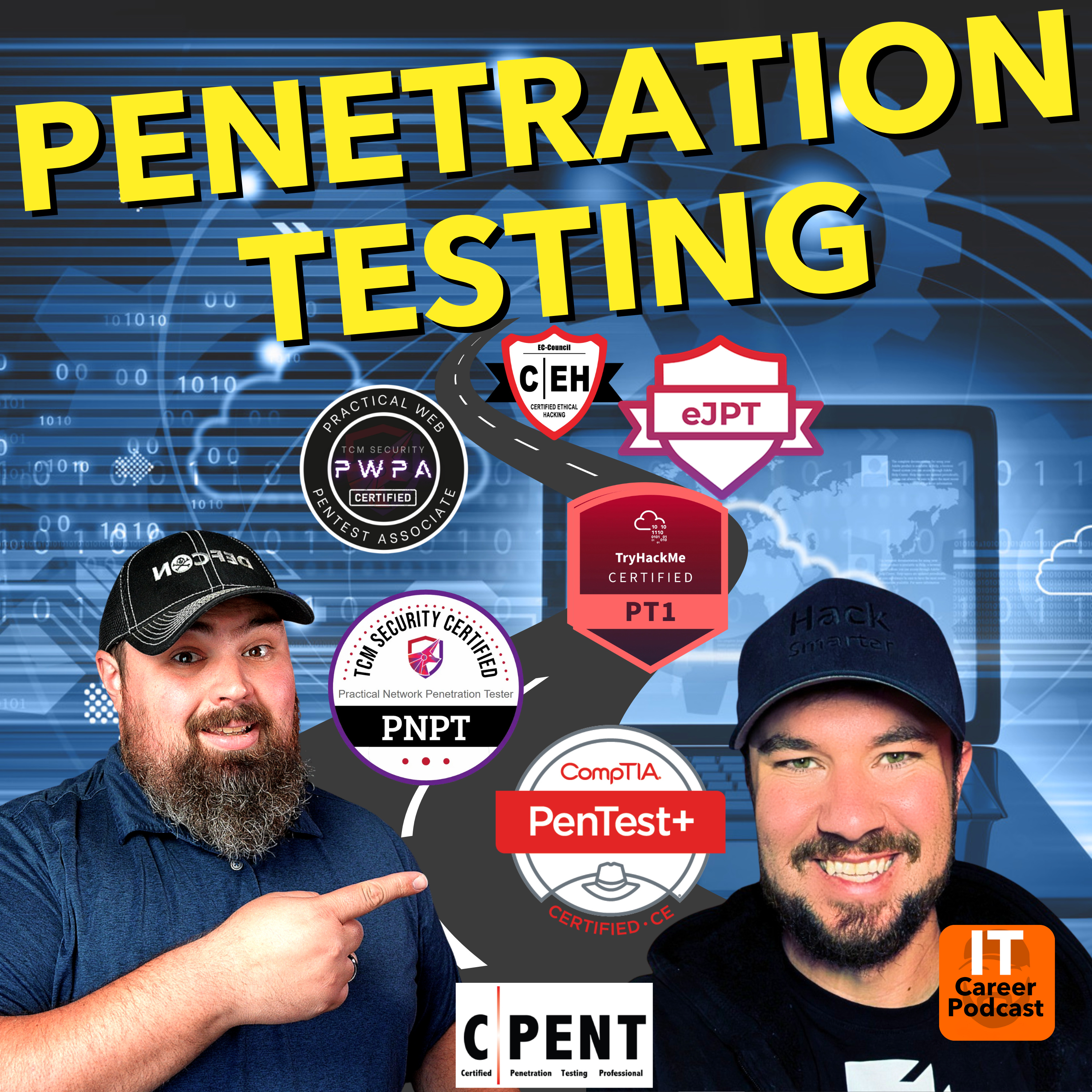
·S1 E107
107: From Beginner to Pro: A Roadmap for Penetration Testing Careers
Episode Transcript
Everyone wants to be a pen tester until they find out what the job actually looks like.
I'm not talking about the Hollywood stuff either.
I'm talking about the real behind the scenes grind that no certification course really ever truly prepares you for.
Today, I'm joined by someone who lives this every day.
Tyler is a professional pen tester who hacks things for a living and is now launching his own offensive cybersecurity company.
We're breaking down the truth behind the role, the mistakes that all beginners make, the skills that actually matter in 2026, and what it really takes to get hired in this dynamic field.
If you are thinking about becoming a penetration tester, this is going to be the episode for you.
Welcome to the show, Tyler.
Thank you for taking the time to hop on and join us.
Dude, thank you for having me and you like that was a beautiful intro for those of you watching after the fact.
He one took that like I don't know if he's going to edit it all, but that was amazing.
Dude, thank you for having me.
Oh absolutely, thank you.
You know I I didn't come up with that until like 5 seconds ago too.
Like I'm like I've realized I didn't have anything prepared.
Yes, I read that off a teleprompter, but I didn't practice it or nothing.
Amazing job.
You know, thank you for joining me.
I I really appreciate I've been meaning to have you on the channel for a while and like the stuff you've been doing, like in your personal life.
You know how you, you quit your job to start your own company.
It's just like mind blowing.
And I can't wait to dive into this conversation.
But before that, do you mind just taking a few seconds here and introducing who you are and what you do for a living?
Yeah, we'll love to.
So I guess before all the career stuff, more important than that, I'm a husband, have a beautiful wife, have two young kids, 9 and 6 now.
So that's honestly where I spend most of my time is hanging out with them and trying to be a good dad.
But outside of that, I am now a business owner.
I run 2 businesses.
The 1st is Kyra SEC, which I think I, yeah, I do have the Kyra SEC shirt.
I don't know if you can really see it really with my microphone there.
But Kyra SEC is a boutique pen testing firm.
For those who don't know the terms, it just means we focus very much on high quality engagements and pen testing, less of a focus on quantity.
So we're not trying to do hundreds of pen tests.
We're trying to find a few select clients.
There really be good security vendors and partners with them in their own journey.
And the second company is Hack Smarter and I have the hack smarter swag on as well.
And hack Smarter is a training platform.
We have courses and hands on labs that people can actually afford in the field of ethical hacking.
But before all of that, I actually spent 10 years as a pastor out of all things, which is one of the unique parts of my story.
My first career was a pastor.
I was a church planner, which means I started a church.
I have a masters of divinity, which means I spent three years academically studying like theology and philosophy and Greek and, and all these topics that most people probably don't care about.
But that's what I did for the first part of my career, always did it stuff on the side because I made no money as a pastor.
So I still had to pay the bills.
And during the Covic pandemic, that's when I was really like, okay, I cannot work like 4 different jobs at the same time.
And now that I have young kids and decided to do tech full time and always loved hacking stuff all the way back to when I was a teenager, we can dig into that.
But that was my goal and I got into it rather quickly.
I was already pretty technical when I got into the field full time and I'd like knocked out search right away and all of that good stuff.
But yeah, I've been doing pentes for quite a while now.
I was a lead pen tester at a small firm before I started my own and now I am here my YouTube channel.
I guess that's the other thing I do is I love making content, love streaming, often just teaching hacking stuff on stream.
That's so awesome.
And you know, I really appreciate what you do with your YouTube channel, with your hack Smarter.
But everything you do is so great.
You know how you're giving back to the community, helping people really kind of excel in this career field.
So I appreciate that.
Thank you.
I haven't read on it.
You know, people think pen testing is all like the black hood and terminal like that's that's immediately what comes to mind when someone's like I want to be a pen tester, but that is not at all the case.
Like the job doesn't look like that.
Do you mind this kind of taking a bit and like walk us through what day in the life of a pen tester looks like?
Yeah, absolutely.
So as a pen tester, and I can only speak for a consultancy, so let me just define my terms a little bit for those who might be new to the subject of pen testing.
So when it comes to pen testing, you have internal pen testing like an internal role to a company and then you have consultancy.
If you're an internal pen tester, you generally only work for one company and you're like a full time AW2 employee for that company.
And as they release new releases, maybe for a web app or for their network, you then do pen testing on the same infrastructure or the same web apps.
That's not what I do and that's not what I've ever done.
I'm a consultant, which means I work for a bunch of different companies around the United States and sometimes around the world who will hire me or my company for short term engagements.
That might be a web app or a network, pen test or cloud.
And so just to define terms, when I speak from pen testing, I'm speaking from the perspective of being a consultant and running a consultancy.
So with that as an introduction as the day-to-day work as a pen tester, it changes depending on the day.
So if you work for a good pen testing firm, you're not actually doing pen testing all of the time.
This is one of the things I encourage people to ask in an interview is how much bench time do you have as part of being a pen tester?
High quality firms give you good bench time.
It could be 25% of your time you have bench time.
And what I mean by that is you're not actively doing pen testing, but instead you have time set as aside for research and development, self improvement, doing CTFS, getting certifications.
Because a big part of being a pen tester, and I'm sure we'll drill down into this more, is the field that's constantly changing and constantly evolving.
There are some IT jobs, I won't name them, but I've had them.
But there are some IT jobs where, let's just be honest, you get the job and you can sort of coast.
Like you can literally look at Reddit for most of your day.
And then every once in a while, like a fire will happen.
And then you have to work crazy hours.
But then you can go back to like looking at Reddit.
You don't have to constantly be learning.
But as a pen tester, you are quite literally breaking into real companies systems and networks and web apps.
There's new technology you encounter on every single engagement.
You're always reading, always researching, always trying to understand new attack vectors, how to discover your own 0 days and CV ES.
So that is a big part of the job as a pen tester, if you work at a good firm, is doing that research and development and security research.
On the other hand, you do spend the majority of your time doing that hands on consultancy pen testing type stuff.
And that's a lot of of course, technical work.
It is significant time of hands on keyboard, but there's a lot of communication as well, which I think surprises people.
But you have to remember as a consultant, it's a client facing role.
So I'm regularly communicating with a client, I'm jumping on calls with them, I'm helping them understand vulnerabilities.
And there's a lot of soft skills that go into it, which is honestly, since I think I was able to sort of accelerate in this field is I spent 10 years talking to people every single weekend and communicating with people and honestly, dark seasons of their life.
Like I've talked people through some of the worst moments of their life.
And talking a client through a vulnerability, even if it's a bad vulnerability is incredibly easy compared to what I used to do.
So that's sort of a day in the life.
It is a lot of hands on keyboard, but it's a lot of soft skills, a lot of communication, a lot of writing.
We could talk about report writing and all of that stuff, the final deliverable for the client.
But significantly more than just hacking all the things, you also have to be able to communicate all the things, write all the things, report all the things.
Those are just as important as your hacking skills one.
100% Those communication skills, I feel get so undervalued in this sector.
So many people think that they're going to become a pen tester and they're going to be like the guy in a dimly lit basement with the hood on, you know, sitting at the terminal not talking to a soul, having showered for days.
And that is like the furthest thing from the truth in this field.
Cyber security, especially pen testing, is a customer service job first and foremost.
Like you are dealing with customers, whether that's internally or externally.
Your job depends on how well you can communicate with the other people that are probably nowhere near as tech savvy as you are.
So you got to figure out that happy medium and you know how you can explain something without making them feel like you're talking down to them, but making it, it sounds simple enough where they actually understand what I'm saying.
So that is a very delicate dance and a very unique skill that not a lot of people have naturally, I feel like.
And before we kind of dive into that more, I kind of want to backtrack a little bit and ask you like, what originally pulled you into pen testing?
Like out of all the different possibilities in cybersecurity, why did you pick pen testing?
Yes.
So my journey goes back to when I was I think I was 13 when I first discovered hacking.
So back I'm 32 now.
So you can do the math.
I don't know how many years ago that was, but when I was 13, me and my friend Nate who was also a pen tester, we actually used to work at the same company.
But one of my few IRL friends, I don't have that many of them.
I usually just hang out with my kids.
But one of my few IRL friends, he is also a pen tester.
But when we were both like 1314 years old, we discovered a website calledhackthissite.org.
So before try hack me, before hack the box, there was hackthissite.org and it was actually created by Jeremy Hammond, no relation to John Hammond.
Anyone who's in like the OG hackerspace, you know who Jeremy Hammond was, right?
He well he still is.
He was one of the leaders of LALSEC back in like 2011, 2012.
He went to prison for that.
He got out I think in 2020, but he spent a 20 years in prison.
I think he got kicked out of Defcon this past year for shouting at the stage at some some general.
So like Jeremy Hammond is like the OG hacker culture, but he founded Hack this site way back in the day.
I don't even know when, but me and my friend Nate stumbled across it and you can still go to it now.
It is still alive.
But they have like basic hacking challenges and then real world missions.
And so that's what we would do.
Some 13 year olds would spend all night like playing Halo.
We would be on Hack this and we would like pull all nighters and be dead tired at school the next day.
But then we would go to school and we think, hey, we don't have a hack the Box pro lab, but you know what we have?
We have a school network.
And so then we would try to take what we are learning, practice it at the school.
Nothing malicious, but just like you couldn't, for example, you couldn't launch a command prompt on the computer.
So we thought, hey, well you can open up notepadyoucansaveasa.bat file.
You can then use that to launch a command prompt.
So just doing things like that to see what we were able to bypass.
Long story short, we ended up getting three strikes against us and we got pulled into the office with like the school police officer and the Superintendent and they were like, hey guys, you cannot touch computers anymore for the next year.
And if you do, then we are going to come at you with criminal charges.
So that was my entry into the hacking field.
But I grew up in rural Minnesota.
I now live in rural South Dakota.
And especially when I was 13, I didn't even know that ethical hacking or testing was a thing.
Hacking in my mind was breaking stuff and being malicious, which as a teenager sounded a lot of fun because I was under the age of 18 and that was hacking to me.
So I've always had an interest in it.
I kind of changed careers, but when I was 16, I got arrested.
Crazy story.
But anyways, that's when faith became a big part of my life and decided to pivot from it because I didn't see a role for hacking back then.
Did doing pastoral ministry and then doing it on the side so always working random IT jobs.
And then I realized hey, pen testing and ethical hacking is a thing.
I live in the middle of freaking nowhere, but maybe it's possible for me to get a remote job and figure out what it means to be a pen tester.
So that's how I ended up there.
But it does go all the way back.
Thirteen years old, hackthissite.org, learning like the basics of JavaScript and then web hacking on that website.
That really is like my foundation of my entire career.
So I've never met Jeremy Hammond, but honestly, shout out to Jeremy Hammond for making hack this site.
I know he has a little bit of a reputation in the community, but he's truly one of The Pioneers in one of the O GS in the entire hackerspace you.
Know that that's such a fun story and I feel I relate to that so much because it's so I feel so similar to mine.
But I, I felt like I'm a little bit of a late bloomer, you know, back in high school, my high school offered ACC and a course.
So that's where my love for networking started.
But as you're learning CCNA, you learn a lot of different things and vulnerabilities in the network.
And again, like very similar to you, I didn't have like some lab I could practice on.
Packet Tracer wasn't a free thing.
People who had Packet Tracer that weren't taking the Cisco courses, they had to pirate it from somewhere, which wasn't actually that hard to do.
Limewire.
Yeah.
You know, you know, we had credentials into the full school network as part of our course.
And let's just say I will not admit to anything, but we did not get in.
We did not.
We weren't up to anything good.
How about that?
There is a couple things that happened and yeah, but you know, after high school, I, I kind of lost my way too.
Funny enough, there was a rest on my side as well and that started me down a journey, but I didn't come back around till tech until later in my career.
So I really can appreciate that story.
But the things I learned early on like stuck with me to this day.
Like those those skills, those that joy and the passion is really what keeps me going.
And I think it's something people should reflect on if they are considering getting into this field.
Like are you passionate about these things?
Because if you're just trying to make this career change for the money, like let's be honest, there is some decent money to be made if you play your cards right.
But will you truly be successful long term if you're just in it for the money you pen testing?
Cybersecurity is evolving at such an incredible rate these days.
I feel like you really have to have the passion to keep you going.
You have to constantly be learning.
I'm I'm not sure if you have you know what your opinion is on that.
Yeah, I passion is huge and even like I, so I gave the talk.
I was actually the keynote for Simply Cybercon a few weeks ago in South Carolina.
But my whole talk was you need to redefine success.
And I think for a lot of people in the world of tech, they define success as maybe making over $100,000 a year, having a certification, having a title, all of those things can be good things.
But what I've noticed is when you define success by what you are doing, you will never be satisfied.
So I always try to encourage people your career is much more about the person you're becoming and less about the work that you are doing.
And I've noticed in my own life, as I focused on being emotionally healthy and an emotionally healthy leader, that pays off dividends in my career.
And then passion of course, feeds into that.
Exactly what you were saying.
As a pen tester and cybersecurity in general, It's constant learning, constantly doing labs, constantly grinding.
I mean I work during the day, then I jump off work, hang out with my kids, and then I'm usually back on almost every night.
Either live streaming, making videos, making labs, going through labs, trying to learn.
But I genuinely enjoy it.
But that's where it's not for everyone.
Like I would even argue most of the people who go to school, they want to get like a four year degree in IT.
Their goal is they want to make a lot of money.
Which OK, you might.
But honestly what's likely going to happen is you're either 1.
Going to burn yourself out because you're going to be spending a lot of hours learning about something you're not interested in or #2 you are going to become successful in your career.
But honestly, you're going to become a terrible person because you pursued success via the money and not pursue success via the person that you are becoming.
So there's a lot that we could unpack there.
I gave like a 45 minute talk all about that.
But I think that's a big thing to consider.
Passions important.
But also just like what success looks like for Dakota is different than what success looks like for me.
And it's different from what success looks like for you.
You need to define for you what does success look like in your career?
What are these non negotiables that you need to have or that you're working towards?
Hey really quick, I want to talk to you about a new test I use for any tool now.
It's the 2It's the 2:00 AM test.
You see, back when I was breaking into networking, if a link flapped or Wi-Fi got cranky, I'd end up juggling an ISP portal here, Wi-Fi controller there, a firewall UI that looks like it was built back in 2004, and a support contract that I had to go dig up from someone else's inbox.
None of that helps you when you have a bunch of people standing in front of you asking you, hey, is it fixed yet?
That's why I like Meter.
If you haven't met them yet, think of Meter as the team that builds the whole network and helps you run it.
Instead of stitching together a switch vendor here, a Wi-Fi vendor there, and someone else entirely for security, you get 1 integrated stack, wired networking, secure Wi-Fi, and even indoor cellular.
We need coverage or redundancy.
It's designed to work together from day one, so you're not the glue trying to keep everything going day-to-day.
You live in a nice clean cloud dashboard with full visibility and control.
And because it's delivered as a service, they don't just ship boxes and wish you luck.
Meter handles the site survey, the installation and cabling, the monitoring and ongoing operations alongside your team.
That means clearer accountability, fewer moving parts, and when something needs attention, you already know who to call and where to look.
For me, that passes the 2:00 AM test.
Fewer portals, faster answers, and a network that feels modern instead of pass together.
Thank you to Meter for sponsoring this episode.
Head to meter.com/it Career to book your demo.
That is METE r.com/it Career to book a demo.
All right, let's dive back into this week's episode.
I want to run with that a little bit more here.
You know, we're we're not saying at least I don't think you're saying is, you know, you don't have to be like the hardcore workaholic that you know, like Tyler is.
You know, Tyler, I I can completely relate to that.
You know, I I work an 8 to 5 job.
I come home, I have dinner with the kids and most nights I'm right back out here in the studio till way later than I should, dead tired the next day and do it again.
And I do it because I enjoy it.
You know, I because I have been on the other side of the screen here trying to break into the field, and it was another YouTuber who gave me the nudge I needed to pursue my dreams, to find happiness, to enjoy my job.
And I want to be that for someone else.
That's why I do this.
That's why I continue to strive.
But to find success in this field, you don't have to do that.
It is not going to be an easy path.
Don't get me wrong, there is hard work to be had, but don't don't think you have to live this constant work, work, work lifestyle to be successful.
You have to figure out what success looks like for you.
I I couldn't have said that any better myself.
You got to figure out what your goals and make sure their goals that you know you are looking forward to that you are happy to achieve.
So often I see these people that set goals that are completely unattainium like you know, I want to make $300,000.
I want to be in the top 1% on, you know, try hack me like these kind of goals, make sure you can achieve them and keep on evolving.
And because these your, your career's going to change your personality, what you like's going to change and you have to be able to adapt with that, I think is really a key to success here.
Dude, that's good.
And like one thing I would add to this because I know it's true for you as well, but for those of you who are parents, do not compare yourself to people who don't have kids.
Like, I'm not trying to be exclusive here, but like, here's the reality.
Having kids, at least if you're a good parent, all right?
If you're a bad parent, this doesn't apply because you don't spend any time with your kids.
But if you're a good parent, being present to your kids is literally way more difficult than any certification, way more difficult than a career, way more difficult than making a YouTube video, which is why a lot of parents aren't good at it because it doesn't immediately pay off.
But that's a huge passion of mine.
And when I was first getting in this field, I compared myself to people like like John Hammond.
Like I love John Hammond, amazing person as far as I know does not have kids, right?
So like if I did not have kids, I could work significantly more than I already do.
I would stay up till 234 in the morning.
But here's the reality.
I got to wake up at 6I got to wake up at 6:00 AM, make my kids breakfast, take them to school in the summer time I spend on my lunch breaks with them.
I go to their school events.
Like people don't realize that aspect of it.
So I just want to encourage those of you who are parents, your kids are so much more important than your career.
And if you have to sacrifice your career in this season of life, not accelerate as fast, not get that certification.
But if the trade off is you get to spend more time with your kids, maybe make a little less money, but you're more present to your kids, that's going to pay off so much more than getting the OSCP 1.
100% you know, I, I have 3 kids, you know, I have an 8 year old.
I have an 11 year old.
I have a 13 year old and you know, initially in my career, I did sacrifice time with family and time with kids to make it here.
And there's different seasons.
I go through these seasons, like short term seasons.
Like right now, I am grinding so hard through the holidays and my family knows this.
They, they understand, they're here to support me because they know once this season is over, I'm there for them.
But also I make sure like this year, I make sure like all my kids are super into cross country.
I took time off to be with them, to go to their meets, to be present.
That is huge.
Now moving forward here.
You know, I, I, I already know the answer to this, but I can guarantee you, people want to hear this.
Is pen testing here in 2026 still a viable entry point into cybersecurity?
And I kind of hear you snickering a little bit already because I, I, I, I know this answer, but we have to address this here tonight, you know, on this video.
So that's, that's actually a really good question because to be honest, it's not a yes or a no.
I'm going to break that down.
So you said viable entry point in the cybersecurity.
I such no matter what I say someones gonna be in the comment like free Tyler is wrong.
So this is for those of you guys who are gonna sound off in the comments, say it's straight.
Yes.
So first of all, pen testing in and of itself is not an entry level career.
That said, it is possible to have your first job be a pen tester.
So at my previous firm, someone who was hired like literally their first IT job ever that they owned a body, a car detailing business before switching over to pen testing, their first ever IT job was as a pen tester.
But I would argue, not just argue, statistics would prove that I'm right.
That is very much not the norm.
Pen testing.
If you imagine for a moment as a consultant, you are working with so many different technologies, so many different clients, that having a strong background in sys admin, IT support, networking, whatever your passion is, all of that builds into pen testing.
So pen testing in and of itself is very much an advanced career.
A lot of people go to school, they're like, hey, I have a four year degree in cybersecurity.
I'm definitely hired as a pen tester.
You're probably not going to be able to one IT.
It's super hard to get into, but #2 at least as of right now, the job market freaking sucks.
We've had so many layoffs due to AI and other cuts.
You have incredibly skilled people trying to get the same job as you.
And so yes, it is a viable entryway into cybersecurity.
But I think in order to get there you need a bunch of stuff.
We can talk about that to unpack at least what my recommendation would be to get into pen testing, but long answer short, I don't think it's a viable entryway as your first career, although it is possible.
I don't want to gatekeep, it's just statistically it's probably not going to happen as your first IT job.
I, I 100% agree with that and I, and I knew that was going to be your answer, but I, I had to ask you because we had to address it because I, no matter how many times I see that in my YouTube videos, like I feel like cyber security in general should not really be someone's entry point into this tech industry.
It can be, absolutely can be.
I see.
I, I personally know plenty of people who've done it, but I feel like you know, you're, you're giving yourself a disadvantage almost by trying to break right into like a pen testing role where coming up and kind of like it's rite of passage.
I feel like to like maybe start not necessarily starting at the help desk, but like an entry level like support role or a network engineering role and then work into that pen testing role or that sock analyst role.
And then pen testing.
Because the skills you learn at those entry level roles are going to really set yourself up for success in those higher level roles and going to make it by the time you get to that pen testing job, you're probably going to be able to demand a lot higher salary because you're going to have more experience, you're going to have more skills under your belt, and you're just going to be that much better of a teammate to your team member.
It's not even just about the skills, it's about being a good teammate and being a good fit within that organization.
It's spot on and like IT support gets a better rap.
I think I remember watching Dude network Chuck.
This would have been three or four years ago.
He did a really good live stream on, I think he was helpdesk or IT support or something back when I think I was a manager of IT support.
Like I managed an IT department for a local college at that time, but I thought it was incredibly well done.
And of course there are some IT supporter helpdesk jobs where you're just like a phone jockey.
You take a phone call and then you don't have any time to troubleshoot.
You just escalate it to Tier 2.
But honestly, a lot of IT support jobs, you get to do a mix of support, sys admin, networking, security, it, it not only is a great entry point, I, I think they're fun.
Like I thoroughly enjoyed my time in IT support and as a pen tester.
The customer service skills you learn in IT support of working with end users, You don't escape that.
You just take that as a pen tester and you turn it up because now you're talking about way more money and way more skilled people sometimes on the other line.
And you need to learn not to have an ego.
That's the other thing that that drives me crazy.
I talk to people who are like, well I want to get into pen testing, but the only jobs that are available are help desk and I don't want to do that.
My answer is freaking get over it.
Like take whatever job you can get.
Start building that experience.
If you think help desk is below you, you have an ego.
You're not going to do good as a pen tester anyways.
Find a different career.
But a good pen tester is humble.
Like we recognize we don't know everything.
And I noticed people trying to get into the field, they seemingly know more than me and I do this for a living, but they think they know more because they did the OSAP or the CPTS or the PNPT or the PT1 or the other alphabet letter soup certifications.
Certs are good, they are not the real world and they don't teach you that well.
How to communicate with PNPT makes you do a debrief at the end.
So I have to give a shout out to TCM for doing that.
But man that was a little rant there.
But honestly, take whatever freaking job you can get, and if you think a job is below you, you need to go look in the mirror.
You're not that important.
You're not that awesome.
Do what job you can get and learn and grow and take the opportunities as they come.
That is 100% the truth.
I mean, absolutely.
And that's, that's really the approach I I took when I first broke in, you know, before I got into tech.
And I'll keep the story short because I've told it a bazillion times.
I feel like, but I was a bulldozer operator.
I drove a freaking bulldozer.
I had no experience and I knew I wanted to be like a networker system and administrator long term, but I knew I couldn't just jump into that role with no experience.
You know, I was a college dropout.
I was way too interested in girls when I went to college.
I, I flunked out of college.
I had no certifications.
Like I took the CCNA in high school, but the CCNA is only good for three years.
This was like, I don't even remember how like 10 plus years later.
So that wasn't going for me anymore.
The only thing I had going for me was my drive and willingness to learn.
Like I was so burnt out.
I'm just doing jobs to put food on the table.
I want to do something that mentally challenged me.
And I always had a huge passion for tech, so I knew I was going to have to start at the entry level jobs.
I knew it was just going to be a stepping stone and set me up for my next job.
And it was exactly that.
I got hired at a hotel company as an IT support specialist day one.
All I was doing is like being that phone jockey guys, resetting passwords, e-mail passwords, creating ad accounts.
I was terrified because I didn't even know what Active Directory was.
I was so worried.
But while I was there, I just made it my mission to learn everything, to learn how everything worked and it didn't go on recognized I anytime I would see like where that they were doing an update or they're doing something new, I would be like, Hey, can I be the fly on the wall?
Hey, can I, can I watch you guys?
Can I help at all?
And I evolved in that role, like so did my like my skills with it.
And before I know it, by the time I was there and I left that company two years later, I was in charge of designing the complete IT infrastructure for every single brand new hotel we are building.
We are building like 3 to 4 brand new hotels a year.
And when I say like in charge, like I was sitting down with the architects, you know, the building architects market at the blueprints like OK, I need a IDF here.
I need cable ran between this idea and this IDFI was placing access points to I was also the guy that was hanging the access points.
You know, I wasn't doing the cabling.
We, we, we got a contractor to do the cabling, but I wired all the switches up.
I hung the access points.
I did it all and it was so much fun because everyday was something different.
And that really set me up for success for my next role, which was a network engineer.
And through that drive and passion, I was able to go from that entry level job, IT support specialist to a director of network operations in three years.
So just because you're starting at the entry level job now doesn't mean you're going to be there forever.
Yes, there are some people that really enjoy the entry level job or just want a job that they can sit back, kind of like you were talking about in the beginning, where they can just sit back and do nothing all day and just only work when things go wrong.
If that's what you want, great.
But if you want to make that money, if you want to strive for a job that you just wake up every morning and are excited for, then be ambitious.
Have that drive, want more?
Because I guarantee you it's not going to go unnoticed in this field.
And if it is going unnoticed at your job, you're in a toxic work environment and it's time for a change anyways.
So there I got on my my soapbox.
We're going to we're going to step off there.
That's so good.
That's and I love what you added about just like the willingness to shadow.
That's actually I remember Chuck talks about that in the live stream and I was sharing it with my students at that time.
They worked in the support center, but they were students.
But that's huge.
Just like having that willingness to learn.
Nothing is below you and everything is an opportunity to learn.
There is few people I think that genuinely have that attitude and when you do have it, it really does pay dividends.
People notice in more than one way and you will just naturally level up in your career as a result, I feel.
Like we've kind of covered the basics.
Let's start diving into some of the skills, like say someone that's either already working in tech and wants to pivot into pen testing, or they're going to be really ambitious and try to break straight in.
Like what skills do you recommend?
Like are some must have skills for anyone looking to break in right now?
Yeah.
So we could talk about skills or certifications.
They kind of go together, but kind of don't.
So let me just start with the fundamental skill that's not even tech specific, but that's just curiosity.
Curiosity is an underrated skill in all things tech, but especially in pen testing.
As a pen tester, you're constantly having to break stuff.
Like no one gives you a document saying, hey, like here's how our application can be broken.
So you need to be genuinely curious every time you're looking at an application.
Like when I'm just using an app in general or my e-mail, I'm always thinking about like, man, how could this be abused?
How could this be attacked?
How could I use this in a malicious way?
And for example, on one engagement, and you see this in a lot of applications, you're able to send invites to someone.
So let's say the Hack Smarter platform has an invite feature.
You send an invite and it emails another person from the Hack Smarter domain.
Well, on this application, it allows you to put in a custom message.
And when I intercepted the request, I also saw I could insert HTML.
And so I was able to use their invite feature in order to send phishing emails from their domain with malicious URLs in it.
All because I was curious about how does this e-mail feature work?
How can I abuse it?
How would an attacker use this?
So curiosity is huge.
And that will take you incredibly far in your career.
Now the reality is I shared before the job market is rough all the round, but the job market has always been really difficult for people who want to be pen testers or ethical hackers because everyone, maybe not everyone, most people have seen Mr.
Robot and they want to do Mr.
Robot stuff, right?
And they, you ask you, I don't know for sure.
So, you know, most statistics are made-up, but I'm pretty sure like 80 to 90% of students, if you ask them right now who are in school, what do you want to be when you graduate?
So many of them are like, hey, I want to be an ethical hacker, right?
Because it looks cool.
They think they'll make a lot of money.
Here's the reality right now, to get a job as a pen tester, you need a few almost non negotiables #1 you almost need the OSCP.
Now I'm personally not a huge fan of off SEC but the OSCP is still by far the gold standard.
If you want to get a job as a pen tester.
There are other search like the PNPTI would say is number 2.
Another well known 1 you have the CPTS which is arguably more practical, more difficult, but doesn't have that HR recognition.
Same with the PT1 that's try Hackney's new cert really practical like very real world but just it takes a long time to get that name recognition in the eyes of HR.
So you need the OSCP.
That in and of itself is about $1700 I think for one exam attempt.
90 days of lab access and there's no questions.
You get a VPN and it's either can you hack or can you not, right?
You get 24 hours to compromise 3 machines and an ad network, another 24 hours to write a report.
But here's the thing, a lot of people have the OSEP who are still trying to apply for that job.
So you need to stand out even more.
So then I recommend getting a CVEI have I think 12 CV ES.
For those who don't know what that is, a CVE is a zero day.
You discover a vulnerability and generally open source software nobody has ever seen you report it to the vendor, they help patch it or you help patch it.
11 fun story is Go CMS, massive CMS used by Mozilla, I think open AI.
I found a CVE, one of my CV ES is in them.
It was cross site scripting that led to privilege escalation.
I found it.
And because it's open source, I patched my own CVE open up hold request.
And so I found the vulnerability and I patched it.
But like you need that as well.
So you need, you need the OSCP, you almost need at least one CVE in your resume.
And then #3 you almost need a personal brand because whether you like it or not, it is very much who you know, not just what you know.
So YouTube may not be for everyone.
Like for Dakota and me, I'm kind of preaching to the choir.
We have YouTube channels.
We make content all the time.
But maybe it's not YouTube.
Maybe it's a blog, maybe it's just being active on LinkedIn.
Maybe it's a Discord community that you're a part of or that you started.
But you almost need all three things in place, honestly, to get a job as a pen tester.
And I'm not saying you have to, but I am saying in order to stand out, you need the OSCP, you need a CVE and you need some type of personal platform.
And most people would hear that and be like, holy crap, I need all of that just to get a job.
And the reality is kind of like you might get lucky and not, but the people you are competing against have many of those.
I don't think many of them have all three.
So that's just one way you can really stand out OSCPCVE personal platform.
And then just maybe you'll finally be able to land a job as a pen tester.
So more difficult, I think than people initially think.
Or they saw some YouTube who wanted to get a bunch of views and said, hey, take my boot camp and you'll become a pen tester.
The reality is no, you won't.
Like it's so much more than a boot camp, so much more than a certification.
There's there's so much that goes into it.
I.
Really think that's shine some light on why we say while it is possible to just jump right into a pen tester job, it's kind of almost unlikely.
You know, you're going to find a lot more success because if you're while you're working like in a sock, you can be building these other skills, you can be building out your portfolio, you can be learning and doing, you know, bug bounties and you know, building that personal brand.
And I, I think having a personal brand is way underrated in almost all fields of tech nowadays because let's be honest, when you are applying for jobs, especially in the tech industry, but I think this is kind of just universal and you are selling yourself.
You are selling you, you are the commodity now.
And you got to convince that hiring manager why they should pick you out of all the hundreds of other candidates.
So having a strong personal brand, having those connections, like we haven't even started talking about in person networking because let's be honest, very, very much so.
And I, I absolutely hate it with a passion.
This field sometimes boils down to it's not what you know, it's who you know.
And I think it's the most unfair thing, but it's the world we live in and networking with people plays a huge factor.
I feel like on your success and part of that, you know, networking with people, it goes back to your personal brand and all that.
So I mean I, I and if you want to, I think we should talk a second about that too, because.
But it's, it's the truth.
Like I, I again, I, I think it's totally unfair because I just know plenty of super smart people out there that just don't like to network with people and they struggle because that they, no one knows who they are.
And, you know, really the people who go out and maybe don't know near as much, but they're, you know, going out and talking to people and working on those communication skills and networking, we're finding it a lot easier to land jobs.
Spot on.
It's true, it is unfair like it really is, but it's reality.
Like you can complain about it all day, but it is reality.
The way I like to think about it is when we generally think of networking, we think of using people, whether or not we say it out loud.
And what I mean by that is people here networking, they think, OK, I need to go to a conference.
I need to find a hiring manager, and I need to, like, somehow showcase my skills to them.
So they then offer me a job that's not gonna work.
Like people can tell if you're using them.
Good networking means building genuine friendships and good networking also means just figuring out what are some ways that you can give back to the wider community.
I mean, that's why I started my YouTube channel.
I know that's why you started YouTube channel.
That's why I started to hack smarter.
That's why I started my Discord community.
But just like my YouTube channel has opened amazing doors.
Like I love it when I go to a place like Defcon and like constantly people are like, hey, I watch your videos and they've helped me in this, this part of my career.
I remember this past Defcon.
This is a crazy, crazy moment.
So we all know, we all know Chuck.
I know you know Chuck as well.
Incredibly nice, one of the nicest people I know.
I was able to be on his YouTube channel a while back, but I got to DEFCON that yes, I so I walked into my hotel lobby at DEFCON, just got off the plane, got off my Uber and then someone's like, hey, Tyler and I'm like, shoot, someone already recognizes me.
It was freaking Chuck and his whole team.
I was like, dude, what?
You're the first person that recognizes me that I run into.
And I remember we're sitting there chatting and like constantly people are coming went up to him and talking to him and I'm like, hi.
But there was one time, one time someone came up and they said, are you Tyler?
And I was like, holy crap, you don't recognize to do with the beard next to me.
And it took them a second.
So there was one person who knew me but somehow didn't know Chuck.
They eventually guessed him once they stared at him long enough.
But it's like, I wouldn't have those opportunities to meet people like you and like Chuck and and Heath and these other big names in the industry.
And what I've noticed about all of these so-called big names is they are just real people who are genuinely committed to giving back to the community at large.
And the reason someone like Chuck that he has such a massive platform is behind all of it is he has a passion for helping other people.
And so my encouragement to people who are a little put off by the word networking, just change it to helping other people.
The more you help other people, the more you give back, regardless of where you're at in your career, that is networking and that will begin to open up those doors and and begin to build genuine friendships and relationships with other people in the industry you.
Know that is so true, but I already can hear the comments saying, well I'm brand new to the field.
How can I possibly help someone out?
Like you don't realize how much like even if you're just sharing what you're learning, how much that might help someone out.
You know, everyone has different journeys.
Everyone also likes learning different things from different people in different ways.
A lot of things you and I do are probably not original.
Someone else has probably done something like this on our that we've done on our YouTube channel.
Doesn't mean that what we're doing isn't good.
It's just we have a different personality.
We have a different way of explaining it and like I create content because people like to watch my content from me, you know, and that's what I I focus on.
Some person might watch you like you.
Like let's say you create the same video that I do like the exact same word for word.
People are going to watch your video because they like you the way you deliver it.
People are going to watch my video because they like me, you know, it just kind of goes back to that.
So you never know if you who you're helping and what connections you might make.
I can I can speak from personnel that this YouTube channel has opened up so many options and so many doors that I would never have had.
And again, you don't have to just create a YouTube channel.
You can start small, create a blog, post articles on LinkedIn, do something like that, but give more than you take.
Because whenever you can give people more than you ask for in return, it's always going to come back to you at tenfold and you, you're just making the world a better place.
I don't.
I don't know how else I can say it.
Dude, you're spot on.
I mean very little that I would add to that.
I think like online networking is important and to be honest, that's where I do most of my networking because I live once again in rural South Dakota.
There's no B size, there's no meet up groups, but those conferences are huge too.
Defcon is a good one.
I go to three conferences every year.
You have Defcon.
I now go to Wild West Hacking Fest over in Deadwood and then simply Cybercon.
All of those conferences are amazing, but the real, I think the real power happens not during the conference, but it's the late nights.
Maybe you're sitting around at a bar somewhere or at a meet up somewhere and that's where that real connection happens and you would just be surprised what comes out of that real genuine face to face connections.
I also know that many people in this field are introverts, myself included.
I literally just released a YouTube video on this on my channel.
But even when I was a pastor, it was a huge struggle for me because, you know, part of being a pastor is meeting people all the time.
And I sucked at small talk.
I sucked at making conversation.
I quite literally read books on conversational skills so that when I meet someone at a meet up, I'm not super awkward, right?
But it's just little things like that that really do pay off dividends if you put in the time and, and put in the work for that face to face networking and also some of those online communities.
Just remember what you post on the Internet is on the Internet, right?
So just keep that in mind.
I also use my real name, like Tyler Ramsby is my name everywhere and I think that's helpful.
I know a lot of people like to use screen names, but it's really hard to connect like Master Kangaroo 321 to John, right?
Like that part's hard on the online.
So if you are doing personal branding, I know people have different levels of OBSOC.
I just took the Jon Hammond route and was just like, OK, I'm Tyler Ramsby, that's my name, that's also my hacker handle.
For good or for bad.
One day I might regret it, but as of now it is what it is.
You know, I, I've thought about that several times.
You know, I went through a rebrand on the channel and of course I am the bearded IT dad.
And that's just the, the branding I decided to go with.
But I, I, I did it for a while, think like, should I focus on branding me more, work more on my personal brand.
And I'm at a point in my career and it's not this.
Don't do as I say, you know, type of theory.
Do as I say, not as I do.
I really enjoy my day job.
I absolutely love it.
I am working my dream job.
I have no ambition of changing anytime soon.
That is not a great advice though, in all honesty, because my job could go away tomorrow.
I'm in a different position.
If my job went away tomorrow, you know, I have my YouTube channel, I could, I could lose my job tomorrow and my family would have still food on the table and a roof over their head.
So I think that's why I focus more on like the channel branding than my personal branding.
But if I was at a spot where I was eagerly developing my career and wanted to make sure like if I ever lost my job, I was ready to go again.
100%.
That personal branding, you can maintaining those connections even when you are not actively looking for a job, still work on that personal branding and that networking.
Because you never know in this day and age when you come in tomorrow and your desk is all packed for you and like you're they got your final paycheck.
So 100%.
So true I.
I want to pivot here a little bit because I really want to hear more about what you're doing in your own organization.
How you know, you left a full time job in pen testing and started your own, your own company.
And I think that's really crazy and amazing though.
And I, I kind of want to hear what drove you to do that, if you don't mind talking about it.
Yes, and thank you for that because I when I talk on this, I always try to level set expectations because I don't want to be the YouTube that's like, hey, look at what I did.
You can do it too you, you might be able to, but there's a lot of very unique things that work in my favor.
So I shared before I was a pastor for 10 years, I made almost no money.
Like my salary was like 30 to $40,000 a year.
Like my kids qualified for like government funded health insurance in South Dakota.
Anyone who knows South Dakota, you had to be really broke to qualify for that.
So I made very little money for most of my adult life, but I was fine.
Like we didn't ever really struggle financially, we had savings.
We always lived below our means.
Once I got into tech full time I made so much more than I ever made as a pastor.
But a big decision that me and my family made is like hey, we were already happy and fine before so we never increased our standard of living.
I live in the same house.
I used to be able to say I drive the same car but my car literally stopped working so I had to upgrade to the 2012 Honda Pilot now.
But like very much live way below my means and always has always have.
And as a result I've been able to put a lot of money in savings, a little bit of investments.
So before going full time on my own.
I had about one 1 1/2 to two years expenses saved for my family.
So if I made zero money for the next two years, my family would be covered, I'd be able to pay for health insurance and all of those things.
So I just want to level set expectations that way I'm not going into this blind and having to like live paycheck to paycheck based on how my personal business is doing.
So that's, that's a big part of it.
But #2 I've always had a passion for doing entrepreneurial stuff.
So of course a church is not a business, but for 10 years of my career, I was a church planter.
So we went to a community.
Actually, where I live now, we started a church from scratch.
I had a staff that I oversaw, but I really didn't have a boss, so to speak.
I LED things, I casted vision and that LED staff in that way.
When I switched over to ITI had a boss.
And honestly, it was a crazy adjustment to like when I wanted to do something for my kids, I'd have to ask for permission.
I was like, what?
This is silly.
I don't want to ask for permission.
Like when I was a pastor.
One of the things I really miss a lot.
Is.
One of my many side jobs is I was a substitute teacher in the school.
So like I used to be my kids as teacher.
It was amazing.
I used to go to the school and teach and was able to do things like that where all of a sudden I have like an employer that's like, no, you have to like be here from here.
Until then, it doesn't matter if you get your work done, you are stuck here.
And so I knew from the beginning, and I told this to my wife five years ago or whatever that I'm going to IT full time.
But like my, I'm, I'm not going to work for other people for very long.
Like I will launch my own thing, a pen testing company specifically told my wife, I want to do pen testing and YouTube and I'm going to make it happen.
I just don't know when.
Well, I just came to a spot in my career as my YouTube set of things are growing.
Hack smarter was growing.
I was at a spot where I just couldn't do it all.
I was quite literally burning myself out working, you know, my 8:00 to 5:00 and then building hacks smarter in the evening and doing labs and courses.
It was just too much.
And I was like, OK, I need to choose one of these.
I have enough in savings.
Let me just try to bet on myself and see what happens.
And had a really good conversation with Rhino Security.
That's where I worked previously with the founder there.
And it was just like, dude, I'm not quitting here to work for somebody else.
So I have a lot of flexibility here.
So I gave a three month of notice, which I don't recommend.
It can get awkward depending on where you work.
It worked for me, but I literally gave from the three month notice.
I was one of the lead pen testers there so there was some complex projects that only I could do.
So I stayed to finish out those projects.
And then October 1st was my first solo day working on my own.
But we're only about two months into it now.
I will say I before October 1st I was already building my platform and honestly making more money from my side gigs than I was from my full time job.
So I wasn't going into it fully blind.
And even now, like it's gone so much better than I ever could have expected revenue wise.
The stress is tough.
We could talk about this, but I said yes to too many other businesses like contracts on the side trying to pay my bills.
So that was one big mistake I made.
But outside of that, it's gotten significantly better than I was expecting.
But I also recognize I'm two months in, a year from now, I'd be able to give a lot more wisdom, I think.
But the other big thing I'm doing, because I'm building this in the public, and that's been my commitment to those in my community from the beginning that I would share with him the good and the bad.
So almost once a week, I'm just share very openly and honestly about how revenue is doing, about whether or not I'm able to pay my salary, about clients, about successes, about failures, and being quite literally as transparent as possible.
Some would maybe say too transparent but I don't know, like I really feel like I'm in this with the entire hack smarter community and the wider community as well.
There's some people who may want me to fail, which is fine, they can follow along as well.
But really I want people to learn from it.
Like maybe you can't start your own business right now, but you can watch me stumble around and maybe, maybe y'all fail.
Maybe 2 years from now I'll be like hey this, this wasn't right for me and I'll go back to being AW2 employee.
But maybe I'll inspire somebody else who builds an amazing company.
And if that's the case, that's still a win win to me either way.
That, that is, that is so cool.
And I, I'm curious, you know, I know you're only about two months into this, but so far, what have you found to be the hardest part of this, this change for you?
The hardest part is managing the anxiety and I knew this going into it.
I actually made videos about this before, but dude, I came so close multiple times before October 1st of just throwing in the towel before it even started.
Just the anxiety was so overwhelming to me.
And a big part of that is I have a wife and two kids.
I'm the sole income provider.
So like I don't have health insurance through my wife's job, nothing like that.
So it is all on my shoulders.
And so I'm always going back and forth between like, dude, I'm leaving high paying 6 figure comfortable job as a pen tester to freaking Yolo this and try something on my own.
Like on paper it doesn't make sense.
But like I have this drive and I have this build that I want to build something on my own, not for somebody else.
But there was multiple times going before October 1st that I came this close to calling my current employer and just being, hey, I made a mistake, I don't want to leave.
Would you let me stay on?
So that was hard at 1st and after launching that is still really difficult.
I mean revenue and stuff has been good, but the difference is depending to being self-employed and being AW2 employee is as a self-employed person.
You, I mean you eat what you kill as they say, right?
You make money when you're able to do sales and work with clients.
You don't make money when that's not happening.
There is not a steady paycheck.
There is so much risk and there's a lot of upside of things pay off, but there's so much risk going into this that you don't fully appreciate until you have no other safety net.
You have no other paycheck.
It's you paying yourself through your own company.
That's incredibly stressful.
But that led me to what I talked about before.
I had a bunch of other contracts I agreed to for really teaching.
Most of it was teaching because I was so anxious about paying my bills.
I said yes to all these other companies and then already stretched myself way too thin to the point that I couldn't even focus on Hacks, Murder and Kairosak.
I was once again building other people's freaking companies because my anxiety caused me to say yes to them and no to me.
So the other big lesson I'm learning is you really do have to say no to good things so you can say yes to the best thing.
So where I'm at now is Hacks, Murder and Kairosak.
They are my only focus.
I am now saying no to every other company.
That's like, hey Tyler, can you work for us?
Can we do this contract?
I could say yes.
I couldn't make more money that way, but that's not why I quit my job.
If I just wanted to make more money, I would have kept working on my other job.
I took a freaking $60,000 pay cut to do this.
Cut my salary by that much.
So like, I'm not here trying to make money.
I'm here trying to build legacy.
I'm here trying to help people.
I'm here trying to make an impact.
And so that just keeping focused on my mission and my definition of success is probably the hardest thing so far.
That that is, is so encouraging to me as a an entrepreneur, you know, someone who also runs a business, runs a YouTube channel, and I'm also working full time.
I definitely understand the struggle there too.
You know, I have fought burnout so many times just by trying to take on too much, trying to say yes too much.
I always come back to why am I doing this?
You know, why am I working in tech?
Why am I creating content?
You know, it's because I want to help others.
I want to help others succeed.
I want to demystify some of these, you know, misconceptions in the tech industry to try to help people achieve their dreams.
That's why I I still do this.
And I got a really quick add on question to this conversation, though, is, you know, if someone else is like they're, they're working like AW2, they're they're working for someone else and they just, they want more.
They want that freedom.
And I don't know it's necessarily know if freedom's the right word because there's a lot of other strings that come attached when you work for yourself.
But how does someone know when it's time to take on these risks themselves?
Yeah, 1 is, I think they really need to understand their motivation.
So I think a lot of people think, hey, I will start my own business for freedom.
Then I can determine when I get to work.
And you know that there's a, there's a joke, but it's so true.
You can determine like which 16 hours a day you get to work.
Congratulations.
But the freedom that I think is amazing is the freedom to build what you want to build and then make the decisions you want to make.
And now you also face the consequences if you make a bad decision.
But that's the freedom.
I love the freedom to build what I want to build.
And it is really nice.
Like when my kids have an event at school, I don't have to ask my freaking supervisor if I can take, you know, an extra 2 hours off as part of my lunch break.
I just do it.
So there is freedom in that way.
But as far as whether or not a person is ready, I think it comes down to do you have the financial safety net for good or for worse.
You do not want to launch a business, I would argue, without at least 12 months worth of your full income in savings or at least in investments that you can pull from quickly.
If you launch a business without a really strong personal safety net, it's going to force you to make bad decisions about your business.
You're going to prioritize short term wins.
Over a long term sustainable success.
And so even for me personally, I've said no to multiple clients already for Chirosec because they didn't fit what I am trying to build or I didn't fit the type of work that we're trying to perform.
But the only reason I have the freedom to do that is because in the front end, I was able to load myself with a bunch of savings so that regardless I can provide for my family.
So that's a big part.
Do you have the financial safety net?
But the other part is how comfortable are you with risk and how comfortable to argue with being a self starter.
There's a lot of people that if they don't have a supervisor telling them you have to clock in at this time, they don't clock in, they oversleep, they maybe don't start their day till 11.
They're only work a few hours.
The best thing that you can do is have a regular schedule.
So I still work 8So I still work 8:00 AM to 5:00 PMI have a set schedule.
I have to work in the evenings as well.
I even purchase office space.
So for a long time I work from home, which is amazing.
But I noticed that for me, I needed a separation from my home and my work to be more productive, but just to have that separation.
So in rural South Dakota is super cheap.
Like I was able to get an office for like $200 a month and it's a full building, fully private just for me.
But I commute to my office.
It's literally a 5 minute bike ride from my house.
But I commute to my office every single day to have that schedule.
I clock in at 8 AMI take an hour lunch break to decompress.
I usually walk home, hang out with my wife for a little bit, come back to work.
So I treat it like a traditional job, which would be my encouragement for other people as well.
You need to treat it like a regular job.
Work your 8:00 to 5:00 and then you will have to work evenings.
You will have to work outside hours, but that's the other big thing.
If you're not a self starter and if you need someone to poke and prod you or answer all your questions, entrepreneurship is definitely not for you.
Absolutely.
Now I I got to ask, what is one thing you wish?
Let me rephrase that.
Through the power of editing, mess up won't be in there.
What is one thing you wish someone dreaming of becoming a pen tester will walk away from this conversation we had today.
But before you answer that, you've mentioned you have a YouTube channel.
You have tons of resources.
You get back to the community.
If people want to connect with you more, where can they find you?
Yeah, the.
Best spot is probably YouTube.
You can also connect over at hacksmarter.org.
That's our training platform.
But on hacksmarter.org you get a link to our Discord.
Our discord is completely free.
We do a weekly goal meetings where a bunch of people gather together, talk about career goals, We do career coaching at a donate what you can, we do free workshops, we do resume reviews.
Everything in the Hack Smarter community itself has no paywall.
It's completely free and I'm super active there so YouTube and discord is probably the the best place to get a hold of me.
To answer your question, what would I want someone to know about pen testing?
I would want you to know if you want to start a career as a pen tester #1 it really is an amazing career and for the right person, it's the best career that you can possibly have.
But I also want to let you know that it's going to be difficult to get into the field as a pen tester.
I do not want to sell you a pipe dream.
I'm not saying buy this course and you'll become a pen tester.
I do have courses.
I do think they're amazing.
You can find them at hexmurder.org.
But my courses aren't going to be enough to get you in the field as a pen tester.
Well, we'll get you into the field.
This curiosity, consistency and persistence, consistency in and of itself is one of the most difficult things to do.
A lot of people can be passionate for a month.
Can you be passionate for three years, six years, 12 years, 20 years?
It's that consistency that's going to pay off long term in your career.
And so it may seem impossible for you to become a pen tester.
I just wanted to let you know it's possible.
I live in rural South Dakota.
There are more cows than people.
I got a job as a pen tester.
I have now launched essentially 2 tech businesses from the middle of freaking nowhere in a cornfield.
If I can do it, you can do it as well.
No, absolutely this.
This field is completely achievable.
You know, if, if you have the motivation, the willingness to learn, the willingness to, to follow your dreams and passions no matter what obstacles you run into, you can absolutely achieve this career field 100%.
And you, you just need to start today.
Like just start working towards your goals.
Create a plan.
I so see so many people, you know, procrastination is kind of huge sometimes where people like, I want to become a pen tester, but I'll start tomorrow.
Tonight I'm going to watch my Netflix or whatever.
You know your your thing is a bit making up excuses.
Start today, start messy.
Start.
Just just do something to work towards your goal every day and follow your passion.
Because that passion for this field is what's going to keep you going when you are sick and tired of studying, when you are getting rejected on every job you apply for.
That passion you have like the willingness to learn, the the drive, the want of this dream, this career.
That's what's going to keep you going in your worst time when you feel like you can't make it in this field.
So good spot on.
I have nothing to add to that.
That's so good.
Well, Tyler, you know, thank you so much for taking this time.
I, I want to be respectful of your time.
I know it's late.
I really appreciate you coming on.
This has been such an amazing episode.
Guys, go check out Tyler's YouTube channel.
He offers such great advice.
I've I've watched his live streams many times.
I've watched his videos.
You know, I got to participate in ACTF with him and I won.
I'm not going to rub that in anymore.
That's right.
Yes.
Yeah, that was that was a crazy experience.
Tyler, you're such a great guy and I can't thank you enough for what you do for this community and helping other people out.
Thank you, Dakota, and thank you again just for the opportunity to be on the show.
It truly is an honor.
Absolutely everyone, I really hope you enjoyed this episode and until next time, keep learning.