·S4 E8
S4E8: Live at 92NY with Samantha Bee
Episode Transcript
Hello, snaff universe.
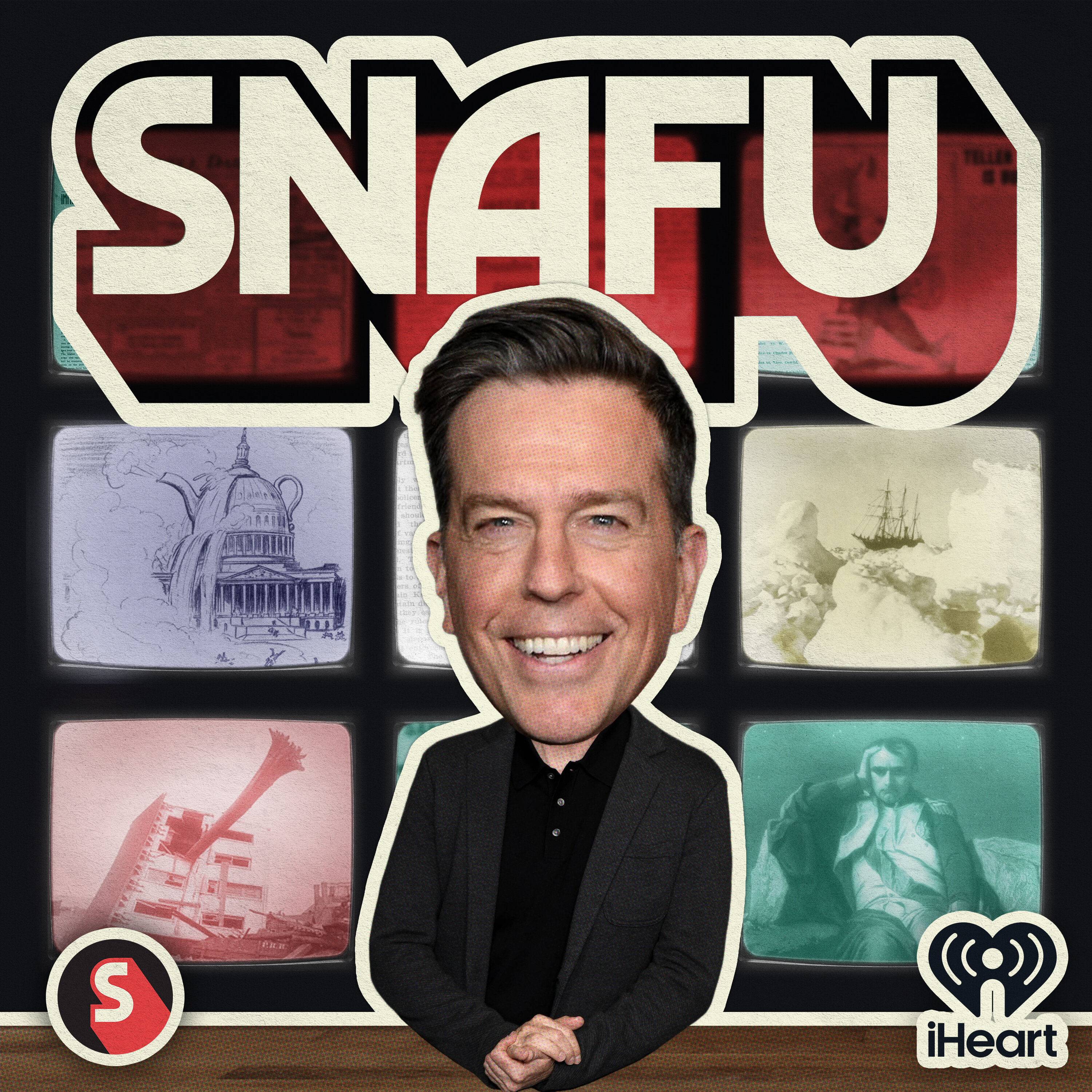
It is I Ed Helms, your ever dutiful captain, steering this ship straight into the iceberg of history's biggest screw ups.
And this week we're going live, baby, well sort of.
I mean, you're not going to be listening to something that's happening live, but it is a recording of a thing that was live, you know what I mean?
Speaker 2All Right?
Speaker 1So, during my book tour for Snafu, The Definitive Guide to History's Greatest screw Ups, I had the absolute pleasure of stopping by the legendary ninety second Street Why in New York City, where I got to sit down with a dear old friend who also happens to be an Emmy winning comedian, producer, writer, and professional destroyer of pomposity.
I am talking about none other than the great Samantha B.
Sam and I go all the way back to our daily show days, which feels like roughly four hundred years ago in time.
So it was really a joy to just hang out and reminisce about the salad days and also dig into some juicy stuff, you know, like the decades of epics screw ups I write about in the book, How the book actually came together, and even some reflections on how the screw ups in the book might inform how we navigate the present moment.
And doing all of this live on stage in front of a fired up New York crowd, it just gave the whole night a kind of electric buzz and it was just an absolute treat.
So stick around for my conversation with sam B.
And Hey, if you're in the market for a gift that's equal parts history, lesson, comedy show and stocking stuffer, look no further than my book, Snafoo, The Definitive Guide to History's Greatest screw Ups.
It's available at snafoo, dashbook dot com or wherever fine books are sold.
The audiobook, narrated by Yours Truly is also out.
Now think of that as kind of cozy little ear muffs for your brain, only instead of warmth, they're packed with shocking blunders and questionable decision making.
Okay, that's it now, please enjoy my chat with the brilliant Samantha B.
Speaker 2All right, this is.
Speaker 3So oh my god, this cheer is so comfortable.
I had no idea the cheers would be so amazing.
Speaker 1I mean, it's good because I just came from my YMCA workout.
Speaker 3That's right, I'm so sweaty.
Speaker 4I'm so excited to be here with you.
Speaker 3Because I miss you, although I haven't seen you in ages ed when you asked me to do this talk with you, I could not have been more excited.
I love everything that you do.
I love Snaffoo.
I love the podcast.
If you don't know what you really should like, download like subscribe all those.
Speaker 4Where we get your podcast wherever we get your podcasts.
Speaker 3Okay, the world is bananas basically, yes, So.
Speaker 4Thank you for writing a book.
Speaker 2I'm had to point it out about how the world.
Speaker 4Yes, the world was always.
Speaker 3Bananas, is what I'm hearing from this book.
Yeah, so the book is called Snaffoo.
Tell us right off the bat, what is a snaffoo?
What does that acronym stand for?
Speaker 1Well, snapfoo it was an acronym that started during World War Two.
It stands for situation, normal, all fucked up, great, and most of us know it just as a term that means disaster or terrible situation or a pickle.
Speaker 2Maybe it would be a lighter usage.
Speaker 1Yes, and yeah, the soldiers used it because I guess World War two is pretty fucked up and and it became just sort of a catchy, catchy phrase that made it into the lexicons.
Speaker 4It's a little bit like fubar.
It's a little bit like fubar.
Speaker 1It's exactly like fubar, which I think and I haven't done.
I haven't done the research, but I think came from the same time.
Speaker 4Same time, upped up beyond all repair.
Speaker 2You know.
Speaker 4No, it's not.
Speaker 2It's got a little more punched here.
Speaker 4They're both very good.
Okay, so okay.
Speaker 3It's the definitive guide to history's greatest scripts.
And I have to say that it was a soothing like It's pretty bizarre that a book that contains many stories about us on the precipice of nuclear meltdown actually cheered me up.
Speaker 4And I think that that says a lot about where we are.
Speaker 3So we've got you know, one of the first, one of the first stories in the book is about a fun toy set for kids called the Gilbert Atomic Energy Science Kit that contained really uranium.
You all haven't read the book yet, but you're about to, and it's excellent.
Speaker 4We've got nuclear reactors melting.
Speaker 3Down, we've got apps with spy equipment implanted into.
Speaker 4Their ears, Howard Hughes related giant plow machines, retrieving Russian subs.
It's excellent.
Speaker 3Okay, was it difficult to narrow down all of the world's fuck ups into only one volume?
Speaker 4Because I feel like it's kind of endless?
Speaker 2Great question, thank you.
Speaker 1Yes, which is why I kind of just kind of put some parameters on the whole thing, just the curatorial decision making boiled down to.
It's mostly American stories.
It's also mostly recent.
Speaker 2The book is.
Speaker 1Divided up into sections by decade.
Yes, so it's it's basically the fifties to now, So that's a pretty small window for human volleys.
There's a lot of other stuff that people did that was dumb.
Speaker 3These blunders, these bad ideas are epic.
Many of them are potentially world ending, but so many of them are childish and silly.
Speaker 2I love Yes, I love that observation.
Speaker 4Childish.
Speaker 3They're like, should we detonate a nuclear bomb on the moon?
Speaker 2This is this is full loony tunes.
That's that's a chapter in the book.
Speaker 4Yes.
Speaker 2Just to give you another little bit of.
Speaker 1A sort of structural breakdown, there are thirty one chapters that are sort of that are divided up into decades and each chapter is its own snaff woo, which makes it great for just like episodic reading.
Speaker 2You could just pick it up.
Speaker 1Yes, leave it on your toilet.
I won't judge you.
If you're reading.
It's good anywhere.
Speaker 3Tell me about Okay, So the podcast that you do snafoo the book.
The format of the book differs from the podcast because the podcast is like one big deep die anyone else shaking through the Yes, the subways.
Speaker 1I've been living in La too long.
I'm like earthquake earth.
Oh no, I forget that.
That ninety second three y and the Angelica film theater Rattle with the trains.
Speaker 3That's right, you know that every time I go to every time I go to La, I've experienced a minor earthquake every time I go.
I'm a harbinger of doom, just like a tiny little you are.
Speaker 4I know.
Speaker 3Well, so what I'm saying is that was an earthquake.
Speaker 4Yeah.
Speaker 3What what is the difference between the podcast process, which is very long form and I mean it's long form to write a book, but it's more chapterized.
So what is the difference between the process of doing those two things?
Speaker 1So the podcast came first We started working on the podcast about three years ago, and it's it is a very different thing because it's each season of the podcast is a very deep dive into one thing, one snafu.
So so there are now three seasons of the podcast out and uh, it's each season is eight episodes and again deep dive into one thing.
And the book, as I just described, is lots of things perfect less of a deep dive.
Speaker 4Perfect for the bathroom.
Speaker 1Yeah, describe, let's talk more about how perfect it is for bathroom.
But the process for building both of these things is not dissimilar, because it's an amazing team or that worked on both.
Speaker 3So about your team, because this is an incredible I mean, these people must be professional.
Is it a group of historians, professional researchers, fact checkers.
Speaker 2Like podcast nerds?
Speaker 3Podcast nerds is a team of how damn nerds?
Speaker 4Much there?
Speaker 1This is an amazing team researchers and and just pulling together so much information, helping structure information.
Speaker 3How do you, I mean, how do you as a team, how do you curate the stories that you want to tell?
Speaker 4How do you decide?
Speaker 2How?
Speaker 4What is the research process?
Speaker 1Like it's building a pool of possibilities pouring through them.
Speaker 2And then in the case of.
Speaker 1The in the case of the podcast, it's it's like, do we have the depth, does this story have the depth to carry a whole season?
And then do we have access to the materials or the people that we want to talk to?
Speaker 2And uh.
And then for the book.
Speaker 1Again we it was it was a matter of finding these sort of organizing principles or or like kind of cure itorial limitations that that would guide a little bit of decision making.
Ultimately, the other the other critical component to both the podcast and the book has been are these stories really well known or not?
And the book avoids things like the Titanic or you know, the Donner Party or things that which which are actually amazing and like just epic stories that are incredible to learn about.
But I think what makes what we made a decision early on to kind of like chase things that are less known to the popular memory.
Yes, and that I think has really been an exciting thing about the podcast and and and the book.
A lot of these things people just don't.
Speaker 4Know, They really don't know.
Speaker 3I many of the stories were surprising to me, and so many of the stories actually have a modern a really modern relevance.
I mean, I'm sure you could not have expected this when you were curating the book, that we would be talking so much about Greenland right now.
And there is an amazing story about Greenland in the book.
And I really had no idea.
And it not only is a very interesting story about something we knew very little about, but is it kind of an origin story about the United States and their relationship to Greenland and Denmark?
Speaker 4Can you talk about that?
Speaker 1Yeah, okay, So there's an entire chapter dedicated to Project ice Worm.
Speaker 2So, and you're right, it's so wild how prescient it is, because.
Speaker 1As early as the nineteen fifties, it was very clear that Greenland was strategically excellent for launching missiles.
And so Project ice Worm is exactly what it sounds like.
Greenland is a giant sheet of ice.
So someone hatched.
Speaker 2The idea, well, what if we could build.
Speaker 1A railroad system underneath the Greenland ice sheet and fairy missiles around and launched them from wherever we wanted.
Speaker 2In Greenland?
Speaker 4What great idea?
Speaker 1Great, I mean, a flawless ideas.
So they opened up Camp Century, which was a sort of military a US military installation that had some cover stories, but was essentially a research project to see if this was feasible.
And they put a nuclear reactor in it because they needed power and everybody loved nuclear stuff in the fifties.
And they started to build basically an army base under the ice, and then they started digging tunnels to see if they could get train tracks out, you.
Speaker 2Know, across the whole country.
Speaker 1And needless to say, ice is an unstable.
Speaker 2Structural shift.
Speaker 1Yeah, it's uh, so many things went wrong.
They realized that that the breathing that people were doing was accumulating.
The moisture from people's breath was adding to the thickness of the ice over time, and so the walls were shifting constantly.
The ceilings were they basically installed.
They dug out these massive holes and then installed prefab structures like kind of like.
Speaker 4Prefram structures and nuclear reactor.
Speaker 2And a nuclear nuclear reactor just.
Speaker 1For just for funds, and the the the Danish government was like, you know what, you guys are cool, just don't tell us what's up.
Speaker 4We do not want to know.
Speaker 1Yeah, and it just none of it worked.
Speaker 2No, none of it worked.
Speaker 1And sadly now there is still a ton of nuclear waste and a ton of human waste because they just dug a giant pit in the ice for all the soldiers' bathroom activity, right, which is a great place to read.
Speaker 4My it's a great place to pick up a book.
Speaker 3And so essentially the subway rumbling that we felt that was so minor was just constantly happening under the ice as people were living and working, and nobody really knew what the outcome was.
Eventually they took everything out, but now we have a long legacy.
Speaker 1Well now there's a lot of nuclear waste frozen under the ice and people got sick from that local Greenland, indigenous people and it was tragic.
And there is also just all of that human waste, and it's a lot is frozen and global warming will reveal it and it's one of one of the things global warming will do that's bad.
Speaker 3I feel great because I feel that when we purchase Greenland, which is going flawlessly, we'll probably clean it up because we have a really good track record of that, right.
Speaker 1Yeah, yeah, a hundred Actually, as soon as it's ours, we probably will.
Speaker 4We probably.
Speaker 2Yeah, it really takes a lot of promises.
Speaker 1Were made that it would get cleaned up and it never did.
Speaker 3And of course, yeah, actually talking, I mean on the subject of global warming.
There's a really great, pretty short chapter about the ozone layer in the in the kind of section on the nineteen eighties, and it was it's a great reminder that scientific consensus is possible, and sometimes we act in our own best interests after tremendous you know, tremendous push and pull, but sometimes we can get there.
Does that feel realistic anymore?
I'll show myself out.
Speaker 1I hadn't thought of that story in that context that I'm so glad you made that connection, because that really is that that is a great example of like seeing a problem, understanding the problem, and then actually pushing hard against industrial interests to fix that problem.
Speaker 2And it worked.
It really worked.
Speaker 3And that's not to say that it wasn't a complicated journey to get there, and I'm sure it took a long time, but there was a kind of a sense that you could harness people's personal activity and people.
Speaker 4You could tell people, population would act.
Speaker 1You could actually inform people that maybe things were bad or unhealthy for them or the world right, and they might listen.
Speaker 4Oh dear, any.
Speaker 3Way, One thing that this is more this is more a comment than a question, is that the book is it's very funny, and it's of course it's like it's chilling, but it's very interesting.
But it is a great reminder that the world is now, but it has always been a scary place with incompetence and institutional chaos and insane ideas.
Speaker 4Those are forever.
Speaker 3I feel like it's happening at.
Speaker 4A speed, like a real a velocity that is.
Speaker 3Really frightening right now in particular.
And what really strikes me about many of the stories in the book is that all of this, like subterrifusion, all these crazy ideas really happen behind the scenes, like behind a very secretive and we just learned about them by accident.
Someone's going through Carl Sagan's old applications for grants and they're like, hey, what now, what are you're reading?
Speaker 4Is this real?
Speaker 3But we're seeing so much incompetence so openly, can you?
Speaker 2I guess, I mean, that's your opinion, that's my.
Speaker 3Opinion true, And I just wonder if we want to take a minute and consider what we're going to find out in the future about what was happening now.
Speaker 2Yeah, no, you're right.
Speaker 1This is a what's what feels different right now is how transparent the incompetence is or seems to be.
Speaker 2But that also like we're probably just.
Speaker 1Seeing that the top ten percent of the iceberg, right, and it will be decades of unfolding insanity.
There are a few threads that I think emerge in studying these things things.
Speaker 2Yeah, and one is one.
Speaker 1That I mean hubris obviously, and the secrecy is a big one that you just mentioned.
Speaker 2Another one is.
Speaker 1The the the group think of a close of people in a closed.
Speaker 2Bubble, right, And that's what that's what happens in.
Speaker 1Like institutions like the CIA or the FBI.
Season two of the podcast is a deep dive into an incredible story about citizen activists in the seventies who broke into Basically, they felt that the FBI was being very dastardly surveilling people, harassing people, encroaching civil liberties.
Speaker 2But who do you go to when law enforcement is out of line?
Speaker 1And also at the time, Jadegar Hoover was the head of the FBI and an American hero.
Everybody loved him, which was a very curated image.
He was very deep into kind of manipulation of pop culture.
He was involved with movies that starred Jimmy Stewart, as you know, the ideal FBI.
Speaker 2Agent and so forth.
Speaker 1But these activists realized that they had one option, which was to somehow infiltrate.
Speaker 2They decided to stage.
Speaker 1An elaborate heist, and they, at insane personal risk to themselves and their families, broke into an FBI office in Media, Pennsylvania and stole all the files.
And that was at a time when this we didn't have hard drives, so most branch offices of the FBI had most FBI files, and they took everything and they poured through it, and they found actual documentation and evidence of some of this horrible malfeasance that Jadegar Hoover's was up to.
And they sent it to a number of congress people and reporters and most of them chickened out.
Speaker 2One person.
Speaker 1Published those papers, and I think she is in the audience tonight too, and it's Washington Post reporter Betty Metzger.
Speaker 2And all that that gave me chills.
Speaker 1Yeah, that's it's an incredible story of citizen activism and heroism and and people putting themselves at risk for just to do the right thing, and it led to the fallout was incredible.
Speaker 2It led to.
Speaker 1The exposure of co intel pro, which was Hoover's counterintelligence program, which was basically an institutional harassment of so many different groups, civil rights activists, anti war activists, and others.
And and it led to the to the church hearings, which is the only reason we now have any congressional oversight over all of these intelligence agencies.
The n Essay, the CIA, the FBI.
I don't know how much good that's doing.
I still have that, but here's what But here's here's what's I think also incredible about that story and this moment is that we're in a moment where the FBI feels like a political tool again.
Speaker 2But the keyword is again.
You know it really it was.
Speaker 1It was a terrifying institution through j Edgar Hoover's epic reign.
I mean, he was in charge of the FBI for so long and and and used it just for so many petty grievances and so forth.
And it feels like we're getting there, if not already there.
Speaker 2Again.
Speaker 1I don't mean to say this in a way that diminishes the sort of terror.
Speaker 2Of the moment or.
Speaker 1The the intensity of the moment.
But what that JEdgar Hoover's story shows us is that there can be light at the end of the tunnel.
Speaker 3You do say that in the intro to the book that you sort of see the book as a force for optimism in a very chaotic world, which feels kind of counterintuitive, but I see, I take the point we have made.
We have majorly blundered in the past, and we have the force of human good has prevailed.
Speaker 1Yeah, it's a choice to see things that way.
It's almost like, but I think it's a good choice.
But I do think that what these blunders and face plants and terrible snapfoos throughout history show us is is a resilience also, right, and a kind of like tendency towards equilibrium of some kind.
Speaker 4Right does it?
Speaker 3How much does it frighten you that our civic edge cation is so inadequate?
Like I feel that people just don't really understand the function of government.
I'm not saying the people in this room, we all know what the function of government is, but I feel like that's a there's a really there's a missing piece right now, and that it's not really Todden's schools.
Speaker 2Yeah, no question.
I think.
Speaker 1Look, I mean, the rise of a strong man is generally the function of of of an anxious population and a population that is not that isn't rooted in in.
Speaker 2The fundamentals of.
Speaker 1Civil society and the process of civil society, and and a and a in our case, a constitutional democracy and what And I'm just agreeing with you.
Speaker 4Yes, we're disagreeing with each other.
Speaker 2But I will say, the.
Speaker 1Other great thing about read about so so studying snaffoos can and be a little bit uplifting for the reasons we just discussed.
The other reason that studying staff who's can feel really good is that you get to say.
Speaker 2Man, I'm not that dumb.
Speaker 1I feel a lot better about a lot of your own life choices.
Speaker 4This is again, this is not a question, but I wrote this down.
Speaker 3Much of our history is very stupid.
Are we condemned to repeat our stupid history?
I think maybe no, of course.
Speaker 1I mean that's the one thing, oh, that we know for sure, is that we never we never learned from history.
I think human enlightenment is not a straight line.
It's a game of shoots and ladders and you're just constantly there's a step forward.
Oh shit, I fell down the slide and I'm going backwards again, and it just you know, we have these huge stumbles, and unfortunately there the cost is tremendous human suffering.
And I hope, I well it's I don't I don't know where we're Well, you know what.
Speaker 3We could talk about cats with microphones embedded in their cat?
Speaker 2Can we talk more about human suffering?
Speaker 4Can we.
Speaker 2Please?
Speaker 4Okay?
Speaker 3I do want to I do want to say that every time I read something about cats with embedded implanted listening devices and pigeons with backpacks.
Speaker 4Yeah, with aerial photography.
That's pretty cute, that's pretty cute.
Speaker 1They put little camera pouches on pigeons to turn them into spies.
Speaker 4To turn them into pigeons spies.
Yeah, And you know, cats make.
Speaker 3The best spies because they're so incredibly trainable and they listen to everything you say and they go exactly where you want them to go and do exactly as they're told.
Speaker 1Yeah, just ask Siegfried and Roy.
Speaker 2They're not trainable.
Speaker 1This is like like anybody knows that.
And this is this is where that like Bubble Group think of like just somebody who didn't have dozen't no cats, was like, hey, they're they're very sneaky and sly.
If we can implant a microphone in their ears and train them to go sit next to bad guys, yeah, then we'll be able to hear what the bad guys are saying.
This is another chapter.
Sorry, this is this is a chapter from the book.
There's teams of adult people workshopping these ideas.
Is spending taxpayer dollars to put these ideas on a whiteboard, and everybody's backslapping and going, great idea, Hank, I love this.
In the book, there's a there's a section of five of the six hundred and thirty four attempts by the CIA to assassinate Fidel Castro.
Speaker 2Yes.
Now, the.
Speaker 1A lot of them didn't necessarily get past the drag board, but there there is a record of them.
And at what point, uh, like, that's a comedy writer's room.
I mean, the ideas are so nuts.
There was one idea to put thallium salts in his shoes, which is a specific, certain kind of poison toxin to the human body that will make your hair fall out.
Why is that advantageous?
Well, the theory that.
The thinking was that'll make his beard fall out, and the beard is what really tethers him to leadership in the in the Cuban culture, and without his beard, he'll be dethroned and humiliated.
Like the steps, like it's so rude Goldberg just to get get from a to and then maybe he'll he'll get overthrown because his beard fell out.
Speaker 3That's a really that's like, that's really long game thinking, like will step by step, hair by hair, we will destroy his manliness.
Speaker 2It's going to take a minute, but it's we're going to get there.
Speaker 4Oh my god.
Speaker 3Okay, there's a season three of the podcast and these are really these are such complimentary endeavors.
But the I'm listening to season three of the podcast now and it is built around a story I really have never heard before.
It takes place during Prohibition, and the story is really about the government poisoning the industrial alcohol supply.
And it's a really fascinating story.
Speaker 4Can you talk about that a little bit?
Speaker 1It's really Yeah, so everybody knows prohibition, it's part of our collective memory.
I was pretty resistant to this story because I was like, everyone knows prohibition.
Everybody you know, like is this really that of a deal.
But the more we dug into it, it.
Speaker 2Was like, oh, this is this is this is horrible.
Speaker 1Well, during probition, the consumer alcohol supply was eliminated, so bootleggers would start to pull from the industrial alcohol supply, but most of that alcohol had been through a process called denaturing, which is basically the government adding things to alcohol to make it extremely yucky and just not palatable and maybe even give you a tummy ache.
And that was for a long time enough, but bootleggers were very, very driven, and so they for figuring out ways to sort of work around that.
Also, people were just drinking it anyway and getting sick.
But then as part of the prohibition effort, they thought, well, maybe if we can deter like, what are some ways we can deter people from drinking.
Oh, let's let's make the industrial alcohol supply like fully poisonous, fully poisonous to point where it will anyone who drinks it like will get severely ill or die.
And that that will be great because then people will start dying and they'll be like, well.
Speaker 2I shouldn't drink anymore because that's how people behave.
This is and thousands of people.
Speaker 4Died, thousands of people died.
Speaker 3Did anybody experience consequences based on this?
Speaker 4No, not at all.
Speaker 2No, and it was fully exposed.
Speaker 4Fully exposed.
Speaker 3Yeah, you know that is actually another theme that really emerged for me is that we are not consequence oriented people.
A lot of people who had ideas that were this bad that resulted in tragedy or near tragedy just sort of got other jobs yep, or failed upward.
We're not anyway, We're not big on consequences.
Speaker 4We all know that.
Speaker 3Now.
Are their favorite stories that you tossed about in the writer's room, which you must have so much fun in your rooms, Like they sound.
Speaker 4Really raucous, Like they sound really interesting.
Speaker 1It's mostly zooms, mostly zooms virtual.
Speaker 2It's hard to be roucous on a zoom.
Speaker 4I guess that's true.
Are their favorite stories that you had to leave out?
There must be so.
Speaker 3Many more stories in your arsenal.
Do you have a volume of twenty bucks lined up?
Speaker 2Yes?
Speaker 4One?
Speaker 1Well, yes, there are hopefully mini books to come tell all your friends about it so it sells really well.
Yeah, and I can just keep churning these out.
But the ones that fell by the wayside, tended to be tended to just not meet the criteria, which would be mostly things that are too well known.
Speaker 2So and then I think once we found a good.
Speaker 1Number, we were like, okay, let's it's just time to.
Speaker 2Start the research.
Speaker 3I liked that you covered mk Ultra, which is a story that people.
Speaker 1That's that's probably one of the most well known stories in here, that in the Suez Canal uh containers.
Speaker 3But but you did, but you did cover an angle of mk Ultra that I did not know anything about.
So it is in a in a kind of a familiar story there is.
It is a kind of a side story in a larger story.
Can you talk about that one?
Speaker 4It's very interesting.
Speaker 1Well, yeah, the mk Ultra, for those of you who don't know, was the thank you so much.
I guess that's the the queue that.
Speaker 3Were your transition is that.
Speaker 4Of question U M.
Speaker 2K Ultra is a really.
Speaker 1Hilarious and totally heartbreaking and horrific chapter in CIA history where.
Speaker 2Essentially the world's supply of LSD.
Speaker 1Was purchased by the CIA and it was administered to people in prisons and in mental institutions and sometimes just people on the streets in the name of science and research try to understand.
Basically, again, it's Cold War and the thing is maybe this new psychedelic drug is a secret to either a truth serum or mind control.
And these were things that the Soviets and the American government were taking very seriously and researching extensively, but so many people were experimented on with no knowledge.
The kind of like funny sick part is that within mk ULTRA was this guy George White was basically given free reign to He built an apartment in San Francisco that had a two way mirror, and he would have sex workers bring their customers back to this apartment and he would watch.
Speaker 2That and they then they would.
Speaker 1Dose them right somehow unbeknownst to them, and then he would watch them and take notes.
Speaker 2Among other things, presumably, And.
Speaker 1So many people were traumatized, hurt, taken advantage of exploited throughout the whole mk ULTRA process, which lasted years and including by the way, Whitey Bulger, the famous Boston mobster, he was in federal prison in Atlanta, Georgia, my hometown, and actually consented to what he thought was.
Speaker 2Research into.
Speaker 1Different kinds of mental illnesses and uh and was given massive doses of LSD for months and he had nightmarish visions for the rest of his life.
And who knows.
Speaker 2If the CIA helped create Whitey Bulger.
Who knows.
Speaker 3On a happy note, at least Jimmy Carter helped stave off a nuclear catastrophe in Canada a young Jimmy Carter.
Speaker 2Yeah, this is an awesome one.
Speaker 1This is like some of the snaffoos have have like a little hero story baked old of them, and that's that's what you're bringing.
One of them up where a nuclear reactor.
It was a research reactor in Ontario, just up up the Ottawa River from the city of Ottawa, and the reactor starts to melt down, but it's based the supervisor gave the wrong instructions to somebody and then couldn't pick up the phone because he's punching buttons that it.
Speaker 4Was and the rods are coming out like a Simpson.
Speaker 2It's very Simpsons.
Speaker 1Yeah, it's a very simpence moment and a meltdown initiates and it's the first, I believe it's the first nuclear meltdown in human history.
Speaker 3And the change the game in Canada.
Oh yeah, we have a lot of rules in Canada.
Speaker 1Now, well could be Canada for long.
Speaker 4Yeah, well that's true.
Speaker 3That's going to be exciting anyway.
Speaker 1The nuclear reactor starts to melt down.
They call the US military for support, and Jimmy Carter, is twenty five years old and is working on nuclear subs and is like, knows a lot about nuclear stuff, brings his men up there.
They have to dismantle this reactor, but it's so radioactive that they can only be exposed to it for ninety seconds at a time, so they build a replica of the reactor on a tennis court nearby.
They start rehearsing this dismantling process basically in a tag team fashion.
So they run in, undo some bolts, and run out in ninety seconds.
Speaker 4They're like a Formula one pick.
Speaker 2Yes, it's a great analogy.
I love that.
Speaker 1That's exactly what it's like like.
Speaker 2With those Rivet guns.
And they run in there and.
Speaker 1They get it done, and Jimmy Carter is one of the leads of that whole operation.
And what I love about it is I love Jimmy Carter, and a lot of people think he's kind of a whim which I think is a cynical tragic take on his legacy.
This is one of the most heroic things you could ever do.
And it's so badass.
Speaker 4It's so bad ass.
We need, you know what I do.
Speaker 3Feel like America is like full of Jimmy Carter's We just have to summon We just actually have to summon the will to save the day.
Anyway, Okay, we have some audience questions, and.
Speaker 4They're very good questions.
Speaker 3This is the first question from Caroline is will any of these stories become a movie?
Speaker 4They are cinematic.
I agree with.
Speaker 2You, God willing, God willing.
Speaker 4And everyone.
Speaker 1Our partner in the podcast is Film Nation Entertainment, and we'll see what happens.
Speaker 3Okay, do you have a favorite snaffoo?
Oh?
Would you have an all time favorite?
Or that's a good question.
Speaker 4It's hard to pick a favorite.
Speaker 1A lot of the snaffoos I forgot.
I left out a criteria in the curatorial process.
One of the criteria is like, can we find the funny?
And that's that's an important one.
Some things are just too tragic or too horrifying, and and so what we in season two of the podcast, which is the one I told you about with the burglary, the citizen activists that broke into the FBI.
Speaker 2That one is.
Speaker 1We found some funny, but also felt like it was just a great enough story and a powerful and meaningful enough story that we didn't need to be as funny.
Season two of the podcasts and I'm so proud of that one, which is ironic because it's probably the least funny of the three seasons.
It's still funny.
It's still funny, but it's also incredibly poignant and incredibly moving.
And as you learn about these individuals and the risk that they undertook.
Speaker 3Is there a role for me in the movie?
Speaker 4Okay?
What has this is a good question.
Speaker 3What has been the hardest historical event to research?
Maybe the one hidden behind the most kind of layers?
Speaker 1Well, Season one of the podcasts.
That season one of the podcasts has a hero who is an historian that we interview extensively throughout the pod throughout that season.
Yeah, and he basically uncovered what is the story of season one?
And he did it just by doggedly, uh, just chasing down like he was the one that just submitted infinite Freedom of Information Act requests and just beat the door down and finally got the goods.
Speaker 3Wow, you know what, I want to take a second to celebrate, like we got I mean, we worked with The Dealer Show together for a bunch of years, and we always got a lot of credit for the work that we did.
But I actually like, there's no world in which we could do the work that we did without the work of journalism, without the work of like dogged journalists like like, but really it's no, Like.
Speaker 2We couldn't make fun of them if they weren't great, if they.
Speaker 3Weren't and if they weren't like, if they weren't working to reveal the layers of hypocrisy, we.
Speaker 4Wouldn't have had anything to make jokes about.
Speaker 3Like, there's no Daily Show without great journalism.
There's no John Oliver without great journalism.
There's none of us, you know, none of that exists without that like dogged work.
Speaker 4And then we then vampire off of it and have fun with it and make it.
Speaker 2We make it silly.
Speaker 4Oh, this is good.
Speaker 3Are there any crazy New York City historical events that you can tell us about?
Speaker 2There are so many.
Speaker 1There's there's one that, uh.
Speaker 3Let's see, well, I loved in the in the season three of the podcast, in the Prohibition one that you have on one of the creators of Boardwalk Empire that's.
Speaker 4At Atlantic City.
Speaker 3But I mean it's like regionally, sure, regionally.
And he didn't even know the story.
Speaker 4He didn't, that's right.
Speaker 1Yeah, Terry Winter created Boardwalk Empire, and man, he is such a fun interview.
Speaker 2He gets his own episode.
Speaker 1There's a bonus episode that's just that interview with Terry Winter and and he he researched prohibitions so much.
And it's the same thing with the first season of the podcast, which is a crazy story.
I won't launch into it, but essentially it's it's the story of the movie Wargames, but the real version and.
Speaker 2It really did happen.
Speaker 1And I interviewed Matthew Broderick, who was the star of war Games and told him about this, and he was he had no idea about that.
Speaker 2And it's just wild.
It's kind of fun.
Speaker 1Like the dig, the deeper you dig on so many of these things, the more there's more is there.
Speaker 3We're going to have so much to talk about in ten years about this period in time.
Speaker 2I think, yeah, I don't know, just don't know.
Speaker 4Just a hand I'm pretty sure a leap forward.
Cash matel is going to fix the culture.
It's gonna be New.
Speaker 1York City staffoods.
I mean, where do you start, right?
I felt a drop of liquid hit me today and it's that I feel like that is a universal New Yorker.
It's just like, where did that come from?
Speaker 4Liquid?
Speaker 1It's not raining, and I hope that it's like a pure drop of of air conditioning condensation, but it's probably something way grosser.
Speaker 2And uh.
Speaker 1One of my favorites truly is the City Corp Buildings.
Speaker 2You guys know that.
Speaker 1Story, The City Corp Building right here on the upper east side.
It was built and fully constructed, and a grad student, an engineering grad student, was was reading, researching it and writing about it and realized is that it didn't have the proper engineering to withstand hurricane force wins at a certain direction.
Okay, it was engineered to I think take like hurricane force winds at the sides, but a diagonal could have.
Speaker 2Knocked it over.
Speaker 4Oh my god.
Speaker 1And so they they like, what do you do in that situation?
It's done, it's fully occupied, and they surreptitiously went in and chant and like added news struts and bolts to the building.
Speaker 2To fix it.
Speaker 1Over over many, I think many months or years, and residents of the building, occupy or tenants of the building had no idea.
Speaker 4Do you know what, that's not.
Speaker 3What you want to that's not what you want to find out when you're like trying to buy into the building and they go by the way, it's not structurally sound.
Speaker 4It's probably frying.
Speaker 3Do you remember, Okay, do you you did this happen?
Or did I dream it that?
When you were living here?
A building fell down behind your building?
Is that your building?
Someone at the Daily Show was had it lived in an apartment and they were building an apartment building behind the apartment and the whole thing collapsed one night.
Speaker 4It all fell down.
Speaker 2Oh my god, I don't remember that.
Speaker 4Okay, all right, well City Corp.
That's great.
I love you know what.
Oh I'm going.
Speaker 3To walk out this door and so much fluid is going to go on my head.
Speaker 2Yeah it is, you know what it is?
Speaker 4Lets This was so fun for me.
What a joy?
Sam, comfy chairs.
I never want to leave.
Speaker 3What are you going to inscribe in people's books?
Speaker 4Oh?
Speaker 2I want your life stories.
I'm going to tell you right.
Speaker 4Put everything long, long wisdom.
Speaker 3Thanks everybody for coming joy, Thank.
Speaker 2You, Oh Ladies, and Gentle.
Speaker 1Snafu is a production of iHeart Podcasts and Snapfo Media, a partnership between Film Nation Entertainment and Pacific Electric Picture Company.
Our post production studio is Gilded Audio.
Our executive producers are me Ed Helms, Mike Falbo, Glenn Basner, Andy Kim Whitney, Donaldson, and Dylan Fagan.
This episode was produced by Alyssa Martino and Tory Smith.
Our video editor is Jared Smith.
Technical direction and engineering from Nick Dooley.
Our creative executive is Brett Harris.
Logo and branding by the Collected Works.
Legal review from Dan Welsh, Meghan Halson and Caroline Johnson.
Special thanks to Isaac Dunhom, Adam Horn, Lane Klein, and everyone at iHeart Podcasts, but especially Will Pearson, Kerry Lieberman, Niki Etoor, Nathan O'towski and Alex.
While I have you, don't forget to pick up a copy of my book, Snaffoo, The Definitive Guide to History's Greatest screw Ups.
It's available now from any book retailer.
Just go to snaffoodashbook dot com.
Thanks for listening, and see you next week.