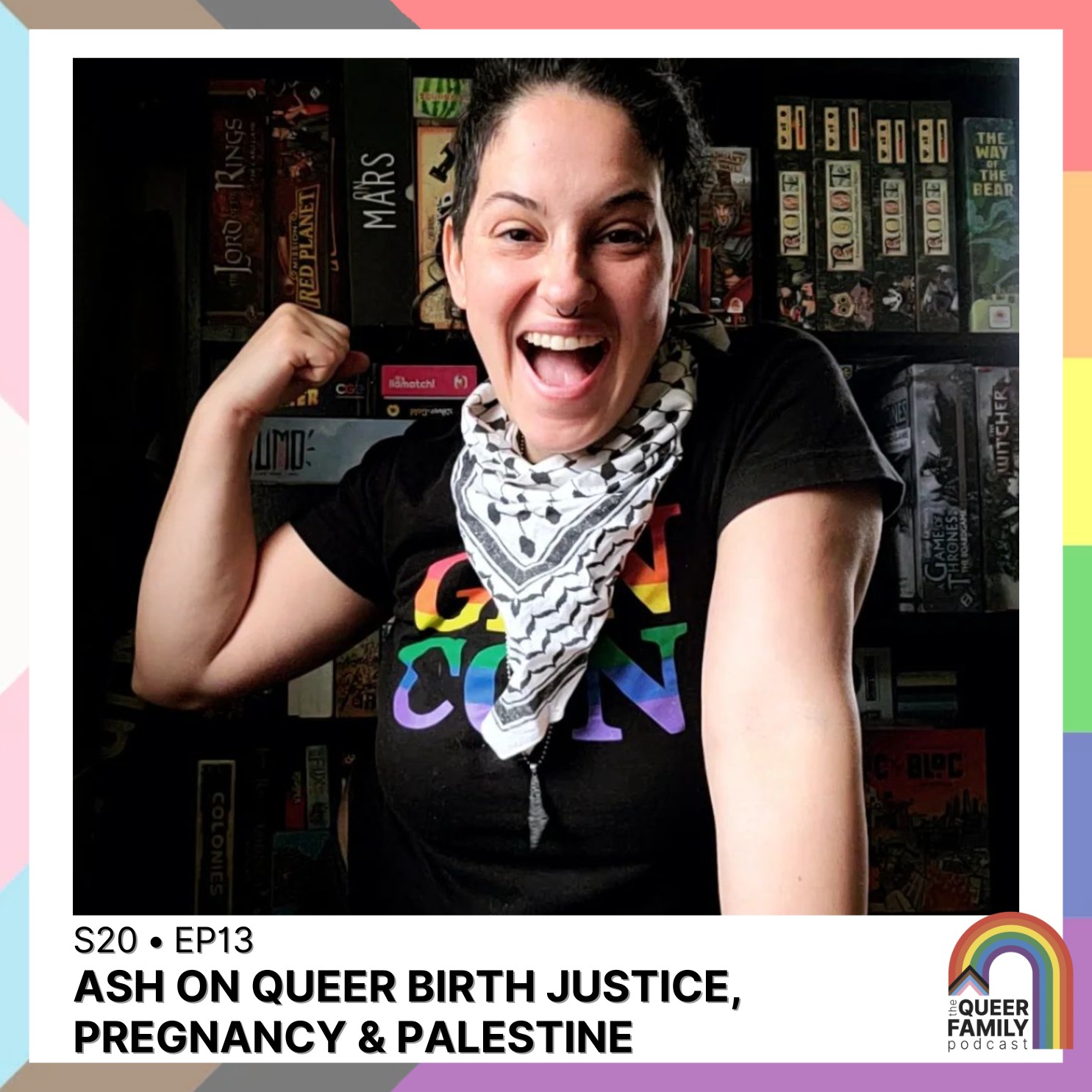
Ash on Queer Birth Justice, Pregnancy & Palestine
Episode Transcript
[SPEAKER_01]: This episode is brought to you by our friends at California Cryobank.
[SPEAKER_01]: Use Code ClearFam25 for a free level 2 subscription to their donor catalog and start that family building journey today.
[SPEAKER_01]: It's also brought to you by B-parent surrogacy.
[SPEAKER_01]: And if you mentioned the ClearFamly podcast when you reach out, you're going to receive $2,000 off any service you book.
[SPEAKER_01]: All right, let's get it into the episode.
[SPEAKER_05]: Love is love, it's love on the queer family, but catch Love is love is love on the queer family, but catch Love is love is love on the queer family, but catch Love is love [SPEAKER_03]: especially folks who have to like put a lot of work into becoming parents.
[SPEAKER_03]: It's not just accidental, like, yeah, queer people are some solid parents overall.
[SPEAKER_03]: Also, like, people who have had to look at the world, a lot of us have been told in different ways throughout our life, they're like, oh, you're not, you're not the right thing, right?
[SPEAKER_03]: Your sexuality's wrong, your gender's wrong, you're doing something wrong.
[SPEAKER_03]: And we had to figure out, like, actually, I'm not.
[SPEAKER_03]: Actually, I'm just myself and everything's fine.
[SPEAKER_03]: And so I think, like, [SPEAKER_03]: in particular queer people are very attuned to like questioning all the narratives to say like I'm not just going to parent the way I've been told by my culture or by default I'm going to put this through the filter of like does this make sense?
[SPEAKER_03]: Is this actually loving or am I just going to re-gird to take what I've been spoon fed?
[SPEAKER_01]: Welcome y'all to the Clear Family Podcast, to show all about family, but with gay.
[SPEAKER_01]: I am Jamie, I'm your gay host, and this is the show that celebrates highlights, uplifts and normalizes, LGBTQIA plus families in all of our fabulous identity.
[SPEAKER_01]: And today's episode is really awesome.
[SPEAKER_01]: I got to sit down with Ash.
[SPEAKER_01]: And now I want to say, before we jump into today's conversation with Ash, I want to give y'all a gentle heads up.
[SPEAKER_01]: And I want to also let you know kind of where I'm at personally.
[SPEAKER_01]: This episode goes in a lot of really beautiful directions.
[SPEAKER_01]: We talk queer and trans-birth work, which is amazing.
[SPEAKER_01]: We talk safety and hospital systems, which is important to talk about.
[SPEAKER_01]: We talk parenting as a queer family, and toward the end, Ash and I step into a topic that feels really [SPEAKER_01]: tender to be honest, and also really scary for me to talk about publicly, Palestine, Zionism, and what's happening in Gaza.
[SPEAKER_01]: I don't know if you've noticed, but I haven't really spoken much to it on the show.
[SPEAKER_01]: So if you've been listening to this show for a while, you know that I lead [SPEAKER_01]: And I want to be transparent.
[SPEAKER_01]: I am actively learning right now.
[SPEAKER_01]: I'm reading.
[SPEAKER_01]: I'm listening.
[SPEAKER_01]: I'm asking questions.
[SPEAKER_01]: I live in New York City where emotions around this topic run very high.
[SPEAKER_01]: And I have Jewish family and friends whom I love deeply.
[SPEAKER_01]: I never want to contribute to harm or erase anyone's trauma or just respect people who are genuinely afraid in these times we find ourselves in and at the same time, I cannot ignore the very real suffering of Palestinian people.
[SPEAKER_01]: I can't ignore the language of apartheid and genocide being used by human rights organizations.
[SPEAKER_01]: I cannot ignore what I am seeing with my own eyes.
[SPEAKER_01]: I cannot unsee what I have seen.
[SPEAKER_01]: So, I am learning.
[SPEAKER_01]: I am unlearning and I am trying in perfectly.
[SPEAKER_01]: Very imperfectly to hold space for complexity without losing sight of humanity.
[SPEAKER_01]: So, when Ash and I talk about Palestine, I am not coming in as an expert far from that.
[SPEAKER_01]: I'm never an expert.
[SPEAKER_01]: We know that.
[SPEAKER_01]: I'm coming in as someone trying to understand the lived experience of a Palestinian guest who trusted me with their words.
[SPEAKER_01]: I want to be clear, the goal isn't to debate or to take away from anyone's pain or to tell Jewish listeners what to believe.
[SPEAKER_01]: The goal is to listen, the goal is to witness, [SPEAKER_01]: And the goal is to keep expanding our capacity for empathy.
[SPEAKER_01]: I know this topic is charged.
[SPEAKER_01]: I know it may feel uncomfortable.
[SPEAKER_01]: It feels uncomfortable for me, but this show has always been about intentionality, compassion, and the courage to hear stories different from our own.
[SPEAKER_01]: And that's exactly what I'm doing here.
[SPEAKER_01]: So with that said, this conversation with Ash is powerful, moving and layered.
[SPEAKER_01]: We go deep into queer and trans birthing, discrimination in medical systems, and what it means to create liberation-focused care.
[SPEAKER_01]: And we also go into Palestine.
[SPEAKER_01]: All right, let's breathe together.
[SPEAKER_01]: Let's keep our hearts open.
[SPEAKER_01]: And please know, I love you all, and I am so glad you all show up and listen to this here show.
[SPEAKER_01]: And I know you all care about intentionality and compassion just as much as I do.
[SPEAKER_01]: So Helen, Bula, there, even here, with candles in their hands, ready to go.
[SPEAKER_01]: Helen and Bula, my fake assistants, can you please roll that beautiful tape?
[SPEAKER_01]: Let's go, let's get into it.
[SPEAKER_01]: Clear family, but good, love is love.
[SPEAKER_01]: Hey, Ash.
[SPEAKER_03]: Hey, how's it going?
[SPEAKER_01]: It is going well.
[SPEAKER_01]: How are you today of this lovely, fine day?
[SPEAKER_03]: I'm doing fine.
[SPEAKER_03]: It's been the weather is going up and down in the hallway where I'm like turning the heat and the AC on back and forth.
[SPEAKER_03]: And I just kind of feel it in my body just like, what is the time?
[SPEAKER_01]: This fall is killing me.
[SPEAKER_01]: Where are you?
[SPEAKER_03]: I'm in Southeast Ohio, like, along the Appalachian mountains, right on the foot hills there.
[SPEAKER_01]: Yeah, and then I'm sure you're seeing all the beautiful colors.
[SPEAKER_03]: It's barely turning, but weirdly, a tree, like in my yard was struck by lightning a couple weeks ago.
[SPEAKER_03]: So it's like the only tree that is turning colors now.
[SPEAKER_03]: Everything else is still pretty green, but this one tree is just like fried, it's wild.
[SPEAKER_01]: Well, I'm in New York City and it's gotten like all of a sudden it's like 40 degrees in windy.
[SPEAKER_01]: I'm not prepared.
[SPEAKER_01]: Not prepared.
[SPEAKER_01]: I think we need to get into the pressure cooker moment.
[SPEAKER_01]: I've never called it that of your 30 second elevator coach of who you are and why you're here talking to the queer fam squad.
[SPEAKER_01]: Are you ready for this?
[SPEAKER_03]: Oh sure.
[SPEAKER_01]: On your mark, get set, 30 seconds, go.
[SPEAKER_03]: I'm Ash, I'm a midwife, and I'm also Palestinian, I'm very queer, trans, I'm binary, whatever.
[SPEAKER_03]: Those are my long list of identities that's not even all of them.
[SPEAKER_03]: Of course, but I think growing up as a Palestinian person, mostly, has meant that I've been like, very liberation-focused, my whole life, and always trying to figure out, like, what's at the root of all this?
[SPEAKER_03]: What's the root of suffering?
[SPEAKER_03]: What's causing a lot of pain in that led me right into birthwork and teaching, education, I'm also in nurse.
[SPEAKER_03]: So that's that's my 30 seconds.
[SPEAKER_00]: Boom.
[SPEAKER_01]: Oh my god.
[SPEAKER_01]: Ash.
[SPEAKER_01]: That was that's beautiful.
[SPEAKER_01]: And I love how you woe suffering and birth together because I obviously I've.
[SPEAKER_01]: made the correlation between birth and suffering.
[SPEAKER_01]: But you putting it on the backdrop of Palestine and the need for freedom.
[SPEAKER_01]: Oh, that was deep.
[SPEAKER_01]: That was like very full circle.
[SPEAKER_01]: Thank you, Ash.
[SPEAKER_01]: I love that.
[SPEAKER_01]: You're like an artist, too.
[SPEAKER_01]: I can see it.
[SPEAKER_03]: Just trying to open some doors for you on the chat podcast, you know?
[SPEAKER_01]: I appreciate you, I see you.
[SPEAKER_01]: So, Ash, let's get into this.
[SPEAKER_01]: So, just to throw it out there for all the listeners.
[SPEAKER_01]: So, Ash, you are not a parent at this point in time, or are you a parent?
[SPEAKER_03]: I am, yes.
[SPEAKER_03]: I am a parent.
[SPEAKER_01]: Oh, you are a parent.
[SPEAKER_03]: Uh-huh.
[SPEAKER_03]: Yeah.
[SPEAKER_01]: Wait.
[SPEAKER_03]: I've got a little 11-year-old kid out.
[SPEAKER_01]: I have an 11-year-old too.
[SPEAKER_03]: I would do you.
[SPEAKER_01]: Yeah.
[SPEAKER_01]: Yeah.
[SPEAKER_01]: Lord, I hear you.
[SPEAKER_01]: I hear you.
[SPEAKER_03]: It's an age.
[SPEAKER_01]: It's, it's an age.
[SPEAKER_01]: It really is, but I'll tell you what my seven year old is driving me crazy or then my 11 year old is right now, which is interesting.
[SPEAKER_01]: It's so strange, but wait, I have to hear like a quick elevator pitch of your family building journey, because you know, in the queer way, it's never straightforward.
[SPEAKER_03]: So I had a baby sort of like the most simple old fashion style.
[SPEAKER_01]: one of the few.
[SPEAKER_01]: Yes.
[SPEAKER_03]: And I have a two incredible co-parents of the person I had a baby with is, you know, no longer a partner, but we're so co-parent.
[SPEAKER_03]: So then my partner now is very much also a parent.
[SPEAKER_03]: But yeah, I birthed our kiddo 11 years ago.
[SPEAKER_03]: We only have one child had him at home and for me, unlike most of the people that I work with, [SPEAKER_03]: the fertility piece of it wasn't like a major part of it wasn't like a major struggle, but I would say like being pregnant and going through birth and becoming a parent as a trans person, you know, has been like intimately hard or confusing over the years.
[SPEAKER_03]: I mean, a lot of people I work with conception is not so easy, of course.
[SPEAKER_01]: Yeah, of course, when you're missing, when you have too much of one thing and not enough of the other or any of the other.
[SPEAKER_01]: Yeah, it's a little complicated.
[SPEAKER_01]: That's why I have this entire show all about it, but like yeah.
[SPEAKER_01]: So when you, I like I like to call it baby dancing because we don't get to baby dance that much in the queer community like we do it a lot, but it doesn't produce a baby.
[SPEAKER_01]: I like I like to call it baby dancing.
[SPEAKER_01]: Were you living a queer life when when the conception happened and all that like what's the story?
[SPEAKER_01]: Yeah, I'd love to get nosy.
[SPEAKER_03]: I've always been trans right, but like didn't know it or wasn't it right?
[SPEAKER_01]: Yes [SPEAKER_03]: And so at that time I would say I still didn't really understand that like my gender was a big part of like not being a woman was like actually a really big part of the like experience I was having in life.
[SPEAKER_03]: I was definitely queer but I grew up self like very self imposed Christian like incredibly Christian.
[SPEAKER_03]: So it was something that like I spent a lot of years just like repressing and pretty immensely.
[SPEAKER_03]: That being said, the person that I had a child with, I loved very much like all that was very genuine, but sure, like parts of myself, I think I was probably like still repressing so much.
[SPEAKER_03]: I mean, I think of myself as a person who's probably paned, like I can connect with all kinds of people.
[SPEAKER_03]: So I don't really view that relationship as being like fully outside of my sexuality per se, but like if I hadn't till like kids you scale myself, it's probably a lot more on like homo side than not.
[SPEAKER_01]: I tell you what, when I was coming out and like really discovering myself, we didn't have all the alphabet we have now.
[SPEAKER_01]: We didn't have knowledge of pans, sexuality and all the things.
[SPEAKER_01]: And I think that if I were to come out in more modern times, I might kind of speak to my sexuality and identity more the way you just did in a way.
[SPEAKER_01]: But you know, I came out and I it was either you were gay or lesbian and by was joke back then, you know, and so it was like I went off I went hardcore okay I'm a lesbian now I just own it and I love it, you know, I love that identity, but interesting how we have really actually morphed in good ways and we still have a long ways to go to get to true acceptance and all the things.
[SPEAKER_01]: So you had a kiddo and then your partner and you, it just didn't work out, you split up.
[SPEAKER_03]: Yeah, as far as like being romantically connected anymore and, you know, life partners, but but we're still very much family and co-parent together.
[SPEAKER_03]: We live in two homes, but yeah, I'm really proud of the like family we've created together among the four of us.
[SPEAKER_03]: It's awesome.
[SPEAKER_03]: It's awesome.
[SPEAKER_03]: needs three parents.
[SPEAKER_03]: So he's very lucky and also like needed it.
[SPEAKER_03]: He needs some extra.
[SPEAKER_01]: What do you mean by that?
[SPEAKER_01]: I'm curious because I wonder if my kid needs three because they drive me crazy.
[SPEAKER_03]: It could be.
[SPEAKER_03]: I mean, I don't mean to make it sound like anything different than it really is.
[SPEAKER_03]: Besides, I just think we all three bring like really different and unique and beautiful things to him that like, you know, when I imagine like any one of us, like not really being there, I think there would be a huge piece of like what he needs and out of parenting.
[SPEAKER_03]: God.
[SPEAKER_00]: Yeah.
[SPEAKER_03]: Missing.
[SPEAKER_03]: So.
[SPEAKER_03]: and also not all parenting is created equal right we're not all doing the same thing as each other even if it's like the same number of kids or something like that it's very different so we sometimes joke that we're on advanced hard mode [SPEAKER_03]: and it's like somebody handed us the controller of a video game, and you've never touched a video game in your entire lives, and they're like, it'd be as hard both.
[SPEAKER_03]: It'd be as hard both life or destination go.
[SPEAKER_01]: That's parenting.
[SPEAKER_01]: Okay, that's literally parent.
[SPEAKER_01]: You're that's a beautiful way to describe it.
[SPEAKER_01]: We are an advanced hard mode here, and there is no takebacks.
[SPEAKER_01]: Yeah.
[SPEAKER_01]: And you don't get another life.
[SPEAKER_01]: Like, let's go figure it out.
[SPEAKER_01]: Oof.
[SPEAKER_01]: That's the parenting is hard.
[SPEAKER_01]: Parenting is hard.
[SPEAKER_01]: And this comes up on my show quite quite a lot because a lot of times, you know, we incorporate chosen family and we incorporate.
[SPEAKER_01]: We have bigger families a lot of times that donors involved and there's there are multiple parents more than just two in many of our families.
[SPEAKER_01]: And I always say, who wouldn't want more?
[SPEAKER_01]: for their children.
[SPEAKER_00]: Yeah.
[SPEAKER_01]: Who wouldn't want more when people are like, oh my God, they might have donor siblings.
[SPEAKER_01]: You know, I don't want them to have a hundred of them, but like I don't see how that's bad for them to have more people who love them as long as we do it in a good intentional way and we're open and honest about all of the things I think our children are extremely well rounded by the way they're raised in these very intentional ways by as queer folks.
[SPEAKER_01]: That's why I always say we're the most intentional parents out there.
[SPEAKER_03]: Oh, absolutely.
[SPEAKER_03]: That's yeah.
[SPEAKER_03]: It's totally true.
[SPEAKER_03]: I mean, especially folks who have to like put a lot of work into becoming parents.
[SPEAKER_03]: It's not just accidental.
[SPEAKER_03]: Like yeah, queer people are some solid parents overall.
[SPEAKER_03]: Also like people who have had to look at the world.
[SPEAKER_03]: A lot of us have been told in different ways throughout our life, feel like, oh, you're not the right thing, right?
[SPEAKER_03]: Your sexuality's wrong, your gender's wrong, you're doing something wrong.
[SPEAKER_03]: And we had to figure out, like, actually, I'm not.
[SPEAKER_03]: Actually, I'm just myself and everything's fine.
[SPEAKER_03]: And so I think, in particular, queer people are very attuned to questioning all the narratives to say, like, I'm not just going to parent the way I've been told by my culture or by default.
[SPEAKER_03]: Is this actually loving, or am I just going to re-gure to take what I've been spooned for my gender?
[SPEAKER_03]: Been work for my sexuality, you know?
[SPEAKER_01]: Exactly.
[SPEAKER_01]: And then we're parenting with that mindset and our children are getting this way more compassionate in many ways, approach to just life, right?
[SPEAKER_01]: And that's why I feel like our children are really entuned with the struggles in the world, because we're raising them with that.
[SPEAKER_01]: mindset, right?
[SPEAKER_01]: Like, if something hurts someone, that's not a good thing.
[SPEAKER_01]: If it's, yeah, I know a lot of other people do this too.
[SPEAKER_01]: I just, I just like to say that queer folks are better because because why wouldn't I?
[SPEAKER_03]: It's good to notice the, the magic.
[SPEAKER_01]: Yeah, 100%.
[SPEAKER_01]: So what brought you into birthwork and what, you're like, how did we get down the path that we got?
[SPEAKER_01]: Because you did it the natural way.
[SPEAKER_01]: And then of course I know you show up as how you show up.
[SPEAKER_01]: And of course everything you just said, but what brought you into birthwork and what brought you into queer birthwork?
[SPEAKER_03]: I mean, it's funny actually, I was in nursing school and the first birthday ever saw was, I was like super reluctant.
[SPEAKER_03]: Me and my girlfriend at the time, we were both like in the same class and we were both groaning about having to watch someone birth.
[SPEAKER_03]: We were just like, we're gay, this is gross, and please no.
[SPEAKER_03]: Why do we have to do this?
[SPEAKER_01]: Wait, had you already given birth by, at this point, or you hadn't given birth yet?
[SPEAKER_03]: No, we were like in college and I don't know, probably.
[SPEAKER_03]: 19 or 20 or something.
[SPEAKER_03]: And then this baby was born right in front of me.
[SPEAKER_03]: I think we were both crying.
[SPEAKER_03]: I for sure was immediately just like tearing, tearing, tearing.
[SPEAKER_03]: I'll never forget that.
[SPEAKER_03]: I remember thinking, that's the most real thing I've ever seen in my life.
[SPEAKER_03]: like even though there was like all of this like equipment and hospital and like clinical instruments and all this like stuff around it I just like could zoom in and I just saw like the baby and the birther and that was it and it was incredible.
[SPEAKER_01]: Interesting.
[SPEAKER_01]: I went when I saw the only birth I've ever seen up close and personal was my wife when when my wife gave birth to our daughter.
[SPEAKER_01]: I had to go home and like cry for an hour because I had such a like a good reaction to it, but I didn't have like it also gross me out.
[SPEAKER_03]: Yeah, and also like for those of us living in the West, you know, I don't think we have like that much intimacy with like life and death like that right like most of us don't actually like Kill our own meat if we eat meat or like maybe some of us garden but like that's as close as we get to like routine death is like maybe pulling a plant or something [SPEAKER_01]: right, right.
[SPEAKER_03]: And then birth, you know, I don't know, it's just like those are those raw moments of life are pretty foreign to a lot of us in like it colonized spaces.
[SPEAKER_03]: So I think I just like felt the starkness of that and I was like, whoa, something, there's something here.
[SPEAKER_03]: And I just kind of followed that thread.
[SPEAKER_03]: I was already exploring like, [SPEAKER_03]: What is suffering?
[SPEAKER_03]: Like I was mentioning before.
[SPEAKER_03]: What is suffering?
[SPEAKER_03]: Why is everyone hurting so much?
[SPEAKER_03]: Why is there violence?
[SPEAKER_03]: What is the root of violence?
[SPEAKER_03]: Why are there people occupying my ancestral land?
[SPEAKER_03]: And like, do why?
[SPEAKER_03]: What is this about?
[SPEAKER_03]: And for, you know, like why was my dad shocked out of the home of like his great great great great great great great great great great great grandparents for a no reason.
[SPEAKER_03]: Just like where is violence coming from?
[SPEAKER_03]: And in following that thread, I was thinking a lot about separation and the way that we're really separated from each other as people separated from the land, separated from a lot of us separating from separated from our ancestry, whether it's people like who are colonizers, right, who like left.
[SPEAKER_03]: their home of origin to go settle and colonize somewhere, or if it's people who have been abducted from their home of origin to be enslaved somewhere else, or if it's people who have been colonized on the land that is their ancestral land, but they're being like separated from their own sovereignty and dignity, just like so much separation from self from land from people, and that just kind of kept taking me back to birth and like [SPEAKER_03]: what modern birth looks like in a modern context and I mean it's there's a birth crisis happening you know like just clinically speaking medically speaking in colonial health care like there's a lot of problems happening.
[SPEAKER_01]: Can you speak to that a little bit I want to hear.
[SPEAKER_03]: Yeah.
[SPEAKER_03]: I think it's like specifically since like 1987 we've had like pretty pretty rapidly increasing rates of mortality for berthers and we're kind of told that like modern birth and this modern context is safer than ever or you know like definitely being in the hospitals where you're going to have access to like everything safe and you're going to be kept safe and all of this stuff.
[SPEAKER_03]: But the real story is that things happening in modern birth, particularly in hospitals, but also outside of hospitals, so many things happening on labor and delivery, and it's for example, are about money, are actually about saving costs and not about evidence.
[SPEAKER_03]: So there's so many things that are actual like routine policy in birth practice that are completely contrary to what the evidence shows is actually safest.
[SPEAKER_03]: And then when you really get down to why a lot of it tends to come down to month, like, you know, it's cost saving.
[SPEAKER_01]: That's American healthcare for you, like, eating a nutshell, right?
[SPEAKER_06]: We'll be right back.
[SPEAKER_01]: Okay folks, you know how on this show, we talk a lot about the search for the super human that while little roller coaster we all go on when we're scrolling donor profiles at 2 a.m.
trying to convince ourselves we're not losing it.
[SPEAKER_01]: Yeah, that one.
[SPEAKER_01]: Well, California Cryobank is where that journey gets a lot easier, y'all.
[SPEAKER_01]: California Cryobank has been helping LGBTQIA plus families for over 45 years and their donor catalog is massive.
[SPEAKER_01]: Like, you will start creating spreadsheets, massive.
[SPEAKER_01]: which is a good thing.
[SPEAKER_01]: And they offer detailed medical histories, they offer baby photos, adult photos with some donors, they offer personality tests, staff impressions, you get the picture.
[SPEAKER_01]: It's basically queer family Pokemon.
[SPEAKER_01]: And I am in Pokemon mode because my seven-year-old is obsessed.
[SPEAKER_01]: We gotta catch the right one.
[SPEAKER_01]: And because they actually care about legitimate to quiet families, they give you things like genetic counselor as family planning support, donor matching tools that don't make your brain melt, letters for second parent adoption, you get the drift.
[SPEAKER_01]: So if you're in the donor search chapter of your family building saga, head to California cryobank and use code, queer fam 25, and you're gonna get a free level to subscription to their donor catalog.
[SPEAKER_01]: You can also use that code on a discount to their level three subscription, [SPEAKER_01]: Things.
[SPEAKER_01]: Go find your superhuman.
[SPEAKER_01]: Go make the babies and then come tell me about it.
[SPEAKER_01]: Yes, love is love My wife and I were both we both did hospital births and also You know just to throw this out there like I was afraid of a home birth because I just didn't I was afraid something But wrong was gonna happen and I hear what you're saying and we made the choice to do it in the hospital I feel like [SPEAKER_01]: whatever you feel you have to do for your own mental health, I think is good, but it's wonderful to hear all perspectives and really get the full picture of what it is and what we're looking at, right?
[SPEAKER_01]: And that's why it's so great to have people like you who is an expert in what you do and it's, you know, like there's so much information out there and there's so much conflicting information out there and it's so hard to sift through it all, especially when you're a pregnant woman with nine months [SPEAKER_01]: to figure it all out.
[SPEAKER_01]: I should have said a pregnant person.
[SPEAKER_01]: I, excuse me, a pregnant person with nine months to figure it all out.
[SPEAKER_03]: Especially if you don't have any kind of health care background or whatever, how are you trying, you're trying to research like, am I going to use a rithromycin ointment or claustrum for my child's like, you know, I prevent it.
[SPEAKER_03]: Like, it's just like there's so many things and to try to navigate those decisions and [SPEAKER_03]: especially like if you really dig into it which you know I recommend people do and you realize okay there's actually more things motivating my doctors recommendations than just my well being there are other things that play my my well being is a part of it but there are other motivators some of them are like legal some are financial some are just like purely technical related to their training some are like just based on their myths the traditions and myths that they believe that are not based on evidence but they mean well [SPEAKER_03]: some of it is based on like they don't have enough vacation time and they're trying to go hang out with their family this weekend which is great because they're normal people, right?
[SPEAKER_03]: But it's the point is like there's more involved than just like our well-being even with our doctors or providers that mean the absolute best there's more going on.
[SPEAKER_03]: But you're right about the hospital, just to speak to the hospital thing where I always say wherever somebody feels safest is where they should burn.
[SPEAKER_03]: There's not like a correct location.
[SPEAKER_03]: Actually, just from a physiologic sense, wherever somebody feels safest during labor is where they're less likely to have as many complications.
[SPEAKER_03]: Hmm, and then just translates to like pure physiology and having like a lot of stress That stress pathway being like but really active during labor does suppress labor and like slow things down and make things like failure to progress occur or You know also called stalled labor or labor rest and just like lots of complications can arise from like [SPEAKER_03]: increased fear.
[SPEAKER_03]: So wherever people are going to feel the most, you know, just at ease is a good place, you know, depending on their risk level and such.
[SPEAKER_01]: and find the person that feels right for you, right?
[SPEAKER_01]: Yeah, find the help that that feels right for you.
[SPEAKER_01]: Like we loved our doctor, so it made sense.
[SPEAKER_01]: But at the same time, I will say, with that hospital birth and with, you know, a practice of multiple doctors who work together, neither one of us had that particular doctor at our birth.
[SPEAKER_01]: We had a different doctor, each of us at the birth.
[SPEAKER_01]: So, that's one of the things that you should know when you're going into this and if you want one particular person, then you need to look at all the different avenues that are open and available to us and listen to folks like you, Ash, and really make a decision based on what's in your heart, right?
[SPEAKER_01]: It's because this is one of the most hardest experiences of your life, get birth.
[SPEAKER_01]: And my birth ended up actually being extremely complicated and I had to have an emergency C-section, which they pushed to the very, very last minute because they didn't want to give me a C-section.
[SPEAKER_01]: I was like at the point, I almost said, just get him out, please, because I didn't want him to die, right?
[SPEAKER_03]: So, and you knew it was, you could tell there.
[SPEAKER_03]: It was like, we don't have time here.
[SPEAKER_01]: No, it wasn't good.
[SPEAKER_01]: And the panic on all of their faces was freaking me out, because you know, anyway.
[SPEAKER_01]: I'm happy that we were in the setting I was in for what happened but you just never know and also you have things for things like that as well, right?
[SPEAKER_01]: Like what would happen in a situation like that in a birth like that you've probably experienced it when things are just you need to ramp it up to something else like what would happen in a home birth.
[SPEAKER_03]: in a home or birth center birth.
[SPEAKER_03]: I mean, most transfers from home and birth center birth are not even emergent.
[SPEAKER_03]: Generally, it's like something like, somebody's like, okay, I actually want an epidural.
[SPEAKER_03]: I've been doing this for too long.
[SPEAKER_03]: Or somebody's been laboring a really long time and like things aren't majorly changing.
[SPEAKER_03]: And so it's just kind of feels like maybe a shift to, or you know, or the birth through the sides like I'm ready to shift and I want to like use more interventions [SPEAKER_03]: And then there's some emergencies that are manageable at home or in a birth center and some emergencies that require transport.
[SPEAKER_04]: So...
[SPEAKER_03]: You know, like from the vast majority of people, particularly low risk, particularly low risk or other people that are going into birth that don't have major risk factors.
[SPEAKER_03]: Burthing at home, assuming they don't live incredibly far away from a hospital, is definitely a safe choice.
[SPEAKER_03]: Like there's times transfer, then there's a lot of things that can be done and route to transfer to, even in like really big emergencies, there are some, you know, there are sometimes there are some interventions [SPEAKER_03]: up to the OR, for example, you know, things like that.
[SPEAKER_03]: But it depends also on like the blood legislation and a particular state and what those things look like.
[SPEAKER_03]: And how forward midwives can be and how much in the background they might need to be.
[SPEAKER_03]: And things like that.
[SPEAKER_01]: right and which brings us to the queer community and bringing like laws into play and like hospitals, um, hospital policies and things like that.
[SPEAKER_01]: So let's take it to just you basically focusing your work on queer birth and like, [SPEAKER_01]: because what certain bodies aren't treated the same in all hospitals.
[SPEAKER_01]: And so like, what is it that brought you to clear work, birthwork, and what are some of the things you see and what are some of the things you do to help with our acceptance and comfort and all the things.
[SPEAKER_03]: You know, I think a lot of the work I'm doing, like, as I'm realizing more and more that I do it, it's especially work that's sort of like mentally emotionally somatically preparing people on the pregnancy side of things or even before pregnancy.
[SPEAKER_03]: Like, I have people who are still trying to conceive or considering trying to conceive soon that take my classes and I also have birth workers taking my classes.
[SPEAKER_03]: in whatever process, part of the process, definitely we're talking about labor and birth and how can you show up to labor and birth as a queer person, as a queer family, as a trans person, and how can you deal with the added potential discrimination or the added potential just stress that exists doing these things in a space that's like assuming you're gonna be cis, assuming you're gonna be heterosexual.
[SPEAKER_03]: But I think a lot of it is actually like, [SPEAKER_03]: just creating community and normalization around birth on the front end of labor.
[SPEAKER_03]: Because then, once people go into labor, even if they're experiencing discrimination here, they are like, a certain nurse walks in that just assumes that your partner is like, you're sibling or like, you know, the classic type stuff.
[SPEAKER_03]: I think when folks have had like a really strong foundation throughout pregnancy or throughout their like birth work education, if they're a duet or whatever, of like normalization that like all kinds of people birth, we are all bodies who do this, it doesn't define our gender, our gender doesn't define what we're doing, you know, just normalizing that like a large diversity of people birth, a large diversity of families birth and have children.
[SPEAKER_03]: I think it's like it builds a lot of resilience for that moment in labor, which is really important to help people's nervous systems like I was mentioning before just like staying in the sensation of like, I'm okay.
[SPEAKER_03]: I'm just doing what my body needs to do, which is birth and I don't have to be like as intimately or deeply affected by like, [SPEAKER_03]: the subtleties around me, but then we also, you know, I get into like a lot of advocacy stuff.
[SPEAKER_03]: How do you advocate for yourself in these ways?
[SPEAKER_03]: Which is really important for particularly by-pock birthers and also queer and transporters, you know.
[SPEAKER_01]: Yeah.
[SPEAKER_01]: Yeah.
[SPEAKER_01]: And so you're doing all of that work throughout the pregnancy.
[SPEAKER_01]: You're working with who with them throughout the pregnancy and helping think through.
[SPEAKER_03]: Yeah.
[SPEAKER_03]: I mean, I like have like three to four birth classes per year and it's like a session class, right?
[SPEAKER_03]: So it's like over a month.
[SPEAKER_03]: time.
[SPEAKER_03]: We usually do it over four weeks.
[SPEAKER_03]: But what I'm trying to do is like really like prepare people and and offer people community to each other because we stay connected in this like online forum.
[SPEAKER_03]: So like I want it to be more like spread out through a pregnancy even if like we're only in like active sessions together for four weeks.
[SPEAKER_03]: I want it to be yeah like something that's preparing them emotionally, mentally, physically, throughout.
[SPEAKER_01]: I think it's really important and I've spoken to numerous midwives.
[SPEAKER_01]: I've spoken to Duelas who work in the queer community and every time I speak with y'all, it makes me think, I think I could have benefited from this.
[SPEAKER_01]: But I didn't.
[SPEAKER_01]: We went the full on medical route just because full disclosure and because I have to stay authentic to myself, my wife and I are like, you're the doctor, you have the degree, you tell us what to do, like full disclosure, that's kind of how we do it.
[SPEAKER_01]: you, and I hear all the extra support and consideration for who we are that you get with someone who does the things you do.
[SPEAKER_01]: It makes me think, oh, yeah, I've, I've really could have used.
[SPEAKER_01]: I really could have used this extra support throughout this.
[SPEAKER_01]: Yeah.
[SPEAKER_01]: And I think that's a really important thing to bring up, especially because like when you're in the hospital setting, you're in the trauma, you're going through the birth, if you don't have anybody advocating for you and we didn't face, we didn't really face much discrimination in the hospital at all, you know, we didn't get.
[SPEAKER_01]: any weird, they might have mistaken us for sisters or something at one point, but it's even like little nuance things.
[SPEAKER_01]: Having somebody to advocate for you, like for instance, when I gave birth it was our second kid, but it was my first pregnancy.
[SPEAKER_01]: And so to all the nurses, I was a first-time mom, I didn't have a kid at home, right?
[SPEAKER_01]: So they treated me and I was a tired, I had a four-year-old at home.
[SPEAKER_01]: I was a tired mom, I was looking forward to getting a good sleep in [SPEAKER_01]: the nurse is kind of putting the baby like help helping me out with the baby a little bit and I had a C section so it was I was in a lot of pain right so but they treated me like this is my first baby like they thought I was being like a selfish I don't know I don't know how to explain this [SPEAKER_01]: But it's a nuanced thing to the fact that I didn't give birth more than once so they treated me differently.
[SPEAKER_04]: Yeah.
[SPEAKER_01]: Had this been my second pregnancy or my second c-section, I feel I would have been treated differently as a mom.
[SPEAKER_01]: But I was treated as a first-time mom who needs to just do it.
[SPEAKER_01]: Yeah.
[SPEAKER_01]: Does that make sense?
[UNKNOWN]: Yeah.
[SPEAKER_01]: And I feel like having someone like you advocating for me would have made a huge difference to be quite honest and just being there for me and helping me through it and helping me afterwards.
[SPEAKER_01]: There was no help in that hospital afterwards.
[SPEAKER_01]: I was on my own.
[SPEAKER_01]: Yeah.
[SPEAKER_01]: And that's really hard.
[SPEAKER_03]: Definitely.
[SPEAKER_03]: It's so hard.
[SPEAKER_03]: It's like, yeah, get a little drum-bop done in and then somebody walks away.
[SPEAKER_03]: I think that what you're describing echo is what I hear so many people say.
[SPEAKER_03]: I mean, I don't want it to sound like I'm just talking about my birth class because there's a lot of really wonderful birth classes, but I just had so many people say, like, oh my god, I did not know what I didn't know and I'm so happy to have, you know.
[SPEAKER_03]: so much of this.
[SPEAKER_03]: You know, not every single thing we talk about is like queer and trans-related because we're just people talking about birth and labor, right?
[SPEAKER_03]: It's just a childbirth class, but so like learning about the hormones, like what's initiates pregnancy and like, but then when you really like dig into all of that, you can end up having conversations that do talk about like, where are you going to feel safe and why does that matter?
[SPEAKER_03]: and supporting folks to like make those decisions.
[SPEAKER_03]: I feel like one of my hardest, the balance I'm like always trying to find, and I like sometimes loosely, but over this, which is fine, I just like say away thinking about it.
[SPEAKER_03]: Is, how do I help people feel more confident about the process about birth itself instead of so fearful about birth?
[SPEAKER_03]: Because I think that's at the origin of a lot of [SPEAKER_03]: What's so unwell in the medical birth system is it's just like fear fear fear fear fear for your anxiety anxiety It's gonna hurt.
[SPEAKER_01]: It's gonna hurt.
[SPEAKER_01]: It's gonna be the worst thing ever.
[SPEAKER_01]: Yeah.
[SPEAKER_01]: It's gonna hurt and you might die basically right well You and or maybe the baby.
[SPEAKER_03]: Yeah, exactly, which is like a real Reel Those are not worries for no reason and also [SPEAKER_03]: if you're only thinking about that, that's at the center of our attention, whether it's like ourselves as brothers, but especially if it's at the center of the attention of like our providers, it does impact the way that they do interventions and how quickly they intervene and how much interventions they provide us.
[SPEAKER_03]: And every intervention carries a risk, so those decisions aren't light, but if they're coming at them from like deep anxiety and fear constantly, rather than a fundamental trust for the physiology of birth, like at baseline, [SPEAKER_03]: It creates a really different outcome, a different environment.
[SPEAKER_03]: I'm working on how do I support people to become confident in the physiology of birth that we've been doing for like 200,000 years or however long you think humans have been around?
[SPEAKER_03]: Yeah.
[SPEAKER_03]: Here we are, we're not about to go extinct.
[SPEAKER_03]: It's been working for like many thousands of years.
[SPEAKER_03]: Birth is effective.
[SPEAKER_03]: Okay, it's physiologic.
[SPEAKER_03]: It's mundane, boring, old, also beautiful, sacred, amazing.
[SPEAKER_03]: And then on the other hand of things, it's also in this modern context, there's a lot to be concerned about how do we prepare, how do we get ready to interact with these sorts of interactions?
[SPEAKER_03]: I mean, different than you most people are being sea sections or being pushed on them when they're not necessarily needed.
[SPEAKER_03]: So that's like more often the situation.
[SPEAKER_03]: and so how do lay people figure out like well am I in the half of C sections that are like unnecessary or is this one of the ones where like it's a life or death situation in which case I would happily go do a C section but if I'm in the half that are not necessary and they're just adding risk factors to me of surgery on top of birth I don't want that but I'm not a doctor how do I even know so I want to prepare people for that but also in still confidence and that is like that's [SPEAKER_01]: I mean, I want you to get sleep, but like, thank you for trying to figure that out because it's really important and when it comes to health care for people with uteruses.
[SPEAKER_01]: I feel like we should be so much more advanced for those of us with the uterus and we're not.
[SPEAKER_01]: They're not, and they don't know.
[SPEAKER_01]: And they never know.
[SPEAKER_01]: I just had to have surgery on my uterus to find out if I had endometriosis, but still, it's like, I don't know if you have it, but we think you do, but let's go in.
[SPEAKER_01]: And you know what I mean, there's gotta be a better way to work with uterus, uteries.
[SPEAKER_01]: but they still haven't seemed to figure it out, but they know how to make sure, you know, erectile this function doesn't happen to a single penis.
[SPEAKER_01]: So.
[SPEAKER_03]: That reminds me of, uh, I'm sure you know this or maybe you've talked about it with somebody, but they just discovered the clitoris in 1991.
[SPEAKER_03]: What?
[SPEAKER_03]: Yeah, before that, before that it was just a little piece-sized nob as was the idea.
[SPEAKER_03]: But in 1991, they discovered the full organ of it.
[SPEAKER_03]: But at this point, we had like deeply in-depth penis anatomy, right?
[SPEAKER_03]: Of course, in and out in every angle.
[SPEAKER_01]: In seventh grade, I learned the vast deference.
[SPEAKER_01]: I learned, like, I know where the parts of a penis.
[SPEAKER_03]: Got another vast deference.
[SPEAKER_01]: Yeah, exactly.
[SPEAKER_01]: And I didn't know 1991 is when they fully discovered.
[SPEAKER_01]: Like, the fuck, I'm sorry, what the fuck?
[SPEAKER_00]: What the fuck?
[SPEAKER_00]: Very wild.
[SPEAKER_01]: Actual fuck, it really is maddening.
[SPEAKER_01]: It makes me so angry when I get on this.
[SPEAKER_01]: And I have issues with my uterus.
[SPEAKER_01]: And they don't, and it's been eight years of me complaining.
[SPEAKER_01]: No, nine years of me complaining about my uterus pain.
[SPEAKER_01]: And I finally had got a doctor to say, [SPEAKER_01]: You know what?
[SPEAKER_01]: Let's send you for an MRI.
[SPEAKER_01]: Yeah.
[SPEAKER_01]: That's all I needed to do.
[SPEAKER_01]: Are you kidding me?
[SPEAKER_01]: Like don't get me started because I will go to town.
[SPEAKER_01]: It drives me insane.
[SPEAKER_01]: Like I need a midwife for you to in pain.
[SPEAKER_03]: It was just your stress and you weren't deep breathing enough for whatever.
[SPEAKER_01]: or it wasn't real pain, like, come on.
[SPEAKER_01]: Oh, yeah.
[SPEAKER_01]: Oh, yeah.
[SPEAKER_01]: You know, some people have really bad cramps.
[SPEAKER_03]: Yeah, I'll just back up soon.
[SPEAKER_01]: Yeah, yeah, I know.
[SPEAKER_01]: And they last 15 days, and this is not normal.
[SPEAKER_01]: Like nuts.
[SPEAKER_01]: So don't get me started.
[SPEAKER_01]: But I do think we need more midwives in the world for so many more things.
[SPEAKER_01]: And if I had it to do over again, [SPEAKER_01]: I would incorporate a midwife and or a dula and figure out, you know, and I will and I will advise my daughter to, you know, if that ever comes to happen.
[SPEAKER_01]: God, you're in healthcare, but I cannot believe that fact about the clitoris.
[SPEAKER_03]: Yeah, unreal.
[SPEAKER_03]: It's like, I do like different forms of like sex education, especially for adults.
[SPEAKER_03]: And I just like do a lot of clitoris ed, where I'm just like cool.
[SPEAKER_03]: I know you all know about the penis.
[SPEAKER_03]: Let's just balance it out a little bit.
[SPEAKER_03]: And also about intersects too, right?
[SPEAKER_03]: These are like two side two poles, but like actually humans are really diverse.
[SPEAKER_03]: And these are not the only two, like it's just where I spectrum.
[SPEAKER_01]: You know, we are expecting these these two poles and like everything in between and all of them are very different from each other anyways I think we could talk for hours on on all the things they got on this this gender war that's happening right now and yeah all the infuriating things that are being said and is madening will be right back [SPEAKER_01]: All right, folks, if you have been listening for a while, you know that the mission of this here show is to highlight all the ways we create families in the Ligipoticua community.
[SPEAKER_01]: And that is why I am so excited to spotlight be parent surrogacy.
[SPEAKER_01]: Oh, I love them.
[SPEAKER_01]: Be parent is a full service surrogacy and IVF agency.
[SPEAKER_01]: That's been helping intended parents grow their families since 2017.
[SPEAKER_01]: Their team handles everything under one roof, from embryo creation and medical care to legal guidance and emotional support.
[SPEAKER_01]: So you're not juggling 10 different contracts when you're just trying to become a parent.
[SPEAKER_01]: There are no wait lists, which means when you're ready to start this journey, you don't have to sit in limbo for months waiting for a surrogate or a donor match.
[SPEAKER_01]: and because many of us are navigating this process across borders, be parent is designed with international LGBTQIA plus families in mind.
[SPEAKER_01]: They have accredited clinics that follow top European medical standards.
[SPEAKER_01]: They have multilingual coordinators.
[SPEAKER_01]: They have full legal assistance.
[SPEAKER_01]: and they support you all the way through getting your baby home.
[SPEAKER_01]: Learn more at bparentsurrogacy.com.
[SPEAKER_01]: You can schedule a free service or IVF consultation.
[SPEAKER_01]: Oh, and if you mention the queer family podcast when you contact them, you can get $2,000 off your treatment.
[SPEAKER_01]: Go there, go to bparentsurrogacy, check it out and let's make those babies and then talk about them.
[SPEAKER_01]: Love is love.
[SPEAKER_01]: I wanted to ask you about your ties to Palestine and if you have family in Palestine and I just want to send you love and healing vibes.
[SPEAKER_06]: Yeah.
[SPEAKER_01]: Because I can only imagine how, I mean, the past two years obviously how hard this has been, but you know, the whole story as well.
[SPEAKER_03]: Yeah, thanks for bringing that up.
[SPEAKER_03]: And I do have family in Palestine, the family I have there.
[SPEAKER_03]: I don't know, incredibly well, [SPEAKER_03]: can loosely keep up a little bit on what's out.
[SPEAKER_03]: And then I also keep up with some other trends that I try to support through like a go-fun me and stuff.
[SPEAKER_03]: But most of my family has emigrated due to needing to leave throughout the year.
[SPEAKER_03]: So a lot of my family's in Jordan and Lebanon have some family in Dubai.
[SPEAKER_03]: I think that I have an aunt also in Jerusalem, but I don't have contact with her, but I believe she's still there.
[SPEAKER_03]: And my dad died five years ago now, so he was kind of like the person that could keep up with everybody, but I don't have Arabic, so it's also just harder for me to track with all of my relatives.
[SPEAKER_03]: But yeah, it's been a hell of a time.
[SPEAKER_03]: There's like some incredible things happening and it's also like deeply like terrifying.
[SPEAKER_03]: kind of constantly.
[SPEAKER_03]: But you know, like when my dad died five years ago, he's my Palestinian parent.
[SPEAKER_03]: I think about it almost daily.
[SPEAKER_03]: I just like wish he knew how much people knew about Palestine today.
[SPEAKER_03]: Like the whole world is talking about Palestine.
[SPEAKER_03]: The like active like resistance, the the it's not just like happening on the on the ground in Palestine, but like it's happening in this media space [SPEAKER_01]: much more than before.
[SPEAKER_03]: Yeah, and also, like, trying to figure it out, like, the number of people who are realizing that, oh, this is, this is, like, deeply atrocious, settler colonialism.
[SPEAKER_03]: I thought it was something else.
[SPEAKER_03]: I thought it was this, like, propaganda.
[SPEAKER_03]: I've been told that it was about, like, the safety of a group of people who are marginalized.
[SPEAKER_03]: And I thought that was a good thing.
[SPEAKER_03]: But it's actually something else.
[SPEAKER_03]: That's just the, that's just the cover for a very, very atrocious evil process.
[SPEAKER_03]: That's been underway for a while.
[SPEAKER_03]: Realizing that and learning that, and yeah, I'm just deeply inspired by the people on the ground, and Vazza, who do not give up.
[SPEAKER_03]: They have been hoping and fervent day in and day out through deep suffering, through, you know, starvation.
[SPEAKER_01]: And I can't even, I can't imagine.
[SPEAKER_01]: I can't, and I am one of the people who was very ignorant to the conflict at all, really.
[SPEAKER_04]: Yeah.
[SPEAKER_01]: And I have been learning a lot and I've been trying to understand.
[SPEAKER_01]: I've been trying to understand both sides because there are, I'm in New York City.
[SPEAKER_01]: So both sides are very adamant in New York City of this argument and it's been challenging to say the least to really figure out what is the truth here and what is actually going [SPEAKER_01]: on.
[SPEAKER_01]: I'm learning.
[SPEAKER_01]: I'm learning so much and it is good that people are paying attention.
[SPEAKER_01]: And what can we do?
[SPEAKER_01]: Like I'm asking you a Palestinian person like for those at home and I'm sorry if this is taxing and you don't have to answer that but like what can we do?
[SPEAKER_01]: What can we do?
[SPEAKER_01]: Watching these these atrocities on our TV screens were so far removed, what can we do?
[SPEAKER_03]: You know, that's a big question that also is like not answerable for every individual and in one particular like [SPEAKER_03]: blanket way.
[SPEAKER_03]: But I think some of the work that you're doing and probably folks listening are doing where you're talking about like, okay, I'm hearing this both side stuff and like, look into what we call both sidesism.
[SPEAKER_03]: Like, it's basically that's a thing.
[SPEAKER_03]: That's another like part of propaganda myths that like, even people who are just trying really hard are like, [SPEAKER_03]: You know, whatever, and the way that both sides thinking can actually turn into like enabling oppression.
[SPEAKER_03]: And it's sort of like if we look at a violent relationship, somebody that we know is violent to someone else who is in that relationship.
[SPEAKER_03]: If we just like, [SPEAKER_03]: really like equally take both sides in a particular way or we're actually just like not holding a predator accountable or actually enabling what they're doing by deeply respecting their narrative, which is probably really true and honest.
[SPEAKER_03]: They're like, that person makes me do this stuff because they're crazy or they're whatever.
[SPEAKER_01]: that person believes they're side.
[SPEAKER_03]: Oh, yes, deeply.
[SPEAKER_03]: So we have to like get a little out of that someone and to like look at things slightly more objectively and I don't mean to say don't listen to people's perspectives but but like at the very least yeah, definitely look into perspectives from Palestinian people you're not gonna hear.
[SPEAKER_03]: the same stuff and then like if you're comparing a contrasting, eventually you're going to find truth like and it's I will say it's not too hard.
[SPEAKER_03]: In the sense that when I say it's not too hard I don't mean there isn't stuff to study or try to figure out or look into but that it's complicated thing is also you know a very widely perpetuated myth from science rhetoric.
[SPEAKER_03]: It's too complicated to understand and that's why people disengage, they just sort of like go into [SPEAKER_03]: I don't know.
[SPEAKER_03]: I'm not there.
[SPEAKER_03]: It's not my thing.
[SPEAKER_01]: I can't which we can't afford to do.
[SPEAKER_01]: We cannot.
[SPEAKER_01]: Especially right now and especially at all.
[SPEAKER_01]: Yes.
[SPEAKER_01]: Yes.
[SPEAKER_01]: And I appreciate everything you're saying here and it like you look at the numbers.
[SPEAKER_01]: You look at what you're seeing.
[SPEAKER_01]: It comes to who's, is somebody being hurt here, is somebody are somebody's rights being taken away, is somebody being hurt here.
[SPEAKER_01]: And then like when I decipher it in that way, I can only come to one conclusion.
[SPEAKER_01]: I can only come to one conclusion.
[SPEAKER_03]: It is possible for victims to become predators.
[SPEAKER_03]: And I think that's really hard for people to like swallow that pill.
[SPEAKER_03]: And that's not to say like all [SPEAKER_03]: All victims have become predators, right?
[SPEAKER_03]: We have some of the most active persistent accomplices in defense of the liberation of Palestine are Jewish comrades, like, you know, like deeply active active, like fighting for the liberation of Palestine.
[SPEAKER_03]: So it's not even about religion, really.
[SPEAKER_03]: It's just like a cellular colonial Zionism, which is using religion as a mask for what it's doing.
[SPEAKER_01]: Okay, so as someone who is just now like diving as much as I can into all of it and trying to find out as much as I can, do you have any good resources that and I'm asking a lot of you and if you don't have an answer, I completely understand and I can do my own research very easily, you know, and I do, but I'm always looking for really good resources to learn more about this very, very long conflict.
[SPEAKER_03]: I think one of the best ones I could recommend is actually not even one.
[SPEAKER_03]: I've personally read, but I've been around it a lot, which is the 100 years more on Palestine by Rashid Khalidi.
[SPEAKER_03]: Okay, is great and like goes through sort of like a more recent retelling of history for people that are like really academic that might want to know like that are like grappling with questions of like, well, it was this like the ancestral Jewish land and what does that mean?
[SPEAKER_03]: And so we're Palestinians, they are not and like are the Palestinians actually the colonizers and [SPEAKER_03]: If Jewish people are they returning, or the Jewish people from Europe returning home, and is it actually like the land belong to them and things like that?
[SPEAKER_03]: Palestine 4,000 year history is great.
[SPEAKER_03]: It's for people battling with or like grappling with those questions, but that one's like very academic.
[SPEAKER_03]: a little bit like headier, but the hundred-year history is like a lot more palatable.
[SPEAKER_03]: There's also a really great historian, Ellen Papay, who writes like more accessible stuff.
[SPEAKER_03]: He's not Palestinian, and I believe was banished because he's...
Because he speaks for the, he speaks for the Palestinian side of things.
[SPEAKER_03]: Yeah, he's like an anthropologist and historian.
[SPEAKER_03]: who is Israeli.
[SPEAKER_03]: So he's had access to like artifacts and has studied artifacts in Palestine and but then his findings continue to lead him to like, oh, this is a problematic terribles profit-seller colonial project.
[SPEAKER_03]: So, you know, he's very much like in support of of Palestinian people and free Palestine.
[SPEAKER_03]: So some people appreciate reading from his perspective.
[SPEAKER_01]: 100, yes.
[SPEAKER_01]: Those sound like great.
[SPEAKER_01]: Thank you.
[SPEAKER_01]: Thank you.
[SPEAKER_01]: And I'm sure the listeners are thanking you too.
[SPEAKER_01]: That's great to know.
[SPEAKER_01]: And they are probably way more well-versed than I am at this point.
[SPEAKER_01]: Most people are in everything.
[SPEAKER_01]: So, but good to have the stuff.
[SPEAKER_03]: do you mind if I say one more thing about the health, the scientific people who are learning more?
[SPEAKER_03]: I also just want to like, destigmatize and like, D-shame folks who have been like in both sides thinking their whole life or even like in more Zionist thinking without knowing it, because especially people living in America or like, [SPEAKER_03]: settler-clonial US project, like whatever that wherever that is like that is the narrative we are given and pushed so it's like really no fault of people to just be have been in that and it's okay and now you know just keep going with pursuit you know what is what is the truth underneath the story that the powers that we have been trying to tell me for a long time.
[SPEAKER_01]: Right.
[SPEAKER_01]: Well, there's a lot of information to dive into, right.
[SPEAKER_01]: And in my case, it's just been like, I'm not anywhere near it.
[SPEAKER_01]: I don't need to know about it.
[SPEAKER_01]: And which is, which is not great at all.
[SPEAKER_01]: And now my eyes are open and now I, I personally want to do my part to really, really, really understand everything.
[SPEAKER_01]: about it all.
[SPEAKER_01]: That's all in our soil now, too.
[SPEAKER_01]: I mean, it always has been actually didn't realize that, right?
[SPEAKER_01]: You know, so yeah.
[SPEAKER_01]: So there's a lot to learn.
[SPEAKER_03]: It's great proud of you and it's rewarding the policy and people are beautiful people.
[SPEAKER_00]: Yeah.
[SPEAKER_00]: Yeah, so they're all people.
[SPEAKER_03]: Absolutely.
[SPEAKER_00]: Like, hello.
[SPEAKER_03]: Turn it out.
[SPEAKER_03]: People are wonderful.
[SPEAKER_03]: All of them.
[SPEAKER_00]: Uh-huh.
[SPEAKER_03]: And also can be shitty too.
[SPEAKER_01]: Truth.
[SPEAKER_01]: Truth.
[SPEAKER_03]: And we all deserve the right to be, you know, the whole spectrum of humans.
[SPEAKER_01]: Can you please tell everyone how they can get a hold of you and where to get your offerings and what, you know, all the things.
[SPEAKER_03]: So, for folks that might be interested in doing the queer transbirth class, like, first of all, I have, like, really abundant sliding skill options.
[SPEAKER_03]: It's like meant to be very accessible to folks.
[SPEAKER_03]: And then if my slides go options are still not enough, it's like all over my website.
[SPEAKER_03]: Email me, tell me, that's embodiedbirthclass.com.
[SPEAKER_03]: And I also have like, I haven't Instagram my mostly.
[SPEAKER_03]: I have like a lot of content and videos that I have throughout and there.
[SPEAKER_03]: embodied dot birth and sometimes I'll have like webinars and such coming up sometimes free or just like sliding scale, donation based, whatever like I'm doing one called defeminizing birth next Tuesday and it's just like zero to sixty five dollars.
[SPEAKER_03]: So pay what you want.
[SPEAKER_03]: So there's little things like that you can find there.
[SPEAKER_03]: And then, yeah, sometimes I'm speaking at various places and things, I'll usually throw that on my website, but I would say the Instagram and my email list on my website are like, good places to keep up.
[SPEAKER_01]: Okay, and that will all be listed in the notes, the show notes, so everybody can find you there.
[SPEAKER_01]: This has been a wonderful conversation.
[SPEAKER_01]: I'm so happy to know you and I feel honored to have been able to speak to you, so thank you so much.
[SPEAKER_03]: Yeah, that was so lovely.
[SPEAKER_01]: A special thank you once again to California cryo bank for being a sponsor of this episode.
[SPEAKER_01]: Use code queerfam25 for a free level 2 subscription to their donor catalog.
[SPEAKER_01]: And tune in next week for another amazing episode of queer family goodness.
[SPEAKER_01]: Whew, well folks, I hope you enjoyed that episode as much as I enjoyed it.
[SPEAKER_01]: And if you did enjoy it, feel free to listen to another or watch another.
[SPEAKER_01]: I have so many episodes for your listening or viewing pleasure.
[SPEAKER_01]: Just go pick one and enjoy.
[SPEAKER_01]: There's a lot.
[SPEAKER_01]: They're really good.
[SPEAKER_01]: And also, if you really do like this show, please, I know I say it all the time, but please do consider supporting the show on Patreon.
[SPEAKER_01]: You're just gonna go to patreon.com slash the queer family podcast.
[SPEAKER_01]: You're gonna pick a tear, you're gonna join, and you're gonna get that bonus content.
[SPEAKER_01]: And you're also gonna get my love and adoration for the rest of my life.
[SPEAKER_01]: I love you all, thanks for tuning in, keep on tuning in, and I'll see you next time.