·S6
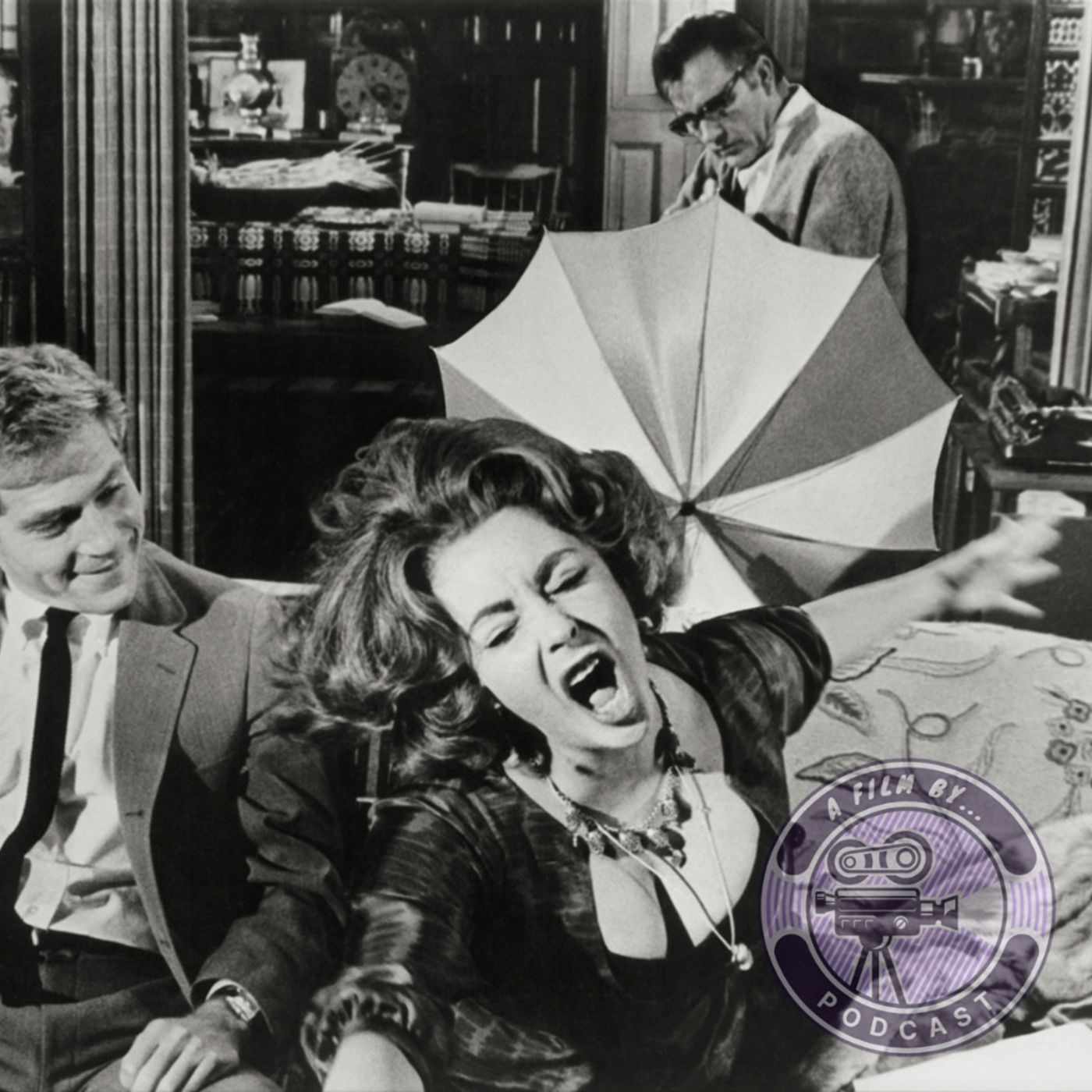
Mike Nichols - Who's Afraid of Virginia Woolf?
Episode Transcript
Robert.
We've been friends for a long time and we know a lot about each other.
But I don't think I've ever asked you this question.
Have you ever attended like an awkward dinner party or an awkward get together where you were just like, please, dear lord, let me find an excuse to go home.
Speaker 2Every family Thanksgiving ever, right.
Speaker 1Like, my family doesn't get that bad, Like they'll kind of flare up and then it'll calm down, you know.
Speaker 2No, No, we would see the relations that we would only see once a year, and inevitably that it was booze, and my uncle would become more and more charming and whimsical, and my mother would get more and more hostile toward one of her aunts that she despised.
One year, she threw a gim ledge into my aunt Lee or her aunt Lea's my great aunt les face over an argument and said, you've always been a badge and you're a bitch.
Speaker 1Now I've always wanted to do that, but not so much to your aunt.
Speaker 2Well, I know it, well, I mean Lee was a bitch, but anyway came in.
But no, they are well the good preparation for a movie we're gonna talk about today because it was a very similar vibe where it's like whimsical and funny.
Oh my god, now the knives are out.
It did.
Yeah, so yeah, Thankgiving.
Always every time.
Speaker 1Something about that turkey comes out, there's too many knives on the table.
I don't know, as you said.
On that note, let's talk about a film by Mike Nichols, his nineteen sixty six underrated film Who's Afraid of Virginia Wolf.
Welcome to be a Film by podcast.
I'm Amber Lewis, and I will be your host for this episode now.
On our previous Mike Nichols episode where we discussed the movie Wolf, Jeff promised me that when Mike Nichols came up again, I could pick the movie and dear listeners, he lied, as all of you do.
Our regular host Jeff Johnson.
We love him, but he loves to make me watch movies that are uncomfortable and make me cringe, and this one is no exception.
So joining me to discuss the worst dinner party in the history of dinner parties is our expert in all things Disney, Broadway and classic films, my dear friend, Robert Burnett, So welcome.
Speaker 2Robert Buckle Oh yeah, I guess we got two of the three.
I mean, although we could count Disney if we thought that the Who's a Fate of Virginia Wolf was really to the two Who's Afraid of the Big Bad Wolf like it was supposed to be and not whatever they used and did.
But yeah, sot my got my Broadway down, got mailed movies.
I'm in hog heaven for this one.
Speaker 1I knew you were gonna just be chomping at the bit.
So now, this was my first time watching this film, and honestly, I had like literally actively avoided it.
So I've now watched it two times.
Speaker 2To your opinion change?
Did your opinion change?
Speaker 1I did enjoy it more the second time, but I still had a tummy ache.
Speaker 2See it's funny the first time I saw it, And that was what I.
Speaker 1Was gonna ask you, is this This isn't your first time.
Speaker 2A million times?
My first time I saw it, I like laughed my ass off and thought it was the funniest thing I'd ever seen.
And then I watked it again a few months later and I all of a sudden, I was like, this is horrible.
These people are monsters?
What is that?
I was like, like, stop stop doing it to each other.
And that's one reason why I really love this movie is because I take away different things every time I watch it.
So I was wondering when you said it.
I didn't know it was your first time.
Yeah I would if you're second all of a sudden, if you kind of flipped and went, oh, well, now that some of the parts are funnier and some of the parts are sadder, or how it went.
But yeah, I fascinating.
I had no idea.
Speaker 1Yeah, it was definitely an experience.
So now it's also it's based on the stage play written by Edward Alby.
So have you seen the play?
Because I feel like it would be different.
Yes, I have a person.
I don't know if it well for better or worse, But.
Speaker 2I don't know.
You're getting all my bullet points early.
I love this.
I did see it in a production that just about blew my face off.
I will tell you the cast.
It was going to Jackson as Martha, John Let's Go as George, Cynthia Nixon was Honey, and Brian Kerwin was Nick.
Directed by mister Edward Alby himself.
This was in nineteen eighty nine at the Huntington Hartford Theater, which is nice because in Los Angeles that is the small theater.
It would have been lost in the big barns like Yama San and where they do the oscars and all that, and it wouldn't have worked.
But my hand almost flew off when I thought I'd already decided.
Gwen to Jackson was probably my favorite at the time living actress, and to see her in this, I gotta tell you it was weirdly not great reviews.
It was just very which which I think everybody was expecting so much more.
But I've got to say, Glenda perfect American accent, and oh my god, when she got to lines like I am the earth Mother and you are all flops, like the entire audience was scorched.
It was like it was like you couldn't and and Ligo was was just it was He's completely his own take on the role.
But he had that same blend like usually Will that Burton did, where he can be meek and and and and mousey and put upon and then all of a sudden kind of stand up straight and just become this like like you know, strong in charge.
And so they were both perfectly cash and I just loved it and say, only only production I've ever seen of it.
But but what a way to go?
Speaker 1Did you like it live better than on film?
Speaker 2Well, it was one of those weird things.
I had seen the movie at that point a billion times.
This is the movie that that my friends and I at the time and Stephen and I since since, because I saw it before I've ever met him.
But we quote this movie all the time.
It is so quotable.
And it took me about fifteen minutes get into the production because I kept hearing the film yeah, and I was like, that's not right, that's not right, not wrong inflection, No, no, that's not but to be funny, and so I was kind of like resisting it, but then I kind of gave over to it and it was great, and it was I mean, the movie is very very close to the playscript.
I mean it is not one of those adaptations where they just said, oh, we'll keep the premise and we'll bring in some after characters and we'll like have a scene, you know, with thirty other characters.
Like.
No, this is a very well done transfer of play to screen.
So seeing the play did not really change up much about it it, which is neat to see a different interpretation of some of these same characters with different different dynamics and different you know, kind of kind of power plays going on than what I saw in the film.
Yeah.
Speaker 1I always feel like it's a little bit like when you've seen a movie a million times at home and then you get the opportunity to see it in a theater with an an audience, you know, the rest of the audience, and they're laughing at things that you never laugh at, and you're like, what, it just brings a whole different, you know, kind of experience.
Speaker 2Or if you're me, you laugh at things no one else does.
I tell you a little and then like the entire room is silent.
I've like made this like big laugh and it's I own it.
I don't care.
You make them think about it later, right exactly?
Speaker 1To talk about dinner?
Speaker 2What does that mean?
Speaker 1Three bits of trivia facts about our director Mike Nichols and a quote from Mike Nichols.
Richard Burton, who in his private diaries is frequently scathing about his colleagues and just has no qualms about ripping them to shreds.
He writes glowingly about Mike Nichols.
Professionally, he believed that Nichols was one of only three directors who brought out something in me as an actor which I didn't know was there.
And on a personal level, thought Nichols and Noel Coward were the only men of talent whose company he actually enjoyed.
Speaker 2Wow, I'm not surprised.
I mean, Elizabeth Coward, like, hello, Elizabeth Taylor asked to have Nichols direct this.
It was his first film, and it was on account of she wanted him to do it, So I'm sure.
I'm sure Richard had something to say about that too, But.
Speaker 1I mean, luckily they thought about everything else.
It's good that they agreed on him.
Yeah.
I know we talked about this on our Wolf episode, but I have to bring it up again because so dagone impressive.
Mike Nichols is an egot.
He has four Emmys, one Grammy, one Oscar and eight Tonys.
Speaker 2Like he also had no eyebrows.
Is that is that in your trivia?
Speaker 1That is not in my trivia.
Speaker 2He had alopecia, but yeah, yeah, and he had no eyebrows and he started wearing fake eyebrows back when he was working with Elaine May and kept him up till till almost the whole of his life.
Speaker 1Hey, you got Diane Sawyer, So there has to be something to that.
Speaker 2He was wearing his sexy eyebrows.
Right.
Speaker 1He had five rules for filmmaking.
Number one, the careful application of terror is an important form of communication, which I feel like that is this entire movie for me.
Number two, anything worth fighting for is worth fighting dirty for.
I don't know how I feel about that one.
Speaker 2Number three sounds like it came out of the movie right.
Speaker 1Number three, there's absolutely no substitute for genuine lack of preparation.
Number four.
If you I think there's good in everybody, you haven't met everybody.
And number five friends may come and go, but enemies will certainly become studio heads.
Speaker 2It sounds like he must have written those five right after he directed this movie, because there's a lot of that saying kind of kind of like I have to deal with you, but I kind of hate you, but it's reciprocal.
And yeah, yeah, interesting, interesting.
Speaker 1And then I love this quote because I love and adore Elizabeth Taylor.
I think she was just fabulous, and Mike Nichols said about her, there are three things I never saw Elizabeth Taylor do tell a lie, be unkind to anyone and be on time.
Speaker 2Oh that sounds fabulous.
Speaker 1I know.
It's just the best quote ever.
Speaker 2I've got two more?
Can I throw in two more?
Speaker 1Yeah?
Yeah?
Speaker 2What is just so random?
It was one of those like cosmic universe things, right, which is like what now?
So Nichols famously directed a production of Waiting for GOODO in the eighties with Robin Williams and Steve Martin and Bill Irwin.
Speaker 1On PBS and it was so amazing.
Speaker 2Yeah, But it turns out he has an association with that play.
Before he teamed up with Elaine May in Chicago and was doing their stand up.
He was trying to be a legit actor, and he appeared in a production of Waiting for GOODO as I think it was lucky.
One of the more minor characters, and one of the two leads was Harvey Korman.
Oh my god, Harvey Corman.
Harvey Corman was also trying to be like a legit serious actor and Mike Nichols was trying to be this legit serious actor.
So they appeared in the production of Waiting for GOODO in Chicago in nineteen fifty seven.
I want a time machine and I want to go back to see Harvey Corman in a Beckett play.
I just without like a funny accent or boobs or you know whatever else he needed to do to make it funny.
That just blew my mind.
I was like, this is the kind of weird trivia that it gets me excited.
The other one though, and putting on my Broadway hat for a minute.
Nichols, as you mentioned, it is an egot.
He has a bunch of te's in that egot, Tony, Tony, Tony.
But he was also really famous in the biz for being a show doctor, which is basically somebody who isn't really a writer or a director or involved with the show at all, but swoops in when they're having trouble and says, here's what you need to do.
Boom boom boom, you're going to have a hit, And then they do those things and they have a hit.
So he's most famous for taking the musical Annie from this ridiculous hot mess that was not working and had all kinds of problems, and he came in and like Mike Nichols did, and said, no, we're doing this, We're doing that we're changing this, we're changing that.
Here's what you're going to do.
And of course it opened and played for years and you know, everybody in America can sing tomorrow.
But he also did that for My One and Only, which is a fantastic Gershwind musical, and lots of other shows.
They would just call him up and say, Mike, we got some problems.
The funny part of it is a lot of show doctors do it out of friendship.
It's in the theater community.
I'll help you out, and you're gonna come and help me out whatever.
Mike Nichols always got paid for it, even though he was not credited.
He made sure he was always paid, which I think was a little window into his mind or his life that that, oh, he would help, he'd be a pal.
But he also, you know, had a contract.
Speaker 1Yeah, shrewd, very shrud.
That's awesome.
I did not know that.
Speaker 2All.
Speaker 1Right, here we go.
We're getting into it.
As I mentioned, this film is about the Dinner Party from Hell.
So Robert, can you give our listeners who may not have seen or heard this film a little more informative synopsis than just you know, it's two hours of misery.
Speaker 2Certainly it is a George and Martha sad sad sad anyway.
One of my favorite quotes from that I said it all the time anyway.
The film is set in a small college town.
George is a middling professor married to the president of the college's daughter, Martha.
Keep those mind names in mind.
George and Martha, they become symbolicalator in anyway that they are been married for some time, they are discontent that they, like many longtime married couples, they have their moments, but they're they are to kind of over each other at this point in their marriage.
She in particular things that George should have made more of himself.
She, after all, is the daughter of the president, and uh, George, she feels is done enough to be running the school.
As she says, you are in the English department.
You should be the English department anyway, in her emphatic way of speaking.
And they've come home from this ghastly party that we did not see, and as he's winding down and getting ready to go to bed, she announces, oh, no, no time for that.
Makes some drinks.
We've got guests coming over.
She has invited two young people.
They don't actually have names.
We never learned their real names.
He is known by conventionist Nick.
I think it's in like the play text, but he doesn't name's never given, and she is called Honey.
But we don't know their names.
They're just this younger couple.
He is in the math department.
Well he's not in the math department.
Martha says he's in the math department.
Anyway.
Turns out he's actually in the science department.
But anyway, they are coming over for a night cap because Martha has invited them, and we spend their red to the evening more or less in real time with them.
Over the next couple hours, as they drink and drink more and drink more, and all four people start to kind of unravel and show their their other side and what's really going on.
And there are shenanigans and high jinks and party games, lots of party games, my favorite, the well known named hump the Hostess, But anyway, that one comes after get the guests and before bringing up baby.
But anyway, party games and lots of drinking and animosity, and after many hours of arguing and recriminations and the secrets revealed, everything kind of explodes and Nick and Honey are finally dismissed, and George and Martha realize it is dawn and have to begin another day in their marriage.
Slow curtain the end.
Speaker 1I love the first five minutes, but then after that, I'm like, why are these two people still married to each other?
Just save yourself and run away.
Speaker 2You can see it all through though.
That's one thing I love about this movie is especially in the first five minutes, which is so brilliant because it sets it all up.
But they are affectionate and and they do they have got which probably Burton and Taylor Bills brought a lot of their own relationship along with fast that they're both amazing actors.
But I just totally bought this is a couple who've been together forever, and they go off into their little baby talk game, and they go off into their little thing and they have that same fight they always have.
It's kind of like a fun little Saturday night tradition.
And they just I totally bought them as a long time married couple.
And and I but they were close.
I didn't I didn't think that they were you know.
Speaker 1Go ahead, Oh sorry, no, I was gonna say.
I love the whole sequence when she quotes Betty Davis and she's like, what is that movie?
And she goes through the whole scene imitating Betty Davis and describes this movie.
And that is such a real, like longtime couple argument, like you know, the one with the guy in the thing, and what I.
Speaker 2Love about that sequence too.
And I can talk about the opening sequence now, I guess rather than save it up for later, but I.
Speaker 1Think we're kind of throwing our guideline out the window.
Speaker 2Now.
That's fine, but the opening sequence to me, the first well, I mean, first of all, you've got like this three or four minute credits montage of this quiet, peaceful college campus.
It's very late at night, there's no one around except a couple walking through the dark, and we don't really see them.
And it goes on for a couple of minutes, and then you see the couple in silhouette coming to the front door, and then we do a reverse angle and it's dark and the door opens and the light switch turns on.
There are Burton and Taylor just standing there in this hideous light, just staring straight ahead.
It is such a brilliant star entrance.
I love Star entrances in movies, and this is such a great one because I mean, they were two of the most famous actors in the world at that time, they were the most famous couples certainly in the world at that time, and we get this great build up to them just like and boom, there they are, like you almost want to applaud, like during that pause they're about just.
Speaker 1You can feel like that is the moment when someone famous is in a Broadway show and they made their entrance and you lose the whole show for like five minutes.
Speaker 2While so brilliant, but then to your point, she goes off on that Betty Davis riff.
That entire bit just not only is it hilariously funny, and she's sitting there and bless Elizabeth Taylor for putting on thirty pounds for this role like she did and everything else.
She's sitting there like eating fried chicken out of the fridge, talking with her mouth full, and it's like las so George chewing on her chickens.
Speaker 1At the same time, yeah, and then eating like.
Speaker 2He's like not even listening, but he's listening enough that he keeps correcting her grammar, which I think is hilarious.
It's like the perfect red couple.
I am the George in that race.
Grammar can't help it.
Even when I'm not listening, I'm like, no, it's to whom, not to whom anyway.
But her speech where she basically ostensibly talking about this Betty Davis movie, Betty Davis comes home from a hard day at the grocery store, and he's like, what she's like, she's a housewife, she buys thing.
It's hilarious, and then she does this whole thing and it's so funny, and it's like just campy and funny and just exactly what you would think she would say.
But then there's this pause and he says, he mumbles something, and she says she discontent, and all of a sudden, she's not talking about the damn movie anymore.
She's not being her like blousy, funny self.
She is like, here's what we're really talking about now, and to me, that that is what so many relationships, whether it's with your parents or with your whatever.
It's like, I'm gonna shoot the breeze about this movie we were talking about.
But then oh wait, here's my thing.
Boom uh.
The opening scene is great and then so many more quotable lines.
The mousey little thing with any without any hips or anything.
She says about the guests coming.
I just and then and then I squeal every time.
When he's like, don't bray, Martha, She's like, I don't pray.
Oh my god.
And props for Elizabeth Taylor for making herself so just almost grotesquely unattractive, unappealing, brain eating her chicken, boobs are falling out of her dress.
Speaker 1Still the most beautiful woman in the history of the world.
Yes, she's got all this makeup on.
Oh you know, a wig that's grey, like she had put on weight, which even with extra weight, like, she looks fabulous, and you're still just like, my god, it's amazing.
Speaker 2It sets up the whole movie so brilliantly, and the whole play before that, but where ostensibly they're talking about one thing, but really there's all this other stuff that's going on.
So her discussion about Betty Davis being the discontent housewife, Yes, she's trying to remember what the quote is she says when she says want to dump, But also she is now introduced like, here's our theme of what tonight's going to be about I'm just content that that's our topic.
We can call it Betty Davis, we can call it, you know, whatever you want.
But here's what's going to really go down, and it does.
It sets up the wreck of the movie so well.
Speaker 1So now I have a question for you because this has bothered me through both like watchings.
So you get through exposition that it's two am when the first party ends and they come staggering home and they're already blotto.
So my question is to Nick and Honey, like, who agrees to go out for a nightcap at two am?
Like what sort of self destructive, like kind of wanting to be beaten kind of people are these that you already have read the room and know that these two are a hot mess from the party you were just at because their behavior was disgusting there.
So why in God's name do they go?
Speaker 2Well?
I amber the reason is because, as we learned about all the characters, nobody's what they seem us at first.
Nick is super super ambitious, and she is, as we hear often, the college president's daughter.
And he knows that if the college president daughter says, come have a drink and it's freaking two in the morning, and everyone's already slashed.
You go and you, you know, suck up and you kiss her button, you defer, and you because well, think about how deferential and also flirty he is in the beginning with her.
Speaker 1He is disgustingly flirty with her.
Speaker 2At the beginning, and then and under the under the guys probably of oh we're all a little tipsy, ah flirty thirty, your husband's right here, there's my wife.
It doesn't mean anything, right, everybody in this movie is is in some way or they're kind of despicable and although also entertaining.
But but he is just career minded.
And I mean he married he marries Honey.
Spoilers alert for everybody listening.
If you haven't watched the movie, pause now because we are already.
But anyway, yeah, he already we already learned that that he married Honey ustensibly because she thought she was pregnant, but in actuality because her family has a lot of money.
They mentioned that that that her father has money.
So Nick, yeah, I.
Speaker 1Was so focused on the hysterical pregnancy thing.
Speaker 2When he and when he and m and George are having their little hell they did the round robin thing in this the only thing we don't really get is a really good scene, a long scene between Honey and Martha, which would have been great.
But we have, like, you know, the different pairings.
Speaker 1Of I don't know, I couldn't handle George being mean to Honey.
I don't think I could have handled Martha just eating her alive in little tiny pieces.
Speaker 2Oh well, okay, we have we have different different takes on Honey.
But no, I think I think Nick is just super super ambitious and if he need to help the hostess to get a promotion, he'll do it.
Speaker 1Oh that just makes him even more gross, Like already didn't like him.
Speaker 2Do you love?
Though?
I mean when I think of George Siegel, I think of I guess, late period George Siegel what I amused to seeing, where you know, the sweet little Jewish man, the comedian even.
Speaker 1On like he's and is he's the the schmo and look who's talking that gets Kirsty ally pregnant and he's such a jerk.
Speaker 2Yeah, but but he like I mean, I think that's all I can think of.
Well, he was on that I think it was called Just Shoot Me.
Maybe there was a sitcom with him and David Spade and some other people.
He'd been in a lot of things, but he almost always, especially the older he got, which is very comical and very lovable and twinkling and and comical, kind of leaned more into the Jewish thing, which he kind of did not do in early in his career.
And and but in this it's like I forget that early on he was really more of a dramatic actor than he was a comic actor.
But he found a groove and went there, you.
Speaker 1Know, yeah, for sure.
Well, let's take a quick break and then when we come back, we'll get even further into the cast and talk about the production and talk about some noteworthy scenes.
Speaker 3This episode is brought to you by the Mayroe and Co.
Dog Treat Bakery, a full service bakery for your dogs, providing classic treats, cookies, doughnuts, custom cakes, and more.
Their treats are baked with only the highest quality, locally sourced ingredients.
Baking just a pound of treats at a time ensures that their treats are the best and the ones your best friends deserve.
Speaker 4Mayroe and Co.
Dog Treat Bakery has been treating Cincinnati's dogs to tail wagon goodness since twenty twelve and now they're available online at Mayroanco dot com.
Speaker 1So welcome back to our discussion of Who's Afraid of Virginia Wolf.
Let's continue talking about the cast.
There's only four people in the whole movie.
I don't count like the bar, center, at the at the pub they stop at, because they don't do that in the play, right.
Speaker 2Their whole play is in their living room.
It's one set.
And that's one thing I think Nichols did, because he is our raised debtra for this episode.
Mike Nichols just made this what could have been stagey one set play so filmmic.
It is just you don't ever get this viewing that you're you're trapped in one room with these people.
I mean partly because they did set up the device of zooming off to the roads, roadhouse or whatever it was with the jukebox or whatever, and then coming back and then they film one of the scenes is outside or in their backyard or wherever, but even the scene so in the house, Nichols just keeps the camera moving and the editing going to where he You do not feel like you are watching something that's going on behind the proscenium and you're like oh god, are we ever going to get out of this room?
But yeah, and weirdly more trivia the I learned this today when I was reading up a little bit more on it.
The guy at the roadhouse and the waitress or barmaid or whatever she is, we're actually that that's the gaffer and his wife.
They just like they were just like somebody come in here and carry a tray of glasses and you come and yeah, so they did.
They just did that, but yeah, only only for four actors.
Speaker 1And talking about the way Mike Nichols shot this, I am not a big fan of super duper close ups.
They make me very uncomfortable.
And but the way he uses them in this movie to make you uncomfortable, I think is so amazing and to make sometimes it makes the character vulnerable, sometimes it makes them uglier.
Sometimes you know, it makes them harder.
It just kind of depends on the angle.
I thought that was really really well done.
Speaker 2I love how he uses individual close ups and then sometimes who'll have like two people in a shot.
Yes, that whole sequence where it's all starting to unravel near the end, and all of a sudden, poor Nick is like, I don't know a few people are lying or what.
And then all of a sudden we cut to this shot and it's been a lots of like on one head, one head, one head.
He said, I don't know if you two were lying or what.
All of a sudden they're George and Martha side by side in the shot and they're like, you're damn right, you're not supposed to and it's like bam, they've like teamed up literally in the shot on him.
And then there's a great follow up where George says sorry, Nick says something about like, oh, and your parents were there?
Was that after you shot them?
And we see only Burton in the shot, only George, and he says maybe, and then all of a sudden, up pops Martha into the frame and goes yeah or maybe not.
And it's like these two have got like this like two for act going.
That is so brilliant.
And then those scenes would not have played the same way if you'd been doing justice close ups or just like a master shot or something.
And then that great.
I just love the cinematography of this and the filming that great.
The only time we really get a big master shot the very beginning of the party, when they all sit down on the couch and they're kind of yacking a little bit, and George is hovering in the background.
And then at the end when like all hell is broken loose and they're getting ready to leave, and what was the but Taylor crying her eyes out and it just snap dragons or all over the floor.
It's the whole thing, I think, gladiolos.
Speaker 1But anyway, who I was gonna say this.
They're not snapchecking, I.
Speaker 2Know, but anyway, but whatever they are.
The all of a sudden we get this great master shot and for the first time in the film, it's not like you're at the party.
You're at the in the room with them, not like a straight on shot.
The camera's way up showing her sitting in the window box crying and George is hovering over her, and the other couple is in the corner kind of like trying to think, like how the hell can we get to that door?
It's only four feet away, but like help us, And we have this long master shot as all these final things are being said, and then they go into that nice shot of George and Martha in the window frame where he comes over and consoles her and they're they're having the very last line of the film, and again just so filming, it's so great to all of a sudden kind of set up the claustrophobia and the being too close and they literally are in your face yelling and screaming at you.
The party starts would have we're kind of omnissioned and detached, and it kind of ends that way where I think it partly just to give us breathing room.
At this point we are all rung out, just like they are, and like a little nauseous and a little bit.
Speaker 1Like seriously like my tummy hurts.
Speaker 2Like you want to put your drink down.
You're like, I'm never doing that again, you know.
Speaker 1Yeah.
Speaker 2But I think that that lovely second to last shot where the cameras just very removed is it's like we're backing up.
It's ending, you can you know, the franticness and the claustrophobia and the intensity it's dissipating now.
So Nichols his direction is so extraordinary, how he tells so much of the story or give so much of the feeling through where he puts his cameras and stuff, which which again with four people in one one setting, ostensibly it could be really dull to watch.
But you know, I mean did did this.
Both the play and the film had really LPs of the entire show.
You can you can get them.
Yeah, And because like literally it is a radio play, you don't need to see any of this, yeah to get it.
Albi is great, but he's very talking, but you don't need to really see anything's going on.
Ever, So the album is both sold and both work.
But but Nichols was able to take take it and make it so filmic and make it work as a movie where you were not visually bored or or you know, able to anticipate what you were going to see next.
Speaker 1Absolutely, Let's talk about Richard Burton.
He is usually like I always thinking of the movie The Sandpipers, like so romantic, so dashing, oh my gosh, like you could just fade.
And he is so like driven to his knees by Martha on so many occasions that he finally like steps to her.
At first, you're kind of cheering him on, but he always takes it too far.
Yeah, Like, and I can't get over the fact that you know he was, you know, just a famous drinker in the you know, pantheon of like Richard Harris and Peter O'Toole and just carousing their way through you know, the English countryside.
But he remained sober during working hours because he said, like he you can't work when you're falling apart, Like I can play drunk, but I can't be drunk and play like it just doesn't happen.
Speaker 2Since I saw on one of the Bonus features things that they were showing some behind the scenes footage, and I was like, what is going on with Burton?
What is happening?
Because he's standing there and he's listening, I think probably to Mike Nichols.
I forget who siderable people in the shot and he's standing there listening, and You're like, something is not right.
And I'm not going to say that he was like swaying and anebriate, and he was not.
But all of a sudden he go to step up in front of the camera and his whole posture just crumpled, and I was like, oh my god.
He was like when he was listening and not acting, he was like standing up with this great posture and looked his head up and like they said, well film and it was like this beaten down man who like aged ten years walked in front of the camera and I was like, oh my god, I mean it was it seems like it should be obvious, but I was like, he's doing so much and his power in this because he is so beaten down for so much of the movie.
When he starts to kind of get back his power and flips the switch on poor little uh Martha Burton, I mean, did keep that camera on his face and you can just see the thought process and the evil evil glints and and the the you know, I mean just.
Speaker 1Every time he's listening to Nick and Honey, you can watch him filing away all this information that he is going to use to just destroy their lives later on.
Like Martha, I think is more like she shoots from the hip.
I don't think she's as calculated as he is.
She's just so quick that she can just nail you, you know, without having to really work at it.
Where he is constantly like preparing and sifting through everything you've said for the thing that he can devastate you with the most.
Speaker 2That that is one criticism that this movie and play of both received was that exactly to your point, George and then also Nick, the men are very shrewd and calculating and smart and and and and whatever you want to call it.
And Honey and Martha are just emotional.
They're not and and and so the people are acute albion in another plays too, of being very kind of sexist, where the women are reactive and emotional and and and the men are smarter and in control and and and and thinking ahead and in that kind of thing.
And it doesn't.
Speaker 1Didn't think of it that way, but that does seem to be a fair criticism now, and it also.
Speaker 2It sets up the wonderful fan theory.
I keep waiting for someone to write the play, but I love the fact that that in Nick and Honey because of that, because the men are both playing the long game, so to speak, and listening and really carefully and gathering up all all their little bits of knowledge they can use against somebody later, and the women are just kind of like whenever, I'm just you know, in my moment.
But the idea is that with Nick and Honey, what we're looking at is a future George and Martha put twenty years on them, and they will be exactly like George and Martha are the same dynamics.
She's emotional and manipulative and he is shrewd and kind of playing a role.
I know it's a theory.
I don't know if I buy it either, But people people think that's like I feel like situating.
Speaker 1Maybe it could have been if they hadn't gone to this party.
Speaker 2Mmm.
I like that.
Speaker 1I think that this experience, like they are leaving changed people, and I don't think they'll ever be alone in a room with Georgia Martha ever.
Speaker 2Again, No, no one should, I.
Speaker 1Mean seriously, And that's the thing that drives me crazy is why don't she just leave?
Like I would have gotten it the minute he brought out that freaking shotgun that gag.
Mmm, I'm out.
Speaker 2Yeah, Well, I think at that point, I mean that that is a valid question, because there's so many times where I'm like no, it's like no, that is when I'd be like, get the car, We're out of here.
I'm not, I'm not, but but are you?
I don't know.
Especially with Nick, there is this kind of mano a mano, like the two rams butting their heads sing right, feel like as long as George's game, Nick is gonna keep pushing at him and they're gonna see who's like the real the real man in in this.
You know, I don't know perhaps.
Speaker 1Well, and I do keep reminding myself and I was trying to keep track and I always lose track, but like, just how freaking drunk are they?
How many drinks do they have?
Speaker 2Like I was.
Speaker 1Trying to keep track and I kept getting distracted and then I'd lose count.
But I mean they're like half a Battle of Brandy in, you know, halfway through the movie, and I mean I would be in the hospital.
Speaker 2Well when George does break the unbottle though, so you know, at least we were spared that.
Speaker 1Yes, did you love?
One of my favorite things when they come back from the roadhouse, there's a whole sequence with Elizabeth Taylor just kind of walking through the house and she's looking, She's like, where did everybody go?
And she's looking for them, and she walks out into the yard and the whole time she's carrying her drink and you just hear this incessant clinking of her ice cubes.
I don't know why I am so fascinated by that, but that whole sequence, I was just like in it, and it had to do with that that sound effect, you know, was just so effective, like this this ghost rattling through the wreckage of this party.
Speaker 2That is hilarious because I'm thinking about it.
You don't usually hear the ice cubes through the movie, but you hear them then for sure.
Speaker 1I love Elizabeth Taylor.
I think she is absolutely amazing in this role.
To play twenty years older and unattractive and hateful.
Speaker 2Well, that's the thing is, she did nothing to make her character.
None of them did but likable.
There was no but y'all know, I'm Elizabeth Taylor.
Wink wink.
It was like, no, she was a virago.
She was just shrill and loud and braying and everything else.
And it makes me a little sad because so much of her career she spent just being kind of the pretty object, you know, and it was like.
Speaker 1A place in the sun where she's like the trophy, this beautiful.
Speaker 2Yeah, And she was absolutely that I got she was stunning.
But she had so much depth.
I mean, I think this is probably by far my favorite movie of her in terms of her acting and her range, because she gets to do so much.
Speaker 1Now, we talked about George Siegel a little bit.
Sandy Dennis.
How do we feel about her?
She makes me crazy?
And when I see the list of actresses that played Honey on stage, you know, like Carry Kuon and Cynthia Nixon and you know Imma Jeen Poots, I'm like, anybody else?
Does she make you crazy?
Do you like her?
Speaker 2I don't like her, But by the way you left off the original Honey, Melinda Dylan, Oh my gosh, that's right.
Ten years later is Richard Dreyfus's a little fling and Close Encounters of the third kind talk about range like, I'm gonna be on Broadway doing Albie and then I'm going to be in a Spielberg movie.
And I can nail.
I can nail both.
But no, Sandy Dennis gives me hives.
Basically, I mean she is.
She won an Oscar for it.
I mean that was one of the things about this movie is all four of the actors won Oscars for the movie.
I mean it, it was kind of it was nominated for thirteen and won five and but all four and I just I mean the sifty when we started doing Kookie and Weird, that's why we got Nickel, Jack Nicholson and and al Patino and a lot of those actors who were not a movie star handsome or classically trained.
It was these kind of more real people.
But I I, yeah, I I I liked her when I saw her in this, even though the character is annoying as fuck, but you know, liked her a lot.
But then I saw her in like two other things, and I was like, oh my god, that's just her.
She just like she's not inhabiting a role.
She's just this weird KABOOKI.
Speaker 1Is the same way, yes, yeah, where they just like show up and are weird and twitchy.
Speaker 2And or do you mean Jennifer Chilly?
You mean no, Meg Tilly.
Jennifer Tilly is a national treasure and I.
Speaker 1Love Yeah, but they're talking against her.
Speaker 2Okay, I just want to make sure we were on the same patient.
Speaker 1But yeah, Dennis.
Speaker 2I'm told it was very very effective.
I think she I think she has a tony for something else.
I mean, she was.
Speaker 1People love her, not me, No, But then I wondered, like, Honey is annoying, but I feel so I hate when George turns on her, when he rips her apart because of the baby and just starts taking all this information that he's gathered and just completely eviscerates her.
I hate it so much because it's I'm like kicking a kitten.
There's no challenge there, there's no you know.
I think it is spiteful and mean just for the hell of it.
Speaker 2I think it's more to get at Nick more than it is to do a faft Honey.
And and and let me.
Speaker 1Hope doesn't care.
Well, no, he doesn't get as mad as he should.
Speaker 2No, But the that's the thing.
I mean, George and Martha are super loyal to each other.
You you know, you can, they can ripeat o the guts out.
But you do not get to play that game that is that is just for them.
You are not worthy.
But I I like to believe Honey seems like she is the only one in the film who has had a drink, and and obviously far too many.
She is super like drunk and weird all through.
And I like to believe that the next morning she's gonna wake up and and have a horrible headache and and and a dry mouth and and and turned to Nick and say, did we go to that those people's house last night?
Did we have fun?
And he was like it was fine, dear and she's like, Okay, that's why I'm hoping, because yeah, that was that was a lot that George unleashed on her.
I also wonder too, because I believe these people are all real.
I wonder George just was so frustrated with Martha that he was just lashing out, like at anybody and everybody, you know, without without his usual calculation and stuff.
He just was just being he just kind of his Yeah.
Can I talk for a minute about about the screenwriter?
Oh yeah, since we're ostensibly in the cast and crew portion of the year, I know, sorry, death outline, there's no outline with us now anyway.
The no, it's that Ernest Lehman was the screenwriter for this.
Now.
What I love about Ernest Lehman is he made like twenty movies and all but one he adapted a stage play into a movie.
So he was known famously in Hollywood as the person who wrote exterior George and Martha's House in between all the dialogue because he never changed the dialogue really, not ever, very very rarely he did.
He was mainly known weirdly for musicals.
He he he took The King and I and then West Side Story, which we've talked about, and then the sound of Music and then Streisand's Hello Dolly.
All of those were screenplayed by Ernest Lehman, which basically may meant take take the play and just write some directions for the camera on the page and something else.
Now West Side Story, he did come up with the ideal that was also Robert.
Why is the director switching some scenes around?
Speaker 1Robert Wise has his hands all over the place.
Speaker 2Yeah, so so that.
But but but Lehman was basically was the go to guy for we have a smashed Broadway show, how do we make this a movie?
Handed to earn it, till write in you know, exterior day, uh, you know whatever.
But but but he did write one screenplay entirely on his own.
It was his own idea and he wrote it himself.
And that was north By Northwest.
So if you're only gonna have one movie that you remembered for your movie, I'm like, where he got this?
I have no idea.
But Hitchcock loved him.
He also worked on Family Plot too.
I forget if he got credited, but he worked on the last Hitchcock the Family Plot movie.
But but Liam and what I love especially about himides the fact that he had a twenty five year Hollywood career just turning plays in the movies.
But was that he this movie, this lovely movie.
We're talking about black and white, four characters, dark, nasty, foul language.
It was unrated at the time, and I let him get released.
Came out in between Sound of Music and Hello Dolly.
Before that it was the Singing Nuns and the Alps, and after that it was Barbara being you know, bigger than the train Station and everything else, and then he slid this one in in between them, So I mean nothing else.
That guy was versatile.
But anyway, I crashed me up because because you can literally sit with the play in your lap and watch the film and I think, what one like, you know, fuck you turned into or screwed you?
Maybe it was turned into damn you.
You know, there's like a few little barely uh language shifts, and that's it.
That's all he did.
Was basically like the dialogue.
It's all there on the page.
You can do a read along.
But Lehman and Nichols obviously came up with the shots and the angles, along with the Haskell Wexler, who did the amazing cinematography.
But uh yeah, I can't understand the career of Erness Lehmann because some of my some of my favorite movies, and he contributed as far as I can tell, nothing.
Speaker 1But when you got a gag, you know.
Speaker 2But but you know, North Northwest.
Speaker 1Like I would forgive a lot of that movie.
Speaker 2Yeah, exactly, exactly, all right, I.
Speaker 1Want to talk behind the scenes a little bit.
So this story just completely blows my mind.
Burton and Taylor, as you have said, were like the hugest stars, I just legendary stars.
And so the story goes that it was a challenge to actually get them in front of the cameras.
They both they both had it in their contracts that they didn't have to be on set until ten in the morning, even though like most other productions, begin like a dawn, especially because she had two hours of makeup to do and she did not care.
So they arrive on set.
It takes them two hours, you know, around ten o'clock, two hours of makeup, hair, and wardrobe.
Now they're ready for shooting.
And by the time they were camera ready, now it's lunchtime.
So they'd go off for these lengthy, cocktail filled lunches and return late in the afternoon to finally begin shooting.
And when they finally did come back, they'd just ignore it all and be real nice, hey, Mike, We're sorry, we're late, you know, but we're ready.
Let's shoot.
And but then they wouldn't come back until like five o'clock.
And they had it in their contract that they couldn't work Peck six.
Speaker 2So they were the biggest stars in the world, you know, right.
Speaker 1So they'd show up, they'd get into their gear and then go drink for four hours and come back and like shoot for an hour and then they're dead.
So Mike Nichols ended up being thirty days over schedule and doubled the budget, and the studio was going to kick him off the movie, but they knew if they fired him, the Burtons would walk, so like they were hamstrung.
There was nothing they could do, and like Richard Burton and Elizabeth Taylor just did like whatever they wanted.
Speaker 2Did you read about the original cashting idea for this movie that Warner Brothers was all gone ho for.
Speaker 1I think I did, but I don't remember what was it.
Speaker 2They wanted Betty Davis as Martha and James Mason as George.
They were both longtime Warner Brothers stars.
I mean, Mason had done Starr was born, and Betty had almost her entire career was it Warner Brothers.
And they they both wanted this movie so bad.
And Warner Brothers was like, nobody, You're not going to play someone who's first scene as imitating Betty Davis because.
Speaker 1That just that's a little meta.
Speaker 2But yeah, you know, and John Crawford and dead I don't think so.
And yeah, and and and Mason I think wasn't available maybe or something, but that that was the original thought was to go with them.
And and honestly, I mean seeing this on paper, you would not say, oh, the Burton Taylor's, they'd be perfect at the shrews ugly over the hill, crazy college couple.
Like they're not.
They're not a first pick except for the fact that they have acting jobs, you know, right, But they're not.
They're not a good fit for this, you would think.
So if they want to like lay around all day and you know, have Martinez offset, I say go for it, because this movie was well worth it.
Speaker 1Yes, whatever they did, it made it happen.
Speaker 2I did want to mention it is interesting that there have been so many variations and spin offs and and spoofs of this every I mean, the Simpsons have done a spoof of this.
This It is very iconic.
But I love all all the theories about this, this play that have gone around for years.
One was said, and I alluded to it earlier, is that it was this deconstruction of modern American life, George and Martha being of course George and Martha Washington, uh, the the the the the parents, and the the old guard of the country, and Nick and Honey were the next generation and and you know, learn from the sins of the father and mother, although neither were not a father or mother.
And it was just sort of So there's one interpretation.
I'll Be laughed at it and said, no, he said, actually, George and Martha were based on some real people he knew that he thought were so horrible he wanted to put them in a play.
But and then also dogging, I'll be for most of his career because he was a gay playwright.
Was that everyone said when they in the sixties, when they saw the play, and then later when they saw the movie, Well, everyone knows that's not how real, real straight couples are.
It's obviously four gay guys.
It's obviously like this, like campy, over the top bitch fest, two gay couples having at it, which I'll be also thought was stupid.
Is he said, Well, I wouldn't have had like a pregnancy be one of the most important plot points of the entire play if in fact it was put to be four men, because that doesn't have happened.
But even the people harped onto the idea of George and Martha can't have children, so they pretend to have a child, and well that's what two men would do, I guess if they can't.
Well, idiotic, although fun fact, in the nineteen seventies there was going to be an all male version of this.
It was going to be and it got pretty dang far, and this is going to be a stage version and then I'll be a state or actually he was still alive and i'll Be heard about it and said, this is not happening.
He still has even though he's been dead for years.
In his contract to do his plays, he's very specific about you cannot do this, you cannot do that.
He really wants this thing to be thinking.
But anyway, this nineteen seventy production.
It was going to go to Broadway, they had financing, the stars were set, everybody was ready until the author got word of it to know.
George and Martha were going to be once again Richard Burton opposite Henry Fonda, and the young couple was going to be Warren Beatty and John Voight.
Warren Beatty was going to be uh Nick, and John Voight was going to be Honey.
They were all for it.
It was actually Henry Fonda's idea.
They were gonna just and allb was just like, this is not happening because my characters are not all men, two of them are women, two of them are men.
And in fact, to this day there has not been an authorized legit production of this with anything except two men and two women playing our four characters.
But I thought that was kind of fascinating.
But and I love all the different interpretations of what this play is really about.
What was really about the decline of America.
It's really about gay couples and how they get bitter they don't have kids or whatever.
Yeah, frankly from a gay man, blessing no kid, just saying.
Speaker 1Anyway, the saren well.
Speaker 2God knows today especially but anyway, Yeah, but but no, that's really about all I've got for that.
Although, and then one of the fun fact about the play itself, because the movie got all the Oscars and all the acclaim it was the first film to have the entire cast nominated.
One of our other favorite Sleuth, also falls into that category.
And do you know what the third one is?
There's only been three in film.
Speaker 1History to have the whole cast.
Speaker 2Yeah, the whole cast nominated.
Speaker 1No, I'm always stuck on you know, there's the movies that got like the top five pictures screen Yeah, played director, So no, I don't know what the other one is.
Speaker 2Yeah, the third one's kind of idiotic because it was a filmed like thing, but it was in theaters.
Give them hell Harry, which I think it was James Whitmore, one of those actors playing Harry Truman in a one man show that they turned into a movie.
So but but yeah, this one all four.
But this play was up for a Politzer Prize nomination and was going to receive it, but the political committee was like, ew, it's just so nasty and ugly and they say bad words.
No, so they did not give an award for drama that year.
Even though the committee had said, this is who we vote for, this is the best play.
The Politic Advisory Committee said, We're just not going to have an award this year.
I'll be showed them.
Though he got three more in his lifetime than for three later plays, like one every decade as long as he was around.
But no, I think that that's oh I got I could I could, you know, quote this movie all night long.
Speaker 1But on home, let's discuss some noteworthy scenes now.
I have what I think is the pivotal moment.
I've am pretty sure that we'll agree on that.
Were there any noteworthy scenes?
Speaker 2Now?
Speaker 1We talked about the opening, which is just opening.
Speaker 2And the closing are just also brilliant, And I kind of touched on that too, with that great master shot and everybody just kind of taking your breath and winding down.
But then I love that final bit with George and Martha and and just it's it's so great because he just there's she's sitting there, he's standing with her, he has his hand on her shoulders, very affectionate and very kind and just watching her just grapple and try to understand and figure it out.
There's that he heartbreaking moment uh where she says, well, maybe we could and he's like no, and it's like the idea of you know, keeping going with the sun, and just it's so devastating and and and the camera just keeps getting closer slower and slower, and then the horrible music, by the way, the score by Alex North, the only part of the movie I cannot stand.
Speaker 1Well, it's only there for like a minute in the beginning and a minute at the end.
Speaker 2Yeah, but it's to suffer too minutes.
Yeah, thank goodness.
But anyway, if we magnet John Williams got his hand on, this would be like Marca's theme and you know, anyway, no, but then the final yes, this final shot of the two of them just kind of reconnecting, and the camera just keeps pushing in and pushing in and finally just stops with the two of them kind of clutching each other's hands, and then it just says the end.
And just such a great way.
I mean, it starts off very light and comic with her Betty Davis impersonation and the the fuddle husband only half listening, and it's very joky and funny.
Then we're like taking for this two hour nightmare ride, and then it ends on this really loving, like earned moment that that is not expected from where we started and certainly not expected from anywhere we thought we were in the middle of the movie to end up well.
Speaker 1And I feel like it also leaves you where at the beginning you could probably project where you where they're going to be tomorrow, yeah, you know, but by the end of it, they're not in the same place, and you're left wondering, like, where are they going to be tomorrow?
Like what the hell happens after they go to bed?
Speaker 2Like yeah, you know?
Speaker 1And I think that's interesting that you don't.
You thought you knew at the beginning, but you don't.
Speaker 2I get this vibe that there's going to be like one of those episodes of you know, Twilight Zone or Night Gallery or whatever, where the next day is going to start and they're going to like have some drinks and it's going to all start over, you know, you know, because they're like they're in this like time loop or something where they're just going to be like, there was no last night.
Meanwhile, how's our side?
Oh did you you did today?
You know?
And I don't know but but it is, Uh.
Speaker 1Well, so then we've kind of talked around it.
But let's talk about the pivotal moment.
Speaker 2When you called the pivotal moment, well, now I'm not sure.
Speaker 1Because I thought it was and I still kind of think it is.
The expression on Richard Burton's face when George learns that Martha told honey they have a son.
Yeah, because the rule is you can't talk about him.
But then I think right, But then I think I'm wrong, And it's actually when you find out that he doesn't exist at all.
Speaker 2Well, yeah, I think I think you're right about this.
You might be more right because the movie ultimately is about relationships.
It's about the relationship between George and Martha, as dysfunctional as it is, and mentioning the son, although breaking a rule, it's not this does not give you as much insight into the relationship as there is no damn son.
I mean, I don't get emotional every time, and it's not subtle.
But when when George Siegel is going, I think I understand, Oh my god, I think I understand.
If you're the only person in the audience who isn't caught up yet at that point, it did.
It's heartbreaking, it's so horrible.
But what's interesting about that?
So I think it is not that I think it's a catalyst for the future action because once he finds out that Martha has broken the rule, he can break all the rules.
But I think I think it did for the audience, it's revealed there was no son.
But what's interesting about this this play is that this movie is that there's all kinds of lies and misinformation, Like, was Honey ever pregnant?
Speaker 1Does she want kids?
Or does she not want kids?
Speaker 2Right?
And she has this quote hysterical pregnancy.
Well, did she just basically tell Nick that, oh, I'm pregnant, now you have to marry me and she like knew or did she actually think she would just so?
Speaker 1Well like they talk about her gaining weight, and I'm like, well, did she just put on the freshman fifteen?
And everybody's there's this whole?
Speaker 2And then was it deliberate?
Was it not deliberate once she happened?
If it was, did she and invertuately she you know, wasn't planned?
Did she did ensnare him with it?
Anyway?
I mean, so there's that whole.
Then there's the whole mystery of did George kill his parents or not, Like we don't really ever know if that ever happens.
This whole movie, like everybody is just lying out their ass about everything, and so there's there's this whole thing, and then of course you have all this subtext of he's in the math department, he's not in the math, he's in the math department.
And then when finally when Nick says, well, I'm not in the math department, I'm in the science department or biology department, and she says, are you sure?
Like the whole the whole thing is just everybody's the things they say, they're just all untethered from reality.
It's like and it's like, is it deliberate?
Is it coping mechanisms?
Are they all just pathological?
So so the Sun Reveal ought to be even more shocking than it is, or maybe I mean to say less but less shocking.
But but because everything they said all night, you don't know what's real and what isn't real, because they just say crap, and and they they will defend to their death that he is in the math department even if he isn't.
And even then they're like, and so these are four people who don't have a very good grip on reality or just don't want to, and so so the sun reveal It's it's sort of inevitable.
But it is not the only lie or half truth or or illusion that we've heard during the evening, because it's been all full of just crazy stories and things that may or may not be true.
So it's just kind of the biggest one for sure.
But yes, so so I'm gonna say pivotal moment when we ought realize and sequel that it is a fictitious child.
That is, it's like when the rugs pulled out from you and you're like what am I watching?
Then?
Speaker 1Like what is what has actually been happening this whole time?
Yeah, all right, we are going to take one more break and then we'll come back to wrap things up.
So Robert I absolutely adore My Nichols.
I think he's just a genius.
If someone was unfamiliar with this director, which three films would you suggest that they watch?
Speaker 2This was such a tough question.
But the thing about Nichols is looking over his filmography, he was so of his time.
Do you do you want all three at once?
Or you want tick turns.
Okay, I will start with probably, uh, what would be my number three?
We'll do this county backwards style Angels in THEA from two thousand and three.
It was for television, it was on HBO, but it was six hours long, so I counted as a movie and he did direct it.
And again another adaptation of a play, or actually in this case two plays, Tony Kushner's Politzer Prize winning plays about the AIDS crisis, and so much more.
Like every Nichols film, chocola block with big, big, big name actors doing amazing work.
I mean, this one had Meryl Streep and al Pacino and a host of other people.
Emma Emma Thompson was in it as well.
It is brilliant, it is dramatic, It has so much to say because the Kushner script, and it really definitely sums up the whole AIDS crisis of that era and the reality of what was going on.
And again another case where he took a very stagey, stagey play with angels appearing and hallucinations and things and made this brilliant, brilliant heartbreak film of it.
So Angels in America would be my number three.
Speaker 1That's why it didn't make my list because I don't have enough tissues to ever watch it again.
Speaker 2Don't don't start with that one because it is a lot from one thing in six hours long.
But but and so then my number two is it's a personal favorite and it's delightful in a lot of ways.
On Postcards from the Edge, super accessible and funny again.
Meryl streep uh and Shirley mcclaim her lifetime twirled up.
I want to attatoo and says it twirled up.
Speaker 1But I love it when she says that she's be sure to put my eyebrows on before I get buried.
I don't go in the ground without them.
Speaker 2I wonder if Mike Nicholas put that line in being as how he anyway, No, but uh, it's super accessible.
Gene Hackman is in it briefly.
He is hilarious, so beautiful and of course it was baked on the book by really missed Carrie Fisher, who we just adore.
Yes, and so much great about this movie.
An incredible Nichols is a good introduction to Nichols has one of his amazing opening tracking shots.
He was known for his like long tracking shot The bird Cage has one that took three different cameras where they fly in over the water and outside of Miami Beach and then it goes through the crowd and then they go into the club and it's like, yeah, well the post trids from the edge.
I forget how long it is.
It's like seven minutes or something.
It's like this ridiculous, endless, lengthy tracking shot.
Then the punchline is it gets screwed up at the end, and Hackman's like, tat you fucking do it again?
So he was kind of even mocking his own film excesses.
But a great love letter to movie making and also the mother daughter story and one of my favorites in all all ways.
But definitely a good, a good Mike Nichols movie.
And then finally for my number one.
Much as I love this movie, it is is you know, Amber, It's a tough nut to crack.
I advocated as being one of my favorite movies always and everybody should see it.
But I'm gonna run with the graduate, which was super obvious.
It was his next movie after this one.
Between the two movies, they got twenty Academy Award nominations.
Whatever, even though it is so set in the nineteen sixties and that whole time period and that whole you know plastic U you know one, yeah, plastic mindset.
It introduced the unknown Dustin Hoffman and another great cast, another great script the time by Buck Henry and very funny and again very very accessible, but very much Mike Nichols movie, with the same kind of ambivalence about some things and the same kind of sharp satire that almost goes too far, but it's still totally believable.
So I'm gonna say, Graduate, Postcards and Angels in America.
Speaker 1All right, that is a great less Now I still stand by my choices from our episode on Mike Nichols movie Wolf.
But I get to make another list because this is my show.
Speaker 2So what was the same list or different?
Speaker 1It's it's different.
I can't remember.
I'll I'll listen to it, and I know that one is the same because I can't not have it.
So but to this list, I have changed a couple around.
Uh.
From two thousand and one, Emma Thompson kind of became his muse for a little while, and they did a movie called Wit based on the play by Margaret Edson, and it's the story of a professor who reevaluates her life after being diagnosed with terminal cancer.
And it's almost like a one woman play.
There are other characters, but it's really Emma Thompson's show, and it's devas statingly beautiful and she's just amazing.
Speaker 2She co wrote it, adapted it.
Speaker 1I guess I should say yeah.
From the play, and then from nineteen eighty six, the movie Heartburn, starring Meryl Streep and Jack Nicholson, based on the book by Nora Efron, telling the story of her marriage to Carl Bernstein.
And I just love Meryl and Jack in this movie, like they are just spectacular, spectacular and the movie is just so funny, and it, you know, is an early example of why we all fell in love with Nora Efron.
And then the same movie, of course, my all time favorite movie ever, Working Girl is I can't not have it.
Speaker 2On any list, Like only why I left it off my list because.
Speaker 1You know, I quote it endlessly.
I mean, I'll just burst out six thousand dollars.
It's not even.
Speaker 2Leather now I have I have to kind of junk Cusack and Sigourney Weaver, everybody.
It was just amazing.
The the line where Sigourney Weaver's character says, spray me down Pet.
Is that in the movie or is that just in the trailer?
Speaker 1That's just a tailor.
Speaker 2That's what I thought.
Yeah, yeah, because I remember I saw the movie enjoyed it tremendously, but I had seen the tailor like ten times, and Sigourney Weaver slays me, and she like walks up and wants, I guess some kind of perfume or something.
He says like, spray me down pet to poor little Melanie Griffiths.
And when I sat and watched the movie, I was like, where's my line?
Speaker 1Where?
Speaker 2But then and then, of course over the years, I kind of had forgotten whether it was in the movie.
Movie Okay, yes, I was kind of picked that one too, because it's one of my favorite Mike Nichols movies and also one and probably probably not my top ten, but probably my top hundred, and so much great about the movie.
I knew that I knew you were going to pick it.
Speaker 1Yeah, I was like, oh, and I love This was the first time I remember seeing Harrison Ford kind of playing well, honestly playing a character that is probably more like who he is in real life, where he's kind of like this nerdy, kind of schlubby guy.
He gets like, you know, mayonnaise on his chin when he's eating you know, his peta, and you know he's kind of dorky, but like he's a good guy.
And that was amazing to see.
You know, Han Solo and Indiana Jones like be just this kind of nerdy Wall Street guy.
All right, let's go back to uh, Who's Afraid of Virginia?
Wolf?
Do we recommend seeing this film?
So I'm gonna say, if you want to see the most amazing performances by Elizabeth Taylor and Richard Burton and you want to know, like what is the US all about?
With these two, like, definitely watch this movie.
But I honestly I will never probably ever watch it again.
You know, they did an episode of the Office.
You talked about different adaptations.
There's an episode of the Office called Dinner Party, and it's exactly this movie only half an hour instead of you know, two and a half hours.
And I literally skip that episode because it makes my skin crawl and it makes me, tell me, you hurt.
So, you know, if you don't have the two and a half hours to watch this movie, watch the episode of dinner party and you'll know everything you need to know.
But if you want to give it a shot, it is available to rent on Prime.
It is free on Canopy with O K.
Robert.
I have a feeling you're gonna highly recommend this.
Speaker 2Well, I'm it's gonna rebut your thing about don't watch the Office episode because it does not have Edward Albi's language.
His language is amazing, and his his it's amazing, and it did not have Mike Nichols direction, to say nothing of the performances.
I mean the performance.
Speaker 1I mean, if you want to watch an uncomfortable dinner party where people like want to crawl out the bathroom window to escape, then.
Speaker 2Yeah for me, Yeah for me.
For me that this is more than some of its parts.
I think this is not not a movie about an uncomfortable dinner party.
This is just like artistry all the way.
I I love it tremendously.
I would not just wholesale recommend it to everybody, though, because it is it is a lot unique and uh, I mean I have friends who are younger than me who will not watch black and white movies because they're weird and.
Speaker 1They're old, and it's like, oh my hea't anyway.
Speaker 2Whatever, Yeah, I know anyway, but but I would so I would say it's a qualified recommend.
If you are in for a challenge, if you like really great filmmaking, if you like, you know, complicated storytelling and great acting, jump in.
But if you're more of a popcorn movie person, pass this movie up and enjoy what you want to see well a lot.
Speaker 1All right, listeners, what do you think of Who's Afraid of Virginia Wolf?
Have you seen it?
Did we get this one right?
Did we get this one wrong?
Let us know on social media.
We are on Facebook, Instagram, and x Check out a Film by Podcast dot com for film and TV articles and our entire library of episodes streaming free.
Write to us at a film by Podcast at gmail dot com with your questions, comments and concerns.
We may just read your response on the show and send you some of film by swag.
Robert thank you as always for your insight.
We love having you on the show, and you can also find Robert and his husband Stephen at area festivals with their Mayrow and Co dog treats, which are also now available at Jungle gyms.
And to all of you listening to the show, following us on social media, and subscribing to our Patreon.
Speaker 2We thank you.