Why Is a Jack O' Lantern Named Jack? | The Legend of Stingy Jack
Episode Transcript
(Transcribed by TurboScribe.ai.
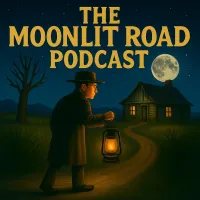
Go Unlimited to remove this message.) Night has fallen, and the moon is a glowing golden orb in the black sky.
See how it shines on the dark back roads of America, and on one road in particular.
Come with us, and we'll take a walk down the moonlit road, for the night is waiting.
And the moon is full.
Hi, this is LaDoris Bias Davis.
And the story I'm going to tell you is called, Why is a Jack-O-Lantern Named Jack?
And if you stick around until the end, I'll tell you where this story came from.
Ever wonder why the name Jack and the phrase Jack-O-Lantern come from?
Why is it once a year, we gorge out the innards of these poor fruits, yes they are fruits, carve an evil looking face and put a candle inside?
But, who is this Jack fellow anyway?
Well, down on the South Carolina coast, the low country route doctors used to tell a story about Jack, and why we place Jack -O-Lanterns outside our homes each Halloween.
As you might expect, the devil is involved.
Many years ago, an old handyman named Jack lived in a small town outside Charleston.
Jack was not an honorable craftsman, and often did substandard work.
But, he was the only game in town when something needed fixing.
So folks tolerated his bullying and shakedown tactics for at least a time.
But as competitors moved into town, offering higher quality work at fair prices, folks stopped calling on Jack.
So Jack became a bitter drunk, often seen stomping through the streets of town, hands thrust in his pocket, a scowl on his face.
People crossed to the other side of the street to avoid him.
But there was someone who saw an opportunity in befriending old Jack, and that's the devil himself.
So, the devil convinced Jack to meet him one hot summer night at a crossroad deep in the swamp.
It was there the devil made Jack an offer.
For the next seven years, he would make Jack the richest, most successful craftsman in all of South Carolina.
But after that time, Jack would agree to give his soul to the devil.
Now you may be asking, why would someone take such a bad deal?
Well, like I said, Jack was not an honorable man.
He had no intention of honoring that deal.
When the time came, he figured he'd weasel himself out of it.
So seven years passed, and just like the devil promised, Jack became obscenely rich.
His competitors had a funny way of disappearing overnight.
The townspeople were back in Jack's world of high prices and shoddy work.
Each night, Jack would be seen in the local tavern laughing heartily at all the stupid people who dared question his work ethic.
But Jack's time ran out, so the devil came calling to his large woodworking shop.
Uts benowing to the devil, Jack had long planned for this moment.
I've come to collect, Jack, hits the devil.
Put your tools down and come with me.
Jack glanced above the devil's head.
Above the doorway, a set of keys hung on a rusty nail.
Before we go, would you mind grabbing those keys so I can lock up, asked Jack.
I don't want nobody taking my tools.
The devil reached up for the keys.
Quick as a gazelle, Jack leapt into a stepstool, whipped out a hammer, and nailed the devil's right hand to the doorframe.
Howling with agony, the devil begged Jack to take out the nail.
Only if you swear to give me five more years, answered Jack.
Even the devil was more honorable than old Jack.
So he promised Jack more time.
Jack ripped out the nail and laughed as the devil stacked it away, rubbing the gory wound in his hand.
Five years passed.
Once again, the devil came calling for Jack.
This time, he found Jack at the local tavern, several whiskies in and belligerent as ever.
I've come to collect, Jack, hits the devil.
Pay your bill and come with me.
Jack wobbled off of his barstool, rummaging around in his pocket.
I'm a little short, glancing at the annoyed bartender.
Mr.
Devil, if you would be so kind as to turn yourself into a silver coin, I can pay this fine barkeeper and we can be on our way.
The devil sighed.
This man's soul, or what there was of it, wasn't worth the hassle.
But he just wanted to get him off the ledger.
So the devil transformed into a silver coin.
But as you might expect, Jack didn't pay the bartender.
Instead, he stuck that coin into his pants pocket right next to a silver cross he planted there.
The devil screamed.
His powers were gone.
I'll let you out if you promise never to take my soul, laughed Jack.
So once again, the devil agreed.
Jack put the coin on the bar and poof, the devil reappeared in a cloud of red smoke.
A man of his word.
The devil stormed out, Jack's maniacal laughter ringing in his ear.
Hee hee hee hee hee hee hee hee hee hee hee hee hee hee hee hee hee hee hee hee hee hee hee.
What the devil could not achieve, Father Time eventually did.
Jack lived to an old age but died alone in his sleep.
In the month of October, no friends or family left.
The relieved townsfolks buried him in an unmarked grave along the roadside.
But Jack didn't care.
He figured all in all, he'd been a decent enough fellow in life to earn a place in heaven.
But St.
Peter refused him entry at the gate and sent Jack back down.
As Jack arrived at the gates of hell, the devil laughed heartily.
Didn't Jack make him promise never to take his soul?
Jack had no way to wiggle himself out of this predicament.
He now knew there was a fate worse than hell.
At least there he'd have plenty of company.
But wandering the earth alone, as a ghost, unwanted in either heaven or hell, watching centuries of life pass him by, that was the worst fate of all.
He screamed at the devil to let him in.
Let me in!
But the devil wasn't having it.
He tossed a burning hot coal at Jack so he could light his way back.
Before he knew it, Jack found himself deep in the fetid murk of a cypress swamp.
Sloshing his way to town, he stole a pumpkin from the farmer's field.
He then carved out the inside, put the hot coal inside, and used that pumpkin as a makeshift jack-o'-lantern.
Jack had a more sinister mission in the afterlife.
Townsfolks spotted his lantern floating, vanishing, then reappearing in the swamp each night.
Drowning, snakebites, alligators, many gruesome fates awaited those beckoning to the dark swamp by the hellfire of Jack's lantern.
If he was cursed to wander the earth, Jack figured he'd take as many people with him as possible.
As words play, children especially were warned to stay away from the swamp.
Especially at night, when Jack would return, his lantern light bobbing playfully amongst the mist and mossy trees.
Soon the townspeople came up with a plan.
They carved their own jack-o'-lanterns, put them on their porches each year around Halloween, and kept the children occupied at home.
Repelled by the light, Jack kept his distance.
With no fresh victims, he was truly alone.
Now some people claim there's an easy explanation for that mysterious light in the swamp.
Some claim it's a natural phenomenon known as swamp gas, a wheel of the wisps, phosphorescence caused by decaying plants in the marsh.
But if you ask me, there's no point in taking any chances, for that light you see just might be Jack and his jack -o'-lantern luring you towards certain death.
You may be wondering, where did this story come from?
Why is a jack-o'-lantern named Jack?
This story combines well-known African American and Scots-Irish folktales about the origin of the jack-o'-lantern.
Irish Halloween traditions date back to the Gaelic festival of San Juan, which was a special time between autumn and winter, when the bridge between the living and the dead was most easily crossed.
So Irish people lit candles and bonfires to repel malevolent spirits.
They also dressed in costumes to avoid identification by these roaming spirits.
As they crossed to America, Irish settlers brought the tradition of carving jack-o'-lanterns each Halloween.
They also brought the folktale of Stingy Jack, a man with a habit of stiffing bartenders.
The tavern scene in our story is inspired by Stingy Jack, but the Irish version contains an additional trick where Jack asks the devil to get an apple out of a tree.
When the devil climbs up, Jack carves a cross into the trunk so the devil can't come down.
Early African-Americans in the South assimilated these tales of Jack and his lantern.
Like the Irish, they believed Jack was a malevolent spirit, having been refused entry into heaven and hell.
Many thought he was a deceased loved one.
Others described him as a hairy monster with the irresistible power to lure people into the swamp.
Over time, African-Americans created their own folktales about Jack.
Our scene in the woodshop comes from the African-American version, as does the scene where Jack is tempted at the crossroads, a very common scene in Southern folktales, including the temptation of famed blues artist Robert Johnson.
We hope you enjoyed this story from the Moonlit Road podcast.
Please tell your friends, family, complete strangers about us by rating and reviewing our podcast.
You can also find us on Facebook and Twitter, now X, at The Moonlit Road.
Visit our website, themoonlitroad.com, for many more stories not on the podcast.
This episode was adapted from folklore and produced by Craig Dominey.
Your storyteller was me, LaDoris Bias Davis.
Henry Howard is the sound engineer.
The Moonlit Road podcast is a production of The Moonlit Road, LLC.
See you next time.
That concludes this walk down the Moonlit Road.
But you can always come back on your own.
It will be here all year round, brimming with captivating and spooky tales for the whole family.
The Moonlit Road can be found on the World Wide Web at www.themoonlitroad.com.
The stories are always chilling, and the moon is always full, on The Moonlit Road.