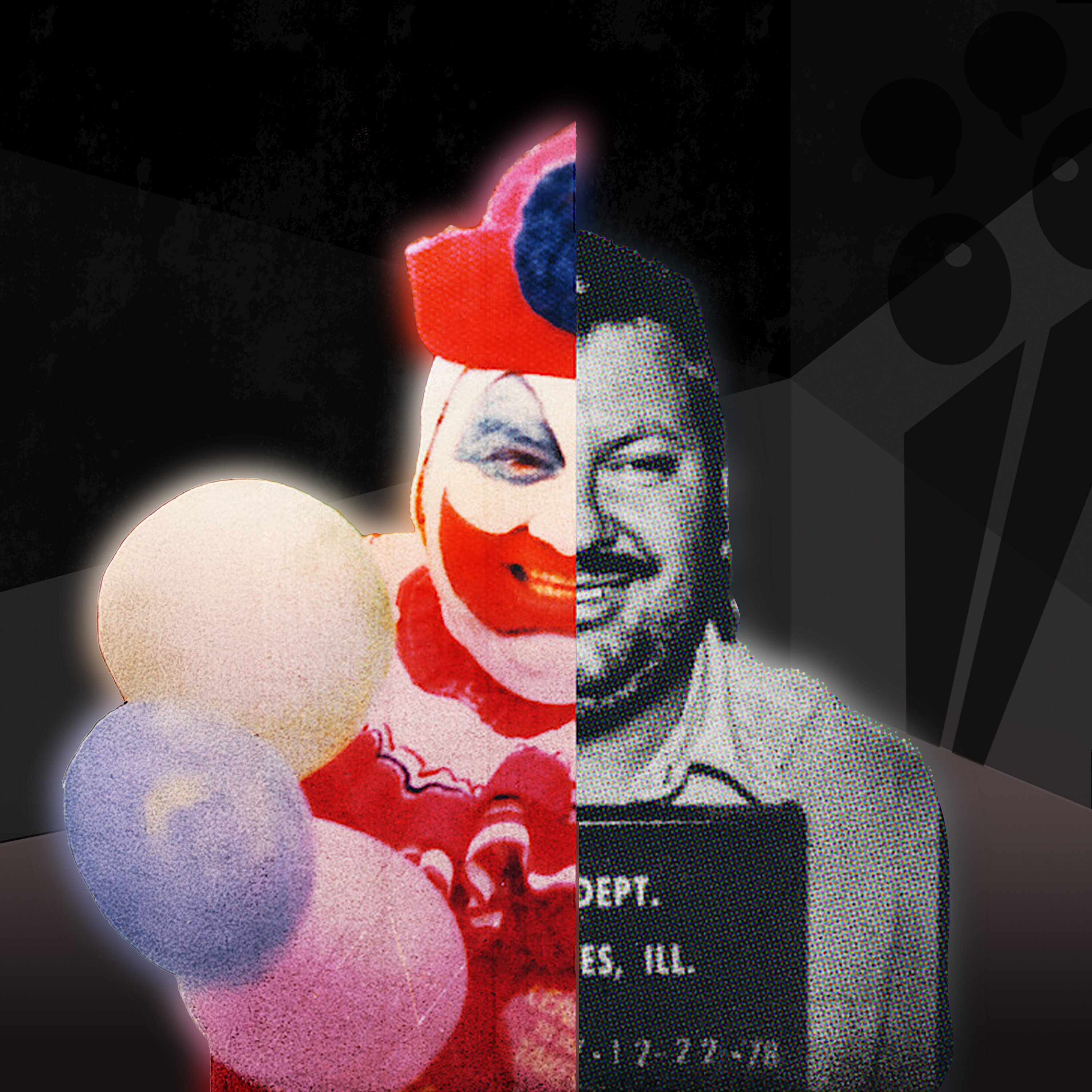
The Killer Clown Used Magic Tricks To Lure His Victims
Episode Transcript
Sixteen year old Timothy Jack McCoy spend Christmas nineteen seventy one at his aunt and uncle's home in Michigan.
After some quality time surrounded by his cousins, ringing in the new year with them, he left on January two, nineteen seventy two, planning to jump on a bus at the local Greyhound station back to his dad's house in Nebraska.
In the early hours of January three, Timothy had made it to Chicago.
It's cold, and Timothy is waiting for his connecting bus, which won't arrive for another twelve hours.
He's wandering around killing time when a man pulls up to the curb and offers him a scenic tour of the city to fill in the layover.
When Timothy says he's hungry, the man offers to take him back to his place for food.
He would never leave.
Fourteen years later, Timothy's family would receive the phone call they'd been waiting for.
Police finally knew what had happened to him.
Their relief, though, would be short lived, when they found out that Timothy had fallen victim to the killer clown.
I'm Claire Murphy and this is true crime.
Conversations, a podcast exploring the world's most notorious crimes by speaking to the people who know the most about them while he was victim one.
Timothy's story is shared in episode six of the new Binge series The Devil in Disguise John Wayne Gacy.
The story follows the nineteen seventy eight arrest of Gaysey after investigating the disappearance of another young boy under the floorboards of his home.
Buried in the crawl space or the bodies of twenty six boys and young men.
Three more would be found buried in the backyard.
One of them was known unofficially as Greyhound Busboy.
That's how Gaysey referred to him.
Officially, he was body nine, with eight bodies having been pulled from the dirt below Gasey's home before him, and it wouldn't be until nineteen eighty six that body number nine would be formally identified through dental records as Timothy McCoy.
In episode two, We Meet Johnny Sick.
He disappeared in January nineteen seventy seven.
Police are unsure what led him to come into contact with Gaysey, but they found his high school ring in Gasey's home.
Episode three, We meet Samuel Stapleton and Randy Reffert.
Samuel's one of Gasey's youngest victims.
Randall went missing just a day after Samuel.
His identity was confirmed from X rays on Christmas Day, three years after he went missing.
In episode four, we meet Billy Kindred and Greg Godzig.
Billy was a bit of a bad boy, but he'd met the girl who would help him turn that around.
Speaker 2Greg worked for Gaysey.
Speaker 1He left for a date with his girlfriend in December nineteen seventy six, but never returned home.
In episode five, we meet Billy Carroll, Dale Landigan and Robert Donnelly, one of Gasey's seven known survivors, and yes, Robert Donnelly survived Gaysey, but he's not sure why.
The then nineteen year old was waiting at a bus stop when Gasey pulled up in a black car, claiming to be a police officer.
He asked to see his ID, and as he stepped closer to show it, Gasey pulled gunn ordering him to get in, and handcuffed him.
Robert was He was actually assaulted several times in Gasey's home before he was told that he was about to take his last ride, Gaysey asking how it felt, knowing he was going to die, but instead Gasey let him go, telling Robert that no one would believe him if he told anyone about it, and he was right.
Police did take Gaysey in for questioning, However, he claimed it was all consensual, describing the encounter as a game of sexual slavery, saying Robert probably reported him because he didn't pay him for it.
Prosecutors declined to pursue the case.
This wouldn't be the first or even the last time Gasey was questioned by police only to be let go.
In episode six, we meet Timothy, who we revealed as Gaysey's first victim, John Bukovich and Robert Peaste.
In episode seven, we meet Jeff Rignell.
Jeff, who was in a happy thropple relationship with his boyfriend and girlfriend, came across Gaysey while walking to a gay bar in March nineteen seventy eight.
Gasey offered him a ride and a joint to lure him into his car and out of the cold, then used a rag so in chloroform to drug him into submission.
Jeff woke up in Gaysey's house, tied to a tortured device made of a wooden board and chains, and naked Gaysey standing in front of him.
He was then subjected to hours of rape, torture, and physical assaults.
He also claims there was another man present at some stage who also took part.
He passed out again and awoke under the statue of Alexander Hamilton in Chicago's Lincoln Park.
He told police everything, but they didn't believe him.
He took on the investigation himself and eventually found Gaysey.
Taking his details to investigators, they were slow to act, so when Rob Peacet went missing in December nineteen seventy eight, Jeff's battery accusation against Gaysey had been filed, but he was allowed to remain free.
When Gaysey was finally arrested and the bodies found in his home.
The reporting of Jeff's story motivated many young men to come forward, who all shared similar stories.
Devil in Disguise brings just a and full of Gasey's thirty three victim stories to light and the shortfall in.
Speaker 2Justice they each were handed.
Speaker 1As a director, it was Patrick McManus's job to do these stories justice, and the way in which he chose to tell them was the reason he finally said yes to the project at all.
He joins us now, Patrick, thank you so much for joining us today and for sharing your insights on the creation of your TV series of Devil in Disguise.
Welcome to True Crime Conversations.
Speaker 3Thank you still very very much for having me.
I appreciate you taking the time.
Speaker 1I guess we need to start off by asking you what allowed you eventually to say yes to this story?
Because I understand you knocked back making this series previously, so what changed for you in order for you to turn that into a yes.
Speaker 3Yeah, You've done your research.
I said no twice because I just didn't understand what worth it was going to be to do a serial killer show.
Quite frankly, it wasn't until I sort of stumbled on this idea of telling the victim's story is that I realized that there was a way into telling this differently.
It was way early in the process because I had turned it down, as I said, a couple of times, and when they came back the third time, they basically said, and these are partners of mine.
I've known them for years and years and years, both at Universal Content and at peacock, and there was what would it take?
And I said, well if I focus it not on Gaysey, And in all honesty, I thought they were going to say no.
I thought they were going to be like, sorry, well now move on.
We've asked you three times.
And when they said yes, I honestly thought they were just shining me on and telling me what I wanted to hear and then they were going to like pull the rug later and they never did.
But I will say that I had this like abstract idea of focusing on the victims, the victims' families, the police, the lawyers, but I didn't really understand how it worked until we came up with this idea in the writer's room of the short we called them short stories, where we would tell these stories that were completely taken away from Gacy at all, and that I keep saying it, it sort of fell into perf clarity, like what the show was, what the north star of the show was.
And it's weird for me to say this that it suddenly sort of became easy to break to figure it out.
So number one whatever, like sort of little spark we got in the room to figure that out.
I'm very grateful four Number two.
I'm very grateful to the studio the network for taking the chance on it and letting us explore it because it was a swing.
Speaker 1Well, can we talk about that decision, because, I mean, in making anything about John Wayne Gacy, you have endless amounts of research material.
There's the tapes that he openly admitted to what he was doing to his legal team.
There are documentaries.
There is the interview he did before his execution from prison, like, there is books, there are documentary like There's so much that you could lean on for his story.
But in choosing to focus more on the victims, that would have been more difficult because their stories and especially because Gaysey chose his victims for a reason, A lot of them were from lower socioeconomic backgrounds.
They were, you know, from the LGBTQ community, like people whose lives were not publicly available at the time.
So how did you piece their stories together like this?
Speaker 3Well, I mean you sort of landed on it.
I mean, we did an immense amount of research, and that really is always the first step in all of the shows that I've done, outside of Happy and Homecoming, you know, which didn't need it.
But going back to Marco Polo, which was the first show that I ran, like, I deeply, deeply believe in research.
And so not only did we have the NBC News team which did the documentary, which was spectacular, So we had a ton of research that was both in the documentary and out of the documentary.
That's part one.
Part two was as you said, there are there are tons of books that we were able to draw from as well that did begin to paint a picture of the victims.
Number three, we had depositions and we had court testimony.
I mean, like I'll use even as you know in the Randy Reford Samuel Stapleton story right the state that it was very famous that he had had this bracelet that he had welded onto his wrist, and that was we sort of got the inspiration from that, very much from the fact that his mother broke down on the stand and couldn't carry on.
They had to pause the proceedings.
And so we then also had this.
We have an amazing researcher that I've worked with on multiple shows named Patrick Murphy.
He did a deep, deep dive into whatever he could find on the record and about each of the victims up to an including he went to Chicago and he actually went to the room that to this day holds all of the Gacy files and dug through that and give it give us a very deep dive of everything that was in there.
So we downloaded quite a bit of information to be able to try to build these stories.
And at the end of the day they a lot of it was as always inspired by right, like we were not able to do.
It isn't a documentary, and so we were dramatizing within the body of it.
And the hope is is that when when people are wh watch it, they realized that we're not going to get it all right, but that we're trying to get the spirit of the story and the spirit of their story as right as we possibly could.
Speaker 1I understand that you did reach out to surviving members of the victims' families as you were going through this process of creating this series.
That must be an incredibly difficult thing to do.
And secondly, what do you do if they say, I don't want you to do this.
Speaker 3It's a really good question.
Well, part one to your question is I don't want to undersell or it.
It didn't feel difficult to do because it genuinely felt like the right thing to do.
And it's interesting early on when we were discussing the reaching out to the family members and our team at Universal were gathering whatever their last known contact information was of their next of kin, and quite frankly, we didn't get a ton back.
Like we'd sent out thirty letters and emails and phone I made phone calls and we did reach out to every last contact that they had, and we only heard back from a handful of people.
But in that time where they were gathering the contact information, they were saying to me, They're like, you know that it's very probable that they're going to be upset at you.
And I said, that's the point, Like, the point is to open a dialogue.
And and while we were going to make the show, and I was absolutely going to open open myself up to any criticism or any perspective that was going to come back my way.
If someone said to me, I definitely don't want you to focus on my on my family member, we would have we would have adjusted.
And we did it early on in the process so that they anyone that we did touch base with, had the opportunity to say that to us.
But we weren't necessarily asking for permission.
We were I was opening up a dialogue, so they at least knew that they could have a dialogue with us.
And to me, I think that that's that's that's important.
And I'll go on the record as saying that.
I've said it before, and I'll say it again, and I'll keep saying it.
I know that we've probably disappointed people like I am aware of that, and I don't know if there is any way to work around it, right, but I desperately want anyone who is listening to hear me when I say that what I said before, that we were trying to tell the story as best as we could.
We were trying to tell the story with as much respect as we could, and for anybody that we may have disappointed, I am immensely sorry.
That was never That's never my intent and I and what I am proud of so far is that there seems that people seem to be getting it like they you know, I don't know if the family members are, but like for the first time in my career, people are really getting what we were trying to do.
And that I'm so proud of our writers first and our director and our actors, because everyone went in with a very open heart and a desire to get this as right as possible.
Speaker 2Whose story did you tell first when you were making it.
Speaker 3In terms of the in terms of the victims, Yeah, it was Johnny Sick.
It was, And that was very purposeful because in the pilot I had written in his high school ring without knowing who it was, and so we knew that which was real.
They found that in Casey's attic, and so we knew that Episode two was going to be focused on Tovar going on that journey to identifying the owner of the ring.
Johnny's story was not told because of any other reason other than it made the most sense in that arc of storytelling between those two episodes.
But I will say that I always knew, even when I was alone and I was pitching to the network like what it was going to look like before we had the green light, I knew that Jeffrey Rignoll was going to be the last story.
Always there's going to be the last story.
Speaker 2We'll talk about Johnny Sick.
Speaker 1Part of his story, and a part of so many of the stories of these victims, is that they are young gay men who are in the nineteen seventies not openly gay.
Johnny has to kind of hide it by having a very close girl friend who are kind of led to believe that she is his girlfriend, even though she is herself not straight.
Speaker 3Correct.
Speaker 1But you're telling a lot of stories about the LGBTQ community.
How do you do you consult with people in trying to tell those stories in a way that is sensitive to the fact that in the nineteen seventies was a very different climate for people in that community, but also understanding you're playing this to a twenty twenty five audience.
Speaker 3Yeah, So the first answer is, yes, absolutely, we again when I was all alone and I knew what we were because I look, I'll fully confess that when I came into the story, I only knew all of like the surface little trivias about John Wayne Gacy.
I knew that he was the clown killer.
I knew that he was a contractor.
I knew that he like was posed with Roslin Carter, and like, I knew like all of these surface level level things and I and I knew that he obviously that he abducted and tortured and raped and murdered these young these young boys and young men, but I didn't fully understand the degree to which homophobia played a part in him getting away with it.
So once I had stumbled on that piece of information as I was running the pilot, I knew that I had to reach out, and I reached out to Glad immediately, because what I was most afraid of was that I was somehow going to equate psychopathy with with queerness, and that was something that I could not let happen because look, at the end of the day, I only know what I You know, I am a white, middle aged, you know, heterosexual man, and I will say that I while I believe the old adage that a writer can write anything, I don't necessarily believe that a writer knows everything, nor should they write everything.
And so they were very generous to us, not only with me.
Then they came into the writer's room and they helped us from the outline stage through the script stage.
And one of the rules that we came to together that they were encouraging was don't approach this through a twenty twenty five lens.
You have to approach it through the nineteen seventies.
But the one thing that is so ignorant of me, and I will readily admit that.
So the writers in the room, these are writers.
I've worked with some of them for over almost fifteen years, ten years, eight years.
The staff writer was a new writer to me, but by happenstance, they were queer, the majority queer.
Not everybody, but the majority queer.
And so the room became this story ground of our writers who were finding their identities in very modern times and were struggling with the exact same the exact same challenges.
You know, what became apparent to me.
And when I'm asked what do you want people to take away from this series, is that this is as relevant today as it was in the nineteen seventies, And I would go on the record as saying that I actually believe that it is more relevant today.
I believe that the level of hatred and prejudice and bias that we were seeing today that is leading to record number of violence across the spectrum, but especially to underrepresented voices the LGBTQ community, especially that the idea in any viewer's mind that those problems have been solved.
All you have to do is sort of look at the world around us and know that they haven't.
So it became a very powerful journey in the writer's room to listen to these people that I've known for years expressed the same challenges and prejudices and biases that we were exploring in the stories in the nineteen seventies.
Speaker 1You do tell the majority of these stories from the victim's perspectives, but something you touched on there about how much homophobia played a role in how much John Wayne Gacy got away with.
You also tell the story of law enforcement amongst this too, and not just the team who are investigating Gaycy himself after he kills his final victim, but for those officers who've investigated him in the past, and just how difficult the families of those victims found it when they came up against police officers who just told them their sons were runaways or that, you know, it didn't matter because they were sex workers, or that they were gay and they lived certain lifestyles and so if they disappeared, I guess they didn't matter as much as the next person.
Do you feel like you'll get blowback from law enforcement for kind of exposing that storyline amongst this as well?
Speaker 3I think that if we do, then it is a very narrow interpretation of what we were doing in the show.
And I'll expand on that in a second.
And if it is that narrow interpretation of what we're doing in the show, I would ask that the Royal they to go back and rewatch because I don't believe, I know that what we were presenting is a reality of the time and a reality of the system, and the idea that it can be denied then as much as it could be denied today is just fantasy.
Right.
It is a complete and utter reinterpretation of what actually happened.
So putting that into a box, right, and let's pretend that I have to defend that interpretation, and right, I will then pivot and I will bring up what you just brought up at the top of your question, which is, yes, we are pointing out the systemic failure of certain segments of the police force, not only about blatant prejudices, but also communicate failures, right, which are obvious because the system changed quite a bit after the gaycy case.
But on the flip side, we're also showing officers who were in that pit for months on end, who were digging with their bare hands, who could not voice at the time the concept of PTSD, but who absolutely came out of that experience with PTSD police officers who quit the force, who lost marriages, who turned to alcohol and drugs because of the things that they sought on there.
But they were down there every single day trying to find and identify every last person that was buried underneath Gaycy's house.
So the concept that we're somehow demonizing police is absolutely too narrow of an interpretation of the reality, because we are showing heroes on the one end and a complete systemic failure on the other.
And I stand by that, and I will say that I hope that people who interpret it any other way will go back and just look a little bit, a little bit more closely of what we're trying to say in the show.
Speaker 1You're listening to true Crime Conversations with me, Claire Murphy, I'm speaking with Patrick McManus, director of Devil in Disguise John Wayne Gacy.
Up next, Patrick tells us what you have to do to get into the mindset of a serial killer in order to play the role.
So he said, before you knew some surface level stuff about Gaysey going into this, were you as shocked as I was, because I think I was the same as you.
I knew some stuff about him, but I didn't know the depths of things when you did see how many times Gaysey had been in contact with police.
I mean, he went to jail for eighteen months over the molestation of a young boy and then was released.
It's supposed to serve a ten year sentence, released after eighteen months, and then goes on to have other very very suspicious things, you know, allegations leveled against him by all the young men.
And that's kind of it's a he said, he said situation, And it's kind of like, go like, were you shocked by how many times Gasey could have been stopped and wasn't.
Speaker 3Unbelievably so, I mean, I don't want to, you know, give too simple or too quick of an answer, but it's overwhelming.
I mean, the it gets me every time, the simple bit of disturbing, morbid, horrible trivia that is a that is true.
And I remember the moment in the writer's room when we when we found it out in the research that had Gasey simply done his time for the first sodomy charge in nineteen where he went to jail nineteen sixty eight.
He would have gotten out on the exact same day, day and year that Rob Peaste was abducted and murdered, which we talk about in the show.
The concept that had he just done his time, none of those boys would have died at his hands is insane.
And then and then you go into all of the moments when the police knocked on his door, all the moments when the police chased him, all the moments when or followed him.
Excuse me, all the moments when family members went to the police.
The kicker being the one that I talked about earlier, which is the Jeffrey Rignal case, which is where he was abducted, chloroformed, raped, torture, dumped back on the street.
Police did nothing.
He did everything, found his house, staked him out, found his house, brought it to the police, and they still did nothing, and Gacy went on to kill four more young men, including Rob Peacete.
After that, consfidable like it's impossible to wrap your brain around that.
Speaker 2I want to ask you if that's true too.
Speaker 1When Rignold took a piece of Casey's mail to police and said that's the guy, that's his address, that the officer said, do you know that stealing mail is a crime?
Criminal offense?
Did that actually happen or was that dramatization?
Speaker 3That was dramatizing.
But however, the fact that they got his license plate, his home address and brought it and the police said to him that there's nothing we can do, it's out of our jurisdiction.
That's true.
Speaker 1What victim after telling so many of these stories now, and I'm not saying that any are going to stand out in more than others, because each of their stories by themselves are so terrible and sad, But was there any one of the victim's stories that really hit you hard?
Speaker 2I mean, they all would have.
Speaker 1I guess I don't know what I'm asking exactly, But is there one that stands out for you that you can't stop thinking about?
Speaker 3So I want to say no, but I'm going to answer the question in a different way.
All of this stories were were sort of overwhelming in various in various ways.
The story that gets me the most, and it's not an individual story, it's just sort of a blanket of what happened at the time, was that when the when they first started breaking the case and they and they and the police we were setting out up hotlines, and you know, they were asking the public all over not just the not just the city or the state or the country, but the world if you were missing anyone in the Chicago area.
And then and the number of calls were it was like a tsunami of calls, like they were getting pings from all over the place.
And the second that the press made it out to be that Gacy was queer and the victims were queer, it dried up.
And that always just stuck with me.
I don't I mean, look, it's I hate to I don't want to be ignorant about it, because I'm not, but it's it's just so abhorrent to me that relatives of victims would not want the memory of their son or brother or friend to be tainted by homosexuality.
That's really hard to that's really hard to fathom for me.
Speaker 2So that's the thing too, isn't it.
Speaker 1Because whilst we know of thirty three of Gaysey's victims, many of whom were buried under his house, some in his yard, some dumped in a river, that there are still at least five unidentified at this point in time, and they are still identifying the victims even now.
I think the most recent was twenty twenty one, twenty twenty two.
DNA obviously is playing a role now and they have exhumed bodies and done for the DNA testing, but there are still victims now that remain unidentified.
Speaker 2How does that sit with you?
Speaker 3I mean, I will share because he's not here.
Michael Chernis, who plays Gaycy, he and I have done a lot of pre us separate and together, and he says like the thing that he wants people to take out of the show, like if you could accomplish anything with the show, that it's that people would would come forward and somehow because of our show and the other reporting, not just our show, but like there are a lot of people who have really tried to get this story out there for this exact same reason that we might be able to identify one more young young man.
And so I see it as sort of like a call to action, and that I feel like the more successful our show is, the more successful the documentaries are, the more successful the books are, the more of an opportunity we have to bring one one more boy home.
And that to me is sort of empowering in many ways.
It's you know, we do these social action campaigns alongside our shows, all of our shows, and our current social action campaign for Devil in Disguise is called Guarding Youth, and it's and it is about trying to give people not just the education, but the tools in order to try to better protect youth through at risk at home, at school and communities.
And so I feel like this is another opportunity for people to do something and to begin, you know, to begin to look into your family's past and and see if there is some story that you have heard about or know about, or that might have some connective tissue to these to these young boys.
I would love nothing more than to bring another one home, to be party to it, not to do it on our own, but to be party to it.
Speaker 1You mentioned Michael Chennis there, who does play Gacy in your series.
How do you work with someone to recreate someone who is so essentially evil?
And I mean you do take us through the process of him speaking to you know, the therapist and being psychoanalyzed and getting a better understanding as to what kind of mental state this man was to have done the things that he's done, not saying that anyone who suffers from any of those things will go on to do what he did.
But in order to play someone like that, and I don't know.
He said in other interviews that he watched some of those interviews and listened to the tapesticket an understanding of how he moved and what he sounded like, but to exist in that character for a while.
And you and I spoke just before we hit go on this interview that I've been sitting in the law of gacy for the past few days in preparation for this interview.
You've sat in this law for years now?
Have you made this and now you're talking about it again?
For him, he had to embody this evilness.
How do you work with someone to make sure that they can safely navigate.
Speaker 3That well, Michael, first of all, was partner from the beginning.
I mean, I told the show and I went out looking for looking for the person to play easy and it became very apparent, very quickly that if Michael Churnis was going to say yes, that he was the one.
And then he became a partner, I mean from we were in the writer's room still for months, and one of the challenges, first of all, for I think both the writers and for Michael was how is this person real?
You know, when I wrote the first episode, even I was struggling with how this guy the way he talks, how he talked, Like what he's saying is so not what you expect out of a quote unquote serial killer, that it seems fake, and that if you, like had written it on your own and it was a pure piece of fiction, people would would call, you know, call bullshit on you.
Then the writers came in, and the writers called bullshit on me.
They were like they read the script and these are writers again and I've known forever, and they were like Patrick, this come on, man, like, give me a break, Like what are we supposed to do with this?
And I said, just do me a favor and go off and do some research and then come back to me.
And they did that, and they came back and they were like, oh shit, okay, how do we write this fucking guy right?
Like he's a whole other thing?
And then then we're in it with Turnis, and Turnis was like bristling at it right, not not in a bad way, but in like the same way we had it right where we're like, how do we deal, right, And I said to him, and he talks about this like that, Michael, if you don't approach it from this perspective, which is the real perspective, which is this guy was affable, charming, He was the guy and the charming in quotes, because he was a goofball really right, then it's sort of a disservice to the victims because you're because then you're like, you know, if you're not doing it that, You're like, why do you get in the car?
Why do you want a job?
Why are you going home with this guy?
Right?
So that was like challenge number one was just getting everyone on the same page of who Gaycy really was.
And then as it relates to just sort of the psychology of taking I don't know if that if the if the question you're getting at is like, how do you take care of an actor who has to deal with this?
You know, I will say speaking for Turnis because I've heard him say this quite a bit.
You know, Number one, he's he talks quite a bit about how as an actor and he's Julliard trained.
He's like, right, he's like a really well trained actor.
He's like, you're supposed to figure out all the ways in which you could do which you connect and excuse someone, right, like, you're you're this person, and he said, doing this role, he had to throw all that training out because he's like, I will never be able to accept this person.
I can't do it.
He's like, I can do it to a point.
And then I get to the next point, which is him murdering and raping and torture, and I'm like, I can't find a way to excuse that.
And we talk about we can talk about that next.
We talk about that quite a bit, that you can't excuse it.
And you said right there that someone with mental health issues are not going to go on to do this thing.
There's no way of explaining this guy away other than the fact that he is pure, unadulterated, singular evil.
Right.
There's no struggle with identity, there's no struggle with dads and alcoholic dads, there's no struggle with mental health.
Right.
That excuses this away.
So turnus in terms of taking care of himself.
I know that he talks about how and I saw it because I was in his trailer quite a bit.
He had a list of all of the names of the victims on a board, on like a fold out tryboard, And while he never did it in front of me, he talks quite a bit about how he would get done with his day and he would go and he would just read the names.
And his point was, we're doing it for them, like, this is not about Gayzy, this is about them, and so that's why I'm doing it.
And I thought that was a very interesting way of protecting himself.
Speaker 2I think that's interesting.
Speaker 1What you say about Gaysey is that he is a very difficult character to wrap your head around in that he seems quite charming in a very fun, dad jokey kind of way, and his ability to lure people into that, and he talked himself up quite a bit, and you know, heyes an important person, and people believed that, and they believed that he would give them a job and pay them lots of money, and so there was lots of ways that he lured people in.
Speaker 2But do you feel like it from your surface level.
Speaker 1Understanding of who he was at the beginning all of this, do you feel like you at all could get a handle or an understanding of the person John Wayne Gacy who he actually is, Because I don't think anyone truly understands them motivations for the things that he did.
But do you get it was there a moment that you thought, this is who this guy really is?
Speaker 3I know this is a podcast.
I shouldn't take such a long breath or thought, I'm it's such a you know, it's so it's amazing.
I've been doing press for this for like a more than a month, and I've been talking about it for three years, and I'm no one's ever asked me this question.
I I guess I'm going to have to go back to a version of what I just said, which is, I don't think there was any world in which myself and the writers and Turness could have read more, studied, more dissected more.
I don't know how we could have done more.
And I don't think that I can say yes that I I know who John Wayne Gacy is because I and I'm stealing a little bit from Turnis on this.
But I think that I know a lot of people who struggled with their identity, and I think that I know a lot of people who struggled with abusive parents and I and struggled with alcoholism and drug addiction.
Is Gaysey did and and I think that I've known people I know, I know very personally, people who have struggled with their mental health in my family.
And this is where I'm stealing from Turnus.
I think you can you can understand Gacy only to that far, and you can't make the next step.
And so I have to attribute that answer to Michael because I think it's like the most universal way of looking at it, which is that you can understand him only to a point, but you will never fully understand.
And then and I think that you then go to the most base answer, which is and the most simpleton answer, which is that he was just evil like And how do you explain evil?
Right next?
Speaker 1What parts of this story did Patrick decide to leave out of the series and why When you're deciding what parts of Gaysey's life to include in this story and what not, how do you then decide what to discard?
Because I understand you shot a fair amount more footage, say in the final episode, which takes us to Gaysey's execution, which we will never see because you cut all of it, how do you decide to say, you know what, this is a really important part of Gaysey's story, the fact that he did receive the death penalty, and he was eventually executed, but yet you see him very briefly in this final episode where it should all be about him.
It is his death finally, but you choose to make it not about him, Like how do you come to that point?
Speaker 3So, first of all, there is a part of me not for a while, I want there to be some space because I want I'll get to the answer and this will go to why I want to want space.
But there is a very large part of me that someday wants to release want.
I want to release the original cut of it, because I will say that Michael did an extraordinary performance and he was in half of it.
I mean, I feel really bad for the studio and the network and especially my line producer, because we spent a lot of money that did not end up on screen a lot, and Michael's performance is spectacular.
So I directed for the first time, and I directed the finale, and I was in post on it, and I remember it really, really clearly.
It was a Sunday morning.
I woke up early.
My wife and I on Saturday Sunday's trade off, bringing each other coffee in bed and eoli.
My wife who runs our social action in our philanthropy for the company, came upstairs with my coffee and she looked at my face and she's like, what's wrong.
And I was like, I think, I think I have to cut Surnas out of the finale.
And I woke up super early with just this like flash that it was the last chance I had to like make the statement that it was not about gaycy because I feel like, and I can say, like the scenes were really powerful with journies that I don't think that there was any world in which an audience wasn't going to come away with some semblance of weirdly feeling for him, like weirdly like it was.
It wouldn't you're not going to be on his side.
You're gonna want him to die.
But there was enough in there that there would be something.
And even if you didn't, right like, even if I was guaranteed to have you have nothing but antipathy for him, there was a world in which, you know, we were still going to be focusing on him for thirty five minutes of the finale.
And so I asked my editor, Ryan Denmark, who I've we've worked together for years.
I was like can you tomorrow cut me and cut without Journis in it?
And he's like what, And I said, just do it and let's see how I went.
And so he did it the next day and at noon lunch we watched it down together on zoom and we got to the end and I just said, what do you think and he goes, Yep, this is what it is.
And by the way, Denmark, I mean this with nothing but love, because I'll never work without him.
Is a big asshole, like he would tell me he would one hundred percent tell me if I was wrong.
He not, like That's why I love him is that he'll tell me that I suck all the time.
And then the question was how do I tell Urnis?
And it took me a long time to tell Turnis uncomfortably long time because I wanted to fly to New York and watch it down with him and I couldn't make it happen.
And then I had to eventually break down and tell him.
And I got to tell you, I know he will say that he he took it hard at first, like he says, he's like the ego, the actor ego, right, but he was very professional about it.
He went off and he watched it and he came back and he said he got it too, And I will say, I think it's really good because he's not in it.
Speaker 1I'd love to know if you've gotten any feedback on dramatizing true crime.
Speaker 2Because we did speak to the author of the book.
Speaker 1On Ed Green after Rian Murphy made Monsters about Ed Green, and he was concerned that people had the wrong impression as to who ed Gen actually was due to the dramatization of his life in that story.
Have you had feedback about people concern that dramatizing any of this story was the wrong thing to do, yes, or maybe you've had the opposite.
Speaker 3Both honestly both.
I mean, as I expressed a little while ago, like I know that I'm going to disappoint people.
And there's absolutely not a question that we've received people said, well, that is not right, that is not accurate.
I can tell you that it's not at the same level as what some of the pushback has been another series.
Overwhelmingly it's been positive.
And again, like, look, there are scenes, whole scenes in the show that in which we lifted dialogue from depositions or from interviews, and we like made that the dialogue.
Speaker 1Well you can also see that too when sometimes you run a storyline and then you've played the actual footage of the exact thing that was said in that episode.
Speaker 3Yeah, I mean yes, but I mean absolutely the preponderance of the dialogue is fictional, right, Like we're operating under an inspired by dramatization, and there's no way we could have been in these conversations, right.
So but I will say again, like wherever we faltered, and I want to put that in quotes, I will say that it was absolutely inspired by a desire to get the spirit of all of the research right.
And the places where we overstepped quote unquote bounds of what was real and dramatized, it still all came from a place of us studying this character and this character, and maybe these two characters were never in the same room together, right, but they were sharing an experience that was real, and that was what we were trying to get at.
So I am in no way, shape or form casting any aspersions on other shows you mentioned, ed Geen, I stand by what I've said a million times and I will say for the rest of my career, which is that art is subjective and is there for a reason, and it is going to be judged both positively or critiqued, both positively and negatively, and that's just art, right.
I can tell you that every moment of every day in the writer's room and then on in prep and then in production was in a desire to get it as right as we could possibly get it, even if what we're saying is that it's a spiritual rightness.
And I know that that phrase is probably loaded and and probably is going to upset people who don't think that we should do this in any way.
But I can tell you that I feel very proud that we did something that was super respectful, as respectful as we could possibly do one of these things.
And I'll always try to get it better the next time, like I'll always continue to try to evolve this process as long as I am doing it, so that at the end of the day, I hope that people can look at what we've done in Doctor Death and Girl from Plainville in this show and say we tried to not be sealacious, we tried to not be gratuitous, we tried to not glorify.
We really did try to honor the memory of these stories as best as we possibly could.
Well.
Speaker 1The fact that you did not show the deaths of a single one of them, or the lead up to.
Speaker 2Their deaths, that felt very respectful.
Speaker 1No violence was shown throughout this entire series, and you to think a story about a serial killer that would be the main focus.
Speaker 2That must have been a very deliberate choice.
Speaker 3Oh yeah.
From that was the one red line that we that we refused to cross, and that was both out of respect but also strategic.
I mean, I will say that I learned a real valuable lesson in Doctor Death when we didn't show any surgeries until the finale.
And I was blown away by the number of people who have come up to me over the years and said those surgeries were so grotesque.
And I was like, you never saw anything, and I said, of course we did, and I said, go back.
You never saw anything, not intil the finale.
You see it in the finale.
But it was all imagination, sound design, imagination.
And when we made the decision out of respect to not show the murders, we also knew strategically that people were going to still find it extraordinarily like they were going to have a visceral experience because you didn't need to see it to feel it, and you didn't need to see it to imagine it.
And and the more that you've got to know the people around the moment of their death, the more visceral of an experience it was going to end up being.
And that is not me trying to take advantage of those feelings.
That is me just simply saying that is the human reaction, is that your imagination is extraordinarily powerful and you don't need to show it.
I also will say that I know that we disappointed people who wanted to see it, Like I'm readily aware of the fact that there are people who probably find our show boring out there, and that's again the subjectivity of art, right Like for some people it works, for other people, it doesn't work.
And I stand by what we did because I think that it was I think it was ultimately the right way to do it.
Speaker 1John White Gacy was put to death on May tenth, nineteen ninety four.
Rob Peat's body was finally found in the Deplains River in April nineteen seventy nine, four months after he went missing.
Victims number twenty eight, twenty six, thirteen, twenty one, and ten still unidentified Thank you to Patrick for helping us tell this story.
You can watch Devil in Disguise John Wayne Gacy now streaming on Binge.
The link is in our show notes.
If you want to see images from this story, head to our Instagram page at True Crime Conversations.
Give us a follow and have a look at our case explainers there too.
If you enjoy this episode, please review our show on Apple Podcasts.
Speaker 2I'll eave a comment on Spotify.
Speaker 1True Crime Conversations is hosted by me Claire Murphy and produced by Tarlie Blackman, with audio designed by Jacob Brown.
Thank you for listening.
I'll be back next week with another True Crime Conversation.
We want to hear from our true crime fans.
Tell us what kind of content you love, what you'd like to hear more of, and a bit about your listening habits.
You'll final link to the show notes to take our quick five minute survey, and you have the chance to win a one thousand dollar gift card just for participating.
True Crime Conversations acknowledges the traditional owners of land and water that this podcast was recorded on