The Past: The vision that got us here
Episode Transcript
The sound of the leaves underfoot really transported me back home to Australia the very first time I stumbled upon Wakehurst, and I found myself in the middle of England in a glade of eucalypts and Wollemi pines.
And the Wollemi for me has a particular significance because they're a fossil, really, or a dinosaur tree that were thought to be extinct.
And they were discovered in the Blue Mountains in the mid- 90s.
And I got married in the late 90s in the Blue Mountains.
And so the sound of the Wollemis and their fragrance and the fact that they've been preserved here in a place like Wakehurst.
When I stumbled upon them the first time I came here, I stood here and I wept.
And I wept because they could be lost, but they're being protected here at Wakehurst.
But also as you wander through this incredibly unique and magical and precious glade, it's connected to so many other species from so many other parts of the world.
And you realize that every tree, every plant, every flower, every seed, whilst it's specific to a territory, it's all interconnected.
And it reminds you just how precious those songlines are, and they happen here at Wakehurst.
It's a magical, magical place.
Wakehurst is Kew's wild and beautiful botanic garden set deep in the heart of the Sussex countryside, a sanctuary for nature.
You can lose yourself here as I did in the astonishing diversity of trees, plants, and grasses covering every inch of its sweeping grounds.
But Wakehurst is so much more than a garden and a lovely day out.
Beyond its beauty lies a living laboratory where groundbreaking research is shaping the very future of biodiversity.
At the heart of Wakehurst is the Millennium Seed Bank.
Its vaults, hidden underneath the hollows of these grounds, house almost 2.
5 billion seeds, 40,000 rare, important, and threatened species from almost every country and territory across the globe.
And they're safely stored, ex situ, protected outside their natural habitat.
It's a modern Noah's Ark, and it's the largest repository of wild seeds on earth and the most biodiverse place on our planet.
I'm Cate Blanchett, and that experience that I had in the Wollemi pines was the catalyst that led me on a journey to becoming Kew's ambassador for Wakehurst and a champion of the Millennium Seed Bank.
And on this journey, I've learned of the scope of the work that Wakehurst is doing to preserve the future of our planet because there's no way around it.
We have to face the fact that our planet is in crisis.
Climate change, deforestation, the relentless unsustainable use of our natural resources, species disappearing at a pace unprecedented in human history.
Like most people, some days I despair, but the work being done at Wakehurst gives me hope.
The Millennium Seed Bank holds within its vaults tools to restore habitats, to bring species back from the brink, to discover how little- known plants might become our future foods, our medicines, our materials.
In this series we'll go behind the scenes of this extraordinary partnership to understand its humble roots, the work it's doing now, and the impact it could have on our future.
And it's a true partnership, an international collaboration between visionary scientists and devoted collectors, working together on an insurance policy for our planet.
Life begins with seeds, and so does our best chance to save it.
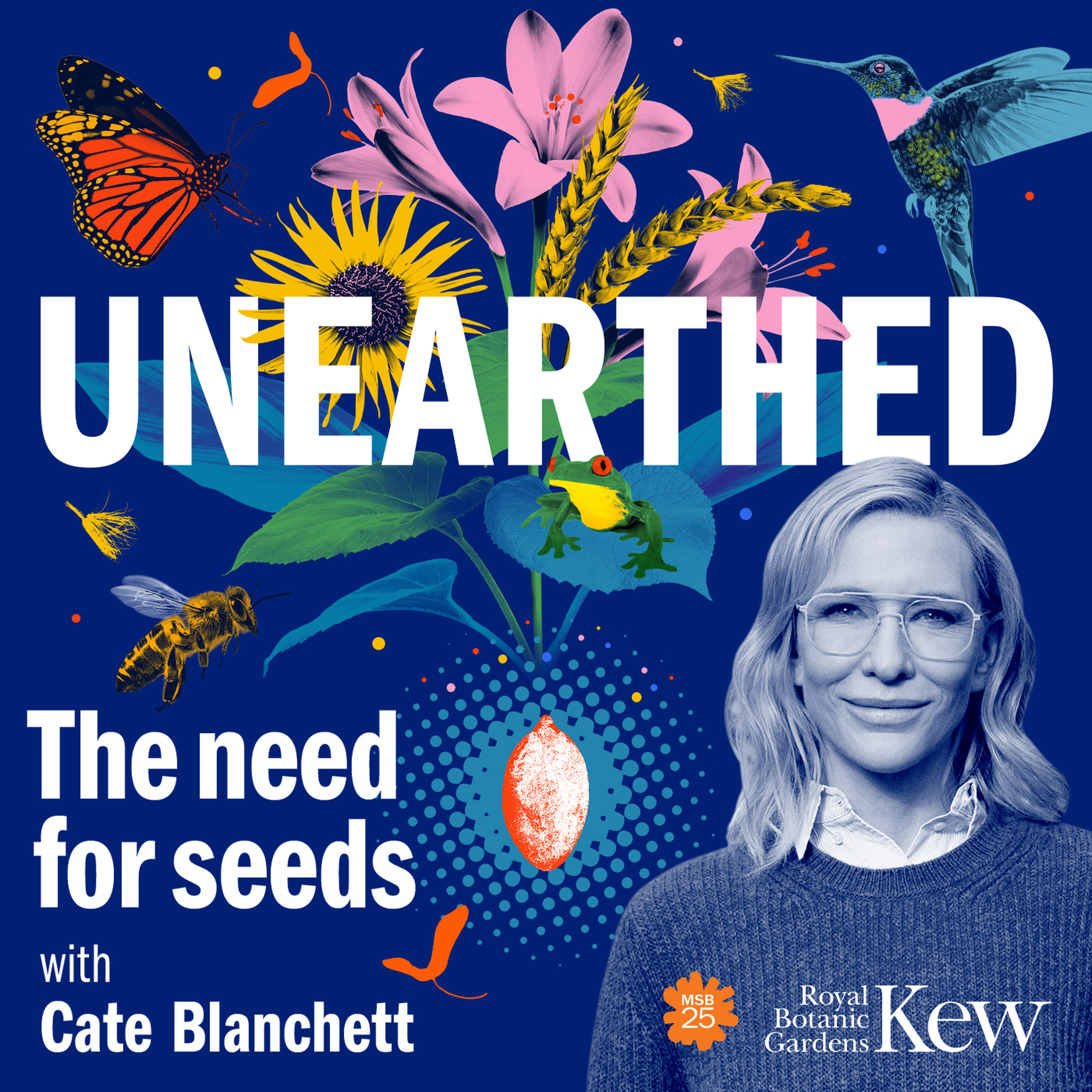
Welcome to Unearthed: The Need for Seeds, episode one, the past.
This year marks the 25th anniversary of the Millennium Seed Bank, or the MSB.
It's now a world- leading initiative at the cutting edge of science, but it wasn't quite so cutting- edge in the beginning.
Every great story starts somewhere, and ours begins over a quarter of a century ago.
In this chapter, we'll meet the visionary people who saw the future coming.
Roger SmithWe sneaked onto the site and looked in the hole, and that is the point at which I said to Simon, " What have we started?" And from there on, there is only one way, which is out and up.
Cate BlanchettAnd we'll understand how that vision is already bearing fruit.
Dan Duval100s of plants have been introduced working with the community, but this never would've happened if we didn't bank this in 2006 with MSB.
Cate BlanchettAnd we'll hear from those continuing to build on the legacy who are just as passionate about it as the Seed Bank's founders.
Dr. Chris CockelThose wild relative seeds are now at these international crop- breeding gene banks with the aim of making our domesticated crops more able to withstand the pressures of climate change and various pests and diseases that they might be faced with in the future.
Cate BlanchettBut let's begin in a place that represents both the past and the present of this story.
While I'm standing in an American prairie, it's full of native plants, and I can see rattlesnake master, which is a very tall, sort of beautiful silvery thistle, and this foxglove, and there's beardtongue, and there's black- eyed Susans, which I absolutely love.
And I mean some of these grasses and plants are as tall as my shoulders.
It's an American prairie, but I'm not in America.
I am in the heart of Sussex in Wakehurst.
And this landscape is only possible really because of the amazing work that the Millennium Seed Bank is doing, and more incongruous perhaps than an American prairie in East Sussex is the juxtaposition of this prairie with a quintessential English mansion just ahead.
I'm here with Dr.
Eleanor Brehman, who's the senior research leader in seed conservation.
Dr Eleanor BrehmanHi, welcome to Wakehurst.
Cate BlanchettThank you.
I mean, just in the distance, there is a grade one Elizabethan mansion and that was built around 1570.
Dr Eleanor Brehman1500s.
Cate BlanchettYeah.
Dr Eleanor BrehmanYeah.
Cate BlanchettAnd it's old stone.
It's almost like something out of a storybook.
So it's very old, but it feels really at odds with this experimental landscape that we are standing in.
This wild landscape here at Wakehurst.
Why did you want to meet me here?
Dr Eleanor BrehmanWell, because this is where seed banking started at Wakehurst.
So the Seed Physiology department moved down from Kew in the 70s.
We were based in the mansion originally and actually had a big walk- in freezer, like one of those butcher's freezers in the chapel.
That was the original seed bank.
Cate BlanchettThe seed bank was in the chapel?
Dr Eleanor BrehmanAnd the physiology team were working up in Lady Price's bedroom, and they were doing some work on one of the mahogany desks once, and when she came around, and she was really not very happy that science was being undertaken on this heirloom of the family.
So I think they got some lab benches in after that.
Cate BlanchettSo given that you were able to store seeds in a butcher's freezer in the mansion, that's not very high- tech.
I mean, obviously the modern building that houses the seed bank now, for the past 25 years, it's got a lot more sophisticated freezers than, say, there or I would have at home.
What are the facilities like there?
How would you describe them?
Dr Eleanor BrehmanYeah, I think when we were in the mansion, it was more in an experimental phase and we were trying to understand the seed biology that enables seeds to be dried and then stored at sub- zero temperatures to extend their lifespan.
And we really wanted to know if that was going to work for wild plant species.
Because it had already been done for agriculture, but they've quite uniform seeds.
So it was that experimental stage, but then we'd proved the concept and in the 90s collected the UK flora, so that we could show that it really worked before going international.
And the point of our new facilities, well now 25 years old, was the scale.
We needed to scale up.
So the technology still remained relatively simple.
We're drying, and we're putting in an airtight container and we're putting in a freezer.
So yes, the freezers are bigger, they've got roller shelving so we can maximize the space usage, but at the end of the day, it's just a - 20 freezer, but it's conserving all this biodiversity from around the world.
Cate BlanchettI mean, people obviously, if they're interested in building a garden, they buy seeds at their local gardening store.
But why do you think it's so important at this juncture in human history that we gather and preserve seeds?
Dr Eleanor Brehman45% of all wild plants are faced with extinction.
So the race is on, really, to conserve seeds from those species before it's too late and we've lost them forever.
Because you don't know what you're losing until it's gone.
Nobody's worked on these; we don't know whether that's the next medicine, whether it could improve our sustainable agriculture, what properties it has that we might find useful and might provide ecosystem services that we're depending on and we don't even realize.
Cate BlanchettAnd the way those plants and species have an interdependent culture.
Dr Eleanor BrehmanYeah.
And interact with each other to form that ecosystem.
Cate BlanchettSo when you say that 45% of plant species are facing extinction, that isn't just reflective of the UK, is it?
Dr Eleanor BrehmanNo.
Cate BlanchettI mean, it's a global figure, right?
Dr Eleanor BrehmanYeah.
That's plants across the world.
So in all environments, from pole to pole, from sea level to the tops of mountains, plants are feeling the pressure of human land use change, overexploitation, invasive species, pollution, and then climate change as well.
So it's not a very friendly environment for a lot of our plants anymore.
Cate BlanchettI don't know whether it's that I've specifically noticed that there's fewer plants around, but I have noticed, particularly in summer, when you go for a long drive, there are not as many bugs-
Dr Eleanor BrehmanNo.
Cate Blanchett- On the windshield.
Dr Eleanor BrehmanNo.
Cate BlanchettThere's fewer butterflies, fewer bees when you're out in nature, not here in the American prairie, of course, but is that a direct effect of that 45% loss?
Dr Eleanor BrehmanYeah, I mean, we've seen a dramatic decline in natural habitats all around the world.
I mean, the human population is expanding, people need places to live, we need to grow food to eat.
So those things have to happen, but we need to start doing those things in a smarter way and realizing that we have to do those things in harmony with nature rather than seeing nature as a never- ending resource that will just keep being there or keep bouncing back.
We actually need to be supporting nature.
And one of the ways we're doing that is through seed banking so that we're buying time for these species, which are feeling a load of pressures in their natural environments.
And we have had partners who go out on a collecting trip, and something that they rescued earlier in the year, they go back, and it's gone.
They can't make that collection, and that happens more and more frequently, unfortunately.
We do have wonderful moments as well where they discover plants that have never been described by science.
So it can work both ways, and I think that's the beauty of seed banking and this collaborative work around the world is, its discovery.
There's always something new to learn, and these experts are just giving all of their time and their knowledge and their passion to making sure that we have the best possible outcomes for plants going forward as we can.
Cate BlanchettThe Millennium Seed Bank is the largest ex situ wild plant conservation program in the world.
When you say " wild seeds," what do you actually mean?
Dr Eleanor BrehmanYeah, so it means that they're seeds that have been collected from their natural habitat, so where they would normally grow.
So this is why we work with partners all around the world to help them conserve their native floras.
And that's very different to going to an agricultural setting and taking cultivated material, which are the seeds that you'd buy in the packets in the garden shop.
And it also means that you are conserving a huge amount of diversity because these plants in their natural habitats are adapting to thrive and survive in these changing conditions.
And so by capturing seeds from populations across that species' natural range, you can capture all of this diversity.
And the amazing thing about seed banking is that you can store all of that in a really small space, and for a relatively low cost.
I mean, it's a relatively low- tech, simple solution to a really big problem.
Cate BlanchettHow much has the mission changed in that 25 years?
It was so state-of- the- art and cutting- edge, but also the future probably seemed much further away than it does here and now.
Dr Eleanor BrehmanI mean, when it first opened, there was more of an acquisition phase.
We were just trying to get plants to be prevented from extinction, get the seeds into the bank, and know they were safe.
But then as we got more and more species in, that allowed us to understand more and more plants and their ecology, and actually this information that we get through germinating the seed and the data that we're amassing from the field when we collect the seeds and all of the processing is really, really important for restoration.
And we are then using these seeds.
You know it is a bank; you make deposits and withdrawals, right?
So the seeds are coming back out of the bank.
It's not their end resting place.
And the real focus is on supporting active ecological restoration programs in spaces where the environment is stable enough to be putting these rare and threatened plants back into the landscape and that they will still be there in 10, 20 years' time.
Cate BlanchettThe times where I've been in the seed bank, there's invariably been students and researchers from all around the world.
Is it important for them to come here?
Dr Eleanor BrehmanWe have really close relationships with our partners, and actually Australia's a really good case in point because we've been working with them since 2000.
During that time we've helped develop a wild plant seed bank in every state and territory in Australia, and they've now formed their own Australian seed bank partnership.
So that's kind of the journey that we want to go on with all of our partners.
We provide training, we provide resources.
Initially we might provide some funding to get them out to the field and make those initial collections and help them start, but the idea is for them all to stand on their own and be organizations who can manage their own floras.
Cate BlanchettWe'll come back to Australia later, but we're having this conversation, as I mentioned earlier, in the middle of an American prairie landscape in the middle of Sussex.
It's a landscape that's made up of seeds that are collected from the USA and brought back here to Wakehurst.
Dr Eleanor BrehmanThe horticultural team went out to the states and made collections from existing prairies over there so that we had that authentic seed mix to put into the prairie land here.
But we've also got those rare, threatened, endangered species which we collected.
We've got in the seed bank, grew on, and then have mixed in to this kind of mosaic of planting here.
So that visitors could engage with that story and understand that plants in all corners of the world are under threat, but they're beautiful and create these amazing landscapes that we want to be in and just make us feel happier.
And then it has the links to the seed bank as well, and I love that about Wakehurst is that there's so much collaboration between the seed bank and what's going on in the landscape.
It's more than 50% of the plants in the Wakehurst landscape have been grown from seed that have been collected from all around the world.
Cate BlanchettNow a seed holds so much potential.
But there are also many different types of seeds, and as we've heard, what sets the Millennium Seed Bank apart is the fact that every single seed banked here is wild.
Dr. Chris CockelI guess the unique selling point of the Millennium Seed Bank is that we're a wild species seed bank.
So in general, we don't bank domesticated crop seeds.
Our role is to collect the wild and then make them available.
So that was what the project was all about, was making those seeds available for breeders.
Cate BlanchettThis is Dr.
Chris Cockel.
He's now the UK's conservation projects coordinator at MSB.
But before that, he headed up a project that focused on collecting the wild relatives of crops that you and I would think of as food.
Now for many of those species, there's very little family resemblance that remains.
Dr. Chris CockelSo what we have here are some wild banana seeds.
They're quite large, half a centimeter across perhaps, and the banana those came from were very small.
So there's a misconception, I guess, that bananas come from the Caribbean.
They were collected in Vietnam, Malaysia, Thailand.
So what we have here is a wild banana plant from Vietnam, and this was grown from seed, from 2016, and the seeds came from one of our partners for the Adapting Agriculture to Climate Change project.
The main difference you'll see between a wild banana plant and a cultivated banana plant is the fruit actually.
Part of the domestication process, including with bananas, is that humans have over millennia created fruit and vegetables that are palatable, that are edible, that are high- yielding.
So in the case of the wild banana plant, the fruit is much smaller and it's full of seeds, whereas the domesticated Cavendish banana, the ones from the supermarket, it doesn't have seeds in it because they're all generated from clones.
And what you see in the center of the Cavendish banana is just the remnant of seeds, and also there's a lot of flesh that you can eat, whereas in the wild banana, there's virtually nothing that you would think you would want to eat in there.
These plants are not genetically modified.
They are the product of, as I say, millennia of traditional breeding methods where farmers have taken different varieties and crossed them with one another to bring out the traits that we want in terms of yield and size, taste.
There's something called the genetic bottleneck, where you've come from a very broad genetic base to a very narrow genetic base, and this makes the domesticated crops vulnerable to pests and diseases and to changes in climate.
Cate BlanchettIt's taken human ingenuity to evolve edible fruits and vegetables as we know and consume them today, but the same processes that increase their attractiveness to us as food also makes them vulnerable to an increasingly threatening future.
However, there are potential solutions to that problem within the wider family tree.
Dr. Chris CockelThere are also still the wild relatives that are out in the wild, and they contain a lot of adaptive traits that have been lost in the domesticated crops.
So that's what we're trying to capture when we're collecting the seeds of these wild species.
There's a scale between wild and domesticated, so we're now at the fully domesticated.
There are intermediate stages as well, semi- domesticated, and these are called heritage varieties.
And then there's the truly wild, and the further away from the domesticated you get, the more difficult it is to breed those wild ones with the domesticated because they're almost different species.
In some cases they are different species.
Cate BlanchettThese are called crop wild relatives, and they're really important.
Dr. Chris CockelThe important thing about the crop wild relatives is that we can take those adaptive traits, and through traditional breeding methods, we can breed back into the domesticated crops some of those important traits that have been lost.
And by reintroducing some of those lost wild traits, you can make our domesticated crops more capable to withstand the different pressures they're going to face in the future.
Cate BlanchettSo much of the work of the partnership projects of the Millennium Seed Bank are future facing and will focus specifically on the work going on in order to future- proof in episode three.
But for now, let's step back in time, not as far back as the dawn of agriculture before crops were ever domesticated, but to the early 1970s, when it was agricultural industry itself that inspired an idea.
Roger SmithLooking back, what we were actually doing was seeing how much of the technology that they used in crops to conserve seeds could be successfully applied to undomesticated, wild plants.
And it was a case of then beg, stealing, borrowing ideas to solve the problems that we had of seed storage.
Cate BlanchettThis is Roger Smith; he's one of the founding fathers of the Millennium Seed Bank.
And now decades later, he's striding over to meet us in a brightly colored stripy jumper, with a mysterious smile.
Roger SmithI came in 1974 as the seed collector, and then I became the head of the seed bank project in 2000.
Cate BlanchettWe talked to him back outside the old stone mansion where it all began.
Roger SmithAt Kew, they had a refrigerated collection of seeds, which they used to share with other botanic gardens, and it was big enough when it did come down here to go into the boot of a Ford Cortina; that's how it was transported down.
And it went into the chapel.
So if you like, the chapel changed from saving souls to saving seeds.
Cate BlanchettBut the job of saving seeds was new and it was not straightforward.
Roger SmithSo we were covering everything from " Can you actually collect these seeds," and then insufficient number.
Then we had to learn how to clean seeds so that you ended up with just seeds and not seeds and bits of rubbish because you're trying to get the smallest volume that you can of viable seeds.
The other thing you can't do is damage the seeds.
And we had a few experiments in there where we did end up with flour, rather than seeds.
It was learning just like that as you went along; not one question off, move on to the next.
At the same time we learned keeping them in the building, in the open, they would die or begin to die in a couple of years.
So you had to find out how to keep them dry and viable.
And then when you've got the seeds, you've then got to learn how to germinate them to turn them back into plants because if you can't turn them back into plants, then what was the point?
And so it goes on, and never- ending sort of beg, steal, or borrow any idea you could find that appeared to solve the problem you'd just bumped into.
We had 20 years of learning how to become an overnight sensation.
Cate BlanchettAnd 20 years of learning came with its own particular challenges.
Roger SmithWe started to accumulate more research evidence at the same time that the conditions that we were putting them into were the best for the seeds, with a compromise for the economics of running it and the health and safety, because at one point we had a room that was not at - 20; it was at - 40.
And the minute you'd say minus 40, you have to go through a whole set of medical examinations to make sure you are not going to have a heart attack when you walk in or walk out.
It was a little bit of a Boy Scouts adventure, I suppose, if you like, in that respect.
It was not, " Here you are, sit there, this is what you do." It was a case of " This is what we want to do.
How do you think we do it?" It was adventurous.
Cate BlanchettThere's a strong thread, I think, that you'll hear throughout this series, and that's the passion and determination of like- minded people from across the globe not taking no for an answer.
People who were pushing the existing boundaries of science as they play their part in securing the future of our planet.
And that passion was there from the beginning.
For the people at the heart of the MSB, it's not a job; it's a true vocation.
Roger SmithI think I had thought I was joining a job.
Where it became an obsession.
And yes, I suppose more and more people in the world of biology and botany who were concerned about species loss but didn't know what to do about it.
For us, the mentality was, " Well, we've got to start somewhere, and we'll find out as we go along." Because that's what humans have always done.
And so that when the Millennium Commission comes along and offers large sums of money for something that is not business as usual but is something of a grander scale, they wanted it to...
I reread the establishing paperwork; they wanted the projects to last for the next 30 generations, which is another millennium.
We'll happily...
By that time we had seen research that showed that some seeds could last for even longer than that.
So we could meet their sort of ambition.
And we had enough partners who'd visited, learned around the world that we could say, and " We'll work on a global scale, and we'll do 10%," which is the rate at which species are reported to be becoming threatened with extinction.
Having got that, I moved my job to go and meet partners and persuade them, would they join in.
Made relatively easy by that time by the Convention on Biological Diversity, which had been, I think, in 1993, and there is my favorite bit in the preamble, which says that lack of full scientific certainty should not be a reason for not acting.
So they all signed up and stood up, and then the rest, as they say, is history.
Cate BlanchettIf they hadn't signed up and stood up, that history would look very different today, and so would our future.
I was really, really struck by Roger recounting the early days of the Millennium Seed Bank.
I mean, ultimately it was a group of people who strongly believed in action, not just talking about it, but action to preserve our planet.
They might've been thinking about seeds, but they were thinking big.
And the Millennium Seed Bank still thinks big today.
Chris Cockel worked with partners in 25 countries around the world to coordinate seed collecting efforts for the Crop Wild Relatives project.
Dr. Chris CockelSo our partners went out and collected the seeds of the wild relatives.
They sent two- thirds of the collections to us, and they retained one- third of the collection in their home countries.
And then further down the line, our role was to send a portion of those seeds to crop breeders.
So from the very start of the project we had an end use for these seeds.
There were two years spent at the very beginning of the project, from 2011 to 2013, when a gap analysis was conducted.
And this basically looked at what was already stored in seed banks around the world and also decided which were the priority crops.
And it turned out that almost 30% of those wild relatives were not represented in seed banks at all, and up to 95% of them were not geographically represented.
So you are missing a lot of the genetic diversity that you get from collecting species from across its geographic range.
So for instance, one of the very basic crop wild relatives we were collecting was the relative of the carrot.
So whereas the domesticated carrot that you would buy in the supermarket is a nice, long orange vegetable, the wild relative is just a gnarly root that you probably wouldn't want to eat.
It's almost like a weed.
And that was what was missing in existing collections.
And so that material wasn't available for breeders to use.
The project focused on 29 important crops; some crops will have more wild relatives than others, like bananas, only have a few, but aubergine have quite a lot.
You would've thought that the wild relatives of something as common as a potato would be well banked and collected, but not at all.
That was one of the really high- priority crops to collect from, and that was done by our partners in South America, which is where potatoes originate.
We also collected the cereals, which were collected mostly in what's called the Fertile Crescent in the Eastern Mediterranean and places like Cyprus and in Italy and Spain.
We collected African and Asian rice, different varieties relating to that.
Virtually everything we eat is, well, yeah, I mean, I'm just thinking about what I would eat in my breakfast.
I'm having a slice of bread, which is made out of wheat, and it's just a grass you're eating, so it's all linked.
Cate BlanchettBut collecting seeds is not always plain sailing.
Dr. Chris CockelOur partners in Brazil, for example, collecting rice wild relatives in the tributaries of the Amazon, they were faced with caiman in the river.
So then they were sort of wading around in the Amazon River, and they were worried about crocodiles.
In other countries, our partners in Lebanon, where we were collecting a lot of the cereal wild relatives, of course, there's human conflict going on in some of those places, and they weren't able to get to areas where the wild relatives existed because of security issues.
Cate BlanchettOnce again, this was a partnership populated by passionate and determined people.
And so despite these issues, the seeds were collected and then stored for safekeeping.
Dr. Chris CockelSo those wild relative seeds are now at these international crop- breeding gene banks, and they're available to be incorporated into breeding projects with the aim of making our domesticated crops more able to withstand the pressures of climate change and various pests and diseases that they might be faced with in the future.
Cate BlanchettIt's become very clear to me that the Millennium Seed Bank thrives because of its global partnerships and that this isn't just a future- facing mission.
Also, it's about deposits and withdrawals in the present.
And the first- ever withdrawal request struck a very personal note for me.
Dan DuvalIn late December 2019, there were a number of major bushfires around South Australia.
One of them, which started on the 20th of December 2019, was in Adelaide Hills, and it was basically catastrophic fire conditions around the state.
So this is where we have very strong winds and very high temperatures.
And this fire that started on the 20th of December was finally put out on the 3rd of January 2020, but in that time it burnt out 24, 000 hectares, probably 80 to 90 homes were destroyed.
Cate BlanchettAs with any disaster on this scale, it's not just the built environment and we humans that suffer; all of nature suffers.
Dan Duval is senior seed collections officer for the South Australian Seed Conservation Centre in Adelaide, which has been working with the Millennium Seed Bank since 2003.
Dan DuvalAt the time, we were monitoring a number of threatened species within small reserves in that area, and unfortunately, there were a number of localized population extinctions of threatened species that occurred within that fire scar.
One of those species that we thought we lost were a couple of populations of what we call clover glycine.
Clover glycine is a nationally vulnerable species, so it's something of significance nationwide in Australia.
The populations in Lobethal Park were banked some years ago, probably 2004.
And because we weren't seeing a good recovery of this plant species post- fire, we knew we needed to actually utilize some seeds from the seed bank and use them in post- fire recovery work to reintroduce this plant species.
We couldn't use the seeds from the Seed Conservation Centre for recovery work within the fire scar because the population we had banked here in Australia was from a different location.
Fortunately, we had a collection banked near the fire scar that we'd actually banked with MSB in the UK.
Cate BlanchettBut bringing those seeds back wasn't easy.
Dan DuvalOne of the challenges was we were repatriating a species of native plant that was rare from Australia back into country.
Cate BlanchettNow for any of you who have visited my homeland, you'll know that even bringing muddy boots into the country is difficult, let alone reintroducing a whole plant species.
Dan DuvalOur quarantine service had never dealt with this before, so they had no process for us to be able to repatriate the seeds back into our country.
So it was an interesting process to go through to actually ship native seeds.
Originally collected from South Australia, stored in the UK back into Australia.
Cate BlanchettReturning the seeds to Australia was just the beginning.
Dan DuvalThe most important thing is to utilize every seed that we received in the sample.
So after nicking the seeds to remove the physical dormancy and germinate them, and the first thing we do was grow the seeds and plant them in a seed orchard.
So we want to turn the 100 seeds or so that we received into 100s of plants that we can use for reintroduction.
We planted seeds that we germinated in the lab into pots that we then grew for a period to ensure they were viable.
And then the successful plants were then transplanted to what we call a seed production area, which are large raised tank beds that we then harvest plants or harvest seeds from.
Those plants are still in the seed orchard today and are still flowering and setting seed and still being utilized in projects.
Walked past it yesterday.
Cate BlanchettBut of course, the habitat that the seeds were originally collected in was a very different one to this new fire- scarred version.
Dan DuvalThe landscape post- fire was completely different to that prior to the fire in the sense that it was almost a moonscape.
There was no vegetation cover.
There was an ash layer that was a few centimeters thick.
So when you think about a few months earlier when you could have visited the glycine, it was a quite shady habitat growing of mosses, south- facing slopes.
It's taken some years for that landscape to settle down and for that shade or canopy cover to develop and for that ash layer to become more minimal.
So in 2022, we introduced our first plants of clover glycine to three sites within the fire scar.
When a fire event of this scale comes in, there's not a capacity for these small populations to survive these events.
So what we need to do is produce a resilient population that can survive these sort of events, that can compete with introduced species that can attract pollinators.
And that's why we've been reintroducing the clover glycine since 2022.
So we've reintroduced hundreds of plants to some of these sites now, and monitoring back in June by volunteers have got populations surviving up to 100%.
So some populations: 75%, 80%, and some of these populations are now 100% from year to year.
So we're getting success over time.
We think we're doing well, and we're now getting to the point where those populations are at least equivalent or more to what the original population was pre- fire.
There's more work being done, and more clover glycine will be introduced.
Cate BlanchettAnd the long- standing collaboration with the team at Wakehurst has been key, even up to the present day.
Dan DuvalThe partnership with MSB has been very significant for the SA Seed Conservation Centre, partly because the program wouldn't have commenced without the support of the Millennium Seed Bank, but also the sharing of knowledge and expertise.
We have a seed bank here in Australia, but if anything were to happen to our collections, at least we know that we've got these collections that are managed very well in the UK by MSB and that we can call on these insurance collections that are stored in the UK when we need them.
Cate BlanchettListening to Dan, you begin to grasp the far- reaching impact of a project set in motion decades ago by Roger Smith and his colleagues, Simon Linington and Giles Coode‑ Adams.
From makeshift lab benches in the old mansion to a state- of- the- art facility sunk deep beneath the grounds in Wakehurst, it's an extraordinary journey.
And I wondered, did they ever have a moment when the sheer gravity of their idea truly settled upon them when they realized the scale of what they'd begun?
Roger SmithThe only time I panicked was when they had started to build and they had dug the hole into which the second floor was going to be sunk.
And Simon and I, on a Friday, we sneaked onto the site and looked in the hole, and that is the point at which I said to Simon, " What have we started?" And from there on, there is only one way, which is out and up.
Cate BlanchettTaking part in this series marked the first time in many years that Roger had returned to Wakehurst.
And as he stood outside the old stone mansion, 51 years on from that old butcher's freezer, he reflected on his work and all that had stemmed from it.
Roger SmithAm I proud?
I'm proudest of the fact that a strange, ragbag of individuals, in which I include myself quite happily, should come together and do something that had global significance, we hope.
It is 51 years since I walked in with hair and not really knowing what I'd come to and what was expected of me.
So coming back today has been quite...
I even drove the same route that I drove from home to come into work.
A lot has changed.
It's quite emotional to be back in a confusing way because what you do is to regret the things you could have done better.
And I wouldn't say downplay the things you did that worked well.
But yes, you will remember those occasions as you think, " Oh, if only they could replay the tape," and you'd get there.
But on the whole, it's been fun.
Cate BlanchettThey were a self- proclaimed, strange ragbag of individuals who, over 50 years ago, sowed the seeds of a small project with a big vision.
A project that has since grown into a global endeavor with branches all over the world, sustained by remarkable people united in their mission to use the power of wild seeds to secure the future of our planet.
In our next episode, we'll be moving from the mansion to the modern building that houses the MSB today.
We'll go behind- the- scenes into the laboratories and the vaults themselves to uncover the extraordinary science of seed processing and preservation.
Seeds we're banking on for our future.
I'm Cate Blanchett, Kew's ambassador for Wakehurst, and this is Unearthed: The Need for Seeds.
Find us wherever you get your podcasts, and please follow us so you don't miss a moment of our story.
And I invite you to join me in supporting the vital work of the MSB by making a donation today.
Just click the link in the episode description to learn more.
Until next time, thanks for listening.