The Present: Inside the world’s largest seed bank
Episode Transcript
You really are on the edge of South Downs.
Could you describe it as a natural landscape or...
Ted ChapmanSo, the landscape we're driving through now is not really natural.
No.
So, these fields are arable fields, so they would normally be gray cereals, but for this year, at least they've been sown with it looks like some kind of wild seed mix.
Cate BlanchettI'm in a Jeep lurching over a dusty single track road where deep in the South Downs National Park, which is just beyond Brighton on England's southern coast.
Ted ChapmanSkylarks are taking advantage of that because they nest in the ground.
So, they're probably nesting.
Cate BlanchettYou can hear them outside.
That's Ted Chapman behind the Wheel UK Conservation Partnerships Coordinator at Kew's Millennium Seed Bank at Wakehurst.
He's also my guide for today.
Ted ChapmanSo, these hills that we're driving over now are all chalk, and the chalk is really close to the surface.
So, the soil here is only 10 or 20 centimeters deep and that very chalky soil, very low fertility, very sharply drained, it drains really quickly.
That's really what informs the type of vegetation that we have, and that's what makes this habitat special because these types of soil conditions and rock conditions are not found very commonly.
Cate BlanchettWe're heading to Castle Hill National Nature Reserve, which is looked after by Natural England, and I'm joining Ted and his team to collect wild seeds.
Is this somewhere where you'd come see collecting a lot?
Is this an annual pilgrimage?
Ted ChapmanSo, we've collected a lot of seed in Castle Hill in sites like this, because the chalk grassland supports an exceptionally diverse flora, and many of those species are highly specialized and quite rare.
So, because we're often targeting threatened species, we're often found in places like this.
Cate BlanchettThe MSB's central mission is to gather wild seeds from across the globe, preserving them to safeguard the future of our planet.
This work focuses on species under threat around the world, often found in far- flung countries.
However, you might be surprised to know that some of the species most in need of protection are much closer to home.
It's just magnificent.
It's so wide and open and there's a big smudge of red down there though poppies.
Ted ChapmanYeah, we're going to get a close- up view of these beautiful poppies.
Cate BlanchettBut just as important as place is time.
In seed collecting, timing is everything.
What we're hoping for today is that our visit coincides with the precise moment the seeds are ready to be gathered, so that we can follow their journey as they're carefully processed and then stored for safekeeping in the vaults of the Millennium Seed Bank at Wakehurst.
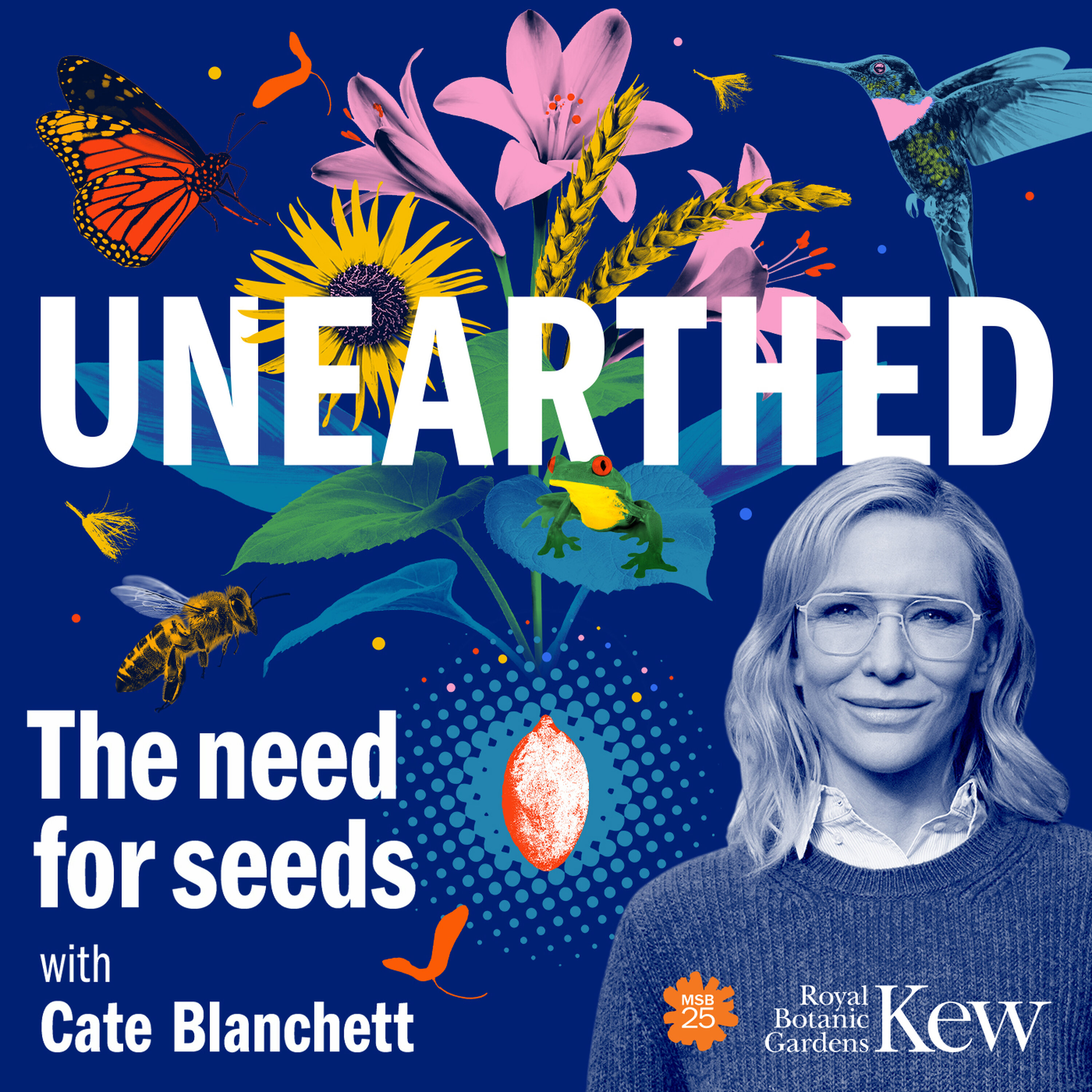
I am Cate Blanchett, Kew's ambassador for Wakehurst, and this is Unearthed: The need for seeds.
Episode two, the present.
Ted ChapmanSo, we need to get through this gate.
Cate BlanchettYeah, I can do it.
It's the gate etiquette.
You learn that in Australia very quickly.
Oh, I see those two bars there.
Ted ChapmanSo, the last thing we want is off- road bikes, off- road vehicles coming into the reserve and destroying the habitat, which would just happen so easily.
You can imagine these habitats takes centuries or millennia to evolve, but only seconds to destroy.
Cate BlanchettYes, yeah.
Gosh, there's this team flowers, isn't it?
Ted ChapmanYeah.
Cate BlanchettThey're heavy.
Ted ChapmanThey are heavier.
Are you okay with that?
And then you twist it at the top.
That's it.
Oh, great.
Okay.
Okay.
In we go.
Cate BlanchettHere we go.
We pass through multiple gates and descend into a valley.
It's wildly overgrown with shrubs and vegetation encroaching on the track.
And then as we lurch around a corner, the tree's clear and I'm greeted with the most beautiful vista.
Oh my goodness, this is magnificent.
It looks so ancient because the hills are just given away to a flat plane.
It's got a smattering of poppies.
And what's the yellow?
Is that this grass...
Man, it's so beautiful.
It's almost like someone's taken a brush with a thousand colours.
Ted ChapmanYes, yeah.
So, the reserve is on these steep hillsides and then at the bottom of the valley, we've got this flatter area with deeper soils.
And then we've got this wash of poppies.
So, beautiful.
Cate BlanchettSomething out of The Wizard of Oz.
So, if you find me asleep in there, rescue me.
Ted ChapmanSo, the slope ahead of us is where we're going to be doing our harvesting today.
And this is Castle Hill itself.
Cate BlanchettYou mean the green quite vertiginous- looking slope ahead of us that's got the...
Ted ChapmanExactly.
So, we can see-
Cate BlanchettThe strawberry on the top.
Ted Chapman...
we've got the scrub at the top.
We've got this arable field at the bottom.
We've got this slightly flatter, rough bit in between.
And that area was ploughed in the second world war.
And that's why even now, it's still very different to the ancient short grassland, which is on the steep slope.
Cate BlanchettAnd what was attempted to be grown there?
Ted ChapmanThat would've been crops for eating in that dig for victory effort.
So, these soils are with chemical fertilizers, they're quite amenable to growing things like cereals, wheat, barley, flax.
Now that farming ceased some decades ago, but even with decades of very careful management, you can see the grassland at the bottom of the slope is very different to the grasslands on the sides.
Cate BlanchettIt's really green and tufty.
Ted ChapmanYeah.
So, that is good, but we don't want too much of that.
We need a good balance.
Cate BlanchettSo, what makes this spot so special apart from its incredible beauty?
Ted ChapmanIt's really the quality of the chalk grassland.
So, we're going to be in one of the nicest patches in just a second.
You'll see the diversity of species and they're all tiny weeny because it's so infertile, but there are many, many species packed in.
So, we can record 40 or more species in a square metre here.
So, this is one of the most plant- diverse habitats in Western Europe on this small scale.
So, it's really special floristically and it's of course the vegetation then supports the butterflies, the other invertebrates, the birds that are associated with the invertebrates and so forth.
So, that's really why this is such a special place.
Cate BlanchettAfter a quick safety briefing from Ted and his colleague, Isabel Negri, UK Conservation projects officer at the MSB, we start to clamber up the hill.
We wade through some tall grasses at the bottom, but they soon thin out.
There's so many varieties of plants and I'm sure a myriad of insects all thriving underneath my feet.
Ted ChapmanWe try to tread lightly in habitats like this where we can.
So, we've got into the chalk grassland.
It's very low.
Cate BlanchettAnd not as dense.
Ted ChapmanMuch, much less dense.
And if you start looking into the sword, you can see there are lots of different species, different grasses, different species, and they're all little thistle there, a little bedstraw there, all growing intermeshed, one with another.
And underneath, you can see it now looking very dry and droughty this grey soil.
That's the very chalky alkaline soil.
So, this site is grazed by cattle.
Grazing is essential because without the grazing this would revert through scrub to woodland and the grassland would be lost.
So, that sustained grazing at the right level over centuries and centuries is what has created and maintained this landscape.
Cate BlanchettAs Ted started pointing out different plants, I began to think I was getting rather good at spotting unusual species.
I should work at the MSB.
Ted ChapmanLet's head up.
We'll find...
There's always so much to see.
Cate BlanchettYes.
It's hard not to get waylaid.
Ted ChapmanYeah.
Cate BlanchettWhat's that little?
Ted ChapmanThat is rabbit poo.
Cate BlanchettOh, great.
I might put that in my pocket
Ted ChapmanSo, we don't aim to collect that.
Cate BlanchettWe can use it later.
Chocolate covered rabbit poo.
Here I was, thinking I'd found a rare seed rabbit poo.
Clearly, I'm not going to get a job at Wakehurst.
After my identification of the rabbit poo, we continued up the hill making our way towards some orange markers.
Ted ChapmanSo, these markers mark out where we've got a really lovely population of yellow rattle.
So, yellow rattle is what we've come here to collect today.
Cate BlanchettAnd what's so important about the yellow rattle?
Ted ChapmanSo, yellow rattle is a semi- parasitic species.
So, that means it produces its own food, but it also parasitizes other species growing with it.
And that means it reduces their vigor.
And that makes it quite important in this habitat, because it helps balance the really vigorous species against the more delicate species and allows those more delicate species to thrive.
So, it's really very important for the kind of function of the plants growing here.
Cate BlanchettIt's a regulator.
Ted ChapmanIt's a regulator, like a community engineer almost.
It's found in a lot of grassland sites.
We specifically need to collect it now because we've used quite a lot of the collection that we have for research work that we've done looking at the germination needs of this species.
So, yellow rattle is actually a species which has a very narrow temperature window in which it can germinate.
And so, we've done some work and Isabel has been involved in this to work out exactly what the minimum and maximum temperature range that yellow rattle needs.
And then we model that against climate change.
So, we think in 50 years' time, will the climate still provide the conditions that yellow rattle and other species need to germinate?
So, many species are resilient and they will be able to regenerate successfully in a warm climate.
But yellow rattle is an example of a species which is quite vulnerable, because it needs cold winter conditions to break dormancy and germinate.
So, it's important to understand that and start thinking about how we can manage grasslands and restoration projects to counter that and build adaptation and make sure this particularly important species survives.
So, we've used seed to support that research, so we need to replenish that seed in the seed bank.
So, we've got it for next time.
So, the first thing we're going to do is find similar rattle and take a look at it.
Some specimens here.
Cate BlanchettIt's got a sort of a reddish brown stem with almost like two little pods, green pods.
Ted ChapmanThat's right.
Yeah.
Will it rattle?
That's the seed rattling around and that's how it gets its name.
Cate BlanchettSo, you want to collect them when they're dried?
Ted ChapmanExactly right.
So, we want to collect seed at the point of natural dispersal.
So, that's when it's being dispersed into the environment.
That's when it's mature, it's when its longevity.
So, the amount of time it will be able to survive in the seed bank is at its greatest.
Cate BlanchettIt struck me as almost paradoxical that we were gathering seeds from the very habitat where I just learned how vital they are as nature's own community engineers.
But Ted and his team work by a clear principle.
You never take more than 20% of the seeds in the field.
Each of the pods are filled with tiny seeds.
And so, our collection begins with some counting.
Ted ChapmanOkay, I make that 25 in my patch.
Cate BlanchettThere's quite a lot here actually.
Isabel NegriHow many did you find?
Cate BlanchettI think about between 35 and 40 in a square meter.
Isabel NegriOh.
Ted ChapmanOkay.
Yeah, we average at about 20 plants per square meter.
Cate BlanchettAnd a little bit of maths.
Ted ChapmanI've crunched the numbers and I can tell you that we have approximately 1.
4 million seeds in our sampling area here of yellow rattle.
Cate BlanchettYeah, down.
Ted ChapmanThere's always tonnes more seed than you think there is.
Cate BlanchettAnd just before we start collecting, there's one more important step.
Ted ChapmanIf you've got some seed in your hand, Isabel- ...
shall we see if we can do a cut test?
Isabel NegriYes.
Yeah.
I'll pass it to Kate.
There you go.
Cate BlanchettA cut test is used to determine whether the seeds are of good quality.
Ted ChapmanSo, I'm going to give you the tools of the trade.
So, some snips, just watch yourself.
Cate BlanchettLittle, they're very sharp scissors.
Ted ChapmanAnd so, the question is, can you grip that seed in the end of your fingertips?
Carefully slice off the top.
Cate BlanchettAm I going into the dark part of the seed?
Ted ChapmanIn the dark part, yeah, right through the middle.
Nice.
And then I'll give you that lens.
And then if you hold up joy and then have a look, see if you can see-
Cate BlanchettOh gosh.
Ted Chapman...
anything white and flowery in there.
Cate BlanchettWell, on the edge of the seed, there's a tiny bit of...
It almost looks like someone's moved to a white pencil along the edge of it.
Ted ChapmanThat's probably what it will look like is like...
Cate BlanchettDo you want to check?
Ted ChapmanIt will look like a little white,
Cate BlanchettLittle tiny little dots.
You see?
Ted ChapmanSo, that's the end of sperm of the seed.
It's its food store.
So, sometimes we can also see the embryo, which is the little seedling waiting to come out.
And if we can see those things, it gives a clue that the seed has got the potential to germinate.
We don't know if it definitely will, but it potentially could.
If it's empty or moldy or there's a grub, then we know it's not good.
So, the cut test is a really important way we go about in the field just assessing the likely quality of the seed.
Yep.
That seed's good.
Yep.
So, yellow rattles, it's a very thin seed.
Cate BlanchettYes.
And the bulk of it's dark.
Ted ChapmanAnd the bulk of it's dark.
But those white flowery bits tell me that that seed is good.
So, we've cut tested five in total, four of which were good and one of which was not good.
So, we could say for the purposes of our collection today, that about 80% of the seed here is full and good.
So, what I would do now is I'm going to take my 1.
4 million seeds in this whole population.
I'm going to work out 80% of that.
So, you've got 1, 120,000 approximately good seed in the population.
But our absolute maximum that we could collect here is only 20% of that seed, which is 224, 000 seed.
So, there's tons of seed here.
We don't need worry about depleting the natural population.
Cate BlanchettOver one million seeds are available here, an astonishing number.
Ted ChapmanTo make our conservation collection, we're going to want to get 25 heads each because there are three of us collecting today.
So, we're pretty much ready to go.
Cate BlanchettWe fan out, walking slowly, each of us following our own line in parallel with one another gathering as we go.
Ted ChapmanWe're walking towards that orange marker.
It's fine if we wave around a little bit.
It doesn't have to be a dead straight line, but it just means that we'll cover the whole area between us.
Cate BlanchettThis is when seed collecting gets competitive.
I'm trying to get a lot of heads.
There we go.
Isabel NegriDon't be tempted to just collect the pretty ones.
Ted ChapmanNo.
Isabel NegriYou want the ugly ones too.
Cate BlanchettNo, that's a different one.
Yeah, it hasn't got so many heads on it.
These ones are really rattley.
I may have felt slightly competitive, but ultimately, this is a team sport.
Ted ChapmanYou've actually done it.
Cate BlanchettHave I?
Ted ChapmanHow many have you got?
Isabel NegriI think I've got about 25.
Ted ChapmanOkay.
All right.
Cate BlanchettI think I've got about 13.
Ted ChapmanOkay.
Cate BlanchettDo I get the job?
Ted ChapmanYeah.
Cate BlanchettThe yellow rattle heads are scooped up into a bag, carefully labeled and a specimen is pressed.
This part of the process is now complete.
So, once we've collected the seeds, what happens now?
Where do we go?
Where do these little seeds travel?
Ted ChapmanSo, those seeds would be returned as quickly as possible to the drying room at the Millennium Seed Bank.
And that's where they'll start their drying and can begin their journey through being cleaned and tested and ultimately banked.
Cate BlanchettCome on little seeds.
Later, I'll be going inside the MSB to see what happens to the seeds when they arrive at Wakehurst.
Collections like this are essential to the work of the Millennium Seed Bank, but they're carried out not just on its doorstep, but also in collaboration with partner organisations all over the world.
With a global network across nearly 100 countries, the MSB works with experts to help inform projects that will save biodiversity in myriad places.
Nattanit YiamthaisongI am Nattanit Yiamthaisong.
I am a PhD student in Chiang Mai University.
I'm working with FORRU, which is Forest Restoration Research Unit or in Thai name we call, Nuay Wichai Fuenfu Pa.
FORRU and MSB is like we are the partnership for collaboration around more than 25 years.
FORRU do the research about the restoration and we collect the seeds for sent to the MSB and I am the small part in the team for collect the seeds to send it here.
Cate BlanchettNattanit is spending three months at the MSB as part of her PhD studying how varying temperatures influence seed germination.
Nattanit YiamthaisongWe want to know if the climate change or the global warming in the future, the temperature will increase is maybe effect with the seed and germination of the seed.
We want to know if the temperature increases effect with the seed or not.
For two species from Thailand in different temperature from five to 45 degrees Celsius.
Cate BlanchettShe has come to the Millennium Seed Bank to access equipment she doesn't have in Thailand.
Nattanit YiamthaisongI would like to learn about everything here because everything is new thing for me.
In Thailand, we have a lot of limitation because we don't have enough incubator, we don't have enough machine to handle with the seed.
Then I have to come here to use the facility, use the machine here.
It's like a x- ray machine, aspirator or the incubator that I have to germinate the seed.
After I finished the germination here, I have to analyze it in Thailand.
Cate BlanchettNattanit's research allows us to understand how different seed species respond to shifting temperatures.
Knowledge that could guide us in choosing the right seeds to use for future restoration.
Her work was made possible by an MSB project called the Western Global Tree Seed Bank.
Nattanit says that their funding has inspired and opened new doors for her career.
Nattanit YiamthaisongThe scholarship or the fund for the student is so good for Thai student or every student who do the research for approve the research and for learn the new things.
And everyone here is so nice.
I like everything here.
And the machine is so good, it's so new.
I think the MSB and the Seed Bank is like a treasure in the future for everyone.
It's like a hope for everyone in the future, because we don't know what happened in the future, right?
If we have the result in my hand, we can do anything in the future.
Cate BlanchettOnce collected, the seeds must be carefully processed to ensure that they survive in the seed bank so that researchers both here at Wakehurst and around the world can use them for study or habitat restoration.
It's a meticulous and time- consuming process.
So, not many people get to do this.
I've been invited inside the lab in the Millennium Seed Bank to get a better understanding of how the seeds are actually banked.
And showing me around is seed curator, Sian McCabe.
Hello, Sian.
Hi.
Hey, hey.
Can you explain what are we going
Sian McCabeHi, nice to meet you.
Cate Blanchettto do today?
Oh, is that to clean my feet?
Sian McCabeYeah, yeah.
Just to make sure you're not bringing any-
Cate BlanchettThere we go.
Sian McCabe...
outdoor.
Cate BlanchettEverything's nice and squeaky clean.
Biosecurity is important at the MSB.
So, I slip on a lab coat.
Very official.
Sian McCabeThis is where the magic happens.
We've stepped into the cleaning lab, the space where every single seed is carefully freed from dust and debris and seeds that are empty or infested are removed.
But before they're cleaned, there's a very important stop they have to make.
Cate BlanchettSo, this looks like a freezer, but it's more like a sauna.
Sian McCabeSo, it's 18 degrees Celsius and 15% relative humidity.
And this is really important because with every 1% a seed is dried, it can double the lifespan of the seed.
Cate BlanchettAnd then what do you do with say, a recalcitrant seed?
So, the seeds that won't withstand the drying process.
Sian McCabeYep.
So, we have other different humidity rooms.
So, this one is at 70%, so we...
Cate BlanchettQuite a big difference humidity.
Sian McCabeSo, yeah.
Cate BlanchettSian told me that 90% of the seeds collected are what we call orthodox.
And those orthodox seeds can withstand normal drying and freezing processes.
The remaining 10% can't.
Sian McCabeWe know not to put them into the dry room and to treat them regarding...
Cate BlanchettAnd what's an example of a non- orthodox seed like that?
Sian McCabeThey tend to be food, so quite yummy.
So, we've got avocado and I wouldn't recommend eating it, but acorns are recalcitrant.
So, they're just a few examples.
So, there's the door.
Cate BlanchettOkay.
Sian McCabeAnd this is the airlock area.
Cate BlanchettOoh.
Through double airlock doors, we move into a cool unassuming room with every corner stacked and packed with crates.
Sian McCabeSo, we need to make sure that door's shut, that's it, before opening this one to protect our seeds.
Cate BlanchettLike Star Wars.
Sian McCabeYeah, if you just push it.
Cate BlanchettIt resembles a supermarket store room.
Yet here, I'm surrounded by seeds from all over the world.
There's lots of plastic storage trays and there's some seeds in envelopes of South Africa, Sierra Leone, Georgia, Madagascar, they're from all over.
Greece, Ghana, Mozambique.
Goodness.
Sian McCabeYeah, all these crates to the right are ready to clean and to process.
Cate BlanchettGiven that you've got so many seeds, I mean they all obviously need to drive for different amounts of time.
That's quite a complicated thing to matter.
Sian McCabeYeah.
Yeah, we have species that are super short- lived, so they're outlined at the beginning.
And with some seeds, like with the orchid seeds, we come in, we have to process within two weeks to keep the seeds alive and well.
But with most orthodox non- short lived seeds, six months seems because we have really big seeds that will take longer to drive.
So, the default position of these collections are in the dry room.
And when we get out to process them and after each process, they'll go back here to re- dry.
Cate BlanchettOnce the seeds are fully dried, the next step is to clean them.
Oh, there's a rack of metal.
They look like film canisters, but they're not.
Sian McCabeYeah.
Cate BlanchettWhat goes on here.
Sian McCabeSo, these are sieves.
So, similar to what you'd have in your kitchen, but they're all different pore sizes.
So, we go from the small this end.
So, you can see here that it's a very fine mesh.
Cate BlanchettSo, that's for something like dust particle seeds like the orchid I imagine?
Sian McCabeYeah, exactly.
Cate BlanchettWow, I can't imagine how...
it feels so solid.
How could anything go through there?
Sian McCabeYeah, it's sometimes to save the seeds above it and then the dust falls behind.
And then we have the larger ones at this end.
This is for the big tree seeds, and this is what we use to get most of the bulk from the collection to separate the seeds and the debris.
Cate BlanchettThere's a more high- tech solution too.
This looks like something in a fun arcade.
Sian McCabeThis machine is called an aspirator, and that uses airflow to separate the light parts of the collection to the heavy part.
Cate BlanchettLooks like you put a coin in and it will travel all the way along.
There's a almost like a big slide.
There's an opening in the top, goes into a slot, then it goes along a strange convoluted journey bit.
It's a bit like a pinball machine.
Is that to shake things off the seed or...
Sian McCabeYeah.
So, here's the chute.
So, it's a bit like a funnel.
We'll just turn it down so the seeds don't escape.
Cate BlanchettSo, you're popping the seeds in the top, like peppercorns.
Sian McCabeThere we go.
So, in theory, the heavy parts are the good full seeds and the light parts are the debris and the empty seeds.
So, the light empty seeds get exposed to the airflow and fly over to the right- hand side.
Cate BlanchettDown the pinball machine sheet.
Sian McCabeYeah.
And then the heavy seeds fall down.
Cate BlanchettAnd that's done with air.
Sian McCabeSo, this button, you turn right to vary the vibrations of the plate to move the seeds along.
Cate BlanchettSo, they're bouncing off the side of that chute and then bouncing off it, that's shaking.
Sian McCabeYou can see some bits of debris flying over onto the right-hand.
Cate BlanchettI see the air takes the light debris up and down.
Sian McCabeSo, we've got manual sieving, and this is a more high- tech version.
And then the very low- tech version is we have a rubber mat and a rubber glove.
Cate BlanchettOnce the seeds have been cleaned, they are x- rayed to assess their quality.
I hadn't really thought before that a seed could actually be x- rayed.
Sian McCabeAfter cleaning, it's really good to see inside of the seed to see whether there's still any empty seeds or invested seeds.
As you can see in this image, we have a few different seeds.
So, here, you can see the embryo.
So, this is the endosperm surrounding the seed.
And this is...
Cate BlanchettTiny little thing.
Sian McCabeThis is what's going to hopefully turn it into a plant.
So, we have some really bright white images of seeds, which means that it's a solid, lovely, full content.
But here, can you see...
Cate BlanchettIt's like a dark shadow in the middle
Sian McCabeIt's a maggot.
Cate BlanchettOh.
It's a maggot?
Sian McCabeYes.
Cate BlanchettYou've got three maggots in that batch?
Sian McCabeYep, but the problem with maggots is when it comes to cleaning, if you think back to the aspirator that it's all based on weight difference.
So, we can't necessarily clean out this collection because the weight of a seed with a maggot in weighs a similar amount to a full seed.
So, we try our best, but the maggots are usually not with us after six months of drying.
Cate BlanchettAfter being x- rayed, the seeds are counted and then taken underground to the vaults, the seed bank itself.
Downstairs?
Sian McCabeYes.
Cate BlanchettSian leads me there next, descending a steep metal spiral staircase to arrive at the heart of the building concealed behind a thick metal door.
So, this is the door of the vault.
Sian McCabeThis is the door of...
Cate BlanchettAnd that is the longest key I've ever seen in my life.
Sian McCabeSay about 10, 15 centimeters long.
Cate BlanchettI would say it is.
Sian McCabeSo, we just need to open the very heavy door.
Welcome in.
This is actually the most biodiverse place in the world.
Cate BlanchettIn this very room?
Sian McCabeYeah, because we have so many species in.
Cate BlanchettSo, are these technically called the vaults?
Sian McCabeYeah, these are the vaults where their seeds are kept at minus 20.
Cate BlanchettOh my goodness.
It is absolutely freezing in here.
Arctic.
It feels so alien.
Almost like an old- fashioned library.
You're expecting library cards to be pulled out from these metal trays.
But along the right- hand side from meters and meters and meters are a whole lot of preserving jars, which look like the ones that I've got at home in my pantry.
Sian McCabeYeah.
So, the pickling jars are actually the best glass jars that we have.
Cate BlanchettAnd on the right- hand side, ooh, it's really icy.
On this side here, they almost look like tiny little medicine or pill bottles.
Sian McCabeYeah.
Cate BlanchettAnd so, some seeds are stored in the preserving jars and some?
Sian McCabeIt all depends on the size of the collection.
I can show you some examples in the warmer.
Cate BlanchettSo, that's minus 20?
Sian McCabeYeah, minus 20.
Cate BlanchettI've been cold dipping, but really that is quite cold.
And how many times a day do you go in there?
Sian McCabeProbably once or twice a week, but we had a fluffy hat with ears on to protect us, two gloves and a really big coat that makes me look 10 times the size.
Cate BlanchettBut not all the seeds remain here locked away indefinitely.
Sian McCabeWhen our seeds are ready to bank, we separate them into two parts.
So, we have an active part.
That's the parts that gets used for germination testing and for research and for restoration.
And then the other part, which is the base just gets left there because we're not sure.
And taking seeds in and out of the bank too often, we don't want to compromise the quality of a collection.
So, these are all glass.
So, it's really nice to see the seeds, but we're moving more onto these foil bags.
Cate BlanchettTaking up less space.
Sian McCabeAnd if you drop them accidentally, they don't break.
Cate BlanchettBut these new bags that you've got, look a little bit like my daughter got some astronaut's ice cream.
Sian McCabeOh, yeah.
Cate BlanchettThat was look like it came into one of those pancakes.
Sian McCabeYeah, this is exactly it.
So, it's a thick foil sachet that we heat seal.
So, yeah, exactly what they have in space.
Cate BlanchettStoring the seeds is one thing, but the team here must also ensure that they can be brought back to life revived as fully fledged plants when needed.
Just as we heard in episode one, after the fires in South Australia, this process begins just a few months after the seeds are first banked and then is repeated at 5- or 10- year intervals.
It is a meticulous and monumental task.
Sian McCabeYou ready for the heat?
Cate BlanchettOh, and here we are.
Sian McCabeSo, this is our germination lab.
Cate BlanchettOh, wow.
The smell is really, it's very strong, very earthy.
You can tell things are growing in here.
You can really smell the soil.
These ones are growing, the clappers.
Those ones are massive.
They almost look like cockroaches, and those ones almost look like a moldy chocolate.
They're very strange and the shape of them is really varied because normally, you think about a seed as looking uniform.
Sian McCabeYeah, a bit like humans.
Even though we are the same species, we all look a bit different, don't we?
Cate BlanchettReally?
Sian McCabeSo, yeah.
Cate BlanchettWe're surrounded by Petri dishes filled with germinating seeds.
Tiny emerging plants of every shape and size.
Some are gnarled, like potato roots, others almost otherworldly like something from science fiction.
The lab simulates day and night, 12 hours of UV light followed by 12 hours of darkness.
What's this one here?
Sian McCabeSo, this is a goat willow from Scotland.
And as you can see, it's got really good germination.
So, you can see the part that's coming out from the seed is what we call a radical.
And the cotyledons, which are the first leads coming out.
And this is really good because Salix, the goat willow, it's supposed to be super short- lived, but this has been in our bank since 2019.
So, this is five years after checking to check it's still alive-
Cate BlanchettIt's still doing.
Sian McCabe...
and it's still alive.
Cate BlanchettAnd so, now that all of these little goat willows have germinated, will any of those get planted out?
Sian McCabeOnly if they're needed for identification purposes or restoration purposes.
Cate BlanchettThank you.
Thanks so much.
I've had the privilege of going inside the working spaces of the MSB and of witnessing the seed's journey from collection to germination.
But this is not a world hidden away.
Anyone visiting Wakehurst can step into the atrium here at the Millennium Seed Bank, peer into the labs, and even look down at the vault door.
What really strikes me is how these tiny, fragile beginnings hold such extraordinary promise.
I mean, each sprouting seed is a quiet guardian of our future, a small, but vital piece of the puzzle protecting our planet.
Join me next time as we look forward to the future these seeds may protect to the vision driving the final chapter of our story and the innovative science behind it.
This is Unearthed: The need for seeds.
Please follow us wherever you find your podcasts.
And hey, leave us a review so others can find us too.
And I invite you to join me in supporting the vital work of the Millennium Seed Bank by making a donation today.
You can just click the link in the episode description to learn more.
Until next time, thanks for listening.