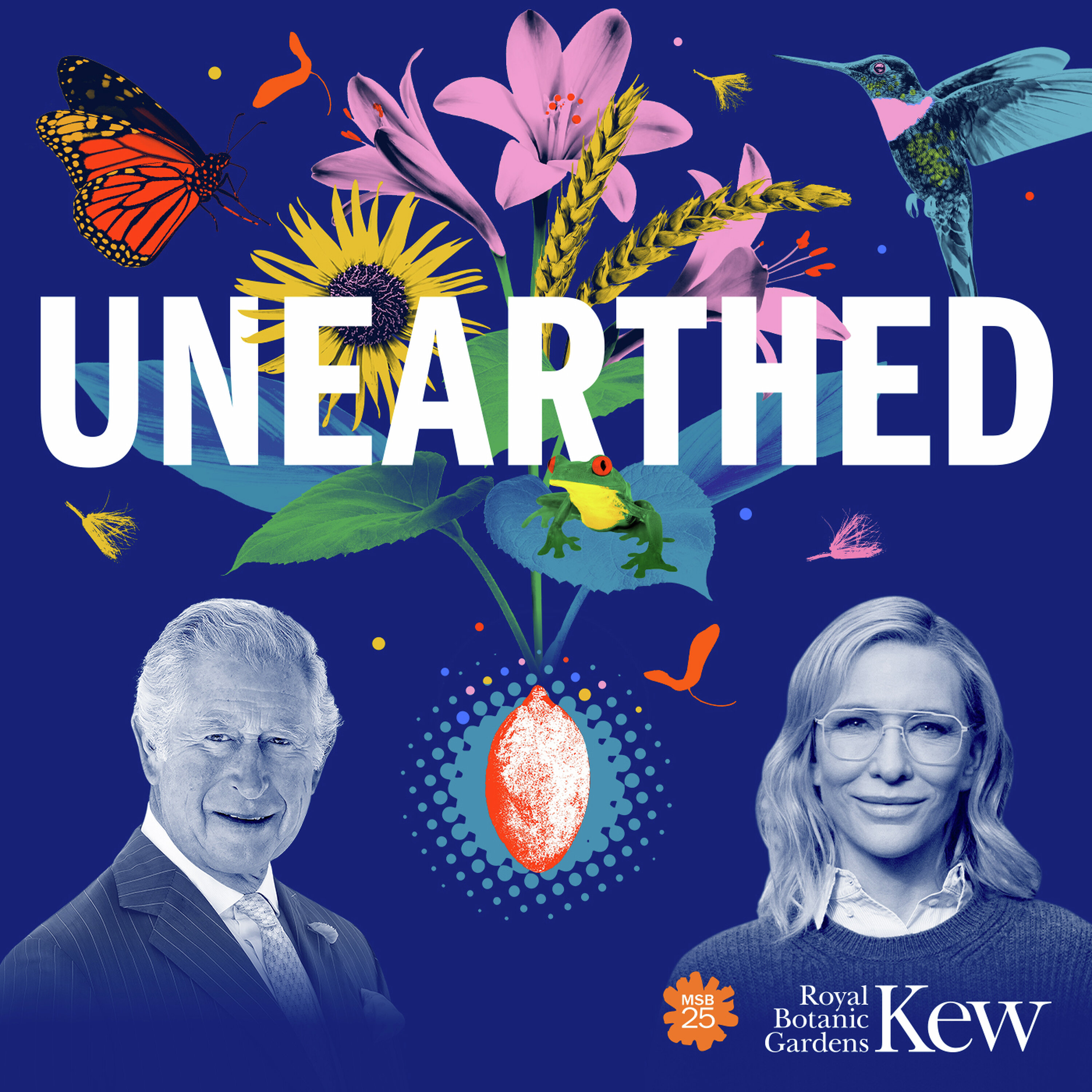
Special episode: With His Majesty the King
Episode Transcript
Welcome to a new chapter of Unearthed from the Royal Botanic Gardens, Kew.
Now, this series is a little bit different for an exciting reason because this year marks the 25th anniversary of the Millennium Seed Bank.
Now, the Millennium Seed Bank is the largest store of wild seeds on earth, and it's also the most biodiverse place on the planet.
The roots of this extraordinary initiative lie tucked away deep in the Sussex countryside at Wakehurst, Kew's wild botanic garden, but its impact stretches far beyond those quiet hills.
You might be thinking, " Well, that's fascinating, but why does it matter to me?" Because the future of life on Earth may very well depend on the seeds stored within this bank.
I'm Cate Blanchett, and I'm so passionate about the Millennium Seed Bank's mission that I've become Kew's Ambassador for Wakehurst.
And the work done here is vital.
But don't just take my word for it.
In this special episode marking a momentous milestone, you'll hear from another voice, one that has long championed the natural world.
On a sunny summer afternoon Kew's Senior Research Leader in Seed Conservation, Dr.
Elinor Breman and I were invited to the private gardens of Windsor Castle where we had the honor of speaking about the Millennium Seed Bank with Kew's patron, His Majesty, The King.
Now you may hear the occasional rumble overhead.
Windsor lies directly beneath a busy fight path.
It's a gentle reminder perhaps that nature is so often interrupted by human activity.
King Charles has a deep connection to the natural world, and this is evident through decades of conservation and philanthropic work.
But you may not know that he opened the Millennium Seed Bank back in the year 2000, and has taken an active interest in its progress ever since.
Dr. Elinor BremanI wanted to take you back to the start of the Millennium Seed Bank.
King CharlesWere you there when I came?
Dr. Elinor BremanI was not, unfortunately.
I wish I had been.
And I wasn't even there when you came back in 2019.
King CharlesReally?
Dr. Elinor BremanBut it's been wonderful to have your involvement and support for all of that time, so thank you so much.
King CharlesNo, because I knew how important it was.
Cate BlanchettIt was such an innovative, state of the art and bold initiative, so future- facing, but now it's just so vital.
And you've been such a pioneer in this space.
King CharlesI do forget that, was it 40 something years ago?
45 years ago?
I remember I became a patron of the Henry Doubleday Research Association, which has now become Garden Organic.
But in those days, it was actually rescuing all the heritage vegetables and fruits and plants and everything.
Because at the time, all the old varieties were being thrown away, wasn't considered as well.
Dr. Elinor BremanThey were being lost.
Right.
Yeah.
King CharlesAnd the same with, that's why I became patron of the Rare Breed Survival Trust, to help with the native breeds matter.
Everything was being shrunk down to the absolute minimum for maximum production purposes.
Anything that was not maximum production was not considered vital.
Dr. Elinor BremanWas gone.
King CharlesBut I just felt it was critical to keep the balance always.
Dr. Elinor BremanThey're very foresighted.
King CharlesBecause you may need them at a later stage.
Don't throw them away.
Dr. Elinor BremanNo.
King CharlesSo it was quite difficult.
I know how absolute critical it all is in the destruction of rainforests, the extinction of endless species which have very likely remarkable properties, medical and everything else, without any concern.
Cate BlanchettYes.
It's sort of we understand the built world and the history, but we don't think about the history contained within a seed.
King CharlesNo, no, no.
Cate BlanchettAnd the importance of...
I only actually became aware of the concept of an allium seed through the work that you've done, so it's been so influential and much appreciated.
King CharlesThank you.
Cate BlanchettBut it's all contained and the Seed Bank 25 years on.
Dr. Elinor BremanI know.
So it was interesting because it relates to that...
The origins of seed banking of wild plants came from agriculture and seed saving.
And then, one of the things at the heart of the Millennium Seed Bank, apart from plant conservation on a global scale, was really that engagement with the public and making them understand the need for the conservation.
So this is a mini seed bank in a Tupperware box.
Cate BlanchettState of the art.
Dr. Elinor BremanState of the art, doesn't get any better than this.
But you can bank seeds to international kind of standards just with this box.
And it was something that we developed just after the Seed Bank opened so that anyone visiting could take a piece of this science and the conservation home with them and feel like it was something they could do.
Getting people engaged in conservation has been such a vital piece of the work.
King CharlesI'm so glad.
Because now what is it?
It's 85% or something of the indigenous plants here are collected.
Dr. Elinor BremanYeah, so we've managed to bank already 85% of the UK's threshened flora.
So there's some seeds that you can't bank.
They just don't like being dried and frozen.
Cate BlanchettRecalciant.
Dr. Elinor BremanRecalciant.
It's a great name for them, isn't it?
But of those that we can bank, we're about 98% there.
So now we're trying to capture more genetic diversity within those, just make sure that we've got them collected from all the populations across the UK.
We've done some great work on UK trees.
And in fact, some elms as part of a conservation program that we've been doing with Natural England are actually out here in the Windsor Great Park.
Yeah.
So we've sent some material back from the brink.
King CharlesWell done.
Yes, yes, yes.
Dr. Elinor BremanWell, thank you for providing a home for them.
King CharlesNo, no, no.
Well, I keep trying to provide homes for lots of these sort of things I get given.
I went to the National Pinetum the other day in Bedgebury.
Dr. Elinor BremanYeah, wonderful place.
King CharlesWhich did start with Kew.
Dr. Elinor BremanYes.
King CharlesWas it in 1925 or was it '29?
Dr. Elinor BremanYeah, it was back in the '20s, I'm not sure which year.
King CharlesBut they've got this incredible collection there.
Dr. Elinor BremanYeah.
No, absolutely.
Priceless.
King CharlesThey've given me something there to try and see if you can...
Dr. Elinor BremanOh, fantastic.
And see if it can grow here as well.
Cate BlanchettI understand there's been a lot of regeneration of this part of the private garden as well.
King CharlesYes.
Cate BlanchettThat's a real labor of love.
This didn't look like this three or four years ago.
King CharlesYeah.
Because I've been making more beds.
I marked them all out where I wanted them.
Cate BlanchettIt's a beautiful design.
King CharlesAnd more trees and things, but trying to keep them going is the problem with this dry weather.
Cate BlanchettWell, to think that you have to drought-proof of garden here in this bucolic isle is...
King CharlesAbsolutely, because the key nowadays I think is I've been trying to do for years is take the rainwater off the roofs and somehow get it onto the garden.
Dr. Elinor BremanYes.
King CharlesAnd the grey water is the other thing I've been trying to show what you can do with.
Cate BlanchettBut what you can do with black water too, it can be purified to drinking.
Dr. Elinor BremanYeah.
Cate BlanchettBut as an Australian, I'm water obsessed.
And in fact, I was really humble, but also inspired by the work that the Seed Bank had done with partner organizations in Australia.
And after the 2019 bushfires at Cudlee Creek, almost 30,000 hectares were destroyed and there were many species that were in danger of being completely wiped out.
But of course, with the South Australian Seed Conservation Center, they had banked over a thousand seeds of a key variety.
Dr. Elinor BremanYes.
It's clover glycine.
It was a rare species vulnerable in Australia, and our partners in Australia had banked it in 2007, but it had only ever been a small collection because there were only a few plants left in the wild.
And unfortunately they were lost during those bushfires, but we were able to send them back the seeds and they could propagate new plants and collect more seeds.
And it's been a really successful reintroduction story.
And I think it just shows the value of seed banking.
It's not a static place.
It's not that we want the seeds to end up in the bank.
They're there for safekeeping.
But the whole idea is they're going to be plants in a landscape, not seeds in a glass jar in a minus 20 freezer.
That's where they need to be for now, but it's not their end story.
King CharlesBecause I was riveted in Australia last year, I managed to go and visit them briefly, the Botanic Gardens in Canberra.
Dr. Elinor BremanYes.
King CharlesBut their particular place where they do the smoke testing.
Dr. Elinor BremanYeah.
So we've got some here.
King CharlesThey told me about all this there.
Senecios, yes.
Cate BlanchettSenecios.
Dr. Elinor BremanSo these are fire- adapted species, so you have to adapt to your environment.
And these guys will only open once a fire has been through.
So this one, the seed pods are still closed.
We had to blowtorch this-
King CharlesDid you?
Right.
Senecios.
Dr. Elinor Breman...
In the lab to get it open because they'll only respond to fire.
King CharlesYep.
Dr. Elinor BremanAnd then these are another species of Leucadendron from South Africa, also only responds to fires.
Cate BlanchettSo these are the Banksia seeds.
There's nothing ugly in nature.
This one is open.
It looks like a series of little mouths, hard little mouths where the seeds have popped out.
And this one is a, well, it's a bit like a toilet brush.
Dr. Elinor BremanIt is a little bit like a toilet brush or a microphone, yes.
It does look a little bit like a cone.
It's not botanically a cone, but it kind of has that feeling of being a cone.
I don't know if you want to smell this, but it smells of smoke.
King CharlesNo, this exactly is.
Dr. Elinor BremanWe put it in as a smoke solution to get the seeds to think that they've been through a fire episode.
And only then will they start to germinate.
So we have to tease out and mimic the environment of all these 40,000 different species that we hold in the bank, because it's so important to know how to turn the seed back into a plant.
That's the vital step in the restoration of all of our global habitats that we're all depending on.
King CharlesRight.
Dr. Elinor BremanSo yeah, I think for me that part of the work of the seed bank is vital and the expertise that people have built up there.
King CharlesBut I wonder how long it took these ones to adapt to the idea of fire was the critical?
Dr. Elinor BremanWell, fire has been-
Cate Blanchett40, 000 years.
Dr. Elinor BremanYeah, exactly.
Part of the landscape for a long time.
Cate BlanchettThese, even though they are fire resilient and have adapted, the last few bushfires, the intensity of the heat has been such that it's making it even difficult for these seeds to survive.
And even though they're part of the regeneration process after a bushfire, it's just so hot that it's a challenge even for these ones to survive.
King CharlesWhich is why I think the great thing is, and another thing I tried to do 35 years ago, was to try and see if I could collate another kind of seed bank of all the indigenous traditional knowledge and wisdom around the world.
But in those days, it wouldn't help in any way.
Cate BlanchettNo.
King CharlesSo now the great thing is there are more and more efforts.
One of my organizations I started, the Circular Bioeconomy Alliance, been trying to help set up these fire resilience initiatives, particularly in Calder that I discovered in Australia because they learned so much from the Aboriginal knowledge and understanding to make sure you'd burn it off.
Cate BlanchettThe mosaic burning.
King CharlesThe fuel load.
Cate BlanchettI had gone to Uluru 25 years ago and two years ago where took my four children back because they'd never been to Central Australia.
And the difference in the landscape, because it had been handed over to Indigenous land managers, was profound.
It was La Nina, so it was very green, but the diversity of grasses and the wildlife that had had been brought back to the base of the rock was just, it made me weep.
It was extraordinary, really extraordinary.
Dr. Elinor BremanAnd nature is resilient.
And if we give her the chance, she will come back.
King CharlesThat's right.
Dr. Elinor BremanSo I see the Seed Bank as buying time to give nature that chance and to be able to have those habitats where we can put things back.
So the plants that I brought along today, there's a cylindrophyllum hallii.
Cate BlanchettFingers, this one looks like a lot of little green squishy fingers.
Dr. Elinor BremanYeah, it's kind of a succulent starbursts really coming out in different places.
And a pachydermic, this is from Madagascar, and actually they're quite ornamental plants.
They're really beautiful.
And unfortunately they're being collected from the world and so becoming endangered.
But our partners, both SANBI in South Africa and SNGF in Madagascar are doing a really great job of, they're creating a little arboretum with some that have been seized in Madagascar.
And in South Africa, they're doing a really great job of trying to stop the illegal poaching and trade in succulent plants as well.
So I just feel anything we can do to give nature a hand.
King CharlesAbsolutely.
So do these get bigger?
Dr. Elinor BremanThey're going to get much bigger, yes.
That one's going to not go too much bigger because of the pot size it's in at the minute.
King CharlesYes.
Dr. Elinor BremanBecause the glass house is only so large.
King CharlesBut it could get more.
Dr. Elinor BremanYeah, they can get a lot bigger.
Yes.
King CharlesAnd is it growing literally in virtually nothing, is it?
Dr. Elinor BremanYeah.
It's a very nutrient poor medium, yeah.
And we have two collections in the bank of this species and a lot more of the cylindrophyllum.
That was down to only six individuals in the wild.
King CharlesBut this one?
Dr. Elinor BremanYes.
King CharlesThese ones, do you treat them the same way?
Are they better being dried or frozen or what?
Dr. Elinor BremanSo the seeds are being treated in the same way.
So in our Seed Bank, 85% of plants produce seeds that we call orthodox.
So they can withstand drying to 15% relative humidity, a bit like a long haul flight, I always say.
And then...
Cate BlanchettThat was a bad thinking about.
King CharlesI don't know.
I wouldn't know.
Dr. Elinor BremanYou'd be preserving on the flight.
Let's look at it that way.
And then, in an airtight container at minus 20.
So then that extends their natural lifespan for tens to hundreds of years, which is amazing.
So it provides an opportunity not just for today, but for future generations.
King CharlesAnd are you increasing the number of collaborators around the world who are able to help with the collections?
Dr. Elinor BremanSo I think that's been the real strength of the Millennium Seed Bank is its global partnership.
And over the last 20 years, we've worked with a hundred different countries and territories to help them conserve their native flora.
And I think that's almost 300 partners, different institutes.
And we have a large training and capacity building program because ideally I'd almost love to put us out of business.
I would like all of our partners to have the means and the wherewithal to be doing this on their own and conserving their own native flora without any need for our support.
And then with our partners, all the seeds are stored in the country of origin and a part of it is sent to us to safety duplication.
Yeah.
You always need that extra insurance policy.
Cate BlanchettBut there is an urgency to the work that the Seed Bank does here in this country.
I was shocked to learn that 97% of the wildflower meadows have been decimated.
I don't think it's something that we quite understand here.
Dr. Elinor BremanNo.
Cate BlanchettBecause we look around us and in the immediate term we see so much natural beauty, but we don't think about how fragile it is.
Dr. Elinor BremanYeah.
And the fact that unfortunately, the UK is already biodiversity- depauperate from the starting point as well.
So we've got a lot of diversity to put back into our own landscapes, and we're doing a lot of restoration work across the chalk grassland and also working with partners all across the Four Nations.
I think we've done about a hundred different restoration projects over the years, which is fantastic; seeing the seeds leaving the bank and going to their rightful homes.
King CharlesWell, I did manage to get an initiative going called the Coronation Meadows to celebrate my late mama's anniversary of her coronation.
But I thought it was a good excuse-
Cate BlanchettTo highlight that.
King CharlesBecause I knew about that real damage has been done to all our flower- rich meadows since the war, really.
Cate BlanchettReally in that short a space of time.
King CharlesAbsolutely incredible, because what you can destroy in one day by just plowing it up takes practically a hundred years to replace.
And it requires constant management, the same management to create this remarkable diversity.
And I've seen it in Transylvania, it's even more unbelievable.
Dr. Elinor BremanOh, a spectacular.
King CharlesI'm trying to rescue some of those meadows before they get destroyed because they're unique.
Cate BlanchettAnd what's the difference between them, forgive my ignorance, the meadows there and here?
King CharlesWell.
there's a lot of similarity to what we would've had in the medieval times.
Cate BlanchettI see.
King CharlesI think.
There was a terrific arrangement amongst the local communities as to how they managed it all and shared the effort.
And so on the same, the management of the forests.
Cate BlanchettRight.
So they didn't have big large- scale industrial farming.
King CharlesNo, no, no.
Cate BlanchettSo that meant that they could preserve them.
Right.
King CharlesAnd it somehow went on and on and on, same way.
And that's what's enabled many of these meadows to have something like 17 or 18 or something different species of orchid.
Dr. Elinor BremanYeah.
And it's stunning, the diversity there.
We worked with partners in Romania to help conserve the diversity and across the whole mountain chain as well, because there's so much unique diversity there.
It's absolutely stunning.
King CharlesNo, I think it's wonderful what the Seed Bank is doing, but we've got to speed up the process.
Dr. Elinor BremanWe need to ramp it up.
Cate BlanchettYeah.
Dr. Elinor BremanThe idea moving forward is to take advantage of a lot of the technologies that have come in over the last 25 years.
We really need to upscale and improve, make use of high- throughput screening for genetics, for traits, for image- taking.
There's so much information held within each seed- ...
that we need to access much, much more quickly.
King CharlesYes, isn't there.
Dr. Elinor BremanAnd also, we need to scale up our conservation efforts unfortunately, because 45% of plant species are now threatened with extinction, so almost half of the plants around us, which unimaginable.
And I do think there's an education piece in that people take plants for granted still despite your years of work and others'; they don't understand their relevance to the life, to the fact that literally the air we breathe would not be here without the plants.
Cate BlanchettAnd also I suppose to enable your partners to build not necessarily facilities that will survive an airplane crash or a nuclear disaster as the Seed Bank will, but to have the capacity.
Dr. Elinor BremanExactly.
Anybody can do seed banking.
And we have a lot of partners who don't have regular electricity supply, but they can still bank seeds to international standards and conserve their flora and all of that hope and possibility for their future.
Cate BlanchettYeah.
King CharlesBut you would think that we try to encourage the pharmaceutical sector to see that actually it's surely in their interest to invest in the protection and enhancement and restoration of this biodiversity from which so many actually of the treatments we are looking for have already come from.
Dr. Elinor BremanExactly.
King CharlesSo it's surely in their interest to do that.
But one of the greatest things I've discovered is there's only at the moment the carbon credits market, which is not as good as it could be.
There's no biodiversity credits set up.
So this is being tried to be established now, because that would revolutionize the opportunities for investment in the restoration of biodiversity.
Dr. Elinor BremanDefinitely.
Kew is involved in a lot of those conversations as well around biodiversity credits and how we can ensure that all of these large schemes under the current global biodiversity framework to restore and maintain natural habitats don't do any harm and actually enhance biodiversity rather than harming it in tree planting schemes or others.
So we need to monitor that.
King CharlesSo the only way to do that is to make sure we have ecosystem services payments.
Dr. Elinor BremanExactly.
King CharlesSo you make the-
Dr. Elinor BremanIt needs to be valuable.
King CharlesYou make the trees more valuable alive than dead.
Dr. Elinor BremanDead.
Yes.
King CharlesAs timber.
Dr. Elinor BremanYes.
King CharlesIf they're particular species of it.
That's why, again, I feel that agroforestry is such an important and underutilized forgotten technique, which could make a dramatic difference in restoring degraded land rapidly.
Dr. Elinor BremanWe've seen that with some partners of ours in Mexico, and the Veracruz state with the coffee plantations.
It was all kind of open and it used to be cloud forest.
And cloud forest, I think it's only less than 1% of Mexico.
King CharlesWhat's cloud forest?
Dr. Elinor BremanIt's forest which is at kind of high elevation usually.
King CharlesRight.
Dr. Elinor BremanAnd then, it draws in its moisture from the cloud rather than from rain.
It's quite a remarkable system.
But we found some native species with working with local communities that they want to propagate.
King CharlesThat's right.
Dr. Elinor BremanAnd they're using those as a shade over the coffee now.
King CharlesThat's right.
Dr. Elinor BremanAnd set up community nurseries.
They get an income from the nursery.
They're growing the species that they are going to have a use from, and it's producing better coffee.
King CharlesRight.
Dr. Elinor BremanSo you need to find those win- win- wins, don't you?
And then it all happens.
King CharlesBut agro organisations are doing exactly that in Ethiopia.
And they can now demonstrate that within five years you can transform a degraded landscape into something that looks like a forest.
And instantly the biodiversity increases: the insects, the birds, the bees.
Everything starts to come back.
Cate BlanchettYeah.
The only frustration for me about inaction on climate change is that there's so many extraordinary initiatives right there ready to be scaled up.
There's a willingness there, but there's just, there's not the direction of the funds.
King CharlesAnd there's that lack of awareness too, as you were saying about the actual detail of all these things.
Dr. Elinor BremanI know.
King CharlesLet alone the role of pollinating insects.
Dr. Elinor BremanI know we're always told to not have too complex a message, but nature is complex.
Ecosystems are very complex, and every part needs to be there for it to work.
Yeah.
King CharlesBecause everything's interconnected.
Wonderful.
Thank you very much.
Cate BlanchettThank you so much for making the time.
King CharlesNot at all.
Dr. Elinor BremanYeah.
Cate BlanchettWith us.
King CharlesWell, I hope it helps.
Dr. Elinor BremanIt does.
King CharlesIt's so wonderful that you're doing so much to help.
Dr. Elinor BremanIt helps enormously.
Cate BlanchettBut your example and your activity in this space have been, they're legendary.
Dr. Elinor BremanWorld- leading.
Cate BlanchettSo thank you.
King CharlesYou're kind to say so.
I'm not sure how much it's achieved anyway.
Dr. Elinor BremanAn awful lot.
King CharlesWe hope.
Well, I'm very proud to be patron of Kew.
That's a great thing.
Dr. Elinor BremanWell, thank you so much.
King CharlesIt does wonderful work.
Cate BlanchettThat was His Majesty The King, a proud patron of Kew and a remarkable voice with which to start this story of the Millennium Seed Bank.
And this is just the beginning.
From the grasslands of Southern England to the humid landscapes of Thailand, the forests of Southern Australia and even into outer space, in this series we will travel far and wide.
From visionary scientists to intrepid seed collectors, we'll meet the extraordinary people safeguarding our planet as we explore the past, the present, and the vital future of the Millennium Seed Bank.
I'm Cate Blanchett, and this is Unearthed: The need for seeds.
Follow us wherever you get your podcasts so you won't miss a moment.
Until next time, thanks for listening.