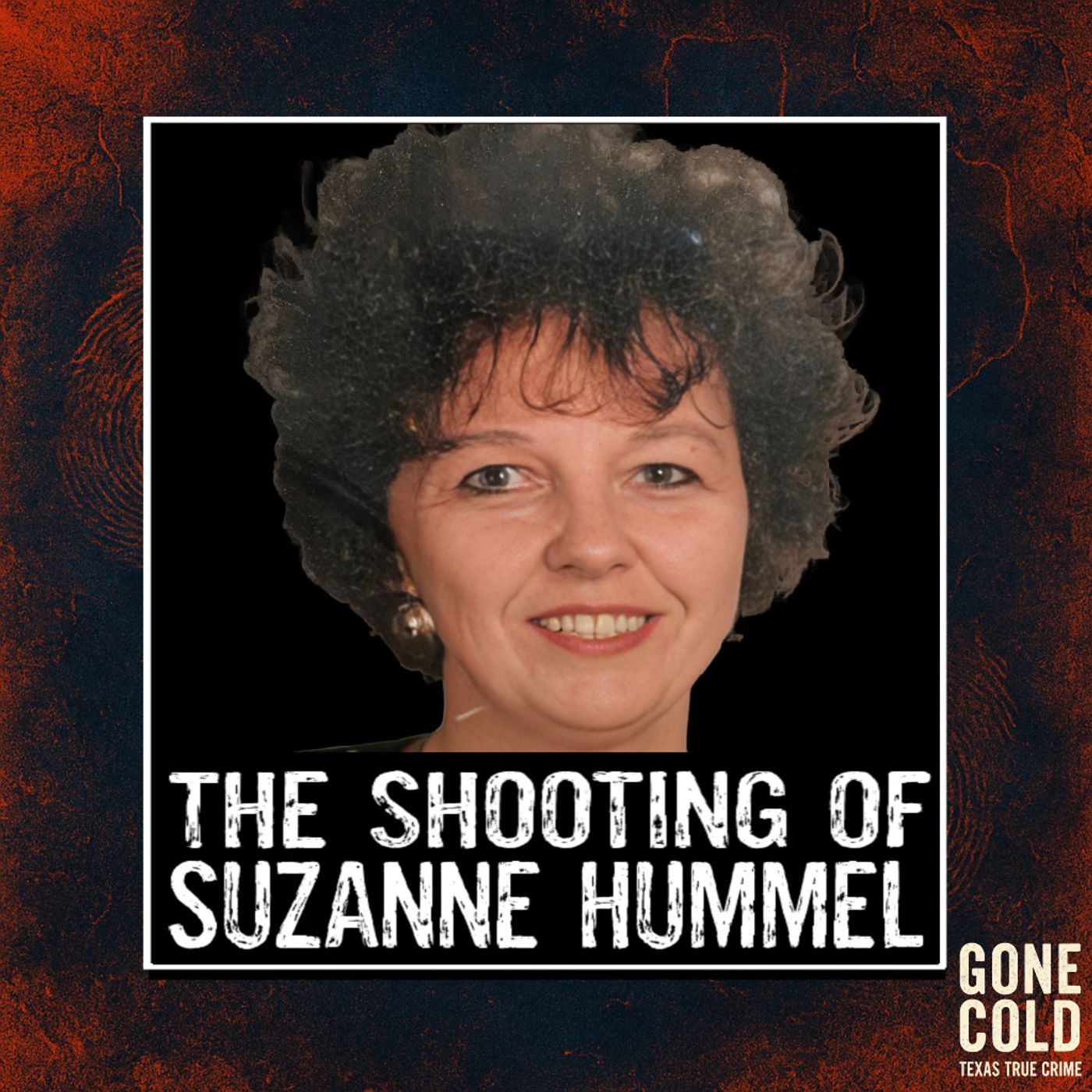
The Shooting of Suzanne Hummel
Episode Transcript
Gone Call podcasts may contain violent or graphic subject matter.
Listener discretion is advised.
The air was cool in Houston on a morning in November of nineteen ninety two.
A quiet chill hung over the Rice Epicurean Market parking lot at Kirby in West Alabama, a place most people believed nothing bad was likely to happen, especially in broad daylight, before the rush of the day peaked, before the sun burned off the haze.
A woman sat in her car eating breakfast.
She had somewhere to be, responsibilities waiting on her and people counting on her to get there, But she had time a little, and she chose to take a few minutes for herself.
Parked in a place she'd come to trust, that small sliver of morning peace was the last thing she would ever choose.
The woman had driven into Houston from Richmond, about thirty miles to the southeast, as she did every weekday.
Working in the city meant making concessions, beating traffic, stretching the morning hours, finding someplace safe to wait until she could get inside the office.
She had picked up breakfast at a fast food restaurant near Kirby and the South freeway, then crossed over to the grocery store parking lot.
It was something she did regularly, an action not designed for safety necessarily.
Rather, it was simply a routine.
But as she sat in her car that morning, the unthinkable happened.
It was seven thirty am on Friday, November thirteenth, nineteen ninety two.
Suzanne Marie Hummel, a divorced, single mother of two girls, sat inside her nineteen eighty eight Ford Taurus, eating her Burger King breakfast, drinking coffee, and maybe reading or applying makeup before heading across the street to Don Brelsford Insurance Agency, where she worked as a certified Customer Service representative.
The agency didn't allow employees in before eight am, and she didn't have a key, and so she waited, filling the gaps left by schedules made without women like her in mind.
Suzanne was thirty nine years old with two teenaged girls, Gretchen seventeen and Emily fourteen, both of whom knew very well that their mama moved mountains to make ends meet.
Neighbors and friends remembered her always rushing trying to get home through Houston traffic to make a volleyball game or girl Scouts event.
She laughed hard, worked harder, and made sure those girls felt supported, even when she worried privately that she couldn't give them everything she wished she could.
Responsibility was Suzanne's instinct.
Efficiency was her habit.
Those things kept her safe until they didn't.
Around Suzanne, the parking lot was filling people walking into the upscale grocery store.
Shoppers and commuters passed with coffee cups, handbags, and briefcases, all assuming that the sun hung high enough to keep danger far away.
A woman approached Suzanne's driver's side window.
Detectives would later theorize that the woman may have asked a question first directions, perhaps some pretext that allowed her to get close without raising alarm.
The window must have been lowered at least part way.
It was chilly that morning.
She almost certainly would not have had it down before someone walked up to her.
Then came the demand.
The stranger wanted her purse.
It probably happened fast.
Maybe Suzanne hesitated a moment of shock at the audacity of a robbery in broad daylight.
Maybe she refused outright, believing the presence of so many others would keep her safe.
The woman, however, pulled out a small caliber firearm.
Investigators later confirmed it was a twenty two handgun.
She fired one shot, tore through Suzanne's left arm, continued into her chest, and struck deep enough to steal her breath.
The robber snatched her purse, its contents later found scattered on the ground, and ran.
Witnesses heard squealing tires, suggesting a getaway car waited nearby.
In a packed lot full of potential onlookers, she disappeared faster than anyone realized what had happened.
Suzanne fought her survival instinct kicked in.
With the last of her strength, she leaned on her horn, pressed her foot down, and drove through the lot, rolling into a metro bus stop enclosure along West Alabama Street.
People ran to her aid.
She tried to speak, tried to help identify whoever had done this to her.
She managed five words, A black woman shot me.
Then consciousness slipped away.
She never regained it.
Paramedics rushed her to ben Toob Hospital, where surgeons raced to save her life.
Her family was called, but at ten forty am the news came Suzanne was gone.
Her parents, who had arrived in Houston just the night before from Michigan, were at her house when the call came in.
They drove to the hospital with Suzanne's sister, Brigetta, whose birthday it was.
Suzanne had left a pot of coffee warming and a birthday cake waiting on the kitchen counter.
When her family reached the hospital, doctors told them Suzanne wasn't coming back for nearly a week.
Afterward, her sister couldn't accept it.
She expected Suzanne to walk back in the door, expected the nightmare to end.
Suzanne's daughters, both still in school, were forced to face a reality.
Their mother had always feared that something could happen to her and they'd be left without enough left without her.
Meanwhile, police were stunned by the audacity of the crime, a shooting in the daylight in a high traffic area bordering River Oaks, a neighborhood where crime wasn't supposed to intrude, not like this.
Nearby workers talked to reporters shaken and afraid.
A woman in her twenties said she'd eaten in that same lot probably one hundred times.
Another shopper said she'd always feared someone breaking into her car, but never once thought about being attacked there herself.
Detectives made it clear there is no such thing as a perfectly safe place.
If an area becomes popular with affluent customers, thieves will come eventually.
Opportunity isn't deterred by zip codes.
Houston Police Department Homicide Sergeant Doug Bacon took the lead on the investigation, working closely with Sergeant T.
C.
Bloyd.
They only had fragments a female sub almost certainly a black woman, as Suzanne said, a small handgun, a purse taken, a vehicle speeding away, possibly white, according to at least one witness, morning traffic thick enough to hide a getaway, and no one who actually saw the confrontation.
Yet the parking lot was busy, the streets were busy, Dozens of eyes moved through the area.
You would have thought somebody driving by would have seen something, Sergeant Bacon said, but no one did, or no one admitted it.
The robbery itself confused investigators.
Women commit robberies, They noted it certainly wasn't unheard of, but they rarely escalate to lethal violence, and this particular attack seemed purposeful, not panicked.
Some with Houston PD even considered the possibility that the suspect may have been a man dressed as a woman.
Given the proximity to Lower Westimer, where male sex workers sometimes dressed in drag.
It was a stretch to be sure, but nothing in the evidence could rule it out.
Police canvassed the area, checked robbery cases with female suspects, and waited for tips.
They pushed through media and designated the murder a crime Stopper's Crime of the Week, offering a reward and asking anyone with information to come forward anonymously.
But days passed, then weeks, then Thanksgiving.
Thanksgiving was a holiday meant to reunite Suzanne Hummel's family, but now served only to underscore their loss.
Her parents, her sister, and her girls sat down to a table that should have held joy and found only absence.
Her sister said it felt wrong, as if they were all waiting for someone still on the way home.
On the police side of things, the investigation struggled to progress.
There were no leads, no witnesses, no forward movement.
Detectives continued to hold onto the hope that the purse would unlock a lead.
Suzanne carried twenty one credit cards, a robber desperate enough to kill might be careless enough to use them, and if they did, detectives would finally have a lead.
But not a single card was ever used.
They probably did it for the cash and dumped the cards.
Sergeant Bacon later said it pointed to someone who knew better than to risk it.
Detectives kept the case file on the move, from Bacon's desk to Bloyd's and back again, doing what they could when time allowed in a department overloaded with death.
They admitted the reality sometimes a case is solved not by detective work, but by what they called the magic phone call.
Someone hears something, someone talks, someone tells the truth.
But Suzanne's murder had the misfortune of competing for public attention with another tragedy the very same day, the brutal, high profile murder of the Coulson family, also in Houston.
Broadcast news and newspapers zeroed in on the sensational five family members slaughtered, overshadowed one woman robbed and killed while eating breakfast.
Public memory shifted overnight, but Houston police detectives didn't forget.
Suzanne's daughters couldn't forget, nor could her parents or siblings.
Her case lingered, suspended, cold waiting.
Detectives Bloyd and Bacon felt in their gut that there was a witness out there somewhere.
Someone saw something, someone knows something.
Someone out there made eye contact with Suzanne's killer, perhaps maybe without even realizing what they were looking at.
The lawmen did what they could cross referenced robberies committed by female suspects across the Greater Houston area, but there weren't many cases matching the profile.
A woman firing a gun during a purse robbery was unusual.
Robbery itself wasn't anything new, but the violence in this one wasn't the norm.
So they looked for outliers, anyone who stood out, anyone with a history of taking what wasn't theirs while carrying a gun as backup.
But finding a single robber in the fourth largest city in America, someone who could just blend in, who might have left town, who may have disguised themselves, became a daunting task.
The detectives also believed the shooter likely didn't flee alone.
The sound of tires squealing just after the gunshot suggested a second person was waiting in a getaway vehicle.
It seemed like a detail that would work to their advantage if they were just patient.
Two criminals meant more opportunities for someone to brag or to slip.
Two mouths capable of talking, but if anyone talked, none of those words ever found their way to the police.
A year passed, then more the case file traveled back and forth between detectives' desks, reopened when they could spare minutes between new murders and active investigations.
The weight of backlog grows fast.
In Houston.
Detectives admit that solving a case often comes from the right phone call, a conscience that finally gives in a relationship that sours a secret overheard.
Those calls happen more than the public realizes.
The moment someone picks up the phone is often the difference between justice and silence.
But Suzanne's case didn't get that call.
Maybe someone knew something but didn't want the trouble.
Maybe they didn't want to be a witness, or maybe they never realized what they'd seen until much later, when the details were too blurred By time, Suzanne's family tried to live inside the empty space left behind.
Her daughters, Gretchen and Emily faced milestones without their mother.
They were smart girls, active in sports and school and community.
They had a mother who cheered on every success.
She ran herself ragged to make every game, every meeting.
Now the stands were missing her presence.
Friends and neighbors tried to help.
A community bank in Sugarland created a benefit fund to support the girl's education.
The dreams Suzanne talked about constantly.
One daughter had only months until graduation, the other was still in junior high.
Suzanne's parents had come to Texas expecting to spend happy days with their daughter and granddaughters, her brother and sister too.
Instead, they stood beside hospital machines as they got word that Suzanne was gone.
Years passed without resolution, and then came another fight, not for a suspect, but for what the family saw as accountability.
In nineteen ninety eight, Suzanne's family brought a wrongful death lawsuit against Rice Food Markets and the security companies responsible for the shopping center.
They argued negligence, that safety in the parking lot was insufficient, that what happened to Suzanne was preventable.
The case was initially shifted to Harris County, where it was dismissed, but the family appealed and the Fourteenth Court of Appeals reinstated the case.
It was sent back to Fort ben County for further action.
That ruling didn't change the outcome for Suzanne.
It did, however, give the family what the criminal investigation had not, a step forward.
Justice remained distant.
Detectives Bacon and Bloyd kept the files circulating when they could.
They continued to believe that someone must have seen something.
A hurried woman, a mismatched pair near a car, a flash of panic, even a stray comment after the fact could hold value.
But the phones stayed silent.
The case today remains open.
It was a case that was culled from the get go.
Suzanne Hummel left her house early to beat traffic.
She bought breakfast to fill a few moments of waiting before work.
She parked in a spot she believed was safe.
She thought of her daughter's futures of birthdays, weekends and college tuitions, and late night conversations with teenagers who still needed their mom.
She did everything right that morning.
The person who took her purse also took everything else.
There is no way to measure the hole left behind cases like this, don't they wait for someone willing to speak, A witness who thought what they saw wasn't important, a memory pushed aside, or a secret someone no longer wants to keep.
The smallest detail could make a difference.
A woman seen hurrying away, a car that didn't belong, a flash of something off in the corner of an ordinary mourning.
Those details, even now, could be enough.
Because Suzanne's story isn't a mystery, it's a wound, and wounds demand answers.
Perhaps someone does know the truth, and her daughters deserve to hear it.
If you have any information about the murder of Suzanne Murray Hummel, please contact the Houston Police Department's Homicide Division Cold Case Unit at seven one three three zero eight thirty six hundred or crime Stoppers at seven one three two two two eight four seven seven.
If you'd like to join con Coold's mission to shine a light on unsolved homicides and missing persons cases, get the show at free and have access to bonus content, you can at Patreon dot com Slash Gone Cold podcast.
You can also support the show by leaving a five star rating and written review on Apple Podcasts or Wherever else you listen, however you choose to support Gone Cold, we appreciate you.
Thanks for listening, y'all,