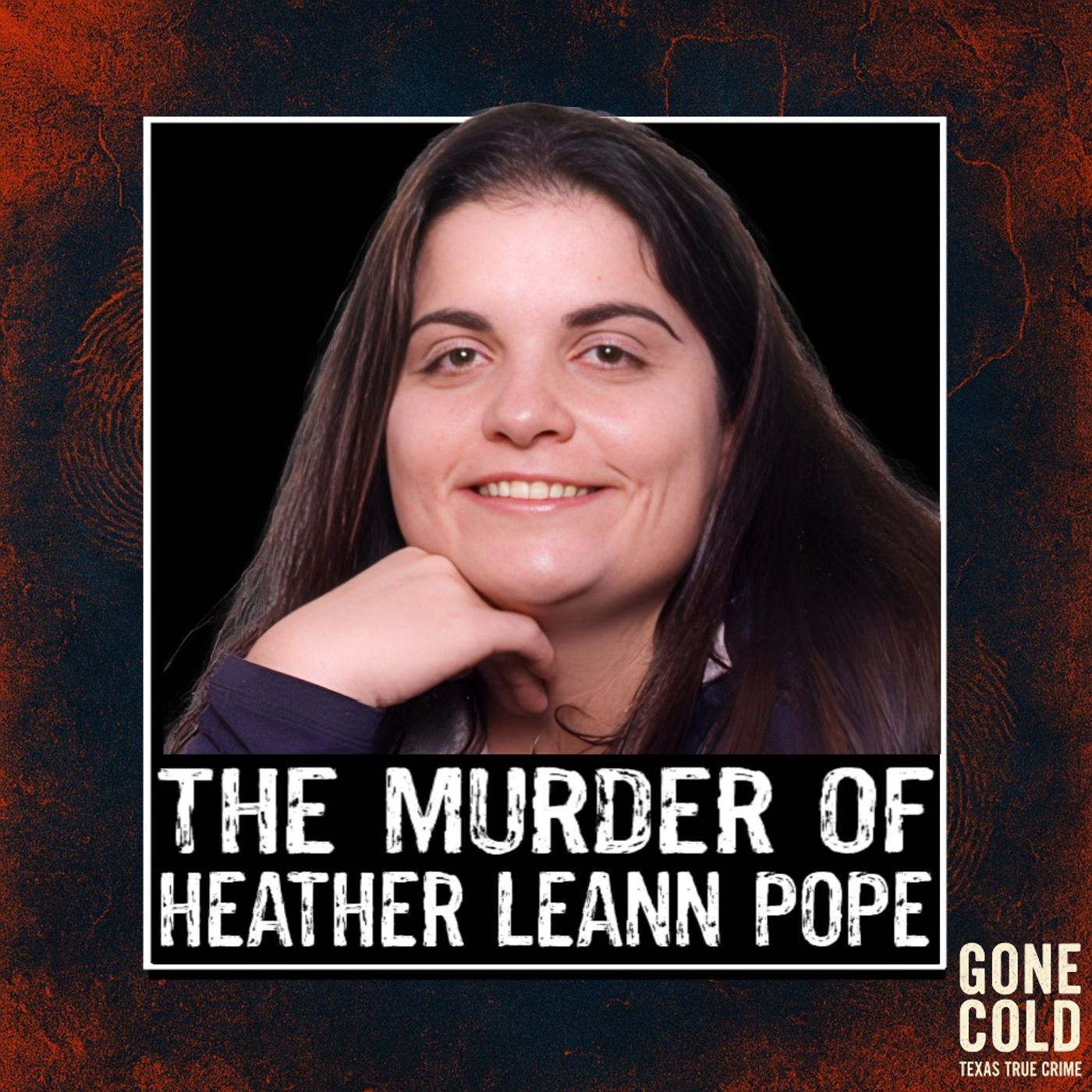
The Murder of Heather Leann Pope
Episode Transcript
Gone Cold.
Podcasts may contain violent or graphic subject matter.
Listener discretion is advised.
The last days of July in Hunt County, Texas pressed down on you.
The air is thick, the heat lingers long after the sun goes down.
In places like Royce City and Quinlan, summer isn't merciful, but instead heavy and unrelenting, stretching days into weeks that seemed to all blur together.
In July of twenty ten, Heather Pope disappeared into that heat.
She was twenty nine years old, a daughter, a sister, a woman known for her kindness, her laughter, and her habit of talking to strangers like they were old friends.
When she left her mother's house one summer afternoon, she had no way of knowing it would be the last ordinary moment of her life.
Heather Leanne Pope was born January thirty first, nineteen eighty one, in Dallas, Texas.
She grew up in Royce City, where she attended church, went to school, and built the kind of reputation that doesn't come from trying, it comes from simply being yourself.
As a child, Heather was bubbly and outgoing, though her family eventually realized something was different.
She was hearing impaired, something that wasn't discovered until she reached junior high.
For years, she spoke louder than others and sometimes responded in ways that didn't quite fit the conversation, not because she didn't care, but because she couldn't fully hear what was being said.
When Heather finally received hearing aids as a teen, it changed everything.
Her mother, Carla Pope, later recalled riding in the car with her daughter as rain hit the windshield.
Heather asked her, Mama, is that the rain I hear?
It was a small moment, but it stayed with Carla, a reminder of how much of the world Heather had missed and how much joy she found once she could finally hear it.
Heather wasn't hardened by that struggle.
If anything, it shaped her.
She was known for her kindness, her ability to talk to anyone, for treating people the same, regardless of who they were or where they were from.
Family members would later say Heather never met a stranger, and that quality, the one that made her so easy to love, may have also made her vulnerable.
By twenty ten, Heather's life hadn't followed a straight path.
She had moved around and worked different jobs.
After years of instability, she had recently moved back in with her mother and Royce City, trying to find her footing again.
Her aunt, Paula Edge, would later say Heather was lost but finding her way.
In the early two thousands, Royce City was changing.
For most of its history, it had been a small North Texas town shaped by farmland, family names and routine.
But as the Dallas Fort Worth metroplex expanded east, Royce City found itself directly in the spillover zone.
Interstate thirty transitioned from a boundary into a pipeline.
Subdivisions replaced open land.
Brick homes went up quickly, filled by families priced out of Dallas and rock Wall.
Many residents worked blue collar or service jobs construction, retail, transportation, local trades, while others drove long hours each day to offices, warehouses, and industrial parks farther west.
It was a working class and lower middle class town built on long commutes, tight budgets, and steady routines.
Growth came fast, sometimes faster than the town could absorb it.
Schools expanded, traffic thickened.
Longtime residents watched a quiet place change almost overnight, while newcomers tried to fit into a community that still moved at a small town pace, church on Sundays, football on Fridays, and familiar faces all around.
By twenty ten, Royce City had more than tripled in size since the start of the decade.
It was no longer rural, but not fully suburban either.
It was a place in transition, adjusting to growth and what it meant to be, a town that was still figuring out what it was.
On July twenty third, twenty ten, Heather Pope told her mother she was going to visit a friend.
It wasn't unusual.
Heather often spent weekends away, staying with people she knew.
She was independent, social and accustomed to coming and going.
But there was one thing Heather always did.
She checked in.
So when days passed with no phone call, no text, no sign of her, Carla Pope began to worry.
Her daughter's silence didn't feel right, it didn't fit.
Carla called Heather's father, Randall Pope.
Though divorced for most of Heather's life, Carla and Randall remained close, united by their love for their daughters.
He hadn't heard from her either.
Both parents felt the same growing dread something was wrong.
A week after Heather disappeared, her parents reported her missing to the Royce City Police Department.
For the next eleven days, Heather's family searched.
They searched Royce City, They searched areas of Hunt County where Heather had friends.
They drove roads, checked familiar spots, asked questions, the kind of desperate, exhausting searching that families do.
When answers refused to come, Carla remembered something important.
Heather often spent time at a convenience store in the Quinlan area of southern Hunt County.
It was a place where she knew people, a place where she felt comfortable.
On August three, twenty ten, Randall, Pope and a family friend went out searching again.
Carla suggested they stop at the store, ask around and see if anyone had seen Heather.
They did, and no one had.
Behind the convenience store sat a vacant house along Cedar Hill Road.
The area was quiet, overlooked, and easy to ignore.
Randall and the family friend decided to walk the land behind the store, and that's when they found her.
Heather Leanne Pope's body was laying on the ground under a tarp next to the vacant house.
It was one of the hottest days of the summer.
Hunt County Sheriff's Lieutenant Roger Seals responded to the scene.
He later said it was clear Heather had been there for some time.
Her body was badly decomposed exposed to the relentless Texas heat.
The scene told investigators this wasn't an accident.
Heather had been killed, and autopsy would later confirm the cause of death blunt force trauma to the head.
She was twenty nine years old.
From the beginning, the investigation faced challenges.
Heather's body was found outdoors in extreme heat, nearly two weeks after she was last seen.
The condition of the remains limited the physical evidence investigators could recover.
Lieutenant Seals later acknowledged that the lack of usable evidence made it difficult to place anyone else at the scene.
The Hunt County Sheriff's Office launched a homicide investigation.
They canvassed the area, They conducted interviews, They searched for leeds, and very early on, attention turned to the people Heather had been spending time with in the days before she vanished, Heather's mother believed someone she knew was responsible for her death.
Carlo Pope later told Dateline NBC she believed Heather had befriended a man who became angry after being rich.
She described it as a crime of passion.
Someone told no one too many times.
Twenty nine year old Heather Leanne Pope's funeral and August twenty ten revealed something her family hadn't fully realized.
More than six hundred people signed the guest book the church had filled.
Folks had lined up outside.
Strangers approached Carla Pope one after another, telling stories of how Heather had touched their lives, how she was kind, how she made them laugh, how she treated everyone the same.
Heather Pope didn't live quietly, and she didn't disappear unnoticed.
The place where she was found wasn't remote in the way people imagine when they think of crimes going undiscovered.
It wasn't in deep woods or miles from civilization.
It sat just off Cedar Hill Road in the Duck Cove area of southern Hunt County, near Lake Tawaukene, close enough to a convenience store that people passed through daily, and that fact alone raised uncomfortable questions.
Someone knew Heather was there, someone believed no one would look.
But despite all the obstacles in the case of Heather's murder, the advanced state of decomposition, the lack of evidence, the Hunt County Sheriff's Office moved forward with what was reported to be an intense investigation.
In the weeks following the discovery, detectives conducted interviews with people known to frequent the area, including individuals who had spent time behind the convenience store near where Heather's body was found.
Investigators learned that several people had been hanging around the vacant house and surrounding property during the time Heather was missing.
That information prompted a search warrant.
The house was searched, items were collected, evidence was sent to laboratories for testing.
Results, however, were slow.
By December of twenty ten, Sheriff Meeks acknowledged publicly that investigators were still waiting on forensic results, even as new leads were being examined.
He was careful with his words, confirming progress without disclosing specifics.
No arrests were made, no suspects were publicly named.
After some time had passed, the Sheriff's Association of Texas's Cold Case Review team became involved.
By twenty thirteen, three years after Heather's murder, Shareff Meeks reaffirmed that the case remained open and active.
Additional evidence had been collected and sent to Texas Department of Public Safety crime labs.
Interviews continued.
The investigation had not stalled, It simply had not reached resolution.
For Heather's family, that distinction mattered.
An open case meant hope, but it also meant living without answers.
As the years passed, media coverage increasingly focused on Heather as a person, not just a victim.
She had struggled, She had bounced between jobs and places.
She had fallen in with people her family worried about.
Her mother and aunt were open about that, not to diminish her, but to tell the truth.
Heather was not perfect.
She was human.
What mattered most was that she was kind.
She spoke to everyone, she gave people chances, and she trusted easily, perhaps too easily.
Carla Pope later said she believed that trust was what put Heather in danger, her ability to like people for who they were without judgment without hesitation, may have brought her into contact with someone who didn't value her life the same way.
Investigators confirmed that at least one person of interest was questioned multiple times in connection with Heather's murder.
That individual was known to Heather, but questioning was not charging.
Lieutenant Roger Seals made it clear there was not enough evidence to move forward with an arrest.
Still, no one had been cleared.
The door remained open, and maybe a key piece of evidence or an eyewitness account can break the case wide open.
But it also means the case sits in the difficult space between suspicion and proof, where families are left knowing someone somewhere holds the truth.
In April of twenty nineteen, Heather's family took action.
A decade after the brutal fact they were still searching for answers.
Of course, they met with Hunt County Crime Stoppers and contributed eight thousand, five hundred dollars of their own money to increase the reward for information leading to an arrest to ten thousand dollars.
In rural investigations like this one, progress often moves quietly.
There are few witnesses, few cameras, few accidental records of movement.
People know each other, and sometimes that familiarity makes them reluctant to speak.
Heather Pope's case carried all of those challenges.
Her family had searched for her themselves, her father had her body, and once the initial shock faded, they were left with the hardest part of it all waiting.
In July of twenty twenty, Dateline NBC revisited the case.
Carla Pope spoke openly about the pain of time passing without justice.
She talked about the summer Heather vanished, how ordinary it seemed at first, and how quickly it turned into something unrecognizable.
She spoke about Heather's funeral, about the hundreds of people who came forward to say goodbye, about realizing only then just how deeply her daughter had impacted others.
And she spoke about anger, not just grief, anger that someone could take Heather's life and walk away, and anger that answers were still out of reach.
The reward money they'd come up with on their own, the eighty five hundred dollars Dy'd added to Crimestopper fifteen hundred wasn't symbolic.
It was a message that Heather's family wasn't giving up.
As of the most recent reporting, that reward remains in effect.
Today, Heather's murder remains unsolved.
The Hunt County Sheriff's Office continues to list the case as active and open.
Investigators have stated publicly that they remain willing to review new information, re examine evidence, and conduct additional interviews.
No suspect has ever been publicly charged, let alone named.
No one has been cleared, and someone somewhere knows what happened to Heather.
She wasn't even thirty years old when she died.
She was known for lighting up rooms, for laughter, for kindness that didn't discriminate.
Her family remembers her as the spark, the person who made holidays more cheerful, who made rooms warmer, who made people feel seen.
That spark was taken violently and far too soon.
If you have information about the murder of Heather Leanne Pope, please contact the Hunt County Sheriff's Office at nine zero three four five three sixty eight hundred.
You can also contact Hunt County Crime Stoppers at nine zero three four five seven two nine two nine.
If you'd like to join gon Cold's mission to shine a light on unsolved homicides and missing persons cases.
Get the show at free and have access to bonus content, you can at Patreon dot com slash Gone Cold podcast.
You can also support the show by leaving a five star rating and written review on Apple Podcasts or wherever else you listen.
However you choose to support Gone Cold, we appreciate you.
Thanks for listening, y'all,