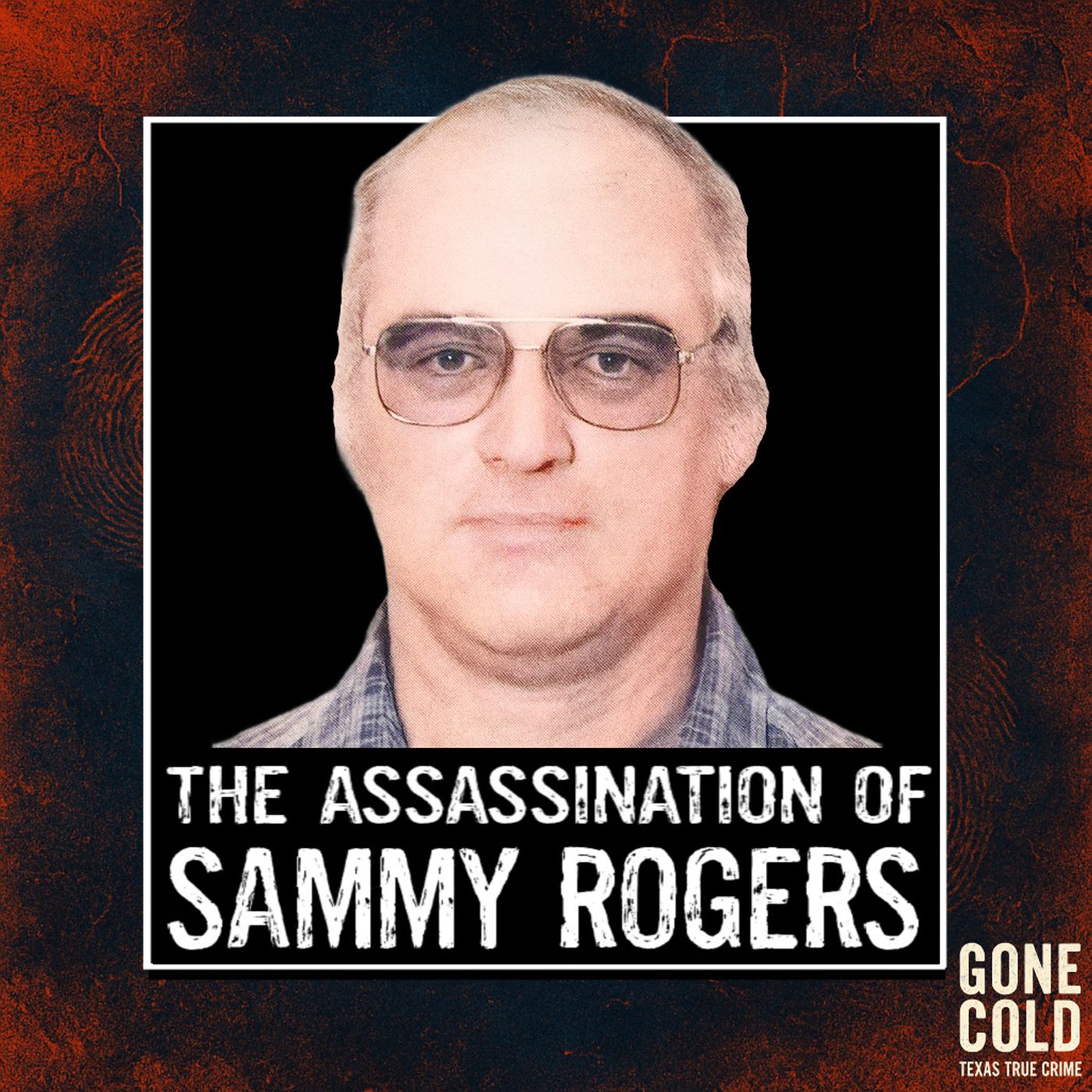
The Assassination of Sammy Rogers
Episode Transcript
Gone Cold.
Podcasts may contain violent or graphics subject matter.
Listener discretion is advised.
In Stephens County.
The land doesn't rise or fall dramatically.
It stretches, pastures, run into scrub mesquite breaks the horizon.
Roads arrive, quietly, intersect, and continue on without ceremony.
If you weren't looking for it, and if you missed the signs, you could pass right through Caddo, Texas and never know you had been there at all.
Caddo is tucked into eastern Stephens County, about ten miles east of Breckinridge, where US Highway one point eighty cuts across pasture land and low rolling hills.
The story of Caddo begins in the late nineteenth century on land that had long been used as a camp site by the Caddo people, whose name the community adopted.
Settlers arrived in the eighteen seventies, and by the turn of the century, Caddo had the markers of a small but stable rural town, churches, a school, a post office, and families tied to ranching and farming.
For a while, it was enough.
Then the oil boom of nineteen sixteen nineteen seventeen changed everything.
Like much of north central Texas, Caddos swelled almost overnight.
Oil workers poured into the area.
Businesses sprang up, and by nineteen twenty the population had climbed to around one thousand people.
It was loud and crowded, but temporary.
When the boom slowed, so did Caddo.
The wells declined, workers moved on, and the town began the long contraction that defined the rest of its existence.
By midcentury, Caddo was shrinking steadily.
Young people left for larger towns.
Businesses closed, the school disappeared.
What remained was a tight cluster of residents who stayed because their family had always been there, or perhaps because leaving felt harder than staying.
By nineteen eighty, census records put the population at around forty people, a number that barely changed through the nineteen eighties and beyond.
By the mid nineteen eighties.
Caddo would not have felt like a town in the traditional sense.
It was more like a crossroads, but it was a place where people knew one another's routines and noticed unfamiliar vehicles.
There were no new subdivisions, no economic revival, no sense of growth on the horizon.
Life revolved around nearby Breckinridge for groceries, schools, work, and entertainment.
What Caddo offered instead was a sort of peace wide Texas silence, broken by highway traffic and the rhythms of rural life.
In nineteen eighty four, Caddo existed largely in the shadow of its own past, with the oil boom decades gone and the population a small fraction of what it once was.
What remained was a place suspended in time, holding onto its name, its post office, and the land beneath it, an almost forgotten dot on the map that still mattered deeply to the few people who called it home.
It was slow and quiet.
That's the part that made what happened there in nineteen eighty four so difficult to understand.
On Halloween Mourning that year, Caddo's tranquility was broken inside a wood framed house just north of Highway eighty.
By the end of the morning, one of the most prominent men in Stevens County would be dead, killed inside the place his family had always called home, And to this day, no one has been able to say why.
The man was Sammy Rogers.
To every single person who knew him, Samuel Martin Rogers was known as Sammy.
He was born on March twenty seventh, nineteen forty two, in Ranger, Texas, but grew up in nearby Caddo, as all Caddo teenagers did.
Sammy attended Breckinridge High School in the town of the same name.
He graduated in nineteen sixty earned a college degree from Texas Tech University in Lubbock a few years later, and returned to Stephens County to build his life.
In nineteen sixty four, Sammy married Pat Simmons.
Together they raised two children, Leslie and Joey, in the same rural community where Sammy had been raised himself.
In fact, he never left Caddo behind.
Even as his business interests expanded.
Sammy's roots remained planted in the same stretch of land.
The house where he raised his kids had once belonged to his grandparents.
His own parents lived nearby.
His life always seemed to follow familiar roads.
By the time he was in his early forties, Sammy Rogers had become one of the most successful oil around those roads.
He was the owner of Delta Oil and Gas Company, one of the largest independent oil operations in Stephens County.
Sammy was also deeply involved in the civic life of the area.
He served on the Breckinridge Independent School District Board of Trustees, the Stephens Memorial Hospital Board, and the Stephens County Tax Appraisal District Board.
He was an active member of Saint Paul Methodist Church and a past director of Citizens National Bank in Breckinridge.
By nineteen eighty four, he was reportedly among the highest tax payers in the county.
To people in Stephens County, Sammy was not an abstract success story.
He was local, He was visible, and he was known.
He had earned a reputation as a hands on businessman, someone who preferred doing the work himself rather than delegating it away.
Friends described him as a country boy at heart, and that meant he didn't mind getting his hands dirty, even after financial success made it unnecessary.
By all accounts, the man was well liked and a respected member of the community.
A lot of folks get rich and become hoity toity, but not Sammy Rogers.
It just wasn't him.
In the months before his death, he had been working toward developing a game preserve on land he owned near Caddo, a project that reflected both his business instincts and his connection to the land.
According to comments later made by his friend Stevens County Sheriff James Cain, nothing suggested Sammy was under threat.
There were no public disputes and no known enemies, nothing to warn him or his family about what was to come.
In nineteen eighty four, Halloween Morning arrived in the middle of the work week on Wednesday, October thirty first for the Rogers family, it began like any other weekday.
Sammy and Pat were home, their children, Joey and Leslie, were getting ready for school.
The Rogers property included a three car garage with vehicles inside, including a Chevy Suburban.
Sometime around seven point fifteen that morning, Joey, a high school student, went out to the garage to start a vehicle.
As he moved through it, something caught his attention.
Across the room, near the suburban, Joey noticed a pair of legs, legs that did not belong there.
Someone was crouched behind the vehicle.
The teenager did not investigate further.
He turned and went back inside the house, telling his mother, Pat Rogers, that there was a man in the garage.
The information moved quickly through the household, pat passed it along to Sammy.
At that point, nothing had yet turned violent.
The person in the garage hadn't made a sound.
Sammy believed he was dealing with a prowler, someone trespassing, perhaps attempting theft.
Not one to back away from protecting his family and property, Sammy went to the garage to see for himself.
What happened next unfolded in seconds in closed quarters, with his wife and children only steps away, and when it was over, the man who had lived his entire life in Caddo, Texas, who had built a business, raised a family, and invested deeply in his community, was also killed there.
When forty two year old Sammy Rogers stepped into the garage on Halloween Mourning in nineteen eighty four, he did not walk into an empty space.
The man his son Joey had seen was still there.
He had been crouched beside the Chevy suburban, concealed just enough that only his legs were visible from across the garage.
When Sammy entered, the man stood up.
He was armed.
The gunman emerged from behind the vehicle and immediately confronted Sammy, pointing his pistol at him, Sammy raised his hands in the air.
From that moment forward, the encounter unfolded under the control of the man with the weapon.
Words were exchanged, though no one could say exactly what was said.
Sammy did not attempt to fight.
He didn't scare easily, but when he was confronted with a firearm, he understood the seriousness of what was happening.
He knew if he did anything brash, he might get himself shot.
The gunman began forcing Rogers backward.
He pushed him across the garage toward the door that led into the house.
Sammy complied, stepping back slowly, his hands still raised.
His wife and children were now fully aware that something was wrong inside the house.
Leslie, a senior at Breckinridge High School, called out to her father, telling him to come inside.
Sammy responded that he could not move, that the man had said he would shoot him.
Upstairs, Joey ran to activate a panic button connected to the family's security system.
The system was elaborate for the time, designed to alert authorities and record activity a road the house, but it wasn't working.
In fact, the system had broken down the day before.
As Joey tried unsuccessfully to trigger the alarm.
Pat began yelling into a company radio, calling for help.
Leslie ran toward the front door inside the garage.
The gunman continued backing Sammy toward the kitchen entrance.
The weapon remained trained on him.
At some point, Sammy made a decision.
He lunged, jumping backward into the house and grabbed the steel door on his way as he slammed it shut.
Almost simultaneously, the gunman fired.
Pat locked the door, but it was too late.
Sammy had been hit.
The bullet struck him in the throat, just below the Adams apple.
The wound severed an artery.
He collapsed inside the house heavily.
The gunman did not attempt to force his way inside the Rogers home.
He didn't even touch the door, not that the family could hear anyway.
Investigators later said that if he had entered the house, the outcome could have been far worse, meaning an entire family might have died that day.
Instead, the man turned and fled outside.
The area surrounding the Rogers home was rough ranch land, open fields, fencing, oil leases, and patches of brush.
Witnesses reported seeing the gunman running north and northwest away from the house on foot.
He was described as wearing camouflage clothing and a mask later specified as a black ski mask.
Inside the house, emergency calls went out.
Pat Rogers contacted the Sheriff's office and requested an ambulance.
Despite the effort to save him, Sammy Rogers was pronounced dead at eight forty five am by Justice of the Peace Sid Rhodes.
The cause of death was clear, a single gunshot wound to the neck.
Within minutes, law enforcement began arriving at the scene.
The response grew rapidly.
Officers from the Stevens County Sheriff's Department, Breckinridge Police Department, and the Texas Rangers converged on Cado.
Sheriff James Cain, who had not yet officially been sworn into office, found himself overseeing the most serious investigation of his career.
His predecessor, Sheriff Louis Hall, was on vacation, and Cain was called to step in as the investigation began.
By mid morning, a massive search was under way.
Roadblocks were established along US Highway one point eighty at County Road two o seven near the community of Necessity, and along Farm de Market Road seven seventeen, leading toward ranger.
Officers searched on foot and horseback.
A Texas Department of Public Safety helicopter was brought in to scan the area from the sky.
Searchers followed muddy tracks leading away from the garage.
The ground was damp and the fleeing gunmen had left a trail of visible impressions.
It ran nearly a mile before reaching a paved road, where it abruptly ended.
Investigators believed the gunmen either had a getaway driver waiting or had reached a vehicle he had left behind for the purpose of fleeing.
Whatever the case, he managed to leave the area before roadblocks were fully established.
Morning showers may have helped erase additional trace.
Despite the scale of the response, the search produced no suspect.
Two men wearing camouflage were stopped and questioned on the edge of Breckinridge later that morning.
Both were released.
They were deemed to be in the wrong place at the wrong time.
By two pm, the intensive manhunt was called off.
What investigators were left with was Stark, a respected oil man dead in his own garage, a masked gunman gone, no stolen property, and no clear motive.
As Sheriff Kin would later say, people had seen plenty that morning, but a question lingered was it enough.
By Halloween afternoon nineteen eighty four, word of Sammy Rodgers's death had spread far beyond Caddo in Breckinridge, the county seat and commercial center of Stephens County.
The news landed like a physical blow.
Businesses slowed, conversations stopped mid sentence.
People gathered in small clusters, trading the same questions over and over again, not because they expected answers, but because there were none.
Sammy wasn't a man people associated with danger.
He was familiar, approachable, someone who waived when he passed.
An oilman, yes, but also a school board trustee, a hospital board member, a church member, and a father whose children attended local schools.
Everybody knew him or knew of him.
For many in Stevens County, that familiarity made the killing feel personal.
Across Loop two fifty two from the Rogers home set Caddo Mercantile, owned by Ronnie Langford, a close friend of Sammy's and at one time his business partner.
The store quickly became an informal gathering point.
People stopped in, not to shop, but to talk or to listen.
Langford said everyone wanted to know who did it.
Employees in Breckinridge echoed the same disbelief.
Sammy was widely described as polite, hard working, and visible in the community.
Nobody knew of any feud.
They couldn't think of a recent dispute.
There was never any public controversy surrounding him.
The question that followed nearly every conversation was simple and unanswered.
Why would anyone do this?
Law enforcement could offer little reassurance.
Sheriff Kine was sworn into office the day after the killing, two months before it was due.
He was candid with reporters.
The only solid information investigators had came from the Rogers family themselves.
Beyond that, there was no suspect, no confirmed motive, and no clear trail to follow.
Cain said the investigation was entering the part of police work that involved far more effort than inspiration.
Leads were sparse, Most tips were rumors, but each one had to be checked.
Even if it were evident, they would lead nowhere, and that's exactly where most of them ended up.
As the days passed, the absence of a motive became the central problem.
Nothing had been taken from the house.
There were no signs of forced entry, no burglary, no robbery.
The gunmen had come prepared, concealed, and armed.
He'd fled immediately after firing a single fatal shot.
The security system was down.
Investigators were left to consider possibilities without evidence to support them.
Anyone in business at Sammy's level, Sheriff Kane acknowledged, inevitably had people who disliked him and business rivals.
Those ideas alone, however, were not enough to build a case.
Law enforcement examined rogers oil dealings, his landholdings, and his financial relationships.
None produced a clear lead.
The killing of Sammy, Rogers and Caddo also reopened old wounds in the region.
In nearby Ivan, residents were reminded of the unsolved nineteen seventy eight murder of Doc Moon, a former Stevens County rancher, whose body had been found beside his pickup truck along Farm to Market Road seven seventeen.
Like Sammy, Doc had been well known and respected.
Both men had been shot, and like Sammy's killing, Doc's murder had never been solved.
The similarities were difficult to ignore.
Both men were prominent.
Both were killed in rural settings.
Investigators didn't formally link them, but the comparison lingered in public conversation.
It fed the sense that someone could kill a well known person in Stephens County and disappear.
That feeling only deepened as reporters began noting similarities between the Rogers killing and other violent crimes elsewhere in Texas that year, including one one hundred miles to the east in Colleyville.
Two weeks after Sammy's murder, on November thirteenth, nineteen eighty four, a masked man wearing camouflage clothing strangled Judy Herron and attempted to kill her young son inside their home.
Judy's father was well known in the oil industry.
Authorities were careful not to overstate the connection.
Sheriff Kine initially acknowledged the similarities and sent investigators to Colleyville to compare notes.
Later, he said he did not believe the cases were connected, though he stopped short of ruling it out entirely.
Without physical evidence tying the crimes together, the similarities remained just that similarities.
As weeks passed, frustration grew quietly.
Sammy's funeral was held in Breckinridge, with burial in Caddo Cemetery.
Friends, business associates, and community leaders gathered to mourna man described repeatedly as self made, generous, and deeply invested in the place he lived.
Behind the scenes, investigators continued working.
They ran down every tip, They questioned anyone who might have seen something unusual that morning.
They re walked the scene, They reviewed what little physical evidence existed.
By late November, friends and associates of Sammy Rogers took another step.
A reward fund was established, initially totaling twenty five thousand dollars for information leading to the identification and conviction of the killer.
The amount would eventually grow larger.
Sheriff Cain said he believed the case could take a long time.
Some cases do not yield answers quickly, no matter how much effort is applied.
The law men also praised the patience of the community and the restraint shown toward his department.
The Rogers murder, he said, was not going to be solved by luck, and if it wasn't solved in the coming months, it might not be solved at all.
As nineteen eighty four turned to nineteen eighty five, the murder of Sammy Martin Rogers settled into an uneasy place in Stevens County.
The initial shock faded, the roadblocks were long gone, the helicopters stopped flying.
What remained was the case file, thin worn and growing heavier with time, rather than answers.
In January nineteen eighty five, authorities announced that the reward for information had been increased.
What had begun as a twenty five thousand dollars fund was raised to thirty thousand dollars and the terms were changed.
Instead of requiring a final conviction, the reward would now be paid for information leading to a grand jury indictment, and additional ten thousand dollars was offered for the recovery of the murder weapon.
By then, the investigation had narrowed to what little evidence existed.
The autopsy had confirmed what had been known from the beginning.
Sammy died from a single gunshot wound to the neck.
Footprints left in the muddy ground behind the house remained one of the few physical traces of the killer's escape.
The bullet was recovered, but for months investigators refused to publicly identify the weapon.
Then, in March nineteen eighty five, Sheriff James Cain confirmed what ballistics experts had determined.
Sammy Rogers had been killed with a three point fifty seven caliber Magnum pistol.
The announcement came alongside something new, the first development in the case that could be described as progress.
More than four months after the murder, investigators received a tip from from a witness who claimed to have seen someone driving north at a high rate of speed from the vicinity of the Rogers home shortly after the shooting.
The witness provided what Caine described as a pretty fair description of both the person and the vehicle.
Texas rangers brought the witness in for hypnosis.
A police artist produced a sketch, but the result left much to be desired.
Investigators tried again, this time using computer assisted technology in nearby Graham.
From that effort came composite sketches, which were released publicly and distributed to law enforcement agencies nationwide with assistance from the FBI.
The suspect description was specific but broad enough to include countless men across Stevens County and beyond.
A white male approximately twenty five to thirty years old, between five foot ten and six foot two, weighing one hundred and sixty to one hundred and eighty pounds, with dishwater blonde hair, a ruddy complexion, and a small mole on his right cheek.
The sketches generated attention, they did not generate arrests.
By the fall of nineteen eighty five, the Rogers case had reached its one year mark.
Sheriff Kine, now fully settled into the job he had assumed under the worst possible circumstances, spoke about the investigation.
He said his department and Texas Ranger James Key had chased hundreds of leads, phone calls, rumors, tips that ranged from promising to implausible.
Most led nowhere.
None solved the case.
The trail, Caine admitted, had gone cold shortly after the murder and never truly reheated.
Investigators still did not know why Sammy Rogers had been killed.
Robbery didn't fit, neither did botched burglary.
There was no evidence of personal conflict that explained a masked man lying in wait inside a garage.
Cain said that among the many theories examined, one carried more internal logic than the others.
The idea that Sammy had been targeted deliberately the hitman theory, but logic wasn't evidence.
If the killing had been professional, Cain said, it might never be solved.
Someone would have had to pay for it.
Someone would have had to want Sammy dead badly enough to arrange it, And yet after exhaustive investigation, law enforcement could not identify who that might be or why.
By late nineteen eighty five, rewards totaling forty thousand dollars had produced no break.
Composite sketches had drawn no response.
Physical evidence remained limited to a bullet and footprints that ended at a paved road.
Cain said the case frustrated him more than any other aspect of his first year as sheriff, not just because it was unsolved, but because Sammy was his friend.
Despite that, Cain said, the work continued, Every tip was logged, every call was checked, The case files stayed open.
In Cado, life went on quietly.
Highway eighty still funneled traffic past pastureland and scrub brush.
The Rogers home remained standing, holding the memory of a morning that changed everything, and somewhere beyond Stevens County, a masked gunman or someone who knew him.
Perhaps someone who hired him carried the answers to a killing that left no motive behind.
More than four decades later, the questions that remain are the same ones asked in CADO in nineteen eighty four.
Who killed Sammy Rogers and why?
If you have any information about the murder of Sammy Martin Rogers, please contact the Stevens County Sheriff's Office at two five four five' five nine two four eight.
One if you'd like to Join Gon cold's mission to shine a light on unsolved homicides and missing persons, cases get the show at free and have access to bonus.
Content you can At patreon dot com Slash Gone cold.
Podcast you can also support the show by leaving a five star rating and written review On Apple podcasts or wherever else you.
Listen however you choose to Support Gone, cold we appreciate.
You thanks for, listening, y'all