·S1 E20
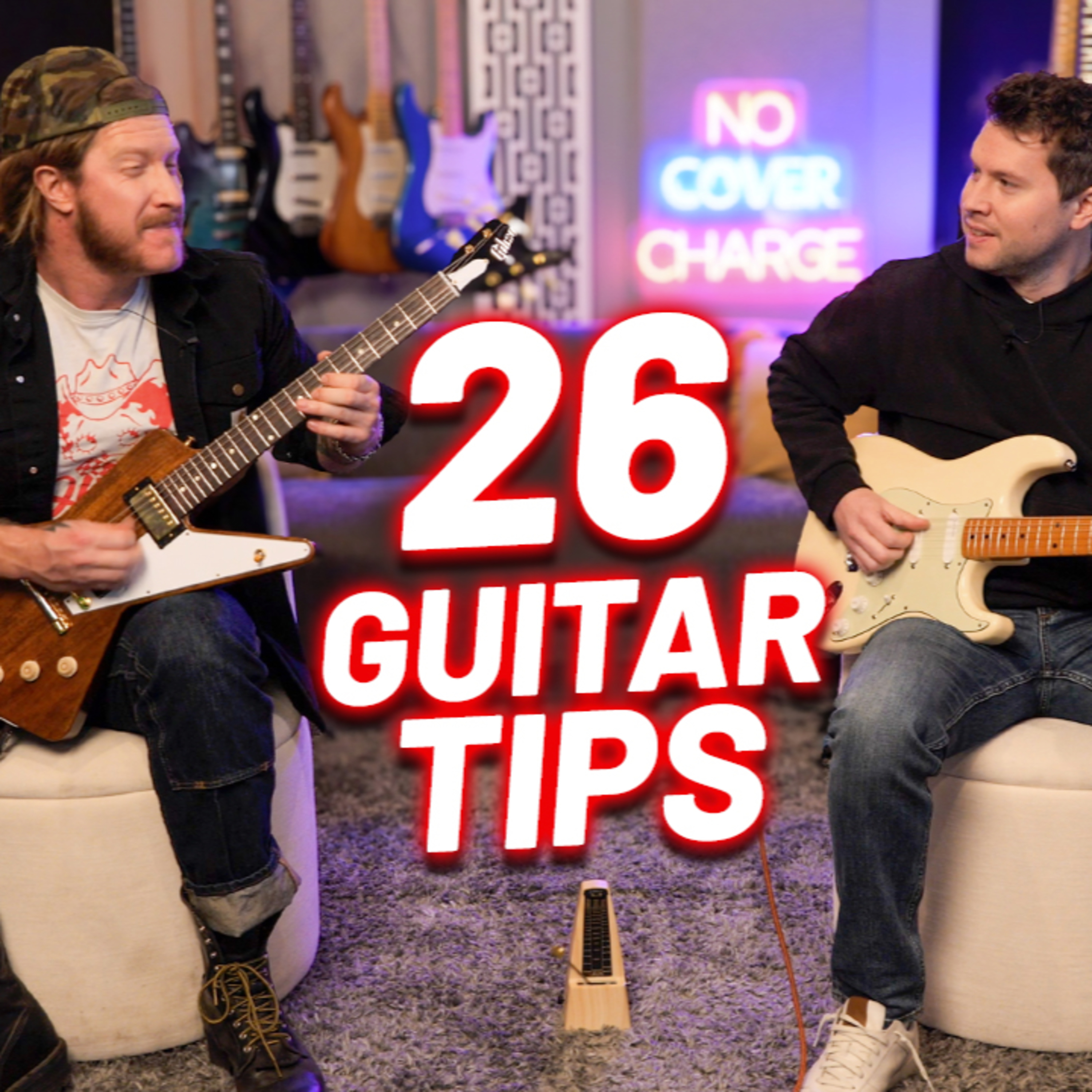
Episode 20 - 26 Guitar Practice Tips for 2026 (That Actually Work)
Episode Transcript
Who made this for you?
Copper sound pedals.
That's really cool.
The red pedal right there.
The same dudes made it.
Same dudes, Tris shout out Tris.
Shout out Tris dude.
I asked Tyler what this was on his pedal board, thinking it was like a BY switch.
It's a flashlight.
The better to see my shred with my dear dude.
You could do like a little leprechaun thing where you go?
That could be a tip right there.
Practicing in the dark.
That is a great tip.
Or just close your eyes.
Get an eye mask bro.
Are you filming this?
It's all been on camera.
It'll surely be an intro first practice tip episode we've ever made ever, in the short life of this pod.
Is this going to be a resolution episode?
I resolve to practice every day for 12 to 25 minutes.
Dude, you know what I was thinking about though, because obviously life gets crazy for everybody.
I don't care what you're doing, if you're working or you have kids or you have a what, your job, whatever.
I thought to myself.
I was like, man, if I did wake up every morning, and I've done it so far.
Today's the fifth.
Yes, I've practiced like 30 minutes straight right when I wake up, like I'm waking up earlier.
And that's maybe one of my tips.
Is that a tip?
30 minutes straight when you wake up.
Right when you wake up.
It's sort of a mindset, right?
You have to build these practice tips into your daily routine or whatever that routine is, some sort of time commitment that you make and you will see results.
Whether or not these all apply to you, You can use your own description question, but surely at least one of these tips will get you moving in the right direction.
What's your first tip, Jared?
Why don't you kick us off?
OK, my first tip When you're playing, play rhythmically.
Now this seems really like a simple tip, but.
We've heard this tip before, yes?
What does it mean to you?
To me, think about this, how many times do you pick up your guitar and you're rehashing some of your old licks or you're just playing or, you know, it's almost like noodling, right?
When I think about noodles, I think of like, you know, if I'm playing and I and I start playing.
I could just do that all day, right?
But here's the thing, Having a backbone to everything you play, AKA rhythm, I feel like that is such a crucial part of playing licks, of jamming with people, of everything.
So one of the big things, even I'm trying to implement it in my playing is have some rhythm.
I'm looking on the floor at that metronome.
I've played with so many guitar players, musicians in general that have incredible chops, but it's almost rhythmically there's more to be desired.
And it's as simple as, you know, having a phrase right and playing something you go like Now, I'm not playing anything crazy, but what I'm doing is I'm thinking completely about the rhythm.
Simple phrase, but in my heart I feel like the strongest players are the ones that are rhythmically really, really solid.
So that's my first tip.
Get the metronome out, dust it off.
Look at that old thing.
What is that, Mozart?
There we go.
Is that Mozart gave me this?
Dude, have you ever heard of Mozart?
Yeah, you gave me this.
Oh, there we go, 3.
Dude, I'm just in my mind, I'm thinking about rhythm.
What did Greg Cox say?
Good old fashioned clean fun.
That is some good old fashioned clean fun.
We're thinking about practice as a very humbling experience, so you shouldn't be afraid to be embarrassed and make mistakes during this time.
Playing one note until it feels annoying in finding ways to get the most out of one note, whether it's in a different area of the neck.
This will start connecting the neck in a way it feels familiar and you're you're broadening your horizons, but you're also sticking so simply to a melodic sound that isn't complicating the other aspects of your musicianship.
So if you want to play an.
AI can do that.
I'm going to find one note and stick to it and see if we can make it should.
We stay on that same groove.
Sure, 1234.
O I ended up sort of practicing a little half step bend and that's the whole point of I'm not trying to make a great melody.
You can't really necessarily do that.
I'm not David Gilmour, but I got really in the pocket of that little quarter bend and that's something that would maybe I'd start working on further.
It's like, oh, I'm going to find quarter bends all over the place.
Add in another note.
Oh yeah, You know what's crazy about that too?
I'm watching you play, and I'm obviously listening to you play.
You're playing the same note in different places on the neck and it sounds completely different.
That's crazy about the guitar.
Like not to like totally like just be like a fanboy about the guitar.
But when you play an A here compared to here, they all have a total different like timbre and tone that when you play them, it's almost like you're making a melody with the same note with like different tone you.
Know what I'm saying?
And that comes back to the tip that we started this podcast with, which is rhythm.
Because if you're only working with one note, you got to have some interesting rhythm happening if you want to have any hope to just take a tip out.
OK, this one is this one is also the big one that I have for 26 play melodies, not Lyx.
So check this out.
Give me that a groove, 3 notes licks.
I'm not going to think about anything besides if I were to sing it like a melody, right?
Now you might say, Jared, that seems super simple.
Jared, that seems super simple, man.
But check this out When you're jamming, you're improvising.
You're thinking about, you know, writing songs or even writing a solo.
I always feel like regardless of genre, when I hear something that's done, super melodic single note or double stops or whatever you're doing, that to me always has a super lasting effect.
And one of the things I think about is like one of my biggest heroes for me on the guitar, this guy Leslie W, he would play and it was like same with Gilmore and all these people, Steve Vai.
I mean, you could sing those solos.
You could sing those parts of those solos and it was like, beyond thinking about the guitar, it's like, you know, the solo because of the melodies.
And I think really moving forward when you're improvising, when you're thinking about playing, thinking melodically, not even more so on a scale level or you know, oh, I want to play a 6th here.
But taking things you already know and incorporating that and trying to make it a melody, that's a really big win in my book.
And some of this is interesting to discuss because not all practice when you think of that word feels like this or you don't envision practice being something like this concept, but this is practice.
You are honing your craft.
It may not be alternate picking technique at 200 BPM, but that's not, this isn't the time and place for that at this exact tip moment, tip number.
All right, we need to make sure to keep track of a practice mindset, which is to practice like you're auditioning for your favorite band.
Oh, I like that one.
I like.
To put I know music's not a competition.
It should be fun.
It's all a game.
It's all a good.
One but hey, it's it's a game exactly.
And sometimes games have a little pressure, little stakes.
It's it's fun to put a little bit of what would it feel like if this, if nothing else, to activate some sort of sentiment inside yourself to care in a different way whether or not you're ever going to audition for your favorite band.
None of us probably will, but the feeling and the excitement that you can get really activates.
It's sort of like going into anaerobic mode when you're working out.
I think it if you can get to this level in your practice session, whether it's fabricated like this or if it's, you know, you're really in the zone, whatever you can do to put yourself in a very individual tunnel vision focus with this instrument, then that'll just set you up for success in whatever it is you choose to practice.
So more of just like an overarching tip.
That's a great tip.
And like when I think about that, I mean, man, getting in that mindset where it's almost, and I've, I say that all the time, music is a competition, but within myself, I'm extremely competitive, extremely.
So this is a tip that I like because it's like it puts you in that kind of like fight or flight mindset of being like.
You can kind of feel it right now if you just think about it right now.
All right, You're in the room with X and they're looking at you play kind of.
Cool.
It's very cool.
And it's it's, it's scary, but also at the same time, it's like that exhilarating thing.
That's a great tip.
I'm disciplined, Tyler in the year 2026.
Let's go practice your worst habit first or your weakest link first.
It's sort of like you're trimming your nails.
You you trim your non dominant first, you're going to be set up for you.
Do the hard thing first and knock that out.
Sort of like what you said, waking up, getting it out of the way in the morning, it can really just make the rest of your practice a little bit more fun.
Do that because it's where you're most fresh and you just pick up the guitar and like you said, it's almost like you just get the worst of everything out of the way.
And there's nowhere to go but up at that moment because you have a little sense of accomplishment, like, all right, I did my thing.
And now when it moves on to what you actually are enjoying practicing and what whatever that may be, that's just going to feel that much better.
That's a great tip, dude.
All right, you ready for my tip?
Go ahead.
Now I'm going to say this to you, and it's going to be really funny of me saying this.
Practice standing up.
Oh, that was one of my tips.
Is it?
We we, we cross tips man.
Dude, that's what we call in, in our business crossing.
Tips.
Yeah, we couldn't avoid the puns, but yeah, that's definitely one of my tips.
So what do you have to say about that?
OK, this is all I have to say about it.
And now for me, this seems super, super basic because I remember when I first got my guitar, I was like, OK, cool, it's got a strap, man.
I put the strap stand up and start jamming, right?
I've come across a lot of people, and this isn't a dig, that literally when they get out of their comfort zone of a chair with their guitar, you put a strap on the guitar, they just like freeze and it's almost like all of this technique and kind of comfort level goes away.
It's so important literally to just stand up, maybe if it's even for 15 to 20 minutes of your playing and put that strap on the guitar and actually stand and, and play as if you were playing on stage or you're playing in a session or in a, you know, a jam session, whatever.
Because to me, it's almost as if like, that's the Yang to the Yang of of being a guitarist.
You have to play on stage a lot more than I ever do, so it's really important for me to keep that in my rotation.
So all sometimes just stand up for the hell of it in videos, but I'm like, I have no reason to otherwise.
And I think a lot of people who just practice or play for fun, you don't even realize it because your strap height really dictates and also the way the way you tend to hold your guitar here maybe your strap is is looking more like this.
Using these different motions standing up can also translate to better posture and technique and overall playing.
When you are sitting down you can forget about it though.
It's so funny that it's, it seems like such a simple thing to say, but yeah, you can forget about it.
And you know, yes, I do play on stage a lot, so it's something that I have to think about.
But even when I'm at home, sometimes when I have breaks, like over Christmas break, I was just sitting at home and I was playing guitar and I was getting so comfy.
I was.
Dude, you were just in the couch corner.
Like this is great right here.
You're playing it like a cello after a.
While I stood up and I was like, you know, I'm like, and I was like, man, I need to put the strap back on.
And I was like, I and then I stood up and played for a while and I was like, oh.
And you got all these new different fancy guitars with strap locks in different areas.
So you got to know like where it's going to hang on you, dude.
So I'm.
Here, here's another good one for you.
OK, this is.
No die guitar.
Can I have like, like a little like a bullet point on said tip?
Sure, sure.
So I just did this gig in Lake Tahoe for New Year's Eve.
Fantastic.
I was playing gear that wasn't mine.
That's a whole nother story.
Everything went good, but the strap that was on that guitar was really nasty.
It was a terrible.
Use it.
Would stay afraid of that strap the whole night.
It popped off at least five times.
Oh God.
You caught it every time, so just like.
Literally, dude, I'd be like jamming.
And also they catch the guitar and I remember at one point I was like, and then I put the strap back, you know, And then it would, I'd be looking at it and I'd be playing and I'd just watch it be like, it was almost like that movie cliffhanger where the ropes about and I'm like, no.
But with that practice standing up, make sure that the strap that you use and the buttons on your guitar are all structurally great, because that brings a whole nother element of surprise to playing.
Yeah, so sub tip, check your check your strap.
This is something that I employ anytime I'm really trying to internalize music.
And you can do this for any solo you want to learn.
And that is before you actually play the solo.
Listen to that thing so you can sing every single note of it by heart and that will speed up I would say more than 50% of the process because you're automatically correcting and knowing when you're wrong instead of trying to figure it out note by note.
Inherently.
A perfect example, I heard comfortably Numb the the guitar solos in that and I could sing them way before I ever played guitar.
And then I went to play them and I was like 15 or something.
I was like, Oh no, that's not the note.
It goes like this.
And I'm like, I know it's just a little band right there it goes.
So I know it's not it's and immediately I started picking out the solo and it's like my fingers knew where to go.
And that's a slow solo.
It doesn't always happen like that, but the concept of knowing the solo, being able to sing it in your head, whether you can sing in person in real life, your internal monologue will guide you.
That is a great one because also with that, it's almost like you internalize it before you even touch the guitar.
One of the things I actually like to do to add to that is if I have to like learn, let's say I have to learn a song for a jam or something or whatever, and maybe it's something I'm not truly familiar with, man, it's almost like I cram, like I'm cramming for homework where it's like, let me listen to that song like 15 times to the point where it's like annoying, you know?
And then it's like usually by then I have that internal kind of thing where I'm like, all right, I know they're going to the chorus and you know what I mean?
That's a great tip.
That's Gorgeous.
I'm saying it again, that's my favorite Tyler guitar.
People can chime in in the comments, but the other day when we did, when we wrote together and he picked that one up, I was like, I really like that guitar.
I've been playing this one non-stop.
Somebody call Fender.
Birth your guitar.
OK, I got a tip for you.
OK, now this goes specifically, this is like Phase 2 guitar player stuff, like when we're doing our jam tracks starting to jam with people.
You jam with a drummer, you're jam with a bass player, maybe keyboard, whatever.
This is the tip.
Listen to everybody else.
Listen, listen, listen, because the tip of it all is when even if I'm on a jam track or you know, I'm I'm playing over something for a solo or whatever, the biggest thing that I would always do is I would go Jared guitar, You know, like, hey, like I go like this.
Let me turn on every pedal.
I love it, don't get me wrong, But the biggest thing I'm noticing as I'm maturing as a player, as I'm being put in situations where I'm playing with maybe musicians I don't play with all the time or people, you know, it's like, it's almost like speed dating, right?
Like when where you're playing with musicians and you're like, what's up, dude?
I'm Jared.
And it's like, hey man, what's up?
I'm Paul or whatever.
Show me your licks, yeah?
Hey, man, you just want to RIP some nasty licks together and say you're the bass player.
Can you just play on that a like, say the bass player's doing that right?
The drummer comes in instantly.
I'm listening to what's happening right now.
Switch to like AG.
Oh, OK, he went down a whole step, goes back up to the A.
So that's our groove.
Now I'm thinking to myself, what can I do?
I'm hearing what they do and I go, you know, So the tip, listen to what everyone else is doing because I feel like as guitar players we are not the rock solid of the bass and the drums.
And when we really zone in on what's happening there, we can really actually bring something to the table that musically is fulfilling.
So use those ears, turn them on.
Well, what you got, dude?
You, you sort of alluded to this one, but I'm going to solidify it in this tip.
Dude put it in a number.
Steal from non guitarists.
Oh, I love that tip.
I love that.
And this could mean a drum groove that you translate to guitar.
I love that.
This could mean a saxophone line.
If we're thinking more traditional, copying any horn line is always going to be a challenge on the guitar just because of the intervals and the way horn players play.
But if it could be a synth sound, it could be anything that you try to recreate or replicate the feeling of on a guitar.
Try and do that and I think let's just see if we can do it.
Yeah, dude.
Let's say, let's say we hear a song.
I just pull out the C4.
I'm like for sure bro.
Oh yeah, dude.
How would we possibly make our guitar feel like that?
So this is awesome.
You interpreted that as how can I create a groove out of the bottom beat?
Yes.
Now the way I'm thinking of it is how can I literally create the bottom beat?
Oh wow.
So it's like it sounds like there's definitely a bunch of reverb and probably the repeat.
I think that's practice though.
That is so practice because also it goes back to the same thing.
Like that's the coolest part about what we're able to do as guitar players.
Like especially in the world that we live in now with like the amount of cool pedals and this is me talking baby, the creativity is out of the world because you can do things like that and that's totally practicing.
That's totally opening your mind to like, different soundscapes even.
And it gets you excited, gets you in the mood and that sort of tip applies to all gear.
I don't think we need to go further in depth on like get a new pedal and it inspires you.
Although I do have one tip.
Oh, here we go.
Ractice technique that Eric Johnson revealed to us was not a ractice routine for him at all.
It was his intro of clips of Dover that everybody, you know, he's wearing that incredible jacket.
Dude, Austin city limits, dude.
I want that jacket.
And I think I actually commented.
I think I actually commented on that original video years ago.
My comments still there.
It's like, where'd you get that jacket, Eric?
Oh my gosh, man, dude, when when I was a kid, I went to a vintage store because I saw Eric Johnson with that jacket and Jimi Hendrix with a jacket kind of like it, you know?
And I saw like a marching band jacket.
And I was like, mom, can I have that?
And she's like, why?
It's so close to a marching band, but there's something about it.
Oh, dude, it's, it's like so sick.
It's like Sergeant Pepper.
You have to be playing exactly like that in order to wear it though, I think.
If you're going to wear that jacket, it's almost like wearing the SRV hat or whatever.
Exactly bro, you better come at me like real deal.
So he he, I don't know exactly what pedal he used, but you can accomplish the same thing with a loop pedal or a reverb pedal like I have here with just an infinite decay.
And the idea is to have this droning sound where you can manipulate.
And this is assuming you know, you got your scales and stuff under your fingers.
This is a musical way to practice these different sounds as not scales, but as sounds, right.
So if we just have AG.
That's where it comes from, but.
Dude that's so cool.
A million different things you can take from just one pad.
You can use a piano, you can use a backing track on YouTube.
But the important thing is just one note.
That's what I learned from.
You can just have it looping forever and really spend way more time than you thought you would doing that.
You know, my favorite of all that is too, is like I'm watching you do and I'm going yes, yes, sometimes I even try and do that without the effects where like you like hold parts of a chord and then you'll do that like if you had like AG, right, and you're going like that, you know, then the one baller thing I was going to say that I would hear like Eric Johnson or man, I didn't hear like bottom Also.
Do they they start to hit that mate, that so good.
That's a cool.
That's a really cool tip.
And that, that will help you understand, oh, that's a six.
That's why I like that.
That's how intervals clicked for me.
It's not because I'm necessarily sorry, Joe Sastriani, I didn't memorize every single note on the neck first.
Like Joe, we're sorry.
That's what he commanded of all the students.
But I learned the intervals and the sounds and what they were, and I was like, oh, not that's six.
So that means this is 7.
So that's how I put it together.
That sort of thing can be an introduction to music theory.
Absolutely is, and it's also like a really fast way to get whatever theory you're learning straight applied to the guitar.
So you're not saying they're going Oh yeah, I know what a minor 6 is but I have no idea how to get?
Or you don't know what a minor 6 is, but you have learned these tablature shapes, which is what I did first.
I learned the major scale in tabs.
I thought the major scale was only right here.
Wait, wait.
It isn't, no.
Wait.
Yeah, for sure, my.
Whole life is a lie.
I'm over here like, shaking like.
Yeah.
So I thought that was the only place you play it, but it turns out use these tips as you move forward and adjust them to your own tastes.
But we have another tip that I think is you can only do this tip one way.
What you got?
And this is practice in total silence.
Have you ever seen the movie called The Pianist?
Yeah, years ago.
This guy, I mean, it's a terrible war movie, but he essentially is hiding from his captors.
He's an incredible pianist, and he can't play a piano that he finds in like during his hiding, but he wants so badly to play because he's a master.
So he just like, pretends that he's playing.
It's like a really powerful cinematic scene in the movie.
How I used to practice when I was taking the train, like sometimes be an hour commute going back and forth to class.
I was in music school and I would just be like thinking about and maybe like using my arm or something and like dude, and really hearing.
And I think there is substance to this of envisioning something and whether or not you're actually putting your hand on the guitar.
If you're just thinking about it and maybe hearing it, I think that strengthens your musicianship and is a form of practice.
Bro, a million percent I still to this day, whenever I'm traveling or you know, I'm there's any sort of downtime and especially if I'm just kind of like relaxing, I feel like that's the best part is like, you know, if I'm on a plane or whatever it is, I'm always doing that.
And a lot of times too, when I'm listening to music, I'll listen to music and I'll almost think of I'm almost ear training, you know, and don't get me wrong, I'm not trying to take the enjoyment and excitement of listening to music out.
Don't you dare.
But I'll sit there and I'll I'll be listening to something.
Maybe I've heard never heard it or I've heard it a million times and I think to myself, I'll go, oh, you know, how are they playing that on the neck or like, where is that being played or what could I play alongside this?
It's almost like when we had Josh Smith and he was talking about the producer stuff and it's like, well, if they're already playing that, maybe if I played this, I think that's such a powerful thing because once you, it's almost like an athlete.
It's like you can't run all day every day.
It's like you're going to have your time to practice, but you can still, you know, envision yourself doing it.
Then when we pick up the guitars, that's a total thing where you're like, OK, cool, yeah.
And you start to put, you know, put the pieces together.
It's beautiful.
Crash and burn tip when you're practicing something to not stop even after you mess it up dude because.
That's a life.
Tip I don't know about you just.
Crash through the wall, baby.
Just go.
Just keep going.
Going because you will eventually end up on your feet, we hope.
Playing a lick, for example, just like a an endurance lick.
Dude, you got it.
See where I stopped?
Don't do that.
It's like you have to breakthrough that.
Right here is when it starts to tighten up and every time you go forward, assuming you're using proper technique, you'll be able to go a little longer, a little faster.
I think that's just muscle training in general.
Any, any sort of thing, whether you're working out or playing an instrument that's sort of breaking through the boundaries of what's already there.
Feels tough, feels, you know, don't hurt yourself, but little pain is gain.
Absolutely.
OK.
This kind of goes along with your tip.
I'm like additioning to your tip.
Don't be that player that stops if anything goes wrong when you're playing.
So let's say you're improvising and you play something and you go, I've, you see it a million times, someones playing and they hit a note and they go, are they, you know, are, you know, you remember when you do that, that ill-fated, I'm going to bend up and I lose it.
Yeah.
Well, one of the things that I see a lot of players do is they really let us know when they screw up, whether that's with like a disgusted look or they just stop playing in general.
One of the biggest things I learned, which goes along with that, whether you're practicing technique or you're improvising or you're in the set, whatever you're doing, if you screw up, keep going, act like nothing happened.
Or if you want to be a total boss about it, if you screw up playing a chord real quick, Take a mistake or whatever and like literally just dust off and just keep going.
I got a tip.
Yeah.
What are we on?
We might be on the.
I'm going to just start putting the numbers on your.
Counter.
Next.
Tip, Finish what you've started now.
This is like kind of a tip that I've had to think about for myself.
When you're writing a song, improvising, when you are playing a song, even if you're not playing with other people or you're at home, do you ever have it where somebody will say, oh, you play guitar, that's cool, can you play me a song?
And you go what you're like.
I've had times where I got a couple of.
Risks.
I'm so into like my technique and learning things that sometimes I forget.
I'm like, oh, you want me to play a song?
Next thing you know, I'm playing a song and I'm going, you know, whatever.
And it's like, and I'm like, what's the next part of the song?
Because you know, and you have to think in a different.
Mindset that is so hilarious because the holidays just passed and there were plenty of little performances for family and friends here and there you know impromptu like well look at this put something up plug it in and.
Plug it in, play us a song.
Bro so guess what, nobody gives a shit about sweet picking arpeggios like super cool jazzy drop 2 inversions they care about.
Can you play just any song?
I got to, to be honest, there is, and this hurts my soul to say it, but many, many, many times I would be asked, oh man, you know, you play guitar, you know, play us a song or do whatever.
If you did one of your techniques, like a sweeping or something cool one time, if they went, oh wow, like that's about all you're going to get because a lot of those things are going to go over a lot of people's heads straight up.
And like you said, then I've been in places where I've played said Lynyrd Skynyrd song or whatever, and I'm playing the simplest part of the song and the people are going.
Oh, and you go, whoa, yeah, exactly.
You go like, that's it.
How?
Did you do that where you went?
You know what I'm trying to say or or like, you know, sweet child, any of these songs and I'm not trying to down credit those songs.
They're all amazing.
But you know what I'm trying to say?
You're working so hard to get all this crazy stuff down.
And then to the normal person, they go, OK, you know, it's not like as daunting.
For me to make things interesting, learning songs where I think if you truly know a song, you can play it in a bunch of different varieties for sure.
OK, well, how can I still have fun?
So it's like.
And then they they know what song it is and they're like, oh, cool, kind of.
I don't know.
That's the ideal is when we have our influences wearing them on our sleeves, but we're still playing our own thing.
I would always do that too, like where I would like have like, you know, the common motif that like the normal person be like, Oh yeah.
And then?
Now I'm going to RIP for a minute.
Here's my time for 6 minutes.
No, but that's one of those tips where it's like, it seems really funny.
Don't sleep on the things that people that don't play guitar might want to hear.
Yes, part of being a musician I suppose.
This is a tip I have practice with a bad tone on purpose.
I kind of had a similar tip.
OK, so let's see.
I don't know if I can get a bad tone on this hand, but hey, hey man, not gonna.
Happen around here.
Bad tone.
I'll put the tone knobs pretty much down.
There you go.
Put this on.
Just like the bridge verb, I got to turn off the verb that's.
Oh yeah, verb's always like my little helper.
Here's just here's just like, here's my ketchup.
Here's my stank tone.
Yep, Yep, you want my tone was always here, let me show you my put the treble all the way up.
Oh, that's a good idea.
And then put everything else down.
That'll really give you a shitty tone that's revealing.
Dude, that is a revealing tone.
And then you hear every.
You can hear like the strings like.
So let's see if we can possibly play something melodious and beautiful with these terrible tones.
Oh, you got a progression?
Yeah, progression.
Probably like let's get off of A.
How about C# minor?
bad, bro.
Here's the weird part.
My ears started to go, oh, this is cool, Yeah.
And then kind of liked it.
Yeah.
And then all of a sudden you go this sound, it's the treble all the way up with nothing else, no but and whatever.
But it made me play in a certain way that was kind of cool.
Wouldn't it come out?
Had we dialed our tone perfectly?
Seriously.
You truly at that point are like the the tone architect and you're like, well, I got to work with that.
So I know I need to do this, this and this.
And I think that's a super, super good tip for just like moving on from the comfort of your own gear and your settings.
People will say to me all the time, dude, what were your settings on this video man?
Whatever sounded good in the room that day.
Literally sometimes ago, I don't know, I hit it man, and it sounded good right away.
So I just went, OK, cool.
I, I that's covered.
That's good.
Now let's make sure I don't, you know, fall off the stage or something.
You know what I mean?
It's a it's a super important thing that I think a lot of players don't obsess over your one guitar or where your tone set.
And I'm not saying that that's not a fun and important thing to do, but just kind of go in and go, what's the tone?
What am I working with and make the best out of it.
With that being said, dude, I'm taking the treble and I'm turning it down.
I'm going.
Back to go back to your warm, warm, cozy bed of Tone.
Yes, I'm gonna go to my cozy bed of Tone.
This is a great tip I didn't realize was a practice tip until I started defining what practice really was to myself.
If you practice like you're teaching a student, you will really get a lot better and just more have more vocabulary and have more methods of communication with whatever it is you're trying to do.
It's like a Manifest Destiny thing.
You're saying it out loud.
OK, well, I have to put my hand here and I have to go like this.
Talking to yourself.
I find that this became a form of content for me when I would be figuring out the hardest Megadeth solo or the hardest Metallica solo.
And I was like, this is kind of valuable because I'm just sitting here, what the hell is he doing right there?
And saying that out loud?
It might feel a little awkward if you're just talking to yourself.
Enunciating what it is you're doing can be a valuable practice tool that you didn't know you needed.
I talk to myself all the time.
No, I really do.
Especially when I'm learning a part or if I'm trying to break something down, I'll literally go, OK, so it's going to go from A and I'll do that and I'll also.
Not that it matters as much.
It's even like writing a list or it's like, OK, I'll write the chord progression down and then I'll say it out loud because I feel like it helps you internalize it.
You know, for me, for some reason, when I write something down, I remember it.
If I just think about it, like, oh, I got to be there too, you know, even something like that, it's like, OK, cool.
But if I write it down, like literally even if I write it in my notes on my phone, it's like, got to go to Tyler's house to steal his guitars.
No, it just helps me internalize.
So I think that's a great tip.
And a way you can translate that literally to the guitar is if you're learning a lick like a Steve Vai sound.
I don't necessarily know this lick by heart yet, because that would be.
Doing it in a different place, yeah.
Yeah, I've never actually played it right there, but I know it pretty well apparently to be able to do that with the open strength.
Yeah.
What's the same concept as I know this like and yeah, I know it here.
It should be the same tool, the same device everywhere you want to put it.
That's truly knowing a lick.
That's truly knowing a lick and it's like any key, any place on the neck.
Well, this is a funny thing too.
I was, I did that gig a while back and I was jamming with Paul Gilbert.
Shout out to Paul.
Paul, come on, we want to have you.
On we talked about Paul a lot with.
Ben too.
We did.
We love you, Paul.
I love you, Paul.
We.
Please come, Please come on the show.
I'll holler actually.
We'll we'll hit you up, Paul.
But what I was going to say is we did, we're on stage man, and we're jamming over like A1 chord vamp.
And Paul, Paul was kind of doing like a quasi clinic and he's going, Jared, you know, what key would we play in that?
Like, you know, we might have some problems and we were playing an E and he goes, you know what man?
He's like, let's go for it.
He's like, let's play an F And I was like, OK, so he had like a little groove.
And we kind of did like a calm response, an F This is going on with your tip.
It's like, you know, all these licks in E, right?
Yeah, Shift them up, like, learn them in F, Like, trust us.
Like this is so important.
And then he goes, let's go to F#.
And I was like, OK, and I love the key of F.
Sharp.
I like F#, I think it's the Rage Against the machines.
Key.
That's like a mean key and we did it there.
But I guess the the moral to the story was that like internalizing licks and making sure you know how to play that stuff all over the fret board, that's a super big tip.
Big tip, big tips.
This next one's a good one just for the the modern hobbyist.
I don't think this is too much to ask, but to record all of your practice.
Oh yeah, and delete most of it.
You know you'll delete maybe all of it.
But looking at your practice, hearing where your weaknesses are, chances are you already know where your weaknesses are.
Seeing the waveforms and actually understanding what it is that you're doing and where can be improved or just confirming, validating what you already know.
Recording yourself.
And that could also mean like setting up your phone and analyzing your technique.
What do you look like?
Play in the mirror, Some form of capturing your progress.
Ideally, it's a recording so you can, you know, look back at it critically.
It is an undervalued thing.
I've seen massive benefit just inherently recording myself.
I've seen where I need to work on things or when things are wrong.
I'm like, well, that's why?
And it's a really great tool for accountability.
Just kind of fun to look at yourself shredding sometimes, I don't know.
The first time that I so even if you say you could be like me and be like, well, I don't record at home, you know, I don't have a setup or whatever.
Who'd that access to?
He don't record at home.
Record at home.
This is the thing, you have AI guarantee you 99% of people watching this.
Well, how are you watching?
Yeah, yeah, you got to have a phone, I mean.
I, I started, I remember this was a few years back and I was really, really trying to hone in on my bending and my vibrato.
But like, I remember at one point I was like, man, I feel like I'm slipping a little bit.
And I talked to someone.
I it might have been Bono Masa or somebody, but he was like, dude, just record, listen back, record yourself and listen back and you'll hear right away where it's, you know, you're lacking.
And I thought to myself, I was like, you know what, I'm going to do that.
So I used the voice memos on my phone even, And I just started to record myself playing melodies or playing anything and listening to the Benning and vibrato.
It's the, I believe that recording yourself, whether it's visually or just listening, it's the quickest way to start to go, oh, geez, that's wrong.
Yeah.
It's almost like when you hear your voice the first time you hear your singing voice, most people go, that's what I sound like and you're like, no.
Same applies for the guitar.
And it's a way to also, like, you've sort of alluded to, capture some ideas and you didn't even realize, like, that's pretty sick.
And maybe you become, like, the next Ray LaMontagne, 50 years old.
You're like, actually I am a songwriter.
Literally, you never know.
And I think that so many people are untapped talent.
It's not an age thing.
That is a big deal.
I was talking to someone about that recently, but let's just say by the time you're 50, you're like, oh, that's it.
I guess I didn't do it.
And that's it.
Not even close, man.
If you have that, the blood boiling inside you and you have the the creative spirit and the ambition, that's all it takes.
Age truly is just a number on.
That tools available now allow you to expedite a lot of time you may think you've lost a.
100% even 1 of like my a lot of people watching this.
Do you guys ever have some of your favorite artists that you go man, they just kept getting better and they just kept evolving.
Like for me, Jeff Beck was like that where I would like, I remember like I love all the classic Jeff Beck, of course, but I remember seeing Jeff even a few months before he passed away and I was going like he's, he's still literally Robin Trower, another one of my heroes, old school Blues rock player.
They're still like evolving and I think that age, especially when it comes to what we love, totally just a number.
Tool is a band that comes to mind for me.
I saw them on their latest tour and it was like the greatest live performance I've seen.
It's amazing, man.
It's amazing to to realize harnessing your inner potential doesn't have with, you know, cultural expectations.
It's literally like how how bad do you want?
How bad do you want it?
Frank Zappa inspired Tip, and I believe he did this to Steve Vai when he was auditioning Steve for his band.
Frank Zappa told him to, all right, play the song that, you know, in 4-4 in the key of A, All right, now play that in 7-4.
I'm just paraphrasing what he told him to do and he's like, all right, now play it in 7-4 in G# harmonic major.
Oh boy.
And now play with a reggae feel and he's having to do this and, and this is, you know, a very complex thing.
Ready.
So sort of like what we did with transmuting or transposing licks to different areas of the neck, taking a lick and totally destroying it and, and pulling it apart in every way possible.
OK, add this note here.
And he plays a note.
So I said, OK, and I thought about it and I add the note.
He goes, OK, now play it in 7-8.
And I said OK, and I played it in 7-8, you know, and he goes, OK, now play it 7-8 reggae.
And I, and I thought for a minute and I said, OK, OK.
And I play it in 7-8 reggae, you know, And it's this ridiculous line that has nothing to do.
It should never be played on the guitar, you know?
And then he goes, OK, now add this note.
And I looked up at him.
I said it's impossible because it was nobody could do it, you know?
And he goes, well, I hear Linda Ronstadt is looking for a guitar player.
When you're practicing, man, as many mistakes in order to figure out what you're trying to say, where you're trying to go, I think that that's a big key that not a lot of people, you know, they'll almost look down on themselves because it's like, well, oh, I suck.
And it's like you're practicing, you're figuring it out.
Like that's a huge part of it.
When every time I would sit and I would try and even play over like Blues changes, you know, I would screw up all the time and it would sound like horrible.
And it took a very long time to get to the point where I was like, OK, cool.
I really have.
You know, it's like, I think I heard Coltrane say it was like, First off, there are no wrong notes, but then every time that you hit something that's wrong, you quickly figure out I'm not going to do that again.
You know, it's the easiest way to learn.
Oh, yeah, that does not sound the way I want it to sound.
We're not going to go there.
And I think that's a tip.
When your practice, when you are practicing, practice mistakes, all of it, just put it all out on the table because that's how you're truly going to grow and develop as a player.
Practice without looking at the fret board.
We we already turned the lights off in this episode.
You can practice in the dark.
Light pedal.
I got the practice in the dark practice with a an eye covering on but just the idea of having the muscle memory I think is a no brainer practice tip.
Watching TV is a really great one for this.
Like learning.
Oh yeah dude muscle memory.
OK, this is where my scales are and you can do that again.
Do you know that over here too?
Same shape, it can translate to your stage performance too if you can, you know, RIP without looking.
Victor Wooten had one.
I remember it was one of his books.
He was trying to make sure that he would never break his groove, right.
So you'd hold conversations with people while he's playing.
Think about that man.
You're playing, you know, and let's say you're like, let's just say you're playing something like a so dude, what are you doing later today?
You know, did you see what happened on that?
You know, did you see who who got kicked off the tour or whatever?
And it's almost like, what was that?
Well, it's like that whole thing where it's like, don't even think about it.
And it's like, that's really tough to do is to keep something going.
And it's like, because I'm, I'm, I want to stop talking and I want to think about what I'm doing, but I still want, you know, it's like, so anyways, there I was, you know, I was driving my car down the street and I couldn't believe it.
That's really tough.
It's interesting to see what translates to what you can instantly talk and play and what is like breaking your brain.
I'd be interested.
So if I'm playing Blackbird can I finger pick?
No, I don't.
I don't think I can do.
It hear about.
This if I'm.
Going to ask you questions so you just think about playing for a minute.
I'm trying to play Blackbird but I got to go on different beats I think.
Tyler, what day of the week is?
It I think it's there, it goes, dude.
Things like that where you're like, once you live, you have to like use your thinking for real.
And you got to go, Oh yeah, what day of the week?
And it's like you drop.
So true.
Here, let me try.
Ready.
Here we go.
All right, Jared.
Yeah.
Explain.
Explain what you had for breakfast today.
Oh, man.
So today I had pancakes, man to man.
Pancakes.
I'm doing OK because I'm, I'm like barely here.
Give me another question.
No, give me another question.
All right.
What's better, bacon or sausage also?
Oh man, it's hard though, because right away the first thing that happens to me is I lose my finger.
We didn't exactly pick an easy one.
Like, yeah, we were kind of like playing something.
Yeah, like smoke on the water might be easy.
Maybe.
Maybe smoke on the water?
So.
How do you feel about the conflict and?
No, I'm just singing and playing.
Talking and playing can can yield the same results.
Yeah, I think it's a, it's a cool exercise if anything, because you know how many of us, when we play, we're so hyper focused on what we're doing that it's like, don't break my focus.
And then all the sudden you're going, yeah, I'll take a #4 can you add cheese?
Oh my God, that's hilarious.
And you know what?
That probably makes you a better listener as a musician if you have that a little bit of brainpower freed up.
Well, going along with that, think about it like when, you know, before we were talking about like listening to everyone else, it's almost like, how do you play?
You know, so you're thinking about what the guy's doing on the keyboard and you're still playing.
You know, I'm trying to say, and it's like, OK, I'm following what's along there instead of being like, I'm right here.
This is everything to.
Me.
This is all I can possibly maintain, right?
Literally like a car roll, like anything could happen in front of you don't even notice because you're so like, you know, hyper focused.
That's a that's a good tip.
Man, always end your practice session with something you love is my next tip.
That's a great tip.
I, I always say play what you love, but especially for practice, it's like you got to like, you got to remember, you got to bring it on home, man.
It's sort of like you can't leave the basketball court without hitting a sweet shot.
It's almost like it's like bad luck.
You don't.
You don't hit a huge brick and then just go home.
You feel like crap.
You're all sweaty and you're like, well, I guess that's that.
It's like anyway, so all right, that's enough like.
I'm done.
Thank you later.
Why do we practice?
We practice because we want to grow and we want to have whatever is inside of us be able to get it out through the guitar.
So it's like, it's almost like connecting all the dots at that point.
Which leads us to our 26th, I think 26th practice tip for 2026.
We appreciate you sticking with us on this list and we hope it yields you fine results.
And I hope you don't use this tip yet, but that tip is take a break.
That's that's a great tip.
I wish I'd have thought of that one when I was younger more.
Yeah, You know, it's like, it's almost like a where you're like, dude, you're so burned and you've just been playing and playing and playing, or you're like you're at your wit's end and you just keep going and it's like it's not getting better.
Right.
We don't really condone that kind of behavior.
Taking a break.
We always want to power through.
But of course it's OK.
It's so OK.
We won't tell anybody if you got to take a little break.
I promise I won't tell.
Nobody's going to know you're missing.
One of the biggest things though is for me especially is a lot of times you just get like, I don't know, it's like, you know, when you kind of get stuck in a rut, one of the ways, you know, you can think about all these different ways to kind of play out of it.
Maybe the real key is just put the guitar down for a little bit, put on some music, listen to some different stuff, find something new you haven't heard that maybe it's going to like kind of give you a different perspective.
Or, you know, put on those records that made you pick up a guitar and just say, what was it about that I got to almost kind of get back on track, get this out of your hands for a while and kind of just put your mind to a different place.
And with that, the 26 guitar practice tips for 2026 and the No Cover Charge podcast bid you adieu.
Hey if you got any tips for me you know hygiene.
Your best tip, guitar related or otherwise, in the comments.
We'd love to hear and get a little conversation going on with this lovely community.
Absolutely.
And we'll see you guys next week with surely an incredible episode.
Oh, you just wait.
We can't even tell you what it is yet.
We won't do that.
It's just going to be a surprise.
We'll see you then.