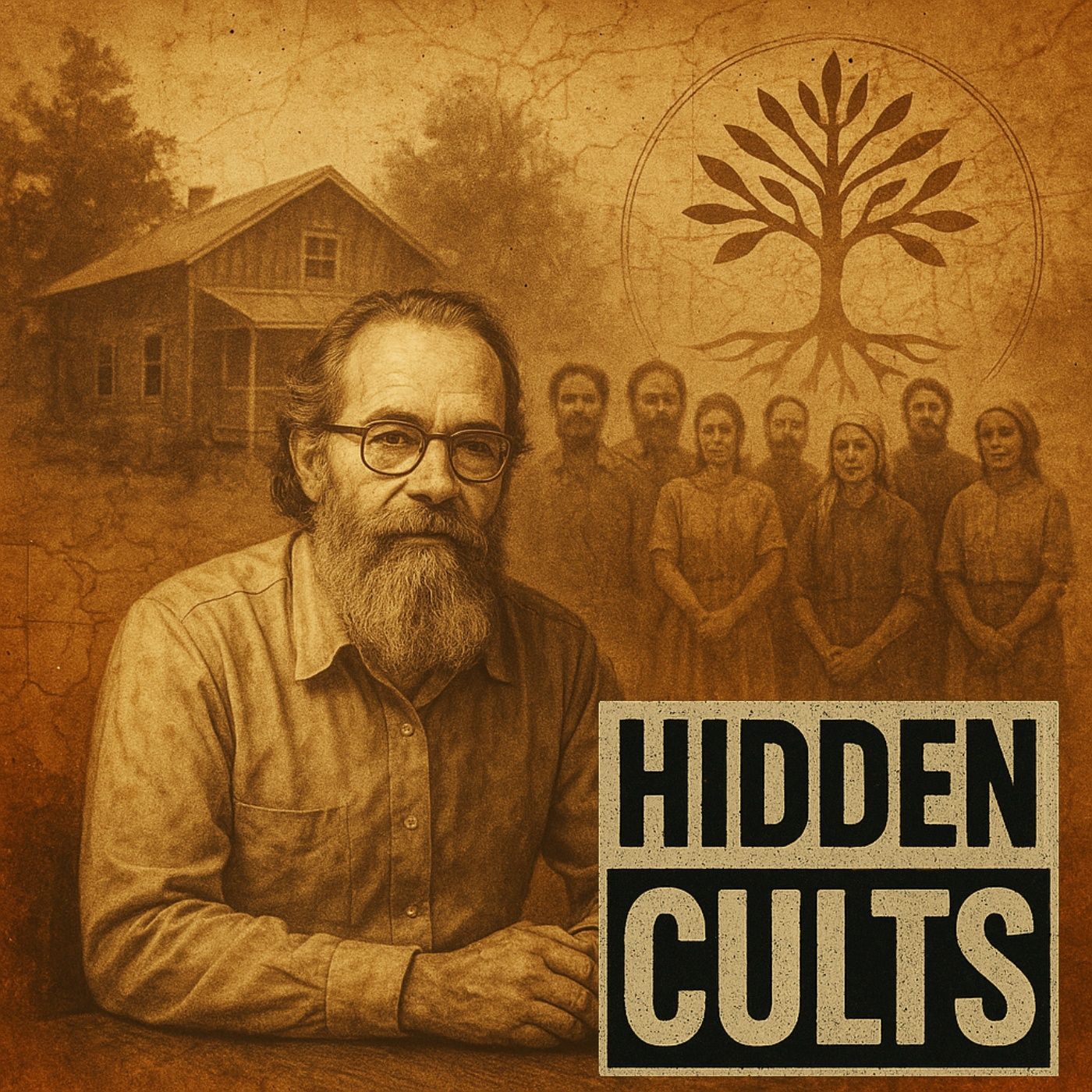
Ep.35 The Twelve Tribes (Messianic Communities)
Episode Transcript
Welcome to Hidden Cults, the podcast that shines a light into the shadows.
Here we explore the strange, the secretive, and the spiritually seductive.
From fringe religions to doomsday prophets, from communes to corporate empires.
These are the movements that promised meaning and sometimes delivered something far more dangerous.
I'm your host, and in each episode, we uncover the true stories behind the world's most controversial cults, the leaders who led them, the followers who followed, and the echoes they left behind.
If you or someone you care about has been impacted by a cult, you're not alone.
There is help.
Whether you're still inside a cult or trying to process what you've been through, support is out there.
You can find organizations and hotlines in the description of this episode.
You deserve freedom, healing, and a life that's truly your own.
Reach out.
The first step is often the hardest, but it's also the most powerful.
If you'd like to share your story and experiences with a cult, you can email it to me and I will read it on a future Listener Stories episode.
Your anonymity is guaranteed always today's episode, let's begin the twelve Tribes Communities Part one, the Birth of a New Kingdom.
In the late nineteen sixties, America was unraveling and remaking itself at once.
The Vietnam War was still raging, protests filled city streets, and young people were abandoning traditional religion in search of something more authentic.
Churches were emptying, communes were forming, and the words spiritual had begun to replace religious.
It was in this shifting landscape that a Tennessee school teacher named Elbert Eugene Spriggs decided that the Christianity he'd been raised with had lost its soul.
Spriggs was born in nineteen thirty seven in Tennessee, and for much of his early life he seemed ordinary.
He taught high school, coach sports and attended church with the kind of regular devotion expected in the American South.
But beneath the surface, he was restless.
By his own account, he felt that Christianity had become a performance, a social club, rather than a calling.
The sermons were hollow, he said, and the people who claimed to follow Christ were Sunday believers and weekday hypocrites.
By the early nineteen seventies, Spriggs had left his teaching job and was working as a psychotherapist in Chattanooga.
There he began holding informal Bible studies off and outdoors, preaching a radical message that appealed to a generation disillusioned with institutions.
He told listeners that the world was collapsing under greed and corruption, and that only a complete return to the communal faith of the early Church could save them.
His message echoed the counterculture's rejection of materialism, but it added a distinctly apocalyptic tour whist time was running out.
Spriggs began gathering followers, young men and women who had grown up in the shadow of the nineteen sixties but found little meaning in peace marches or psychedelic rebellion.
They were drawn to his intensity and his promise of renewal.
He spoke softly, but carried the conviction of a prophet.
He told them that true faith required not only prayer, but the surrender of personal property, ambition, and ego.
Together, they would live as the first Christians had, sharing everything, working side by side, and raising children in the ways of God rather than the world.
In nineteen seventy two, Spriggs and his wife Marcia opened their home in Chattanooga to a handful of these seekers It was a small, improvised commune at first, mattresses on the floor, shared meals cooked from donations, and long nights spent meant reading scripture aloud.
But for the people who came it felt like a revelation.
They called themselves the Community and later the Vine Christian Community Church.
They saw themselves as a rebirth of the Book of Acts, the biblical account of the first Church after Jesus's death, a time when believers lived together, sold their possessions, and devoted themselves to a shared life of faith.
From the beginning, Spriggs's message stood apart from both the mainstream church and the broader Jesus movement that was sweeping America.
While many Christian communes of the time emphasized love and personal salvation, Spriggs emphasized obedience and separation.
He preached that the modern world was under the control of Satan, and that true believers had to isolate themselves from its corruption, from television, from politics, from higher education, even from family members who refused to believe.
By nineteen seventy three, the group had grown large enough to draw attention.
They began holding public gatherings in Coolidge Park, preaching on street corners and inviting passers by to join their new kingdom.
To outsiders, they looked like another group of Christian hippies, but within the commune life was becoming more structured and more demanding.
Members gave up their money, homes, and personal possessions.
They worked without pay, shared everything communally, and referred to one another as brother and sister.
Spriggs, now called YONEK, positioned himself as the teacher, the shepherd of a new era.
They opened a small restaurant called the Yellow Deli, serving sandwiches and herbal teas in a space filled with candles, plants, and wooden carvings.
The Deli quickly became both a business and a mission field.
Customers were served food alongside scripture.
Those who lingered too long or expressed curiosity were invited to Bible studies and sometimes to stay.
The Yellow Deli would become one of the defining features of the movement, a friendly front for what was beneath the surface, a growing religious order.
In interviews from those early years, Spriggs spoke about community with a kind of nostalgic longing, as though he were rebuilding Eden in the middle of a decaying world.
People are lonely.
He said, they want family, they want purpose.
The Church has forgotten what it means to live for one another.
It was a message that resonated deeply, especially with those who had come out of broken homes or disillusioned churches.
Yet, even in those first years, there were signs that Sprigg's vision demanded more than fellowship.
It demanded total surrender.
Members were discouraged from questioning his teachings.
Discipline was framed as love, obedience as salvation.
If you're not willing to give up everything, he told his followers, you cannot be part of the kingdom.
It was a line lifted from the Gospel of Luke, but in Spriggs's mouth it became the cornerstone of control.
By the mid nineteen seventies, the Vine community had outgrown its Chattanooga home.
New converts poured in from across the southeast, and Spriggs began sending groups to start new communities in other cities.
Each one lived communally, worked collectively, and funneled money back to the central leadership.
The members saw themselves as the seeds of a restored Israel, twelve spiritual tribes that would one day rise to greet Christ at his return.
What had started as a small experiment in shared living was becoming a movement, and at its center stood a man who believed he had been chosen to rebuild God's Kingdom from the ruins of modern faith.
Part two, The Gathering of the Tribes.
By the late nineteen seventies, Albert Eugene Yonick Spriggs was no longer a small town preacher running a single communal house.
He had become the leader of a fast spreading religious movement that his followers now called the Messianic Communities.
What began in Chattanooga as a single household of a few dozen people had multiplied across the American South and beyond, bound together by a vision that combined first century Christian living with absolute submission to divine authority.
The message was simple and appeal feing to those who were spiritually adrift.
Modern Christianity was corrupt, the world was collapsing, and only by living as the early disciples did could one find true salvation.
Members quoted the Book of Acts as their blueprint.
Just as the first believers had shared all things in common, spriggs followers surrendered their money, jobs, and property to the community.
In exchange.
They were promised a life of purpose, unity, and preparation for the coming Kingdom of God.
The expansion was remarkably fast.
Spriggs dispatched trusted elders to form new settlements in Georgia, North Carolina, and eventually Vermont.
Each community followed the same template, a cluster of simple houses or farm buildings, a communal dining area, and a yellow deli, the group's signature restaurant.
The delis became both livelihood and recruitment tool.
Decorated with handmade wooden signs, soft lighting, and folksy charm, they attracted curious college students, travelers, and disillusioned Christians looking for warmth and belonging.
A sandwich came with a smile, a conversation, and an invitation to visit the community.
By the early nineteen eighties, there were dozens of Twelve Tribes locations across the United States, with satellite groups forming in Canada and Australia.
The movement began referring to itself collectively as the Twelve Tribes of Israel, with Spriggs teaching that they were the spiritual heirs of God's chosen people.
Each community was one tribe named after the biblical sons of Jacob.
The faithful believed they were building the foundation of a restored kingdom that would usher in the second coming of Christ.
Inside the communes, life was tightly ordered.
Families lived together in large, shared houses, rising before dawn for prayers and communal meals.
Men and women wore modest clothing modeled after ancient Hebrew styles.
Long hair and beards were encouraged for men.
Women covered their heads with scarves and wore handmade dresses.
Work was divided by gender and age.
Men farmed built furniture, while women cooked, cleaned, and cared for children.
Everything from daily chores to spiritual discipline was done in the name of unity.
Money ceased to exist as an individual concept.
Wages from community run businesses went into a collective fund controlled by elders.
Personal possessions were surrendered upon joining, symbolizing freedom from worldly attachment.
Members did not vote, hold outside jobs, or maintained private bank accounts.
Their lives were entirely wrapped around the rhythms of the community morning worship, midday labor, evening teaching, and group prayer.
The sense of belonging was powerful.
Former members have described those early years as warm and intoxicating, a place where everyone seemed to care, where life had order and meaning.
People who had struggled with addiction, loneliness, or the chaos of the nineteen sixties comfort in Sprigg's structured world.
They believed they had finally found what the hippie communes could not, a disciplined, godly version of utopia.
But structure came with control.
Every decision, from marriage to clothing required elder approval.
Members who questioned doctrine were rebuked or ostracized.
The group practiced public confession, where individuals stood before others to admit sins or failings, often followed by tears and embraces.
To outsiders, this looked like emotional catharsis.
To insiders, it became a means of surveillance and conformity.
As the group grew, so did its confidence.
Spriggs published teachings and letters that circulated among the communities, framing himself as a prophetic voice restoring the lost truth of Christianity.
He insisted that all other churches were part of the fallen world institutions led by false teachers who had betrayed Christ.
To follow Yonick was to follow God's true plan for humanity.
In nineteen eighty three, the group made headlines when one of their Tennessee communities clashed with local authorities over home school regulations.
Spriggs insisted that the state had no right to educate the group's children, declaring that the world belongs to the evil One.
From then on, the Twelve Tribes would view government scrutiny as persecution, a badge of righteousness that proved their divine separation from society.
Meanwhile, the Yellow Deli network expanded into a kind of spiritual franchise.
Each new Delhi was built by hand, furnished with reclaimed wood, and filled with scripture inspired artwork.
The restaurants ran on long hours and volunteer labor, but customers rarely saw the exhaustion behind the smiles.
To diners, the workers seemed serene and content, always speaking of community, love and Jesus's return.
But to many inside, the pace was relentless the expectations constant.
Members worked from sunrise until midnight, then rose before dawn to pray again.
By the mid nineteen eighties, the Twelve Tribes had communities in Vermont, New York, California, Canada, and Australia, as well as growing out post posts in Europe, the group rebranded again, officially adopting the name the Twelve Tribes of Israel to reflect their global vision.
The name change symbolized both ambition and insolation.
They were no longer a small movement, but a self proclaimed nation of God's chosen people preparing for the end times.
At the center of it all, Spriggs remained both distant and revered.
Followers called him YONEK, spoke of him in near biblical tones, and treated his words as scripture.
He rarely appeared in public gatherings, but issued letters and teachings that were read aloud across the world.
The man who once sat with street preachers in Chattanooga now ruled a network of hundreds, soon to be thousands, who saw him as the voice of Yeshua on earth.
To outsiders, the Twelve Tribes looked like a harmless offshoot of the nineteen seventies Jesus Movement, But to those inside, it was already becoming something much more, a closed world where obedience was love, work was worship, and questioning the leader meant questioning God himself.
Part three, The Law of the Twelve Life inside a Twelve Tribes community was governed by a rhythm that felt ancient, almost biblical in its precision.
Every day began before sunrise, when a trumpet or handbell summoned members to gather for morning worship.
Men, women and children filed into the communal hall, dressed in simple, handmade clothes.
The air smelled faintly of herbs and baking bread.
Someone read a passage from the Book of Acts or from the writings of Yonick Albert Eugene Spriggs, and the group would sing hymns together in soft harmony.
It was peaceful, ordered, and in its own way beautiful.
But beneath that harmony lay an undercurrent of fear and control that defined every moment of community life.
His word, delivered through elders, dictated how every member dressed, worked, ate, raised their children, and even thought.
The Twelve Tribes believed they were restoring the pattern of the first Christians, a world where all things were shared and every action was spiritual.
To outsiders, it looked like communal living.
To insiders, it was a total surrender of individuality.
Gender roles were fixed and unquestionable.
Men were the heads of the household and the spiritual leaders.
They were taught that eve's disobedience had unleashed sin into the world, and that obedience to their husbands was not only moral, but redemptive.
A woman's virtue, they said, was measured by her silence, her humility, and her willingness to serve.
Marriage within the tribes was not a matter of romance, but of arrangement.
Elders approved all unions, often matching young couples after a period of spiritual discernment.
Consent was secondary to the perceived will of God.
Wives were expected to bear many children, whom the group called arrows in the quiver.
These children were viewed not as individuals, but as future members of the Twelve Tribes, soldiers for God's coming kingdom.
Discipline was central to this worldview.
Children were not just corrected, but broken to obedience.
Spriggs taught that a child's will must be crushed like a seed so that submission could take root.
Corporal punishment was common, often severe.
Wooden rods and thin reeds were used to strike children for infractions as small as refusing chores, fidgeting during worship, or speaking out of turn.
Spanking was described as an act of love, a way to cleanse the soul of rebellion.
A child left to himself will bring shame, one elder would often repeat, quoting proverbs.
In practice, this meant that children lived in fear.
Ex members later described scenes of mass punishment where crying children were lined up and struck while others were forced to watch.
Those who resisted were beaten harder, and those who cried too loudly were accused of pride.
Some children were sent to live with other families for training, separated from their parents for weeks or months.
Education focused on scripture, chores, and obedience.
Reading and arithmetic were taught sparingly.
Science and history were dismissed as worldly knowledge.
From an early age, children worked long hours.
They were told that work was holy, that serving others brought joy to Yashua.
In many communities, they labored alongside adults well into the night.
The movement's businesses relied heavily on unpaid labor, much of it done by children.
For the tribes, this was not exploitation, but devotion to them.
The world outside worshiped money.
Inside the community, labor was worship itself.
Spriggs maintained his authority through a network of elders who enforced every rule Each community had local leaders responsible for discipline, marriages, finances, and communication with other communities.
Members were required to confess sins publicly, anything from disobedience to lustful thoughts, in meetings that could last hours.
Confession was framed as purification, but it also created a culture of surveillance.
Members learned to police themselves and each other, terrified of being accused of pride or rebellion.
Spriggs teachings on purity extended to every aspect of life.
Members were discouraged from watching television, listening to outside music, or reading secular books.
Contact with family members outside the tribes was heavily restricted.
Those who left were considered spiritually dead, cut off from the route.
Letters from former members when unopened phone calls were ignored.
The outside world was the domain of Satan, Spriggs taught, and to remain pure, one must have no fellowship with darkness.
By the late nineteen eighties, whispers of abuse began to surface.
Social workers in Vermont and Tennessee received reports of harsh corporal punishment and child neglect.
Investigators found children who could barely read or write, some with bruises and scars, but when questioned, the children defended their parents repeating the teachings they had been raised on.
Discipline was love, pain was correction, and the world outside was wicked.
Former members began to come forward, describing a system that crushed individuality in the name of holiness.
They spoke of exhaustion, fear, and the quiet despair of realizing that every decision, every thought was owned by the community.
Some told of young girls being married to older men under spiritual guidance.
Others described how even illness was treated as sin, with members discouraged from seeing doctors.
Authorities struggled to intervene.
The Twelve Tribes presented itself as a peaceful religious movement, and its communal structure made it difficult to identify specific abusers.
The group's isolation and secrecy frustrated investigators, who often left empty handed after being greeted by polite, smiling members who insisted that reports of abuse were lies of the devil.
To outsiders, the communities seemed idyllic, children playing in gardens, handmade bread, cooling on windowsills, men and women singing during harvest time.
But those who lived inside knew that peace came at the price of freedom, that every hymn carried the weight of obedience, and every smile masked a life ruled by fear.
Through the nineteen eighties and into the nineteen nineties, as more communes formed across the world, the same stories, followed, the same songs, the same rod of discipline.
What bound them together was not only belief, but submission, the law of the Twelve, written not in scripture but in Control Part four a Kingdom Apart.
By the early nineteen nineties, the Twelve Tribes had grown into a sprawling transnational network, a patchwork of farms, villages, and yellow deli cafes stretching from the United States into Canada, Europe, South America, and Australia.
Wherever the group went, it recreated the same pattern, a self contained, insular world where every aspect of life, from birth to death, was governed by immunal law and the teachings of Yoneck, Albert Eugene Spriggs.
In the movement's literature, this expansion was described as the gathering of the scattered tribes.
Followers believed they were laying the foundations for a renewed Kingdom of God on earth, a society purified from greed, ambition, and corruption.
They saw themselves as a chosen remnant, rebuilding what humanity had lost since the fall of Eden.
Each new community followed a familiar blueprint.
Land was purchased quietly, often in rural areas or small towns where scrutiny was minimal.
Members built homes by hand, farmed their own food, and opened a yellow deli or common ground cafe nearby to earn income.
The delis were almost identical across continents.
Rustic candlelight, filled with scripture verses and the soft sound of folk music.
The same sandwiches, the same smiling faces, the same rehearsed warmth greeted every visitor.
For those who joined, life inside these villages was all consuming, no weekends, no private property, and no individuality.
Every decision, from what to eat to who to marry, passed through layers of elder approval.
The group's teachings warned constantly of the world's approaching destruction.
To leave the community, they said, was to abandon God and risk eternal death.
The twelve tribes presented themselves to outsiders as a peaceful, family centered society.
Visitors to their farms saw children playing barefoot in the grass, women kneading doe, and men chopping Wood.
Journalists who accepted invitations often described the atmosphere as serene, even idyllic, until they noticed the walls that separated the community from the outside world.
Questions about leadership or discipline were met with smiles and evasions.
Members referred to Spriggs reverently as our teacher or our father, though few had met him in person.
By this time, Spriggs had become increasingly reclusive.
He lived for periods in Vermont, then in France and later Brazil, communicating with his followers through letters and recorded teachings.
His words were read aloud in every community, treated as scripture.
Those who disagreed or questioned were reminded that yonek was the chosen vessel of God's wisdom, a prophet continuing the work of the Apostles.
He warned his people that the world outside was under the dominion of Satan, and that persecution was not only inevitable, but proof of righteousness.
That prophecy seemed to fulfill itself repeatedly.
As the group spread, so did scrutiny.
In Vermont, authorities rated a community in nineteen eighty four after allegations of child abuse and educational neglect.
Over one hundred children were removed in a single morning, placed temporarily in state custody, but within days a judge ruled the raid unconstitutional and the children were returned.
For the twelve tribes, the event became a defining moment proof.
They said that the government had persecuted them for their faith, just as the Romans persecuted the Early Church.
Similar confrontations followed elsewhere.
In Germany, officials launched investigations into the group's practices after reports of child beatings and forced labour.
In Australia, journalists exposed the community's use of corporal punishment and isolation.
In Argentina and Brazil, labor authorities accused the group of exploiting children and undocumented workers on farms and construction projects.
Each new controversy was spun into the same narrative, the righteous under siege by the wicked world.
Inside the communities, those raids and reports were not seen as warning signs.
They were celebrated.
Members believed persecution was confirmation that they were the chosen ones.
Yonick told them that opposition from the world was proof that they were succeeding in separating themselves from it.
If they hated him, Spriggs wrote, they will hate us.
Also, what outsiders saw as fanaticism, members saw as faith under fire.
They doubled down on separation, retreating form from society.
Children were homeschooled, often with minimal academic education.
Members avoided doctors, preferring natural remedies in prayer, voting, television and modern technology were dismissed as the tools of a corrupt civilization.
By the late nineteen nineties, the movement's reach had become astonishing.
There were thriving communities in France, Spain, Germany, Canada, Mexico, Brazil, Argentina and Australia, each following the same rituals and teachings.
The Twelve Tribes printed their own literature, brewed their own tea, manufactured their own soap, and built their own schools.
They even printed their own calendars, marking sacred festivals.
Unknown to outsiders, every element of modern life was replaced by a homegrown alternative, giving members the illusion of complete self sufficiency.
Sprigg's writings grew increasingly apocalyptic as he aged.
He warned of a coming collapse of civilization and the rise of a beast system that would enslave humanity.
Only those living in his communities he said would survive and inherit the earth.
In the two thousands, he began comparing himself to Moses and John the Baptist, the prophets who had prepared the way for salvation.
To his followers, these claims were not arrogance but reassurance, a promise that their suffering was part of God's plan.
In twenty twelve, the group faced one of its most public crises when German police raided a Twelve Tribes community in Bavaria, rescuing dozens of children after undercover footage showed beatings with wooden rods.
The images shocked the world, small children being whipped by calm, expressionless adults in the name of discipline.
The group denied wrongdoing, insisting that corporal punishment was biblical and that outsiders could not understand spiritual correction.
Through it all, the tribes endured.
Every country that expelled them seemed only to strengthen their resolve.
They would leave one region and quietly establish another.
Farms and craft businesses continued to grow, generating millions in untaxed labor and income.
The movement had become, in many ways, its own nation, a self contained kingdom scattered across continents, answering only to one man.
By the time Spriggs died in twenty twenty one, his followers numbered in the thousands.
They called themselves the people of Yashua.
The Twelve Tribes of Israel.
Restored to them the outside world was Babylon, doomed and dying.
They were the faithful remnant, waiting for the trumpet of judgment.
And though the prophet was gone, his words still ruled the world.
He built a kingdom apart, walled off by faith and fear, where obedience was eternal and doubt was heresy.
Part five, The Eternal Community.
Half a century after its founding, the Twelve Tribes still exists, not as a relic of the nineteen seventies, but as a living, working network of communes that spanned the globe from Hiddenite, North Carolina to Klangen, Germany, from Picton, Australia to Buenos Aires.
The same patterns repeat.
Yellow Deli cafes, glowing softly at night, children in handmade clothes, men with long beards, and women in headscarves, all speaking of peace, purpose, and the coming Kingdom of Yeshua.
On the surface, it looks unchanged, but beneath the calm veneer, the same machinery of control continues to turn quietly and relentlessly.
After the death of Elbert Eugene Yonick Spriggs in twenty twenty one, the movement did not collapse.
Instead, it adapted, just as it had done after every scandal, raid, and public expose.
A leadership passed to a council of elders, but spriggs teachings remained untouched.
His writings, bound into thick volumes and circulated through every community, are still read aloud as sacred instruction.
He is remembered not as a founder, but as a prophet, the man who restored the lost Church of Acts and built a kingdom that, in his follower's eyes, will never die.
In the modern day, the Twelve Tribes operates in more than a dozen countries.
Their yellow deli restaurants, organic farms, and craft businesses function both as sources of income and as a shield from scrutiny.
Customers who wander into one of their cafes in Vermont, New York, or Sydney might have no idea they are supporting a religious commune accused of child abuse and forced labor workers serve food with serene smiles, rarely mentioning the communal life behind the counter.
The group's public image has evolved.
Gone are the open references to spanking rods and the fiery sermons about Satan's world.
In recent years, the Twelve Tribes has rebranded itself as a wholesome, faith based community living in harmony with nature.
Their websites speak of simplicity, kindness, and family, but the core doctrine remains untouched, the absolute authority of elders, the rejection of modern society, and the belief that corporal punishment and submission are divine imperatives.
Ongoing investigations in Germany, Argentina, France, and the United States continue to challenge that image.
Journalists and law enforcement have documented disturbing consistencies across continents.
Children educated only in scripture, denied medical care and punished for disobedience, Adults working unpaid in commercial ventures that funnel profits back into the movement.
In twenty twenty, German police raided communities in Bavaria, seizing documents and interviewing witnesses about child abuse.
In Australia, media reports exposed the same practices that had driven earlier raids decades before, bruised children, underage labor, and isolation under the guise of holiness.
Survivors who escaped the group have become some of its most powerful critics.
Many describe years of internal conflict of trying to reconcile their love for the community with the pain it inflicted.
Some left as adults, others escaped as children.
Their stories echo one another constant exhaustion, fear of eternal damnation, and guilt for questioning authority.
One woman who fled the Vermont community at sixteen said she still wakes up at dawn haunted by the sound of the morning trumpet.
You're taught that the world outside will destroy you, she said.
When you finally leave, you don't know who you are without them.
Another survivor from France described the psychological conditioning that made leaving nearly impossible.
You can't imagine being loved outside.
You're told that you're nothing without the community.
You start to believe it.
Psychologists who study the Twelve Tribes describe it as a closed ideological system, a self reinforcing world where control is disguised as devotion.
Every structure serves that purpose.
Communal living eliminates privacy, confessions erase descent.
Corporal punishment enforces fear, and constant work drains the will to question even love.
The very thing the group claims to perfect becomes a tool.
Members are told that to disobey the elders is to hurt the family, to betray God himself.
The group's ability to survive Contra lies partly in its adaptability.
After every major investigation, it reforms its language, not its structure.
Public statements soften, websites vanish and reappear, and spokespeople reassure the press that reports of abuse are misunderstandings or past mistakes.
Behind closed doors, the cycle continues today.
The Twelve Tribes presents itself as a global community of artisans and farmers.
Their dealers serve the same food, their farms sell the same organic produce.
Tourists can visit their properties, buy handmade soap, or attend a festival where members sing folk songs about love and redemption.
To many who pass through, the communities seem peaceful, even admirable, a rare alternative to the chaos of modern life.
But for those who lived inside, that piece was always conditional and that love always had a cost.
Former members often speak of the paradox at the heart of Sprigg's creation, the longing for purity that turns poisonous when it demands absal obedience.
What began as a search for genuine community became a hierarchy of control.
What promised freedom from sin became a life ruled by fear.
The desire to return to the innocence of the early Church led inevitably to something darker, a reminder that whenever one person claims to hold the only truth, others will be forced to suffer for it.
And still the Twelve Tribes endures.
Its members work, sing, and pray as they have for fifty years, convinced that the outside world will one day crumble and that their way of life will stand as the last light of faith for them.
Isolation is not imprisonment, it is salvation.
For the rest of the world, it is a haunting example of how easily devotion can blur into domination.
The kingdom that Yoneck built was never just a commune.
It was an idea, and ideas, unlike leaders, do not die easily.
Next episode.
The Family Australia, led by Anne Hamilton Burne from the nineteen sixties to the nineteen eighties.
This cult adopted children and then subjected them to psychological and physical abuse under the guise of spiritual purity.
That's next time.