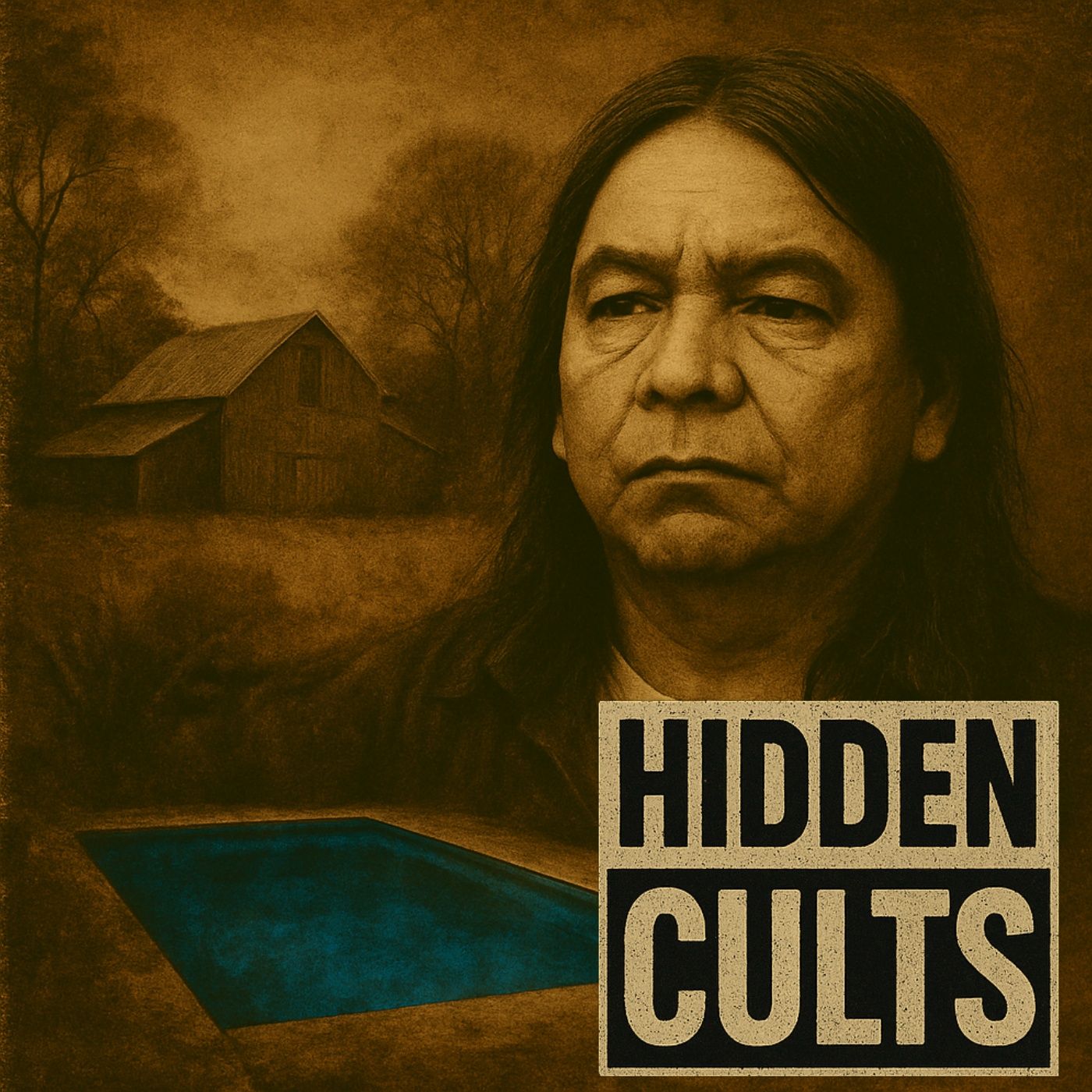
Ep.28 Angel’s Landing
Episode Transcript
Welcome to Hidden Cults, the podcast that shines a light into the shadows.
Here we explore the strange, the secretive, and the spiritually seductive.
From fringe religions to doomsday prophets, from communes to corporate empires.
These are the movements that promised meaning and sometimes delivered something far more dangerous.
I'm your host, and in each episode, we uncover the true stories behind the world's most controversial cults, the leaders who led them, the followers who followed, and the echoes they left behind.
If you or someone you care about has been impacted by a cult, you're not alone.
Speaker 2There is help.
Speaker 1Whether you're still inside a cult or trying to process what you've been through, support is out there.
You can find organizations and hotlines in the description of this episode.
You deserve freedom, healing, and a life that's truly your own.
Reach out.
The first step is often the hardest, but it's also the most powerful.
If you'd like to share your story and experiences with a cult, you can email it to me and I will read it on a future Listener Stories episode.
Your anonymity is guaranteed always today's episode, let's begin Angel's Landing, Part one.
The Angel of Kansas.
On the surface, lu Castro seemed like an enigma wrapped in charm.
He appeared in Kansas in the late nineteen nineties, an outsider who spoke softly, smiled often, and carried himself with an air of quiet authority.
He told stories about wealth, visions, and immortality.
He said he was an angel sent to protect a chosen few.
Those who met him rarely forgot the encounter.
There was something magnetic about the man, but lu Castro was not his real name.
Behind the polished demeanor and mysterious past was a man named Daniel Perez, born in Texas in nineteen fifty nine.
His early life was unremarkable.
He had no stable career, no theological training, no recognized ministry.
What he did have was a talent for persuasion and an instinct for reading people.
Friends from his youth described him as manipulative, confident, and quick to twist stories to his advantage.
He could make others believe almost anything if he thought it would serve him.
By the late nineteen eighties, Perez had begun reinventing himself under the name Leu Castro.
He told acquaintances that he had lived many lives, that he was hundreds of years old and that he possessed supernatural insight into death.
He claimed he could predict when someone's time was near, and that angels spoke directly to him.
When tragedies struck those around him, he treated it as confirmation of his divine gifts.
For people already seeking meaning or comfort, his confidence was intoxicating.
Lou didn't preach in churches or on street corners.
His ministry was personal.
He approached individuals quietly, often through mutual friends, presenting himself as a guide who understood pain and destiny.
He told them that death wasn't random, that it was part of a celestial plan he could interpret.
He said he knew when it would come, and for those who followed him, he could delay it.
His earliest known followers were women in their twenties and thirties, who described feeling instantly drawn to his calm, almost hypnotic presence.
He offered guidance wrapped in mysticism, mixing fragments of Christianity, reincarnation, and psychic premonition.
It was a language that gave the illusion of depth without requiring proof.
When followers questioned him, he would simply smile and say you'll understand in time.
By nineteen ninety eight, Lou had gathered a small circle of devoted believers who viewed him as both protector and profit.
Together, they purchased land outside Wichitac Hands and built a secluded community that would come to be known as Angels Landing.
The property sat near a quiet lake, surrounded by trees and open fields.
To the neighbors who occasionally glimpsed it from the road, it looked peaceful, just a cluster of homes and workshops set back from view.
But for those inside, the land represented something sacred.
Lou said it was a refuge chosen by divine will.
He told his followers that he had seen visions of the end times, that the world beyond the property was full of corruption and deceit.
Only those who lived close to him who followed his guidance would be safe when the angels returned.
The group's members began pooling resources to support what they saw as a holy mission.
Lou explained that angels required physical vessels on earth to do their work, and that money was simply energy, a tool for divine progress.
That explanation opened the door to something far more elaborate Lou told the group that he and certain followers were immortal beings by divine power, but dependent on the deaths of others to sustain balance.
When tragedies struck within their ranks, he claimed it was necessary, a trade off required to maintain the group's spiritual safety.
This belief would later become the foundation for his manipulation and financial crimes.
The earliest documented tragedy linked to the group occurred in two thousand and one, when a close associate died in what Lou called a predicted accident.
Insurance money followed.
Lou explained that it was a blessing from the Angels, a gift for their continued faith.
The payout was placed in accounts controlled by him, and soon after construction began on new homes at Angels Landing, neighbours noticed the sudden influx of money.
Expensive vehicles a Cadillac, a Corvette, a Jaguar appeared on the property.
Followers, many of whom had worked modest jobs before meeting Lou, now lived in relative luxury.
They explained to curious locals they were cared for by an angel who insured their prosperity.
It sounded unbelievable, but in a place as quiet as Valley Center, Kansas, people tended to mind their own business.
Inside the community, Lou established a hierarchy that revolved entirely around him.
Members referred to him as Lou or the Angel.
He demanded loyalty, secrecy, and unquestioned obedience.
He controlled where people worked, who they associated with, and even what they believed about their own lives.
According to later testimony, he often told followers that he knew the exact day they would die.
I can see the future, he said more than once.
If you stay close to me, the Angels will protect you.
Children grew up hearing those words as truth.
Adults repeated them as reassurance.
Every small event, a car breakdown and illness, a lost job, was framed as part of a spiritual lesson.
Lou cast himself as both interpreter and savior.
Publicly, he kept a low profile.
The community wasn't registered as a church or a nonprofit.
There were no sermons or outreach events.
To outsiders, Angels Landing looked like an extended family living together on private land.
The isolation worked in Lose favor.
He maintained control by limiting outside influence convincing followers that outsiders were blind souls who couldn't comprehend the group's divine purpose.
His charisma was key to maintaining belief.
People who met him described him as articulate and gentle, almost magnetic.
He had a way of turning casual conversation into something intimate and profound.
If someone expressed fear, he would quote scripture.
If they spoke of doubt, he would share a vision to reassure them.
His authority came not from any institution, but from his ability to convince others that he possessed knowledge beyond human reach.
Former followers would later tell investigators that Lose teachings constantly shifted.
One day he emphasized Christian imagery, the next he spoke of reincarnation or cosmic cycles.
This fluidity served a purpose.
It kept followers dependent on him for interpretation.
Whenever contradictions arose, he claimed that divine truth was not meant to be understood by ordinary minds.
As his control deepened, Lou began blending spirituality with financial exploitation.
He persuaded members to take out life insurance policies, naming him or the group as beneficiaries.
He said it was preparation for spiritual transition.
To make the request sound noble, he framed it as part of a divine exchange, a ritual of giving up material attachment to embrace faith.
It worked over the years, multiple policies were established.
Each time a member or associate died unexpectedly, the pattern repeated, grief, justification, and profit.
Lou told survivors that death was not tragedy but transformation.
The money, he said, was proof of their continued favor in the eyes of the angels.
By the mid two thousands, Angels Landing had evolved into a fully self contained community.
Several homes stood around a central property, all connected by shared belief in Lou's divinity.
Followers cared for children collectively.
They cooked together, worked together, and rarely questioned Lou's authority.
He told them that angels lived among them in human form, and that he could recognize them instantly.
Those who obeyed were praised as enlightened.
Those who doubted were warned of spiritual danger.
The psychological hold he maintained was subtle but powerful.
He alternated between kindness and intimidation, using affection to draw people closer and fear to keep them from leaving.
He often spoke of unseen threats, forces that wanted to destroy their mission.
The world will never understand what we are, he told them.
If they find out, they'll call us crazy or worse.
That narrative kept the group insulated for years.
Parents raised children within his mythology.
Teenagers grew up believing Lou had supernatural abilities.
When outsiders asked questions, members deflected or simply refused to answer.
They were convinced that speaking about angels landing to outsiders would bring disaster.
Lou's control extended to the smallest details of daily life.
He dictated what people wore, how they spent their time, and where they worked.
He arranged relationships and approved marriages.
Some members worked outside the compound in regular jobs, funneling their income back to him.
When questioned, they said the money was for the mission.
Behind the scenes, Lou's private behavior grew increasingly exploitative.
Later investigations revealed evidence of sexual abuse, manipulation, and grooming that targeted the most vulnerable members.
Speaker 2Of the community.
Speaker 1He told victims that physical contact was part of their spiritual journey, a way to channel divine energy.
Most were too afraid or too conditioned to resist.
Those who did question him often found themselves isolated.
Lou would declare that they were spiritually unclean or under attack by dark forces.
Isolation reinforced his authority.
Members who saw the punishment of others learned quickly to stay silent.
At the same time, Lou maintained a double life outside the commune.
He interacted with local officials, bought cars, cars and property under his real name, Daniel Perez, and presented himself as a successful businessman.
The contradiction between his worldly wealth and spiritual message went largely unnoticed.
Angel's Landing was small, private and quiet, but cracks were beginning to show.
A few former members had left, quietly, carrying with them stories that didn't add up.
They spoke of strange teachings, unexplained deaths, and an atmosphere of fear behind the facade of holiness.
Law enforcement began hearing whispers, but without clear evidence, there was little they could do.
The turning point would come with another death, one that would expose the pattern and begin unraveling the entire illusion.
For now, Angel's Landing remained untouched, a hidden world built on faith, money, and fear, ruled by a man who called himself an angel, but lived as something far more dangerous.
Part two, Life in the Commune.
Life at Angel's Landing looked ordinary from a distance.
The property stretched across several acres of quiet Kansas land near Valley Center.
Speaker 2There were a few.
Speaker 1Modest houses, a large garage, and a scattering of vehicles parked neatly in the gravel drive.
A visitor might have seen children playing adult's gardening, or people walking to the nearby lake.
There was nothing that resembled a cult in the conventional sense, no signs, no uniforms, no public rituals.
What made it different was what couldn't be seen, the psychological machinery that kept everyone orbiting around one man.
Inside the commune, Lou Castro's word was absolute.
Followers believed he had direct access to angels who guided every decision.
They called him Lou the Angel, or sometimes Father.
His authority wasn't enforced by overt violence.
It was maintained through belief and dependence.
Members were told that leaving him meant losing divine protection.
To disobey was to invite death.
Lou presented the community as a chosen family, one that lived outside the corruption of the world.
He told followers.
They were part of a divine hierarchy, each playing a role in a cosmic plan that only he fully understood.
It replaced the uncertainty of modern life with order, and that sense of belonging became the core of his control.
The commune's population fluctuated between a dozen and two dozen people, mostly women and children, with a few men who handled construction or maintenance.
The homes were fully equipped with modern comforts, electricity, heating, large kitchens, and entertainment systems.
Liu insisted that comfort was a sign of divine favor.
Unlike the poverty often associated with apocalyptic groups, Angels Landing radiated success.
The cars were expensive, the houses well kept, and the children appeared healthy.
To outsiders, it looked more like a private estate than a religious commune.
But beneath the surface, everything revolved around ritual obedience.
Each morning began with quiet gatherings where Lou would deliver guidance informal talks filled with mystical references and coded instructions.
He claimed to receive messages from unseen beings who told him how to lead his followers.
Some days he spoke of angels preparing to reveal themselves.
Other days, he warned of dark forces trying to infiltrate their ranks.
These daily sessions were unpredictable, and followers waited anxiously for his moods.
Members learned to read his behavior the way sailors watched the weather.
When he was calm, the community felt peaceful.
When his temper rose, tension filled the air.
He could switch from kindness to fury in seconds.
According to survivors, his authority depended on keeping everyone slightly off balance, fearful enough to obey, hopeful enough to stay.
He often tested loyalty through small acts of control.
He might demand that someone changed clothes because the angels disapproved, or order followers to avoid certain foods.
Those who complied were praised for their faith.
Those who hesitated were told they were spiritually weak.
Over time, the constant surveillance wore down personal boundaries.
People stopped making independent choices.
Lou also kept the group f financially dependent.
Followers turned over their income or pooled resources to maintain the property.
When money ran short, he reminded them that angels always provided the insurance.
Payouts from past deaths were spoken of as miracles, divine rewards for faith.
Those funds paid for vehicles, home improvements, and the kind of luxuries that reinforced the illusion of heavenly favor.
Children grew up within this structure.
They were taught that Lou was not fully human, that he had lived many lives and could communicate with celestial beings.
He told them that he had died and been resurrected, that he could not be harmed by earthly means.
When he performed small tricks predicting visitors, finishing sentences before others spoke, the children saw it as proof of his power.
Adults encouraged the belief, too afraid to question it openly.
Some of the women took on maternal or administrative roles.
They cooked, cleaned, homeschooled the children, and managed the property's affairs.
Lou framed this as spiritual duty.
He told them that obedience was a path to enlightenment, and that any doubt was a sign of contamination by evil forces.
The language of faith masked the mechanics of coercion.
According to later testimony, Lou maintained a network of emotional and sexual relationships within the group.
He claimed intimacy with him was a form of divine connection, a way to receive light from the angels.
Women who resisted were told that refusal meant rejection of divine will.
Speaker 2Some gave in.
Speaker 1Out of fear, others believed compliance was sacred.
The secrecy surrounding these acts insured his control.
No one spoke about it openly, not even to each other.
Outsiders occasionally visited the property, delivery drivers, tradesmen, or curious locals, but they rarely saw anything unusual.
Lou greeted them politely, dressed in jeans and collared shirts, often wearing a cross around his neck.
He presented himself as a businessman managing family investments.
His calm manner and polite tone disarmed suspicion.
Even the local sheriff's deputy who passed by saw nothing more than a private, wealthy household.
As the years passed, his followers dependence deepened.
Many had cut ties with family and friends.
They no longer visited relatives or maintained outside relationships.
Lou told them outsiders were jealous or spiritually blind.
He said only those at Angel's Landing were chosen to survive the coming upheaval.
That prophecy of doom kept people anchored.
The world outside was dangerous.
The commune was sanctuary.
When doubts surfaced, Lou used fear to silence them.
He reminded members of his supposed visions, predictions of car crashes, illnesses, or deaths that always seemed to come true.
He would point to pass tragedies as proof you saw what happened.
When they doubted, he'd say, the angels protect those who believe.
The message was clear.
Obedience was survival.
Children attended public school briefly, but Lou often pulled them out under the claim that earthly education corrupted the soul.
He insisted that only his teachings could prepare them for their divine destiny.
He sometimes told the children they would never die, that the angels had already chosen them for eternal life.
When one of them asked about people who left, he replied, they're gone because their time was over.
Speaker 2The angels took them.
Speaker 1The isolation created a closed circuit of belief.
No outside authority contradicted him.
Those who might have intervened, teachers, relatives, or social workers saw only polite families and well kept homes.
Behind closed doors.
Psychological abuse became normalized.
In two thousand and three, Lou expanded his property holdings.
Using funds from life insurance payouts connected to past deaths.
The commune added vehicles, boats, and even small aircraft.
To question where the money came from was to risk being labeled faithless.
Even the children began parroting his language.
They spoke of destiny and angels as casually as other kids talked about school.
Lou used them as symbols of purity, showing them off to visitors as proof of his blessings.
He often filmed them for home videos, narrating their playtime in the language of prophecy.
To an untrained eye, it looked like a fatherly gesture.
To those within the circle, it was a reminder that he watched everything.
By the mid two thousands, Angels Landing had existed for nearly a decade without significant interference.
Lou's followers continued to live under his direction, convinced that their wealth, safety, and salvation depended entirely on him.
Yet beneath the calm surface, something was changing.
The deaths had drawn attention not from locals, but from insurance companies who began noticing a pattern of repeated claims connected to the same group.
Their reports to law enforcement would become the first small crack in Leu Castro's illusion of divine authority.
For the people still living at Angel's landing, that moment hadn't arrived yet.
They woke, worked, prayed, and slept under the quiet belief that their lives were protected by an immortal man who called himself an angel.
Part three, Power, Prophecy and fear.
Diictions always centered on two themes, death and money.
He said that certain deaths were fated, but that angels could turn them into blessings for the faithful.
When a follower died, he used the tragedy to reinforce belief they fulfilled their destiny.
He'd say, their sacrifice keeps the rest of us alive.
Over time, these prophecies became financial operations.
Every death brought insurance payouts.
He never described it as profit.
He called it energy, a sacred flow that sustained their mission.
Insurance investigators would later trace multiple policies linked to the same small circle of people.
Each policy was taken out before a sudden death, and each named Lou or his associates as beneficiaries.
One death followed another, car accidents, drownings, sudden illnesses, all explained as fate.
Lou's reaction was always the same, sorrow mixed with authority.
Speaker 2He spoke of.
Speaker 1Visions of angels visiting him in dreams, of knowing that the deceased had reached the next phase.
To his followers, he sounded like a prophet mourning a friend.
In reality, he was constructing a system of coercion built on tragedy.
The pattern was difficult for outsiders to detect.
Kansas is a quiet place, and accidents happen.
The victims came from different backgrounds, and the claims didn't always overlap geographically.
Without a central investigation, the deaths appeared coincidental.
Lou's financial power grew, and so did his influence.
He purchased additional land and cars, traveling frequently between Kansas and Texas.
Whenever he disappeared for days or weeks, followers said he was meeting the angels.
He returned with new stories and warnings.
Some followers began to feel uneasy.
The deaths were too frequent, the stories too convenient.
One woman confided her doubts to another member, but within days Lou confronted her, repeating details she had thought private.
Someone had reported her.
Afraid of losing favor, Lou accused her of betrayal and declared that she was under attack by darkness.
The humiliation was enough to silence others.
Still, small signs of rebellion appeared.
One teenager began asking questions about Lou's identity, searching online for his past.
Another secretly contacted a relative outside the commune.
Lou discovered both acts and responded with prophecy.
He said he had dreamed of a falling star, a symbol of a child losing grace.
The teenager was punished with isolation, and the message was clear.
Curiosity led to ruin.
Despite the fear, the outside world was beginning to close in the pattern of insurance claims had reached the attention of Kansas law enforcement detectives began quietly reviewing death records connected to angels.
Landing on paper, the coincidences no longer looked random.
He had built a perfect cycle.
Predict tragedy, witness it, collect money, and call it divine balance.
Each repetition made escape harder to imagine, but prophecy had its limits.
The next tragedy would draw not reverence but attention, and it would mark the beginning of the end for the Angel of Kansas.
Speaker 2Part four, death and deception.
Speaker 1By two thousand and seven, the world lou Castro had built around Angel's Landing was beginning to fracture.
The deaths that once seemed like acts of divine design were now patterns on paper, and those patterns were attracting attention.
The first significant break came through insurance investigators.
They noticed multiple life insurance policies connected to people who had died under unusual circumstances drownings, car accidents, sudden illnesses, all linked to the same cluster of names.
At the center was Lou Castro.
The payouts had gone to him directly or to members of his inner circle who shared accounts with him.
The numbers didn't lie.
Over a span of roughly a decade, more than a million dollars had been collected.
Each policy had been purchased only months before a death.
Each claim described Lou as a close friend, caretaker, or business partner.
The investigators reported their findings to Kansas law enforcement, and detectives began a quiet review of the deaths associated with Angel's land Their task was complicated by the secrecy surrounding the group and the fact that the victim's families rarely pushed for deeper inquiry.
The group appeared respectable, and Lou presented himself as a grieving companion.
Still, the similarities between cases couldn't be ignored.
The most striking case was that of Patricia Hughes, a longtime member of the group and one of Lou's closest followers.
Patricia had become one of his most trusted aides, handling paperwork, helping with finances, and caring for children in the commune.
She was devoted to Lose Vision and often spoke of him as a divine protector.
In two thousand and three, Patricia drowned in a small pool on the property.
The death was ruled accidental.
Her husband, who was also a member of the group, accepted it as fate.
Lou told everyone that Patricia's passing had been foreseen, that the angels had warned him it was coming.
The explanations seemed to comfort the community.
They mourned her, but accepted the loss as part of the celestial balance.
Shortly after her death, a large life in shi insurance payout was processed nearly two hundred and fifty thousand dollars.
The money was placed into accounts connected to Lou and used to maintain the property members said the angels had provided once again.
Investigators would later identify at least five similar deaths connected to Lou Castro's circle, all leading to financial gain.
Each case followed the same structure.
A close follower died, Lou interpreted it as prophecy, and the resulting insurance money strengthened his control.
For years, these coincidences slipped through the cracks of bureaucracy.
Local law enforcement viewed each case in isolation, unaware that the same man appeared in every file.
But when Kansas Bureau of Investigation KBI agents began assembling the reports side by side, a pattern emerged that was impossible to ignore.
While the investigation developed quietly in the background, life inside Angel's landing appeared unchanged.
Lou continued to host gatherings where followers listened to his stories of angels and destiny.
He dressed well, spoke politely, and maintained friendly contact with neighbors and local officials.
The property was immaculate, freshly mode lawns, manicured trees, and expensive vehicles parked outside.
He often told visitors that he ran a family investment business.
Those who met him described him as articulate and intelligent.
His charm disarmed suspicion.
Even when rumors surfaced about his unusual lifestyle, they were easy to dismiss.
He didn't resemble the caricature of a cult leader.
There were no strange robes, no loud preaching, just a confident man surrounded by people who seemed to adore him.
That appearance of normalcy made the truth even harder to detect.
Behind the scenes, some members were beginning to struggle with the contradictions in Lou's story.
The promised divine protection hadn't prevented tragedy.
People they loved were gone, and yet Lou insisted it was all part of a higher design.
A few followers began asking quiet questions, Why did every death result in financial gain?
Why did the angels demand so much money?
Lou responded with anger and prophecy.
He warned that doubt would bring ruin.
The Angels don't tolerate disbelief.
He said, they can take anyone at any time.
He cited Patricia Hughes's death as proof she knew her time was coming.
He told them she was ready.
The effect was chilling.
Instead of questioning further, most fell back into obedience.
Fear of death or the appearance of it was a powerful deterrent.
Still the whispers continued.
A former member who had left the group years earlier quietly reached out to local authorities, expressing concerns about the deaths.
That tip aligned with the insurance investigation already under way, giving the KBI cause to dig deeper.
In two thousand and eight, Kansas investigators began surveillance on Angels Landing.
They observed Lou's movements, documented the cars he drove, and monitored financial activity tied to the commune.
The challenge was connecting the crimes to evidence.
The deaths were old and most had been ruled accidental.
There were no direct witnesses willing to testify.
That changed when investigators decided to focus on the children growing up inside the commune.
They believed the key to breaking the case might lie in the next generation, those who had seen Lou's behavior without fully understanding it.
Child welfare authorities began visiting the property under routine pretenses, checking on education and living conditions.
Lou remained polite and cooperative, but the scrutiny made him nervous.
He reminded his followers that government agents were tools of darkness trying to destroy their mission.
He said they were being tested and that their silence.
Speaker 2Would protect them.
Speaker 1Despite his warnings, small cracks widened.
A few of the older teenagers confided privately to social workers about strange rules, fear, and punishments.
One mentioned Lou's claims of immortality.
Another described being told that their lives were tied to his survival, that if he died, they would all perish.
These fragments of testimony gave investigators the leverage they needed.
In two thousand and eight, tragedy struck again.
A woman named Trisha Hughes, related to the earlier victim, Patricia Hughes, died in a plane crash.
She had been close to Lou and was insured for a large sum.
The parallels were unmistakable.
Investigators immediately flagged the death as suspicious and began tracing the money trail.
When they followed the funds, they found once again that the ultimate beneficiary was Lou Castro.
That connection was enough for the KBI to escalate the case into a full criminal investigation.
Agents began interviewing former members, neighbors, and anyone with financial ties to Lou.
Slowly, a clearer picture emerged.
Lou wasn't an angel.
He was a con artist, orchestrating deaths for profit and hiding behind a fabricated spiritual system.
As investigators uncovered more evidence, Lou's mythology unraveled.
His supposed visions had coincided perfectly with life, insurance renewed.
His predictions of death always involved the same inner circle of followers.
The coincidences were too precise to ignore.
Lou's personal story began falling apart as well.
He had told followers he was centuries old, but public records revealed a man born in Texas with a long trail of aliases and small time frauds.
The angels he claimed to speak with had never existed outside his own imagination.
The more investigators dug, the more they found.
Bank records showed deposits matching insurance payouts.
Vehicles purchased with those funds were registered under various names tied to the commune.
He had moved money between accounts to obscure the source, a deliberate effort to hide the flow of cash.
By two thousand and nine, the investigation had grown large enough to justify federal involvement.
The FBI and IRS joined the KBI to examine potential fraud, money laundering, and conspiracy.
Surveillance intensified.
Undercover agents began approaching members of the group, posing as outsiders curious about the community.
Inside Angel's landing, Lou sensed the pressure closing in.
He told followers that angels had warned him of persecution.
He claimed the government was under demonic influence and that they would soon be raided.
Stay faithful, he said, when the world turns against us, the angels will show their power.
That prophecy would soon come true, though not in the way he imagined.
In twenty ten, investigators made their first direct move.
They arrested Lou Castro on charges of child endangerment, aiming to remove him from the commune temporarily while they built the larger case.
During his detention, agents searched the property and seized financial documents.
What they found confirmed everything they suspected, evidence of fraud, insurance schemes, and long hidden abuse.
The victim's stories began to surface.
Former followers described the culture of control, the manipulation, and the fear that had kept them silent.
They spoke of how Lou convinced them that each death was part of divine balance, how he turned grief into justification, and how money always followed tragedy.
Lou's arrest fractured the commune completely.
Without his presence, members began to talk openly for the first time.
Some defended him, insisting that he truly had powers.
Others admitted that they had long doubted but were too afraid to act.
The financial evidence, however, told a different story.
Investigators traced millions of dollars through various accounts tied to Lou.
The Angelic mission was, in reality, a sustained fraud operation built on psychological manipulation and exploitation.
When questioned, Lou maintained his composure.
He told detectives that he was being framed, that he was a spiritual leader misunderstood by the world.
But the evidence kept building.
Insurance companies, financial institutions, and former followers all told the same story, death, prophecy and profit.
Among the Sea's documents was a collection of notes written in Lou's hand, detailed records of insurance power policies, payout dates, and amounts.
They were methodical, precise, and entirely devoid of the mystical language he used in public it was a business ledger masquerading as faith.
The discovery stripped away the last pretense of divinity.
Leu Castro, the self proclaimed Angel of Kansas, had built his empire not through supernatural power, but through calculated deception and the exploitation of belief.
As the investigation turned toward prosecution, the people who once called him divine were forced to confront a grim reality.
The deaths that had seemed destined were at best preventable and at worst orchestrated.
The story of angels Landing was no longer about prophecy.
It was about control, greed, and the devastating human cost of trust misplaced in the wrong man.
Part five, The Fall of the Angel.
By the time Lou Castro was arrested in twenty ten, the mythology of Angel's Landing had started to crumble.
For more than a decade, he had convinced his followers that he was an immortal being guided by angels, that every tragedy around them was divine balance, and that money flowing from death was a sign of celestial favor.
But now that story was colliding with evidence, and the investigators building a case against him were determined to show that the Angel was nothing more than a man hiding behind faith and fear.
The Kansas Bureau of Investigation and the FBI began coordinating the case with prosecutors from Sedgwick County.
They faced a difficult task.
Lou had not left behind a simple paper trail of murder.
There were no confessions, no eyewitnesses to direct violence, and most of the deaths connected to him had been ruled accidental years earlier.
What they did have was a pattern, one of financial fraud, insurance manipulation, and sexual abuse.
It was enough to hold him, but they needed more to convict.
While Lou sat in custody on minor charges, investigators combed through thousands of pages of financial documents seized from the Angel's landing property.
The paper evidence was staggering bank records showing deposits matching life insurance payouts, property deeds under various aliases, and investment accounts that disguised the source of funds.
They found notes written in Lou's own handwriting, lists of policies, payment dates, and the names of the deceased.
Each page read like a business plan structured around death.
The investigators also discovered records of vehicles, vacations, and luxury purchases that contradicted Lou's claims of divine simplicity.
For years, he had lived in comfort financed by tragedy.
The blessings he attributed to angels were in fact stolen lives turned into profit.
To build a criminal case beyond financial fraud, investigators needed testimony from the people who had lived under Lose control.
The challenge was getting them to talk.
Even after his arrest, many followers still viewed him as a supernatural being.
Some refused to cooperate, convinced the angels would punish them for betrayal.
Others remained loyal out of fear or emotional dependency.
Detectives began reaching out carefully to former members, emphasizing safety and confidentiality.
They explained that Lou's power ended the moment he was arrested, that he could no longer control or harm them.
Slowly, one voice after another began to speak.
The stories they told were consistent and chilling.
They described how Lou created a closed world of obedience, convinced followers that questioning him was blasphemy, and claimed he could see their deaths.
They detailed how life insurance money always followed tragedy.
And how Lou said the angels demanded those sacrifices to protect the rest.
The most disturbing testimonies came from young women who had grown up inside the commune.
They revealed years of sexual abuse that Lou justified as part of their spiritual duty.
He told them that their bodies were conduits for divine energy, that he was chosen to share light through intimacy.
Many had been abused as miners, manipulated by a man who claimed to speak for heaven.
The accounts were detailed and credible.
Combined with the financial evidence, they transformed the investigation from a case of fraud into one of exploitation, manipulation, and predation.
As prosecutors built their case, investigators launched an undercover operation designed to expose Lou's pattern of deception in real time.
They had evidence from the past, but they wanted to see how he operated when confronted by new people, whether his manipulation continued outside the commune.
An undercover agent approached Lou through a contact after his release on bond from the initial minor charges.
The agent posed as someone seeking spiritual guidance and financial advice.
Lou, confident as ever, took the bait.
He spoke openly about his divine insight, offering to predict the agent's future and interpret visions.
He mentioned investments and protection from tragedy.
The language was the same one he had used for years to lure followers.
The meetings were recorded, and the transcripts would later reveal the same mix of charm, mysticism, and veiled control that had defined Angel's Landing.
Lou was careful not to admit to crimes, but his words painted a clear picture of the man investigators already knew he was a manipulator who blended faith and fraud seamlessly.
In twenty eleven, prosecutors filed a sweeping indictment against Lou Castro.
The charges included sexual exploitation of a child, aggravated in decent liberties with a child, aggravated criminal sodomy, and multiple counts of fraud, identity theft, and money laundering.
The case did not accuse him of direct murder, but the narrative was clear.
The deaths at Angels Landing were the framework that allowed his crimes to flourish.
Each charge carried heavy penalties, and the evidence supporting them was overwhelming.
Dozens of witnesses, financial records, and forensic documents built a portrait of a man who had used religion as a tool to dominate and destroy.
The trial began in twenty fifteen in Wichita, Kansas.
The courtroom was crowded with reporters, survivors, and relatives of the dead.
For years, the story of angels landing had existed in whispers, strange rumors about an angel living among believers on a lake.
Now the details were public.
Prosecutors laid out their case methodically.
They showed jurors the paper trail of insurance policies, the flow of money, and the timeline of deaths.
They called witnesses who had lived under Lu's control.
Some broke down on the stand as they described years of fear and manipulation.
One woman testified that Lou told her he could predict her death down to the day, and that she only lived because she obeyed him.
Another described how he claimed sexual acts were part of a spiritual transaction that maintained balance between heaven and earth.
The courtroom atmosphere was tense.
Lou sat quietly through most of the proceedings, occasionally smiling at witnesses as if reassuring them that he still held power.
He denied all alle delegations, claiming he was a misunderstood spiritual guide.
His defense attorney argued that there was no physical evidence of murder, no signed confession, and that his client's financial dealings were legal, if unusual.
But the prosecution's case didn't depend on proving murder.
It focused on the consistent pattern of abuse, coercion, and deception that sustained his control.
The evidence of exploitation was too extensive to dismiss.
After weeks of testimony, the jury returned its verdict.
Lou Castro, legally identified as Daniel Perez, was found guilty on all counts.
The judge sentenced him to eighty years in prison.
When the sentence was read, Lu showed no visible reaction.
He did not speak, did not apologize, and did not acknowledge his victims.
For the first time in more than a decade, the people of Angels Landing saw their so called angel without his mythology, just a man in shackles.
The survivors wept quietly as the sentence was delivered.
Many said afterward that the moment felt both liberating and hollow.
Justice had come, but it could not restore what they had lost, their families, their youth, or their faith in something greater.
The aftermath of the trial left the community around Valley Center reeling.
For years, Angels Landing had been an odd but accepted part of the local landscape.
Now it was a crime scene.
Reporters from across the country descended on the area to cover the story of the Angel of Kansas.
Documentaries and articles dissected how such a group could exist in plain sight for so long without intervention.
Neighbors expressed shock at how normal the commune had appeared.
Some had shared fences or exchanged greetings with members without suspecting anything sinister.
They were quiet.
When neighbor told reporters, they kept to themselves.
You'd never think something like that was happening.
For law enforcement, the case became a study in how psychological control can hide serious crimes behind the appearance of faith and community.
Investigators later admitted that the group's suburban image had made it harder to suspect wrongdoing.
There were no outward signs of extremism, no weapons, no isolated compound deep in the woods.
Angels Landing looked ordinary, and that was part of what made it so dangerous.
In prison, Lou continued to deny guilt.
He told interviewers that he was framed, that his accusers were liars, and that the Angels still spoke to him.
Some of his surviving followers continued to believe.
They sent letters and money insisting that he was still their protector.
Investigators believe that even from behind bars, he maintained psychological influence over a few loyal adherents.
They saw his imprisonment as a test of faith, rather than an admission of guilt.
For them, the mythology of the Angel couldn't be undone by a courtroom verdict.
The property angels Landing itself was eventually sold.
The homes were cleared, the land divided, and the property fell silent.
The once pristine lawns grew wild, The lake remained still and reflective, bearing no trace of the years of secrecy and control that it unfolded.
There.
For the community nearby, it became a haunting landmark, a reminder of how easily ordinary places can hide extraordinary darkness.
The KBI called the Angel's Landing investigation one of the most complex in Kansas history.
It required coordination across state lines, patience, and the willingness to challenge assumptions about what cults look like.
The case changed how investigators approached groups that blended religious language with financial or sexual control.
Prosecutors described Lou as a rare type of manipulator, someone who understood how to use belief as currency.
He built a church of one one prosecutor said after the trial, every sermon was about himself, and every donation was paid in fear.
The judge who sentenced him called his actions the systematic destruction of lives under the guise of spirituality the survivors.
For those who had lived at Angel's Landing, recovery was slow.
Many struggled with guilt, shame, and disbelief that they had once worshiped a man who destroyed so much.
Therapists working with survivors described deep trauma rooted in years of conditioning.
Some were afraid to make decisions independently.
Others continued to dream about Lou, hearing his voice in moments of doubt.
Reconnecting with the outside world was difficult.
Former members had to rebuild relationships with families they had abandoned and learned to trust again.
But gradually some began to speak publicly.
They told their stories to journalists and documentary producers, hoping that awareness could prevent similar situations elsewhere.
Their accounts revealed a common theme.
Lou had promised salvation but delivered captivity.
He had spoken of angels, but acted like a predator.
The contrast between faith and fraud became the defining tragedy of Angels Landing.
Speaker 2In the end, Lou.
Speaker 1Castro's downfall wasn't the result of a single revelation, but the accumulation of small truths, the courage of survivors, the persistence of investigators, and the slow dismantling of his lies.
The Angel of Kansas was revealed to be a man who built a kingdom out of tragedy and ruled it through fear.
He once said that death was only transformation, that the angels required sacrifice to maintain balance, But when the balance shifted, it was his own mythology that burned away.
Leu Castro will likely die in prison for the people he deceived.
The sentence doesn't erase the pain, but it closes the story.
Angel's Landing, once a place of false divinity, became the setting for a final reckoning, where truth at last outlived prophecy.
The story of Angels Landing is not one of sudden violence, but of slow corrosion, the erosion of independence, the quiet reshaping of faith into obedience, and the way love and loyalty can be weaponized by a manipulative mind.
Leu Castro's power came not from physical force, but from his ability to convince others that he could see beyond life and death.
What makes the case so disturbing is how ordinary it looked.
There were no walls keeping people inside, no armed guards, no sermons broadcast to the world, just a handful of houses on a lake and a man who convinced others that their lives and souls were his to protect.
Angel's Landing revealed how easily faith can be bent into control, and how control, once accepted as divine, becomes invisible to those who live under it.
The story stands as a warning about the fragility of trust and how spiritual language can mask exploitation in plain sight.
As Angels Landing faded from the headlines, another kind of cult was spreading, not in quiet Kansas suburbs, but across the hidden corners of the Internet.
Its followers spoke not of angels, but of darkness, violence, and power.
Born in Britain and reborn online.
It called itself the Order of Nine Angles or nine A, and occult network, blending Neo Nazi ideology with Satanic ritual.
What began as obscure writings in the nineteen seventies evolved into one of the most dangerous and elusive extremest movements in the world.
In the next episode of Hidden Cults will follow the origins of Nine A, its doctrines of human sacrifice and infiltration, and how.
Speaker 2It used the anonymity of the Internet to.
Speaker 1Spread a creed of chaos and blood.
Speaker 2That's next time.