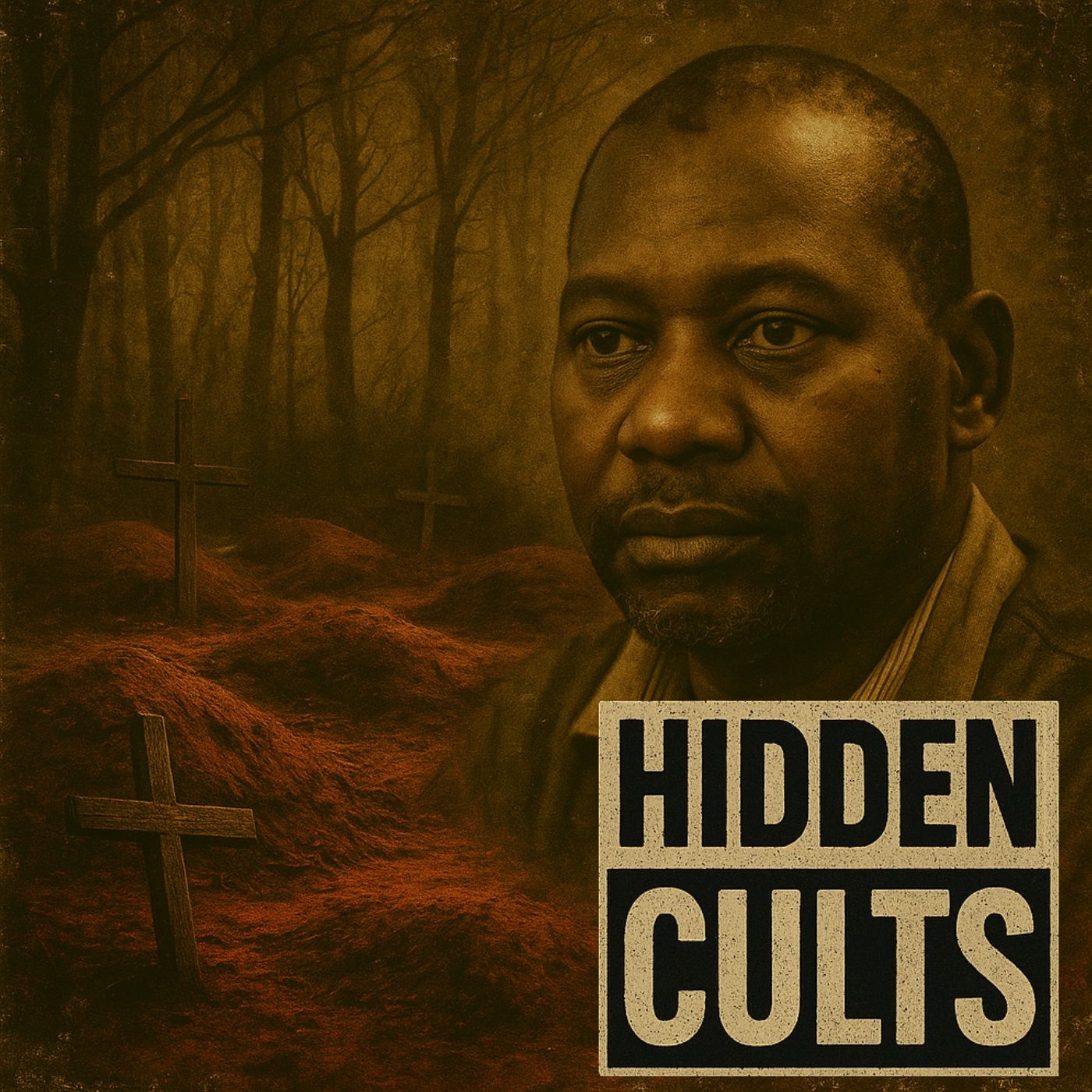
Ep.26 The Shakahola Forest Cult
Episode Transcript
Welcome to Hidden Cults, the podcast that shines a light into the shadows.
Here we explore the strange, the secretive, and the spiritually seductive.
From fringe religions to doomsday prophets, from communes to corporate empires.
These are the movements that promised meaning and sometimes delivered something far more dangerous.
I'm your host, and in each episode, we uncover the true stories behind the world's most controversial cults, the leaders who led them, the followers who followed, and the echoes they left behind.
If you or someone you care about has been impacted by a cult, you're not alone.
There is help.
Whether you're still inside a cult or trying to process what you've been through, support is out there.
You can find organizations and hotlines in the description of this episode.
You deserve freedom, healing, and a life that's truly your own.
Reach out.
The first step is often the hardest, but it's also the most powerful.
If you'd like to share your story and experiences with a cult, you can email it to me and I will read it on a future Listener Stories episode.
Your anonymity is guaranteed always today's episode, let's begin the Shaka Hoola Forest cult Part one, A Preacher rises in the spring of twenty twenty three, when the world learned of shallow graves being dug out of the red earth in Shakahola Forest.
The name Paul Mackenzie and Thengay became synonymous with tragedy.
But long before investigators uncovered mass graves and starving survivors, Mackenzie's story began in the rural landscapes of coastal Kenya, where he grew from an ordinary boy into a preacher whose radical message would lure hundreds into his orbitiulimately into their deaths.
Paul Mackenzie was born in nineteen seventy three into a Kenya that was still shaping its post independence identity.
A decade earlier, in nineteen sixty three, the country had broken free from British colonial rule.
The years that followed were a mixture of optimism and struggle.
Political leaders promise development, but poverty remained entrenched in many regions.
Christianity, introduced during the colonial era was deeply rooted across the country, and churches served not only as religious centers, but also as social anchors in rural communities.
For young Mackenzie, faith was not an abstract idea, but part of daily life, Sunday services, community gatherings, the cadence of hymns echoing through tin roof chapels.
Mackenzie's childhood was, by most accounts, unremarkable.
He grew up in Callify County, near Malindi on Kenya's coast, in a family of modest means.
He attended local schools and absorbed the rhythms of rural life, agriculture, tight knit communities, and the ever present influence of church life.
Kenya in the nineteen seventies and nineteen eighties was a place where preachers wielded enormous influence, not only guiding moral life, but often offering hope.
In a nation where economic hardship and political corruption weighed heavily, the pulpit was power, and even as a child, Mackenzie seemed fascinated by the authority pastors commanded.
As he grew older, Mackenzie's education and opportunities were limited.
He trained as a taxi driver in Milindi, working to make a living in a tourist driven economy.
The job offered steady income, but also long hours of waiting, hours he filled with conversation observation and eventually study of the Bible.
Passengers and acquaintances later recalled him as talkative, opinionated, and eager to discuss scripture.
What began as curiosity deepened into obsession.
By the late nineteen nineties, Mackenzie began attending Pentecostal services.
The Pentecostal and evangelical movements were flourishing across Africa at the time, fueled by promises of miracles, prosperity, and personal transformation.
Churches sprang up in rented halls, tents, and makeshift buildings, attracting the poor, the unemployed, and those disillusioned by traditional denominations.
For someone like Mackenzie, who craved significance and influence, these churches offered both inspiration and a model.
Here were men who commanded audiences, drew donations, and shaped lives with their words.
Mackenzie's break with conventional Christianity began gradually.
At first, he immersed himself in Bible study groups and revival meetings, but over time he became critical of pastors who, in his view, compromised with modern society.
He derided churches that emphasized education, medicine, or wealth as worldly distractions from the narrow path to salvation.
His critiques resonated with some in coastal Kenya, where poverty was endemic and public institutions often distrusted.
Mackenzie's sharp denunciations of modernity had appeal, framed himself as a man uncorrupted by money or politics, a lone voice calling believers back to pure faith.
In the early two thousands, Mackenzie founded his own ministry, the Good News International Church.
Starting small, it quickly grew, drawing followers from Milndi and surrounding towns.
His sermons emphasized separation from worldly life, condemning schools as dens of corruption, hospitals as places of satanic influence, and government as an enemy of faith.
His charisma lay not in scholarly theology, but in conviction.
He spoke with certainty, with the authority of someone who claimed to know God's will without hesitation.
The early years of the Good News International Church were marked by intensity, but not yet by extremity.
Mackenzie preached against secularism and modernity, but his message, at least at first, echoed broader Pentecostal currents.
He promised spiritual protection, moral purity, and the blessings of obedience.
Families came to hear him, drawn by his passion and the sense of community he fostered.
Yet beneath the surface, the seeds of his radicalism were already germinating.
Mackenzie's sermons increasingly dwelled on the end times.
He warned of looming apocalypse, citing wars, famines, and corruption as signs that the world was on the brink of collapse.
Where mainstream pastors tempered such warnings with calls to perseverance, Mackenzie sharpened them into ultimatums.
The world was not simply fallen, it was doomed.
The faithful, he preached, must prepare not by engaging society, but by rejecting it entirely.
Schools, medicine, jobs, even family ties outside the church were obstacles on the road to salvation.
This message attracted a particular kind of follower, those disillusioned with life, crushed by poverty, distrustful of government, or desperate for certainty.
Mackenzie offered a totalizing vision, one that left no room for ambiguity.
Every problem, illness, unemployment, marital strife, could be explained by corruption of the world and solved by separation from faith was not merely belief, it was withdrawal.
By the mid two thousands, Mackenzie's church had hundreds of followers.
Donations increased, allowing him to purchase airtime on local radio and later run his own television station.
Through broadcasts, his sermons reached thousands, amplifying his message far beyond Melindi.
He denounced vaccinations, formal education, and the teaching of science.
He declared that government documents, national ID cards, passports were tools of Satan.
The more he railed against the outside world, the more his followers clung to him as a shepherd guiding them through a dark age.
But the louder his message, the more he attracted scrutiny.
Kenyan authorities began monitoring his activities in two thousand and three, and again in twenty seventeen, he was arrested on charges related to radical teachings and child neglect after followers withdrew their children from school and denied them medical care.
Each time, Mackenzie defended himself as a man of faith, being persecuted for refusing to bow to worldly systems.
His brief imprisonments only bolstered his image among believers.
If the prophet suffered, it was proof that his message was true.
By the end of the twenty tens, Mackenzie had fully shed any resemblance to mainstream Christianity.
He preached a gospel of apocalypse, a message that demanded obedience unto death.
To his followers, he was no longer simply a pastor.
He was a prophet chosen to lead them through the world's final days.
When he told them to abandon their jobs, many did.
When he told them to reject schools, they pulled their children out.
When he said the government was an agent of Satan, they believed him.
And when years later he would tell them that death itself was the doorway to salvation, they followed.
The story of Paul Mackenzie's early life is not one of sudden revelation, but of gradual radicalization.
A boy shaped by rural Christianity became a man disillusioned with mainstream churches, a taxi driver earn preacher discovered the intoxicating power of the pulpit, and a pastor who once offered hope through separation transformed into a prophet who demanded sacrifice through death.
The rise of Paul Mackenzie was in many ways the rise of a cult leader whose message would lead his followers into the depths of Shaka Hoola Forest and into the graves that would horrify the world.
Part two, Seeds of the Gospel of End Times.
By the mid two thousands, Paul Mackenzie had transformed from a small town preacher into a voice that carried across Kenya's coastal counties.
His Good News International Church, once an improvised gathering of believers in Milindi, had grown into a movement fueled by sermons that thundered against the modern world.
To those who listened, Mackenzie offered more than spiritual counsel.
He offered a complete rejection of society as it stood.
At the core of his message was an assault on institutions.
Schools, he declared, were not places of learning but dens of corruption.
Teachers, in his telling, filled children's minds with lies, evolution, science, and worldly ambition.
Education was a trap designed to lead the young away from God.
He warned parents that every hour their children spent in school was an hour spent under Satan's influence.
It was better, he insisted, to withdraw children entirely and raise them only on scripture.
Some followers did exactly that, pulling their children from classrooms and subjecting them to Mackenzie's teachings at home.
Hospitals were no better in his eyes.
Medicine, Mackenzie said, was another snare of the devil.
Doctors and nurses, he argued, were agents of a corrupt system that prolonged suffering rather than curing it.
Vaccines were condemned as poisons, surgeries as assaults on God's design, and even simple treatments were dismissed as unnecessary if one had true faith, Illness, he preached, was a test of belief.
Healing would come only from prayer and fasting.
For followers already suspicious of state run clinics or unable to afford care, his message carried dangerous appeal.
Government itself was framed as the ultimate enemy.
Mackenzie railed against Kenya's political establishment, painting national ID cards, passports, and tax systems as marks of submission to Satan.
He pointed to global headlines wars, corruption, scandals, economic instability, and claimed they were proof that human authority was rotten to the core.
Come out from them, he urged.
Borrowing language from scripture have nothing to do with their ways.
In his theology, obedience to government was not civic duty but spiritual treason.
These themes were not entirely new.
African religious history is filled with separatist movements that rejected colonial or postcolonial authority, but Mackenzie pushed the rejection to apocalyptic extremes.
He declared that the world was rushing toward its end, that the signs of revelation were already visible.
Famine, disease, moral collapse.
He spoke with urgency, warning that time was short.
The faithful must separate from the world world, he said, or risk being consumed with it.
For those listening, Mackenzie's message was electrifying in towns like Melindi and Kilifee, where poverty and unemployment left many hopeless.
His preaching offered both explanation and escape.
Why were jobs scarce?
Why were families sick?
Why did the government seem indifferent?
Because he said, the world itself was cursed, the solution was not to reform it, but to abandon it entirely.
For believers, Mackenzie was not just a preacher, but a prophet, cutting through the lies of modernity.
His recruitment of early Loyalists reflected this urgency.
Families who felt disillusioned by mainstream churches were among the first to join.
Teachers who had grown cynical about the school system, laborers who could not afford medical care, women frustrated with broken promises of politicians.
They all found resonance in Mackenzie's denunciations.
He offered them a new community, one bound not by civic life, but by a shared conviction that they alone under stood the times.
Mackenzie's charisma was central.
He lacked the polished rhetoric of television evangelists, but he compensated with intensity.
He spoke plainly, with conviction that brooked no doubt.
He framed himself as a man without compromise, someone willing to endure prison and persecution for the truth.
When authorities arrested him in two thousand and three for encouraging parents to withdraw children from school, he emerged from custody claiming vindication.
They persecute me because I will not bow to Satan, he told his followers.
To many, this was proof that he was a true prophet.
By the late two thousands, Mackenzie expanded his reach through media.
He purchased airtime on local radio and eventually launched his own television station.
On these broadcasts, he sharpened his message further.
He condemned vaccinations, mocked science, and railed against women in positions of leadership.
He warned of the Antichrist, claiming that modern technology was laying the groundwork for the mark of the beast.
Even ordinary objects schoolbooks, medical supplies, government forms were reframed as tools of damnation.
The deeper his rhetoric drifted into extremity, the tighter his circle of committed followers became.
While casual listeners tuned out, those who stayed were drawn into a feedback loop of escalating separation.
Each sacrifice, a child pulled from school, a medicine refused, a job abandoned, was framed as proof of faith, each act of defiance against the world Titan Mackenzie's grip binding families to him not only through belief, but through the irreversible choices they had made.
In these years, The seeds of what would later become tragedy were planted.
Mackenzie was no longer simply criticizing society.
He was constructing an alternative, a way of life defined by withdrawal, obedience, and anticipation of the end.
His followers were learning not only to distrust institutions, but to rely entirely on him for interpretation of scripture and direction for their lives.
They were becoming slowly but inexorably, a cult.
The Gospel of end Times that Mackenzie preached was not a doctrine of hope, but of inevitability.
The world, he said, was beyond redemption.
Schools would corrupt, doctors would deceive, governments would persecute.
The only path was separation and ultimately sacrifice.
Those who followed him in these years became the foundation of the community that would later vanish into Shakahola Forest, convinced that death itself could be a doorway to salvation.
Part three into the Forest.
By the late twenty tens, Paul Mackenzie's message had shifted from sharp criticism of modern society to a radical call for total withdrawal.
Schools were condemned, hospitals cast as dens of Satan, government rejected outright.
For years, his Good News International Church in Melindi had served as the stage for these sermons.
But as scrutiny from authorities mounted and his teachings grew darker, Mackenzie looked for somewhere new, a place beyond the reach of police, beyond the reach of media, beyond the reach of the world, he declared corrupt.
He found it in Shakahola Forest.
Shakahola lay in Killifee County, not far from Malindi, a vast stretch of bushland where tall cashew trees and scrub gave way to pockets of dense woodland.
It was remote enough to hide a community, yet close enough to the coast for followers to reach on foot or by motorcycle.
For Mackenzie, it was ideal, isolated, wild, and symbolically pure.
If Malindy had been a staging ground, Shakohola would be the Promised Land, a place where the faithful could live apart, uncorrupted, and prepare for the end of days.
By twenty nineteen, groups of followers began selling their homes, abandoning jobs, and moving into the forest.
They brought few possessions, bedding, cooking pots, bibles.
Mackenzie instructed them that material goods tied them to the world they had left behind.
Life in Shakahola would be simple, austere, and holy.
Families cleared patches of land to erect huts of mud and timber paths were carved into the forest, leading to prayer circles and communal spaces.
The settlement spread in clusters hidden beneath the canopy, invisible to all but those who knew the way.
Daily life in Shakohola was shaped by strict routines.
Prayer sessions began before sunrise, with Mackenzie or one of his deputies leading scripture readings and exhortations.
Fasting was central, even before the lethal commands of later years.
Mackenzie promoted fasting as purification, urging followers to eat little and pray much.
Meals were sparse, porridge, boiled roots, small portions of maize.
Work filled the hours in between, clearing land, fetching water, tending small gardens.
Children laboured alongside adults, their education reduced to reciting scripture.
In this hidden world, Mackenzie's authority deepened.
In Malindi, his followers had been able to return home after sermons, balancing his teachings with family or work obligations.
In Shakahoa, there was no such division.
The forest sealed them off from the outside, and Mackenzie's voice became the only one that mattered.
He controlled food distribution, dictated prayer times and determined how resources were used.
Followers who questioned him were rebuked or shunned, accused of lacking faith.
The forest became not only a refuge but a cage.
Mackenzie preached that the forest itself was wholly ground, a place chosen by God for his remnant.
He told followers that they were like the Israelites in the wilderness, wandering apart from a doomed world, sustained by faith.
Each hardship, hunger, sickness, exposure was framed as proof of their chosenness.
Suffering was not failure, It was sacrifice.
For families who had already abandoned everything to follow him.
This interpretation was irresistible.
To doubt was to admit that they had left their homes and livelihoods for nothing.
To believe was to find meaning in every hardship.
As the settlement grew, so did Mackenzie's authoritarianism.
He issued rules that governed every aspect of life, dress, speech, marriage, even the naming of children.
Women were instructed to cover themselves and remain submissive.
Men were expected to enforce discipline in their households.
Children were to obey elders.
Unquestioningly.
Outsiders were forbidden from entering without Mackenzie's consent.
Families who attempted to contact relatives outside were scolded as betrayers.
Step by step, freedom narrowed until only obedience remained.
The forest setting magnified Mackenzie's control.
Cut off from electricity, roads, and communication, followers had no access to newspapers or radio.
Phones were discouraged, then banned outright without outside information.
Mackenzie's sermons defined reality.
When he said the world was collapsing, there was no evidence to the contrary.
When he said government agents hunted the faithful, there was no way to verify otherwise.
In isolation, his words became truth, and truth became law.
By twenty twenty, Shakahol had become a community of hundreds.
Some estimates suggest as many as four hundred people were living in the forest at the cult's height.
Entire families relocated, bringing elderly parents and young children alike.
Recruitment continued, with new converts arriving every few weeks, often carrying everything they owned.
Some were brought by relatives already inside.
Others came after hearing Mackenzie's radio sermons or watching clips of his earlier broadcasts.
Each newcomer was welcomed as another soul saved from Satan's world.
The COVID nineteen pandemic deepened Mackenzie's influence.
When the virus spread across Kenya in twenty twenty, bringing lockdowns and government mandates, Mackenzie declared it a sign of the apocalypse.
He preached that vaccines were tools of Satan, that hospitals were death traps, and that only isolation in Shakahola could keep the faithful safe.
The forest became both a refuge and a prison as followers doubled down on their withdrawal.
Fear of the outside world, already wrong, became absolute.
Conditions inside the settlement grew harsher.
Food supplies dwindled as gardens failed to produce enough for the swelling population.
Water was fetched from distant wells, often unsafe.
Sickness spread untreated because hospitals were forbidden.
Yet instead of undermining Mackenzie's authority, each hardship reinforced it.
He preached that suffering proved their holiness, that hunger cleansed the soul, that sickness was God's refining fire.
The worst conditions became the more followers clung to the belief that they were enduring trials for the sake of salvation.
Mackenzie also began introducing the idea of final sacrifice more explicitly.
Sermons emphasized that the world was irredeemably corrupt, that the faithful must not only withdraw, but prepare to meet Jesus soon.
He hinted that death might not be a tragedy, but a triumph, the final act of obedience that ensured eternal life.
These hints, repeated in sermons and private conversations, laid the groundwork for what would later become his most devastating command.
By the early twenty twenties, Shackahola Forest was a closed world.
Families had surrendered homes, jobs, and possessions.
Children knew no schooling beyond scripture.
Women lived under rigid submission, men drilled in obedience, and at the center stood Mackenzie, a preacher turned prophet turned autocrat whose word determined life and death.
The move into the forest was framed as salvation, but in truth it was entrapment.
The community was no longer simply separated from the world.
It was being prepared for sacrifice.
Part four.
Starving for salvation.
By the time Paul Mackenzie's followers had settled deep in Shackahola Forest, their lives were already marked by deprivation.
Food was scarce, medicine was forbidden, and obedience was demanded in every detail.
Yet what came next went beyond poverty or control.
It was the transformation of hunger into doctrine, the declaration that starvation itself was not not failure, but salvation.
Mackenzie's most devastating teaching was that to die of fasting was to triumph in faith, and that to resist was to betray God.
The shift came gradually.
Mackenzie had long emphasized fasting as a way of purifying the soul.
In his sermons, he quoted scripture about Jesus' forty days in the wilderness, about prophets who went without food in preparation for divine encounter.
At first, fasting was framed as temporary discipline, a way to sharpen prayer and prove devotion.
Followers endured long days with little food, breaking fasts in the evenings with meager portions of maize or roots.
But slowly Mackenzie began stretching the practice, demanding longer fasts, harsher restrictions, and finally no end at all.
By twenty twenty one, his language had hardened.
The world is finished, he declared.
The schools, the hospitals, the government, all belonged to Satan.
Why remain in them?
Why eat their food?
Why prolong your suffering in a world that God has already judged.
In this logic, death was not defeat, but escape.
To eat was to cling to the world.
To starve was to walk into eternity.
Parents were told that true faith meant offering even their children to this path.
Do not fear for the little ones, Mackenzie preached.
To starve is to meet Jesus.
To feed them is to deliver them back into Satan's hands.
Mothers wept as they withheld food, pat torn between instinct and indoctrination.
Fathers dug shallow pits in the forest, preparing for the burials that would follow.
In the atmosphere of total control, resistance seemed impossible.
To defy Mackenzie was to defy God, and to risk the damnation of one's entire family.
Survivors later described scenes of heartbreaking obedience.
Children crying for food were comforted not with bread, but with scripture told that their hunger was holy.
Families sat in prayer circles, bodies weak lips, parched, waiting for death.
Those who faltered, sneaking food or begging to leave, were shamed as weak in faith.
Some were beaten, others were cast out to die in isolation.
Step by step, the line between life and salvation blurred, until death itself was redefined as victory.
The community's isolation deepened the tragedy.
With no schools, no hospitals, no outsiders allowed in, There were no witnesses beyond the faithful.
Families who might have doubted had already burned.
Bridges with relatives outside.
Letters were cut off, phones confiscated, connections severed.
In this sealed world, Mackenzie's words were reality.
Hunger was not a crisis, but a calling.
Each body that wasted away was proof to the survivors that the doctrine was true.
By early twenty twenty three, starvation had become systematic.
Groups were instructed to fast in stages, dying slowly in clusters.
Mackenzie's deputies oversaw the process, ensuring that no one strayed.
Graves were dug in advance their fresh mounds soon multiplied across the forest floor.
For outsiders, the idea that parents could starve their children seemed unthinkable.
But inside Shackahola, every act was framed as obedience, every burial as triumph.
To feed a child was betrayal.
To bury one was faith fulfilled.
Survivors rescued later told of Mackenzie's chilling authority.
Even as people wasted to skeletons, he spoke of glory.
The Kingdom is near, he would say, every hunger, pain is a step toward the throne of God.
His words kept the faithful bound even as their bodies failed.
Some clung to the promise that they would reunite with loved ones in heaven.
Others believed that death would spare them from the horrors of a collapsing world.
In either case, death ceased to be feared.
It became the center of devotion.
The obedience was absolute.
Followers sold their possessions, handed over their savings, and entrusted their very lives to Mackenzie's command.
Families entered the forest hole and left only as names whispered in reports of the dead.
The cult's hidden settlement became a cemetery.
Each grave at testament to how thoroughly faith had been twisted into fatal obedience Part five, the graves of Shakahola.
For years, Chuckahola Forest had remained hidden in plain sight.
Families vanished into the thickets their homes in Milindi and Califia, abandoned, their names, whispered in rumors but rarely followed up by authorities.
Paul Mackenzie's followers believed they were retreating into the wilderness to prepare for eternity.
To the outside world.
Their absence was scattered and unremarkable until April twenty twenty three, when police uncovered the truth beneath the soil.
The first reports came from concerned relatives.
Families who had lost contact with loved ones filed complaints with local authorities.
They had watched sons and daughters sell possessions and disappear into the forest.
Some had tried to intervene, begging police to investigate, but were told that adults had the right to follow their bla Only when a tip off reached senior officials in Milindi did the urgency sharpen.
Police organized a search party and entered Shakahola, not knowing what they would find.
What they discovered stunned even seasoned officers.
As they treked through the dense brush, they came across gaunt figures men, women, and children, too weak to walk, lying in huts or sprawled on the forest floor.
Some whispered prayers, others were silent, their lips cracked, their bodies skeletal.
Survivors told officers that they had been ordered to fast to death, that food was forbidden, that death was the only way to meet Jesus.
Then came the graves, shallow mounds of freshly turned earth, marked only by disturbed soil and makeshift wooden crosses.
Police dug and what they unearthed was horrifying bodies, wrapped in cloth, sometimes buried several to a pit.
Some were children, their small frames a stark reminder of how thoroughly parents had obeyed Mackenzie's commands.
Day after day, as the which expanded, more graves were found, The forest floor became a crime scene, and Shakahola transformed from a place of secrecy into a site of global shock.
News spread rapidly.
Local outlets reported the discovery, and soon international headlines followed.
Kenyan cult deaths stunned the world mass graves in Shakahola Forest.
Images of police carrying skeletal survivors, of relatives weeping at the forest's edge, and of officers digging with spades made their way onto television screens worldwide.
Kenya, a country often known abroad for tourism and wildlife, was suddenly the center of a grim story of faith turned fatal.
Authorities quickly cordoned off the forest.
Teams of forensic experts, medics, and investigators were dispatched to exum graves and rescue survivors.
Helicopters hovered overhead, ferrying the most critically ill to hospitals in Milindi.
The Kenyan Red Cross set up tents to provide emergency care.
Every day, the death toll rose, first dozens, then scol, then more than one hundred.
By May, officials announced that over fifty bodies had been exhumed and more were being discovered daily.
The number climbed relentlessly as search teams pushed deeper into the settlement.
Each body told a story of devotion twisted into tragedy.
Forensic examiners reported signs of prolonged starvation, with some showing evidence of suffocation, likely from parents attempting to hasten their children's deaths.
Survivors testified that Mackenzie had given explicit instructions children must fast first, then adults, to ensure that families entered heaven together.
The horror was compounded by the obedience evident in every grave, obedience so absolute that parents watched their children die, believing it was righteous.
The investigation quickly turned toward Mackenzie himself.
He was arrested in April twenty twenty three, accused of murder, terrorism, and child abuse.
Images of him in custody, a slight man in a worn jacket, stood in stark contrast to the devastation attributed to his leadership.
To the world, he was a monster.
To some followers still loyal, he was a martyr being persecuted by the state.
In police interviews, he claimed innocence, insisting he had closed his church years earlier and that deaths were the result of voluntary fasting.
Authorities rejected the defense.
The graves spoke louder than his words.
The Kenyan government faced outrage.
How had this happened in plain sight?
Why had complaints from families gone unheeded.
Critics accused local officials of ignoring warnings for years of treating Mackenzie as a harmless eccentric rather than a dangerous cult leader.
President William Rutto called the tragedy a wake up call about unregulated churches and promised tighter oversight.
Parliamentary committees launched inquiries into how Mackenzie had been allowed to preach for decades despite multiple arrests.
International reaction was swift.
Human rights groups demanded justice for survivors and accountability for officials who had failed to act.
Religious leaders across Kenya condemned Mackenzie, calling his teachings a distortion of Christianity.
Global media drew parallels with other cult tragedies, from Jonestown in nineteen seventy eight to Uganda's movement for the Restoration of the Ten Commandments of God in two thousand.
Shakahola, once an obscure patch of forest, was now linked to the darkest lineage of cult catastrophes.
For survivors, the days after discovery were filled with confusion and trauma.
Some wept as they were given food, torn between relief and guilt for breaking the fast.
Others remained silent, refusing to eat even under medical care.
Convinced that to do so would condemn them.
Psychologists and aid workers struggled to undo years of indoctrination.
Children skeletal and frightened, clung to strangers in hospital wards, their parents buried in shallow graves.
As investigators continued to exume bodies, the scale of the tragedy became clearer.
By June twenty twenty three, more than three hundred bodies had been recovered, making Shakahola one of the deadliest cult disasters in modern history.
The true number may never be known.
The forests still held secrets beneath its soil, and some families were lost entirely, with no relatives to claim them.
The graves of Shackahola were not just a Kenyan story.
They were a global warning about the power of apocalyptic belief, about the ease with which a single preacher could command obedience unto death, and about the fragility of oversight in societies where faith often outpaces regulation.
Each exhumed body was a testament to how far conviction can go when unchecked, how easily devotion can become destruction.
Part six.
Justice and Warnings.
When police led Paul Mackenzie into custody, in April twenty twenty three.
The scene was strangely anticlimactic.
The man accused of commanding hundreds to starve themselves to death did not appear as a wild eyed prophet or a defiant militant.
He was thin, subdued, almost ordinary, answering questions softly as cameras flashed.
Yet the ordinariness of his appearance only deepened the horror of what investigators were uncovering in Shakahola Forest.
Here was a preacher who had convinced families to bury their children alive, to fast unto death, to transform hunger into holiness.
The charges against him were swift and severe.
Prosecutors accused Mackenzie of murder, terrorism, radicalization, and child abuse.
Survivors described how he had personally instructed parents to stop feeding their children, how he framed death as deliverance, and how deputies enforced his commands.
Forensic teams continued to exhume bodies from mass graves, each discovery, adding weight to the accusations.
In courtroom hearings, Mackenzie denied responsibility, insisting that he had disbanded his church years earlier and that deaths were the result of voluntary fasting few believed him.
The Kenyan judiciary faced intense scrutiny.
Trials were slow, complicated by the scale of the tragedy and the sheer number of victims.
Families demanded justice, while lawyers debated how to categorize mass starvation under existing laws.
Was it murder, manslaughter, or a new kind of crime Altogether, the courts struggled to keep pace with the enormity of the case, while the public seethed at the idea that Mackenzie might exploit legal loopholes to avoid accountability.
Survivor voices provided the most haunting testimony.
A young woman described watching her siblings waste away as their mother preyed beside them, convinced she was leading them to heaven.
Another recalled sneaking food in secret, only to be beaten when caught.
Children spoke haltingly of parents who told them hunger was proof of holiness, who reassured them through tears that death was nothing to fear.
Each story cut through legal jargon, reminding the world that behind every number was a life reduced to obedience.
Kenya as a nation was shaken.
The government faced accusations of negligence, with critics pointing out that Mackenzie had been arrested multiple times before twenty twenty three, only to be released, Complaints from relatives had been ignored, and warnings from activists dismissed.
How had one man been allowed to operate so openly for decades, broadcasting sermons, building a following, and eventually leading families into the forest without meaningful intervention.
The Shakahola tragedy forced a reckoning not only with Mackenzie's crimes, but with systemic failures that enabled them.
In the months, debates erupted over the regulation of religion in Kenya.
The country has tens of thousands of churches, many small and independent, operating without oversight.
Faith is deeply woven into Kenyan life, and pastors often enjoy broad authority, but after Shakahola, calls grew louder for registration, monitoring and limits on unverified preachers.
Parliament considered new laws requiring background checks for religious leaders, financial transparency for churches, and stricter penalties for those promoting harmful practices.
Some pastors supported the reforms, horrified by what Mackenzie had done.
Others resisted, warning that government interference threatened freedom of worship beyond regulation.
The tragedy sparked cultural soul searching.
How had communities failed to recognize the warning signs?
How had poverty, desperation, and mistrust of institutions made people vulnerable to Mackenzie's message.
For many Kenyans, the answers were painfully clear.
When education is underfunded, when healthcare is unaffordable, when politicians are distrusted, people seek refuge in alternative sources of authority.
Mackenzie offered certainty, and in a world of uncertainty, certainty can be irresistible, even if it leads to destruction.
Internationally, Shakahola became a symbol of the dangers of apocalyptic belief.
Shakahola reminded the world that such disasters were not relics of the past or confined to distant cultures.
They remained a present danger wherever Caresmatic leaders exploit faith and fear.
The survivors carried the heaviest burden.
Some struggled to reconcile the teachings they once believed with the reality of their loss.
Others remained loyal even after rescue, insisting that Mackenzie had been persecuted by authorities psychologists working with them spoke of the long road ahead trauma, guilt, identity crises, and the challenge of rebuilding lives after years in isolation.
For the children, especially, the scars would last a lifetime.
They had been robbed of schooling, family stability, and, in many cases, parents themselves.
As of twenty twenty four, Mackenzie's trial continued, with dozens of his associates also facing charges.
The graves of Shackahola remained under investigation, their number staggering.
More than four hundred bodies exhumed, with estimates still rising.
Each discovery renewed grief, each headline reopening wounds.
Yet even amid sorrow, there was determination that the lessons of Shackahola not be forgotten.
The warnings are clear.
Apocalyptic belief, when weaponized by charismatic leaders, can override instinct, sever family ties, and compel people to embrace death as deliverance.
Poverty and mistrust create fertile soil for such messages, and without oversight, destructive movements can grow unchecked.
Shakahola was not merely a tragedy of one cult in one forest.
It was a mirror held up to societies worldwide.
Showing the dangers of neglecting the vulnerable and allowing extremism to flourish under the guise of faith.
The graves of Shakahola Forests stand as a reminder faith can inspire, but when corrupted by fear and control, it can destroy.
In our next episode of Hidden Cults, we leave the forests of coastal Kenya and travel east to Thailand, where another religious movement has stirred controversy for decades.
Founded in nineteen seventy by Chandra khonk Yung and Luangpur Damajaio Watfra, Damikaia grew into one of the largest Buddhist temples in the world, known for its Domakiyah meditation and vast futuristic architecture.
The temple has also faced accusations of commercialization, unorthodox teachings about a true self, and political entanglements.
Government crackdowns, allegations of fraud, and its staggering size have made Damakaya one of the most controversial Buddhist organizations of the modern era.
From starvation in the forests of Kenya to wealth and power in the temples of Bangkok, the thread that connects them is the way devotion can be shaped, manipulated and weaponized.
That's next time.