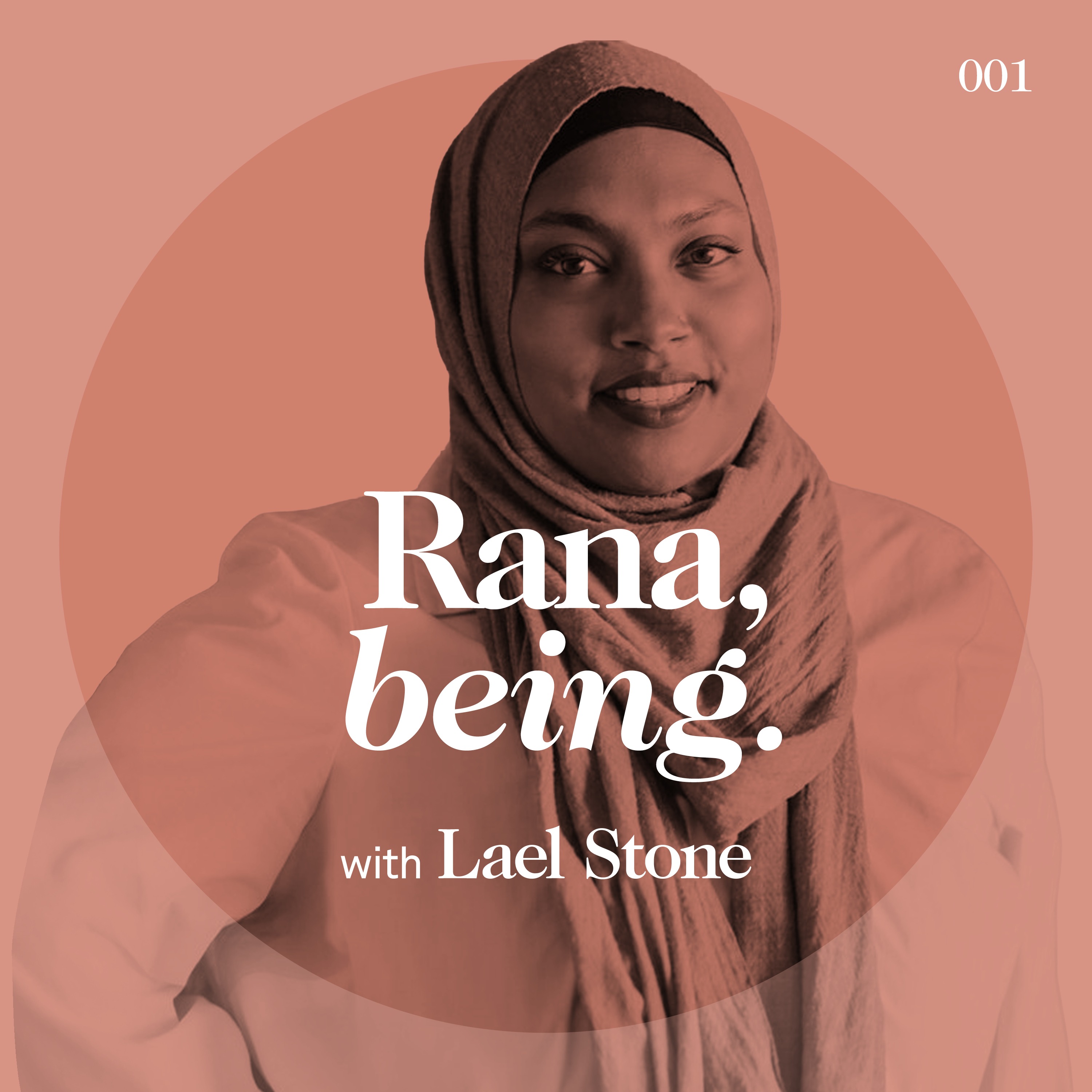
Rana Hussain, being. with Lael Stone | Belonging and Faith ♥︎
Episode Transcript
Welcome to Humans, being.
I’m Lael Stone.
Such a pleasure to have you here.
So my humanness this week, what I have been contemplating and working through has been all about boundaries.
And even though I have gotten very good over the last few years with boundaries, because I used to be completely rubbish with it, what I have really been navigating is, I think, more of those inner boundaries around saying no to things for myself.
And what I mean by that is I've gotten really good over the years of saying no to something that doesn't serve me or, you know, not not keeping everybody happy.
So making sure that I am meeting my own needs.
But I think where I'm finding it tricky at the moment is particularly around work.
And I wonder if you can relate to this, because I love what I do and I love working, but what I've found is that that has become a little bit of my identity lately, and especially as my kids are older.
And, you know, I used to do the juggle between, I'm either working or in parenting, but now my kids are older and I really need to parent.
All of the sudden I have all this small space for work, which is amazing because I do lots of different things.
You know, I run courses and I travel and speak and I sit on a board and, you know, I'm creating these podcasts and all those kind of beautiful things.
But, it is very easy to fill up all my time with work.
And what I'm finding I have to do right now is actually say no.
I'm not going to work on a Saturday, or I'm not going to open my computer.
And it's been really, really uncomfortable because work is easy, I love it.
I feel like I'm making a difference in the world, but I also know that I probably need to play more.
And I also know that I probably need to have more quiet.
And, you know, a few months ago, I actually broke my foot just randomly.
Like I literally stood up.
I went one way, my foot went the other.
I broke my foot like, welcome to old age where you get injuries just by sleeping.
Or just standing up.
And.
I saw it as a bit of a sign to slow down.
I started as a bit of a sign to to listen and go a bit slower.
And I realized what the challenge was, is setting some of those inner boundaries where I had to set a bit of a limit for myself of not just working all the time, but actually really prioritizing, going for a walk, looking out the window, reading a book, doing some painting, catching up with friends because it's so easy to slip into what we're good at.
And you know what?
What we do.
And I find that the older I'm getting, this is an interesting boundary.
I'm having to navigate.
So I wonder if you that relates to you.
I wonder if you can identify with that and what you do to to navigate these inner boundaries.
So that's my human contemplation for for this episode.
Now, today I am so excited to have this beautiful woman sitting with me to have a conversation.
I'm going to read his bio art to start with, and then, and then I'll get all that formal bit out of the way.
And then I want to tell you how I feel about this lovely woman, even though we've actually just met in person for the first time.
But I have strong feelings about it.
So I am welcoming Rana Hussain, who is the founder of Good Human, which helps people and organizations build cultures of belonging across self-esteem and system.
She honed his skills in elite sport and now works across the corporate, not for profit and other sectors, bringing the lessons of high performance culture to diverse environments.
She was the first Muslim woman appointed to a national sporting board, and today sits on the board of Welcoming Australia, Reconciliation Australia and Basketball Australia.
A sought after speaker, facilitator and broadcaster, Rana is driven by the recognition that belonging is a core human need to thrive and the key to lasting cultural change.
So welcome Rana.
Okay.
I am so thrilled for.
You to be here and I.
Just have to I want to start off by saying, I heard about you also you for the first time when you're on the podcast, big shout out to those beautiful men.
And amazing, like.
Just beautiful in helping voices be heard.
So I have a lot to be grateful, thankful to them, to those boys and I listened to your episode, and I was so captivated just by your story, but also your courage.
Just the place that you stand in, in the world and the work you are doing.
And what a magnificent storyteller you were.
And I, I DM'd you after the episode came out.
So you love Instagram and you just.
Kind of do.
But I'm a big.
Fan of reaching out to someone saying, you know, you look amazing and I love what you spoke about, or you're doing beautiful work because I think we need to hear more of that.
And so I dmg and just said, wow, that was amazing.
And, you know, thank you for what you did.
And that's how we connected.
So I was.
So thrilled because.
I had already listened to you on these peaks and was poring over your work and.
Sent your episode to so many people and.
Talked about you, Alexa, and then when you did me, I thought, oh my God, I've made it!
Isn't that so funny how we have these perceptions of people?
And then you're like, no, but yeah, it's like, well, the world is pretty well about that, isn't it?
Wow.
I just have deep respect for what you do.
And I think your work is so important.
And when, we were planning these podcasts, you were one of the first people on my list of that I wanted to talk to.
I wanted to meet because I just thought, I just think what you stand for in the work that you do is so important.
And it really ties into what this podcast is about for me, which is really the humanness of a soul that we are all humans.
And I often say, you know, if we could see the story that is behind all of us, like the path we've traveled, what we've navigated, what we've gone through, we would have nothing but complete compassion for everybody because we would understand these stories right?
Completely.
And it's funny, my business is called Good Human.
And I often say to people that and there's like a little full stop in there.
And it's very purposeful because we're looking at what the next right thing is, the next good thing, and reaching for that and our best selves.
But we're landing in human.
Yeah, it's actually about what it means to be human to me.
So the fact that this is your podcast away, right?
I was like, oh, how could I not do this?
I love that, I'm glad to say so.
Before we jump into other questions, curious about what I was talking about just before around the inner boundaries, I could feel you nodding along.
Is that something that you can really relate to completely?
That whole, I mean, especially working for myself and sort of live the freelance life.
So every moment of your day could be working, could be filled with something, work related.
And I do lots of different things.
So I am a broadcaster.
I do sit on boards, I am a consultant.
So there's just so many avenues.
Which I could fill.
My time.
And I do, and I come from a family history of doing the same thing.
You know, I grew up with parents who filled their time with, their work and community service, and it's taken me a really long time, and I'm actually not nailing it at all, is the honest answer.
But especially lately, I notice I've noticed, like, I'm reaching for my creative brain and I'm not quite getting it.
I.
Things are taking longer off, things feel harder.
I feel like I'm wading through sand a lot of the time, and it took me a long time to realize, actually, I was my trainer at the gym.
That said, when was the last time you had a holiday?
When did you last stop?
And sure, I might have moments of pause, but mentally, I honestly don't know.
Yeah.
And so I realized, for me to actually be my best and happiest and thriving, I need to give myself a break.
Yes, as simple as that.
But then it's not simple at all.
It's not simple.
When you, run your own show, right?
When you're running a business, you're always.
There's always something else to do.
And then when you're also a mum because you are a mum, so beautiful to go.
And that's your other job as well.
So you're doing all of this and then you've got this job as well.
And that job doesn't start off like that's just continuously there.
So I still find if I'm not working then I'm parenting.
And I think now because I've reached this phase of my life where my kids don't really need to be parented anymore, I'm like all, there's all this space and what will I feel?
These will I'll just do my work.
And you know, that can be good.
But it's also it's the balance, isn't it?
It's absolutely the balance.
But I, I noticed a really unhealthy thought that crops up.
And I've seen this in my siblings as well.
And when I saw them then I had to go, oh yeah, actually that's what I say.
This idea that when I pause, when I stop, when I slow down, that somehow that's not good enough or that's lazy and and that I have to really sit with and unpack and do a really good talking to myself that this is actually scheduling the break is also you working.
Yeah.
But it's giving you what you need so that you can work later.
Yeah.
And what you talk about there is something I talk about so much in my work about the imprints that we have from how we grow up.
Right.
And when we watched our family of origin or we watched our parents, who just, you know, their whole identity was either working, giving, serving or those kind of things.
Then that becomes an imprint of, well, that's what being a good human is, or that's what being a successful human is, is you just keep going and it's a hard imprint to undo, isn't it?
Because I had very similar stuff.
Like, I grew up in a family of amazing women, and the kind of unconscious narrative was, if you're not doing three things at once, you're lazy, like, you know, so you can't just sit down on the couch because you don't want to be lazy.
So you just keep going and you keep being productive and you keep doing all these things.
And it was such a tricky imprint for me to put down, because I realized I had to unpack.
Where did the origins come from within it, and what would it mean if I was to change that?
How have you found that that's similar for you?
Very similar.
And, you know, I was raised by a fierce woman who, up for her generation, was kind of phenomenal.
She was the first Muslim female doctor here.
Wow.
Yeah.
Absolutely incredible.
Just committed her life to community service.
Being a professional woman wearing a hijab.
And in her cohort of other migrant women, there weren't many that worked, let alone specialized psychiatrists.
And so I think what I witnessed was this superwoman who was doing it all and wanting to prove that it could be done.
Yeah, but that doesn't come with that.
Yeah.
The baggage and the stress and the consequences of burnout.
Yeah.
And I think the other thing I notice for me, anyway, there's an element of, I think being a migrant and being from a marginalized group, there's so many stereotypes that you walk around with and you're there's a added layer of wanting to prove that you're worthy, that you're valuable, and that you productive, and it's not as conscious as that.
But there's definitely a dynamic.
And I see it play out in our community so much where we're showing all the time that we can be professional with great parents, the, the idea of the model migrant.
And that's just the added layer for me that I think constantly pushes me to kind of be that hyper productive in a way that does veer into unhealthy.
Yeah, that is that is a beautiful and not beautiful insight because I can see the challenges that go with it.
But I know women often feel like that too.
You're trying to prove yourself, whether that is in motherhood, whether it's career or those kind of things.
There.
There is that I need to show that I can do these.
And for me, particularly when I first became a mum, my belief system was if my kids are happy, then it means I'm good mum.
So I spent most of my time trying to keep my kids happy all the time, which did not work, and all it did was make me very resentful.
And because I didn't meet any of my own needs, I thought it was all about being a service to them, making, you know, like, hey.
And it actually didn't serve them because.
And I wonder if this is the same for you.
What really changed it for me is actually when I had a daughter.
So, you know, I had a son first, but it was when my daughter came along.
Much like how you talk about your mom is a beautiful role model.
And just what she laid in front of you of what was possible, I, I was really struck with who my daughter is going to think a woman who's in the world is based on me.
So what am I modeling to her?
And that's when it actually started to change for me, because what she was saying was me just giving, giving, giving.
I didn't really have any good boundaries.
I was all about, I can do this, I can do that.
All those kind of things.
And I thought, how am I?
How is she gonna integrate really healthy self-care and boundaries if I actually don't show her?
How was that similar for you?
Yeah, and I had this moment with my daughter the other day where she her she'd been invited to a sleepover and she was really excited about it.
And the time came, or, you know, the day before and she just was feeling this.
I knew something was not quite right.
And this is what's going on.
Me.
You okay?
You still want to go?
I said I want to go and play with my friend, but I really don't want a sleepover.
I just feel I want to be in my own bed.
Yes.
But I feel really bad.
And I don't want to let my friend down, but.
And I know I was so excited about doing this, you know.
Had kids, we've been safe.
I was just like, I don't want to miss out, but I really just.
I don't think I want to go, but I think I should go anyway.
And I found myself saying to her, absolutely not.
If you need to listen to your body, if you want to sleep in your own bed, that is so fine.
Yes.
And as I was giving her that, I realized I was saying it to.
Myself and I was getting really animated and I was like, really?
In this conversation with her, I realized, oh, this is me.
I never say this to myself.
I never say, yeah, actually, I'm not comfortable with that right now.
And so I'm not going to do it.
Yeah, I thought, that was like one day where I was like, oh, that was some great parenting, okay.
And you're like, and there is the mirror.
Yeah, yeah yeah yeah, yeah.
It it is it actually parenting her?
I think that I've evolved so much I don't know that's that everybody does.
But for me, absolutely that it's in having to really think about, okay, I'm raising this person to become a healthy adult hopefully.
And so what does that actually look like there?
Is it you know, there's a risk in that too, for me of I have to remember, I'm pairing to the parenting the kid in front of me.
I'm not parenting my inner child.
Sometimes I benefit, but I can.
Some I can say sometimes in my parenting it kind of can be era.
Which is is the work, right?
Is so much of the work, because I really think our beautiful kids come along.
And the way I think about it is they they're shining this mirror back to us saying, hey, here's all these pieces that perhaps don't serve you.
And, you know, we get reactive in their behaviors or stuff they do that kind of hits those wounded parts of us, which is why we get reactive.
But in those moments, as we're shining it back, I often see it as them standing there saying, hey, I don't want to repeat this pattern or I don't want to carry this trauma forward, or I don't want to carry this imprint forward.
So I'm going to kind of mirror it back to you.
And I think what I often saying parenting is that parents don't often want to get back or they're not even aware of that.
So they just often make the child wrong for not behaving the right way or doing what they're doing.
Whereas actually, in as you said, there's this moment where we get to pause and go, is this about me or something in this you for me, which I think is it's it's like our children, our teachers, like they are the most beautiful.
I think they are our most beautiful spiritual teachers because they stand there and say, hey, I actually want you to be the best version of you, so I am free to be me.
That's how I often say it.
Oh, this is why I was so excited when you did.
You say things like that to me?
My.
Got it.
Yeah.
I kind of agree with you.
I it's so it's the most challenging thing.
There it is.
It's messy I think because it pokes at those kind of core things going on your own family of origin, like you said, that is to keep it together with.
This child in front of you unintentionally is just poking you right in your vulnerability.
Yeah.
It is, that is, I don't I feel like I've run a.
Marathon some.
Days.
Yeah.
Do you find that your partner has the same, feelings and reactions in those ways, or do you feel like it kind of is more, you know, it's whether it's something you're more conscious of or.
It's just that she mirrors stuff for you.
Like, how is it?
How do you say it?
No, she absolutely wades into he's okay.
It's have all the time.
The funny thing, though, is I think I see it.
Yeah.
Before he does, I think I've, you know, I think because of the work that I've done, social work, previously, I've done a lot of counseling and for young children as well.
So I think there's an element of mangers being further down that track and recognizing things.
And there's a lot of conversation around.
And it's, it's funny, in a partnership where there are times when you have to be in the mirror and say, hey, that reaction, what.
Do you think was going on with that?
That's so tricky because you're if it can feel like you're critiquing their parenting, but you can say, like that was that was a weird thing to respond to.
Or that response just telling me something else is going on?
It absolutely does.
But I don't know how, I don't, I don't, I think I've just done.
So much of that said navel gazing.
It's not navel gazing, but I've done so much reflective work.
I don't think you could probably do the work you do if you hadn't, or you probably wouldn't be doing it as well, because you have to know yourself, right?
You have to know what are those wounds?
Or what are those sweet spots that get activated within you so that you can catch them so you can be aware of them.
Because it's not just children that bringing up fitness.
It's every human like it's all humans, it's relationships.
It's all those things.
All the time.
I mean, I was in a meeting with clients the other day, and, you know, it was me and two other consultants who were white women.
And the clients were responding really poorly to me, really respectfully to them.
And again, it was just like wading into stuff that I was always have had to deal with and, and having to kind of make a choice in that moment and be emotional, like regulate emotionally in the moment enough to say, okay, this is really pushing a button for me.
This is also pushing, you know, childhood trauma and other you bringing up other experiences that have had let's regulate and choose to be the adult in the room and be mature and make a mature choice mean.
Equally, I could.
Respond, you know.
With just as much, you know, lack of professionalism, but it turns up in every single way, all the time, that I'm beginning to understand just what creating distance between you and those feelings actually means.
Yeah, just enough space that you can make a choice.
Yeah.
That feels right for you.
I so on, your insides to be able to pause and say that because not everybody can do that.
It's really hard.
It's really hard.
But how do you take care of yourself, like in a meeting?
Like that when you step out of it, like you've got it going on in the moment and you're having to try and keep you center.
And, you know, I often find I say to people sometimes when we're in meetings like that and stuff that goes on, even the act of leaning back, even the act of just taking a step back to something remotely even physical, helps us just to go.
There's a tiny bit of distance here.
It's still paced.
And I'm still bad.
I know I'm actually going to step.
Back here, but it's usually afterwards where we actually can let ourselves really feel what's present there.
Like, how do you take care of yourself?
Like what goes on for you afterwards?
Yeah, it is always afterwards, even.
You mentioned the imperfect and that was you know, that was a big moment for me.
And I don't as much as I knew what I was walking into.
I don't think I really sat with what that would feel like afterwards.
Yeah.
And they were so great in terms of following up and doing that after care.
They're exceptional actually.
But at any time at so much of my job is storytelling as well.
So much of the way I work is in sharing parts of myself to illuminate what it feels like to be me in the hope that people get in inside and shift that behavior.
But yes, you know, wading into really difficult circumstances with my work, I'm often dealing with race, gender, trauma.
And it's always afterwards in the moment.
I'm really good at keeping it together afterwards.
What I've learned is I need to pick up the phone and talk to someone.
And again, that sounds so simple, but for so long I wouldn't do that.
Yeah, I'd say I had to actually accepts.
No, I'm a venter I need event, I, I need to talk things out.
That's how I process.
And if I don't pick up the phone to someone and actually have that debrief, it's going to sit inside me.
So I can't let you know.
You go for a walk, listen to music, do the deep breathing.
But I know for me, I have to actually talk it out.
And and so I've gotten really good.
And I've got now a couple of colleagues who know that about me and will be there for the day.
Right.
Or if and even if, you know.
I'm depressed and it's like immediately, let's talk about sometimes you can't.
You have to go into another thing.
So but I have to know that I'll get that moment and say, text the person and say, and you know, in that specific instance I did, we got off the phone, we got off the call, we sat down and, got on a phone call and just stay Braves.
So what did you notice?
What did I notice?
How do you feel?
And I know move through it.
For me, that's always.
Yeah.
Always what it is.
Yeah.
I think what you are talking about there is just one of the most valuable things that we can have as a human.
Because and, and I got this so many things I want to.
Talk to you about.
I'm just trying to contain myself because I'm like, I want to get this right this way, this way.
But I'm going.
To start with this.
The listening and being heard is fundamental to everything.
Right?
And so, you know what you're talking about there of how you take care of yourself afterwards is something I've talked a lot about in the parenting space, is that we all need a listening partner.
We need someone where we're having that hard time because that child won't get in the bath, or our teenager push back on something or or whether it is our in our partners relationship, whatever.
You know, the activation within us needs to be heard.
And so I do the same thing.
I have a few people who I will voice note sometimes and just go, okay, here, it's coming.
Just please listen to me.
And I find it so helpful for me to just swear.
Yes, to just be like ear.
It is like.
And I just will become very sweary.
Well, I just need to say it.
I need to say all the things that I want to say that I would never say to that situation, but it gives it a voice.
It allows us to actually just be heard.
And, you know, with some clients or people I work with and consult with, you know, they bump up against lots of tricky stuff.
And I often say, send me the email.
You really want to send them, send it to me first so they get to write email.
That just is like, how dare you?
And that is not okay.
And just all of the rant.
First we need to get it out.
And then when we've got it out and we feel heard, then we are able to come back and find our center and hold a bit more of that insight, see behind why people doing what they're doing, and then respond in those ways.
But that piece about being authentically just, you know, right.
It's okay to be I don't think it's healthy to just push it down and go.
It's fine, because often what we're doing is we're just we're turning away from something that actually isn't okay.
And when we're able to turn towards something and, and speak from our truth in our heart and in a respectful way, we make so much more impact than either turning away or ranting and raving and screaming.
And I know that because I used to do that and I'm like, it actually doesn't work.
It doesn't work.
So how do we kind of come back to being able to integrate what is there for us and then move forward with it?
Yeah.
So I wonder for you because, you know, your work is so much about belonging and inclusion and being heard, like, what does that what does that mean to you?
Like really being heard?
It's everything.
And I, I feel like I've had this conversation the other day with the friend, and he was like, I can't place you because you really you're kind of a people pleaser, but you're also a total badass.
Cool.
Because I just I don't know what's going on.
And I was like, actually, that's so true.
I've got these two.
I've got this real instinct to please and to be lies and to fish.
Yeah.
And I think that comes from that not belonging place and desperately wanting to belong.
But I also have enough knowledge and, and rebellion in me to recognize why that's an unfair system in the first place and wanting to shift all of that.
So being heard for me has become so crucial, and finding the right ways to be heard is really important.
So that what you just said about being able to actually recognize your rage and anger, I still have like even after that call where what actually what I was facing was not only unprofessional, but actually deep racism.
I got on the call to my fellow colleagues and and started making excuses for those people.
And it my colleague had to say, you're allowed to be angry about that.
Yeah.
And that was so relaxing.
Yeah.
Because you start to gaslight yourself basically.
Yeah.
And so for me to be able to have spaces where I get to say, no, that isn't right.
And that was an okay, that you treated me like that, or that person treated me like that, or that system treats me like that has to be.
I have to actually make time for that.
Yeah.
And I, you know, yesterday I sat down at a cafe and did some writing and trying to write more and actually put those feelings down and, and give myself that space to say, yeah, this is my experience of the world.
Yes.
And I'm allowed to be upset by that.
Yes.
And I think there's a, there's two parts that come out for me around that.
One is to when you know about this stuff and you have insight and you have wisdom, they can sometimes and I do this to myself, I shouldn't be responding like I should be angry.
I shouldn't be that that because, you know, bad, and you've done all this work and, you know, you say all this stuff to people, but, yeah, actually, you're allowed to be human.
You're allowed to be pissed off.
You are allowed to go.
That feels unfair.
But I think the dance is not sitting in it.
The dance is expressing it, getting it out, being real.
But when we marinate in it and when we become identified with it, that is, I think when the issue.
Talks and I think the early part of my career and actually weirdly like it was lucrative for me, where I think I identified so much with experiences of marginalization, my identity is even, I would say, and victim and people were.
That's what people wanted to hear.
Yeah.
And so you know, people and and there was a there's a use in that.
But I got to a point where I felt I thought, yeah, actually.
And I was just like, this isn't I know this isn't me.
I'm actually like an inherently joyful person.
This isn't helping anyone, let alone myself.
Yeah.
And I could you know, I could see a path where I created a profile, a voice that was Shashi that was angry, that would get me to so many places.
And the internet loves that, right?
100%.
It's so easy to listening to that.
But it felt like I honestly just felt gross.
Yeah.
And I, I realized I don't I actually want things to get better and that's never going to get us to know.
And so I had to really pull myself out of that.
And like, I quit jobs, I had to work away for a bit and say, what is it I actually want to give to the world?
Yeah.
Rather than tell the world it's doing poorly.
Yeah.
What do I want to affect change.
And then I think, you know, the word belonging started to really come up.
It was how.
Well, that's what it has been called for in my life from day dot.
How do I reorient my life around that?
I'm creating that for myself.
Prefer the things.
I think a lot about belonging because I think in the work that I have had the privilege to do, with lots and lots of adults and the trauma and their pain and that and stuff, and the way that I've often seen it is particularly if we grew up in a fam in families where we didn't feel that we belonged.
Right.
So just in that family unit.
So perhaps our feelings were shut down.
Perhaps we were too loud, perhaps we were too quiet.
Perhaps we didn't achieve in the way our parents wanted.
Perhaps we weren't smart enough.
Perhaps all the things right and all the stories we create around our enoughness.
Then often I think what happens is then we can grow up and we look for belonging elsewhere.
And that's why sporting clubs are great, or religion can be good, or places where we go, are you like me?
Do you see me like?
I think we're often out sourcing for that particularly.
I think if we grew up in families where we felt like the black sheep, or we felt like you know, we we don't fit into the trauma narratives that the family carries or the systemic pain that's been passed out.
Like, you know, every family's got a thing right that's carried on.
And I think sometimes what I see with people is that they then are so deeply searching for where can I belong in different places.
And so then they find someone.
But then if that doesn't really fit the mark, then they get angry at that, like it's it's it's like sometimes it's never going to feel it out because the belonging has to be here, right.
The belonging is we are all enough and we all belong.
I mean, there's a lot that goes wrong in the world with how we express that and how people interact with that.
But I wonder if you found that to, whether you see it more in, in people that haven't had a safe foundation from where they've come from and whether that is a bigger quest for them.
Does that make sense?
Absolutely.
Yeah.
I think it it absolutely turns up for people who have come from that core experience as a child.
And and it often runs along the traditional kind of protected classes, people from marginalized backgrounds.
But it's not always yeah.
When I go into workplaces and I talk to them about belonging, invariably they'll be people that you wouldn't think of as the stereotype of someone who'd relate to that content, who will turn up and go, actually, yeah, this is my story.
And I do feel like I belong to growing up in my family, or this thing happened and it affected me and I feel, you know, totally separate from the rest of the world.
And it is there is something very specific in belonging work when it when we are healing ourselves, that we can fixate on that trauma or that problem and that becomes our core is and it's a really specific phenomenon where if you have, like, everything you just said, if you haven't had that experience of belonging, maybe even just in your own family, you then become fixated on finding it and yeah, and that becomes a really can become a really unhealthy way of living in the world.
And I've been working a lot with, Maori experts on belonging.
And their approach is always self first.
Yeah, we've got to heal self first.
We've got to and it's all interconnected, obviously.
But if we don't understand self then we can't expand at into community.
And that into a broader system.
And I just that to me is always the case.
So I get brought into workplaces, where the dynamic is often really interesting.
I mean, the broad in by bosses who say, we need you to help us because we've got this cohort who really don't feel like they belong in the workplace.
And we need you to fix them, or vice versa.
We don't feel like we belong.
Can you fix our boss?
What is usually the dynamic?
Like.
Okay.
Yeah.
And I'm like, well, I think you need to.
Come to the body.
Actually.
Yeah, the work is in.
What do you need to do to actually help yourself?
To feel like you follow us?
And what does the system need to do?
Yeah.
And so often people are shocked by that, that they might have to do some what.
Yeah.
When leadership is super responsible for the environment they create.
Absolutely.
Yeah.
But we also have to step into this space to have to make that choice.
Yeah.
It's I mean I'm actually I always feel on the verge of tears as you're talking about it, because what I see so often is, in families when I work with families, you know, it's so easy to want to turn towards a child and make them wrong because they won't they won't listen or, you know, they're not respectful or they're just not fitting into the idea of what we want, or they're making my life really tricky.
And I think the narrative for has been for a long time.
We'll just throw these tools at a child, we'll make them feel young.
We do it in our school systems, all that kind of stuff, right?
And these little bandaids maybe help a tiny bit, but it never holds because the work has to be here.
And like what you're saying from a B, a business systemic point of view is exactly what I see in the family unit.
If we aren't willing as the adults to look at our stuff, to look at what turns up, to lean into our own places, we're not going to shift and change it because it's become that, you know, and I'm sure that you see this, but we for so long have been conditioned to turn away from what's hard.
We've been so conditioned to not own our own story.
It's like a little plug.
For my book.
We've been really conditioned to not, you know, to not lean into the hard stuff to make it everyone else's fault, because I think that is so much part of our, you know, the undercurrent of a bit of our victim story is like, they're not doing what I want them to do.
They're saying the wrong thing, and actually, as long as we're outsourcing for that, we're probably never going to feel powerful because it has to start.
Yeah, it has to start here.
And I love that.
The question you're asking is, what does belonging mean for you?
And in your experience, what do people say like or do you?
Is there a theme that keeps coming up around what is strong for people?
Yeah, and I think people are still from a the language point of view, they still really struggle.
But when you the when you say, okay, but can you feel when I say what it where have you felt like you belong.
Can you feel that.
And they're always like, oh yeah, I know what that feels like.
And so what I, they often say, I mean, invariably they will say safe.
Yeah.
That there's just a lack of fear, a lack of bracing for something.
They talk about being able to be themselves, not kind of masked in the environment.
A feeling like there's just no real barrier there for them to kind of turn up and do whatever they need to do.
Yeah.
And that's generally the sense and the sentiment that comes through, which is really fascinating because in a workplace, sometimes you have to put some boundaries around that.
And people people have to there has to be a collective understanding of what does belonging mean when we're in this space.
Yes, yes, that's that's the caveat in this space.
Yeah.
Yeah.
You know, when I started.
Out, I was very much like, yes, you have to be yourself and you.
Should be able to bring.
Everything to the table.
I mean, I was like, oh, no.
Yeah, sometimes it's not appropriate.
It's not right for yet.
And what would happen to me and, you know, I would walk through the world so vulnerable and open because I was bringing everything and that was so damaging.
Yeah.
And I realized, oh, no, actually, I can what I need is for all of us to talk about what's it going to look like, how do we want to play together so that we do feel safe enough to do our jobs, that we do feel comfortable enough to do our best work?
Yeah.
I can't be so inhibited or masked, but I'm not thriving.
You're not getting the best out of me.
That's just not going away.
I also can't be so robotic that I don't feel that human connection with the people.
I'm doing this work.
Yeah, because when we actually feel that deep a sense of connection, then I can say, hey, that's not working for me or this is going really wrong.
We've got to stop immediately and fix it.
Yeah, that's where we're trying to get to.
And so when people talk about where they feel like they belong, they often say, yeah, I can say what I need to, I can ask for what I need.
And that's kind of where it.
Was beautiful, because to me, it's trust.
Yeah.
We feel safe enough to trust me.
Yeah.
Because it's funny you say that because I was pretty much the same as, like, we all need to be authentic, really authentic, and even when I started my school, I wouldn't talk to you about, you know, that I know the work that you do with, with school, you know, we were all like, yes, you can all be vulnerable and bring all your feelings and then we're like, oh, actually, that is so.
This is too much because everyone's like.
Oh, you're going to listen to our feelings.
Well, here's everything.
And I'm like, that's actually not right now.
Like we want to hold space for the kids and we're going to do it.
But there's a way that we can do it that that keeps everyone safe.
But I had to learn that lesson as well because I was like, let's all be authentic.
Like, little do these things.
And I was actually there is a way to do it, particularly in the work space that actually is a lot healthier than, let's just bring everything and just dump it on the table.
It's funny as well, because I was listening to you talk about the work you do and belonging in and how cool that is actually to your initial kind of family of origin system.
And, and even for me, I know I didn't feel like I belonged in my family and then, but I also really feel I belong to my family.
And I often ask myself, why do I work with workplaces?
Because invariably when I do go into workplaces, I'm like, I'm just like.
Noticing everyone's like, you needs therapy.
Yeah.
Oh, you know, there's something going on there.
You know, this course is suddenly really big for you, but I reckon there's probably some belonging to Southwark.
And I just.
I was listening to you, and I.
Keep thinking, like, wouldn't it be great?
I could work with the team and.
Then, like, have I have the exact same thought?
I was like, I need to come to your workshop and go.
Now.
We've identified where I won't I let's go over here.
Something sometimes I it's kind of true.
Yeah.
I just, I mean for.
Me it's so in this, this work is endless and I could pick off any area of it.
I just the bit that I like or feels important and meaningful to me is.
And so many people spend their lives at work.
Yeah.
With their colleagues.
And if work was a place where people feel like they belong, the ripple effects on society would be huge.
You and I and I, yes, I agree, and I feel like that about the family units as well, because I think if we had that same sense of understanding, being saying trust in the family unit, then we wouldn't say it's the challenges that we say a lot of today.
Which again, brings me back to that place of the courage it takes to do the work and look it at wings and at trauma.
Right?
I mean, I know that you're doing that.
You're going out into the world on a bigger systemic lens looking at it, which is huge, which is so massive and I kind of look at it in these little personal, you know, one on one or family units of how we do it.
But it all starts with the courage to be able to pause and go, what's happening for me?
Right now?
Why am I feeling this way?
What is what is why am I agitated?
Why is this really annoying me?
Like it's the first step for me is always is is being able to notice what's here, what's off.
But I think a lot of us have been trained to not even feel or notice that the default is just to make everybody else wrong with whatever's going on.
Yeah, it's amazing to me how often that is where I have to start, because immediately it's finger pointing here or it's someone's done me wrong.
Yeah.
And I get that because, you know, you never want to.
He never feel like you never want to stop.
And go.
Maybe I'm.
Fine.
Yes.
I always say no.
One makes up in the morning and goes, oh, a good day to deal with my childhood trauma.
I'm just going to turn right towards it and go, let's unpack it.
We don't we don't do that.
We work so.
Hard to turn the other way like we're.
Masters at it.
Whereas I think about myself at the lengths I will go to avoid.
Yeah, the hard conversation and I get around, you know, I get a lot of kudos to be brave.
And I often.
Think, oh, this is so much I'm employed.
I'm like, I need to come and talk to you.
Okay.
This is, you know, like.
I, I mean, I'm so grateful that there's you and people like you who do create that space because once you enter it and you can sit with it, and, God, it's like tectonic shift.
It's actually never as scary as what we think it is.
The idea of it is often far more terrifying confronting.
But when we actually are brave enough to turn towards it, it's just that one minute of brave that we begin to then come home to ourselves, which I think is really where the work seeps right to.
Because again, when we feel that sense of connectedness to ourselves, we start to create that, you know, belonging.
We're able to stand in places or sitting rooms where there is stuff going on and not be reactive or be able to create change from a place of awareness and empowerment instead of, you know, yelling and screaming and all those kind of things.
And that to me, that is the deep work, you know, to be able to observe, to be curious, to sit in this space where we get to make changes, where we guide people when I yell at them to do it, we show them there's another way.
And I feel like that's what so much of what your beautiful work is.
It is.
But I'm thinking, like you just said, you know, that that difference between being reactive and and I know for myself, I probably have become really good at professionally doing that.
It's always family for me.
Yeah.
Sweet spot.
Let's go there.
But I'm just, you know, this is, like.
Dying to know, like, actually, how do you how do you master that when it is that kind of deep?
Yeah.
Childhood way.
And so.
Yeah, the work for me, I always look at it this way is it's always the best one is in your own backyard.
You know, there's that saying, if you think you got your shit together, just go to live with your family for weeks and then you'll be like, I clearly don't.
It?
I mean, that's why people move over to the other side of the.
World, or they do.
Stuff and they don't have to be part of it, because just being around those people activates all this stuff.
So for me, I think it is, the first step, you know, and I think this is really in parallel to your work is to not make people wrong.
Because often people, well, not often people are always coming from protection.
The way I look at it is that we are all trying to keep ourselves safe.
So if we look at, like, your family of origin or anybody's family, your parents, your grandparents, your great grandparents, you know, they have had their journey of what they've navigated in life.
And because of that journey, what they've had to do is learn how to keep themselves safe.
Now, sometimes that is all about controlling everything.
Sometimes it's about judging everybody else.
Sometimes it's all about, these high expectations of you should be this, this and this, because that will reflect back to me that I'm enough or whatever.
We've all got many, many different ways that that plays out.
And I think for me, the first part is always being able to take that step back and look at their story and go, and what was their journey.
And I think when we do that and we do it without making them wrong, what we get to do then is we get to see perhaps if I was standing in their shoes, I would have done exactly the same thing.
Yeah.
And I think, firstly, what that can do is help us move out of the wounded part to being curious, because I think curiosity is everything.
And then from that place there, when we begin to see it, then I think we get to take the next step, which is into and what is what is my pain here?
Is it that I always felt judged by my dad?
Is it that, you know, my older brother took all the attention or whatever it is that we then get to identify?
What am I making it mean?
What are my feelings here around it?
And then that is the work to do, because what I've seen over the years is so many people will go, yeah, my mum never listened to my feelings, my dad never did this.
And then they write these angry emails that they turn up on their doorstep.
And when you never did.
And then, of course, what are they parents going to do?
Of course they're going to defend and push back.
Well, here I'm grateful and know I gave you everything and you know, and then we have more of this disconnection going on.
So I say that to people, do not write your parents an angry letter.
Like to not to not when people start to realize that these feelings there for them.
I'm like, they did the best job.
I knew how with what they had the information.
And if we were in their shoes, maybe we would have done the same thing.
Maybe not.
But there's nothing like becoming a parent, right?
When you have to parent your own child, it makes you look at the way you were raised and it makes you go, oh, how could they do that?
And why did they do that and all those kind of things?
And yet, to me, then the work is being able to sit with the self and go, where is my pain?
What am I making it mean?
Do I make it mean that I'm not enough because I don't work as hard as what my mum does?
Or do I make it mean that, because everybody loves playing sport and I don't, that I don't fit in like these stories we tell ourselves.
And for me, I think so much of the healing work is it's coming back to our innate enoughness that we are enough, that we are loved just the way we are, even if we don't experience that out there.
The parties learning to love ourselves.
Because then as we do that work, can we heal it?
We will still go to those family gatherings and the same stuff will happen, but we'll be able to take a step back and not be as triggered, might still be triggered as triggered.
And then we go, oh, it's still a bit more work to do because for me, the goal is we get to a point where we can look at our family and we actually accept them just the way they are.
We don't need them to be any different.
We don't need them to say, I'm proud of you, or we don't need them to say you know, you're beautiful just the way you are.
We don't need them to say any of that because we know that enough inherently in here.
But but I think the bigger keys, in order to get to that place, you have to feel the pain that's there.
And we don't like feeling the pain.
That we really don't.
There's so much Red vines.
Just like so many places I went.
To.
And one thing that I think, that so all of that resonates, something that just struck a black just was a light bulb moment in my head.
Was that idea of enoughness.
Yeah.
And worthiness.
And if I can layer in my experience with faith, yes, I know my faith was taught to me.
And I think a lot of people who come from conservative or Orthodox religious families and have had this experience where we're taught, we're told that, you know, God has created us.
And so a beautiful but when I get given to God in that way, we don't get we don't get taught that God loves us and thinks they're enough.
And we're worthy.
Yes, because he created us worthy.
And I know this this is getting a bit weary for people I know and will be challenged by.
I've with them in.
But as you was talking about that, you know, so much of that resonates as everything for me does come back to eventually.
I have to accept that I am enough really believe that I am enough.
And a lot of that for me is tied to the way faith was given to me, which was community was very much about proving where, yes, and proving self and earning good.
And then, you know, earning, you know, purity.
And I just kind of is hitting me in waves as you is faking it from a faith point of view and, and how I want to give that to my daughter is so different.
Yeah, but actually that is not the point.
Of course, if we believe everything about God being the most merciful, the most compassionate, then we were created enough.
And to to actually be able to sit with that is kind of game changing.
Yeah.
I think he's you touch on such really powerful stuff there because I have seen that with a lot of clients I've worked with who grew up with religion in a way that has taught them that unless they do these things, they're not okay.
You know, and and I think again, coming back to the different places we see it, weaving faith is really important because, you know, the way I view it.
And for me, my faith is a spirituality.
Like, I can't really it's not contained into something.
It's a and knowing and and perhaps I've learned this from listening to thousands of people's stories.
We all carry the same pain.
We all want to know we're enough.
We all want to know that we're lovable.
And for me, I always come back to, a deep belief connection to something greater than us that actually that's who we really are.
But I think it's been tarnished in many different places.
I mean, look at what's happening in the world, right?
It's a massive reflection of those stories within it.
And then it makes sense as to why we have these fundamental, fundamental need to be right all the time.
I'm right.
You're wrong.
The conflicts, all those kind of things.
Where is actually if we all stripped it back to being we all we know blood.
We all have skin.
You know, we are all humans feeling, being all those kind of things.
And yet all these stories surround it in a huge way.
And and I love what you're saying around it, because it really does make us think, particularly when we have our own children.
Like what?
How do I want them to feel?
What are the imprints that I want them to have moving forward?
It's and I think this generation of parents, like where you are and the parents I work with at the moment is some of the most bravest parents, because for the first time, we actually are understanding this on a deeper level.
We have access to information, to research, to science, to support in a way that our parents and definitely our grandparents didn't have rights at them.
It was mostly just survival, and we put food on the table.
Next generation came along like, okay, well, we could work and get an education and then we are here, but now we've got more space, I think, to understand these.
And so part of it, I think, is what I'm seeing is that people have been starting to do the inner work on themselves and have to repair it themselves at the same time, is trying to parent their children consciously.
And it's a hard it's totally harsh.
I spent three hours on the phone with my sister of the week.
And.
Talking about this exact thing that we realized we have exactly what you just said.
We are re parenting ourselves.
We're also kind of breaking some cultural cycles that we don't want to give forward to the next generation.
We're also, yeah, working it out for our kids.
And as kind of first generation migrants, we're letting go of so much, we try to hold on to some of it, and we're recreating culture, actually.
Yeah.
And yes.
And, you know, I was talking to my sister about it.
She just.
Was like.
Why does it feel so bad?
She was like, that.
Is amazing what we're doing, but why does it feel so bad?
And it's like, cause it's so hard.
And we just had to see it.
With like, yeah, there's a lot of great feedback.
That is a piece for me to grief because.
We often get to a point where we realize that perhaps when we're not going to get and we're not going to be met in the way that we did once, and perhaps our parents or grandparents or where we've come from is enabled to meet us in that place.
And we have to grieve that.
I think we have to grieve that.
And I think the challenge that I often say is what we keep doing is we keep hoping to be different.
So we go back and we try a different way, and then we get the same thing again and we like and then we try again and we and it gets to a point where we realize that actually, maybe they're not going to be able to give us what we need.
And I'm sure that's the same way now, because systems sometimes maybe they can't meet us in the way we need.
So how do we meet ourselves in those places?
That is a conversation I'm having more and more with people that I work with, and basically from people who experienced marginalization.
There is so much grief in having to say, it's not going to happen here, or it might have.
It impacts.
Yeah, I feel like that often with sport.
I often find myself with friends who do very similar work.
Having to say sport is going to lift us up in so many ways, but in so many ways it's going to disappoint us.
Yeah, and we actually have to find the spaces where we do that for ourselves.
Yeah.
And sport becomes what it is meaningful for us.
Yeah.
I can't expect my footy clubs to be everything I.
Need them to be.
Sad to say silly, but it feels kind of true.
But it's a bit I think there's wisdom in being able to recognize that, because we often stay in the pain and we keep getting wounded when we're hoping it will be something different.
And, you know, I love I mean, I'm not really a, a sport.
I, I do love and appreciate sport, but, you know, what I love about you is that you sit in those rooms, you talk AFL.
You talk about these things, right?
I mean, I was saying to, I was saying.
The other night that, I grew up in a footy household.
I had a picture of Alex chiseling code above my.
Bed when I was a kid.
Right.
Like, because my was a column family football thing.
And then as soon as I became a teenager, I was.
Like, ooh, I can do that stuff.
So I kind of turned away.
And I'm married to a man that absolutely.
Loves soccer.
Football.
He follows Liverpool.
So it's all about that in our house, right?
So, that's what I've been, you know, steered towards.
But what I admire so much is that it's obviously a passion for you.
And you stand in a place where it was really just for men, let alone a muslim woman, a woman to stand in this.
I mean, I just like and I know you say that there's courage in what you do, but what I so admire about you is you as you are standing in a place to create and be the change.
And I feel a bit that way about the school I created, which was which was to say, how do we just try and create something different from what the system already is with changes that we know, and it's not perfect and it's not going to be the answer for everything, but it's a place to start.
And I feel like that is so important because we can sit there and talk about how it's not fair.
And this doesn't happen, that kind of stuff, which a lot of people do, but they do nothing about it.
It's.
Sometimes I think it's my, like, I wonder why I'm like this.
But it was almost impossible for me to not waiting.
Yeah.
Because I wanted, because I, it was like once I saw it so clearly that I wanted a change in.
I kind of knew what it needed to look like, or at least I felt like I did.
There was it.
There's, like, no other choice.
Yeah.
Which I don't really know where that instinct comes from, except partly because I had just had my daughter and it was just very much about actually.
Oh, she can't go through this.
Yes.
I don't this isn't what I want to give her.
I knew sport was important to me.
I knew I wanted to take her to the footy every weekend and I thought, I can't do that if it feels like this.
Yeah.
If Adam Goodes is getting booed every week, I'm not taking her.
That's actually the opposite of what I want to give her.
And yeah, so it.
Became just became.
Like, oh, I have to have to make this change.
It's just kind of, a bit of.
Like it blows my mind now, looking back on what a young mind, young aged mind thinks they can achieve.
I know, don't you love when you're young and naive?
You have no idea.
And you just go.
Yeah, I can do that.
I mean, you know, if you go past you thinking what?
What was I thinking?
Right?
Just waiting.
Thinking, well, I'll do something.
Yes.
And and that.
I didn't even think.
That that'd be enough, but it just was enough to kind of go, yeah, I'll set one domino.
Yeah.
And surely something else will come of it.
I, I just want to say, how lucky is your daughter to have you as her mum and as a role model of change and healing and possibility?
Again, I feel really emotional saying that because I think I look at Your Honor, and I think the world needs more humans like you who are willing to stand in uncomfortable places and hold a truce and be real and human and be an example, because I think that's what our children need.
And I think that is that is what the world needs as well.
if my daughter walks through the world feeling like she can be herself and be authentic, I'll be.
I'll just.
I'll die very happy.
Yeah.
And, I just thank you for saying that.
I feel like I made it here.
That sometimes.
I know all I ever really want is to feel brave enough and comfortable enough both of those things to be herself.
Yeah, it's just so important to me.
So I hope.
I hope that's what I'm showing it.
Yeah.
Wow.
You are you already.
Yeah.
And even if you don't do anything else, you've already you've already shown how what's what's possible.
So.
Wow.
Okay, we could talk for a long time, so we might have to wind it up there.
To finish off, what would you love people to know about your work, what you've got going on?
What would you love?
People to know?
Actually, the thing I would love people to know is that, yes, I do a lot of belonging work.
I love coming in to a team, whether it's a sporting team.
You know, I work with theater companies, cast and crew.
I love setting a team up for success.
That's one of my favorite things to do.
It sounds so silly, but I you actually just walk away feeling so much joy when I get to work with the team and really help them decide.
You know what we talked about?
How do we want to play together?
Yeah, and that's the thing I do really well.
But what I want people to know is that I also host a FLW radio show.
So but I want to talk about.
Sort of pop culture, and do that in any way I can.
I invite sometimes I think I'm actually just in the business of connecting with patients.
Yeah.
In whatever way back home.
So if it's saying if it's giving a keynote, if it's talking on the radio and yeah, about tells me like, whatever.
Yeah.
So ask me to do that.
Yes.
Do that.
Everybody ask around to do those things.
Yeah.
It's it's so funny people.
You know I've.
Got inclusion, belonging, racism, gender, attached to my name all the time.
So people think I can only tell them about the heavy stuff that I just think, just wait till you see the silly.
Side and get me out there.
Yeah, yeah.
Well.
Thank you so much for coming today and just connecting and sharing your heart.
And I think the world is a much better place because you're in it.
Back at you.
Thank you.
Thanks.