·S5 E5
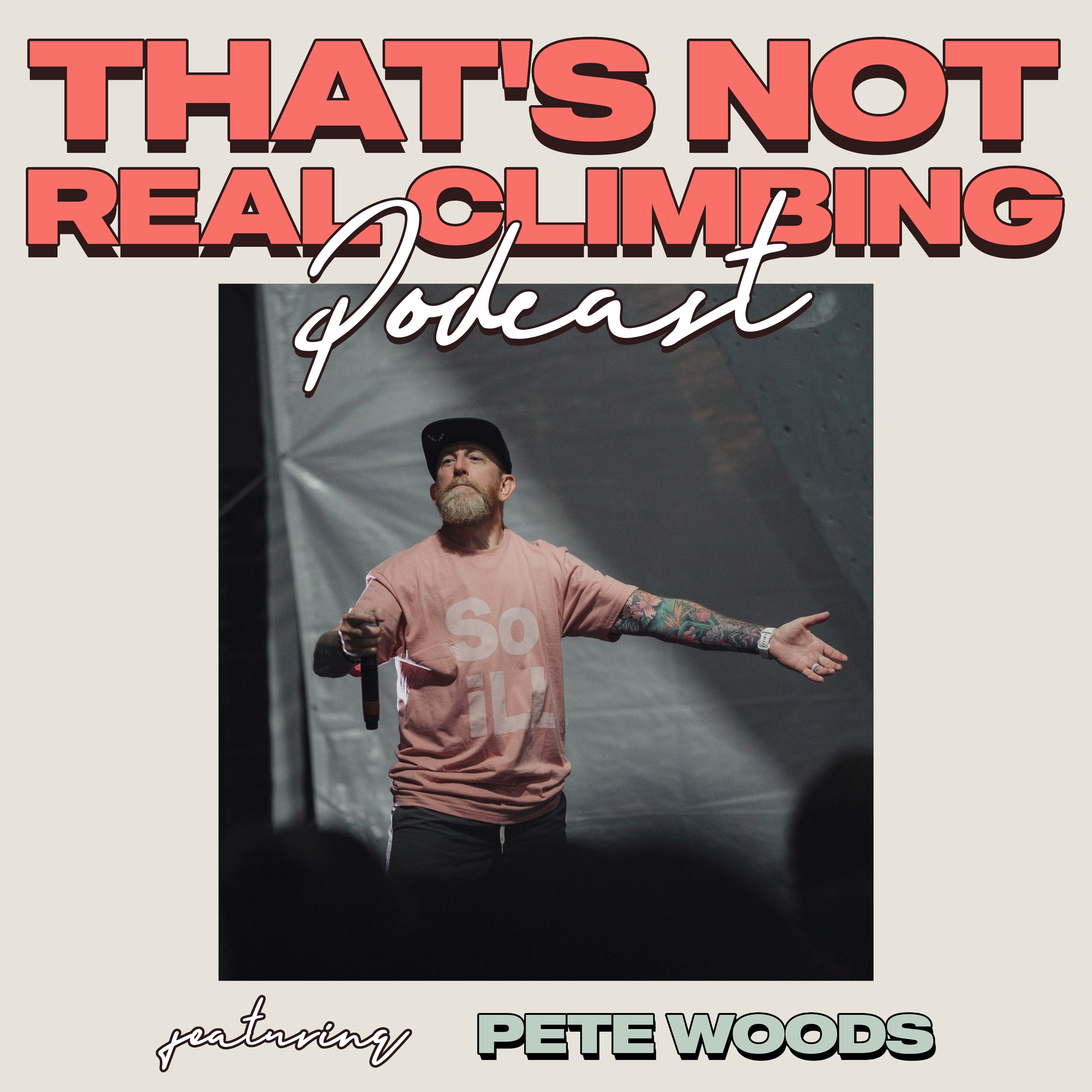
Pete Woods - The Sad FINANCIALS of Climbing
Episode Transcript
Streaming events at the quality that people want is very expensive.
Tens of thousands of dollars.
And people in the tower, oh, the slab was too hard.
And I talked to the chief and he was like, the slab was V6.
People say that World Cup climbing in Europe is now behind a paywall.
It's not.
It's on TV.
That was always the goal.
People that consume sports.
understand that part of consumption is economics.
And I think climbing for so long has had this, it's owed to me that it's free.
Welcome to another episode of the That's Not Real Climbing podcast.
I'm your host, Jinni, and I'm excited to introduce my guest for today, Pete Woods.
Pete is a commentator and MC.
He's commentated for several World Cups and North American elite competitions.
In this episode, we'll learn about the art of MCing, times he's gotten flamed online as a commentator, and we get a lot of insight into the financials of broadcast and climbing as a sport, including the best argument I've heard yet for why Eurosport is a good deal.
It's clear to me in this episode that Pete is a huge proponent of growing the climbing community and his passion really shines.
So I hope you enjoy this episode with Pete.
I'm excited to announce that my sponsor, Mad Rock Climbing, just came out with a brand new pair of shoes, the Remora Pro.
I was so excited to try them on that even though I broke a toe on my right foot, I had to at least try on the left shoe.
So I can definitely say that the Remora Pro is better than a rental shoe.
But really, these are their softest shoe ever, which means you no longer need to worry about standing on sketchy volumes and comps.
They also have a crazy 3D heel that allows you to get more surface area when heel hooking and inserts that lock your heel into the shoe no matter how hard you're pulling.
Feel free to message me if you have any questions about the shoes or sizing and you can use the discount code NOTREALCLIMBER for 10 % off your entire Mad Rock order.
Back to the show.
What have you been up to?
It's been a while.
I'm good.
I've been busy.
Like I have a day job, right?
So like I have my regular job that I do.
What is that?
I'm the head of supply chain for a financial tech company.
Whoa.
Okay.
I didn't know that.
Yeah.
So that's my, I mean, my job keeps me pretty busy.
And then I was just in Mississauga for the Jackalope, which was awesome.
Oh, that just happened.
Oh, I totally missed it.
How was that?
You can't, yeah, you can't catch, there's no online, there's no streaming presence for Jackalope.
You just have to be there.
Oh, sad.
Would it be better if it was streamed, do you think?
Um, yeah, that's something we can definitely talk about.
It's the, we tried it once, um, and it falls into the same problem.
So it's super expensive.
Um, and the Jackalope kind of the model, they like to do things kind of as high end as they can.
So like in the skate side of things, it's mostly a skateboard.
It initially was a skateboard competition.
Um, but two years they've had Tony Hawk, uh, the Tony Hawk for demo team come through.
They always have like top names in skateboarding that they bring in.
Bob Burkess was there this year.
So like they're super established and they decided, all right, we'll stream it and we'll stream kind of all the semis and all the finals.
They brought in, you know, a couple of big names to do the skate broadcast and I did the climbing broadcast.
And the only downside was that that was the one year we decided to make it an NACS event.
So we took a festival comp and we decided to make it an NACS event, hoping, thinking we would bring in some of the highest top athletes.
So now you're dealing with judges and rules and all these things.
And we had like a correspondence sort of like on the mat.
And the idea was like after people came off their finals boulder, you'd be like, hey man, how would that go?
And all the final, all the climbers were into it.
And the jury president for the comp was like, no.
And we were like, this is the future of the sport.
Like why like sideline reporting is a thing.
Um, so it, that kind of fell a bit into like, it was just another broadcast and it poured with rain and it was wildly expensive and they haven't done it since.
So yes, would it benefit from a stream?
Sure.
It'd be awesome.
Even if you just put, you just let it run like with the, the kind of the vibe of the space.
Cause it's, there's like a thousand people watching outside.
So it's a hell of a comp.
I think it would be great to stream it, but it's, really expensive.
Okay.
So we will get into the details of all of that and like the price of setting up events and streaming and stuff like that a bit later.
But for, I think like a lot of the international crowd may not know who you are.
So what is your climbing background and what do you do?
My climbing background, I started climbing a little over 30 years ago.
I grew up in Ontario in Canada and just had I stumbled across it.
I had a friend who said, hey, we're going to go climbing this weekend.
And I said, okay, sure.
Rock climbing, great.
And it was just hooked.
It was one of those things that just caught me that something about it appealed to me.
And I kind of went all in on climbing.
I quit a bunch of other sports that I was doing.
I was in university.
And then I started competing.
So basically in the first year I started climbing, I started competing and I started managing a climbing gym.
Wow.
So there was something about competition.
I've been competing.
Every sport I did, I did competitively.
So for me, climbing and competition was a natural pair.
And then the outside part of climbing was the recreational, like the enjoyment, the escape, the outdoors corner of it.
And also a little bit of competition.
So you're like, you're trying to send roots.
You're trying to send all the problems.
Like that's your focus.
So I've had this anchor in competition since almost the first.
you know it's easily within the first year it's like they're fuzzy memories now it's like i think it was the first year maybe it was the first 16 months something like that but i went to my first ever competition we drove from ottawa to montreal i came in dead last um and i was like that's the greatest thing ever uh and i never came last again you know that's one of those things so i competed um for quite a long time i competed um like in canadian nationals as soon as we started having canadian nationals i did quite well for a few years like when i was sort of in my climbing prime um I went to one World Cup when I was coaching the youth national team.
So I started coaching when I moved out west and I loved coaching.
So you went to a World Cup as a coach?
I went to a World Cup.
I went to Youth World Championships coaching our national youth team.
And then we went to a World Cup in part of our European adventures.
We stayed in for like almost six weeks and climbed all through Europe.
And there was a World Cup.
So myself and Mike Doyle.
went and competed in that world cup and i came in like third last like i was not ready to climb in a world cup yeah it was that experience experience i had no idea you didn't even tell me that one those are i i still have the i have the tank top so i have the was in aprica in italy um i have the tank top from that event and essentially i applied i said we're going to be in europe there's a world cup at the same time i was climbing quite hard like i was like a good climber and I got approval from the National Federation, you know, and off we went and we entered this comp and it was, I mean, Steve McClure, like it was sort of 2002, I think was the year we were there.
And it was, it was only, it was route comps and it was very intimidating.
The city was basically closed.
We were in like the hotel, like all the climbers in the same hotel.
And you walked over to the venue, you just stand in front of this massive lead route.
And you try and work it out.
And then I was nervous and I got pumped.
The route was like really, really technical at the bottom.
So classic route setting would make you pumped like at the very beginning.
And I just couldn't I couldn't outrun the pump by the time I was in the middle of the roof.
And that was it.
And I think I came like fourth last or something like I got rocked.
I mean, you didn't even get last.
So it was super fun.
But I kept coaching.
I love coaching almost right away.
Um, and I'd coached a bit of other sports.
So I, I kind of, I liked coaching in general, uh, and I liked coaching climbing.
There's just something about sort of breaking down movement and, and working with individual athletes, like in that team space.
I really liked the way that lent itself coaching teams where you, it's harder to have an impact.
I think when you're coaching large teams, soccer team, volleyball teams, things like this.
But you're coaching individual climbers in this group environment, in this sort of co -training environment.
So I kept coaching as I kept competing.
And then eventually you, like I wasn't training full -time.
I had a job, right?
I wasn't really a full -time climber.
I tried to be for a little bit.
I was repping a couple of climbing brands.
I went through that art.
I was sponsored.
I had all this stuff.
I was like, maybe this is the way.
And then I was like, I kind of like want to.
live in a nicer apartment and I, you know, want to have a car and I want to go on vacations.
So I decided I got a job.
I had a real job.
And that chips away at your ability to go climbing.
Right?
Yes.
Like, oh, you gotta, you know, you have to go kind of be part of society and not, people choose to do that and not do that.
And some people choose to take climbing in like a full -time direction.
And I just decided that wasn't quite for me.
So I was content.
I have, looking back, become content with making decisions, maybe kind of just at the tail end of the prime of my climbing where I was like, ah, if I had gone all in, you know, what would have happened?
So I think we all have those moments.
And in the moment, I was fine with it.
And looking back, I'm fine with it, but I definitely kind of think, oh, could I have done something different with this sport?
But I think if I had done something different to the sport, I might not be where I am now.
And I love where I am now.
I love having transitioned from competing to being given the opportunity to emcee an event, a local event, and then being given an opportunity to do commentary at a local event and realize that there's a passion for that.
And then I have a good at it and then grow that passion and grow that talent.
And this is where I end up now.
So maybe I wouldn't be here.
So I think every step that you take on the path has an impact.
I'm not a kind of fate person.
I'm not a kismet person.
But I do think that the choices you make, I mean, they take you where you are and you can have regrets.
But if you're happy where you are now, you don't need to have those regrets.
You can have like, you know.
fond memories and like, ah, like I have this sort of anchor memory where a bunch of friends had gone to Bishop.
Um, and I didn't go, I don't either didn't have the vacation time, or I think I was going to go to font and made that decision instead.
And, um, one of them became, it was the first Canadian ascent of the Mandela.
It was like the third ascent of the Mandela.
Right.
And that's, we're climbing the same level.
You're like, oh, could I have been, you know, the third ascent of the Mandela?
Like, could I have a, like a little stamp in a history book?
Maybe, but at this point in your life, does it matter?
You know, probably not.
no yeah i totally feel that um okay so for those who don't know the nuances um how is emceeing different from commentating oh my goodness it's such a good question it's they are branches of the same tree so you are you have a responsibility in the event and i'll go i was just talking with a bunch of people because i was in mississauga the jackalope the mc side of it is the you are responsible for keeping the crowd engaged to a level that the climbers get the response they deserve for the work they're putting in.
So you tread along this line, at least I do.
I tread along this line of being integral to the event without sort of taking away from any of the moments and only trying to build them up a little further.
So a crowd of people is a...
literally a living breathing thing and they react to each other but you can kind of nudge them so i try and get them on my side i try and get them to want to see you know what we're trying to accomplish and the value that sort of their response to hard effort is and you don't only have to cheer for people topping boulders you can cheer for effort you can cheer for camaraderie you can cheer for people being nice to each other like you have all these kind of places where you can Not just be distracted and look at your phone or talking to your neighbor.
So my job is to remind people that there's really exciting things happening right up here on this big stage.
And then just to try to boost the moment.
And it's high energy.
It's high impact.
It's not a lot of nuance.
You're not allowed to describe the boulders.
You're not allowed to tell people anything other than...
Maybe I've pushed it on a couple of events.
I had a chief root setter ask me to push the line a little bit at the bouldering project series a few years ago.
My friend Tonde had said, he's like, we want to nudge it a little bit.
It's not a sanctioned comp.
He's like, you can tell the crowd in the room a little bit about the boulder.
So why is it hard?
It's like, oh man, that foot is so slippery.
They're having real trouble getting it.
Let's see if, you know, Sean can do it.
So they've seen the boulders, right?
They preview the boulders.
There's no surprises.
But the trick to not give away like, oh my God, I can't believe he heel hooked to the person that hasn't seen the boulder yet.
That's where you draw that line.
So trying to push it a little bit in terms of keeping people interested in what's going on.
Are you allowed to say like if someone topped?
I mean, I guess it's kind of obvious from crowd cheering anyway, but I don't know if you're allowed to.
At sanctioned comps, it's way trickier.
So I've had exchanges with chief judges and jury presidents over the years who were like, you can't.
And I was like, they know.
So you people, that's two hands.
You have to connect.
You're not in a vacuum.
Beta, definitely not.
But sort of information, yes.
And you're right.
It's almost impossible not to know.
If someone has topped a boulder and even in whether you're doing festival style where you're changing the format or you're doing like a normal comp where people are sort of in ISO and then in secondary ISO together.
If somebody comes back to secondary ISO a minute and a half after you, they flash a boulder and you'll have heard it from the crowd, especially at an event that has a lot of people at it.
A thousand people are going to make.
like a pretty big noise every time someone does a boulder.
Or if someone gets to the zone and they haven't seen that yet, the kind of hum turns into like an explosion.
And then if they keep going, it, you know, it manages to go even further.
So you kind of, you always have an idea.
Okay.
So then going into commentary, well, I guess, do you have like a preference of doing one or the other?
I, I waver.
I waver when I'm in an event and I'm on the mats.
in the middle of a final, there's a thousand people and the lights are on and people are topping boulders, I wouldn't trade it.
It's so much fun.
There's a kid that just snuck into finals in Mississauga at the Jackalope.
He's a super good climber.
On the last boulder, insane, crazy Gaston dino palm press thing.
Stuck it.
The roof comes off.
He's all excited.
He turns around and I was like, bro, he almost knocked me over.
Like he ran up and like gave me this big bear hug.
I almost fell over.
Like it was so, so being connected to that level of energy and that emotion, it's wild.
And I have these moments, you know, just standing around with people on the mats and at a comp where there's less, you know, we're not sanctioned so we can do what we want.
You hang out with the athletes.
I brought someone their chalk bags.
She was hanging in an upside down knee bar.
Like anybody, does anyone care?
I looked at the other finalists.
I'm like, can I?
And they were like, So I brought her a chalk bag to chalk up in the middle of the climb.
Like you don't, that's the connection for me is like, it's so much fun to be like, I'm just this little corner.
I'm still involved.
But broadcasting as a, at my kind of core in climbing as a coach, as a teacher, as a mentor, that's where broadcasting gets to shine because you have this platform of pretty engaged people who you can.
Bring climbing to.
You can teach the sport as it's happening.
You can provide knowledge.
You can give insight.
You can talk about issues.
I'm a huge, huge fan of root setting.
I mean, I think we mostly are, but I'm a big kind of booster for root setting.
A lot of my close friends are root setters and it's such a core component.
And that's the thing that gets complained.
People always go, oh, the root setting was this, root setting was that.
So I'm a big defendant of root setting as an art.
And you get to talk about it on a broadcast.
You get to talk about the skill and the nuance.
And I'll go and watch them tweak the final or tweak the semi and spend hours moving a foothold around.
And for me to be able to say that to the people watching at home is like, what you don't know is that foothold used to be three inches to the right and the boulder was too hard.
And now, you know, they tried everything and look now it's getting like it's being done a fourth or fifth or sixth try for people.
So you get to have this.
The same kind of conversation that you have out for dinner or around the coffee table, around the fire, where you break down climbing and you get into why you love it and you get into people's style and you get into why someone did a boulder and someone didn't.
You get to get into watching teammates do something different on a boulder that is wrong that no one else did.
You're like, oh my God, they obviously talked about that.
So they're like, oh yeah, we're going to do this.
And they both did it.
And they both did it wrong before they had to come back around.
And that gives you this window to talk about the way that route previews work.
And you just have these threads you get to keep pulling on for a couple of hours.
And you just get to hang out.
And usually whoever the co -commentator is, is going to have a similar level of interest and passion about climbing.
And there's places where you get to like, you know, sometimes you're just plain blown away or excited.
And sometimes you're like.
You get really, really nuanced about movement.
And for me, that's super fun.
So in the middle of a broadcast, if you ask me, I tell you every time I would do, if I had to pick one, I would pick broadcasting.
In the middle of a final, when everything's going off, I'd be like, oh man, this is good times too.
How much does it cost to stream a competition?
And what all goes into that cost?
Tens of thousands of dollars.
Streaming events at the quality that people want is very expensive.
World Cup level broadcast is the sports you're used to watching on TV.
Those are the cameras.
That's the production trailer.
So, you know, I've shown people pictures from U .S.
Nationals of the production trailer that's parked outside and the 50 monitors and like seven produce like people doing graphics, people doing all of these things.
We have show run meetings like there's a team of at least 10 on the production side plus camera people.
Plus the commentary group team and all of those people have to get where you're going.
So, you know, even just to fly, um, and, and a hotel, if to get me somewhere is going to be a couple thousand dollars times a second commentator, you're at probably five grand already just to have people in, in the building from wherever they live, you know, originally.
And then you have to get, you have to pay the camera people, you pay the producers, like all of these things kind of ticking all the way down the line.
Of course, there's volunteers at climbing events, but no one's volunteering from, you know, a camera production crew.
So they're, I mean, $40 ,000, $50 ,000, $60 ,000.
I know the dock masters, the guys that put that on, they do other sports like that camera crew, that production crew.
Um, and they, you know, they're, it's a small country, so they don't have to, they're like, they live in the Netherlands and they just have to come further.
You know, they just come out to the city, but they still have to stay in hotels and still have to drive their cars.
Like even if everyone lives in the city that you're putting the event on in, it's still expensive to pay everybody for that time.
Um, and you, I mean, you're not bought, you're not renting camera equipment at this point.
You're working with production companies that own it, but they're wildly expensive.
Um, one thing, just a side note, if you ever get into broadcasting, grow a thick skin and do not read the comments.
I've read some horrible things about myself.
Hey, I'm an idiot, right?
All these things.
Um, but we, someone put in the comments and it came back around and said, you can't call them girls.
Okay.
But my female co -commentator calls them girls because that's, it's okay for her to say that.
Oh, the girls.
Unlike the women, right?
The female climbers, the ladies, the athletes.
So you have to build these things that are okay in a social setting at the pub that are not okay on a national and international broadcast.
Do you remember like any other things that stand out to you that you had to like learn to change during commentary?
You can't really be a fan doing commentary because then it just sounds like you're a fan.
So I had to learn to be a little bit more kind of toned down a little more level for sure.
So choice of words, choice of language.
I had to change for sure.
Just sort of throw away expressions that you might use that have no real impact.
You know, I kind of learned to narrow your language down and be more descriptive in a more concise way.
I like to wander when I talk.
I like to meander, tell a story.
But you have to be able to tell the story and wrap it up before the next climber gets on the wall.
So I had to learn to be super dialed in.
Um, and I've, it's funny cause I've talked to a couple of other people that did a podcast a couple of years ago and we were talking about being more concise and he was like, you are not a concise person.
I'm like, I know like even this, this sort of wandering conversation that I'm having with him now, I'm like, you know, we're just telling stories and getting off track and you cannot do that.
You have to remember all of these details.
And, um, I was already pretty good at pronouncing names.
Um, maybe just how I grew up.
I started reading super young.
So like, I'm not.
I don't get worried when I look at foreign names.
But I will forget things.
I'll be like, oh, are they from?
Oh, my God.
And you'll sort of forget a country.
And then you just have to change your sentence in the middle of a sentence to not talk yourself into a corner that you can't get out of.
So you tend to think very quickly while speaking in a very measured way.
And you can't offend people.
That's the trickiest one is something you might think is fine.
It's probably if it's on the edge, somebody will think that you're being rude for some reason.
I'll give you another example.
There's a very good, very strong young climber in Canada, Evangelina Briggs.
She's a national champion.
She's the youth champion.
She is an absolute monster competing.
She is also a mask.
She climbs like stoic, serious, almost no emotion.
I said she topped the boulder.
I think the boulder she knew was going to be the win and had this tiny little crack of a smile as she turned around on the camera.
I was like, oh, that's you can tell that smile.
She's going to be happy with that.
And somebody put in the comments.
in quotes, you'd be prettier if you smiled more.
As if that's what I was alluding to.
It blew up.
And I had to go and defend that and be like, that's not, and I brought it up.
I think I even brought it up on the, like, you know, the next broadcast I did because I'm like, that's not what I'm talking about.
Emotion is fine.
Like I'll mention if there's a male climber that smiles, that never smiles or shows emotion or doesn't show emotion.
Emotion is not male or female.
Emotional is not rude or not rude.
It's a descriptive fact about an individual or a sport or whatever it is.
So to think that you have to explain that, you have to be ready for people to take what you've said and twist it with their own version or their own bias and then apply that bias to you.
And even if you don't have it, you have to look in first and go, okay, am I applying a bias that I didn't think I had?
And do I need to change the way I address things like this in the future?
Or is that person just on a little island all by themselves and no one else thinks that I said something offensive?
And in that instance, the.
The Rosanna people in the chat, people were texting me like female friends from across North America were like, you're good.
Like, don't stress it.
I guess in those cases, it's also hard because then maybe one person would say it and then a bunch of other people who didn't even have it in their mind would see it and then be like, oh, maybe.
And I talked about, you know, there's the World Cup in Salt Lake City where Mejdi topped the boulder and spiked his chalk bag and it bounced like four feet up in the air.
Right.
That's raw emotion.
You know, what a story I just told you about Jacob knocking me over on the mats.
That's raw emotion.
And I think we should be able to talk about that without worrying that we're, you know, that we're, we're applying an emotional reaction to a gender specifically, instead of that's just happens to be the person we're talking about in the moment.
So yeah, it's a, there's little pitfalls everywhere.
So I've learned to be a little bit more careful, a little bit more measured, do more homework.
try and understand um where you don't get to just have your own opinion so i don't just get to say that's not offensive i have to have i have to have like consensus so if it's even you know i'm thinking about it or talking about it and either in retrospect or you know in planning i just you apply a different lens which is a lot of people i mean will cups get broadcast on like 57 channels, the cable channels across Europe, like hundreds of thousands of people watch World Cups.
So my first World Cup, I was like, this is not 800 people watching on YouTube.
Yeah.
How did the Salt Lake commentary go?
You did it in 2021, 2022?
And two, yeah.
It was amazing.
It was so good.
It was the, it was the, what I had been trying to achieve since I started doing commentary was like, you know, I want to take this as far as it goes, which is the World Cup.
I was super lucky to have Megan as my co -chair.
She's just so smart and so invested and being in the US and she's friends with like all of the athletes.
So she had this like energy about her of like, I get to watch my friends compete and talk about them on TV.
Like this is the greatest thing ever.
So her energy was super infectious and the crew was.
And they treated me as though I'd been doing it for 10 years, which I had been.
So that was like, it wasn't like, oh, you're new.
What do we do now?
It was, oh, you're just new to this chair.
And the professionalism, the timing, the voice in the ear, like the way the run, everything is like almost to the second.
It makes it like a really enjoyable experience.
The climbing was amazing.
I mean, one of my favorite things, you think you have this idea or maybe people that haven't seen a lot of competitions.
And I did a little behind the scenes with my friend Tyler, who has Plastic Weekly, which is a show at the last Salt Week Wilcox that I did.
We did a behind the scenes and I was like, here's the commentary table.
And it was like a folding picnic table, like in the dirt, like in the corner, like behind some cabling and like a light post.
He's like, it's not glamorous.
You're not, not all venues have like, you know.
a commentary area.
So there's this idea that you're like, oh, I wonder what the, what the booth is going to be like.
And I have a picture from the finals and they put backdrop for the kiss and cry, like where they have the kind of who's sitting in first place.
And they had the, like the USA climbing kind of screen in front of the broadcast table.
So I had this picture of the monitors and a black screen.
That was our view for the final.
We could not see the boulders and we were eight feet away from.
the boulders so um there's you don't get this big sudden jump like oh i'm doing world cups now we're gonna be in like you know oak chairs and like this wonderful environment like no it's still like the money gets spent where it's supposed to be spent and you're gonna sit in a plastic chair on a folding picnic table and you're gonna like it and it's gonna be fine but the experience was amazing and it just made me want to do more it would be nice to see like a nice commentary booth like they have in like the NFL or something where they're like all sat around and there's like a whole row of commentators and they all, yeah, I don't know.
That would be nice.
And if someone running stats to you and yeah, absolutely.
I agree.
That would be great.
I think I was going to say this for a bit later, but since we're talking about Salt Lake City right now, I think you had an interesting anecdote about, I think the setting at Salt Lake in terms of like difficulty.
Please excuse this brief intermission.
In order to keep this episode a bit more focused on a few topics, I had to cut out a lot of really interesting conversation about remote commentary and commentating for new viewership.
If you'd like to unlock that video along with over four hours of bonus content, do consider helping support this podcast on Patreon.
Some other perks include a membership pin shipped to you after two months, prioritize guest questions, or the ability to submit video questions.
questions and more to come the proceeds go back into the podcast help me break even and they help me improve the experience of the guests if you'd like to help out non -monetarily liking commenting and sharing helps a great deal as well back to the show it's into the conversation about how root setting is so integral and we know this but how the nuances of root setting are the important part about high level competition climbing.
The, I've talked to so many root setters over so many years and been so invested in the, the care that they put in to every hold is real.
Um, and their, their goal, and I'm a long time ago, so I'm good friends with a root setter named Tonde Cotillo, who's one of the best root setters that's ever done the job.
And We would just talk about climbing and root setting and stuff.
And I remember saying something about, oh, it's climbers versus root setters.
And he was like, it's not.
It's not.
It's root setters creating movement that they want to see done, but not by everyone.
So you have to create risk and you have to create room for error and you have to create falls and you have to steal time and you have to steal confidence and you have to kind of take all these things from climbers so they don't all just storm up all your boulders.
So they want to see them get done, but not by everyone.
So now the level is really difficult.
If the temperature changes 10 or 15 degrees or it rains an hour before the final, all of those boulders get harder or easier and you can't tweak them half an hour before the final.
So there's so many factors that go into that.
There was a slab in the semifinal in Salt Lake that no one did.
None of the male finalists or semifinalists, finalists?
I can't remember from one.
I think it was a semifinal.
I think you mentioned it was semis, yeah.
Yeah.
And people in the tower were like, oh, the slab was too hard.
And I talked to the chief and he was like, the slab was V6.
You just, you have to, nobody decided to trust the foot they had to trust to lean across to do the rock over to do the boulder.
It's like the boulder wasn't that hard.
They just collectively as a group didn't do their job.
You know, you can, you set the boulders, you set them out and you're like, everybody go.
And sometimes all the climbers are on the same page and they're dialed in and they're crushing it and everything's perfect.
And sometimes collectively they don't climb the boulders well.
And then we get this conversation where people say the setting was, so people will say this, the setting at Salt Lake was too easy or the setting in Salt Lake was too hard.
And I don't, I cannot abide by that.
If you want to talk about.
The third semifinal boulder was a little bit too easy.
I feel like, you know, maybe that sloper could have been worse.
Now we can have a conversation about route setting and how the depth of understanding you need to get to, to know why a boulder gets sent or not sent by six people or eight people or 10 people or 20 people.
But putting these blanket expressions across, so the route setting was too easy.
It's like maybe two of the boulders were too easy, but do you want to see four tops in a final or two tops in a final?
And do you want to see, if you see four tops in a final, do you want to see five finalists top four boulders?
Or do you want to see one finalist top two boulders and five finalists top zero boulders?
That's how thin the lines are with World Cup level route setting.
The athletes are too good.
And it's hard to confuse them.
It's hard to trick them.
And it's hard to make them fall off.
And then you get...
People come up with new hold designs to try and be like, hey, this is going to make it hard to see where the boot rubber is or hard to see where the no -tex is.
And people write in the comments, that's dangerous.
Oh, people are so mad.
It's not dangerous to have no -tex, right?
Like the zebras that made their debut, clear holds.
Like we, as collectively as fans and consumers of competition climbing, if we're not ready for innovation, we're stunting the...
people whose job it is to build a sport were taking that away from them.
And I have this like core memory of competing when I was younger.
And there's a set of holds and we mostly competed on roots.
There wasn't a ton of bouldering in that era and it kind of just came into more and more.
But there was a set of holds that from the bottom all looked exactly the same.
They were half moons with no texture on the bottom, which was a thing.
Back in the late 90s, early 2000s, there was no text then.
And from the bottom, they all look the same, but one was a sloper and one was flat and one was in cut.
So when you're reading a competition from the ground, you're like, oh, that's the good one.
And you get there and it's the flat one and you come off.
We put tape on the inside of holds so they were slippery.
So something you thought was a bucket now has duct tape inside of it and it's slippery.
They used to re -pour well -known shapes.
For the PCA comps, the pusher open down in Salt Lake City, the pusher was in the town.
They'd be like, they would remold a hold you thought you already knew.
You're like, oh, I know that pinch.
It's super good inside.
No, it's two inches fatter.
So that's how we have to evolve.
So root setting evolves, hold shaping evolves, climbers evolve.
And then it has to go back the other way.
So like, okay, climbers are too good at small crimps really far away.
What do we do?
Now we have volumes.
Now we have runny jumps.
Now we have, you know, triple coordination paddle dynos.
Climbers are getting really good at that.
I was talking to Mikael Mauem at the Dockmasters this year.
And I was like, what if we just, if you set like a really hard, like terrible crimp boulder, it was like some of these guys couldn't do it.
So route setting, does it swing back to 1990 where all the holds are like a quarter pad and really far away, but then eventually everyone catches up.
So I think route setting as a, as an art form and as a core piece of that puzzle, has to be understood.
And I think that broadcasting allows that kind of peek behind the scenes to get, you know, oh, this is what actually happens.
They didn't just throw the boulders up and walk away.
This is how much they cared.
I've seen Root Setters after comps like this.
Like, I can't believe the last boulder was too hard.
So they're their own worst critic.
And yet there's people out, you know, hammering away on the YouTube comments saying their Root Setters don't know what they're doing.
Maybe the root setters at your home gym who have been root setting for a year might set boulders you don't like.
But these root setters have been that's their entire life's passion.
It's their life's work and their job is to create the playing field that we get to consume.
So for me, root setting is this.
It's so important that we continue to have an education platform for people consuming high level competition about how difficult it is.
set for this level of climber.
Do you know how often nowadays root setters do these little tricks like pouring a new hold or something like that?
I've only heard of setters saying that they would like sand down a hold so that the texture was a little worse, but I don't even know how often that happens actually.
It happens when their vision for a boulder doesn't have the hold in the hold room that they need.
So you're like, I really need a hold of this size with no texture.
It doesn't exist.
Go get me the sander.
I'm going to grind the texture off of this one.
I have a picture of my friend Caleb at the Doc Masters a couple of years ago, like just on a slab, just like, but he wanted the hold smaller.
So it was a little nubbin and it was too big, but they didn't have anything smaller and they didn't want like a big dish that was like flat.
They wanted low profile aesthetic.
And so he just basically just cut the top off.
And you see blockers all the time, right?
So you take a hold that's pretty good and you block half of it.
So like, I really wish I had a three pad crimp that you couldn't match.
Like, I'll just block it.
So that's the easier trick is to take things around the gym and do a little construction work, a little bricolage, and then you can do what you can do.
It's pretty hard to decide to re -pour holds, but you have whole companies that will not release holds.
to the public until after they've used them in competition.
So you're like, oh, like Flat Hold made the Z.
They're like, oh, we made these new holds.
Let's put them in competition and then we'll sell them.
So no one's climbed on these holds.
No one's trained on them.
No one's grabbed it.
The first time you grab it is your first attempt on that finals boulder.
And that's stressful.
So now you create risk, you create anxiety simply by putting something brand new where you're like, what is that?
And you see them climb.
You see them.
If you watch them preview, they're like.
what did we do with that?
Like, I guess you just hope it's good.
Or you see somebody jump to something that's definitely not a hold you could jump to.
And then they're like, that's not what I thought it was.
Okay.
Good to know.
Okay.
So moving on into something else you're pretty passionate about.
You mentioned you're a big proponent of non -sanctioned comps.
So non -IFSC related.
Why do you think they're so valuable to the community?
Yeah, it is one of my favorite things to talk about and maybe more in recent years.
And it's not I'm just going to put my broadcast mask back on and be like, this is not a knock on the IFSC.
Obviously, we should have World Cup level competitions.
Like, it's not a one or the other scenario.
So just we put that caveat, the disclaimer out of the way.
Yeah.
Little asterisk on the corner.
Like, don't misquote me, please, if you're watching this.
But it's exclusive.
Um, even people that like to compete won't go to a national championship because they'll probably get rocked and you got to spend a lot of money to go and you, your competition experience is, um, you know, the first three moves of two boulders in the qualifier.
And then you're like, great.
I'm glad I trained all year for that.
Um, so the high level competition is the bar.
Um, and then.
For sanctioned local competitions, you still need to be committed enough to pay into your federation, to pay into your state or province, wherever you live, and be in that space.
You need to be a competitor.
And not everyone likes to do that.
But some people think competing is fun.
And I think that non -sanctioned comps, local comps, festival comps, and, you know, something we'll kind of, maybe I'll sort of...
talk to them more at the end because we can tip into that um comps that allow you to make money to continue climbing as a professional climber those are critical pieces of the the roots and the growth of the sport because it makes competition accessible and it makes people maybe grow an interest in it which maybe makes them go and watch a world cup um which builds viewership which means that you can get sponsorship which means that you can pay athletes more which means you can put on a better broadcast the dominoes continue and they start at your local gym putting on a comp series that costs you 30 bucks and they said 40 boulders and it's a fun scramble and you're going to win a chalk bag or a couple brushes or a t -shirt from the local t -shirt guy and that idea that you can compete without needing to be a competitor I think is really important.
You can compete because it's fun.
And if you play other sports, every time you go play it, you're competing.
Any team sport, you rec softball, anything you're doing as an adult or in university where you're no longer on a competitive team where there's people on the sidelines and coaches and all of those things, you're playing like an adult level or a rec sport or, you know, I'm sure.
You know, every province, city, state has some version of, you know, a beer league, baseball or basketball or squash.
You have all these things.
You're always competing.
And then you get to go out and throw the ball around sometimes.
But I go and I play soccer on Saturdays on a soccer team.
Or I go play beach volleyball at the beach on a team, you know, every Sunday.
But when I go climbing, I just go to the gym and I try all the problems and I go home.
So it gives you a chance to go and be in this kind of a little bit hyped up environment.
Maybe they turn the lights off.
Maybe there's a DJ.
Maybe you have an MC.
Maybe you feel like there's a hundred or 50 or 20 people watching you climb a boulder.
And you're like, this is a good time.
Like, oh my goodness.
I didn't know this adrenaline rush, this feeling of like, oh, I can't come back and try this boulder tomorrow.
Oh, I can't, I can't work on it for an hour.
I can't go outside and have a coffee and come back and be ready to climb it.
I have four minutes.
wow, this is exciting.
This is testing everything I need to know.
I coach locally and I coach people who are like, I think I want to maybe go into the triple threat.
We have this comp series through the winter and the summer or they're, you know, Friday nights and we shut half the gym.
So there's still people climbing and they're like, I go and I watch and I see people compete and I think I want to try it.
Like, can you give me some tips on how to compete?
Right.
And I'm like, absolutely.
This is what you want to talk about.
This is what you think about it.
People either come back going, that was the worst experience of my life.
I wanted to cry the whole time.
Or they come back and they go, I didn't think I was going to do that boulder.
And then I did it.
I don't think I've ever felt that in a session like, you know, on Tuesday afternoon with my friend.
So you smash all of that together.
And that's what local level competitions bring.
And if you take it up a notch and you go.
Festival comps, so comps that you would have to travel to that have a few other ones, like a Sequel Block, for example, or Adidas Rockstars or the Jackalope.
It happens a couple of times a year in a couple of different places and has enough money that people will come to it.
But not so much money that the finals will be full of people that have flown in for it.
And now you have this really interesting play where you have people from wherever it is who made the final.
And people who've come in from out of town or who are like a national level competitor.
And now you get to see what the game is really like.
And you're like, oh, I competed against this person and I couldn't do this boulder and they smoked it.
Like, wow, that's how good they are.
And then you think that person went to World Cups and came in 50th 10 times in a row.
Okay, so how good is Meji?
Right?
How good is Johanna for real?
What is like that magic number of like, you'll have some people come in, but like it's mostly locals.
I mean, you have to have, I think you have to have at least $10 ,000 in prize money to get people to travel.
That's, it seems to be, it should, you should be able to convince people for slightly less than that.
But $10 ,000 split between six people goes pretty quick too.
So it's not like.
you know, you're getting, you know, two and a half or 3000 for first and 500 for third, you know, like it's, it's not, that's most people, if you're going to come a long way, that's your plane ticket.
Um, if you have a comp that puts up that brings athletes in and maybe pay some of their travel.
Um, so studio block doc masters, uh, I'm pretty sure if you have a world cup ranking, um, I think that's the bar.
If you have a world cup ranking, they'll pay your hotel.
Um, And if you have a sponsor that's paying for something for you or you have friends in the town that you can stay with, like there's all these reasons you would be like, okay, three grand is a difference.
Do I think I can win?
And so then how much does it cost to run these like bigger non -IFSC comps like Studio Block or Jackalope or something like that?
Well, I guess that's kind of different because that's a whole festival.
Yeah, and it's a good question, but it's a tricky question.
There's so many.
different ways to break that apart and a lot of it depends on sponsors and a lot of it depends on the model so you might have a model where people pay to be a part of it so the event itself isn't really putting out a lot of money but other people are or you have the competitors who are paying their way in or maybe the competitor fee is quite low so you have to have an understanding when you're trying to put on if you're trying to start a new event um what you can do with what you have how many volunteers do you have how many people do you have to pay are you paying your gym staff or you're saying hey it'd be great if you guys could volunteer and they all say never mind i'm not that excited about it you're like dude um so you do have all of those expenses if you stream it or not stream it um you're gonna tack on a 40 or 50 000 or 30 40 50 000 price ticket on top of that um it's not it it shouldn't surprise you that a big A big money comp that brings in international level athletes is going to cost you a hundred grand to put on.
That's like similar to the budget for IFSC comps last that I heard, I think.
Yeah.
And then you get to offset it.
So your decision to keep doing the event or to put the event on is what can I offset?
Am I charging people to come in?
Am I letting people watch for free?
Do I have the sponsorship?
to pay for the event or is, you know, do I have, am I okay with giving out?
So a lot of sponsors would rather give stuff than money because an Arc'teryx backpack is worth $800, but it only costs them 100.
So he's like, am I okay with giving finalists stuff that they're, you know, goes to get people that go, I want shoes.
I'm like, great.
I'm sponsored.
Who wants my shoes?
You have all of these tiered decisions about where to spend money and how to spend it and who's spending it.
There's lots of different versions of that.
I think the chicken and egg problem is if you spend all the money, people will come.
And then if people come, you can then spend the money.
So the Dockmasters, for example, I'll put it down as maybe...
for me, top three in terms of organization and idea.
So they have, it's a qualifier.
So you can sign up to be in Open.
You know, in the morning, you go and you compete with the pros and they take your top six climbs and 18 people go to, or 16, 15 people go to semifinals.
So you just get to sign up, but you obviously pay as that as a competitor.
Or there's a citizen's comp.
So that's just for everyone else.
But they have two citizen's comps.
So they have one on Saturday and your entry into the citizen's comp is your ticket to the semifinal.
So you compete in the citizen's comp.
Then you get a meal ticket because you paid for food and beer and they have a caterer come in and you get like.
The foods are really good.
So you get a catered meal and a couple of beers and you don't leave the gym and you watch the semifinal.
Anybody who's put on a comp, I know there's people listening to this who are like, everybody competes, then they go home and then they don't come back and watch the final.
And then you have this sort of flat local environment where like 50 people watch a final where you could have had 200 if everyone that competed just stayed.
So they've created this environment where the right thing to do, the better choice is to stay at the gym.
And then the same on the, and they charge for finals tickets and people pay, they sell out.
So people are like, yes, I would happily pay 50 bucks to watch world cup competitors this far away.
But not every climbing community has that.
And the Dutch climbing community, I think it's most gyms per capita.
They don't have a lot of rock climbing.
in the netherlands so they have a ton of climbing gyms and then therefore you just sort of breed gym culture you breed competition culture and it just spreads out but having events like the dock masters on studio block masters adidas rock stars to some extent that provides this anchor of this is world cup level competition in the final and you get a chance to peek at it and try the boulders and qualify and there's always a couple locals that make the semi Because there's maybe six or eight World Cup athletes that will come.
So there's room.
There's room for you to make the semi and then get smashed on semifinals boulders and watch World Cup climbers just go, oh, yeah, I did the semifinals.
It was fine.
It was great.
That top five boulders.
And you're like, I couldn't start three of them.
Yeah, I do kind of wish we had something like that.
You mentioned that Punk Rock Masters is kind of a similar structure to that coming up.
Yeah, this is.
I'm so excited for this.
I'm so excited.
So Mark Bradley, who is the mind behind the Punk Rock Masters, he owns the whole room.
He grew up, we're of the same era.
He grew up where there was a lot, there was more sort of, we just competed locally.
There's lots of competitions, grew up skateboarding.
There was always a way to be like, I could do this.
I could make money at this.
This could be what I do for a living.
I could be a climber.
I could be a skateboarder.
I could be X, Y, Z.
And he also noticing sort of this gap in either you're competing at this level or you're competing at this level.
And how do we create an environment where if it's not world cups, can you compete for enough money to make it worth it?
Um, so he's hosting a comp, um, on, I'm going to make sure I get the date, right.
Cause I don't want to get the day wrong.
I don't have in front of me, October 11th in Huntington beach.
And it's $50 ,000 in prize money.
It's huge.
Yeah.
It's huge.
It's the second most prize money of any Masters comp in the world.
So the only one, there's a French comp, the Paris, I'm going to forget the name of it.
And they had $100 ,000.
Whoa.
And the fact that, did you know about it?
No, I haven't heard about it.
Exactly.
That's telling, right?
Um, it got almost no social media.
If you go to their Instagram page, they don't even have the winners.
Whoa.
So I, I, I was, we're going back and forth and Mark and I were talking about, he's like, I want to say that, um, this is the, the most prize money of any non -sanctioned comp, um, ever.
I was like, we were talking about it.
So I'm pretty sure this, sort of this comp in, in Paris was a hundred grand.
And I texted Chloe Cosboy, who was, who was there.
Uh, I pwned him.
She's like, it was wild.
It was a hundred grand.
And every finalist.
It wasn't just podium spots that got paid.
Oh, nice.
Yeah.
So he's like, why not put the effort in?
It's like a year and a half of planning and building sponsorship and doing all these things.
Why not have a competition that brings in that mindset of you can make a living competing because we've put in the work to bring in the money that makes it worth it.
And this the first time it's going to be it's.
It's an invite.
It's basically a final.
So it's it's it's more there's no qualifier semifinal.
It's just a final.
Oh, wow.
But it's on the beach.
It's outside.
And there's a punk rock show.
So we're just he's just he's twisting it to be like, you know, we can have this amount of fun.
And similar like the Jackalope is a skateboard comp.
There's motocross, big air.
There's bands playing DJs like it's this.
Why wouldn't you want to go down to Huntington Beach?
And watch some of the best climbers in the world.
And the confirmed athletes, it's like Mejdi, Mika Mauem, Colin Duffy, Brooke Futaba, Tomoa, Fanny Jube.
Like, this is the level that's going to be climbing at this comp.
And the proof is that if you put the effort in and you build the stage, people will come.
And that's that mindset is like, what if, like, what if I built the thing, um, and gave this reminder to the climbing community that it is possible to put on events that allow climbers to make money doing the thing they're good at.
Cause not every climber has sponsorship that pays for their, their lifestyle.
There's only a handful of people that can afford to climb full time.
Um, and having like an enjoyable life out of it.
Um, not everybody's winning world cups all the time.
Um, so you want to have this other way to be like, oh, in the off season, you can go do these events.
And the jackalope was a bit like that.
So the sort of the climbers that are around in North America during the jackalope events, because you're winning, you know, enough money to pay a couple months worth of rent, right.
A couple of car payments and go, whatever it is, you know, three or two or $3 ,000 is not anything to laugh at when.
climbing's ability to make money bar is unfortunately relatively low.
So I think the value in having competitions like this, when you stack on community, you stack on exposure, you stack on the connection that people can gain by being closer and having a little more fun.
So World Cups are amazing, but you...
It's not the same because it's judges and rules and you can't do these things.
The Jackalope, we have a different format where it was a session format.
So we take three of the finalists and put them on the boulder for eight minutes together.
So they just work the boulder.
And now they get to go to a comp and hang out together instead of being isolated and being like, oh, I wish I'd seen you top that boulder.
That would have been really cool.
It's like, oh, I get to watch my friends compete in top boulders.
And you put enough money in front of it that then people are like, oh, I want to do that.
And now you kind of blur the lines between the chicken and the egg and say, do I want to go see Tomoa and Brooke and Fanny?
And yeah, I do.
Do I want to go see like on the beach?
Yeah, I do.
Do I want to not have to go through the hassle of traveling to Europe or, you know, only seeing the Salt Lake World Cup come up?
Yeah, in North America, we don't have the same ability to be like, oh, just hop on the train for 30 euro and go to Bern and watch a World Cup.
We're like, oh, great.
You can watch a World Cup or you can watch.
Nobody goes to watch US Nationals or the team trials.
If you're not connected in the community proper or local, it's just not a draw.
You're not winning anything, right?
They're winning team spots, not winning money.
You don't get to turn the lights off and like have music raging.
That's not how sanctioned competitions work.
Non -sanctioned competitions, you can play with what's allowed and not allowed in competition, and you can make it enjoyable for the athletes.
At the DocMaster, they have streamers go off when they announce the winner, coming down from the ceiling, and it's like popping champagne and spraying it all over the place.
It looks fun.
Exactly.
That's the word.
It's fun.
And it's enough money that you get to keep doing it.
So for me, things like that are so valuable.
And I do want to promote festival -style non -sanctioned competition as an anchor, a pillar of...
climbing in north america and in europe anywhere really um we just i think it's more valuable in north america because we are we lag behind what's going on in europe simply through geography you know that's the drawback is that you can travel around europe in the same amount of time it takes you to travel around texas right yeah yeah um so yeah i'm i will i will stand up and and put my hand forward for do what you can um and go and then you have to support that so i think i've heard i was talking to um a couple friends of mine just a couple weeks ago about punk rock masters and they're like that's not real it's like yeah it's real and like it can't be real like the names that they had sort of confirmed athletes as they go down the list like yeah that's what happens when you put up 50 grand and like yeah oh well no one's ever put up 50 grand how is that possible i was like a year's worth of legwork to get sponsors to be able to do that.
That's how that happens.
Yeah.
Is that how they managed to afford such a big cash purse?
Like just sponsors and - A lot of work.
Yeah.
Sponsors, connections, all of those things.
And, you know, I think anybody who's tried, and I know there'll be people that listen to your podcast that have tried.
to either run or volunteer or work at their local gym or have been part of competition climbing and they've tried to fundraise or find sponsors or find like literally anything like for a youth comp or a local comp or just stuff to give their volunteers, they know how hard it is to cold call businesses and ask for stuff.
There is a finite number of climbing companies and they cannot give out climbing stuff to every competition that asks them.
And they're also not making a ton of money.
So we keep going back to this pool.
over and over and over again and be like hey um hi hi evolve can you give us some shoes i'm like this is like the 50th request we've had this year for shoes and no we can't so yeah we sent you some brushes and a couple of t -shirts that were misprinted how's that so then you have to start thinking well like what if i went to walmart and i asked the walmart guys if they would give me 50 gift cards for my local competition so fundraising is really hard and i think You have to go outside of the climbing box a little bit to really make it work.
So you get, I mean, U .S.
Nationals has been sponsored by Yeti.
Yeah.
Which isn't a climbing company.
And now there's an insurance company that's on board, right, that sponsors the U .S.
National Program.
So if anybody that's watched any number of sports will see that most of the big sponsorships are not sports -related companies.
There's no Nike Stadium in the NBA.
Nike doesn't, didn't buy a stadium.
MetLife is an insurance company.
Like all of the real money in big sports comes from other places.
Yeah, I guess that kind of leads into one of the other hot takes that you had.
Well, what you had mentioned was that people aren't willing to pay for climbing entertainment.
But I guess that also kind of extends into just like, like you said, sports brands not being.
Like not being that profitable, I guess.
Is that what it is?
Yeah.
And it's a fair question because I did bring it up when we were talking before.
And it's something that I struggle with being inside climbing media.
And I think that the sustainability of climbing media is like razor thin.
Yeah.
The number of people, and I've put polls on my Instagram, I've talked to, I mean, I've just talked to thousands of climbers over the years.
And every time you say, would you pay for that?
Most climbers say no.
So climbers won't, and it starts at the bottom.
Like, well, why would I pay to enter a comp when I can just climb those boulders on Monday for free?
Like, I don't know, because it supports the climbing community.
So why wouldn't you?
I have a friend who's been in bobsled forever.
So he's now the high performance director of Bobsled Canada.
And we were talking about like fringe sports and like how you kind of get money and where the, where it goes and what happens.
And he said, well, how much of your average person's gym membership goes to the federation?
And I was like, what?
He was like, how much of.
Like if I go and buy a year's gym membership, how much of that is earmarked to go straight up to the National Federation?
I was like, bro, zero.
It's like, why not?
It's like, how many people have national, have memberships at gyms?
And if you just took 20 bucks a year, I said, because we've taught, and I've talked about it on a smaller level and people are like, well, why would I pay for something I don't do?
And that's not just climbing, lots of sports.
Like, why would I support something?
I don't compete.
Why would I want to pay for competition?
But your national team is self -funded.
They buy their own uniforms.
They have to buy their own plane tickets to go to the youth world championships.
So we have this problem where we need money, but we have people who are unwilling to spend money that's not to their own kind of benefit path.
And then it grows.
So I want to consume climbing media.
I want to watch World Cups.
Okay.
So you'll have noticed, and I'm sure lots of people will notice, that...
People say that World Cup climbing in Europe is now, in quotes, behind a paywall.
It's not.
It's on TV.
That was always the goal.
The goal was always be big enough to play with the big kids and be on television.
And people are like, well, I don't want to pay for X, Y, Z.
It's like, okay, well, I want to watch the NBA.
I'm an NBA fan.
I love the NBA.
So I pay for cable with the channel.
It allows me to watch the NBA.
And so this mindset, even of saying, why would I pay for cable to watch climbing?
It used to be free on YouTube.
It's like, OK, but we've outgrown free on YouTube.
So you want a better product.
You've asked for a better product.
You've asked for a better way to consume it.
You've asked you like you take your laptop and project it onto your TV.
Five years ago, it was pixelated to watch a World Cup.
Now you can watch it on cable.
On TV, by just sitting back on your couch and watching your 60 inch TV, high res, that was always the goal.
But to say that you don't want to pay for cable, how can I steal this and have that be the default rather than, oh yeah, like my dad watches Premiership Football and so he just pays for DAZN because you can't watch Premiership Football in Canada unless you pay for an extra cable channel.
If you want to watch F1, so all these people that consume sports.
understand that part of consumption is economics.
And I think climbing for so long has had this, it's owed to me that it's free, that I struggle with it.
And I struggle with people saying, I wouldn't pay $5 to watch that.
It's not good enough.
Okay.
So the conversation we had earlier, how much does it cost to put on a live stream?
If you want the...
quality to go up if you want the cameras to be better higher resolution you want the graphics to be better you want to have a producer who can actually talk to me rather than just passing post -it notes back and forth at 100 miles an hour yeah then that costs money oh I don't want to have commercials though I don't want to stop for a commercial like okay so now what like where does the money where is it supposed to come from you don't want to pay to watch it you don't want advertisers to pay so that you can watch it Oh, why don't we just put like someone's logo in a corner of a screen?
Okay.
So find me, find me a company that's going to give me 20 grand to ghost their logo in the screen, but not show a commercial.
So I think there's so many places where it wouldn't be that difficult to contribute to climbing media, to consume competition climbing.
But for some reason we haven't pushed the norm to, of course you pay for that.
Of course I do.
Oh, I don't want to watch, I wouldn't pay to watch Canadian nationals.
Okay.
So I don't want to tell you how many times I've, I've gone to competitions to put on a broadcast for $0 and spent my own money on my own points to travel, buy my own food, because I think that competition and being able to showcase it has that value.
I am super passionate about it.
And I think it's funny that it comes off as a hot take.
And for me, it shouldn't be.
That should just be like, oh, yeah, that man is just speaking facts about what do you mean people don't want to pay?
Like, I tell other people that don't watch climbing that people don't want to pay to watch climbing.
And they're like, well, how do they expect it to get to them?
Like, where is the money supposed to come from?
Oh, the IFSC has millions of dollars in its bank account.
Like, they don't.
They definitely don't.
So, and then when you bring it back down a level and down a level and down a level in the national championships, I mean, if you want people to watch, then yes, the quality has to be at a certain level where people are willing to pay to watch, but we're there now, right?
We're streaming on YouTube in, you know, 20, like full resolution to say, would you pay 25 bucks to watch, you know, all of the NACS comps?
It's not a lot of money.
Would you pay 20 bucks to watch the national championships, which is like seven days of competing?
To me, that shouldn't be a lot of money.
The U .S.
did a really good job a couple of years ago introducing commercials, essentially between each boulder.
So after everyone's finished boulder one, there's a natural break.
And the athletes don't care if they have to sit for 45 more seconds.
They flipped the script and said, in sanctioned competition, in order to make the product consumable, then the show needs to pull more strings than the competition does.
So the producer is at ISO telling the climber when they can go out on the mat, not a judge.
Because the climbers come off the boulder and they have them stand.
Like this, facing out where there's a camera and we show that climber and their sort of immediate emotion after the boulder they just tried.
And then their current score after that boulder.
And then you wave them off and they run back.
And then the next two come out, which gives the production team enough time to pull their name up, pull up their ranking and get them on their boulders.
So now the competition waits for the broadcast.
which is every other sport.
Anyone who's watched any sport live understands TV timeouts.
So it happens X number of times.
And climbing, we said, what if we just did it three times after boulder one, after boulder two, after boulder three?
And some people think it's fine.
And some people are like, I can't believe they're putting commercials in climbing.
So, I mean, I think we could probably talk for two hours only about this topic.
And I don't, I'm not here to shame people who...
can't afford to spend money on climbing media who are very careful with what they do or how they live their life.
It's not about that.
It's about this imbalance of saying, why isn't it more accessible?
Why can't I watch it in higher quality?
And then in the same breath say, no, I don't want to pay for it.
So I do struggle with that.
I have trouble with it.
I don't think that cable is a paywall just because it used to be free.
And if you had told a bunch of climbers in 1995 that competition climbing would be on cable tv regularly in a world cup season they would be like oh my god we're rock stars rock stars so the snowbird world cup one of the first competitions the snowbird competition outdoors on on the side of a building is on cbs so we started there and then we regressed into people dirtbag climbers saying oh i want to spend my money on a new pair of shoes Okay.
I think that's like the most convincing argument for maybe like why Eurosport and Discovery Plus or whatever is normal and actually expected.
Let's see, taking a look at time.
I think we can move into some of the Discord and Instagram questions now.
So first one from Omar H5, is the current setting of dynamic moves a good way to make climbing more mainstream?
A root setting question.
Hey, I...
I think that creativity, variety, ingenuity are super, super important.
So anybody that's trying to do something new or a version of something that creates exciting movement, I think is valuable.
So dynamic movement has become a way to make very good athletes make mistakes.
So it's a very good way to separate competition.
So a paddle dyno, you're probably not going to flash it.
Boom.
I immediately don't have a tie.
I'm winning, right?
Great.
No ties.
Perfect.
Um, some people won't get a paddle dyno.
Some people won't get like, you know, something where you have to twist or push or, you know, bend or like land or coordinate.
So I think it's important in that way is that it is a, it's an element of movement that we have always done indoors.
We've had dyno comps since.
I mean, we had dino competitions at World Cups as like a whole separate, there was a world record, right?
They had basically a ruler with a slot and you could move, they would move the holdout on like ruler demarcations.
And it was a diagonal, I think maybe 30 degrees.
And it would move it out until you had a winner.
And then they would try and be how far can you make a single dino and stick it.
At World Cups?
Yeah.
Oh.
You had no idea.
Early 2000s.
My friend, Darhan Alshambo, has been climbing, competing in Canada now as a gym owner in Edmonton.
Won one of those.
Was a good climber, but was so springy.
So dino comps have been a part of climbing for longer than people might think, especially if they've only been climbing for five or 10 years.
They're like, oh, this feels new.
Time is a flat circle when it comes to inventing, right?
I like to draw kind of an interesting, what I think is someone who's non -musical, but there's only so many notes.
But can you find a different way to combine those notes in a way that makes people think that this is new?
So then we get musical genres and we get things that are interesting or things that we might kind of be thrown off by, things that might, you know.
be offensive to our ears but we understand that some other people might like it so i think that climbing movement there is we can only do so much like we've created a bunch of climbing holds we've we've created what we think is physical movement and then someone says well what if you could just jump further like i can jump further but there's a limit to how far you can jump right so if you look at like the high jump world record the long jump world record it grows by like incremental amounts every every other year or two years, three years.
So you can't just make the moves bigger.
You can't just make the move smaller, the hold smaller, because that's not realistic.
You can only make them so slopey or so slippery.
So now we've got no text problems or people are just like, are putting water on their hands and shoes.
Like immediately the climber's adapted.
Perfect.
Love it.
People licking their hands, right?
Like, how do I grab this no text?
So I think that big dynamic movement has always been a part of climbing because it's showy, it's exciting, it's fun.
It's like how I can jump further than you is a very base level.
I can run faster than you.
I can jump farther than you.
I can pick up a heavier thing than you can.
These are like core elements to physical movement.
And I think that I'm here for it.
I mean, you make a creative way.
The dino comp at the Jackalope, I was like, I'm only going to give out money to somebody that sticks a 360 dino.
And that's like, people like never have never tried that before.
Like, I don't even know, like, what would that even look like?
So I think it's fun to play with movement.
And I think that there are elements in which if you are new to route setting that you should be careful for safety and like, don't set a big Donald over her, like a protruding volume perhaps, but be creative, right?
Oh, the only way you're going to stick this is if you land your foot at the same time, or you get two hands out.
So, you know, the.
The version of sort of the paddle dyno is not that different from the version of like kind of a like a little big dynamic movement, little half match to a pinch that you wouldn't be able to hold if you didn't flip this one over.
And I did that in 2003.
So, yeah, I'm here for it.
I think it's a great way to make people think about how to move their bodies, how to initiate power, how to control power.
That's part of dynamic climbing.
I think it's a core pillar of climbing movement.
Makes sense.
Next one from Coach Susan McGuire.
I think this one was pretty interesting.
Many years from now, what do you want to be remembered for since you've done so much in the climbing space?
Man, that is an existential question.
I think I would.
like to be remembered for having grown helped to grow knowledge interest and visibility of the sport i think i would like to be have looked back and for myself as well and said i did what i could to keep climbing moving in the direction that will make it successful so it's it's a tricky question um i don't want to be famous right That's not what broadcasters do.
But they get to have those moments where the timing of everything was right and you get to be a part of something and then take that and build on it and see an idea and say, hey, hey, remember when that worked?
What if we tried that?
And if that became the norm, I would love to be part of the movement that makes climbing media grow into a place where it's just kind of.
almost taken for granted.
Like, of course I could watch that on TV, right?
Bam.
The foundation has been laid.
That's good to know.
Okay.
Next one from Sue Lamb888.
What is your current relationship with CEC?
So climbing Escalade Canada?
That's good.
Your French is excellent.
Oh, thank you.
Very good.
Very good.
I do not have a role with the CEC.
So I am essentially a contractor for doing events.
So we have toyed with different models of having a succession plan because I think that we should grow the base.
It's such a funny thing to say.
I should not be thinking I need to go to an event because no one else will do it.
So I think we need to grow some talent in the space where other people feel comfortable taking on a broadcast.
So we talked about sort of a succession plan, like a training ground almost of having different co -commentators come in for different events.
And so they have an opportunity to be exposed to commentary and see what that looks like and do they like it.
I think I'm always surprised by people that say, Um, no, they never want to try commentary.
Um, because some people are pretty cavalier about being, you know, how hard could it be?
And how could this, I'm like, would you want to try it?
Like, Oh Lord, no, I don't want to try it.
Um, I just want to have an opinion on it.
Um, and people who've done it once and they say, ah, man, that's not for me.
Like, because it is a lot of work and I won't, we won't get into necessarily, you know, all that side of it, but it's a huge amount of work and it's a big mental drain to do an event.
And I'm like, you're always exhausted after doing a broadcast.
And I.
But I think that having a model where we grow is important.
And I would like to get back to that maybe with the CEC and say, I would be happy to do mock competitions.
So the first time I work with a new co -commentator, sometimes I'll say, go watch a competition with the sound off and record yourself.
What would you say in that moment?
Or I'll go and I've been on a comp.
So I've done this with someone before.
Canadian Nationals was their first time they'd ever done a broadcast.
We just pulled up a World Cup that they hadn't watched.
And I just think I picked one I hadn't watched.
And we turned the sound off and we just we're like on other sides of the country from each other.
And we just commentated and then we debriefed on it.
And they're like, oh, my God, I froze here.
And I said that I talked over you and then I threw it to you and you get people on broadcast and they just go.
Yeah.
Like I like teed you up to have an opinion and they're like.
they just their brain goes into some sideways mode so i think that having we have a root center development program we have a coaching development program we have long -term athlete development i think that there's still room to have let's make sure that we have people available to broadcast a comp because if there's a world cup if i'm i get back into doing world cups which is a whole kind of other side thing but if i get back into doing world cups or the olympics since there is some competing event in Canada that we should be broadcasting, then it shouldn't be, well, I guess we won't broadcast it because we don't have anyone who's experienced enough to do it.
So I think there's room to grow experience at that federation level, but I don't carry a role with them at all.
That practice, like practice commentating World Cup is a good idea.
I feel like that would have been helpful.
I'm one of those people who like, I did it once and I was like, Ooh, this is not, this is not good for me.
Yeah.
And you can practice something and realize that you can practice and be good at it.
And you might practice something and go, wow, that's just, it doesn't align with how I process information or how I like to speak or whatever it is.
It's obviously, it's not easy.
I'm not here to say it's the hardest job in the world.
I'm not trying to play that card.
It's like, oh, you couldn't possibly do broadcast commentary.
But it is challenging and it is something you have to work quite hard at in order to deliver the product that you think is appropriate for the audience.
Yeah, just like climbing.
It's crazy how much the pressure makes a huge difference.
Even people who are wildly chatty just before a broadcast starts and then just go.
They just suddenly.
don't know what to say or don't think they had something to say and the pressure really does go to go what's going to happen and um for whatever reason um the way my brain is wired that focuses the pressure of i sat down in the chair for the first world cup you know went through the whole thing i had the list all the thing headsets on the screen of the black and the african junior like five four i was like here we go like you know obviously i had some butterflies i was nervous But I wasn't nervous and, you know, shut down.
Yeah.
No, I think it's kind of like what you said earlier about you have to keep all these other things in mind in terms of like how people will react to what you're saying and like you're not allowed to curse and stuff like that.
It all like adds up in your brain as like and then you just kind of freeze because you're like, I can't do this.
I can't do this.
I can't do this.
And it is something that the way if we go back to practicing, it's something that you can practice because the.
Like if you and I are doing a broadcast together, A, it helps if we know how each other speak.
So then you know if I'm pausing because I want to keep talking or if I'm pausing to give you room to speak.
And then we don't talk over each other.
And then you kind of layer in this idea that while you're talking, I'm listening to you because I need to know what you're saying.
And then, but I'm also watching the competition to decide what's happening next.
And when you finish, I need to decide to take your idea and move on with it.
Take your idea and end it.
Let it sit on its own.
Give it back to you to continue.
Cut you off and go to the action.
Take what you're saying and pull it into the action, et cetera, et cetera.
Meanwhile, there might be a producer in your ear saying, hey, if Colin does this boulder in two more tries, he's going to win.
And you're like, you can't say, uh -huh.
And you can't like look.
towards the sky you just have to pretend that there is no one talking in your ear while you're talking and listening and watching and doing all of these mental calculations so you can practice having a conversation with somebody with a purpose and kind of a background that you are basically talking to it's a conversation about climbing woven through a competition that has moments that need to be addressed.
And then you have to remember someone's name and how to pronounce it.
And whether or not this is like, you forget what boulder they're on.
Like we're on boulder three?
Question mark?
Yeah.
It's too much.
We got to move on.
It's too much.
My brain is, it can't handle this.
Okay, we'll do one last one from M.
Durkee.
And I don't really know the meaning of this, so you might have to give some context here.
What's your golf handicap?
Mark is a climber who has also turned to golf and I started golfing a few years ago.
So it's people that we golf with.
It's high.
It's much higher than I would like it to be.
Well, okay.
What does that even mean?
I don't golf.
Never really watched golf.
I know like the basics.
So golf is all golf courses are par is 71 or 72.
So your handicap is your average number of strokes over par.
So if you're new to golf, you're going to you're going to shoot in the hundreds.
You're going to be over 100.
So your your handicap is like 32, 33, 34.
Like it's the number of like shots between par and what you scored on the golf course that round.
Yeah.
So my golf game is not where I would like it to be.
Golf and climbing are like weirdly in opposition of each other because they both take quite a lot of time.
Any like does anything transfer you feel like?
I mean.
In all seriousness, yeah, a few things.
It's a very complex movement.
The golf swing is one of the hardest things that anybody that's listening to this play golf is nodding right now.
They're like, heck yeah, golf swing is one of the hardest things you could do.
And when I started playing golf, I was like, the ball doesn't move.
Are you kidding me?
Like I play tennis, like I played squash, I played ping pong.
I've done all these things where the ball is moving and you still have to hit it.
So the ball is just sitting there all the time.
How hard could it possibly be?
It's really hard.
A golf swing is super complex.
And you have to turn it into instinctual learned movements.
You have to have sort of wired parts of your brain that have a repertoire that just have a natural.
You kind of fall into this shot means this, this means that, do this, do this, do this, do this.
If you try to think about every piece of each muscle group, every time you climb, you would lose your mind and you'd stumble and trip.
If you tried to think about everything it takes to walk or jump or go up or downstairs, you would lose your mind.
So these are things that are so natural movement -based that we take them all for granted.
So easy climbing, good climbers take for granted.
New climbers take nothing for granted.
New climbers are...
are thinking all the time of what do you mean i need to move my like three of my limbs at the same time like i just want to go left left right right and this game is really hard and i'm pumped and i'm doing pull -ups you're like no no you want to chain them together right so you have to learn to not think about how to initiate a pull while at the same time twisting turning reaching letting go how long to pull for how much to pull how much to push etc etc and a golf swing you just have to stand over the ball and go just come through and do your natural swing motion so in terms of physical literacy in terms of like knowledge of movement um there's tons and tons and tons of parallels and it's wildly frustrating and anybody that's projected anything for more than a month and also frustrating is to just why can't i do this one thing um golf is wildly frustrating why can't i just do this one thing slightly better yeah the frustration um they're best friends no i get that and the golf stick is really long so it's just The margin of error is very small because it's just so far away from you.
And it's this big.
And if you get it too high or too low or too in or too out, you've missed.
Like the sweet spot on the head of a golf club is like the size of a golf ball.
Yeah.
I mean, I missed the entire ball anyway.
So I'm not at that point yet.
You and most people who try for the first time.
And if you walked into a climbing gym and I said, oh, the first thing you need to do is hit this dino, you would miss.
You need to learn the movement pattern.
You need to learn what's important.
You need to learn how to anchor and how to have balance and kind of push -pull and all those sorts of things.
There are interesting similarities when it comes to ability to move in a certain way.
Okay, cool.
Well, I think that is all the questions I had.
Any last -minute words of wisdom or things you really got to get out there?
Two things, if you'll allow me, the platform.
The first one is be a fan.
Be a fan of the sport that you participate in.
Be willing to promote other people's success.
Be willing to promote the sport's success as a whole.
Be willing to give people grace who are also doing that.
Be willing to give people grace to enjoy the sport at the level that they want to enjoy it at.
I coach people who have...
been climbing at v5 for a decade and never been happier and just want to learn to be a little bit more effective or do something different um and it's it's important that we continue to create a space even in competition that allows everyone to consume it and enjoy it at a level of understanding that they think is cool or fun and if they want to you know buy You know, we don't do this in climbing, right?
You don't, I don't know how many people have a poster of their favorite climber up on their wall.
But when I was skateboarding as a kid, I had Tony Hawk posters.
Like I had posters everywhere.
You know, I wore shirts.
Like I consumed, I was a fan of the athletes that did the sport that I was trying to be good at.
I read magazines that did all these things.
And I think climbing.
is dangerously close to i do it too so you know they're not like why would i be that infatuated with someone that's better than me at this thing or i don't compete so why would i watch climbing you might learn something about how you can move you might see something that will help you on your project outside so i think be a fan of the sport that you participate in um and just be open and be like accepting of the fact that lots of people like to do the sport in a different way and for some of us um competing is inherent in who we are and wanting to share that and wanting to create a platform where competition can grow and flourish is really, really important.
And I think allow that to grow and maybe try it out.
If you don't watch competitions, watch a competition and just say, man, that's pretty cool.
That was wild.
So I think that's the, that's something that I always want to tell people.
And then the other thing is that if you, it's my, it's always my goal to try and provide knowledge.
I like to just.
transmit knowledge about climbing i'm a coach at heart and i take that mindset into broadcasting so if you watch a broadcast where someone is explaining something at a level that you already know appreciate that that commentator or that person or that color analyst is is trying to share knowledge so that someone might grow into the sport even more and find a way to appreciate it even more so there's this wonderful balance where we think, we don't really know how hard World Cup finals boulders are.
They don't grade them.
And they're not V14, right?
That's just, you can't climb V14 in four minutes.
So sometimes the boulders are not physically, they're not gradably that difficult.
It's just all the other factors that smashed it together.
So we kind of have this like, I don't know, how hard is it really?
Like, could I do a World Cup semifinal boulder?
Like, you could not.
Step one.
Being able to impart that knowledge for me is really important.
And that comes down to being able to break down movement in a way that even if you've been climbing for a decade, maybe you didn't think about timing in that way.
So I've coached people who've been climbing for 10 years who climb V8, V9, V10.
And there's something to be learned at every level about how people move.
So maybe watch with an open mind because the broadcaster is trying to give you some.
deeper knowledge about movement why something's difficult why somebody that is a previous world cup you know gold medalist is falling off a boulder that looks like it should be very doable and don't just think that they're talking below you or they're talking to people who've never watched before i think there's something to learn and that's why we have coaches to to be able to learn and this is my platform to be able to help Get super high level climbing or national level climbing or festival level climbing and get that information over to you and kind of help you understand why it's exciting and why it's important.
Great words of wisdom to end on.
But actually, OK, also really quick.
I just had a random thought.
I wish climbing gyms showcased competition climbing a bit more in the gym.
We can't spend too much time diving into this, but I just feel like that would help with the whole connecting with competition climbing or seeing a move on TV and being like, I could probably do that or it looks easier or something like that.
Watch parties, right?
Yeah.
Our gym has a TV up behind the desk and when the World Cup's on, they'll just show replays that go on YouTube.
It's funny every now and then I'm in the gym and I'm like, hey, that's me.
And people are like, wait a minute, that's you?
That guy climbs at my gym?
Like, Oh, maybe, you know, so you get to have those moments.
You're like, Oh, I've seen that person that I just saw at, you know, competing at us nationals.
They climb in my gym or I watched, um, like a, a para world cup.
And I'm like, Oh, you know, um, maybe I've seen adaptive climbers in my gym.
Like, are we doing, you know, more to, to competitions?
Awesome.
Like, wait a minute.
Like, this is totally like, I didn't know that that was that available.
So yeah, watch parties.
Especially if it's someone locally from you that's competing.
And I love that idea.
Or just have the TV up.
So yeah, I think there's lots of things that gyms can do to make it exciting.
Yeah, I can't believe it's just not more common now that I think about it.
Absolutely.
I'm with you.
I fully support that idea.
I think it's great.
Well, on that note, I think we're a little bit over time.
But thank you so much for joining me today.
Anything you want to shout out or let people know where they can find you?
Um, I'm on Instagram as MC Pete Woods and I try and post, um, you will see pictures of my cats.
So that's also part of the deal.
Um, but I, I try and post a lot of events that I'm at, um, and try and promote climbing.
Um, so MC Pete was also my website.
So if you're curious about other things that I've done, uh, you can go to mcpwoods .ca.
Um, I've kind of got a little bit of background.
Um, and if you want me to come coach in your city, I'm, I also coach, I teach some pretty interesting programs.
So I'm happy to go.
That's part of the things that I do to stay involved in climbing.
And if you see an event that I'm promoting, just pass it around, you know, spread the word because the growth, being able to show media connection is super important.
You know, even like the Pop Rock Masters, just go.
If you're in California, go to Huntington Beach and watch it.
You know, follow along on Instagram and be like, and get excited about the fact that these athletes are coming to California to clap.
That's what competition should do for you.
When it's coming near you, you should be like.
Oh, I could go watch that.
Oh, I'm too far away.
I can watch it on, on a broadcast.
Absolutely.
I mean, awesome.
Well, thank you again.
And it was amazing to talk to you.
It was great.
Thanks for the really good questions.
Good conversation.
I had a blast.
So I appreciate you, you know, putting a podcast like this together, which is, I mean, I love the name.
The first time I saw it, I was just to finish off.
I love the name because that's been this awesome real climbing.
People back in the 80s were like, sport climbing is neither, right?
It was tri -climbing or nothing.
And bouldering is just playing.
So we've always had these sort of expressions.
And there are people that think that competition in plastic climbing is not real climbing.
And it absolutely is.
So I love that you've created this platform for people to come and share their passion.
And there's so many places that it touches.
And anybody that climbs in a gym consumes plastic.
It's a blast.
So I appreciate it.
And I had a great time.
Yeah, thank you.
Thank you so much for making it to the end of the podcast.
Don't forget to like and subscribe if you enjoyed.
Otherwise, you are a super big climber.
If you're listening on a podcasting platform, I'd appreciate if you rate it five stars and you can continue the discussion on the free competition climbing discord linked in the description.
Thanks again for listening.