DH Ep:48 The Yuba County Five
Episode Transcript
Some stories were never meant to be told, Others were buried on purpose.
This podcast digs them all up.
Disturbing history peels back the layers of the past to uncover the strange, the sinister, and the stories that were never supposed to survive.
From shadowy presidential secrets to government experiments that sound more like fiction than fact.
Speaker 2This is history they hoped you'd forget.
Speaker 1I'm Brian Investigator, author and your guide through the dark corners of our collective memory.
Each week, I'll narrate some of the most chilling and little known tales from history that will make you question everything you thought you knew.
And here's the twist.
Sometimes the history is disturbing to us, and sometimes we have to disturb history itself just to get to the truth.
If you like your facts with the side of fear, if you're not afraid to pull up threads others leave alone, you're in the right place.
History isn't just written by the victory.
Sometimes it's rewritten by the disturbed.
If you've spent any time wandering through the shadowy corridors of the Internet reading about unsolved mysteries or unexplained deaths, then you've almost certainly encountered the Dyatlov Pass incident, the nineteen fifty nine tragedy in the Ural mountains of the Soviet Union, where nine experienced hikers died under circumstances so strange that decades later, we still can't agree on what killed them.
Theories range from avalanches to military testing, to indigenous attacks, and yes, even among bigfoot researchers, there are those who whisper that the hairy giant of Russian folklore may have played some role in the deaths of those hikers.
Some investigators point to the strange injuries sustained by several victims, injuries inconsistent with a simple avalanche, as evidence that something more sinister was at work in those frozen mountains.
The dat Loaft Pass has become shorthand for inexplicable wilderness tragedy, a template for those cases where death arrives but explanation doesn't.
It's a story that's inspired documentaries, books, movies, and endless debate.
Mention the D'yatlav Pass in certain circles, and you'll find yourself in a conversation that lasts hours, with theories flying back and forth like bullets in a firefight, but fewer people know that America has its own diatlav pass, A case so strange, so haunting, so utterly resistant to rational explanation that seasoned law enforcement officers have thrown up their hands and called it quote bizarre as hell.
A case where five friends drove to a basketball game and somehow ended up dying in the frozen wilderness, miles and miles away from anywhere they should have been.
A case that's defied explanation for nearly five decades and continues to haunt the families who lost their loved ones on a cold February night in northern California.
Speaker 2This is the story of the Yuba.
Speaker 1County five, and I want to warn you right now this story is disturbing.
Not because of graphic violence, though death certainly features prominently, not because of obvious villains, though the specter of foul play haunts every corner of this case.
It's disturbing because it defies understanding.
It's disturbing because these were good men, gentlemen, men who were looking forward to the next day with the kind of innocent excitement that too many of us have forgotten how to feel.
And it's disturbing because after nearly fifty years, we still don't know what happened to them.
We don't know why they drove into the mountains.
We don't know why they abandoned their car.
We don't know why they walked into the frozen wilderness instead of walking out.
We don't know why one of them survived for months in a cabin filled with food and supplies, only to slowly starved to death without touching them.
So settle in.
This is going to take a while, and when we're done, I think you'll understand why this case has kept families, investigators, and true crime researchers awake at night for almost half a century.
This is one of those cases that changes you.
Once you know the story of the Yuba County five, you can't unknow it.
It'll live in your mind in that dark corner where the unexplained things dwell.
Before we meet the five men at the center of this tragedy, we need to understand the world they inhabited.
This was nineteen seventy eight, a different time in many ways.
The landscape of how society treated people with intellectual disabilities and mental illness was vastly different from today.
The terminology was different, the expectations were different, the support systems were different.
Yuba City and Marysville are twin cities in northern California situated in the Sacramento Valley, about four miles north of Sacramento.
They sit at the confluence of the Feather and Yuba Rivers, surrounded by agricultural land.
These are small communities, the kind of places where everybody knows everybody, where families have lived for generations, where secrets are hard to keep and gossip travels fast.
In the mid nineteen seventies, these communities had a facility called Gateway Projects.
Gateway was part of a broader movement in that era to deinstitutionalize people with disabilities and help them integrate into society.
The goal was noble, rather than warehousing people and institutions.
Gateway aim to help clients learn job skills, find employment, and live more independently.
Gateway treated a wide range of conditions neuroses, psychoses, schizophrenia, multiple sclerosis, cerebral palsy, epilepsy, drug addiction.
The clients learned basic skills.
According to a nineteen seventy five report in Time magazine, they assembled kits of electric rods for utility company field Linemen.
They re upholstered chairs for nearby military bases.
They tied together stalks of hay.
Simple work, but meaningful work, work that gave people dignity and purpose.
But Gateway Projects had its own dark chapter.
In nineteen seventy five, according to contemporary news reports, the facility was targeted by an arsonist.
On February eighteenth of that year, the Gateway Project's workshop was burned down.
The damages totaled one hundred and fifty thousand dollars, including interior and machinery damage.
Weeks later, a Molotov cocktail was reportedly tossed into the main office.
There were attacks on employee cars.
The media dubbed the perpetrator Weirdo the fireball Freak.
On April sixth, nineteen seventy five, a forty three year old man named Garrett, who was a social siated with the facility, was found dead in the Sugar House apartments in Yuba City.
He'd been set on fire.
Investigators found the death highly unusual and suspected foul play, and autopsy confirmed the cause of death was fire, with severe burns on sixty percent of his body.
The attack stopped in August nineteen seventy five.
Gateway eventually recovered and continued operations, but Garrett's apparent murder was never solved.
The identity of Weirdo the Fireball Freak remains unknown to this day.
Why do I mention this because the five men at the center of our story were all connected to Gateway projects.
Ted Wier, Jack Madruga, and Jackie Hewitt joined Gateway in nineteen seventy four or seventy five, around the time of the arson attacks.
Gary Matthias started there in nineteen seventy six or seventy seven.
Bill Sterling's arrival date isn't recorded in available documents.
Whether the men were concerned about the arsons and the violence isn't certain, but it's worth noting that the community they were part of had already experienced unexplained terror before that February night in nineteen seventy eight.
Gateway also had a basketball team, and that basketball team was called the Gateway Gators.
To understand what happened on that cold February night in nineteen seventy eight, we need to understand who these five men were.
Their families called them the Boys, and that nickname speaks volumes about how they were perceived and protected.
Speaker 2By those who loved them.
Speaker 1These were grown men, ranging in age from twenty four to thirty two, but to their parents, they'd always be boys.
Boys who needed guidance, boys who needed protection, boys who brought joy into their families lives every single day.
Theodore Earl Wire, who everyone called Ted, was the oldest of the group, at thirty two years old.
Ted was a gentle giant in every sense of the phrase.
He stood six feet four inches tall and weighed around two hundred pounds ones.
He had a kind face and an open heart.
He was the type of person who'd greet strangers on the street with a smile and a wave, the type who never met anyone he didn't consider a potential friend.
Ted had what his family described as a slowness from birth.
Today, he'd likely be diagnosed somewhere on the autism spectrum.
He could read and write, He could hold down a job, but he needed supervision.
He struggled with abstract thinking, and, as his family put it, lacked common sense.
At the time of his disappearance, Ted worked as a laborer for Pacific Gas and Electric, the major utility company in the region.
His job involved packaging, winding, and repairing cables.
Before that, he'd worked as a janitor at Uba Gardens Middle School and as a snack bar clerk, though his family had encouraged him to leave the snack bar position when they felt his cognitive differences were causing workplace problems.
Ted lived with his parents and was deeply attached to his routines.
He followed patterns, He liked knowing what was coming next.
Disruptions to his routine could be deeply unsettling for him.
His family later told investigators a story that illustrates both his limitations and his character.
Once, during a house fire, Ted had to be physically dragged out of his bed while the ceiling above him was burning.
His concern wasn't the flames consuming his bedroom.
His concern was that if he got up in the middle of the night, he might oversleep and miswork the next day.
His dedication to his job, to his routine was so powerful that it overrode what should have been a primal survival instinct.
That story becomes critically important later in our narrative.
Ted was kind, He was outgoing, he was friendly, and he was incapable of understanding that sometimes the rules needed to be broken to save.
Speaker 2Your own life.
Speaker 1Jack Madruga was thirty years old, and in many ways he was the unofficial leader of the group.
Jack had graduated from high school, a significant accomplishment.
He'd served two years in the United States Army.
He was described as a slow learner rather than intellectually disabled, though he was never formally diagnosed with any specific condition.
People who knew him described him as quiet and introverted, but also intelligent, kind and loving.
He processed the world at his own pace, and that pace was steady and reliable.
Jack was the only member of the group besides Gary Matthias, who held a driver's license.
This made him essential to the group's mobility.
When the boys wanted to go somewhere, Jack was usually the one behind the wheel.
And oh how Jack loved his car.
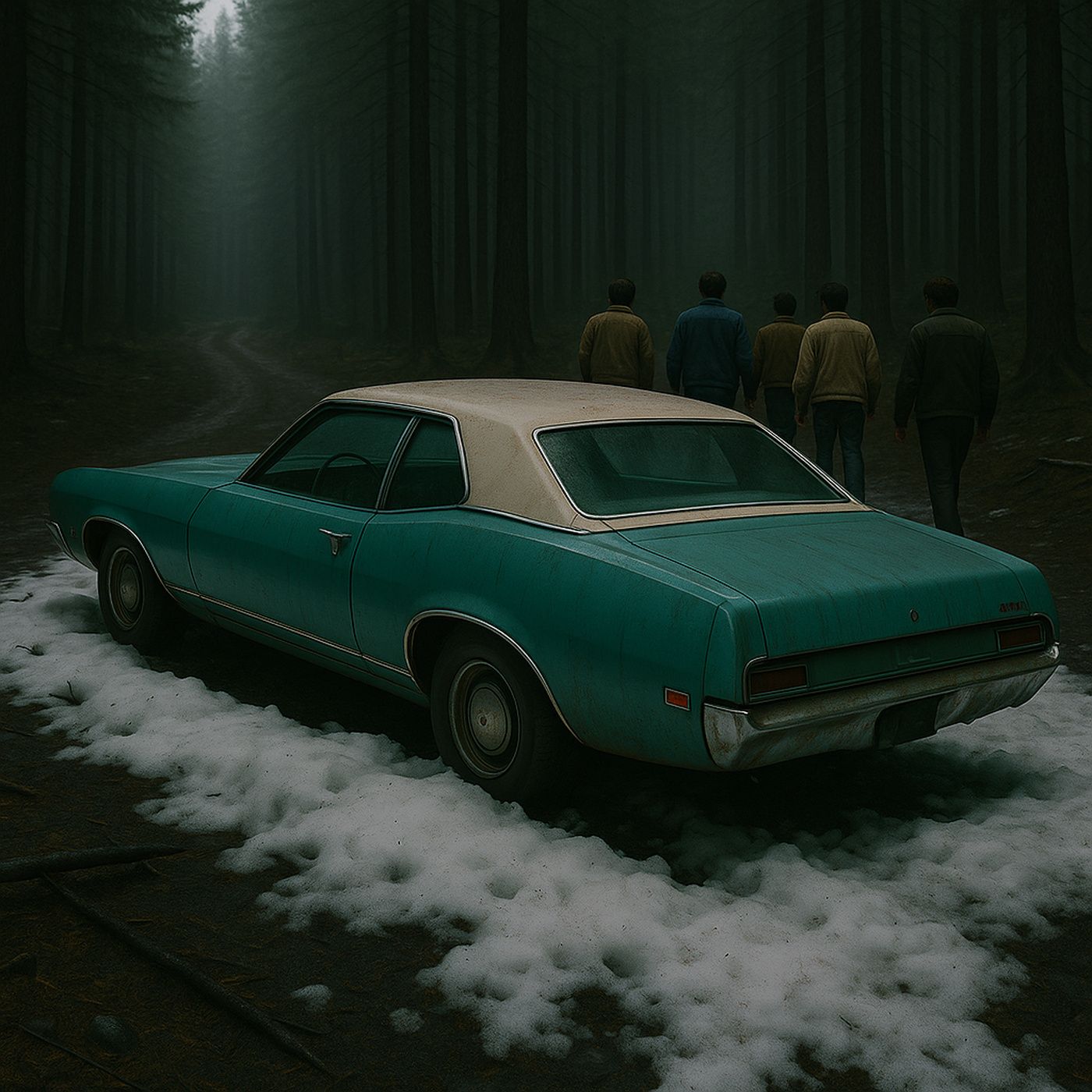
It was a nineteen sixty nine Mercury Montego Coop turquoise in white, and he treated it with the kind of reverence that car enthusiasts understand instinctively.
The Mercury Montago was a mid sized car, stylish for its era, with clean lines and a powerful engine.
Jack kept it immaculate.
He kept it maintained, He washed it regularly.
He was protective of it in a way that his family said bordered on obsession.
Jack's family said he'd never, under any circumstances, take that car anywhere risky.
He wouldn't drive it on rough roads.
He wouldn't take it anywhere that might scratch the paint or damage the undercarriage.
He loved that car like some people love their children.
This detail becomes critically important when you learn where the car was eventually found.
Jack grew up in Lo Marica, a small community in the foothills northeast of Yuba City.
His family said he knew the local area well.
He knew the roads, he knew the terrain.
He also knew what he liked and didn't like, and he didn't like cold weather.
He'd never shown any interest in going up into the mountains.
His father had once taken him on a fishing trip to the area near where his car would eventually be found, but Jack hadn't enjoyed it.
He'd refused to go on any subsequent trips.
The mountains weren't for him.
Bill Sterling was twenty nine years old and Jack Madruga's best friend.
The two were inseparable in the way that best friends sometimes are finishing each other's sentences, sharing inside jokes, understanding each other without words.
Bill had mild intellectual disabilities, but his personality shown through any limitations.
He was cheerful, He was enthusiastic.
He was trusting, perhaps too trusting.
His mother had made him quit his job as a dishwasher because his coworkers were stealing money from him.
Bill either didn't notice or didn't know how to stop it.
He simply couldn't conceive of people being deliberately cruel or dishonest.
The world, to Bill Sterling was full of friends he hadn't met yet.
Bill was athletic.
He was an avid bowler, one of the best in the group.
He was sweet and kind, and, according to everyone who knew him, incapable of harming anyone.
The idea of Bill Sterling as a threat to anybody was laughable.
The man radiated gentleness.
Jackie Hewittt, not to be confused with Jack Madruga, was the youngest of the group at twenty four years old.
Jackie had unspecified physical and mental disabilities, though the exact nature of these conditions was never detailed publicly in the records available.
What we do know paints a picture of a young man who struggled with certain aspects of daily life, but who'd found friendship and purpose with the other boys.
Jackie hated using the telephone.
He hated it with a passion that his family found both frustrating and endearing.
When the other boys called his house, his brother would answer for him.
Jackie would stand nearby, listening, but he wouldn't pick up the receiver himself.
This quirk becomes relevant later when we discussed the sighting in Brownsville.
Jackie was inseparable from Ted Wyer.
Head went Jackie usually followed.
Stay tuned for more disturbing history.
Speaker 2We'll be back after these messages.
Speaker 1They were best friends within the larger friend group, a subset of closeness within an already tight knit circle.
The two of them together formed a unit, each one looking out for the other.
And then there was Gary Dale Matthias.
Gary was twenty five years old and his story is more complicated than the others.
Unlike his four friends, Gary didn't have an intellectual disability.
Instead, he'd been diagnosed with schizophrenia, a serious mental illness that can cause hallucinations, delusions, and disordered thinking.
Gary had served in the United States Army and was stationed in West Germany in the early nineteen seventies.
During his service, he struggled with drug use LSD and other substances.
The drug use, combined with the stresses of military service, seems to have trigger or exacerbated his mental illness.
Eventually, his behavior became erratic enough that he was diagnosed with schizophrenia and given a psychiatric discharge.
He returned home to Marysville to live with his parents.
The early years after Gary's return were difficult.
He was nearly arrested for assault on two separate occasions.
He experienced psychotic episodes that repeatedly landed him in the Veteran's Administration hospital.
His family walked on eggshells, never sure when the next crisis would come.
His father also reportedly struggled with mental illness.
According to later statements from family members, mental health challenges ran in the family, but by nineteen seventy eight things had stabilized.
Gary was being treated on an outpatient basis with antipsychotic medications, specifically triflo operasine and benzatropine.
These were serious medications with serious side effects, including drowsiness, lethargy and disse ziness, but they worked.
Gary's doctors were optimistic about his progress.
In fact, they called him one of our sterling success cases.
Gary supplemented his Army disability pay by working in his stepfather's gardening business.
His stepfather, Robert Cloth, told reporters that Gary had been doing well.
He hadn't gone haywire, to use his stepfather's words.
In the two years leading up to his disappearance.
He was taking his medication consistently.
His last scheduled appointment was on February twenty first, nineteen seventy eight, and his next was set for seven days later.
According to his family, he was in full compliance with his treatment, but there were warning signs that others had noticed.
The basketball coach for the Gateway Gaiters, Robert Pennock, told investigators that even though Gary was on medication and seemed stable, he still felt like Gary could possibly flip out at any time.
There was something about Gary that made some people nervous even when he was doing well.
And there was one more detail that emerged later from the investigation.
A longtime acquaintance of Gary named Janet and Zara told investigators that Gary had repeatedly described a recurring dream to her.
In the dream, Gary and several other people would disappear, just vanish, gone without a trace.
And Zara also reportedly described Gary as a very violent person who'd seriously hurt several men in the past.
Now I should note that these are statements from a single witness recorded in investigator's notes, and they paint a different picture than what Gary's family has said.
The truth about Gary's character likely lies somewhere between these accounts.
Was Gary Matthias a ticking time bomb or was he a success story, a man who'd overcome tremendous obstacles to build a stable life.
The truth, as is often the case, probably lies somewhere in between.
Gary was complicated, Gary was struggling, and Gary was about to become the biggest mystery in a case full of mysteries.
These five men found each other at Gateway Projects.
Gary joined the basketball team, the Gateway Gators, at the suggestion of his drug counselor.
The counselor told him that the boys on the team were all slow, but good guys who needed some leadership.
Gary had played basketball in high school and agreed to help.
He already knew Ted Weyer, who lived down the street from him, so joining the group was natural.
By the time of their disappearance, the five men had become inseparable.
They played basketball together, they bowled together.
Every Saturday.
When they got together, their family said, it was almost always to play a game or watch one.
Sports was the glue that held them together.
Sports gave them a shared language, shared goals, shared joy.
Of the five, Gary was certainly, by all accounts, considered the leader.
He was the most worldly, the one with army experience, the one who'd seen something of life beyond Yuba County.
When decisions needed to be made, Gary usually made them.
Where Gary led, the others followed.
This dynamic would prove faithful.
On Saturday, February twenty fifth, nineteen seventy eight, the Gateway Gators were scheduled to compete in a special Olympics basketball tournament.
The full name was the Sacramento Valley Mother Load Special Olympics Basketball Tournament, held at Sierra College, a community college northeast of Sacramento in the town of Rockland.
This wasn't just any tournament.
The winning team would earn a week long trip to Los Angeles, with all expenses paid.
The prize package included tickets to Disneyland.
For the boys, this was everything, a chance to compete, a chance to win, a chance to take a vacation together in the City of Dreams.
The boys were supposed to meet at eight am on Saturday morning at the Montgomery Ward Department store in downtown Mary's Vieill.
From there, they'd take a bus to Rockland for the tournament.
Winning this tournament would advance them to the California Special Olympic State Games, scheduled for June twenty third through twenty fifth at UCLA in Los Angeles.
In the days leading up to the tournament, the boys could barely contain their excitement.
This was all they talked about.
This was all they thought about.
Ted Wire scuffed his sneakers during practice and became extremely upset.
He insisted his mother wash them immediately.
He wanted to look sharp for the game.
His appearance mattered, The impression they made as a team mattered.
Ted understood that, even if he didn't understand many other things.
Gary Matthias drove his parents crazy.
He talked about the competition constantly.
He reminded them over and over to make sure he didn't oversleep.
On Saturday morning.
He was nervous and excited in equal measure, the way athletes get before big game.
The prospect of winning, of going to Los Angeles, of experiencing Disneyland consumed his thoughts.
Bill Sterling laid out his basketball jersey on his bed the night before the scheduled departure.
He wanted it ready.
He wanted to be ready.
The anticipation was electric.
The Gateway Gats had been having a good season.
They were on a winning streak.
They believed they had a real chance to take the tournament.
The trip to Los Angeles was within reach.
All they had to do was show up and play their best.
But before the big day, there was one more game the boys wanted to see.
Their favorite college basketball team was the University of California Davis Aggies.
On Friday, February twenty fourth, the Aggies were playing the Chico State Wildcats at California State University in Chico.
It would be the last chance to see UC Davis play before the end of their season.
The boys were loyal fans, they'd made this trip before.
Watching their favorite team would get them pumped up for their own game the next day, The boys decided to make the trip.
Yes, they had their own important game Saturday morning.
Yes they were supposed to meet at eight am.
Yes, driving to Chico and back would make for a late night, but they believed they could do it.
Drive up, watch the game, drive home, get some sleep, wake up early, win the tournament, go to Disneyland.
It seemed so simple.
At around six pm on Friday, February twenty fourth, nineteen seventy eight, Jack Madruga picked up the other boys in his beloved Mercury Montego.
Jackie Hewitt was the last to be collected.
Around six pm, they headed north.
The drive from the Yuba City area to Chico was approximately fifty to fifty five miles, about an hour each way under normal conditions.
There were two parallel routes.
Highway seventy ran from Marysville to Chico.
California State Route ninety nine ran from.
Speaker 2Yuba City to Chico.
Speaker 1Both highways merged near Oroville, about twenty five minutes south of Chico.
The boys wore light clothing.
The Sacramento Valley in late February was cool, but not cold.
They didn't need heavy jackets.
They didn't need winter gear.
They were driving to a basketball game, not climbing a mountain.
They arrived at Chico State in time for the game, which started at seven forty five pm at art Acker Gymnasium.
Speaker 2The gym was buzzing with energy.
Speaker 1College basketball games in small towns are community events, and this was no exception.
The boys found seats away from the main crowd.
They were distinctive, five grown men, clearly different from the typical college students and attendance, sitting together in their own section.
Jim Bonnell, the editor of the Chico newspaper, later recalled seeing them.
He remembered them specifically because they were kind of out away from everybody else.
There was something distinctive about them.
Nobody reported any problems, nobody saw anything unusual.
The boys watched the game.
They cheered for their team.
UC Davis won.
The boys were happy.
After the game ended, sometime around nine thirty pm, the five friends climbed back into the Mercury Montego and drove three blocks to a convenience store called Bear's Market in downtown Chico.
The store was located at Pine and East eighth Street.
Today the building houses a different business, Downtown Liquor and Market, But in nineteen seventy eight.
It was Bear's Market, a typical small town convenience store.
The boys arrived shortly before ten pm, just as the store was about to close.
The clerk remembered them.
She was annoyed because such a large group had come in right before closing time.
She was ready to like and go home.
Instead, she had to wait while five men wandered the aisles selecting their purchases.
They bought snacks, sodas, chocolate, milk, burritos, everything they'd need for the drive home.
The clerk watched them pay, She watched them gather their purchases.
She watched them walk out the door.
She watched them get back into their car.
She watched them drive away, heading south.
That was the last time anyone can say with certainty that the Yuba County five were seen alive.
When Saturday morning arrived and the boys didn't show up at Montgomery Ward to catch the bus to the tournament, their families knew immediately that something was wrong.
These weren't the kind of men who'd missed their basketball game.
They'd been looking forward to this for weeks, the trip to Los Angeles, the chance to compete, the glory of winning.
Missing the tournament was simply not in the cards.
It was unthinkable.
Ted Wier's mother had woken up at two am on Saturday morning.
She checked her son's bedroom and saw that his bed was empty.
He hadn't come home.
She called Jackie Hewitt's mother, who answered the phone immediately.
Jackie hadn't come home either.
Soon it was confirmed that none of the boys had returned from Chico.
The families called the police.
Initially, the authorities were cautious.
Missing adults, especially adults who'd gone out the night before, weren't automatically caused for alarm.
People stay out late, sometimes, people sleep at friends houses.
People make spontaneous decisions.
The families were told to wait twenty four hours and call back, standard procedure.
But the families knew their boys.
Ted would never miss work, Gary would never miss his basketball game.
Jack would never abandon his car or his plans.
These were men of routine, men of habit.
Something was very, very wrong, and family spent Saturday, February twenty fifth searching the Chico and Yuba area.
They drove the highways between the two cities looking for any sign of the Mercury Montego.
They found nothing.
By Sunday, an official missing persons report was filed Melbourne, Madruga.
Jack's mother filed the paperwork with the Yuba County Sheriff's Department.
Police in Butte and Yuba Counties began searching along the route the men would have taken between Chico and home.
They found nothing, no sign of the Mercury Montego, no sign of the boys, no indication of what might have happened.
Then, on Monday, February twenty seventh, a Plumus National Forest ranger contacted investigators with information he'd seen a car matching the description of the Mercury Montego parked along the Oraville Quincy Road on Saturday morning, February twenty fifth.
At the time, he hadn't thought it significant.
Many residents drove up that road into the Sierra Nevada Mountains on winter weekends to go cross country skiing.
There was an extensive trail system up there.
It wasn't unusual to see cars parked along the forest roads.
But after reading the missing person's bullet and seeing the description of the turquoise and white Mercury Montago, the ranger recognized the car.
He contacted authorities.
He led deputies to the location on February twenty eighth, and here's where the story takes its first deeply strange turn.
The Mercury Montago was found on a remote mountain road in Plumus National Forest.
The exact location was near Rogers Cow Camp, along a road that hikers and Forest Service personnel would access.
It wasn't a main highway, it wasn't a paved road.
It was a dirt track leading into the wilderness.
The car was stuck in a snow drift, but only lightly.
Investigators estimated there was five to six inches of snow around the tires.
The car was tilted slightly, but was otherwise inte The doors were unlocked, one window was partially down.
Stay tuned for more disturbing history.
We'll be back after these messages.
The keys were gone.
Inside the car, they found evidence that the boys had been there.
The empty wrappers and containers from the snacks they bought at Bear's Market were scattered throughout the vehicle.
Basketball programs from the game they'd attended were present.
A neatly folded road map of California sat in the glove compartment.
The car still had a quarter tank of gas when investigators hot wired the engine.
The car started right up.
It ran perfectly.
There was nothing mechanically wrong with the vehicle.
The Mercury Montego was in good working condition.
It had gas, it worked, and it could have been easily pushed out of the snow by five able bodied men.
Investigators examined the undercarriage.
There were no dents, no scratch.
Despite the rough terrain of the mountain road, the bottom of the car was pristine.
Whoever had driven the car up that mountain had done so slowly and carefully, avoiding rocks and ruts that might damage the vehicle.
Jack Madruga, protective of his beloved car, would have driven exactly that way.
Speaker 2But why would he have driven up there at all?
Speaker 1The location of the car was baffling.
The spot where the Mercury was found was approximately seventy miles from Chico, but more importantly, it was in completely the wrong direction from home.
To get from Chico to Yuba City, you simply drive South Highway seventy or Route ninety nine, straight shot through the central Valley, its low lying land with no snow that time of year, a forty six mile drive about one hour, simple easy routine.
Instead, the boys had somehow driven east up into the mountains along a winding dirt road, past the snow line, deep into the wilderness of Plumus National Forest.
The car was found several thousand feet above the valley floor, in terrain that was cold, remote, and utterly inappropriate for five men in light jackets heading home from a basketball game.
Speaker 2Why would they go there?
Speaker 1None of the families could answer that question.
Jack Madruga's mother was adamant that her son would never take his precious car up a rough mountain road.
His father confirmed that Jack hated cold weather and had no interest in the mountains.
Ted Wire and Jackie Hewitt had never been to this part of the forest.
Bill Sterling had no reason to go there.
Gary Matthias did have friends in a nearby town called Forbestown.
Some investigators speculated that perhaps Gary wanted to make a spontaneous visit, but when police checked with those friends, they said they hadn't seen or heard from Gary in over a year, and even if Gary had wanted to visit Forbestown, the route to the location where the car was found wasn't on the way.
It made no sense geographically.
Jack Madruga's mother spoke for many when she later told reporters there is some force that made them go up there.
They wouldn't have fled off into the woods like a bunch of quail.
We know good and well that somebody made them do it.
Police began searching the surrounding area immediately, but their efforts were cut short.
A brutal winter storm moved into the region, dropping heavy snow and making further search impossible.
The terrain was treacherous.
Search teams nearly lost their own members to the conditions.
After five days of increasingly dangerous operations, the official search was called off until conditions improved.
The boys had vanished.
While the search was suspended, police received numerous tips and reported sightings of the missing men.
Most were easily dismissed.
People wanted to help, people thought they'd seen something of The reports led nowhere, but two sightings stood out, two reports that even now, nearly fifty years later, continued to puzzle investigators and researchers.
The first came from a man named Joseph Shans.
Shawn's was a fifty five year old resident of Sacramento.
He owned a cabin in the Plumus National Forest area near where the mercury would eventually be found.
He told police an incredible story.
On the evening of Friday, February twenty fourth, the same night the boys disappeared, Shawn's had driven up to the mountain area to check on the snow pack.
He was planning a ski trip with his wife and daughter for the following weekend and wanted to see what conditions were like.
Around five thirty pm, about one hundred and fifty feet up the road from where the mercury would later be found, Shawn's got his Volkswagen Beetles stuck in the snow.
This was before the boys would have arrived in the area.
Shawns got out of his car and tried to push it free.
As he pushed, he began exppariencing chest pains, severe chest pains.
He was having a heart attack.
Shan's abandoned his efforts to free the car.
He climbed back inside, keeping the engine running to stay warm, and waited for help.
He was in tremendous pain.
He was alone on a dark mountain road.
He had no way to call for assistance.
All he could do was wait and hope.
At around eleven thirty pm, roughly six hours after his car got stuck, Sean saw headlights approaching behind him.
Through the pain and delirium of his heart attack, he watched a car park about twenty feet behind his position.
What Shawn's reported next has never been satisfactorily explained.
He said he saw a group of people around the car.
In some versions of his statement, he mentioned what he thought was a woman holding a baby.
He saw flashlight beams moving around.
He heard whistling sounds.
Desperate for help, he called out.
The flashlights went out immediately, the people went silent.
Shawns called out again.
Speaker 2Nothing.
Speaker 1Later in the night, he saw more flashlight beams outside his car.
He called out, once more, desperate for assistance.
Again, the lights went out immediately.
Whoever was out there didn't want to be found.
At some point during the night, Shawns recalled seeing a pickup truck briefly stop near his position before continuing down the road, but he later admitted he couldn't be certain of this detail.
He was nearly delirious from pain.
His memories were fragmentary and confused.
By early morning, Shawn's car had run out of fuel.
The engine died, the heat died, but his chest pain had subsided enough for him to move.
He got out of his car and began walking.
He made his way eight miles down the mountain road to a lodge, where the manager drove him home.
On the way down, they passed the abandoned Mercury Montago.
Shawns didn't think much of it at the time, had bigger concerns.
Doctors later confirmed that Shawn's had indeed suffered a mild heart attack that night.
The question that haunts this case is simple, did Joseph Shans encounter the Yuba County Five.
If he did, why didn't they help him?
Ted Wier's mother was emphatic when she heard about Shan's account.
Ignoring someone's pleas for help was completely out of character for her son.
She recalled how Ted and Bill had once helped an acquaintance get to the hospital after overdosing on valium.
These weren't the kind of men who'd leave someone suffering in the cold.
They would have tried to help.
They would have done something.
But there are problems with Shan's account that we need to acknowledge.
His story changed in different tellings.
Some details were inconsistent.
The woman with a baby, for instance, seems impossible to explain.
Where would a woman with a baby have come from?
None of the boys had partners, none of them had children.
If Jean saw the boys, where did this.
Speaker 2Woman come from?
Speaker 1And if he didn't see a woman with a baby, what else did he imagine or misremember?
There are also questions about Sean's credibility that have been raised over the years.
Some neighbors said Shawn's had a history of drinking.
Some said he was known to tell stories for attention, to embellish details for dramatic effect.
His old neighbor reportedly said Sean's had made quite a few enemies over the years.
Was his account reliable or was he confused hallucinating from pain, filling in gaps with his imagination.
We simply don't know for certain.
Some researchers have speculated that Shawns might have encountered the boys and inadvertently frightened them.
Picture it from the boy's perspective.
They're lost, confused, stuck in the snow on a dark mountain road.
They see another car, they approach, and suddenly a man starts yelling at them from inside the vehicle.
If the boys were already scared, already disoriented, a strange man shouting at them in the darkness might have been enough to send them fleeing into the woods.
This is speculation, but it's worth considering.
Other researchers have gone further, suggesting that Shawn's himself might have been involved in whatever happened to the boys.
I want to be clear that there's no evidence to support this theory, but the coincidence of Shaan's being at that exact location on that exact night, combined with the inconsistencies in his account, has led some to wonder.
The second notable sighting came from a woman who worked at a store in Brownsville, a small town about thirty miles from where the car was found.
The woman and the store owner both reported that two men matching the descriptions of Ted Wire and Jackie Hewitt came into their store on Saturday, February twenty fifth, the day after the boys disappeared.
The time was around midday.
The men bought burritos, chocolate, milk, and soft drinks.
They made a phone call from a nearby phone booth.
Outside, the store owner said they saw a red pickup truck with three other men inside.
The descriptions were compelling.
Ted wire was hard to miss, six feet four inches tall, distinctive.
The store owner noted behaviors that seemed to match what the families had described.
Ted would eat anything he could get his hands on.
Jackie hated using phones if someone else had to make a call while Jackie waited.
That would fit his known behavior exactly.
Ted's brother later confirmed that the description of Ted eating anything he could find was accurate.
Jackie's brother confirmed that Jackie hating telephones was accurate.
These weren't details that a random stranger would know.
These were behavioral quirks specific to these two men.
But if this sighting was accurate, it raises enormous questions.
Where did the red pickup truck come from?
The boys didn't own a red pickup truck?
Where they with someone else?
Were they being held against their will?
Had they gotten a ride somehow?
Were they trying to get home?
Why would they be in Brownsville thirty miles from where the car was found in a completely different vehicle.
No one was ever able to confirm or explain this sighting.
Like so much in this case, it remains a tantalizing but frustrating piece of an incomplete puzzle, a clue that leads nowhere, a trail that goes cold.
There's one more detail about the mountain area that may be relevant.
On Thursday, February twenty third, the day before the boys disappeared, a United States Forest Service SnowCat traveled up the mountain road to service a trailer at the Daniel Zinc Campground.
The SnowCat was a large tracked vehicle designed for travel over snow.
It left behind a packed path in the snow, a visible track that someone could follow.
The trailer that the SnowCat serviced was approximately nineteen miles from where the Mercury Montego would be found, nineteen miles through deep snow in freezing temperatures at high elevation.
Some investigators have theorized that the boys saw the snow cat tracks and decided to follow them.
Perhaps they thought the tracks would lead to shelter.
Perhaps they thought help was nearby.
Perhaps confused and disoriented, they simply followed the only clear path they could see.
If this theory is correct, then the boys made a fatal miscalculation.
They thought they were walking towards safety.
Instead, they were walking nineteen miles deeper into the wilderness.
Every step took them further from the road, Every step took them further from any chance of rescue.
But why would they follow the tracks at all?
Why not walk down the mountain toward the valley, toward civilization.
Why not try to push the car out of the snow.
Why not stay with the vehicle and wait for help?
These questions have no good as answers.
For months, the mountains kept their secrets.
Heavy snow made further searching impossible.
The families waited, hoped, prayed.
They searched when they could.
They pressured authorities when they couldn't.
They refused to give up.
Spring came slowly to the Sierra Nevada in nineteen seventy eight.
The snowpack was heavy that year, the melt was gradual.
By early June, the snow had finally receded enough to allow access to the remote areas of the Plumus National Forest.
The families organized search parties.
Private citizens joined the effort.
Everyone wanted to know what had happened to the boys.
On June fourth, nineteen seventy eight, more than three months after the boys disappeared, a group of motorcyclists were riding through the forest trails when they came upon a United States Forest Service trailer near the Daniel Zinc Campground.
The trailer was a small structure used by forest crews during fire season.
It wasn't a residence, It wasn't staffed during the winter.
It was simply a utilitarian building, locked and empty, waiting for the summer fire season to begin.
The motorcyclist noticed something wrong.
A window on the trailer was broken.
Glass was scattered on the ground.
Someone had been here, someone had broken in.
Curious, the motorcyclists opened the door.
The smell hit them immediately, the unmistakable, unforgettable stench of decomposition, the thick, sweet, horrible odor of death.
Inside the trailer, they found a body.
Law enforcement arrived at the scene on June fifth, nineteen seventy eight.
What they found inside that trailer would haunt them for the rest of their careers.
The body belonged to ted Wire.
He was lying on a bed in the trailer.
He was wrapped in eight sheets, including his head.
His pants were rolled up to his knees.
His hands were folded on his chest in repose as if someone had arranged him after death.
Stay tuned for more disturbing history.
We'll be back after these messages.
His leather shoes were missing.
Ted had lost nearly half his body weight when he disappeared in February, he'd weighed approximately two hundred pounds.
At the time of his death, he weighed closer to one hundred.
He'd been a big man.
Now he was skeletal.
His beard had grown significantly.
Based on the length of the beard and his physical deterioration, investigators estimated he'd survived for somewhere between eight and thirteen weeks after the group's disappearance.
That means Ted Wire was alive in that trailer for two to three months.
He likely died sometime in April or May of nineteen seventy eight.
He'd survived the initial crisis, he'd found shelter, and then he'd slowly, agonizingly wasted away.
Ted's feet were badly frostbitten.
Three toes from his right foot and two toes from his left foot were missing.
There was evidence of gangreen.
The tissue had died, the rot had begun.
His frostbitten feet had been bandaged using materials found in the trailer.
Someone had tried to treat his injuries.
Someone had cared for him.
On a table beside the bed sat Ted's personal effects, his wallet still containing cash, a nickel ring with Ted engraved on it, a gold necklace he always wore, and one item that didn't belong to him, a gold Waltham watch with the crystal missing.
The families confirmed that this watch belonged to none of the five men.
No one could explain where it came from.
No one could explain who'd.
Speaker 2Left it there.
Speaker 1The mystery of that watch has never been solved.
The autopsy determined that ted Wire died from a combination of starvation and hypothermia.
He'd wasted away from lack of food, he'd frozen from lack of heat.
Both causes of death were entirely preventable.
And here's where this case becomes truly deeply disturbing.
The trailer contained supplies.
Just outside.
In an adjacent shed, investigators found thirty one cans of military rations, sea rations, ham crackers, other preserved foods.
These cans had been opened and their contents consumed.
Twelve of them were empty.
Someone had eaten, someone had found the food and used it.
The cans had been opened with a military P thirty eight can opener.
This was a small specialized tool that came with military rations.
It wasn't intuitive.
You had to know how to use it.
The only members of the group with military experience were Jack Madruga and Gary Matthias.
One of them presumably had opened those cans.
But there was another locker in that shed, a locker that contained an even greater quantity of dehydrated foods.
Investigators estimated there was enough food in that locker to keep all five men alive for up to a year, a full year, enough food to wait out the winter and the spring and still have reserves.
That locker was never opened.
Inside the trailer, there were matches.
There were paperback novels that could have been used as kindling.
There was wooden furniture that could have been broken up and burned.
Heavy forestry clothing hung in storage, warm clothing, protective clothing, the kind of clothing designed to keep forest service workers comfortable in mountain conditions.
The trailer had a heating system.
A propane tank sat in a nearby shed.
All someone had to do was turn a valve and they would have had heat, reliable heat enough to survive the winter.
None of these resources were used.
There had been no fire built in the trailer.
The propane was untouched, the valve had never been turned.
The warm clothing remained hanging in storage.
Ted Wire had slowly starved and frozen to death in a building that contained everything he needed to survive.
Speaker 2Why.
Speaker 1Ted's family offered an explanation that's both heartbreaking and plausible.
They said Ted lacked common sense.
Remember the story about the house fire.
Ted had to be dragged from his burning bed because he was worried about oversleeping for work.
He couldn't process urgent situations the way most people do.
His brain didn't work that way.
Perhaps Ted didn't understand how to turn on the propane.
Perhaps he was afraid to try.
Perhaps he didn't realize that the dehydrated food in the other locker was edible.
Perhaps he thought he was stealing and didn't want to get in trouble.
Perhaps he kept expecting someone to come rescue him.
Perhaps he couldn't conceive of the idea that no one was coming.
Some investigators have speculated that whoever was with Ted and the trailer, whether Gary Matthias or someone else, may have deliberately avoided using the supplies because they were afraid of being found.
If they were hiding from someone.
If they believed someone was hunting them, then lighting a fire or making noise might have seemed dangerous.
Better to freeze in silence than burn bright and be discovered.
This is speculation, of course, but it might explain the otherwise inexplicable decision not to use the available resources.
But this theory raises its own questions.
Who would they be hiding from, Why would they be so afraid?
What could have terrified them so badly that they chose slow death over the risk of discovery.
The discovery of ted Wier's body launched an intensive search of the surrounding area.
The next day, June sixth, nineteen seventy eight, searchers found skeletal remains along a road in the Granite Basin area.
The location was approximately five miles from where the Mercury Montego had been found and several miles from the trailer.
The remains were identified as Jack Madruga and Bill Sterling.
Both men had died of hypothermia exposure cold.
They'd frozen to death on that mountain road.
Their bodies had been partially consumed by scavenging animals over the intervening months.
Only bones remained.
The scattered bones made reconstruction difficult, but investigators were able to make identifications.
Jack and Bill were found on opposite sides of a canyon road, close to each other.
Near each other, investigators theorized that perhaps one of them had succumbed to the desire to sleep that marks the final stages of hypothermia.
In severe hypothermia, victims often feel paradoxically warm.
They want to lie down, they want to rest, they want to sleep, and when they sleep, they die.
Perhaps Jack collapsed first.
Perhaps Bill refused to leave his friend's side.
Perhaps Bill laid down next to his best friend and waited for the end.
We'll never know for certain, but the image of those two men, best friends in life, dying together on that cold mountain road is one of the most heartbreaking elements of this case.
When investigators examined Jack Madruga's remains, they found his car keys in his pocket.
The following day, June seventh, searchers found the remains of Jackie Hewitt.
The discovery was made by Jackie's own father, Jack Hewitt Senior, who joined the search parties.
I need you to understand what that means.
A father searching for his missing son, Hoping against hope to find him alive, walked through the wilderness and came upon a pile of clothing, his son's clothing.
He picked up the clothes, and his son's spine fell out onto the ground.
Jackie's skull was found about one hundred yards away downhill from the clothing.
His body, like the others, had been scattered by animals.
The mountain had taken him apart.
Jackie was found approximately two miles from the trailer where Ted had died.
This proximity has led some researchers to theorize that Jackie may have been the one who wrapped Ted in those sheets.
Ted and Jackie were inseparable, best friends, brothers in everything but blood.
Perhaps Jackie stayed with Ted as long as he could.
Perhaps Jackie was the one who bandaged Ted's frostbitten feet.
Perhaps Jackie was the one who arranged Ted's hands on his chest.
Perhaps Jackie only left when he had no other choice, when staying meant dying too.
Ted's brother said it plainly, Jackie would have never left Ted alone.
If Jackie was found two miles from that trailer, it was because he was trying to get help.
Or because he was trying to survive, or because he'd given up.
But he wouldn't have abandoned his friend Willingly.
Four bodies had been found, Ted Wier, Jack Madruga, Bill Sterling, Jackie Hewitt.
But where was Gary Matthias?
Search parties combed the area looking for Gary Matthias.
They found evidence that he'd been in the trailer.
His tennis shoes were found inside, near where Ted Wire had died.
They found notes on a memopad that investigators believed were written in his handwriting.
But Gary himself was gone.
His body wasn't in the trailer, His body wasn't on the mountain roads.
His body wasn't in the surrounding wilderness.
Gary Matthias had vanished.
The Presence of gary shoes in the trailer tells us he was there.
At some point he reached the trailer, he spent time there, but the absence of Ted's leather shoes suggests that someone took them.
Investigators believe Gary may have swapped footwear.
If Gary's feet were frostbitten like Ted's, then Ted's roomier leather shoes might have fit his swollen feet better than his own tennis shoes.
Speaker 2The question is.
Speaker 1Where did Gary go?
Did he leave the trailer to seek help.
Did he try to walk out and die some where in the wilderness, his body never found.
Did he somehow make it to civilization and disappear into a new identity.
Did someone take him?
His photograph was distributed to mental institutions throughout California.
Without his medication, Gary would eventually experience a psychotic episode.
Schizophrenia isn't a condition that stays dormant forever.
Eventually something would happen.
Gary would become disoriented.
Gary would behave erradically.
Gary would come to the attention of authorities, but no report ever came.
No one ever identified Gary Matthias in a hospital, No one ever found him living under a new name.
No one ever found his body.
In October twenty twenty forty, two years after his disappearance, a Yuba County Sheriff's Department letter officially declared Gary Matthias to be a victim of foul play.
The letter was made public in October twenty twenty three following a record's request.
It stated that the case remains open as a missing person and homicide investigation.
Gary Matthias has now been missing for nearly fifty years.
If he's alive today, he'd be in his early seventies.
But most investigators don't believe he's alive.
Most believe he died somewhere in the Plumus National Forest.
The wilderness is vast, the terrain is rugged.
Bodies can disappear, Scavengers do their work.
The mountain can swallow a man and never give him back.
Gary's father participated in the searches.
He later told reporters what he was looking for.
What I looked for all the time I was up.
There were his glasses.
Gary wore glasses.
His father hoped to find them, to find some trace of his son.
Speaker 2He never did.
Speaker 1From the beginning, investigators struggled to construct a coherent narrative of what happened to the Yuba County five.
Former Yuba County Sheriff Jack Beecham described the case in the bluntest terms possible.
Bizarre as hell.
Those were his exact words, bizarre as hell.
Let's consider the theories that have been proposed over the decades.
The first theory is the simplest.
The boys took a wrong turn.
They got lost.
They made a series of bad decisions that led them deeper into the wilderness instead of back to safety.
By the time they realized their mistake, it was too late.
This theory has the virtue of requiring no villains, no conspiracies, no malevolent actors, just confusion and bad luck.
Did Jack Madruga miss an exit?
Maybe the boys thought they knew a shortcut, or did Gary want to take a detour to visit his friends in Forbestown and they got turned around trying to find it.
But this theory has significant problems.
Jack Madruga knew the area, he'd grown up nearby, he would have recognized that they were heading in the wrong direction.
The boys had made the tree to Chico before they knew the route.
A simple wrong turn doesn't explain driving seventy miles in the opposite direction up a winding mountain road, past the snow line, into terrain that none of them had any reason to visit.
The second theory involves foul play.
Perhaps the boys encountered someone dangerous in Chico after the game.
Maybe they picked up a hitchhiker who turned out to be a threat.
Perhaps someone followed them from the basketball arena, or did they witness something they shouldn't have witnessed.
Jack Madruga's mother believed this.
There is some force that made them go up there.
She said, they wouldn't have fled off into the woods like a bunch of quail.
We know good and well that somebody made them do it.
Jackie Hewitt's brother, Tom has spoken publicly about his belief that a specific individual was responsible.
Tom believes that a bully from their hometown, a dangerous man who reportedly held a grudge against Gary Matthias, may have attacked the group.
Tom theorizes that this person and others may have assaulted Gary, possibly killing him early in the encounter, and then forced the remaining boys to drive into the mountains.
Tom believes the boys were so frightened by what they'd witnessed that they continued walking into the wilderness rather than risk returning to the road.
I want to be clear that this is Tom's theory, based on local rumors and his own suspicions.
There's no concrete evidence to support it, but Tom is a member of one of the victim's families, and his perspective deserves consideration.
This theory would explain why the boys drove so far into the mountains.
They weren't lost.
They were fleeing.
They were trying to escape from someone who meant them harm.
It would also explain why they might have avoided using the supplies in the trailer if they were hiding, if they believed their attackers were still searching for them, then attracting attention of any kind would have been dangerous.
But there's no concrete evidence to support this theory.
Stay tuned for more disturbing history.
We'll be back after these messages.
No suspects have ever been identified, no witnesses have come forward, no physical evidence of assault was found on the bodies.
It remained speculation, tantalizing, but unproven.
The third theory focuses on Gary Matthias.
Even though Gary was stable and taking his medication, some investigators have wondered whether his mental illness played a role in the tragedy.
The basketball coach Robert Pennock said he always felt like Gary could possibly flip out at any time.
The acquaintance Janet and Zara, told police that Gary had described dreams of disappearing with other people.
She also called him a very violent person.
These statements come from investigative records, and they paint a troubling picture.
Perhaps Gary stopped taking his medication in the days before the tournament.
The antipsychotic drugs he was prescribed significant side effects, including drowsiness and lethargy.
Maybe Gary wanted to be sharp for the basketball game.
Perhaps he decided to skip a few doses.
It's possible that decision triggered a psychotic episode.
If Gary experienced a break with reality that night, he might have led his friends into the mountains for reasons that made sense only in his disordered mind.
The other boys trusted Gary.
Gary was the leader.
Where Gary went, they followed.
If Gary said to drive up the mountain, they would have driven up the mountain.
If Gary said to leave the car and walk, they would have walked.
But Gary's family disputes this theory.
His stepfather said Gary had been taking his medication consistently.
His doctors called him a success story.
The people at the basketball game and the convenience store didn't notice anything unusual about Gary's behavior.
A schizophrenic episode severe enough to cause this kind of catastrophe would typically be obvious to observers.
Researcher Tony Wright, who spent four years investigating this case for his book Things aren't right, pushes back against blaming Gary.
He points out that nobody noticed Gary behaving strangely at any point that evening.
If Gary had been having an episode, it would have been apparent.
There was nothing to link him to any ill will with the group.
The fourth theory is perhaps the strangest.
Some researchers have noted that the Brownsville siding, if accurate, suggests the boys weren't alone after they left Chico, the red pickup truck, the men inside, the unexplained woman that Shawn's reported seeing.
What if someone else was involved?
What if the boys were taken?
What if they were held, transported in another vehicle, and released or escaped somewhere in the mountains.
This would explain the pickup truck.
This would explain why they ended up so far from where they should have been.
This would explain the woman and the baby, if indeed Sean saw what he thought he saw.
But this theory has no supporting evidence.
Beyond those two disputed sightings, there were no reports of kidnapping, no ransom demands, no indication that anyone had taken the boys against their will, and the physical evidence at the car, the snack wrappers, the basketball programs.
The neatly folded map doesn't suggest a struggle.
The truth is we don't know what happened.
We have theories, we have speculation, we have questions.
What we don't have is answers.
There's one more piece to this puzzle that deserves consideration.
The arson attacks on gateway projects in nineteen seventy five, the murder of the man named Garrett, the mysterious figure known as Weirdo the Fireball Freak.
These events happened just three years before the boys disappeared.
The perpetrator was never identified.
The attack simply stopped.
Is there a connection.
There's no evidence of one, But it's worth noting that the community the boys belonged to had already been targeted by an unknown predator.
Someone had wanted to harm gateway projects and the people associated with it.
Someone had committed murder and arson and gotten away with it.
Could that same someone have returned three years later?
This is pure speculation.
There's nothing in the case files linking the arson attacks to the disappearance of the Yuba County five, But in a case this strange, every possible connection deserves at least a moment of consideration.
Some Researchers have also noted the timing of the tragedy.
February nineteen seventy eight was the peak of the serial killer era in California.
The Golden State Killer was active, The Zodiac Killer had terrorized the state just a few years earlier.
The idea of encountering a random predator on a dark road wasn't abstract or paranoid.
It was a realistic fear.
Could the boys have encountered someone dangerous that night, someone who's never been identified, someone who got away with murder?
Again, this is speculation.
There's no evidence linking the Yuba County five to any known serial offender, but the possibility can't be entirely dismissed.
Before we discussed the legacy of this case, it's worth examining how the investigation was conducted and where it fell short.
Four jurisdictions were involved in the search for the Yuba County five, Yuba County, Butte County, Plumus County, and the United States Forest Service.
Multiple agencies, multiple chains of command, multiple priorities.
Coordination was challenging, communication was imperfect.
The initial search was hampered by weather.
The storm that hit the mountains in late February and early March made continued operations impossible.
Search teams were putting their own own lives at risk.
The decision to suspend the search was reasonable, even necessary, but it meant that crucial evidence was buried under snow for months.
By the time the snow melted, decomposition and animal activity had destroyed much of what might have been found.
Psychics were brought in to help.
This wasn't uncommon in the nineteen seventies and eighties.
Desperate families would try anything.
The psychics provided various theories and claimed visions.
None of their information led anywhere useful.
The case didn't benefit from paranormal intervention.
Investigators followed up on countless tips.
People called in from across California and beyond.
Sightings were reported in distant cities and states.
Most were quickly ruled out.
The boys weren't in San Francisco, they weren't in Oregon.
They weren't living new lives somewhere far away.
They were dead in the mountains.
The investigation officially went cold.
Without new evidence, without witnesses, without confessions, there was nothing.
Speaker 2More to pursue.
Speaker 1The case wasn't closed.
Cold case files are never truly closed, but active investigation ceased.
The boys became statistics, unsolved, unexplained, forgotten by all but their families and the true crime community.
In recent years, advances in technology have given investigators new tools DNA analysis, digital records, enhanced imaging.
Researchers have hoped that these tools might provide fresh leads.
So far, they haven't.
The case remains as mysterious today as it was in nineteen seventy eight.
The Netflix documentary files of the Unexplained and various podcasts have brought renewed attention to the tragedy.
Tips have come in, none have proven useful.
The boys keep their secrets, the mountain keeps its secret, and Gary Matthias, wherever he is, keeps his The Yuba County five case has never been solved.
Nearly fifty years have passed.
The boys who went to a basketball game and never came home have become men frozen in time, forever young in the memories of their families, forever lost in the mountains of northern California.
In October twenty twenty, the Yuba County Sheriff's Department officially classified the case as a missing person and homicide investigation.
The wording was significant homicide foul play.
The authorities believe someone is responsible, but no suspects have ever been named, no arrests have ever been made.
The case file remains open.
The families have lived with this mystery for almost half a century.
Some have passed away never learning what happened to their sons and brothers.
Others continue to seek answers.
Ted Wier's brothers, Dallas and Perry, have spoken publicly about their belief that foul play was involved.
This wasn't a bunch of disabled people who got lost because they were too stupid to.
Speaker 2Know what they were doing.
Speaker 1Dallas has said these guys had very specific wants, desires, talents and abilities, and what one lacked the other had there was a combined acumen there.
Dallas is right.
These weren't helpless men.
They weren't incapable of making decisions.
They'd navigated the world successfully for years.
They had jobs, they had routines, they had each other.
Something intervened, something beyond confusion or bad luck.
Researcher Tony Wright spent four years investigating this case.
He interviewed family members, He reviewed documents, He walked the ground where the boys walked.
His conclusion is sobering.
We lack concrete evidence, he says, mostly it's circumstantial stuff.
Town talk rumors.
This case is a journey into madness.
The story has attracted renewed attention in recent years.
A Netflix documentary series called Files of the Unexplained devoted an episode to the case.
Multiple podcasts have covered it in detail.
The comparison to diatlov Pass has introduced the tragedy to a global audience, but answers remain elusive.
The mountain keeps its secrets, the dead can't speak, and the fifth man, Gary Matthias, has never been found.
I've spent hours.
Speaker 2With this case.
Speaker 1I've read the reports, I've studied the maps, I've looked at the photographs.
I've tried to imagine what those five men experienced during their final days and weeks.
Here's what we know for certain.
On February twenty fourth, nineteen seventy eight, five friends drove to a basketball game.
They were happy, they were excited, they had a tournament to play the next day, and dreams of a trip to Los Angeles, dreams of Disneyland, dreams of victory.
Ted Wire had washed his sneakers so he'd looked sharp.
Gary Matthias had badgered his parents to make sure he woke up on time.
Bill Sterling had laid out his jersey.
They were ready, They were eager.
They were innocent.
Something happened after they left that convenience store in Chico, something that sent them driving into the mountains instead of home, something that made them abandon a working car and walk into the frozen wilderness.
Something that killed four of them and erased the fifth from the face of the earth.
We don't know what that something was.
Maybe they took a wrong turn and panicked.
Maybe they encountered someone who meant them harm.
Maybe Gary Matthias experienced a break with reality and led his friends to their deaths.
Maybe a combination of factors, a perfect storm of bad decisions and worse luck, conspired to trap them in circumstances from which there was no sa gape.
What we do know is that these were good men.
They were gentle men.
They were men who loved basketball and bowling and their families and each other.
They deserved better.
They deserved to play in their tournament.
They deserved to go to Disneyland, they deserved to come home.
Instead, they died cold and hungry and alone in the mountains.
Ted Wire survived for months in a cabin filled with supplies he couldn't or wouldn't use.
The others died on frozen mountain roads, their bodies left for the animals.
Gary Matthias vanished into the wilderness and has never been seen again.
Nearly fifty years later, the Gateway Gaiters are still missing from the roster of history.
We know their names, we know their faces, we know the terrible outline of their fate, but we don't know why.
We don't know who.
We don't know what force, human or otherwise led them into those mountains, and that, more than anything, is what makes this story so disturbing.
The mystery, the absence of answers, the questions that echo across the decades without response.
The Yuba County five went to a basketball game, and they never came home.
If you have any information about this case, contact the Yuba County Sheriff's Office.
Gary Matthias is still listed on their missing Person's page.
His family is still waiting.
Some mysteries never get solved, some questions never get answered, Some families never get closure.
That's the cruelest truth of all, there's something about this case that lingers, something that makes it different from other cold cases.
It's the ordinariness of how it began.
Five friends going to a basketball game, a routine trip, a normal Friday night, the kind of thing millions of people do without incident, and then somehow it became something else, something dark, something deadly, something that still defies explanation.
The families of the Yuba County five have carried this burden for nearly five decades.
They've aged, some have died, children have grown into adults who never knew their uncles.
Grandchildren have been born into a family marked by tragedy.
The ripples of that February night spread outward through time, touching lives that weren't even imagined in nineteen seventy eight.
For the families, there's no closure.
There can't be closure without answers, and answers have proven impossible to find.
Every anniversary brings fresh pain.
Every podcast, every documentary, every article reopens wounds that never fully heal.
They appreciate the attention.
They want people to remember, but remembering also means reliving, and reliving means suffering.
I think about ted Wire often when I consider this case, Ted wrapped in those eight sheets, slowly dying of starvation while food sat yards away.
What was going through his mind in those final weeks?
Did he understand what was happening to him?
Did he think someone was coming to save him?
Did he give up hope?
Did he ever even have hope to give up?
Ted's story within this larger tragedy is perhaps the most disturbing element of all.
The others died quickly relatively speaking.
Hypothermia is a harsh master, but it takes you fast.
You get cold, you get confused, you get sleepy, and then you're gone.
Ted didn't have that mercy.
Ted lingered, Ted suffered, Ted wasted away while the resources to save himself sat untouched around him.
Was someone else in that trailer with him?
The sheets suggest yes, someone wrapped Ted up, Someone cared for his frostbit and feet.
Someone tried Gary Matthias, probably Gary shoes were there, But then Gary left or Gary died somewhere in the wilderness, and Ted was alone, alone, and incapable of saving himself.
This case teaches us uncomfortable truths about vulnerability, about the way society can fail people who need protection, about the thin line between safety and catastrophe.
These were men who depended on routines, on familiar surroundings, on the guidance of people who understood them.
Strip all of that away put them in an unfamiliar environment.
Add fear and cold and confusion, and they couldn't adapt.
They couldn't improvise, They couldn't save themselves.
Some people have suggested that the boy's disabilities made them easy targets, that a predator recognized their vulnerability and exploited it.
If true, this makes the trage even more horrific.
These were men who trusted the world because they didn't know how to distrust it.
Bill Sterling, remember, couldn't recognize when his co workers were stealing from him.
He assumed good intentions.
All of them assumed good intentions, and perhaps that assumption killed them.
Or perhaps not.
Perhaps there was no predator.
Perhaps there was only the mountain, the cold, the dark, and a series of decisions that made sense at the time but led inexorably toward death.
Perhaps the real villain of this story is chaos itself, the random cruelty of circumstance, the universe's indifference to human plans and human hopes.
We'll probably never know.
And that's the final disturbing truth of the Yuba County Five.
Some mysteries don't get solved, some questions don't get answered, Some families never get the closure they deserve.
The boys went to a basketball game and came home, and nearly fifty years later, no one can tell us why this has been disturbing history until next time.
Stay safe, stay vigilant, and remember that the world is full of things we don't understand, Things that lurk in the shadows, things that wait in the cold.
The boys learned that lesson.
They learned it the hardest way possible.
May they rest in peace, May their families find the answers they deserve, and may we never forget the Yuba County Five.
Speaker 2My shf, your scheme, have God tas fun your shine.
I'm safe, w child and come fall.
Speaker 3You better no, some mooney is out.
Now you're gonna hear my home home Lard Scott red eyes.
Speaker 2Can't be love father, my drink.
Please you're li.
Speaker 3You'll see the come and full come and full you you better from movie Z.
Now you're gonna hear my.
Speaker 2Oo.
Speaker 1You better run.
Speaker 2Sison.
Speaker 3Now you're gonna hear my
Speaker 1Out