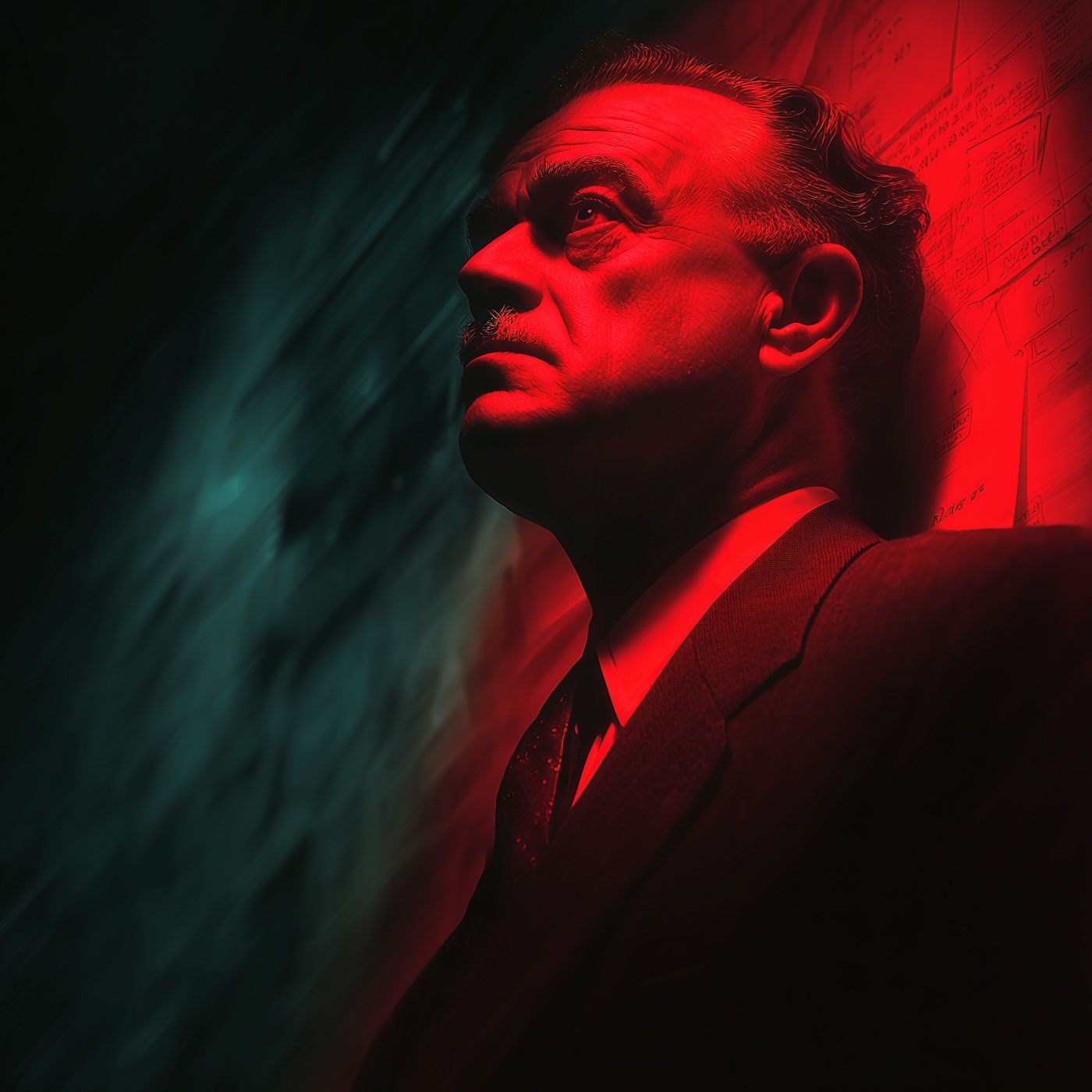
DH Ep:43 J. Edgar Hoover
Episode Transcript
Some stories were never meant to be told, Others were buried on purpose.
This podcast digs them all up.
Disturbing history peels back the layers of the past to uncover the strange, the sinister, and the stories that were never supposed to survive.
From shadowy presidential secrets to government experiments that sound more like fiction than fact.
Speaker 2This is history they hoped you'd forget.
Speaker 1I'm Brian Investigator, author and your guide through the dark corners of our collective memory.
Each week, I'll narrate some of the most chilling and little known tales from history that will make you question everything you thought you knew.
And here's the twist.
Sometimes the history is disturbing to us, and sometimes we have to disturb history itself just to get to the truth.
If you like your facts with the side of fear, if you're not afraid to pull at threads others leave alone, you're in the right place.
History isn't just written by the victim.
Sometimes it's rewritten by the disturbed.
On a humid May morning in nineteen seventy two, the most powerful man in Washington lay dead in his bedroom, naked on the floor beside his bed.
But this wasn't the president.
This was someone who had outlasted eight presidents, someone who knew where every skeleton was buried in the nation's capital because he had helped bury most of them.
John Edgar Hoover had finally done what no president, no attorney general, and no congressional committee had managed to do.
He had removed himself from power.
Within hours of his death, his personal secretary, Helen Gandy, began destroying files.
Not official FBI files, mind you, No, These were Hoover's personal files, the ones marked official and confidential files that contained the of information that could topple governments, destroy careers, and rewrite history books.
For forty eight years, Hoover had been collecting secrets like other men collected stamps, and now those secrets were turning to ash and a fire that burned for days.
The man they found on that bedroom floor had been many things.
A crusader against communism, a relentless pursuer of gangsters, a closeted homosexual who persecuted gay federal employees, a racist who wiretapped Martin Luther King Junior.
A patriot who violated the constitution he swore to protect, A bureaucratic genius who built the modern FBI, and above all, a keeper of secrets who understood that information was the ultimate currency of power.
This is not just the story of j Edgar Hoover.
This is the story of how one man built a shadow government within a democracy, how he held democracy itself hostage for nearly five decades, and how the very things he feeled most about himself drove him to become one of the most feared men in American history.
This is the story of contradictions so profound that even today, fifty years after his death, were still trying to understand who John.
Speaker 2Edgar Hoover really was.
Speaker 1John Edgar Hoover entered the world on New Year's Day, eighteen ninety five, in a modest house at four thirteen Seward Square in Washington, d C.
The timing seemed prophetic, a new year, nearly a new century, and a child who would shape the next century of American law enforcement had just drawn his first breath.
But prophecy is easy in hindsight.
At the time, he was just another baby born to a struggling middle class family in the nation's capital.
His father, Dickerson Naylor Hoover, worked as a printmaker, for the US Coast and geodetic survey making maps for the government.
It was steady work, respectable work, but not particularly lucrative work.
Speaker 2Dickerson was a.
Speaker 1Quiet man, prone to outs of depression that would later manifest as serious mental illness.
His mother, Anna Marie Shitland Hoover, whom everyone called Annie, was the backbone of the family.
She was the descendant of Swiss immigrants, a woman of rigid moral principles and fierce ambition for her children.
The Hoover household was one of contradictions from the start.
They lived in Washington, d c.
The epicenter of American power, but they were very much on the outside looking in.
They were white Protestants in a city that was still very much shaped by Southern traditions, but they weren't part of the established Southern aristocracy.
They had pretensions to gentility.
Annie made sure of that, but they had to watch every penny.
Young John Edgar, who was called Edgar to distinguish him from his father, was the baby of the family.
He had an older brother, Dickerson Junior, who was fifteen years his senior, and an older sister, Lillian, who was thirteen years older.
Some biographers have speculated that Edgar was an axe, an unplanned pregnancy that came when Annie thought her child bearing years were behind her.
Whether that's true or not, what is certain is that Edgar grew up as essentially an only child, his siblings already teenagers when he was born.
The Seward Square neighborhood where Edgar spent his early years was a study in American transformation.
It was predominantly white and middle class, but just blocks away were some of Washington's poorest black neighborhoods.
The city itself was essentially a Southern city that happened to be the nation's capital, with all the racial tensions and contradictions that implied.
Segregation was not just custom here, it was law, and young Edgar absorbed these attitudes like a sponge absorbs water.
Annie Hoover was the dominant force in Edgar's early life, and she would remain so until her death.
She was a woman of extraordinary contradictions.
Deeply religious, she dragged Edgar to the old First Presbyterian Church every Sunday, where he would absorb sermons about moral righteousness and the battle between good and evil.
But she was also intensely ambitious, pushing her youngest son to excel in everything he did.
She dressed him in somewhat feminine clothes well into his childhood, keeping his hair in long curls until he was nearly five years old.
Some biographers have suggested this might have contributed to the sexual confusion that would plague Hoover throughout his life.
When Edgar was six years old, something happened that would shape the rest of his life.
Though he would never speak of it publicly, his father, Dickerson, suffered what the family called a nervous breakdown in nineteen oh one.
Mental illness was not something respectable families discussed.
Dickerson would spend several months in a sanitarium, and when he returned he was never quite the same.
He would continue to work, but he was a shadow of his former self, prone to long silences and strange behaviors.
For young Edgar, his father's breakdown was both traumatic and instructive.
He learned that weakness could destroy a man, that the world was full of dangers that could strike without warning, and that the only defense was rigid self control and constant vigilance.
He also learned the importance of secrets.
The family never discussed Dickerson's illness.
Outside the home.
To the world, they presented a facade of normalcy.
Edgar learned that appearances mattered more than reality, that what people believed to be true was more important than what was actually true.
At Central High School now known as Cardozo High School, Edgar found his calling.
He joined the debate team and discovered he had a gift for argument and persuasion.
But more importantly, he discovered the power of organization and information.
As captain of the debate team, he instituted a card file system where every argument, every fact, every piece of evidence was meticulously cataloged and cross referenced.
His teammates found it obsessive, but they couldn't argue with the results.
The team won championship.
After championship, Edgar was not a natural athlete, but he forced himself to participate in track and field.
He was not a natural leader, but he forced himself to run for class office.
Everything was an act of will, a triumph of determination over limitation.
His high school yearbook would describe him as a gentleman of dauntless courage and stainless honor.
But even then there were those who found him off putting.
He was too intense, too rigid, too eager to report rule violations to teachers.
His nickname in high school was Speed, though it's unclear whether this referred to his quick wit or his rapid fire delivery and debates.
What is clear is that Edgar was already showing the traits that would define him as an adult.
He was obsessed with order and classification.
He kept detailed files on his classmates, noting their strengths, weaknesses, and secrets.
Speaker 2He was prudish.
Speaker 1About sex, recoiling from the crude jokes and boasts of his male classmates.
And he was intensely ambitious, though he was careful to hide that ambition behind a facade of humble service.
In nineteen thirteen, Edgar graduated from Central High as valedictorian of his class.
His graduation speech was titled the Lessons of History, and in it he argued that great nations fell not from external threats, but from internal moral decay.
The speech was a hit with parents and teachers, but some of his classmates found it preachy and self righteous.
One classmate would later remember that Edgar talked like he was forty years old when he was eighteen.
That fall Edgar enrolled at George Washington University Law School, but not as a full time student.
The family's finances wouldn't allow for that luxury.
Instead, he took night classes while working days at the Library of Congress.
It was there, in those vast halls of knowledge that Edgar refined the skills that would make him legendary.
He learned the power of information, the importance of filing systems, and the art of finding exactly what you needed when you needed it.
The Library of Congress job paid thirty dollars a month, not much even by nineteen thirteen standards, but Edgar made the most of it.
He studied how the library's classification system worked, how information could be organized and retrieved, how knowledge could be weaponized.
He was particularly fascinated by the library's collection of books on crime and criminology, spending his lunch breaks reading about famous criminals and the detectives who caught them.
But perhaps the most significant event of Edgar's time at the Library of Congress had nothing to do with books or filing systems.
It was there that he first encountered the concept of fingerprinting as a means of identification.
The library had just acquired a collection of books on the subject from Europe, where finger printing was already being used by police forces.
Edgar was fascinated.
Here was a perfect system of identification, a way to classify and category human beings with scientific precision.
While Edgar was studying law at night and working at the library during the day, the world was changing around him.
World War One broke out in Europe in nineteen fourteen, though America wouldn't enter the war until nineteen seventeen.
The Progressive era was in full swing, with reformers trying to clean up government and business, and in Washington, d c.
The federal government was growing larger and more powerful than ever before.
Edgar graduated from law school in nineteen sixteen with a Bachelor of Law's degree, and in nineteen seventeen he earned his Master of Law's degree.
He was twenty two years old, highly educated, and burning with ambition.
But he was also something else, something that would define his entire career.
He was afraid, afraid of disorder, afraid of moral decay, afraid of foreign influences, afraid of sexuality, both others and his own, and perhaps most of afraid of being powerless in a world that seemed to be spinning out of control.
These fears would drive him to seek power, to accumulate secrets, and ultimately to become one of the most feared men in American history.
On July twenty sixth, nineteen seventeen, John Edgar Hoover joined the Justice Department as a clerk at a salary of nine hundred and ninety dollars per year.
America had entered World War One three months earlier, and the department was overwhelmed with work related to enemy aliens and suspected spies.
Edgar was assigned to the Enemy Alien Registration section, a job that would seem mundane to most, but was perfect for a man obsessed with classification and control.
The Justice Department that Edgar Hoover entered in nineteen seventeen was a mess.
Files were scattered, procedures were inconsistent, and no one seemed to know exactly how many enemy aliens were in the country or where they were.
For most young lawyers, this would have been a nightmare.
For Edgar, it was an opportunity.
Within weeks of starting his job, Edgar had reorganized the entire filing system for enemy aliens.
He created a card index system similar to what he had used on his high school debate team, but far more sophisticated.
Every suspected enemy alien had a card.
Every card was cross referenced with other cards.
Names were indexed alphabetically, but also by nationality, by occupation, by associates, by geographic location.
It was, for its time revolutionary.
His superiors were impressed.
Here was a young man who actually seemed to enjoy paperwork, who thrived on the mundane details that drove other lawyers crazy.
Within months, Edgar was promoted.
By nineteen nineteen, at the age of just twenty four, he was appointed head of the Justice Department's Radical Division, with responsibility for monitoring and prosecuting political radicals.
The timing could not have been more perfect for an ambitious young man with Edgar's particular ties and fears.
The Russian Revolution had just happened and America was gripped by the first Red Scare.
There were actual bombings by anarchists, including one that damaged the home of Attorney General Mitchell Palmer, but there was also hysteria, a fear that communist revolutionaries were hiding under every bed, ready to overthrow the American government.
Palmer, whose house had been bombed and who harbored presidential ambitions.
Decided to crack down hard on suspected radicals, and he needed someone to organize this crackdown, someone who could bring order to chaos, someone who understood the power of information.
He found that someone in John Edgar Hoover.
The Palmer Raids, as they came to be known, began on November seventh, nineteen nineteen, the second anniversary of the Russian Revolution, in coordinated raids across the country.
Federal agents and local police rounded up thousands of suspected radicals.
Many were immigrants who barely spoke English.
Many had admitted no crime other than attending a meeting or subscribing to a socialist newspaper, but Edgar had files on all of them.
Stay tuned for more disturbing history.
Speaker 2We'll be back after these messages.
Speaker 1The raids were, by any measure, a violation of civil liberties on a massive scale.
People were arrested without warrants, held without charges, denied access to lawyers.
But Edgar didn't see it that way.
He saw it as a necessary defense of American values against foreign contamination.
In his mind, the Constitution was not a suicide pact.
Sometimes to save democracy, you had to suspend it.
The second wave of Palmer raids came on January TEWOD, nineteen twenty.
This time, over four thousand people were arrested in a single night.
The raids were meticulously planned, with Edgar personally overseeing the coordination.
He had agents infiltrate radical organizations, compile lists of members, identify meeting places when the raids came.
They were swift and efficient, But the Palmer Raids were also the beginning of a pattern that would define Hoover's entire career.
He would identify a threat, real or imagined, and then use that threat to justify expanding his power.
He would blur the line between legitimate law enforcement and political persecution, and he would keep files on everyone friend and foe alike, because information was power and power was survival.
The backlash against the Palmer raids was swift and severe.
Prominent lawyers, including future Supreme Court Justice Felix Frankfurter, condemned the raids as unconstitutional.
The press, which had initially supported the crackdown, began to question whether the threat had been exaggerated.
By the spring of nineteen twenty, Palmer's presidential ambitions were dead and he would soon be out of office.
But Edgar survived.
He always survived.
When the new Attorney General, Harry Daugherty, took office in nineteen twenty one, Edgar was still there, still running the Radical Division, still compiling his files.
He had learned an important lesson.
Attorney's general come and go, but a smart bureaucrat can outlast them all.
It was during this period that Edgar first encountered the organization that would define his life, the Bureau of Investigation, later renamed the Federal Bureau of Investigation.
The Bureau had been created in nineteen oh eight, but by nineteen twenty one it was a cesspool of corruption and incompetence.
Agents were political appointees with no law enforcement experience.
They took bribes, sold pardons, and spent more time playing politics than fighting crime.
The Bureau was also caught up in the Teapot Dome scandal, one of the biggest corruption scandals in American history.
Several Bureau agents were implicated in covering up the illegal leasing of government oil reserves.
By nineteen twenty four, the Bureau's reputation was in ruins, and the new Attorney General Harlan Fisk.
Stone needed someone to clean it up.
Stone was an interesting choice for Attorney General.
A former dean of Columbia Law School and future Chief Justice of the Supreme Court, he was a reformer who believed in professional law enforcement free from political influence.
He was also deeply suspicious of the Bureau and considered abolishing it altogether, but first he decided to give it one last chance with new leadership.
On May tenth, nineteen twenty four, Stone summoned Edgar Hoover to his office.
Edgar was twenty nine years old, still living with his mother, and had never arrested anyone, never carried a gun, never investigated a real crime.
But he had something Stone needed, a reputation for incorruptibility and a genius for organization.
Stone offered Edgar the job of acting Director of the Bureau of Investigation, but with conditions.
The Bureau would be divorced from politics, appointments would be based on merit, not political connections, and there would be no more Palmer Raid style violations of civil liberties.
Edgar readily agreed to all conditions.
Whether he meant it is another question.
Edgar's first day as acting Director was May tenth, nineteen twenty four.
The bureau he inherited had about four hundred and fifty agents and was universally regarded as a joke.
Within forty eight hours, he had fired nearly a quarter of them.
Within a month, he had instituted new hiring standards.
Agents now had to be between twenty five and forty years old.
They had to have a law degree or accounting degree.
They had to pass a rigorous background check, and they had to look the part.
This last requirement was pure Edgar.
He believed that appearance was crucial to authority.
Agents had to wear dark suits, white shirts, and conservative ties.
They had to be clean shaven with short hair.
They couldn't drink alcohol on or off duty.
They couldn't gamble, they couldn't have debts.
They were to be, in Edgar's words, young men of good character who looked like young businessmen.
But Edgar's reforms went far beyond appearance.
He created the first national fingerprint database, consolidating fingerprint records from police departments across the country.
He established a training academy for agents.
He created standardized procedures for investigations.
He instituted regular inspections of field offices.
In short, he transformed a corrupt patronage operation into something resembling a professional law enforcement agency.
By December nineteen twenty four, Stone was so impressed that he removed the acting from Edgar's title.
At twenty nine years old, John Edgar Hoover was the permanent director of the Bureau of Investigation.
He would hold that position until his death forty eight years later, making him the longest serving leader of any federal agency in American history.
The late nineteen twenties were a time of transformation for both America and Edgar Hoover.
The country was riding high on the stock market boom, Prohibition had created a vast illegal economy run by organized crime, and new technologies like radio and automobiles were changing how Americans lived and worked.
For Edgar, these years were about building his power base and creating the mythology that would sustain him for decades.
One of Edgar's first major public relations coups came from an unexpected source, the o Sage Indian murders.
In the early nineteen twenties, members of the Osage Nation in Oklahoma, who had become wealthy from oil discovered on their land, were being systematically murdered for their inheritance rights.
Local law enforcement was either incompetent or corrupt, possibly both.
The case had become a national scandal.
Edgar sent a team of undercover agents to Oklahoma, led by a former Texas ranger named Tom White.
It was a risky move.
The Bureau had no real jurisdiction and murder cases which were state crimes, but Edgar understood that solving a high profile case could establish the bureau's reputation as the nation's premier law enforcement agency.
After months of dangerous undercover work, White and his team uncovered a conspiracy involving prominent local businessmen and corrupt officials.
The successful prosecution of the conspirators was front page news across the country.
But while the O Sage case brought positive publicity, it was the rise of notorious gangsters during Prohibition that really put Edgar's Bureau on the map.
Men like Al Capone, John Dillinger, and Machine Gun Kelly had become folk heroes to some Americans.
They're exploits, filling newspapers and newsreels.
Edgar saw an opportunity.
If the Bureau could bring down these public enemies, it would become legendary.
The campaign against gangsters was as much about public relations as law enforcement.
Edgar personally oversaw the creation of the public enemy list, a stroke of marketing genius that turned crime fighting into a spectator sport.
He cultivated relationships with friendly journalists, feeding them stories that portrayed Bureau agents as incorruptible heroes fighting evil.
He even helped create the term g men, which came from machine gun Kelly allegedly shouting don't shoot g men when he was arrested.
The pursuit of John Dillinger in nineteen thirty four became the bureau's defining moment.
Dillinger had robbed banks across the Midwest, escaped from jail twice, and humiliated local law enforcement.
Edgar made his capture a personal crusade, assigning his best agents to the case, including Melvin Purvis, the head of the Chicago office.
When Dillinger was finally shot dead outside the Biograph Theater in Chicago on July twenty second, nineteen thirty four, it was front page news around the world.
Edgar made sure the Bureau got all the credit, even though it was actually a tip from a brothel madam named Anna Sage.
That led to Dillinger's location.
In Edgar's version of events, it was brilliant detective work by his g men that brought down public Enemy number one.
Speaker 2But even as Edgar.
Speaker 1Was building the bureau's public reputation, he was also building something else, a vast surveillance apparatus that would eventually monitor millions of Americans.
It started innocently enough with the fingerprint database and criminal records, but Edgar's vision went far beyond tracking criminals.
He wanted to know everything about everyone who might pose a threat to what he saw as American values.
In nineteen thirty six, President Franklin Roosevelt gave Edgar's secret verbal authorization to investigate fascist and communist activities in the United States.
It was a vague mandate, and Edgar interpreted it broadly, very broadly.
He began compiling files not just on suspected spies and saboteurs, but on anyone who expressed political views he considered dangerous.
Labor leaders, civil rights activists, journalists, professors, even members of Congress all went into Edgar's files.
The filing system itself was a masterpiece of bureaucratic deception.
There were official files that could be inspected by Congress or the courts.
There were June mail files, named after their supposed destruction date, that contained politically sensitive information.
And then there were the official and confidential and personal and confidential files that Edgar kept in his office, files that officially didn't exist.
These secret files contained the kind of information that could destroy careers and lives, sexual indiscretions, financial improprieties, political associations, medical records, family secrets, all carefully documented and cross referenced.
Edgar never called it blackmail.
He preferred to think of it as insurance.
If you had dirt on everyone, no one could touch you.
One of the most persistent questions about Edgar Hoover is his sexuality.
He never married, never had a known romantic relationship with a woman, and lived with his mother until her death in nineteen thirty eight.
After that, he spent virtually all his time outside the office with Clyde Tolson, the Associate director of the FBI.
Tolson joined the Bureau in nineteen twenty eight and quickly became Edgar's closest companion.
They ate lunch and dinner together almost every day.
They vacationed together, often to places like Miami, beach, where they would be photographed in swimming trunks standing remarkably close together.
They went to the horse races together, despite Edgar's official prohibition on gambling for agents.
When Edgar died, he left the bulk of his estate to Toulson.
Speaker 2Were they lovers.
Speaker 1The evidence is circumstantial but compelling.
Multiple sources reported seeing them holding hands in the back of Edgar's limousine.
Some claimed to have seen them in more compromising positions.
One story, probably apocryphal but widely circulated, claimed that mobster meyer Lansky had photographs of Edgar and Tolsen in a sexual encounter and used them to blackmail Edgar into denying the existence of organized crime.
What we know for certain is that Edgar was obsessed with persecuting homosexuals, particularly in government service.
He maintained that gay people were security risks, susceptible to blackmail by foreign agents.
The irony, if he was indeed gay himself, is almost too perfect.
The man who collected secrets to protect himself from his own secret, who persecuted others for what he himself might have been.
The nineteen forties brought World War II, and with it a massive expansion of Edgar's power, the Bureau was given responsibility for counter espionage and counterintelligence within the United States.
Edgar's agents infiltrated suspected Nazi and Japanese spy rings, monitored potentially disloyal immigrants, and kept tabs on anyone who might puts a security risk.
The most controversial aspect of the Bureau's wartime activities was its role in the internment of Japanese Americans.
While Edgar didn't order the internment, he provided much of the intelligence.
Speaker 2That was used to justify it.
Speaker 1His agents compiled lists of potentially dangerous Japanese Americans, most of whom were guilty of nothing more than being of Japanese descent.
Over one hundred twenty thousand people would be forcibly relocated to concentration camps based partly on information provided by Edgar's Bureau, but the war also gave Edgar the opportunity to expand his surveillance of American citizens.
Using the war as justification, he had his agents monitor labor unions, civil rights organizations, and anyone else he considered potentially subversive.
The American Civil Liberties Union, the National Association for the Advancement of Colored People, even Eleanor Roosevelt, the President's wife, all had thick FBI files.
Relationship with Franklin Roosevelt was complex.
Roosevelt found Edgar useful, a man who could provide information on his political enemies and handle sensitive tasks without leaving fingerprints.
But Roosevelt also understood that Edgar was dangerous, a man who knew too much and had too much power.
There were several attempts to remove Edgar during Roosevelt's presidency, but Edgar always survived, partly because he was too useful and partly because he knew.
Speaker 2Too many secrets.
Speaker 1When Roosevelt died in nineteen forty five and Harry Truman became president, Edgar faced his first real crisis.
Truman was suspicious of Edgar and the FBI, calling them Edgar Hoover's secret police and comparing them to the Gestapo.
In nineteen forty five, Truman actually wrote a letter ordering Edgar's dismissal, but he never sent it.
Why, probably because Edgar let it be known through intermediaries that he had information about Truman's connections to the corrupt Pendergast police medical machine in Kansas City.
Stay tuned for more disturbing history.
We'll be back after these messages.
This became Edgar's standard operating procedure with presidents.
He would have his agents compile detailed reports on their personal lives, their families, their associates.
Then at strategic moments, he would let them know what he knew, not as a threat, of course, but as a courtesy, just so they understood that Edgar was looking out for them, protecting them from embarrassment.
And if they happened to decide that Edgar should remain as FBI director, well that was their decision.
The end of World War II brought the beginning of the Cold War, and with it the second great expansion of Edgar Hoover's power.
The Soviet Union, our wartime ally, was now our mortal enemy.
Communism was spreading across Eastern Europe and Asia, and in America there was a widespread fear that Communist agents were infiltrated the government, the entertainment industry, and every other aspect of American life.
For Edgar, the Cold War was a gift from Heaven.
He had been fighting Communism since the Palmer Raids of nineteen nineteen.
Now, finally the rest of America had caught up to his level of paranoia.
The Communist threat justified everything, expanded surveillance, infiltration of political organizations, loyalty oaths, blacklists.
In Edgar's mind, America was in a fight for its very survival, and in such a fight, constitutional niceties were a luxury the nation couldn't afford.
The Alger Hiss case in nineteen forty eight proved, at least to Edgar that his fears were justified.
Hiss, a high ranking State Department official, was accused of being a Soviet spy by Whittaker Chambers, a former Communist.
The case became a national sensation, with Hiss maintaining his innocence and many liberals defending him.
But Edgar's FBI had evidence, including documents that Hiss had allegedly passed to the Soviets hidden in a hollowed out pumpkin on Chambers farm.
The successful prosecution of Hiss made Edgar a hero to anti communists and established the FBI as the nation's first line of defense against Soviet infiltration.
It also launched the political career of a young congressman named Richard Nixon, who had pursued the Hiss case aggressively.
Edgar and Nixon would develop a close relationship that would last until Edgar's death, but the Hiss case was just the beginning.
In nineteen fifty, Edgar's agents arrested Julius and Ethel Rosenberg, accusing them of passing atomic secrets to the Soviet Union.
The evidence against Julius was strong, the evidence against Ethel was much weaker, but Edgar pushed for the prosecution of both, believing that the threat of executing Ethel would force Julius to confess and name other spies.
The strategy didn't work.
Both Rosenberg's maintained their innocence to the end and were executed in nineteen fifty.
Three years later, declassified Soviet documents would confirm that Julius was indeed a spy, but Ethel's involvement was minimal at best.
She was essentially executed to put pressure on her husband, a fact that even Edgar's supporters find difficult to defend.
The nineteen fifties also saw the rise of Senator Joseph McCarthy and the anti communist hysteria that bears his name.
Edgar's relationship with McCarthy was complicated publicly, he maintained that the FBI was a non political law enforcement agency that simply gathered facts privately.
He fed McCarthy information about suspected communists and government, helped him prepare for hearings, and used the senator's crusade to justify expanding surveillance.
But Edgar was too smart to tie himself too closely to McCarthy.
He saw that the senator was reckless, alcoholic, and ultimately self destructive.
McCarthy began attacking the US Army and making accusations he couldn't prove.
Edgar distanced himself.
When McCarthy fell from power in nineteen fifty four, Edgar emerged unscathed, still the nation's top communist hunter, but without the taint of McCarthyism.
While Edgar was fighting communists, real and imagined America was undergoing a social revolution that he found deeply disturbing.
The civil rights movement.
To Edgar, raised in the segregated Washington of the early twentieth century, the idea of racial equality was not just wrong, but dangerous.
He believed that the civil rights movement was infiltrated by communists, that racial mixing would weaken America, and that Martin Luther King Junior was a threat to national security.
Edgar's campaign against King began in the late nineteen fifties and would continue until King's assassination in nineteen sixty eight.
It started with surveillance and infiltration.
FBI agents attended king speeches, monitored his phone calls, and reported on his activities.
But as King's influence grew, so did Edgar's determination to destroy him.
In nineteen sixty three, Edgar authorized one of the most extensive surveillance operations in FBI history against King.
Agents bugged King's home, his offices, and his hotel rooms.
They recorded his conversations, his strategy sessions, and, most controversially, his extramarital affairs.
Edgar was particularly obsessed with King's sex life, listening to the tapes personally and making detailed notes.
The surveillance revealed that King did indeed have multiple affairs, a fact that Edgar tried to use to destroy him.
In nineteen sixty four, just before King was to receive the Nobel Peace Prize, Edgar had a package sent to King containing recordings of his sexual encounters and a letter suggesting he commits suicide.
The letter, written by FBI agents to sound like it came from from a disappointed Black supporter, said King had thirty four days to kill himself before his filthy, abnormal, fraudulent self was exposed to the nation.
King didn't commit suicide, of course.
Instead, he continued his civil rights work, continued his criticism of the Vietnam War, and continued to be a thorn in Edgar's side.
Even after King's assassination in Memphis in April nineteen sixty eight, Edgar continued to insist that King had been a Communist dupe and that the civil rights movement was a threat to America.
Edgar's opposition to the civil rights movement went beyond King.
He had the FBI infiltrate every major civil rights organization, from the NAACP to the Student Nonviolent Coordinating Committee.
He had agents provoke violence at peaceful protests to discredit the movement.
He spread disinformation to create conflict between different civil rights groups, and all the while he maintained that the FBI was simply enforcing the law not to making sides in political disputes.
The nineteen sixties brought new challenges to Edgar's empire.
A new generation was questioning authority, protesting, the Vietnam War, experimenting with drugs and sects.
To Edgar, it was the nightmare he had always predicted.
America was falling into moral decay and subversion.
The Black Panthers, the Weather Underground, the anti war movement all became targets of FBI surveillance and infiltration.
Cointail pro short for counter intelligence program, was Edgar's secret war against domestic descent.
Officially, it was designed to protect national security by disrupting groups that posed a threat to America.
In practice, it was used to harass, intimidate, and destroy anyone Edgar considered dangerous.
The FBI forged letters to create conflicts between groups, planted informants who encouraged violence, and spread false information to discredit leaders.
One of the most notorious cointail pro operations was against the Black Panthers.
Edgar considered them the greatest threat to internal security in America, more dangerous than the Communist Party.
FBI agents infiltrated Panther chapters, provided information that led to police raids, and even drugged Fred Hampton, the Chicago chapter leader, before he was killed in a police raid in nineteen sixty nine.
But even as Edgar was fighting his secret wars.
His power was beginning to erode.
The culture was changing, the media was becoming less deferential, Congress was asking uncomfortable questions, and most importantly, Edgar was getting old.
By the late sixties, he was in his seventies, said in his ways, unable or unwilling to adapt to a changing America.
By nineteen seventy, John Edgar Hoover was seventy five years old and had been director of the FBI for forty six years.
He had outlasted eight presidents, weathered countless scandals, and built an intelligence apple that reached into every corner of American life.
But he was also increasingly out of touch with the America he claimed to be protecting.
The generation that had come of age during the sixties saw Edgar not as a protector, but as a symbol of everything wrong with the establishment.
His rigid anti communism seemed anachronistic in an era of detente.
His opposition to civil rights put him on the wrong side of history.
His surveillance of anti war protesters made him an enemy of the young.
Even within the FBI, Younger agents were beginning to question his methods and his mental state.
Edgar's behavior in these final years became increasingly erratic.
He would fly into rages over minor infractions, fire agents, for having long hair or being a few pounds overweight.
He became obsessed with protecting his reputation, ordering agents to investigate anyone who criticized him or the FBI.
He even had the FBI lab analyze a critical letter to determine if it had been and typed on a government typewriter.
His relationship with presidents had always been complex, but with Richard Nixon it reached new levels of dysfunction.
Nixon, who owed much of his political career to the anti communist crusade that Edgar had helped launch, was both dependent on Edgar and desperate to be rid of him.
Nixon wanted to use the FBI for his own political purposes, but Edgar, while willing to help Nixon to a point, wasn't willing to be anyone's puppet.
The tension came to a head over the Pentagon Papers in nineteen seventy one, when Daniel Ellsberg leaked classified documents about the Vietnam War to the press.
Nixon wanted the FBI to investigate aggressively, but Edgar, sensing that the case was politically motivated and legally questionable dragged his feet.
Nixon was furious, but couldn't fire Edgar without risking the exposure of his own secrets.
There were persistent rumors in nineteen seventy one that Nixon was finally going to force Edgar to retire.
The president's men put out word that Edgar would be stepping down after the nineteen seventy two election, but Edgar had survived such rumors before.
He had his agents compile reports on Nixon's associates, particularly their connections to organized crime.
He made sure Nixon knew he had this information.
Once again, the President backed down.
But while Edgar was fighting to keep his job, the world was changing around him.
In March nineteen seventy one, a group of anti war activists broke into an FBI office in Media, Pennsylvania, and stole thousands of documents.
These documents, which the activists sent to newspapers, revealed the existence of Quintaeil pro and the extent of FBI surveillance of American citizens.
For the first time, the public had proof of what critics had long suspected.
The FBI was spying on Americans for political reasons.
Edgar's response was typical.
He claimed the documents were forgeries or taken out of context.
He ordered a massive investigation to find the burglars.
He accused the media of endangering national security by publishing the documents, but the damage was done.
Congress began investigating FBI abuses, the media became more critical.
Even some of Edgar's longtime supporters began to distance themselves.
In his final months, Edgar seemed to sense that his time was running out.
He became even more reclusive, spending most of his time in his office or at home with Clyde Tolson, who was himself in poor health.
He continued to maintain his rigid routine, arriving at the office at precisely nine o'clock, eating lunch at the same restaurant at the same table, leaving at exactly five o'clock, but those who knew him said he seemed tired, worn down by nearly five decades of constant vigilance.
On the evening of May one, nineteen seventy two, Edgar returned home as usual.
He had dinner with Toulson, watched some television, and went to bed around tien sometime during the night, he got up, possibly to go to the bathroom, he suffered a heart attack and collapsed beside his bed.
His housekeeper, Annie Fields, found him the next morning.
John Edgar Hoover, the man who had defined American law enforcement for nearly half a century, was dead at seventy seven.
The reaction to Edgar's death was immediate and contradictory.
President Nixon, who had been desperate to fire Edgar just months earlier, ordered flags flown at half staff and praised him as one of the giants of American history.
Congress authorized his body to lie in honor in the Capitol Rotunda, an honor usually reserved for presidents and military heroes.
Thousands of people filed past his coffin to pay their respects.
But even as the official Washington was mourning Edgar, the scramble for his secrets had begun.
Within hours of his death, his personal secretary, Helen Gandy, began destroying files.
She would later testify that she was simply following Edgar's instructions to destroy his personal correspondence, but many suspected she was destroying something more, the secret files that Edgar had used to maintain his power for so many years.
Acting FBI Director L.
Patrick Gray was ordered by Nixon to find and secure Edgar's secret files, But when Gray arrived at Edgar's office, Gandy told him that there were no secret files, that everything had been properly filed in the FBI's central record system.
Gray didn't believe her, but there was nothing he could do.
Over the next several weeks, Gandy continued to remove boxes of files from Edgar's office, taking them to his house, where they were burned in the fireplace.
What was in those files we'll never know for certain, but based on testimony from FBI agents and officials who saw some of them, they contained information on the sexual activities of politicians, celebrities, and business leaders.
They contained evidence of illegal surveillance break and other FBI crimes.
Stay tuned for more disturbing history.
Speaker 2We'll be back after these messages.
Speaker 1They contained the secrets that Edgar had accumulated over forty eight years, secrets that could have destroyed careers, toppled governments, and rewritten history.
In the months following Edgar's death, America began to learn just how extensive his secret empire had been.
Congressional investigations revealed surveillance programs that monitored millions of Americans.
Former FBI agents came forward with stories of illegal break ins, forged letters, and campaigns to destroy political dissonance.
The myth of the incorruptible g man gave way to the reality of a secret police force that had operated outside the law for decades.
One of the most shocking revelations concerned the extent of Edgar's personal involvement in illegal activities.
For decades, he had maintained that the FBI never conducted black bag jobs, illegal break ins, to plant bugs, or photograph documents, But documents that survived the destruction of his files proved this was a lie.
Not only had the FBI conducted thousands of illegal break ins, but Edgar had personally authorized them, often with his distinctive blue ink signature.
The surveillance of Martin Luther King Junior was even more extensive than initially revealed.
The FBI hadn't just bugged King's hotel rooms, They had infiltrated his inner circle.
One of King's closest advisors and photographers was an FBI informant.
The bureau had advanced knowledge of King's travel plans, his strategies, even his sermons.
They had tried to prevent him from meeting with world leaders, block him from receiving honorary degrees, and stop him from getting funding for his civil rights work.
But King was far from the only target.
The FBI had files on virtually every prominent American of the twentieth century.
John Lennon had a three hundred page file documenting the FBI's attempt.
Speaker 2To have him deported.
Speaker 1Albert Einstein had a fourteen hundred page file investigating whether the physicist was a communist.
Ernest Hemingway was surveilled so intensively that some historians believed FBI harassment contributed to his suicide.
Even presidents weren't immune.
The FBI had documented John F.
Kennedy's affair with Marilyn Monroe and his connections to organized crime through his father.
They had recordings of Lyndon Johnson's crude sexual boasts and evidence of his financial corruption.
They had reports on Richard Nixon's connections to the mob and his history of dirty tricks.
Every president, from Franklin Roosevelt to Nixon knew that Edgar had damaging information on them, and that knowledge shaped their relationship with him.
The sexual files were perhaps the most powerful weapons in Edgar's arsenal.
He had evidence of extramarital affairs by dozens of congressmen and senators.
He knew which politicians were secretly gay, which one's frequented prostitutes, which ones had unusual sexual preferences.
In an era when such revelations could end a career, this information was incredibly powerful.
Edgar never had to explicitly threaten anyone.
The mere fact that he had the information was threat enough.
But the deepest irony was Edgar's own sexuality.
Despite decades of speculation, no definitive proof of his homosexuality emerged after his death, but the circumstantial evidence was overwhelming.
His relationship with Clyde Tolson went far beyond normal friendship.
They were together constantly for forty years.
Edgar never showed romantic interest in women.
He was obsessed with masculinity and appearance in a way that suggested deep insecurity about his own identity.
There were also the stories whispered for years but never proven, stories of Edgar and Toulson at gay parties in New York, stories of Edgar and drag calling himself Mary, stories of young male FBI agents being summoned to Edgar's office for private meetings that had nothing to do.
Speaker 2With law enforcement.
Speaker 1How many of these stories were true, we'll never know, but the fact that they persisted for decades despite Edgar's enormous power to suppress unflattering information, suggests there was something to them.
The Organized Crime files revealed another layer of Edgar's deception.
For decades, Edgar had insisted that there was no such thing as the mafia, that organized crime was a myth created by Hollywood and sensationalist journalists, but his own files proved he knew better.
The FBI had extensive intelligence on mob families, their structures, their operations, their connections to legitimate businesses and politicians.
So why did Edgar deny the mafia's existence.
The most likely explanation is a combination of factors.
First, Edgar knew that seriously pursuing organized crime would be difficult and dangerous, potentially disposing FBI agents to corruption.
Second, the Mob had connections to many politicians who protected Edgar and going after organized crime might have cost him political support.
And third, there were persistent rumors that the Mob had compromising information on Edgar, possibly related to his sexuality.
That they used to keep him at bay.
The cointail pro revelations were perhaps the most damaging to Edgar's legacy.
These programs, which ran from the nineteen fifties through the early seventies, showed that the FBI hadn't just been investigating potential threats to national security.
It had been actively trying to destroy political movements it disapproved of.
The Bureau had forged letters to create conflict between civil rights groups.
It had planted provocateurs to encourage violence.
It had spread disinformation to discredit anti war activists.
One of the most disturbing cointail pro operations was against actress Jene Seberg.
After Sieberg publicly supported the Black Panthers, Edgar authorized a campaign to destroy her.
The FBI planted a false story that her unborn child had been fathered by a Black panther rather than her husband.
The stress from the scandal caused Seaburg to go into premature labor, and.
Speaker 2The baby died.
Speaker 1Seaburg herself committed suicide a few years later, with friends and family blaming FBI harassment for her death.
The domestic surveillance programs were staggering in scope.
Operation Chaos monitored anti war activists.
Operation Minaret intercepted international communications of American citizens.
Project Shamrock gave the FBI access to every international telegram sent from the United States.
The FBI had also infiltrated newspapers, television networks, and universities, recruiting journalists and professors as informants.
What emerged from all these revelations was a picture of a man who had essentially run a secret government within the government for nearly five decades.
Edgar Hoover hadn't just been a law enforcement official.
He had been a powerbroker, a blackmailer, a political puppeteer who had shaped American history from behind the scenes.
He had violated the very constitution he had sworn to protect all in the name of protecting America from threats that were often exaggerated or imaginary.
Behind the public facade of the incorruptible g man and the private reality of the secret police chief, there was another John Edgar Hoover, a deeply troubled man whose entire life was a performance, a carefully constructed identity designed to hide truths he couldn't face about himself.
Edgar's home life was a study in contradictions.
Speaker 2He lived with his mother.
Speaker 1Until her death in nineteen thirty eight, when he was forty three years old.
Annie Hoover was a domineering woman who controlled every aspect of her son's life.
She decorated his bedroom, chose his clothes, managed his social life.
Friends reported that Edgar was terrified of displeasing her that well into middle age, he would become anxious if he thought he might be late for dinner with mother.
After Annie's death, Edgar never lived with anyone else, but he was rarely alone.
Clyde Tolson became his constant companion, filling the void left by his mother.
Their relationship was so close that FBI agents joked that they were married.
They dressed alike, often wearing matching suits and ties.
They had adjoining offices with a connecting door that was always open.
They rode to work together, ate every meal together, vacation together.
The vacations were particularly telling.
Edgar and Tolson would travel to California or Florida, always staying in the same hotel suite.
They would spend their days at the racetrack, despite Edgar's official prohibition on gambling.
For FBI agents, hotel staff reported seeing them holding hands walking arm in arm on the Beach in Miami.
They were regulars at a restaurant known to be friendly to gay couples, where they always sat at the same corner table, away from other diners.
Edgar's home on thirtieth Place in Northwest Washington was a shrine to his own importance.
The walls were covered with photographs of Edgar with presidents, celebrities, and foreign dignitaries.
There were plaques, awards, and honorary degrees from universities around the world, but there were no personal photographs, no pictures of family or friends, nothing that suggested a life outside of his role as FBI director.
His daily routine was rigid to the point of obsession.
He woke at exactly the same time every morning, ate the same breakfast, took the same route to work at the office.
He had a series of rituals that had to be performed in exactly the same way.
His desk had to be arranged just so, and his pen always had to be filled with blue ink.
Documents had to be presented in a specific format.
Any deviation from routine would send him into a rage.
The rages became more frequent as Edgar aged FBI agents learned to fear his temper, which could be triggered by the smallest things.
An agent who was a few pounds overweight would be transferred to an undesirable post.
An agent whose wife was seen at an anti war protest would find his career destroyed.
An agent who questioned an order, no matter how gently, would be marked as disloyal and driven out of the bureau.
Edgar's treatment of FBI employees was often cruel and capricious.
He had a particular hatred for agents who were too handsome or too tall, Seeing them as threats to his authority, he would find reasons to fire or demote them.
He also had bizarre rules about appearance.
Agents couldn't have facial hair, couldn't wear colored shirts, couldn't have their hands in their pockets.
One agent was disciplined for wearing white socks.
The fear Edgar inspired in his employees extended to their personal lives.
Agents knew that the FBI conducted background checks on their wives, their children, even their in laws.
They knew that their phones might be tapped, their mail might be opened, their neighbors might be questioned.
They lived in constant fear that something in their personal life might displease the director and end their careers.
Edgar's own fears were numerous and often irrational.
He was terrified of germs, constantly washing his hands and refusing to shake hands with people he considered unclean.
He was afraid of being poisoned, having all his food tested before he ate it.
He was afraid of flying, traveling by train or car whenever possible.
He was afraid of being assassinated, surrounding himself with bodyguards even in the safest situations.
But his greatest fear was exposure.
Edgar knew that he had made countless enemies over the years, people who would love to see him destroyed.
He knew that his entire life was built on secrets and lies, and that if those secrets were exposed, everything would come crashing down.
This fear drove him to accumulate evermore power, evermore secrets on others, creating a cycle of paranoia and control that consumed his entire existence.
The psychological toll of living this double life was evident to those close to him.
Toulson, the one person who truly knew Edgar, reportedly told friends that Edgar never relaxed, never let his guard down, even in private, he was always performing, always maintaining his image, even when there was no one to see it but Toulson himself.
Edgar's relationship with his own sexuality was perhaps the most tortured aspect of his psychology.
He was obsessed with masculinity, constantly talking about the importance of real men and condemning anything he saw as effeminate.
Yet many of his behaviors, his fastidiousness about appearance, his collection of antiques, his love of gossip were stereotypically feminine for his era.
It was as if he was constantly trying to prove his masculinity to himself and others, while simultaneously unable to suppress aspects of his personality that didn't fit his rigid definition of manhood.
This internal conflict manifested in his persecution of homosexuals.
The FBI under Edgar conducted widespread surveillance of gay Americans, compiled lists of homosexuals and government positions, and worked to have them fired.
The irony if Edgar was indeed gay himself, is almost unbearable.
He destroyed countless lives for the very thing he might have been, turning his self hatred outward in a campaign of persecution that lasted decades.
The FBI that Edgar Hoover built was more than just a law enforcement agency.
It was a vast intelligence apparatus that reached into every corner of American society.
Understanding how this system worked how one man managed to accumulate and maintain such power for nearly five decades, requires examining the bureaucratic and psychological mechanisms he put in place.
The filing system was the heart of Edgar's power.
By the time of his death, the FBI had over six million files on American citizens, not counting the destroyed secret files.
These weren't just criminal records.
They included political affiliations, sexual histories, financial information, medical records, gossip rumors, and unverified allegations.
The files were cross referenced in elaborate ways, so that pulling one file might lead to dozens of others.
Speaker 2The system for.
Speaker 1Gathering information was equally elaborate.
FBI agents were stationed in every major city in America, but they were more than just criminal investigators.
They were intelligence officers tasked with monitoring local politics, infiltrating organizations, and reporting on anything that might be of interest to headquarters.
Every field office had a squad dedicated to security matters, which in practice meant political surveillance.
Stay tuned for more disturbing history.
We'll be back after these messages.
The informant network was vast and varied.
The FBI had paid informants in every major political organization, from the Communist Party to the Ku Klux Klan, but they also had unpaid informants, people who provided information out of patriotism, fear, or hope of favor.
These included journalists who would plant stories for the FBI, business leaders who would report on their employees, landlords who would spy on their tenants, and neighbors who would watch their neighbors.
One of Edgar's most effective tools was the liaison program with local police departments.
FBI agents would train local officers, share intelligence, and provide resources.
In return, local police would conduct surveillance and investigations that the FBI couldn't legally do itself.
If evidence was obtained illegally by local police, it could be laundered through the FBI system and made to appear legitimate.
The media manipulation was sophisticated for its time.
Edgar cultivated relationships with friendly journalists and publishers, feeding them stories that portrayed the FBI in a positive light.
He would provide exclusive access to reporters who wrote favorable articles and freeze out those who were critical.
The FBI even had journalists on its payroll, though they were officially listed as special service contacts rather than informants.
Edgar also understood the power of popular culture.
He cooperated with Hollywood studios making movies about the FBI, providing technical advisors and access to FBI facilities in exchange for script approval.
Television shows like The FBI starring FBRM Zimbalist Junior were essentially propaganda pieces, portraying FBI agents as heroic and incorruptible.
Comic books, radio shows, and pulp novels all contributed to the mythology of the g Man.
The psychological control within the FBI was absolute.
New agents underwent intensive training that was as much about indoctrination as education.
They were taught that Edgar was not just their boss, but a father figure who cared about them personally.
They were told that loyalty to Edgar was loyalty to America itself.
They were made to understand that their careers their futures.
Their very identities were dependent on pleasing the director.
The inspection system ensured compliance.
Teams of inspectors would arrive at field offices without warning, examining everything from case files to agent's personal appearance.
A single negative comment in an inspection report could end a career.
Agents learned to fear these inspections more than they feared criminals.
They would work overtime without pay, falsify statistics, and cover up mistakes rather than risk a bad inspection.
The transfer system was used as both reward and punishment.
Loyal agents were assigned to desirable posts in major cities.
Those who displeased EDGAR were sent to remote offices in places like Butte, Montana, or Anchorage, Alaska.
The threat of transfer was often enough to insure compliance.
Agents with families, mortgages, and children in school couldn't afford to resist.
The culture of fear extended beyond the FBI itself.
Government officials knew that opposing Edgar meant risking exposure of their secrets.
Business leaders knew that criticizing the FBI could lead to investigations of their companies.
Journalists knew that challenging Edgar could mean losing access to FBI sources and information.
Even presidents knew that firing Edgar could lead to the release of damaging information.
But perhaps Edgar's greatest achievement was making this system seem normal and necessary.
He convinced Americans that the threat of communism, then later the threat of crime and disorder, justified extraordinary measures.
He made surveillance seem patriotic, infiltration seemed protective, and violations of civil liberties seemed like small prices to pay for security.
He created a culture where questioning the FBI was tantamount to questioning America itself.
The international dimension of Edgar's empire is often overlooked.
The FBI had legal attache offices in major embassies around the world, ostensibly to coordinate with foreign law enforcement, but these offices also conducted intelligence operations, sometimes in competition with the CIA.
Edgar had files on foreign leaders, international businesses, and exile groups.
Speaker 2He used this.
Speaker 1Information to influence American foreign policy and to build relationships with foreign intelligence services.
The relationship with the CIA was particularly complex.
Edgar saw the CIA as a rival and fought constantly over jurisdiction and resources.
He refused to share information with the CIA even when national security was at stake, He had his agents surveil CIA officers and compile files on their activities.
The dysfunction between the FBI and CIA, which continues to this day, can be traced directly to Edgar's paranoia and territoriality.
The financial mechanisms of Edgar's empire were cleverly designed.
While the official FBI budget was subject to congressional approval, Edgar had access to confidential funds that didn't require detailed accounting.
He used these funds to pay informants, conduct secret operations, and maintain his personal comfort.
There were also unofficial sources of funding, including wealthy businessmen who contributed to the FBI Recreation Fund in exchange for favors and access.
The technological capabilities Edgar developed were advanced for their time.
The FBI Laboratory, which Edgar established in the nineteen thirties, became a war old leader in forensic science, but it was also used for less legitimate purposes, analyzing documents to identify critics, testing substances to be used in harassment campaigns, and developing surveillance technologies that pushed the boundaries of legality.
John Edgar Hoover died fifty years ago, but his ghost still haunts American law enforcement and intelligence.
Speaker 2The FBI he.
Speaker 1Built has been reformed, restructured, and supposedly tamed, but many of the capabilities he created remain.
The tension between security and liberty that he exploited continues to define American political debate, and the questions he raised about power, secrecy, and accountability in a democracy remain largely unanswered.
In the immediate aftermath of Edgar's death, there was a brief moment when real reform seemed possible.
Congress passed laws limiting FBI directors to ten year terms.
New guidelines were established for domestic surveillance till pro programs were officially terminated, and the secret files were supposedly destroyed.
America, it seemed, had learned its lesson about giving one man too much power for too long, But the reforms were incomplete and in some cases cosmetic.
The surveillance capabilities Edgar built were not dismantled, they were simply given new names and new justifications.
The culture of secrecy he fostered didn't disappear, It adapted to new circumstances.
The basic architecture of the surveillance state he created remains intact, even if its most obvious abuses have been curtailed.
The September eleventh attacks in two thousand and one gave new life to many of Edgar's ideas.
The Patriot Act expanded surveillance powers in ways Edgar could only have dreamed of.
The FBI resumed infiltrating religious and political organizations.
The collection of data on American citizens reached levels that would have seemed like science fiction in Edgar's time.
Once between security and liberty shifted decisively towards security, just as Edgar always argued it should.
The technology has changed dramatically since Edgar's time.
Instead of filing cabinets full of index cards, the FBI now has vast digital databases that can process millions of records and seconds.
Instead of planting bugs in hotel rooms, they can monitor electronic communications from anywhere in the world.
Instead of recruiting human informants, they can use artificial intelligence to analyze social media posts and predict behavior.
The tools are different, but the underlying philosophy of prevention through surveillance remains the same.
The questions Edgar raised about the nature of power in a democracy are more relevant than ever.
How much surveillance is too much?
Who watches the watchers?
Can a democracy survive if its citizens don't trust their government?
What happens when those entrusted with protecting society become threats to it themselves.
These questions don't have easy answers, and Edgar's legacy makes them even more complex.
There's also the personal dimension of Edgar's story that continues to resonate.
He was a man destroyed by his own fears and prejudices, someone whose entire life was a performance designed to hide truths he couldn't accept about himself.
In an era when we're still struggling with issues of identity, sexuality, and authenticity, Edgar's story serves as a cautionary tale about the cost of living a lie.
The most troubling aspect of Edgar's legacy is how easy it was for him to accumulate and maintain power.
He didn't seize control in a coup or inherit it through birthright.
He built it slowly, methodically, using the very systems designed to prevent such accumulations of power.
He showed that in a bureaucratic society, the person who controls information controls everything, and he demonstrated that people will surrender their freedoms voluntarily if they're frightened enough.
Looking back on Edgar's life and career, it's tempting to see him as a unique figure, a one of a kind aberration in American history, But that would be a mistake.
Edgar was a product of his time and place, shaped by the fears and prejudices of early twentieth century America.
The forces that created him haven't disappeared.
The fear of the other, the desire for order, the willingness to sacrifice freedom for security.
These are constants in human nature that each generation must confront.
What made Edgar unique wasn't his fears or his prejudices, It was his ability to institutionalize them.
He took the dark impulses that exist in every society and gave them bureaucratic form.
He transformed personal paranoia into national policy.
He turned individual bigotry into systematic oppression.
He showed how a democracy could be subverted from within by someone who claimed to be protecting it.
The victims of Edgar's reign are too numerous to count.
There were the obvious ones.
Martin Luther King, Junior harassed until his death, Jene Seberg driven to suicide, Fred Hampton killed in his bed, the thousands arrested in the Palmer raids, the hundreds of thousands surveiled for their political beliefs.
But there were also the less obvious victims.
The FBI agents forced to live in fear, the politicians blackmailed into compliance, the ordinary citizens who self censored out of fear, and, perhaps most tragically, Edgar himself, a man so twisted by self hatred that he spent his entire life persecuting others for what he feared in himself.
In the end, John Edgar Hoover's story is a fundamentally American story.
It's about the tension between freedom and security, between individual rights and collective safety, between transparency and secrecy.
It's about how power corrupts, how fear can be weaponized, and how even the strongest democracy can be undermined by those who claim to be protecting it.
Speaker 2It's about the.
Speaker 1Danger of giving anyone too much power for too long, no matter how noble their stated intentions.
But it's also a human story, a tragedy in the classical sense.
Edgar had the intelligence, the organizational skills and the determination to be a great public servant.
He could have built an FBI that was both effective and respectful of civil liberties.
He could have been remembered as a reformer who professionalized law enforcement.
Instead, he let his fears and prejudices consume him, and in trying to protect America from imaginary enemies, he became a real threat to American democracy Today, as we grapple with new technologies that make surveillance easier than ever, as we debate the proper balance between security and privacy, as we confront the reality that those entrusted with protecting us sometimes abuse that trust, Edgar's story remains relevant.
He showed us what can happen when we let override our principles, when we give too much power to too few people, when we prioritize order over justice.
The building that houses FBI headquarters is still named after John Edgar Hoover, a fact that remains controversial.
Some see it as honoring a man who built an important institution.
Others see it as celebrating someone who violated the very principles he was supposed to uphold.
The debate over the building's name is really a debate about Edgar's legacy, and more broadly, about how we reconcile the contradictions in our history.
Perhaps the most fitting epitaph for John Edgar Hoover comes from the Bible he claimed to revere, but whose teachings he so often violated.
What does it profit a man to gain the whole world but lose his soul?
Edgar gained enormous power, influenced the course of American history, and became one of the most feared men of the twentieth century, But in the process he lost something essential, not just his soul, but his humanity.
He became the very thing he claimed to be fighting against, a threat to American democracy and values.
As we look back on his life from the perspective of half a century, we can see both the danger he represented and the vulnerabilities he exposed.
He showed us that democracy is more fragile than we might like to believe, that freedom requires constant vigilance, not just against external enemies, but against those who would protect us from ourselves.
His story reminds us that the price of liberty is not just eternal vigilance against our enemies, but also against our protectors.
John Edgar Hoover died alone, clutching the secrets that had given him power but had also imprisoned him.
In his final moments, was he thinking about the empire he had built, the enemies he had destroyed, the secrets he had kept?
Or was he thinking about the life he never lived, the person he never allowed himself to be.
We'll never know.
Like so many things about Edgar, his final thoughts remain a mystery, one last secret in a life built on secrets.
But while Edgar's personal secrets died with him, the questions his life raises live on.
In every debate about surveillance, in every discussion about the balance between security and freedom, in every revelation about government overreach, we hear the echoes of John Edgar Hoover.
He may be gone, but the struggles he embodied, the contradictions he represented, and the warnings his life provides remain as relevant today as they were during his lifetime.
This is the legacy of John Edgar Hoover, not just the FBI he built, or the files he kept, or the power he wielded, but the ongoing reminder that democracy requires constant vigilance, that power must always be checked, and that those who claim to be protecting our freedom may.
Speaker 2Be the greatest threat to it.
Speaker 1It's a lesson written in surveillance files and blackmail letters, in violated rights and destroyed lives, in the story of a man who gained enormous power, but lost himself in the process.
The man who started life as a frightened boy in a troubled household, who built himself into one of the most powerful figures in American history, who held democracy hostage for nearly five decades, ended as he began alone, afraid, and ultimately powerless against the one enemy he could never defeat the truth about himself.
And in that truth, in that very human tragedy, lies the most important lesson of all.
That power without accountability, fear without courage, and security without freedom lead not to strength, but to a corruption so complete that it destroys not just individuals, but the very foundations of democracy itself.
Speaker 3Half God, A taste from your hot I'm seen, lord, child and calm and full.
Speaker 4You better know.
Speaker 3The moon is out.
Speaker 4Now you're gonna hear money home.
Speaker 3Home ward, scot.
Speaker 4Red eyes can't gig love, father, My drink is You're life.
You'll see me.
Come fu, Come and fooll you.
You better some movies on.
Now you're gonna hear me.
Speaker 3Oh, you better run.
Speaker 4Some movis O.
Now you're gonna hear my
Speaker 3O.