·S1 E101
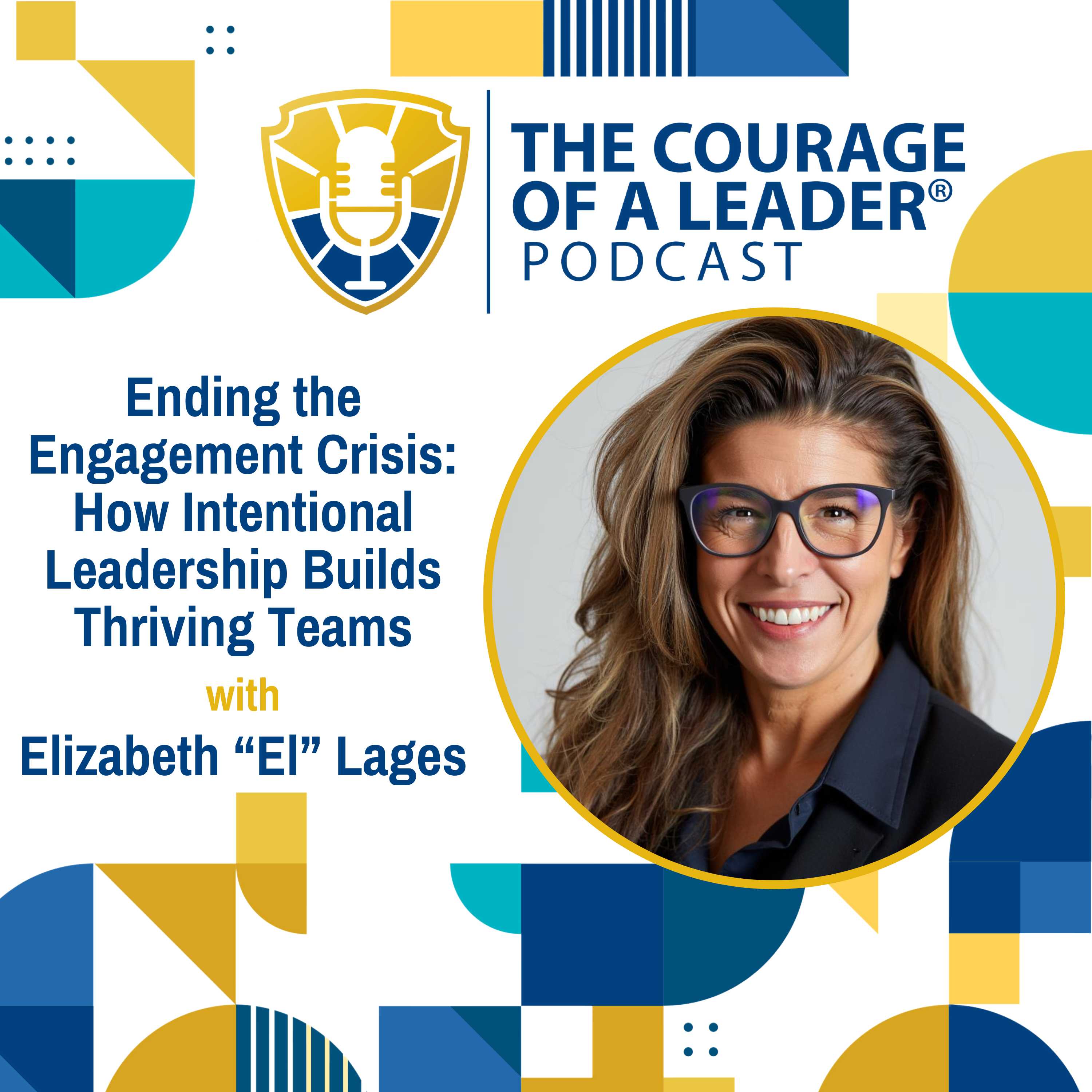
Ending the Engagement Crisis: How Intentional Leadership Builds Thriving Teams | El Lages
Episode Transcript
Amy Riley: Employee Engagement is at a critical low, and leaders everywhere are asking how to turn the tide.
In this episode, I talk with Elizabeth "El" Lages, Chief people and culture officer at Flexera, a global company known for its people first approach and high performance culture El shares practical strategies for building engagement through clear expectations, accountability that works and authentic connection, insights every leader can apply immediately.
If you want to know how to inspire commitment and create a workplace where people thrive, you'll want to keep listening.
Welcome to the Courage of a Leader podcast.
This is where you hear real life stories of top leaders achieving extraordinary results, and you get practical advice and techniques you can immediately apply for your own success.
This is where you will get inspired and take bold, courageous action.
I'm so glad you can join us.
I'm your host.
Amy Riley, now are you ready to step into the full power of your leadership and achieve the results you care about most.
Let's ignite the courage of a leader.
El, thank you for being on the courage of a leader podcast today.
Thanks for having me.
It's nice to see you again.
Yeah, it's always good to see you.
We are talking about, I think, the most critical conversation that can be had in the workplace.
Right now we are going to talk about, how do you create high levels of engagement across teams, across an organization?
So let me start by asking you, El, how do you as the head of culture and people at Flexera.
How do you think about or define high engagement?
Elizabeth LagesElizabeth Lages: So for us, high engagement has a lot of components to it, and recognizing the importance of regularly being in communication and creating awareness with all of your employees is really important.
So we look at it in how we expect all of our managers and leaders to conduct regular one on ones, right?
So there's this constant line of communication that's occurring that's an opportunity for feedback.
We look at this as part of performance, right in that, and again, that ongoing dialog around expectation setting, having clarity.
We do quarterly check ins, we do quarterly business reviews.
We also actually leverage surveys, right?
We do engagement surveys twice a year when we do an acquisition which we just completed, one in March, we do separate we call them pulse surveys to newly acquired team members, right?
So we can gage and meet them where they are.
And that information helps us understand, where do we need to focus?
Where do we need to action?
We just it's interesting because we just finished our post survey from April.
We are in the process of going through the results, looking at what the themes are, and I'll be talking to the entire company based on, you know, what we know we're doing well, where we have opportunities.
And then we will share broadly with the company by function, here's what's working, and here's where there's opportunity to do better.
And each function is accountable to action something based on their survey results, and we will be posting that as well, so it's very visible.
Keep score is a core value of ours, and so we want that accountability for all of us.
Again, we're not perfect, right?
This is constantly in motion and trying to figure out where we have opportunity to get better and raise the bar performance scenario that you and I have talked about is one that I'm keenly focused on, but all of those things impact engagement as well as regular communication points.
So we do a regular all hands with our CEO.
We do ask me anything sessions with all of our senior leadership.
So we try to make sure that there are monthly occurrences of some type of engagement happening all across the country, around the world.
Amy RileyAmy Riley: Nice.
Al, you have already said so much, and one thing I'm hearing loud and clear, and I think we foundationally forget this, that what is engaging is to have two way understanding that's right, right?
You immediately started talking about regular communication, regular awareness.
And listen, I am more engaged if I understand what the heck is going on and what we're up to and what direction we're headed and why and what.
What has changed and shifted things recently.
And then I also hear you making sure that you're understanding your leadership is understanding from the full employee population.
Where are they at?
Oh, you're part of our newly acquired members.
Where are you at?
How do we meet you where you're you're at.
So I just like that two way understanding is so important.
Agree Absolutely.
So Al, you mentioned that keep score is one of your company's core values.
Say more about that,
Elizabeth LagesElizabeth Lages: absolutely.
When we think about our core values, they're foundational, I think in terms of who we are as a company and how we operate, and we try to ensure that our values are instilled in everything that we do.
So whether that's part of our performance process, whether that's part of recognition, we have a program called give, allow, where we recognize performance, and the giveaway is tied to someone exhibiting one of our core values.
So keep score.
I mentioned right?
We do?
We expect accountability.
We look at metrics.
We have OKRs as part of our performance and goal conversations.
Passion is a core value.
You know, we're incredibly passionate about what we do at Flexera.
We have employee resource groups, we have Flexera days, we have days of connection.
We try to have high customer impact.
And we, we expect our employees to show up, you know, passionate about who we are, what we do, candor.
This is a Jim Ryan, our Chief Executive Officer.
This is a special of his.
We actually see a lot in the survey results how much they love Jim's transparency and his candid approach.
And so people love it.
Candor creates the opportunity for feedback loops.
We know from our employees they want the feedback.
We assume that people don't want to hear anything opportunistic or perceived as criticism.
But the truth is, most people, especially those that really aspire to continue to develop professionally, want promotions.
They want to understand where they have an opportunity to do different, to do better.
So candor is a key feedback of ours, and being really transparent about what we can do, what we can't give back.
You know, we're really fortunate.
We work in tech.
Most of our team members here are, you know, paid at a healthy level.
It starts again.
You know, Jim Ryan has a lot of work that he does from a charitable perspective.
We actually, today in the UK, we have a bunch of our teams doing a three peak charitable give back that they do every year.
So around the world, this is something that all of our team members embrace.
It's organic, by the way.
We don't force anything.
We don't say you have to do X people, just they get together, they self organize and and we love it.
There's actually been, I won't get into it, but there's a great LinkedIn post from Jim Ryan about one of our team members here who donated kidney to another former team member.
And it's a LinkedIn post.
Jim Ryan posted it.
It's a Flexera.
You know, it's who we are.
We are Flexera, that's one of our tagline so I encourage people to look at that, but that's a big reflection of us as a company.
We celebrate success.
Yeah, I talked about the giveaway for our go to market folks.
We do a first class presidents club to recognize our our top achievers in that function and professionalism, right?
Our culture is we have clear ethics expectations.
We believe our managers are we're all accountable and also important that we treat each other, you know, with respect and in a professional manner.
Amy RileyAmy Riley: Thank you.
You're really expanding, for many of us, what the definition, or what all can be encompassed inside of the idea of engagement.
And when you think about it, when people are professional and treat each other with respect and there's appropriate behavior that is engaging accountability, celebrating successes, getting feedback, recognition.
Okay, I want to drill down onto a couple of those.
But first, let me pause here, El and tell listeners a little bit more about you sure Elizabeth lodges, or El lodges, is the chief people and culture officer at Flexera.
Flexera is a global company that helps organizations gain the visibility and insight they need to optimize spend, minimize risk, achieve sustainability goals and make data driven decisions to propel their business forward.
El has been with the company since 2004 focusing on building high performing teams and enabling a culture rooted in candor, accountability and celebrating success.
You've already heard her say it.
She leads with the people first mindset and a keep score philosophy, driving engagement, developing leaders and aligning performance with purpose.
We will share information to connect with El in the show notes.
I want to talk about the concept of accountability next El.
So I.
Might have heard and observed leaders recently who are afraid to hold people accountable.
They're worried that that will be disengaging, and I know you and I are of the mindset that accountability is engaging.
Yes, tell us more about this mindset and how accountability plays out day to day,
Elizabeth LagesElizabeth Lages: absolutely so when, when I think about our core values, right?
If you think about keep score and you think about candor, right at the end of the day, accountability helps us all understand what is expected of us.
You know when is something to be delivered?
Why, the how.
And I think, you know, if we have no accountability, I don't really know how you drive a business forward, right?
The Accountability helps us all understand what's the goal post, what are we working toward, and when do we want to get there by so and to your earlier point, which I know this firsthand, because we've actually heard this from our employees.
Employee people are not afraid of being held accountable.
They want to be held accountable, but they also want to be recognized right when they do well and when they deliver, you know, ahead of schedule or they deliver exceptional work, they want to be rewarded and recognized fair enough, and if they deliver something and they are accountable, but it misses the mark, they also want to know why, and that's that's fair and reasonable as well.
So I think accountability is just a critical part of running a successful business and and allowing each team member to understand, you know, what is needed and expected of them and how they're helping drive whatever that company strategy is forward, you know, based on the results,
Amy RileyAmy Riley: yes, based on the concepts that you're sharing.
L, I'm making a little diagram over here on my piece of paper, like it's okay to expect something big from me.
Of course, if you've got clear expectations if I've got the information that I need about why and where and how and what my role is, and if I'm getting good feedback along the way, right?
So these are my arrows going into that right?
And we're celebrating and acknowledging my input and the value that I brought.
So expect big things from me.
Fine, if you're going to support me in that, in all the ways that you described, yes,
Elizabeth LagesElizabeth Lages: yes.
And I think creating a culture and an atmosphere where people also feel like they can say, you know, Hey, Amy, this is a really big project.
That's great, but I have this other thing that you're expecting from me as well.
So can you help prioritize which area do I need to work on?
Right?
So again, I think it is that expectation setting that becomes really important, and allowing people to understand where they need to focus is knowing that they will be held accountable, right?
There needs to be some exchange in in how that happens
Amy RileyAmy Riley: now, it takes different skills, a variety of skills, from leaders, in order to be able to support team members in the way that we're describing.
How do you coach leaders, support leaders so that they are there, clarifying expectations, holding people accountable, helping their teams prioritize.
Elizabeth LagesElizabeth Lages: Yeah, it's a great question, manager and leader development, I think for all companies is so critically important.
And I think I will say, I'm going to guess, that most companies feel like this is an area where you can never do enough, whether it's organically external resources for us.
It's really grounded in on our practice.
Again, I mentioned the oh three that happens at every level, right?
So I meet with our CEO every week for 30 minutes, and that is the start of, you know, he's offering me coaching and development.
Well, have you thought about this?
Or I can go to him and say, I'm really struggling with this scenario.
Here's how I think I want to handle it, and he'll use the opportunity to coach and guide me.
So it starts with that regular connection that we talked about, that piece of engagement, but we also hold more structured and have more formal enablement and education that we do.
So we have a new manager training that's rolled out from my organizational excellence team.
We do regular flex talks.
We call them for managers and leaders.
We have a woman who has worked with us for a while, who is the former CHRO for McDonald's globally, and she has shared with us practices that we talk about regularly, like the shadow of a leader.
How we show up has a big influence.
We talk about skill Hill and will.
And you know, if you're having a challenge with an employee, is it their skill?
Is it the will of the desire, or is it that they need help, right?
It's too big of a hill to climb.
So we have certain foundational philosophies that we talk about.
We talk a lot about the change.
Curve, because changes are constant.
And so we also help our leaders and managers understand how change impacts all of us and how we process change at different times, so that they're keenly aware and a little bit more open right when we are acquiring a company, and that has an impact to their team.
So we really try to make sure that we're regularly engaged in communicating with our managers and our leaders and offering them opportunities for development.
We do a delegation segment.
We're doing a coaching segment in the second half of 25 so so we have a road map specifically focused on manager and leadership development, what we will cover throughout the course of the year, and trying to balance that time is so precious, and, you know, and so they hate when they get the invitation, because, like, I don't have an hour.
It's like, we try to, we're trying to learn more about how to deliver impact and bite sized pieces.
But I think, you know, it goes back to everything that that we've been talking about, and like you said, Amy, it's that engagement and that regular two way dialog becomes important, and also learning.
You know, the survey results again, you know we saw from our director level and above, you know, they're feeling like there's a little bit too much process right now, they're feeling a little stretched thin.
We've done back to back acquisitions that's given us the clarity to say, alright, this is good information.
How do we help them be successful?
How do we take this information and think about, you know, we're going to incorporate days of no meetings to free people up, right so listening to what we're being told, and we can't action everything.
And there are certain things that people want that just are never going to happen, right?
We're never going to give 10% raises.
It's not happening.
But there is, there are nuggets of information, like understanding those high level themes, where it creates an opportunity for us to say, Okay, we need to really listen and pay attention.
Amy RileyAmy Riley: Yes, I'm so glad that you started with what, oh, three, the one on ones, yes, one on one.
Sorry, yeah, no, I knew what you meant from our conversations.
How important it I mean, sometimes people gets really fancy about leadership, but listen, just talk with your team members once a week, find out what's going on.
I mean, what you're because I want to break this down into what are some things that every leader listening can do that you don't have to be the chief culture or people officer in order to make this kind of difference.
Ask people, ask for their feedback, right?
If your company doesn't have an employee engagement survey, fine.
Gather your own data and act on it.
Recognize that when there's a change going on, you often, as a leader, are getting that information.
You've gotta process it ahead of time.
You gotta figure out how you're gonna own it, and then make sure you're giving that space and that time to bring people along, what conversations are they going to need to have in order to get there?
Elizabeth LagesElizabeth Lages: So yeah, I think you nailed it at a very baseline.
It is that one on one every week.
It is ensuring that you are giving feedback.
It is asking them, where are they how are they right?
Do they have clarity of expectation?
And it's being, you know, really engaged and present on a regular basis, and not assuming that they know what you mean, not assuming that someone automatically is reading your mind, that you expect them to deliver this by Friday, when you just said, Hey, can you get that done?
Yeah, so, so I think at just a baseline level, it really and it doesn't have to be fancy, it doesn't like I said, it doesn't have to bring in external consultants.
At a very fundamental level, it's that one on one, and even having a one on one at a skip level, so you understand that another level of what's happening, and it's it's the clarity of expectations, it's candid feedback, and it's really using that in a manner that creates opportunity for dialog and conversation.
Amy RileyAmy Riley: I'm thinking, as you're talking El, about how powerful your organizational values are, that there is that permission, that invitation for everybody to keep score, to be candid with one another, right?
So when you're a leader and you're rolling something out, and you put those expectations on a dashboard very visibly, and that's all out there.
And I know as your team member, I'm expected to do A, B and C by x date, right?
Then we're just keeping score.
This is how we drive things forward, right?
And then when I'm falling behind, we could talk about why that is.
Is what's getting in my way?
Elizabeth LagesElizabeth Lages: Yes, yes, exactly.
I think for us, the core values, you know, most companies have some level of values, and they are genuinely, authentically like part of how we roll.
And like how we roll are essentially our core values.
That's how we think about it.
And they really do show up in how we operate our business.
And I think, you know, one of the most impactful aspects of it is it does start with your chief leaders, right?
Like, you know, our chief executive officer, he lives these and it's that shadow of a leader notion, right?
So every employee at every level sees that.
They see that.
I I hope they're seeing it in me, right?
So, so I think as we're all showing up, and that's what really makes it stick and become part of of who you are as a company, and, you know, part of your culture,
Amy RileyAmy Riley: yeah, shadow of a leader, the responsibility for all of us it is.
They're watching you every moment, not just when you're being fully intentional about it, but every time you walk into a room, every time you join that Zoom or that teams meeting, how are you showing up?
They are watching.
So I want to ask you one final question.
L So let's say that there is a listener out there, and they're like, Huh?
I don't know that I have been engaging my team in this way, right?
I haven't fully been holding them accountable.
I don't know that I have been making the expectations completely clear.
Where would you suggest that they start?
Elizabeth LagesElizabeth Lages: It's a great question.
We actually went through this exercise when I stepped into this role, I think was about eight years ago.
Jim and I have followed which much of our philosophy comes from.
It's called Manager Tools, and they actually have podcasts, and it really is at the front of it, you meet with your team or your team member, and you say, hey, I want to make sure we have a better connection, and I want to do a better job of making sure I'm clear with you.
So here's what I'd love to do.
I want to start implementing 30 minutes every week where we sit down.
We can spend 10 minutes talking about whatever you want.
We'll spend 10 minutes talking about, you know, what may be relevant to the business, and 10 minutes on if you know, if there are other projects, initiatives, or perhaps a career discussion, right?
So we're going to spend that 30 minutes together, and then I'm going to be clear with you going forward on what I think the key things for us to be working on, so that you know what I need from you to be successful.
And I'm also opening that door so that you know this is a safe space.
Please ask me questions.
If I'm giving you something that's unreasonable, let's talk about why, and you just start
Amy RileyAmy Riley: there.
I like it.
I like it.
Al, I was wondering whether you would start with the suggest that folks start with the Oh threes.
But I like also how you broke that down.
If that's a new practice for a leader, your oh three also has three components, right?
UnknownUnknown: Connect person,
Amy RileyAmy Riley: connect about the work, and then connect about career and development or or their interests.
That's right.
So that can give folks that are not in a regular practice of having those kinds of conversations a process and a flow to
Elizabeth LagesElizabeth Lages: follow.
That's right?
One thing I will add to that is those one on ones or threes, as we call them, they create the pathway right, to build rapport, to establish trust, and that's when you can get to a point of more easily giving feedback, right?
And by the way, over 95% of feedback is positive, right?
It's saying you did that really well.
Let me be specific.
When you did this, it created that, and that was an excellent end result, but it creates that trust where you can also then give someone opportunistic or constructive feedback to say there are opportunities, maybe you could have done it this way and had a different outcome, and help people with professional growth and development, but it's it's those one on ones that start to create that foundation.
Amy RileyAmy Riley: I agree, I love, that the connection that you're creating and the positive feedback that you give gives that permission for you to have what might be tougher conversations, right?
A really candid conversation, yes, El, thank you for everything that you shared with us on the podcast today.
So delighted to spend this time with you.
Elizabeth LagesElizabeth Lages: Thank you so great to see you again, and I'm pleasure to be here.
So thank you for
Amy RileyAmy Riley: having me.
Thank you.
Thank you for listening to the courage of a leader podcast.
If you'd like to further explore this episode's topic, please reach out to me through the courage of a leader website at WWW dot courage of a leader.com I'd love to hear from you.
Please take the time to leave a review on I.
ITunes that helps us expand our reach and get more people fully stepping into their leadership potential.
Until next time, be bold and be brave, because you've got the courage of a leader you.