·S5 E9
S05E09 Flashback: Bad Wolf
Episode Transcript
S05E09 – Flashback: Bad Wolf
FLASHBACKWe’re looking back at October 5, 2011 this week and an interview with Valerius Geist (February 2, 1938 – July 6, 2021) about the myths and reality of wolves. How dangerous are they? There’s complexity and nuance here. Some people fiercely believe wolves are just peaceful misunderstood beautiful animals that would not hurt a person. Others believe they’re fierce and dangerous predators. Internet debates will happen but history – and Valerius Geist – suggest using extreme caution if you find yourself in close proximity to these beautiful predators in the wild. MonsterTalk Live (Disco Edition)
—-FLASHBACK—-
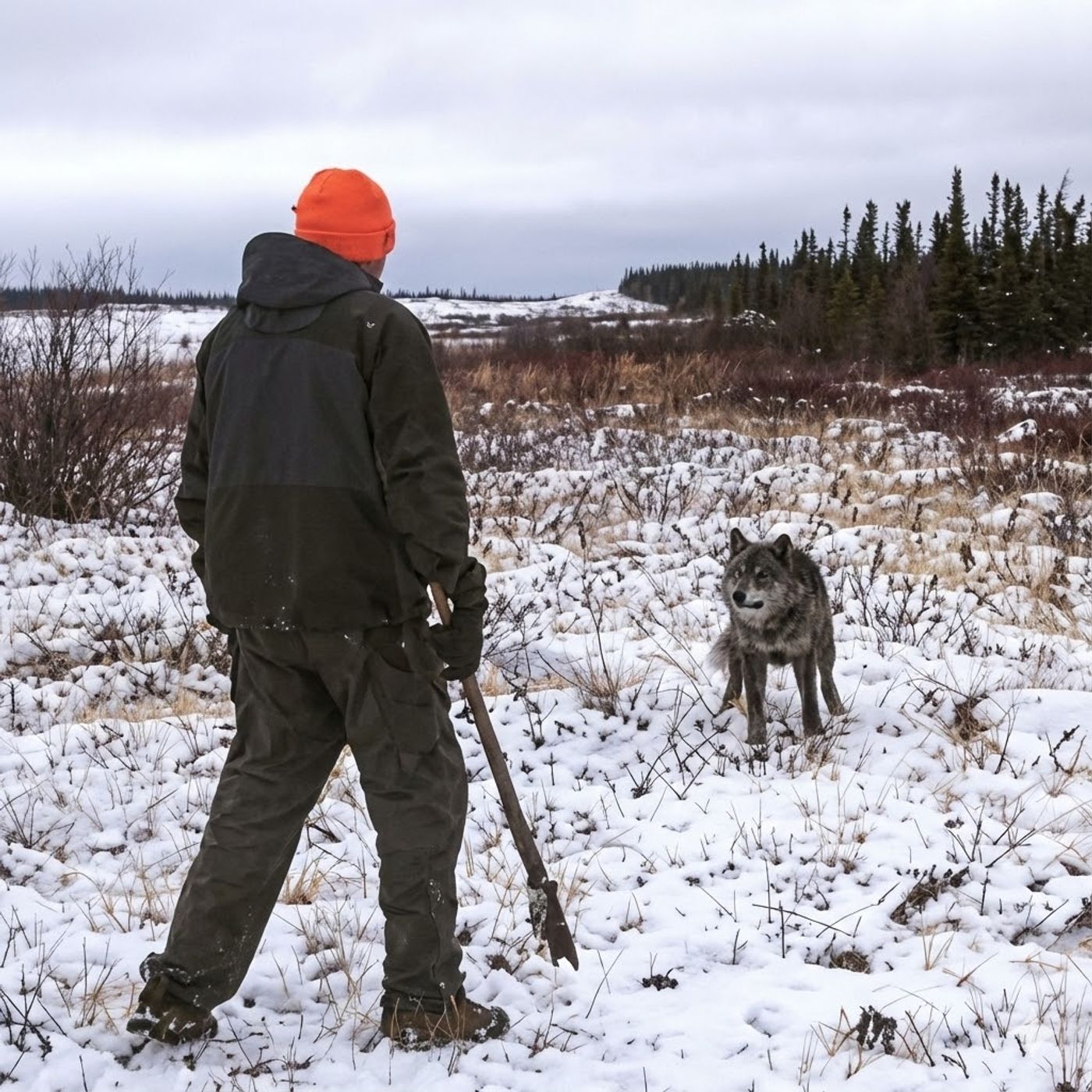
ON NOVEMBER 8, 2005 Canadian geological engineering student Kenton Carnegie went for a walk. He told people that he’d be back by 5 pm. When he hadn’t returned by 7 pm, a search party went out and discovered his remains in the woods. In this episode of Monstertalk (a follow-up to last week’s), we interview professor Valerius Geist about the true cause of Kenton Carnegie’s death. Some people thought he was killed by a bear, but more likely he was killed by a myth.Todd Svarckopf confronting a habituated wolf, four days before the Kenton Joel Carnegie wolf attack. (Photo by Chris van Gelder at North Point Landing Saskatchewan)Further Reading
- When do wolves become dangerous to humans? (by Valerius Geist)
- The Kenton Carnegie Wolf Attack on Wikipedia
Music
- Our Breath Shall Intermix by Symbion Project (used with permission)
- Le Fétichisme Dans L’amour by Symbion Project (used with permission)
Monstertalk Theme: Monster by Peach Stealing Monkeys
SEO Transcript
This is not a fully accurate transcript, and was machine generated. It’s here for helping search engines find the episode but not intended to be a faithful transcript of the episode. (But it’s not AWFUL.) Some of the material in this transcript only exists in the Patreon/Premium edition of the show and was excised for the commercial version.
———————
On the afternoon of November 8, 2005, a geological engineering student named Kenton Carnegie went for a walk in the woods of Saskatchewan. It was supposed to be a 90-minute excursion. Later, as the sun set, he hadn’t returned. A search party was formed, and what they found in the woods was horrifying. A beast, or beasts, had torn the young man to pieces. But what animal was responsible? The answer has been surprisingly controversial with two camps emerging. One side believed it was a bear and the other that it was wolves. One thing seems clear. If you go into the woods with wolves believing that they won’t harm you, there’s a chance you’ll find yourself dead wrong.
It’s actually quite unlike anything we’ve ever seen before. A giant hairy creature. Part ape, part man. In Loch Ness, a 24 mile long bottomless lake in the highlands of Scotland. It’s a creature known as the Loch Ness Monster.
MONSTER TALK
But if that’s true, then why don’t we see those kinds of behaviors in North America? I think that question’s answered pretty well in our interview today, but it’s worth noting that since 2005, we’ve had at least two probable cases of wolf predation on humans. The case we’ll be talking about in this interview is that of Kenton Carnegie, but in 2010 in Alaska, Candace Berner was such a victim as well. And in Russia, India, Afghanistan, and many other places in the world, wherever wolves and humans intersect, there’s a risk of such attacks. I don’t want to be lurid. The subject matter of this episode is gruesome and frightening. The warning here is not that wolves are fearsome man-killers, but remember that we humans are made of meat. And when it comes down to it, as far as the wolves are concerned, we’re no different from elk or deer or, for that matter, sheep. We’re not magically protected by our status as intelligent creatures. Rather, we’re damned by our soft bellies and lack of natural defenses. To understand what causes wolves to attack people, we need to understand their behavior. And the study of animal behavior is the job of an ethologist.
Today on Monster Talk, we’ll be talking with ethologist and professor emeritus of environmental science from the University of Calgary, Canada, Professor Valerius Geist, who has extensively studied the case of Kenton Carnegie and what makes wolves eat people.
Blake Smith: So you’re Valerius Geist, and you’re an ethologist and professor emeritus of environmental science at the University of Calgary?
Valerius Geist: Yes.
Blake Smith: Okay. And I came across your name while researching wolf behavior and wolf violence. And specifically about the case of Kenton Carnegie, who was killed in an animal attack in 2000.
Valerius Geist: That’s right. Yes, I was very much involved in that because his family asked me to investigate this, and I was one of three scientists who totally independently investigated the case and came to the conclusion that it was wolves that killed him. And, of course, prepared ourselves to go to court on that. And it was Mark McNay from Alaska who was chosen by the court to be the speaker. I don’t want to tell you the circumstances, but he did an absolutely first-rate job. And Mark McNay also left a large, very large… which was not published. My report was not published either, incidentally, but mine has been circulating at least in the Internet.
Blake Smith: That’s true. We’ll link to that in the show notes. Now, before we talk about the case, how did you come to study the aggressiveness of wolves?
Valerius Geist: Very simply. You see, I’m a zoologist. I retired, and we have an acreage on Vancouver Island. We moved to this acreage in 1955, and this was a wild-back paradise. We had trumpeter swans in the meadows. Canada geese, pheasants, and about 120 deer also scattered through the meadow systems back of our house. And so for the next four years, being a zoologist, of course, and a hunter, I sensed these, and we had about 30-some deer per square mile at that time point. And only once I saw a wolf track, and I was very excited by that because I had seen and observed wolves when I was doing my studies of stone sheep and mountain goats. It’s in Northern British Columbia in 1961 to 65. And I had wolves visiting my area quite commonly, about once every two weeks. And there was a group of seven that repeatedly came, and they were very visible because they were out in the open above Timberline. It was an ideal situation, much better than anything my good friend David Meach, for instance, had. And so my views of wolves were then formed by observing these very shy, very beautiful, very large animals, etc.
Now, I did work, of course, with large mammals, but only with the hoofed large mammals, with the prey of wolves, basically, and wrote in 1988 a book about deer, in which I basically offered the opinion that various species differed by their anti-predator strategies, although I had not really studied the predators myself to an extent, but I had studied the prey in detail. And then, in 1999, on the 8th of January, in fact, my son was here, and we went out after a snowfall, and lo and behold, we discovered tariff wall tracks further back into an area where there were quite a few deer. And I said to my son, by golly, maybe we’re going to have a pack this summer. Well, that’s what we did. And within three months, we had no more deer. They were gone completely. There were snowfalls in November, and I was out there sentencing, and there was not a track available. So the wolves then settled themselves around our neighbor’s place because he had sheep. They were very attracted to these animals. He had five dogs, and the wolf pack and the dogs developed a deer-enemy complex because they met roughly at 5.30 at an old railway grade. One pack on one side, the dogs on the other, and they howled and barked at each other. And this was a ritual you could set your clock by for a while. So these wolves then ran basically out of food and began targeting people. And I reported on that at a meeting of the Wildlife Society and described in some detail the seven steps by which you can recognize that wolves are targeting people. And it turns out that six years earlier, two scientists in California had described exactly the same steps for coyotes when they were targeting children in urban parks. So this is how I got into it. And I was, because we suddenly were confronted with wolves, and wolves were behaving here in a manner that nobody had ever written about in North America. But they were behaving very much like Russian wolves. And so one thing led to the next, and I began to study wolves from the perspective of when do wolves become dangerous to people. And it’s an incredible story in many regards. But that’s how it began.
Blake Smith: So the Carnegie case in particular was very tragic.
Valerius Geist: Oh my God, was it ever tragic. Horribly tragic.
Blake Smith: Yeah, it was really frustrating to read about the struggle between people who wanted it to not be a wolf killing and those who said it was. So how did that play out?
Valerius Geist: Well, the way it played out was the following. The people that wanted to make sure that it was not a wolf—It was basically Paul Paquette. Paul Paquette is a scientist whom I have known since he was a graduate student. I knew him as a professor as a graduate student. He was a fairly good man, but he has become not a scientist nowadays, but an advocate. You see, from the perspective of the wolf people in those days, it was unthinkable that wolves would attack humans because there was no history of that in North America. Later on, I’ll tell you why there wasn’t a history. There’s a very good explanation for that. But let’s stay with Paul Paquette.
So as it started out, shortly after Kenton was killed, two people that are of similar importance came to inspect the location. One was a lady. She was the coroner. She was also the information officer for the tribe, basically. And this lady had been raised in northern Saskatchewan until she was 14 years of age in the bush. And she was raised by her father as a hunter and a trapper and a fisher. In other words, she was very, very, very familiar how to make a living in the bush as a child, as a teenager. In other words, she had a very, very good education in tracking. The second person was the constable. He was also a native from Northern Bridge Club, Saskatchewan, and he was also raised as a hunter and trapper. These people were on the spot, and the RCMP officer… the native RCMP officer still saw the wolves there. He fired the shotgun to scare them away, and they inspected the area in detail, and between these two people, they wrote a very good report about what has happened. Now, when this report went to the coroner of Saskatchewan, the man probably didn’t realize the significance of the people that had investigated this tragedy, and he wanted to have it hardened up by doing it via the scientific route. And so he got two scientists involved from the University of Saskatchewan. The other one was Paul Paquette.
Well, Paul Paquette came, and all that Paul Paquette had to work with is what the rest of us had to work with after the fact. And that was the pictures taken by the constable of the tragedy and the scene. And I can tell you the pictures of the body is something the most horrible you can imagine. They are not available. God thanks. The family has withdrawn them, and they’re keeping them under lock and key, basically. And I don’t have them either. I returned my copies to them. But when Paul looked at the pictures, he saw there was a lake, and there were very large holes in the snow. And he said, this couldn’t possibly be wolves. It must be a bear. Well, what he made a mistake of was so elementary, particularly in the coroner’s hearing that it came out, was so embarrassing, is that if you live in the North Country and you travel across a lake, you know very well that the lake ice buckles, and that there are going to be lenses of water standing on the ice covered by snow, and you are going to break through those things, guaranteed. And so if you walk across it, it’s going to be your footsteps in the snow, very nicely, and all of a sudden, boom, you break through into the water below, which is usually about six inches or something like that. Normally, these overflows are quite shallow, yeah? And you’re going to have a huge footprint as a consequence. And that’s elementary tracking. Everybody who has worked to any extent in the North Country, like I have, knows right away that if anything runs across the lake, you’re going to have these big things as well as the tracks. What counts was, of course, the tracks on land as they came out from the ice. And so we then took the pictures, and I know that Mark McNay took his to four colleagues in Alaska, and they examined everything. They could find only wolf tracks and a fox track, incidentally. And I sent mine to some colleagues in Finland. Not that I cannot interpret. I can. And I interpreted what I saw in front of me as being wolf tracks. And they also came up, which is very cute, with a fox track.
Blake Smith: There’s no bear tracks anywhere. There are human tracks, wolf tracks.
Valerius Geist: Yes, but no bear tracks. And besides, there was fresh snow on the ground. So that was a group of scientists that examined the fox tracks. But after the coroner and the officers had examined them, the Saskatchewan government sent up two game wardens. They came a day late, and they also examined the scene, and they also could find nothing else except the wolf tracks. And remember, if a bear had gone into the area, no matter how much trampling had occurred in the spot where Kenton Carnegie was killed, all you had to do was go a little bit further to see where… if the bears, if they were entering, were coming, you would see the track. And bear track is utterly unmistakable. None of that was happening. So we had two native people that examined the track. We had two very competent hunters, incidentally, also examining this area, only found wolf tracks. We had two game wardens examining this. They also found nothing else. And we had, looking at the pictures, four scientists from Alaska and two scientists from Finland and myself and Mike McNay and another gentleman from Ontario, another scientist from Ontario. All we saw was wolf tracks. Now, the only way a bear could have been there is if he had wings, he was flying, and his feet never touched the telltale snow.
Blake Smith: Which is very unusual for bears, right?
Valerius Geist: It would have been a touch unusual for bears. There we go. That’s right. I have written a lengthy article about that, just to clarify it, and there’s been another article, a good one, that came out on it as well. They’re available, and I can send them to you if and when you need them. But what was more interesting to me was to then investigate why, what were the circumstances that led to this huge tragedy, and why did it happen, and why, for that matter, did we have wolves behave in one way globally, and quite another one in North America. And it was crystal clear that here on the island, I had the situation where the wolves were behaving globally. I called them, they behaved like Russian wolves. And the conditions of these were that they run out of food, basically, that they are in close proximity to habitations, that they then take down dogs and cats, then they turn on to livestock, and eventually they target human beings. We’re the very last in line, mind you, but we are still on the menu. That very last point, mind you.
So what’s the difference between here, Russia, oh my God, in France, there’s a book out where the historian describes over 3,000 deaths. 3,000 people killed in France. And in Italy, something similar. In Germany, anyway. Why the difference? Well, the difference is very simple. From 1920 onwards into the 30s, 40s, 50s, ending in the 60s. We had a situation where in the heartland of wolf distribution in North America, which is Canada, northern Canada, there were thousands upon thousands upon thousands of impoverished men, trappers, which were trying to make a grub stake catching fur and making less than $500 a winter, incidentally. And desperately poor men, particularly in the 1920s and 30s. And that was virtually the only thing to have. There was no social assistance or anything of this nature. If you wanted to eat, you better have money. The only way you got money was you went trapping. And so we had, in Alberta alone, 5,000 trappers, licensed trappers. British Columbia, Saskatchewan, Manitoba, and so on and so on and so forth. You can see there are tens of thousands of trappers. Now, these trappers had no loves for wolves. Guaranteed, because for two reasons. Whenever wolves show up, game disappears, and the men have nothing to hunt and kill for themselves and their dog teams. And that was very bitter when that happened. There was nothing to sneeze about. I have followed the writings of some of these trappers. They escaped starvation, sometimes by a hair. It was so important for them to have wildlife available to kill and to shoot for themselves. So when wolves showed up, gone was the wildlife. The second reason is that wolves followed their trap lines, which were very long, and wolves could travel a long ways, and the wolves would destroy the fur that they had caught. So they had absolutely no love for wolves, and with every means, legal or illegal, they were trying to capture these wolves on the trap line. Now, they were, on top of that, encouraged by a bounty. And the bounty was set in such a fashion that it was worth while bringing in the wolf for bounty than selling the fur. And this was recognized, the worthlessness of the fur, in other words, was recognized. So all they had to bring in at Alberta was just simply the scalp of the wolf, and they were getting their full payment there.
So, first of all, the trappers, encouraged by a bounty and the misbehavior of wolves, were trying to kill every wolf possible. Then there were native people, which were also participating, but which we know very, very little. On top of that, we had predator control officers, which were operating in the livestock zones, and they were killing every wolf in sight. Then it was taken as good behavior and good form for wardens, I know that in British Columbia, to go out after the season poisoning wolves. On top of that, you had an open season on wolves for anybody to kill them anytime, anyplace, wherever you want to. From the bounty records, we know that the trappers brought in for bounties roughly in Alberta about 1,000 wolves a year at peak periods. And it turns out that there was roughly one wolf killed for every five trappers. It means it’s not that easy to do so. Well, in addition to that, a rabies breakout in the early 1950s in the north led to fairly massive wolf poisoning from the air by horse meat being thrown out of aircraft. and onto lakes and along river systems and so on and so forth. And that was terminated in 1961. And that’s when I went to the wilderness, incidentally, in 1961. And we had wild back coming out of our ears at that point because of the severe reduction in wolf populations which had taken place.
But the most important thing is that everybody who knew wolves in Canada, myself included, knew them only when they were at low concentration, absent in most areas, very very shy and these wolves were of course no problem they didn’t kill livestock because if they did they were dead in a very short time killed by livestock by federal control officers and the wolf is in fact some of the most remarkable observations were made in that period because we had height of rabbit concentrations which happened every 10 years and the wolves were taking advantage of those and when they were on rabbit feed they ignored everything And so my good friend, the late Reinald Eben Ebenau, describes how wolves are hunting rabbits right in amongst wintering moose, and the wolves don’t give a damn about the moose, and the moose don’t give a damn about the wolves. Remarkable observations of that kind. So when the wolves are at very, very low number, when they’re being controlled by one of the most murderous machines that has ever existed in controlling wolves, of course, there are no attacks on humans. There are no attacks on livestock to speak of. Wolves are very shy indeed. It’s only when they run out of feed, when they are in close proximity of humans, that they become a totally different animal. And so everybody who has studied wolves ignored what I have just told you. They were not aware of that. And they thought the kind of wolves that they met was the natural behavior of wolves. It wasn’t. It was the most unnatural behavior because it was an artifact of extreme control.
Blake Smith: What are the signs that wolves will hunt humans?
Valerius Geist: The signs are that they begin to observe humans. They sit down and watch and watch and watch and watch humans. And eventually they come closer and closer to humans. My wife and I have experienced a wolf coming to within about 10 faces of us, standing there, watching us. wolves are observation learners. We know that from studies carried out by colleagues that studied wolves. They’re observation learners and they learn, I don’t want to go into detail, but the point is this is how you know that the wolves are targeting you because they keep on watching and watching and following you and watching you. And then comes the preliminary attacks which were beautifully described for the Kenton Carnegie case because four days before he was killed, two wolves attacked two Men from the camp, one a pilot, the other one a physicist. And the two young men grabbed hold of little trees growing in the bog and smashed them towards the wolves and kept the wolves away and thought it was a lark, basically, and returned to camp. But they took beautiful pictures of the wolves and thought this was an exploratory attack. And that’s totally predictable.
Blake Smith: So it sounds like in India, from my research, as well as in Russia,
Valerius Geist: Oh, my God, yes, India and Russia and Japan and Korea and Turkey, Finland, Germany, France, Italy, all of those places. If you had the time, I could send you the articles I’ve written about that. And my originals have all the references in it. Look at that.
Blake Smith: Yet there seems to be this sort of myth that wolves don’t harm people.
Valerius Geist: That’s a myth. And by the way, this myth has killed not just Kenton Carnegie. It killed three people that I know of.
Blake Smith: Well, that is very helpful. I really appreciate your time on this.
Valerius Geist: Okay. I have to run, actually.
Blake Smith: Yeah, I know. I know. So thank you so much for talking to me. I really appreciate it. And we’ll put links to your material on the website.Valerius Geist: Thank you.
Post navigation
Contact [email protected] to advertise on this show.
MonsterTalk is a proud member of the Airwave Media podcast network.
MonsterTalk is an Amazon Affiliate and where possible we will utilize Amazon Affiliate Links to provide financial support for the show. Your purchases through our affiliate program provide a tiny but helpful method of support. Please consider becoming a MonsterTalk Patron for more substantial assistance in sustaining our mission of promoting science and rationality while celebrating the mysterious and exciting mysteries of the world.