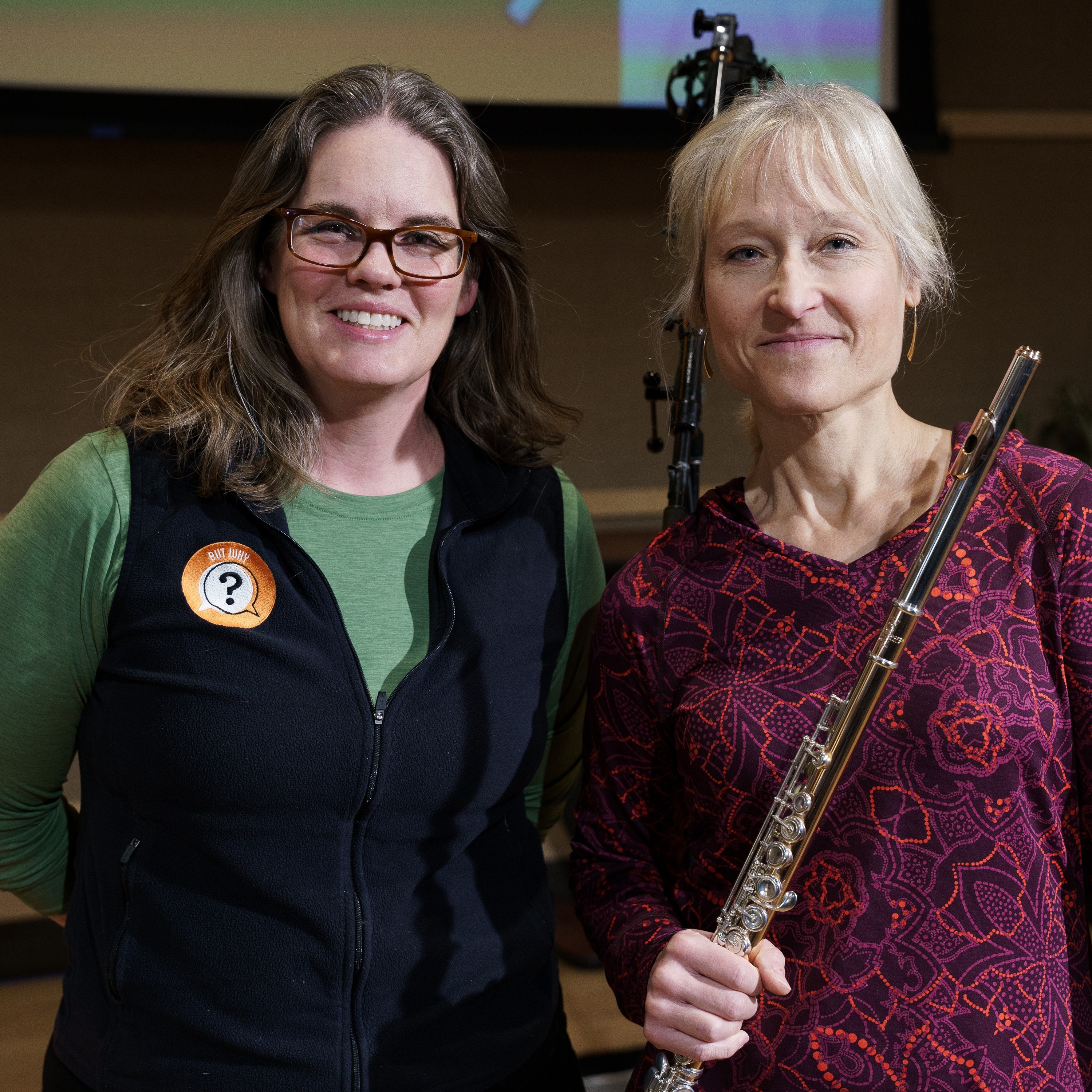
What’s an oboe? How does a flute work? What’s a viola?
Episode Transcript
Jane: This is But Why: a Podcast for Curious Kids.
I'm Jane Lindholm, and today we're making the show a little bit differently from how we normally do it.
We are joined by a live audience right here at our Vermont Public studios.
Say hello everybody!
We are so pleased to welcome you here for our first ever Curious Kids Day at Vermont Public and the theme today is exploring music.
So for this episode, we're joined by musicians from the Vermont Symphony Orchestra.
I have a few questions for them, and then we'll turn the microphone over to you guys.
Okay.
Is that okay?
Okay, great.
So joining me here on stage first today is Melissa Meilens, who knows what instrument she has brought with her?You can shout it out if you know it.
Did they get it right, Melissa?
MelissaMelissa: They did.
I'm impressed.
JaneJane: You play the flute.
Can you take us through some of the sounds that a flute can make?
MelissaMelissa: Sure thing.
JaneJane: What happens if you just blow through that hole at the top of your flute like I'm blowing air out of my mouth like this.
That doesn't sound as good.
MelissaMelissa: No, but there's a fun thing to think of if you want to get a nice sound on the flute.
How many of you have slurped in a spaghetti noodle?
Yes, it makes a nice, big mess.
Anyways, if you think about taking the spaghetti noodle back out of your mouth the same way it came in, that's kind of what I do, to make a sound on the flute.
I do it across the flute and thank goodness there's no noodle that's coming out.
JaneJane: Well, that would be gross.
I'm picturing a lot of spaghetti sauce inside your flute.
MelissaMelissa: Oh, bad scene.
JaneJane: So what does it sound like if you make a bad note on the
MelissaMelissa: That's just not really having an embouchure.
An flute?
embouchure means the way you hold your mouth.
So like I was saying before, it's the whole sucking the noodle or spitting out the noodle position.
Another thing you could think about is if you say the about is if you say the word pool, pool, think about how the corner of your mouth goes pool.
That's what I do with the corner of my mouth that helps me shape my mouth to get a better sound on the flute.
JaneJane: What was that word you said again for how the shape of your mouth is
MelissaMelissa: Embouchure.
JaneJane: How do you spell that?
MelissaMelissa: E-M-B-O-U-C-H-U-R-E.
It's actually a French word.
There's a lot of French history with the flute.
JaneJane: And how does it work?
We know you blow air through it.
That's what you just told us about.
But what is actually happening?
MelissaMelissa: I'm actually blowing across and part of the air is going into the flute, the side of the flute, which then is rocketed down, and vibrations start to go through the body of the flute, and then a sound is produced.
And if I move my fingers on these keys right here, that will change the pitch as I blow.
JaneJane: It's beautiful.
Let's see if we have any questions from the audience.
Melody and Sarah are here, so you can raise your hand if you have a question for Melissa, and they will come around and have you ask them.
IsabellaIsabella: My name is Isabella, and I live in Vermont in Royalton, and I'm seven years old, and I wonder who taught you to play the flute.
MelissaMelissa: I had several teachers and flute was actually not my first instrument.
I started violin when I was four, then I played piano, then I played clarinet, and then I had to figure out what instrument, because I just loved music and I loved instruments, and by time I was in sixth grade, I decided that flute was really what I wanted to specialize in.
BlakeBlake: My name is Blake, and I'm five.
And why do you like to play music?
KidKid: Why do you like to play flute?
MelissaMelissa: I like playing the flute because of all those instruments I mentioned before.
For me, somehow it was the easiest one.
And there's something when I opened up the case, I really liked that I could put it together in this long, horizontal stick.
And I just thought that was cool.
And I like the sound of it too.
But I don't know.
There's just something about being able to hold it up like this that was different from other instruments.
JaneJane: I don't know if you can take it apart right now, or if that then you would need to tune it again, but your flute doesn't it's not always this long, and in case it comes apart into different pieces.
MelissaMelissa: Right.
I could take it apart.
There's three separate pieces.
There's the head joint, which I can make a sound on by its own.
If I stick my finger in the end, I can change pitches too.
And so this.
Then it's called the body of the instrument, where you see most of the keys.
And then there's the foot joint, which makes it a little bit longer as well.
OliverOliver: My name is Oliver.
I'm five years old.
And what kind of musics can you play?
JaneJane: What kind of music can you play, Melissa?
MelissaMelissa: I can play music from all different kinds of history.
I can play it from 200, 300 years ago.
I can play music that was written now.
I can do some what's called extended techniques.
So that means, like I can, it's called flutter tonguing.
But what it really is is I'm growling into my instrument.
So I get a different sound, like this.
Then there's something that means you also like articulate or use your tongue a little bit and get that kind of thing.
JaneJane: Do you ever listen to music on the radio and think I could play that and play like Taylor Swift for yourself?
MelissaMelissa: No.
KidKid: I'm six, and I live in ferrisburg.
How many, how much music do you play?
MelissaMelissa: When I practice, I'll practice two hours a day, and then if I have orchestra work, that could be two and a half to five hours a day, or if there's a concert.
So each day is a little bit different.
I also teach flute, and I'm playing my flute while I teach, and some days are crazy, and I'll be teaching all day long, so it's hours and hours of playing, and that's okay, because it's what I love to do.
JaneJane: When you are playing for three or four or five hours, you're practicing, and then you're teaching, and then you're doing something else.
Are your lips really tired at the end of the day, or your fingers?
MelissaMelissa: They're not unless, if I haven't been...it's like a sport like you don't just suddenly go and run 25 miles.
You work yourself up to that.
So as long as I'm running several miles a day or practicing my flute several hours a day, then it's okay, but if I take some time off, say I go on vacation, this doesn't really happen, but if I went on vacation for two weeks and I didn't touch the flute when I came back, I would not sound so good, and I would get tired sooner, and it would take some time to get back to where I want to be.
AntonioAntonio: My name's Antonio.
I'm four years old, and I live in Jericho, Vermont, and how do you play the flute?
JaneJane: So how do you you've told us a little bit about how you play.
So you're blowing through your mouth, and you told us about your mouth position.
How about your fingers?
What are you doing with your fingers?
MelissaMelissa: For each different tone, I have a different finger position.
And what's interesting is the lower I go with the pitches, I keep adding fingers, so I'll start a little bit higher, and then I add a finger and go lower, and I have to stop and take a breath because I'm blowing the whole time.
So if I didn't take a breath, I'd be passed out on the floor, and that's not a good scene.
AdelaideAdelaide: My name is Adelaide.
I'm nine.
I live in Hartland, and is the flute one of the hardest instruments because it takes the most air.
MelissaMelissa: I think that a lot of people might argue that their instrument is harder, or something like that.
I actually don't know if flute is the hardest instrument, at least for me.
Maybe that's why I chose it, because it was kind of easy for me.
But if I was choosing something like oboe, I think that would be a lot harder, because oboe has a reed that they have to play through, and the reeds have to be just right, and they spend a lot of time just working on the reeds.
I'm lucky, because I just put my metal flute together and I blow and I'm good to go.
LuluLulu: My name is Lulu.
I'm seven years old.
I live in Vermont.
My question is, how many songs do you know?
MelissaMelissa: Honestly, maybe even 1000 so many, so many.
Um, because I've been playing a long time, over 25 years, I've played a lot of music, and I can also have a lot of experience.
So I can just look at something and play something new.
And depending on how hard it is, like how many notes you see here, right?
Sometimes I can play it perfectly the first time.
Sometimes I need to practice it on those two three hours of practicing.
HarperHarper: My name is Harper.
I'm six years old.
And how many instruments have you played?
MelissaMelissa: Violin, piano, a little bit of trumpet, which was terrible.
My mother told me I sounded like a love sick moose when I played it, whatever that is.
Clarinet, Piccolo, saxophone and flute.
So I guess that ends up being seven
KidKid: When you said that you played the piccolo.
What is a piccolo?
MelissaMelissa: Ah, a piccolo is a relative of the flute.
It is a smaller version of the flute is maybe the size of the head joint.
And you're, so it's very small.
And so this is an interesting thing to remember, the smaller the instrument, the smaller the distance the air has to travel, the higher the pitch.
So a piccolo sounds one octave higher than the flute.
So if I'm playing on the flute, if I'm playing this, it actually that's one of the medium notes on the piccolo.
So it's a lot higher, and I think that everyone be shaken out of their boots if I play piccolo here right now.
KidKid: Isn't the flute in the brass family?
MelissaMelissa: it's in the woodwind family.
So originally, woodwinds come from wood instruments.
I'm not so familiar about the brass family history, but they're all made out of brass.
But you know what?
We're a little bit similar in that we all blow through an instrument to create sounds.
JaneJane: Well, since we're all now friends here, will you play a song for us before we end to show us what the flute can actually do?
MelissaMelissa: I would love to thanks.
I want to tell you a little bit about my song or piece that I'm going to play.
It's called Dance of the Goat.
It's by Arthur Honegger, a French composer, and it's a short piece, but there's like a little story behind it that I think works.
So at first the goat is sleeping, then he wakes up a little bit, and he's a really playful goat, and he likes to dance, so you'll hear like a little bit of a dance moment, but he's still waking up.
Has a little bit of breakfast, nourishing breakfast.
The breakfast starts to kick in, and then his light, happy nature comes out, and he starts to dance.
Breakfast kicks in some more.
He dances some more, a little bit faster, a little bit harder, and he's having really good time.
And then he looks over on the horizon, Ah, love interest, friend, I don't know, so you'll notice that the music changes and becomes just a little bit more relaxed and mellow.
And he meets his new friend, and the friend likes to dance too, and so they dance together crazily, wildly.
They exhaust themselves.
And then before you know it, the day is over.
They say goodbye.
There's one last little romantic melody and he goes back to bed and goes to sleep.
I hope you Enjoy it.
[music]
JaneJane: That was beautiful.
Thank you.
That was Melissa Mielens, who plays flute with the Vermont Symphony Orchestra.
Coming up.
What's an oboe?
I'm Jane Lindholm, and this is But Why: a Podcast for Curious Kids.
Let's get back to our live episode with musicians from the Vermont Symphony Orchestra.
Joining us here today is Katie Oprea, who plays the oboe.
Katie, what a pleasure to have you with us.
KatieKatie: Thank you.
It's really a pleasure to be here.
JaneJane: I already said it's the oboe, so I gave it away.
But what is an oboe?
KatieKatie: Well, an oboe is a member of what we call the woodwind family.
So the oboe is a wind instrument that you play by blowing into it, and the instrument itself is made out of wood.
Now, my oboe does not look like wood because it's black, but the wood that's used for this instrument is special.
It's very, very dense, and it has this dark, dark color as part of the fact that it's so dense, it's so dense that if I dropped this in the water, it would sink.
So I try not to do that.
The other thing that's special about the oboe is that the sound is produced by a reed, which is not that special.
I mean, clarinets and saxophones have a reed, but the oboe has what's called a double reed.
So we say it's double the trouble.
But what's cool about the double reed is that it's two pieces of cane that are tied together, and I can play the reed all by itself.
So this is the beautiful sound of the oboe reed.
JaneJane: Oh, that is just so gorgeous.
Couldn't you listen to that all day?
Yeah, Katie, that's beautiful.
KatieKatie: Well, you can actually play songs on it too.
So if you just kind of move it like further into your mouth and further out of your mouth.
That changes the pitch.
So I can play like I can play a little song like this.
JaneJane: I mean, I'm still not sure that's beautiful.
KatieKatie: No, okay, all right.
JaneJane: So what does it sound like when you put the reed in the instrument.
Can you play some of the sounds that an oboe can make?
KatieKatie: That's a bit different from just the reed,
JaneJane: that sounds much prettier.
Take us through the range of sounds an oboe can make from high to low, or low to high.
KatieKatie: So the lowest sound noble can make is a B flat.
Well, a low B flat for us, the highest sound kind of depends, because once you get it really high, it just sounds like a bunch of squeaks.
So that kind of, that end of the instrument is a little bit more, you know, picky and choosy.
Like, do you really want to sound like that?
Sometimes you do, but most of the time you don't.
JaneJane: How do you use your mouth to make that noise?
Because if you just put your mouth on the oboe and hum or blow, what's that going to sound like?
KatieKatie: It doesn't sound like much.
So if I just blow through the reed, it doesn't sound like anything.
What my mouth really does is just makes enough of there's enough pressure on the reed between my mouth and my air that it vibrates really, fast, and that's what makes the sound.
I don't make the sound.
It's not like an instrument where, you know, I make a funny like a buzzing with my lips, like you would do with a brass instrument.
It all depends on the reed.
JaneJane: And you're not making the different sounds with your mouth than once you're blowing through it.
You're not going doo doo doo doo doo doo doo.
You're doing that with your fingers.
What are you doing?
KatieKatie: Well, the fingers, actually, all of the woodwind instruments are kind of engineered the same way.
So a woodwind instrument is just a big, long tube with a bunch of holes in it.
If anyone's ever played the recorder before, you kind of know how this works.
So to make a lower sound, I'm going to have more holes on the instrument closed so more of my fingers are down.
When I have just one finger down, that actually makes the tube the air is traveling through shorter.
The more fingers I put down, the lower the note, the less fingers, the higher the note.
FernFern: My name's Fern.
I'm seven years old.
I live in Richmond, Vermont, and my question is, why can't you see music notes?
JaneJane: Why can't you see music notes?
KatieKatie: Wow, that's a really good question.
In a way, I can see music notes because I can read them off the page.
But music is, it's just sound.
I say just sound, but it's, it's taking sound and making something like a picture, painting, a picture with sound.
So like, if you look at a piece of art.
If you look at a painting, can you hear a painting?
You can't.
Can you can you read a painting?
All you're doing is, is looking at it and seeing it with music.
When you're listening, that's that's all you're really doing is hearing the sounds and listening to the sounds.
But those sounds, your brain takes all that in and turns it into a story or a painting or an emotion or or something more than just the sound.
So I think that's what's magical about music.
That's why we love to play music and listen to music.
HarveyHarvey: My name is Harvey, and I am six years old, and I live in Bristol, Vermont, and my question is, can oboes be different sizes?
JaneJane: Can oboes be different sizes?
KatieKatie: I love that question.
Yes, they can.
This is, this is a standard oboe, but the oboe...
JaneJane: And if you you held that out, Katie, that's about the length of your arm, right?
KatieKatie: Um, yeah, it is.
It's about the length of my arm, but you have a bunch of different sizes of oboe, and the bigger the oboe, the lower the sound.
And I there is one size smaller than this that plays a higher sound.
But you don't hear them very much.
You don't, it's not very common.
There is one kind of relative of the oboe you hear a lot, and that's called the English horn, and that is longer, and it does look different, because the the bottom of the oboe on the English horn has a different shape, but it just plays everything lower.
So it's kind of like a like a tenor oboe.
This is like a soprano oboe, which is high notes, and then the tenor oboe is kind of a little bit lower down.
IsaIsa: My name is Isa and and how old am?
I am five, even, even I live in Montpelier.
And my question is, how can you really play it by using my mouth?
JaneJane: Yeah.
How do you play it using your mouth?
Tell us more about the reed.
KatieKatie: Okay, so the reed is actually, I think, the the coolest part of this instrument, and it's, it's made by taking two pieces of material that are called cane and tying them together onto a tube.
And actually, when you get to be a good oboist, you make your own reeds.
So these are reeds that I made at home.
And when I play it, all I have to do is put the reed in my mouth and hold it.
You do have to kind of be careful how you hold it.
If you bite the reed, it's not going to work.
And if your lips are too floppy, it's also not going to work.
So you have to kind of practice and get so that you're holding it just right, and it's just the air that I'm blowing.
You have to blow very, very, very hard and very consistent air to make the oboe work.
But if you blow hard enough, then you get a sound with just the reed.
KielKiel: Hi, my name is Kiel, and I live in South Burlington, Vermont.
I'm six years old, and my question is, how instruments invented?
JaneJane: Oh, how are instruments invented?
We might have to do some research on that.
But do you know Katie, anything about the history of the oboe in particular?
KatieKatie: Yeah, lots.
I mean, the first instrument is an instrument we all have, right?
It's your voice.
That's the first instrument that any person ever ever learned in the entire history of humankind.
So voices were the first we learned how to talk, but we also learned how to sing.
So you're carrying around instruments with you every day, all day, every day, and you can use those instruments anytime you want just to sing.
Then they kind of started hitting things with sticks, and probably invented percussion instruments, right?
But the first wind instruments were flutes, and the oboe has been around for hundreds and hundreds of years when somebody thought, well, I can make a sound with a flute.
What if I stuck this reed on there and tried to make a sound?
Ooh, I like that sound.
Let's keep doing that.
VeraVera: How did you learn to play the oboe?
My name is Vera.
KatieKatie: My father actually was a music teacher.
And when I was 10 years old, I said, what instrument do you need in your band?
And he said, I need an oboe or a French horn.
And I said, I don't want to play a brass instrument.
I'll try the oboe.
And he taught me how to play, and I started out just playing the reed.
So the first thing that I did, and that I have my students do, is just play a long tone on the reed without the instrument, and then, as I got stronger and better at that, I put the reed in the oboe, and I learned one note at a time how to play every note that I can play today.
LilyLily: My name is Lily, and I'm seven years old, and I live in South Burlington.
What's your favorite song to play?
KatieKatie: Oh, wow, there's so many songs.
It's hard to choose one that's my favorite to play.
I think sometimes it depends on how I'm feeling.
So some days I like to play things that are that are very big and beautiful and peaceful sounding.
And sometimes I want to play things that are really fast and happy sounding.
I think my favorite kind of music to play.
I really love playing in an orchestra, and I love playing music by composers that wrote things like Johannes Brahms, who wrote great big symphonies that are just, just so gorgeous, and you get to sit in an orchestra, you're in the middle of this group of people, and you're all working together and making these beautiful sounds.
That's my favorite thing to do.
ZaneZane: My name is Zane, and I'm four years old.
What is your favorite sound?
KatieKatie: I guess my favorite sound on the oboe would be a particular note that I think sounds prettiest.
It's got a very pure sound.
It's a very stable note.
So that's probably my favorite note.
My favorite sound in life, I think, is laughter.
I think hearing people laugh because it makes you feel like laughing yourself makes you feel good.
HarveyHarvey: My name is Harvey.
I'm seven years old, and if you want to play the oboe, what instrument would you start with first?
KatieKatie: Well, I started with the oboe, and I have a lot of students that start with the oboe, but sometimes it's good to try a different instrument first, because the oboe is pretty challenging.
So I think the flute is very close to the same fingerings as an oboe, so that's a good one to start with.
The saxophone has almost exactly the same fingerings as the oboe, so I actually have a lot of students that started on the saxophone, and the clarinet is pretty good too, but the clarinet fingerings are different, so sometimes that's confusing.
But I would say that if you start on an instrument, even if it's doesn't have anything to do, even if you start, like on the tuba or the trombone, if you think, Wait a second, I think I like the sound of the oboe better, let me give it a try.
I would say try it.
Because when you find that instrument that you like, you're going to figure out how to play it one way or another.
GrantGrant: My name is Grant, and I live in Essex Vermont.
I'm nine years old, and my question is, what was your favorite instrument?
KatieKatie: Well, my favorite instrument is the oboe.
But I think I'm prejudiced if I also, I've actually, I think I love just about every instrument I've ever heard, because they all kind of add something new.
SeamusSeamus: Hi, I'm Seamus.
I am in Jericho, Vermont.
I'm five years old, and my question is, how were instruments made?
JaneJane: There are lots of different ways that instruments are made and lots of different materials.
You mentioned that your instrument is made out of wood.
How is it actually made?
KatieKatie: Well, they take blocks of the wood, and they drill up through the bottom of the wood to make the inside.
Because that's actually it's funny, because we think the outside is the most important part.
The inside is one of the most important parts of of any instrument, because the shape changes the sound.
So the oboe is a conical instrument, so the top is small and it gradually gets bigger all the way to the bottom.
The clarinet is more of a cylindrical instrument, so the top is one size, and the bottom gets a little bigger, but not much, and that makes a completely different sound.
So for.
The oboe, specifically, we take the wood and you bore a hole up through, drill a hole up through the bottom of it that is going to be conical, so small at the top, big at the bottom.
And then they drill the holes to make the keys.
And they have molds that they use where they take silver and they make the keys that are going to go in there.
But underneath the keys, they have pads that are made of things like cork or paper, because these can wear out.
So these have to get changed sometimes, and it takes a lot of years to learn to make an instrument like this.
It takes a lot of experience and time and practice.
So our instruments, when we play an instrument, when you play it seriously and are really into it, you want to take extra good care of it.
And as a matter of like etiquette, it's not polite to touch another person's instrument without telling them, and it's not polite to pick up another person's instrument or play it without asking permission first.
KidKid: I'm from Lyme, New Hampshire, and my question is, do oboes have a certain number of keys?
Or can they have any number?
KatieKatie: They have a certain number.
I have to count now, 6, 7, 8, 9, 10, 11, 12,13, 14, 15, 16, 17, 18, 19, 20, 21, 22, 23.
This one has 23 some of them have an extra key here that would make 24 and student instruments have fewer, so like 1, 2, oh wait, no, I have 24 so minus 24 sometimes they have 25.
So a student instrument would have around 21 keys.
Okay, so if you're starting out, you don't get as many, because my pinkies are what get busy.
I have extra keys for my pinkies, but a student instrument wouldn't have all those.
So 25, 24 that's pretty standard.
JaneJane: Katie, will you play us a piece to really show off what the oboe can do and tell us what you're going to play?
KatieKatie: Sure.
So this is a piece for oboe by a composer from Serbia.
Her name was Isidora Ziebeljan.
And I really like this piece.
I like the way it sounds, but I also like it was written in 2005 and so the oboe is really old.
It's been around for a long time, and a lot of the music I play was written hundreds of years ago.
This was written in my lifetime, and it actually uses a lot of kind of folk music from the area where she lived, and it's called the Miracle in Chargon.
[Music]
JaneJane: That was Katie Opera on oboe.
Joining me here is Stefanie Taylor, who plays what instrument.
If you know what it is, shout it out.
I heard a lot of violin.
Is that what you play, Stefanie?
StefanieStefanie: Not today, not today, but I did hear it.
It is a viola.
It's a little so it's a it's a bigger version of the violin.
Some might even say better version of the violin.
JaneJane: I don't know now, Stefanie's starting a fight.
Why do you think it's better than the violin?
StefanieStefanie: Well, the viola, the viola is, it is a lower sound.
It's a little bit more mellow sound than the violin, and I think it really imitates a human voice.
So I, I really love it, but, but I do play the violin.
JaneJane: Will you show us some of the sound a viola can make?
StefanieStefanie: It's made out of wood, and it has four strings, and I'll play each of the four strings for you.
JaneJane: It's tough for Stephanie to play and be in front of the microphone.
What happens when you move your top fingers up and down on the strings while you play.
StefanieStefanie: Well, when I want to change the pitch of the string, I shorten the string by putting my finger down on it.
So if I play this as a D string, if I put a finger down and another I can play a scale, and what, really what I'm doing is I'm just, I'm shortening the length of the string as I do that, which raises the pitch.
JaneJane: What happens when you play two or three strings at the same time?
StefanieStefanie: We get to hear both pitches resonating at one time, which I think is really beautiful.
JaneJane: What you're using to make the sound or make that sound smooth, is something in your right hand called a bow.
What is a bow?
StefanieStefanie: So this, this is, it is a piece of wood with, does anyone know what that white stuff is?
Your hand went right up.
What is that?
That's right, it is from the tail of a horse, and it's bleached.
It's not just from white tails, and the horse doesn't is not harmed when we take the horse hair.
It's just kind of like having a haircut.
So the horse hair is stretched between these two ends, and it has, actually has quite a lot of tension, but the bow actually still needs to be flexible.
And a long time ago, the bow looked actually more like a bow, like what you think of like with a bow and arrow.
JaneJane: You can play this instrument without a bow with just your fingers.
Can you describe or show us the difference in sound?
StefanieStefanie: Yes, so, so this, this technique is called pizzicato, and it's an Italian word.
It just means plucked.
And what I'm doing with my finger is I'm pulling the string, and that makes it vibrate.
Can then I can do a really hard, pizzicato like that, that has a different sound.
So there's a big variety of sounds that I can make with my finger, but not as many as that I can make with my bow.
When you're making your sound with the bow, though, the string is still vibrating, because that's how your instrument is making the sound, rightThat is true.
What I'm going to do with my bow is actually the same thing I did with my finger.
Is I'm going to pull the string, but this time, I'm going to pull it with the horse hair that has some kind of little nub, nubs on it that makes it a little sticky on the bow.
Plus one thing you didn't get to see is I put rosin on my bow.
Now, has anyone ever seen rosin people, gymnasts or dancers, put rosin on their right rosin, powdered rosin is sticky.
And string players use cake rosin and spread, excuse me, we spread it on the horse hair of our bow, which helps it to be a little stickier, and that helps me grab the string with the bow and makes the string vibrate.
So I'm going to pull, I'm on the string, and I pull the string, and that is essentially the same thing I'm doing with the pizzcato, but I can make the sound last much longer now, so instead of I can do and I can make much more of a singing sound with the bow.
JaneJane: So we know we need the strings.
We know how the bow helps.
Why do you need the rest of the instrument?
StefanieStefanie: Has anyone ever made an instrument, even with an oatmeal box and strings, all of those instruments that you made, the body of the instrument is going to help, help amplify the vibration, make the vibration bigger, so the strings vibrate, which also makes the wood vibrate.
And there's a little post in the instrument that holds the two pieces together, everything vibrates, and that is what makes the sound.
HanaleiaHanaleia: My question is, how frequently do you practice?
And my name is Hanaleia, and I live in Burlington, Vermont.
StefanieStefanie: As an adult, with my own children and a lot of different things to do, I don't practice, I don't practice every single day.
I wish I did.
I would feel better and I would play better if I practiced every single day.
I practice most days, and I play most days.
When I was a child, and I started playing violin when I was seven, I didn't practice every day until, I think, when I was about 12, I started practicing every day, and then I practiced a lot for a long time.
FreyaFreya: My name is Freya and New Jersey, and my question is, how many instruments are there in the world?
And I'm five years old.
JaneJane: Oh my gosh, how many instruments are there in the world?
We might have to do some research to answer that one.
But do you have any guesses, Stefanie?
StefanieStefanie: Actually, my guess is maybe towards that infinity number, because there are, there are instruments that are very traditional and that are part of a certain music tradition, and there are other instruments that are traditional to other music traditions.
And then they're all the instruments that people just make up, that people when you when you take a pencil and and tap out rhythms on on your desk.
You're making an instrument.
You're making you're making some rhythm, you're making some music.
CocoCoco: My name is Coco.
I'm seven years old.
I live in Essex, Vermont, and my question is, why do songs get stuck in your head?
JaneJane: Do you know why songs get stuck in your head?
StefanieStefanie: Such a good question.
I don't.
I don't know exactly, except I do think that's a question that a lot of us have been asking for a long time.
So thank you for saying it out loud.
I think part of it is because music to us is a lot like language, and when we hear something that sounds kind of like a, like a, like a phrase, or like something, something that sounds something that we can kind of keep in our heads, just like you'd say, like, you know, how are you?
I'm fine.
You know, that kind of thing gets that music can kind of sound like talking like that, and I think that's one way that it stays in our head.
AlexAlex: Hi, my name is Alex, and I'm 10 years old.
I'm from Milton, Vermont, and why do your fingers tremble when you're holding the string on the violin?
StefanieStefanie: Such a good question.
Okay, so string instrument players, we basically wave or roll our fingers from the pitch in a little below our pitch to pretty much make the vibrato that is already there in the vibrato, make the vibration in the string even more, even more vibrated.
And that we use an Italian word called vibrato.
And singers use vibrato, and a lot of other instrumentalists use vibrato.
But in in a string instrument, I'm going to play it really slowly so you can hear what I'm doing.
So very, very slowly, and then, then when it's when it's fast and a little narrower, it just sounds like a little bit more warm, and can sound a little bit more shimmery, and actually makes the sound louder too.
NellNell: My name is Nell, and I am six years old, and I live in Williston, Vermont.
Why does music make you dance?
JaneJane: You're getting the tough question, Stephanie, I have to say.
StefanieStefanie: But that's also just such a beautiful question.
I'm not really sure.
I think it's just one of the really amazing and wonderful things about being being a human.
AstraAstra: My name is Astra, and I live in New York, and I'm six years old.
What's the difference between playing and practicing?
JaneJane: Oh, what's the difference between playing and practicing?
StefanieStefanie: I'm going to come here for all of my good questions.
These are very good questions.
So the best way that I have describing between playing and practicing is something I heard a famous pianist say once, and he said, practicing, just pretend you have a jet plane.
And practicing is when you're getting underneath the jet plane with all your all your tools, and you're looking at the wires, and you're looking to see that all the systems work, and maybe fixing some things that are not working, and when you're playing or you're performing, that's when you're flying the jet plane and you're you're moving, and you're going, and you're not actually thinking anymore about, hmm, do I need to look at something, we hope you're not thinking about fixing the wires anymore then.
OllieOllie: So my name is Ollie.
I live in Burlington.
I'm eight years old, and my question is, how many instruments do you play?
StefanieStefanie: I play the violin.
That's what I started with.
And I started playing the viola when I was about 20 or 21 and I play the piano a very, very little bit, not very well, and I love to sing, but I'm not sure if that I'm not sure if that counts in your in your count of instruments, but those are, those are the instruments that I play.
LibbyLibby: My name is Libby.
I live in St Albans, Vermont.
I'm five years old, and my question is, why do some instruments look a little alike, but they make different sounds?
StefanieStefanie: This makes me think it would maybe be a good idea to talk about the string family of instruments.
So the string family of instruments are all shaped like this, but they're different sizes.
So we have the violin, then we have the viola, then we have the cello, and then we have the double bass, which is so big that people often sit on a stool to play it.
When the body of the instrument gets bigger, the sound, the pitch gets lower, but they have a lot of things in common, but it's the pitch that changes.
IggyIggy: How do you make the instrument?
My name is Iggy, and I live in Burlington, Vermont.
JaneJane: There are lots of different ways to make lots of different instruments, but how is a viola made?
StefanieStefanie: It's not easy at all, there are multiple pieces of wood which are shaped to a very specific measurement, and then they are glued together.
And then the this piece is added, and the strings are added.
And then, of course, we also need the bow.
AbdiAbdi: My name is Abdi.
I live in Burlington, Vermont.
I'm seven.
Why?
Why do people make music?
StefanieStefanie: Music is a form of communication.
It's a form of sharing feelings, emotions, with others that are not words, right?
It's another it's another way of communicating.
And I think we've all experienced probably listening to music and feeling like dancing, or feeling like singing or some music makes us feel kind of peaceful, and some music can make us feel very energetic, and some can make us feel kind of sad.
And when those are all feelings that all of us have inside us, and the music helps us to find those emotions and and experience them.
But also music is music is something that brings people together.
Music is a very wonderful way for people to do something collaboratively as a group and also to share something, even as we're doing right now, that we are all together and all from different places and different ages, but we are all we are all here appreciating music.
OtisOtis: My name is Otis, and I live in Charlotte.
What um?
What horse is?
What string is that horse made out of?
JaneJane: Yes, you mentioned that the bow is made out of horse hair.
Can you tell us a little bit more about how they get the horse hair onto a bow?
StefanieStefanie: Well, honestly, I'm not exactly sure how this happens.
Yes, but it is.
It is taken from the tail of a horse, not the mane, and to make it white, it's bleached and cleaned.
And then the person who is the bow repair person, puts the hair on the bow.
I didn't tell you this is one, one interesting thing is that every few months, I need to get new hair on the bow.
So they take all the hair out and stretch new hair over the bow.
And because the little, the little, they're little kind of little nubs that are on the hair actually get worn off when I play a lot, and then I have to start over again and get so I don't get a new bow, but I get new hair.
JaneJane: And the strings on your Viola are not made out of horse hair.
StefanieStefanie: No.
And the strings, the strings on my viola, I also have to change every few months, and they're made with metal, and they're wrapped around a kind of synthetic material.
But not too long ago, all strings used to be made out of sheep intestines, and they were called gut strings, but not any, mine are not anymore, but I should tell you, while I'm talking about my instrument, that my instrument is more than 200 years old.
JaneJane: Wow.
StefanieStefanie: Can you believe it's, it's, it's, really, it seems so much history.
It was built.
It was built in London in 1810 and my bow was built a little bit after that in France.
JaneJane: Wow.
NaomiNaomi: So my name is Naomi.
I'm eight years old, and I live in Rochester, Vermont, and my question is, how many songs are there in the world?
StefanieStefanie: I think it's infinite.
There are so many different songs that are already in the world.
But then there are songs being written.
There are songs being when you're when you're when you're sitting and playing Legos or something and and humming to yourself and making a new song, there's songs everywhere.
JaneJane: Will you play one for us to really show off what your instrument can do?
StefanieStefanie: So I'm going to play you a dancing song called a jig, written by a pretty famous composer named Bach.
And this piece was written a long, long, long time ago.
Was actually written for the cello, but I think it sounds pretty good on the viola.
JaneJane: Big thanks to Melissa Meilens, Katie Oprea and Stefanie Taylor from the Vermont Symphony Orchestra for being part of Vermont Public's Curious Kids day.
And thanks to Elise Burnelle, the orchestra's Executive Director, for making their visits possible.
The VSO is always interested in helping kids understand music and learn to play.
If you want to be in the know when we have events like that, sometimes in person and sometimes virtual, or when we're looking for questions from you for future episodes, join our mailing list.
You can find a link right on our web page, ButWhyKids.org.
As always, if you have a question about anything, send it to us.
We get a lot of questions, and we wish we could answer them all.
But even if we don't get to answer your question, we really want to hear what's on your mind and what you're feeling curious about.
You can have an adult help you record your question using a free app on a smartphone or tablet, then have your adult send the file to questions@ButWhyKids.org.
If you like our show, please leave us a review or some stars on whatever platform you use to listen.
It helps other kids and families and schools discover us.
Our show is produced by Sarah Baik, Melody Bodette, and me, Jane Lindholm at Vermont Public and distributed by PRX.
Our theme music is by Luke Reynolds, and our video producer is Joey Palumbo.
Special thanks this week to Frank Alwine, Phil Edfors, Peter Engisch and Dave Rice for their help with our live event.
And we also want to recognize Amy Zielinski, the event organizer and producer.
We'll be back in two weeks with an all new episode.
Until then, stay curious.