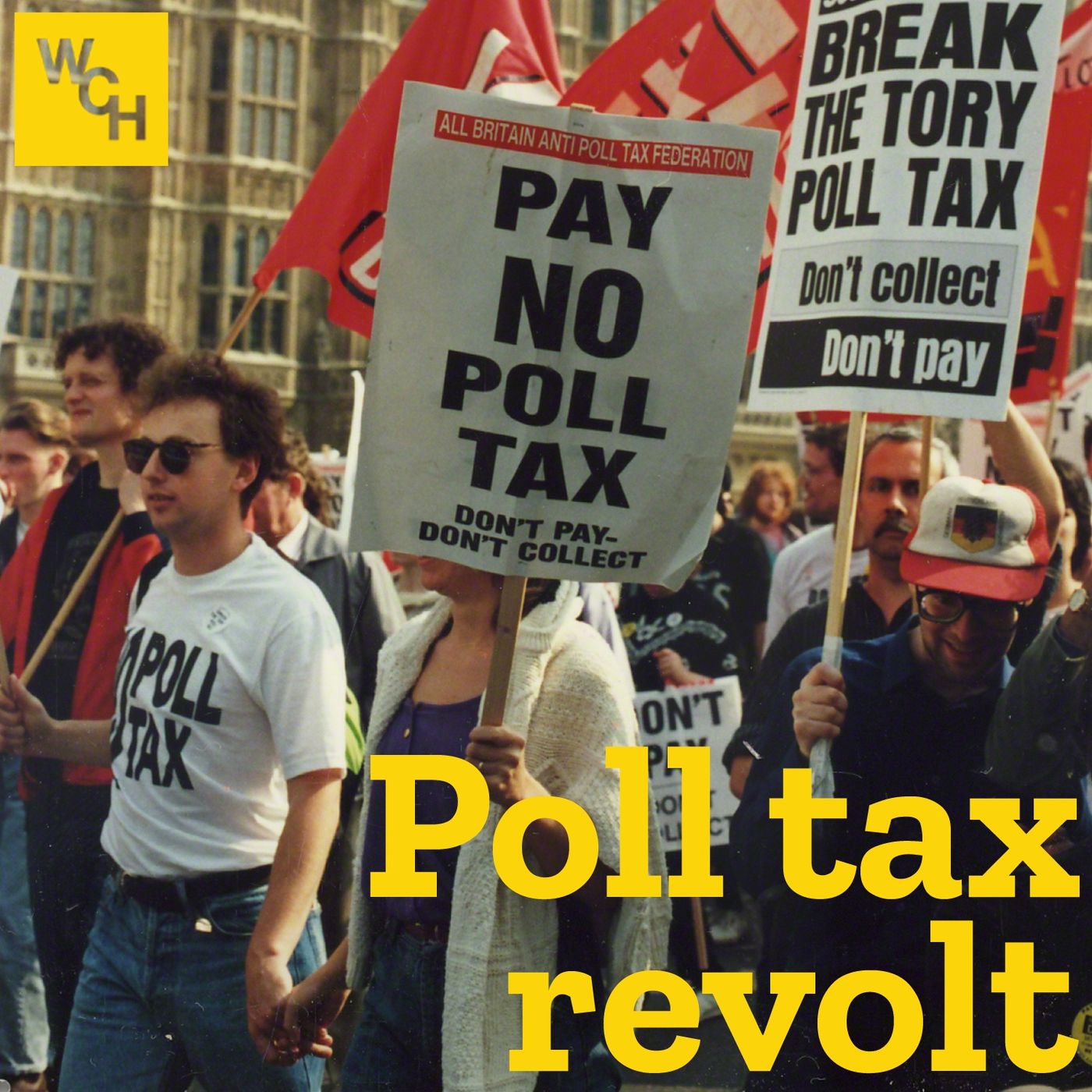
E111.1: [TEASER] Poll tax revolt, bonus episode
Episode Transcript
Hi, and welcome back to the Working Class History Podcast.
As you may know, we don't get any sort of funding from any wealthy benefactors, corporations, governments, or political pies.
Our work is funded by you, our listeners and readers on Patreon.
In return, our supports on Patreon get access to exclusive content and benefits like ad free episodes, bonus podcast episodes, and a couple of exclusive discussion podcast series, fireside chats and radical reads.
So here is a little preview of our latest episode for our patrons.
You can join us, help support our work and listen to the whole thing today at patreon dot com slash working Class History link.
In the show notes.
During the main episodes, Dave also mentioned another mass protest which grassroots activists wanted to hold in October nineteen ninety but Militant the other major Trotskyist group in the UK at that time, which dominated the nash Con Federation known as the FED, disagreed with this strategy.
Speaker 2So there was you know, lobbying of the All Bitten Federation.
In the end, the All Britain Federation said, oh, we'll organized a people's march against the pull tax, but only seventy five people will be allowed to go on it from Manchester to London.
And they were all hand picked and basically they were all members of militant and we said, this is ridiculous, it's like a stunt, but it's not what we need, something en mass that would defend the right to protest as well as to show the movement is strong and the movement is not for turning.
So what happened in the end there was an uneasy compromise in which the All Britain federations said, well, if you in London want to organize a London demonstration, we won't oppose it.
I mean it was hard work working with organizations that are controlled by one political party.
So we in London.
There was a lot of debate in the London Federation and it was agreed that we would have a massive rally and gig in Brockwell Park in South London, in Brixton and Traffago Square.
Defense Campaign said well it's not enough.
We need a protest outside the courts and outside Brixton Prison.
So we decided to organize feeder events which to support the rally, that organize our own feeder events.
So twenty thousand people turned up to the rally, which is a pretty good turnout for just a London demonstration, and we had about fifteen hundred turned up to the protest outside one of the key courts that were processing nonpayers.
And also after the rally, about three and a half thousand people marched to Brixton Prison where there were Trafago Square prisoners and nonpayers being held in prison.
They were quite substantial.
We knew that the police this potentially was quite challenging to the police and we had a meeting I think I attended a meeting with the Chief of Police, London's Commissioner of Police or whoever.
We said, look, we want to all to go off with that incident, could you guarantee from your side?
And he was saying he'd heard rumblings within the police that they wanted a rematch after Trafalgar Square and he was going to stamp that out.
Yes, that's what he said personally.
We've got it in writing to the Trafalgar Square Defendance campaign.
On the day once the rally was coming to an end and we were about to march to Brixton Prison three and a half thousand people, we had this very extensive monitoring system.
Everyone had bust cards on what to do if for rested.
We had videos, we had observers coordinated, we had a ready.
This was the first real kind anything had happened like that in this country, where we had planned for what would happen if the police attacked the demonstration, and we were able to monitor police radios and police conversations on the ground and the events.
Basically, I was one of the heads.
We didn't really add a heads to it, but I was one of the coordinators.
And when we got to Brixton Prison, I think I was the coordinator, was near the front of the march, and the agreement was that we were going to gather outside Brixton Prison for an hour and then disperse.
And without going into detail, a lot of strange things began to happen.
Police suddenly got withdrawn.
Other police units seemed to be arriving in side streets, you know, with the heavier armor, and it seemed obvious that they were gearing up to attack the demonstration, which is what happened.
I can't remember how many people invested one hundred and twenty or something.
The police immediately had a press conference and were able to tell the whole world straight away that it was all caused by the demonstrators, and we within twenty four hours we had a complete alternative proof that this would be the premeditated police attack on an agreed demonstration.
So the aftermath was they wanted to use the situation to say, look, this whole movement, the antipol tax movement, it's kind of, you know, full of radicals.
They're not interested in really the poll tax.
They're just using it to attack the police and the establishment.
And we were able to paint a different story.
The antipol tax movement was united.
We were determined to defeat the poll tax, but also to defend our right to demonstrate, and actually we were able to prove that the police had fabricated their version of events.
Speaker 1That brings us to the end of this episode preview.
Hope you enjoyed it.
To listen to the full thing and help support our work researching and promoting people's history, join us today on Patreon at patreon dot com slash working class history.
That's p A t R e O N dot com slash working class history.
Link in the show notes.
Catch you next time.