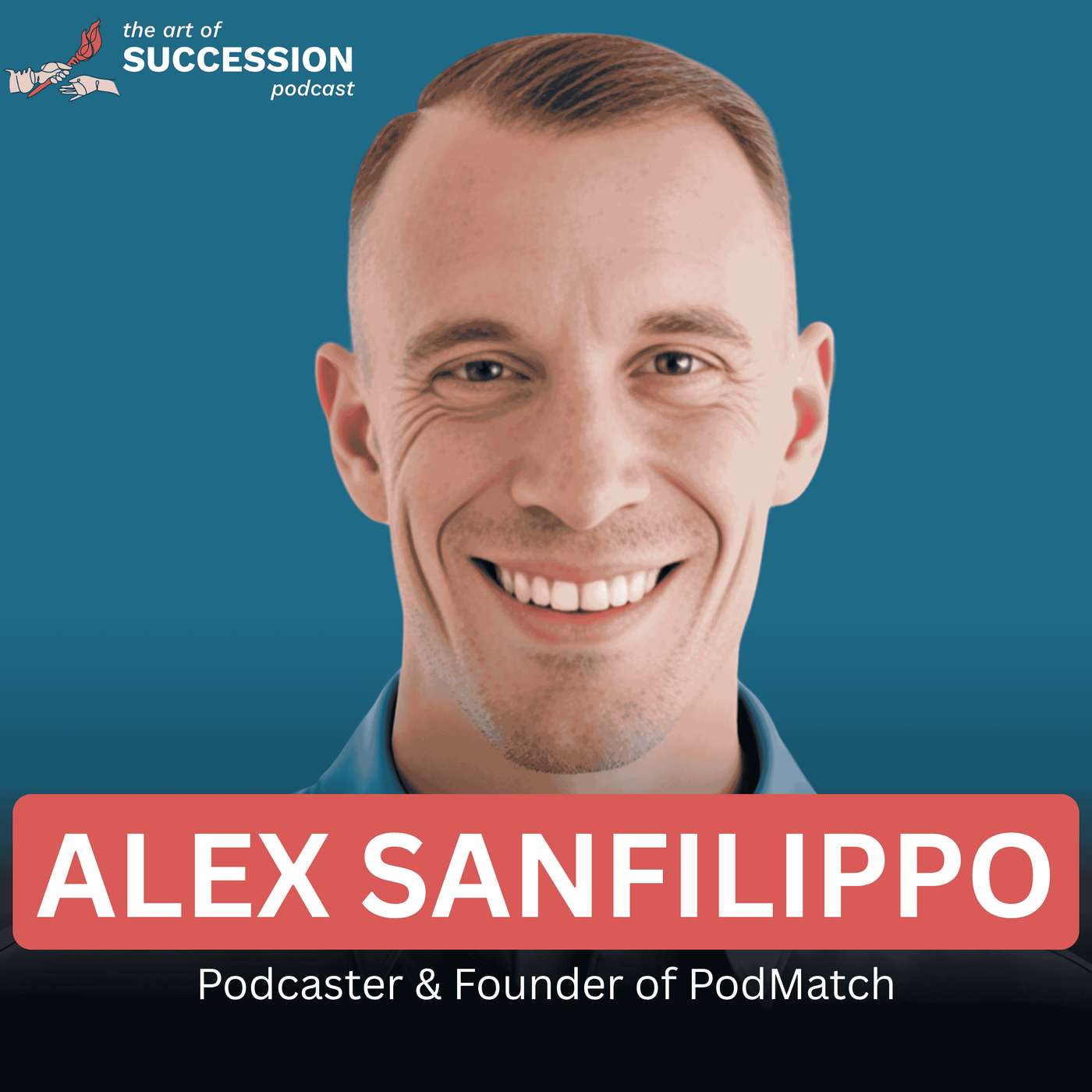
The Bootstrapped Growth for Podcasters to Succeed with Acquisitions and Systems with Alex Sanfilippo
Episode Transcript
Alex Sanfilippo part 1 - Art of succession .mp3
[00:00:00.00] Speaker1: We live in a complex world when it comes to starting businesses. From day one, I didn't really subscribe to that idea. That had [00:00:05.00] to be complicated, although it made me worried from day one.
[00:00:07.72] Speaker2: Could you go on a little bit about that? What's complicated [00:00:10.00] about it? Sure.
[00:00:11.24] Speaker1: When I first had the idea for Meet.
[00:00:14.52] Speaker3: Alex Sanfilippo, [00:00:15.00] the founder and podcaster of Pod Match, a platform that connects podcast hosts and [00:00:20.00] guests automatically for interviews. As a passionate podcaster himself, Alex helps independent creators [00:00:25.00] grow their influence and income to make a bigger impact through their shows.
[00:00:29.68] Speaker1: The most important [00:00:30.00] thing is serving somebody. It don't mean going out and saying, I want to serve a whole group of people like, you need to find someone specific. [00:00:35.00] You gotta have a why behind what you do, and that why needs to be connected directly to like an ideal client. In avatar, there [00:00:40.00] are apps now that you can do a totally AI driven podcast has a lot more bigger database [00:00:45.00] than we do of knowledge. It's trying to mimic. Humanity might be better than when you and I can come up with what do.
[00:00:49.88] Speaker2: You [00:00:50.00] see uniquely? Podcasting can help with facing this AI challenge.
[00:00:53.96] Speaker1: I'm going to share a story about a [00:00:55.00] podcast that I really enjoy.
[00:00:58.24] Speaker2: If you're like most of our listeners, you love [00:01:00.00] the idea of running the show, but you're constantly second guessing yourself if you're ready or the person for the [00:01:05.00] job. Are you missing a key skill? Are you aware of the things you need to know, like reading a financial [00:01:10.00] statement or financing the operations of a business? We are here to solve that for you. [00:01:15.00] Our new Free Ownership Readiness diagnostic will rank you from 1 to 4 on [00:01:20.00] five foundational pillars of successful business ownership. It is the ultimate confidence [00:01:25.00] builder that will tell you, yes, it is time to have that conversation or no. These are [00:01:30.00] the areas that you might need a little bit more time to develop if you're interested in taking that assessment. You [00:01:35.00] can find the link for that down in the description below.
[00:01:37.61] Speaker4: Welcome to the Art of succession podcast with Barrett [00:01:40.00] Young. Join us as we explore the strategies, stories and insights that shape the journey [00:01:45.00] of leadership, transitions and business success. No matter where you find yourself along the journey, this is the [00:01:50.00] podcast where you'll find the tools to make it happen.
[00:01:52.65] Speaker2: My name is Barrett Young and this is the Art of succession [00:01:55.00] podcast. My guest today is Alex Sanfilippo, the founder of Pod Match. [00:02:00.00] Alex and his wife bootstrapped a podcast guest matching service, and along the way had [00:02:05.00] opportunities to cash flow strategic acquisitions of other platforms to grow his [00:02:10.00] reach, resulting in one of the most well-known solutions in the space today. Alex, [00:02:15.00] welcome to the Art of succession.
[00:02:17.71] Speaker1: Thank you so much for having me today. I really appreciate it.
[00:02:19.87] Speaker2: Yeah. [00:02:20.00] Sure thing. Um, so I want to get started with one of the questions I ask all my guests. What brings [00:02:25.00] you to the art of succession today? What do you really want my guests to get out of this interview? [00:02:30.00]
[00:02:30.59] Speaker1: I think to know what's possible, uh, specifically, like you mentioned [00:02:35.00] a little bit, but from doing some strategic acquisition from a bootstrapping standpoint as well. [00:02:40.00] Uh, we live in a complex world when it comes to starting businesses. And I guess from day one, I didn't [00:02:45.00] really subscribe to that idea. That had to be complicated, although it made me worried from day one. But I just want [00:02:50.00] to help people kind of get the freedom, at least in their mind, to understand it doesn't have to be as complicated, [00:02:55.00] I think, as the world wants it to be, or is that we try to make it ourselves.
[00:02:58.56] Speaker2: Could you go on a little bit about [00:03:00.00] that? What's complicated about it, or just share a little bit more about that? Sure. [00:03:05.00]
[00:03:05.32] Speaker1: When I.
[00:03:05.64] Speaker2: First.
[00:03:06.36] Speaker1: Had the idea for Pod Match, which ultimately became the company that we have [00:03:10.00] today, was like, okay, well, I guess I need to hire a lawyer, right? Because there has to be like trademarks. And [00:03:15.00] do I need to like, get an LLC started? And I'm not saying you don't need to do these things, but from day one that [00:03:20.00] may not be step the very first thing. Right? So those were like the first things going through my mind. I'm like, okay, well I [00:03:25.00] have a friend who's going to be a developer. I guess for any co-founders, like we need to draft up paperwork, like we need [00:03:30.00] to have a bank account. There's all these different things. And from day one, for many of us, myself included, [00:03:35.00] that's very overwhelming, especially if we came from a an established corporate job [00:03:40.00] or maybe currently work one. Like for me, when we started the company, I worked in a corporate job where someone did that years [00:03:45.00] before I was even alive at the company I was working at, like all that was done before, I was even anyone's thought. And [00:03:50.00] so for me, when I was getting started, day one, I was excited. Day two [00:03:55.00] I was starting to already have doubts because I was thinking about all the things that you, quote unquote, have [00:04:00.00] to do to start a business. And again, these are things we've all now done. I say we pod [00:04:05.00] match is done as a company, like we've got all of our paperwork and documentation done right. But it seems [00:04:10.00] overwhelming at first, especially when you just want to know if your idea is going to work. Like, is there even a point to any [00:04:15.00] of this at this point in the game? And so that's kind of what I'm really wanting to leave with people today. [00:04:20.00]
[00:04:20.26] Speaker2: Yeah. And it kind of stops you before you even get started because it's just so much stuff. [00:04:25.00] And you're saying, I mean, we know this as you know, veteran business [00:04:30.00] owners, you can learn so much of this stuff on the run. And the more important [00:04:35.00] thing is, is there a market for it? Is there a desire for it? And if there is, then you can solve [00:04:40.00] that stuff. Sounds like what you're saying.
[00:04:42.06] Speaker1: Yeah, that's exactly it. Yes.
[00:04:43.62] Speaker2: Cool. Okay. Uh, so [00:04:45.00] let's get into. Yeah, just your history leading up to pod match podcasting. [00:04:50.00] Just talk talked to me just a little bit about what brought you to the space in the first place.
[00:04:54.39] Speaker1: Sure. I'm going [00:04:55.00] to start way back with all your listeners. Don't worry. I'll keep this short window. I'm not gonna go on forever. But at ten years old is [00:05:00.00] when I discovered that I kind of had this entrepreneurial bug, if you will. I started selling used [00:05:05.00] golf balls in my neighborhood growing up. There's a golf course across the street. Me? We found some people wanted [00:05:10.00] them. So I started bringing other kids together in the neighborhood, some of them being my my younger siblings. We started cleaning [00:05:15.00] up the golf balls, organizing them and selling them on Saturday mornings. And it was so much fun. [00:05:20.00] Like, don't get me wrong, I enjoyed like all the other things that kids did. But like for me, that was like the most fun thing I was doing [00:05:25.00] in my life. And that's why I said I kind of got that entrepreneurial bug. If you fast forward through my, I guess, [00:05:30.00] high school years after this. Right. So this is like when I was ten and then up to 12. And then at that point eBay became [00:05:35.00] a thing and I realized that I could sell action figures I had on there. I could buy the ones I wanted, right? [00:05:40.00] I could buy a lot of 50 of them. I could pull the three I want, add a few more and sell it for more than I just paid for it. [00:05:45.00] Just doing all that type of stuff really was something that I loved. And I got good on computers when [00:05:50.00] I started doing that and that kind of going back to these years, I can't think of the exact year this was, um, but [00:05:55.00] I think it was like probably 2001, two, three type of thing.
[00:05:59.13] Speaker1: Not everyone was good on [00:06:00.00] computers yet. Right? Like that was still a fairly new thing. And so, uh, it caught the eye of some [00:06:05.00] people that were in my dad's corner, and somebody was a friend of his. It's like, hey, I'm looking for someone who can [00:06:10.00] figure out how to do a tech startup in the real estate space. And so that was kind of like my first real [00:06:15.00] business where I had employees. I paid taxes like all that. Right? Like that was my first real thing that [00:06:20.00] I did. And so we started building virtual tours of homes, which is now very common. If you go to a website [00:06:25.00] where you can look at listings and stuff, like you can kind of drag the mouse around and look at the roof, the floor and kind of drag it [00:06:30.00] through the home. But back in those days, we were pioneering that technology. And so [00:06:35.00] for me, it was me and a team of editors and photographers that were going out and just posting directly to the MLS. Any, [00:06:40.00] any realtor that would hire us or any brokerage would hire us. We'd go out and make that happen, at least in the Jacksonville, [00:06:45.00] Florida area where I was at or in kind of like surrounding areas. And, uh, so that [00:06:50.00] was kind of like me growing up. And then again, that being my first, like, real tax paying type [00:06:55.00] of job, right? Or business that I helped start from there. There was a 2008 crash [00:07:00.00] and I was in real estate at that point. Bad timing to be.
[00:07:02.06] Speaker2: In real estate. Yeah.
[00:07:03.10] Speaker1: Right. So the company was in it. And [00:07:05.00] then not only that, but the, uh, I also started investing my own property. So like, I'm gonna do this buy and hold strategy. [00:07:10.00] This looks amazing. And, uh, we all know what happened. 2008. I didn't see it coming, but the company [00:07:15.00] just. I didn't sell it. I just gave it to one of the guys who was working. Said he still wanted to see if it would ever come back [00:07:20.00] and run with it. What happened from there? I actually don't even know because I distanced myself so far from it, because it was [00:07:25.00] like my first real failure. So I guess that's when I really became an entrepreneur. It's like when you had that first big [00:07:30.00] failure. And um, during that time, though, I did find a job in the aerospace industry. [00:07:35.00] So I got a, a formal corporate job, actually did 15 years in big corporate, and I [00:07:40.00] thoroughly enjoyed actually working in corporate as well. It turns out I just like to work. But now there's like a kind [00:07:45.00] of coined term. I think I was more of an entrepreneur, which just means an entrepreneur inside of an organization. So I [00:07:50.00] still have like a very free thinking attitude and perspective. And I did that for [00:07:55.00] 15 years. And my next thing after that was podcasting and ultimately this, [00:08:00.00] this startup that we did, which is Pod match. And for anyone listening who has no idea what that is, it's a service that connects [00:08:05.00] podcast guest and host for interviews. It's actually how Barrett and I got connected to do this today. I would say [00:08:10.00] it works just like a dating app instead of connecting for data, actually for podcast interviews. And so podcasting is what I [00:08:15.00] do full time from a content perspective, from the software perspective, and just educating in the space. And [00:08:20.00] that's kind of my whole background there in a, in a nutshell.
[00:08:23.00] Speaker2: Along the way, those slightly [00:08:25.00] less than ten years working in commercial real estate, I mean, how did you get [00:08:30.00] an aerospace job from that? I mean, did you go into training for that? Was it your tech programing [00:08:35.00] background that led into that? Talk to me just a little bit about that shift.
[00:08:39.56] Speaker1: Yeah, there's [00:08:40.00] probably a disclaimer I have to give here, which is I wasn't an astronaut, skydiver or fighter pilot. I [00:08:45.00] think everyone like, assumes like, oh, he did something cool. No, I worked I worked a.
[00:08:48.61] Speaker2: Rocket scientist on.
[00:08:49.81] Speaker1: Right [00:08:50.00] now we focused below the atmosphere as a parts manufacturing company, and I actually was [00:08:55.00] able to get that job because that was the industry my dad was in. And I actually called him in 2008 [00:09:00.00] when everything kind of wrecked. And I was like, hey, like, I need a job. Like I have to have something. [00:09:05.00] Like, do you have anything? I'm like, can you get me a job anywhere? You think? And, uh, so I will. I will admit [00:09:10.00] right here, I got the job because of my last name. And, uh, my dad being the man that he is, I [00:09:15.00] love the guy. Uh, he said, no, I can't get you a job. I can get you an interview. I was like, okay, fair enough. Right. So [00:09:20.00] he got me an interview, and I got offered the job the next day, and it was a part time receiving clerk [00:09:25.00] position, which is a fancy way of saying I broke down boxes and took out trash for people. And, uh, [00:09:30.00] you know, at first I was really bitter about it, I think just from coming from, like, such a big failure and [00:09:35.00] loss and but I knew it was stable and I ended up really applying myself. And over that 15 year period, I worked my way [00:09:40.00] up to the C-suite level, and during that time as well, it went from a private company to a publicly [00:09:45.00] traded, multibillion dollar organization. And it was really cool to be a part of. And I learned so [00:09:50.00] much about business being involved, even in the acquisition of that. The next company that we, [00:09:55.00] uh, kind of bought us all that stuff. And it was it was a really fun project.
[00:09:59.95] Speaker2: So [00:10:00.00] how do you go from that 15 years? You're successful. You've the company [00:10:05.00] itself has been elevated now to saying, I want to go back to starting [00:10:10.00] from scratch.
[00:10:11.79] Speaker1: Yeah, it's a fair question. And I [00:10:15.00] asked myself that question a lot actually, during that time. But, uh, I'll never forget there was one [00:10:20.00] situation that happened to that company that made me realize that there was a change that was needed in [00:10:25.00] my life, and it was after the company went public. And it was, um, at that point, I was actually had just gotten elevated [00:10:30.00] to the C-suite level, and I was overseeing five divisions of the company, uh, everything from inventory, shipping and receiving [00:10:35.00] to, uh, procurement to sales, marketing. Like, those are my divisions. And in one of those [00:10:40.00] divisions, we rolled it out. A new process that we found actually saved us more than 10% of [00:10:45.00] our margin in that single division, which was absolutely huge. It was like groundbreaking. And, uh, [00:10:50.00] when I saw the numbers come through, I was like really excited. So I went straight to my CEO's office, which is who [00:10:55.00] I reported to. And I was like, I was like, hey, Paul, did you, uh, did you see that? See the numbers and XYZ [00:11:00.00] division? And he's like, yeah, I saw him.
[00:11:03.68] Speaker1: But I could hear like [00:11:05.00] in his voice. It wasn't like excitement. And so I kind of like leaned in. I'm like, so, you know, we like [00:11:10.00] we saved that money, right? Like make sure it's clear he's like, no, no, no, I see it, I get it. And I could hear the frustration [00:11:15.00] in his voice. I just kind of like put my hands up. I'm like, well, what's wrong? And he's like, man, we didn't tell [00:11:20.00] the board and the shareholders we were doing anything like that. He's like, that was a really big move. He goes in a [00:11:25.00] bold move, he goes and thankfully it worked. He's like, but if it didn't, that would have been a problem. But [00:11:30.00] also they wanted to know that we were going to do something this big. And the reality is, I didn't [00:11:35.00] know that we were doing something that big, like, I, I just kept on running business as usual. Like that entrepreneur being [00:11:40.00] like, let's try it. Worst thing happens is something goes wrong and then we'll fix it, right? Like, and worst thing.
[00:11:44.50] Speaker2: Happens, something [00:11:45.00] so successful that we get in trouble for it. Right?
[00:11:48.78] Speaker1: And I just [00:11:50.00] like I didn't get in trouble that day necessarily, but it felt like I did like and he was just like, hey, if we're gonna [00:11:55.00] do this stuff, we gotta talk about it first. Like there's there's tape everywhere now, like there's red tape and we got to be careful. There's gotta [00:12:00.00] be meetings. And, uh, I walked back to my I left his office and was walking back to mine, which really [00:12:05.00] wasn't that far from his office. It was just down the hallway. But that was the first time in that building that I [00:12:10.00] felt like I was taking a really long walk. And I sat down at my desk and I looked out the window [00:12:15.00] and, uh, I just remember thinking to myself, um, it's time to go. And [00:12:20.00] that was like a really scary moment for me because I [00:12:25.00] felt like I was really comfortable at this point. Like I kept on getting promoted. I was doing really well and then saying that to myself. My [00:12:30.00] brain was like, how could you? Right? Like we've worked so hard to get here. Like, what do you mean? [00:12:35.00] Like you're you're going to be the next CEO of this company. You'll be the youngest CEO they've ever had, right? Like, these are things going through [00:12:40.00] my head. And, uh, but I just. I don't know what it. I still don't know what it is, other than the fact that [00:12:45.00] I knew I wanted something else.
[00:12:47.71] Speaker1: Like, I didn't want more, like I was. I was [00:12:50.00] very happy, very well taken care of, but I wanted something different. And, uh, that was kind of when I started [00:12:55.00] pursuing. Is there anything else out here? And, uh, I did like a bunch [00:13:00.00] of little side hustles just to see what I liked and didn't like. So I tried all kinds of things, mostly all failed attempts, really. [00:13:05.00] But, uh, I finally found podcasting, and I, I don't [00:13:10.00] know if this is brilliant or just, like, I was just I don't know how this happened, but I started a podcast talking to people [00:13:15.00] who had successfully left a 9 to 5 job to figure out how they did it, because clearly I couldn't. All my side hustles weren't [00:13:20.00] working. And so, like, I still had this full time job all the time. I'm still applying myself, doing really well in it. And so I just started [00:13:25.00] talking to them and learning and figuring it out. And two things happened. One, I learned how to actually be [00:13:30.00] a successful entrepreneur, but two, that I wanted it to be in podcasting. And again like to not to fast forward [00:13:35.00] too much. But that's ultimately what led me to to to putting in my resignation years after starting that process [00:13:40.00] and going full time as, as a podcaster.
[00:13:43.93] Speaker2: So you originally [00:13:45.00] started a podcast to find out what's next, and in the process, you found out podcasting is [00:13:50.00] what's next for you?
[00:13:51.53] Speaker1: It's a good way. Yeah, a good way to wrap it up. That's exactly it.
[00:13:54.17] Speaker2: That's awesome. I [00:13:55.00] love to hear that because that was going to be my question. It's like, how did you go from aerospace C-suite [00:14:00.00] to podcasting? And it was through the discovery of I don't know what I want to do. [00:14:05.00] So.
[00:14:05.61] Speaker1: Right.
[00:14:06.29] Speaker2: Had you ever hosted a podcast before or what was it about? And I guess [00:14:10.00] tell me the time frame at this point or around 2221. Where are we at? [00:14:15.00]
[00:14:15.41] Speaker1: So I first started these side hustles in 2017, I believe is when I [00:14:20.00] started doing them, and by 2019 is when I well, no, sorry, it was 2018, 2020. [00:14:25.00] The numbers all get blurry. Sorry about that. But yeah, before that I'd actually started [00:14:30.00] listening to podcasting just a few years, I guess in 2014. That's the same year I started my first podcasting [00:14:35.00] project, just for fun with some friends and stuff like that, and I thought it was really cool. Like I enjoyed it [00:14:40.00] for me, like I'm a follower of Jesus. So we were just like talking about our relationship with God, basically. And it was it [00:14:45.00] was a really cool thing. So I enjoyed it. That wasn't like it never felt like it was going to be something I would leave my job for. [00:14:50.00] Nor was that the idea of it. It was just like, this is a cool thing to do. And uh, so that was [00:14:55.00] yeah, that's kind of my introduction to it. But this was my first, like formal podcast [00:15:00.00] that actually used a microphone and a camera and stuff like that before I was just talking to my phone, [00:15:05.00] but I had I at least knew there was something that I could try. So that's kind of what got me into it.
[00:15:09.66] Speaker2: Awesome. [00:15:10.00] Yeah, I did want to hear that because I know among successful podcasters, one of the common threads [00:15:15.00] I've heard is I've failed more podcasts than I've succeeded in. [00:15:20.00] Right. It's like, yeah, I mean, for me, this is my fourth podcast. Um, and the first three [00:15:25.00] had no listeners except my mom and, you a couple friends, [00:15:30.00] so I always appreciate them.
[00:15:32.24] Speaker1: Sounds like my podcast.
[00:15:34.40] Speaker2: So. But [00:15:35.00] yeah, I wanted to see like what brought what brought that up. So. So you want [00:15:40.00] to be a podcaster? You think that that's going to be your future? How [00:15:45.00] do you flesh that out and say and find what's missing in the market? [00:15:50.00] Um, you're interviewing guests. So obviously you've got to find a way to facilitate [00:15:55.00] that for your own podcast. Is that what led to the idea for Pod Match?
[00:16:00.24] Speaker1: That [00:16:00.00] was my pain point, but one of the things I learned through my own podcast was to validate that my pain [00:16:05.00] point was somebody else's as well. Um, like, as an entrepreneur, my my brain just works different [00:16:10.00] than most people, right? So and because of that, what I struggle with might not be what most people struggle [00:16:15.00] with. So, uh, what I learned was find your area of passion and get into the community [00:16:20.00] of that area of passion. So for me, podcasting was my passion. Turns out they have events everywhere. [00:16:25.00] So I started really getting into that. I started speaking at the events, and the next step of what I learned from [00:16:30.00] my own podcast was to find a simple problem that people were struggling with. And I'll never forget this. This [00:16:35.00] was actually the beginning of 2020. So same year I left my corporate job. Um, the beginning of [00:16:40.00] year, I was actually speaking in a podcasting conference in Orlando, Florida. There's about 2000 people there. Yes, [00:16:45.00] it's Florida, but it was before the world officially shut down that year. And, uh, when I got [00:16:50.00] off stage, uh, I just, I asked anybody before I got off, I said, hey, if anyone is willing, just like, [00:16:55.00] I just love to meet you. If you're just willing to chat for a minute, like, let's talk. And again, there being about 2000 people [00:17:00.00] there, I had more than 100 people willing to get in line to to talk to me and meet me, which was really [00:17:05.00] cool. And I made sure I had pen and paper in hand. I wrote down a few things their [00:17:10.00] name, their email address, and what they were struggling with in podcasting.
[00:17:14.21] Speaker1: And so I just everybody [00:17:15.00] I wrote it down and I kept on writing it down. And I heard a lot of things that day. But the common thread was [00:17:20.00] the same issue that I had, which was finding the right guest for my show. Like we could find people that would be on, but [00:17:25.00] like, were they the right people and how much time did it take to coordinate that? Like, it can it can be a mess. And so I was [00:17:30.00] and I kept on hearing that. I was like, oh wow, there. That's my problem. But it might be everyone else's as well. So again, I was [00:17:35.00] in my area of passion. I was speaking in front of the community. I found the problem, which I thought was [00:17:40.00] actually in my mind at that time, was a simple problem. Now I look back and it's actually quite complex, but my [00:17:45.00] overly ambitious mind said that was simple. And then from there I went home. And that's kind of when I hit the drawing board. [00:17:50.00] And like I said at the very beginning of our time together here is that's when the fear started setting in. I'm [00:17:55.00] like, oh, wait, I've done a lot of stuff in corporate business, but I've never actually started a business, right, like [00:18:00.00] even through acquisition. But I didn't have to file an LLC and get a lawyer and like, we already had all this. So [00:18:05.00] that's kind of like where the fear started. But when I had the idea that I know was going to ultimately [00:18:10.00] become what I did full time.
[00:18:12.19] Speaker2: Interesting. Um, talk [00:18:15.00] to me about developing that idea a little bit more. And what was that space [00:18:20.00] like already in existence? Um, and and what do you feel [00:18:25.00] made it made pod match different at the time?
[00:18:28.80] Speaker1: Yeah. So when [00:18:30.00] I first had the idea, I whiteboard it out. And being a corporate guy, I don't have it anymore. [00:18:35.00] But I had an entire wall of whiteboards, even at my home office, just because, you know, that's what we do. So, uh, I [00:18:40.00] used every inch of every one of those whiteboards. And ultimately what I ended up circling were the words [00:18:45.00] like a dating app. But for podcasters instead of people looking for dates, one thing I'm big on is not [00:18:50.00] reinventing the wheel. And I knew if this was going to be a simple problem, I had to find someone who'd already solve the problem. That's someone [00:18:55.00] connecting people that already solved the problem. So I just was like, let me [00:19:00.00] look at that. Let me see what I can do that. And so again, like writing it all down, looking at that was kind of like how I hashed it [00:19:05.00] out quite a bit. And then like, like you mentioned, I actually started looking around. I'm like, is anyone else doing [00:19:10.00] this? And I don't know if apparently there were two and I actually could not [00:19:15.00] find them. I don't know why until after we launched, and it's because they both reached out to me, but I couldn't find them on search [00:19:20.00] engines.
[00:19:20.40] Speaker1: I was asking people, no one knew who these companies were, and my only thought is that [00:19:25.00] they must have launched around the same time that we did. And I just, I didn't know, and their [00:19:30.00] name wasn't out there either. So when we launched, um, we launched kind of in most [00:19:35.00] people's mind is the first and the only. And then some people were like, hey, I've had one of these for six months, right? Like and [00:19:40.00] so we to this day, actually there's others in the, in the industry. We're still to this day the only [00:19:45.00] ones that do like true matching that have an algorithm in AI behind it that's actually [00:19:50.00] working in the background saying these two people go well together because this person talks about this and your show is about [00:19:55.00] this. And so still this day we really stand out. But, uh, yeah, I didn't have anything [00:20:00.00] to really inform. We built completely from scratch and totally custom [00:20:05.00] code. We decided to start off right and, uh, yeah, it was a bit intense. [00:20:10.00] I would have loved a template back then.
[00:20:13.02] Speaker2: But, uh, I mean, the world of [00:20:15.00] guest matching back then was probably like forums, private Facebook groups. [00:20:20.00] Um, booking services like hiring a professional to go out there and basically [00:20:25.00] send invites to anybody who's been on a podcast and say, you want to come on this one. Right. So [00:20:30.00] correct. Yes. And so you said you want to get away from all that and have [00:20:35.00] the computers make the matches. And that's the idea behind behind pod match. Um, [00:20:40.00] talk to me a little bit about. So just some context [00:20:45.00] here. I hosted this podcast for about nine months before using or finding pod [00:20:50.00] match. I think I did try a dating service or two back in July [00:20:55.00] of last year when I first launched, but I didn't see any immediate results, and it felt like a lot [00:21:00.00] of work to go through, and especially with the focus of this podcast, trying [00:21:05.00] to find business owners, but not just business owners, business owners who've acquired [00:21:10.00] their business or sold their business. It's like trying to explain that every month, every two [00:21:15.00] weeks in a Facebook group and then shoot down all of the booking agents that [00:21:20.00] come and they're like, yeah, I represent a business owner. That was so difficult for me. [00:21:25.00] And, um, I actually was in one of those Facebook groups.
[00:21:28.17] Speaker2: I think I've shared this with you, but I don't think I've shared [00:21:30.00] it with the audience. I was in one of those Facebook groups, and I matched with somebody to be on their show, and they said that I [00:21:35.00] should sign up through Pod Match because you guys do a revenue share. And I said, I guess [00:21:40.00] I'll give it a try because I want to be on your show. I signed up and within [00:21:45.00] I was two weeks away from an episode releasing and I hadn't booked a guest yet, [00:21:50.00] so I was really freaking out here. I got booked on another show, but I don't have a guest for my show. I [00:21:55.00] got started with Pod Match the last week of March, which for tax accountants [00:22:00.00] is a very stressful time and I think I booked 11 [00:22:05.00] or 12 interviews over the next month and a half and completely [00:22:10.00] booked up through the rest of 25. So like I said, my target audience, I was no [00:22:15.00] longer you know, I'm still scouring the profiles looking for specific keywords, [00:22:20.00] but it's no longer like, oh, I've got to explain to them, I'm sorry. You're a you're a bootstrapper. [00:22:25.00] I only take on people who've acquired their businesses. So, uh, yeah. Just sorry [00:22:30.00] for the breakout testimonial for Pod match.
[00:22:33.02] Speaker1: But listen, I appreciate that. That's exactly [00:22:35.00] what we set out to solve. So, like, for me getting to hear that, and you and I talked offline a little about this. [00:22:40.00] Like, you don't always hear the good, you hear the bad with your show, with your business. Right. And I think that's [00:22:45.00] there's a lesson there as well for us developing some thick skin and knowing, having faith in what we're doing. But that [00:22:50.00] is so kind of you to say and really means a lot. So thank you.
[00:22:53.62] Speaker2: So what are you specifically looking [00:22:55.00] for? Because a dating service for humans or, you know, for dating is kind [00:23:00.00] of obvious. I'm looking for, you know, height, weight, gender, career [00:23:05.00] goals, stuff like that. What are you specifically targeting with podcasting [00:23:10.00] that you're like, we could make this thing and put it in a professional setting.
[00:23:15.08] Speaker1: Yeah. [00:23:15.00] So this is when I went back to that, that whole whiteboard I drew out. Right. Like. And, um, [00:23:20.00] and I should mention I have a third partner, so it's me, my wife, Alicia, and another partner, Jesse. And [00:23:25.00] he's the developer, and he's a full stack developer. Always has been. And we're we're three even partners. And, [00:23:30.00] uh, so Jesse knows nothing. Still his day. He's been on one podcast with me. I [00:23:35.00] convinced him one time because it was strictly a, like, back end software podcast, and they're like, [00:23:40.00] we want you on, but only if Jesse comes. And so that's that's all he knows about podcasting. So I told him, like, hey, like [00:23:45.00] going back to my pain point, I'm like, here's the biggest problem I have. We start having a conversation back and [00:23:50.00] forth on social media. Come to find out, they're using a translator. They don't actually speak the same language as me. I've had [00:23:55.00] that happen before. I'm like, okay, well, step one, if we don't speak the same language, we should never be a match like we, you [00:24:00.00] know, like there's tech that's changing. But at that point, especially going back to 2020, like that wasn't around yet, [00:24:05.00] right. Um, are we available the same time? Because same thing. I had people that were in other parts of the world. And as [00:24:10.00] much as I'd like to. I know that if I had to wake up at two in the morning to do an interview, it's not going to be good. Like, [00:24:15.00] I just I know myself. And so, like, we need to know some basics. Like we speak the same language. Are we in a time [00:24:20.00] zone where this would ever even work and then we just keep on working our way down? Is your podcast age [00:24:25.00] specific? Uh, a great example.
[00:24:26.85] Speaker1: There was a Gen Z podcast that wanted me on. This was years ago, [00:24:30.00] but they looked at me and thought I was Gen Z because I guess I looked young. And then I told them like, no, I'm actually millennial. And they're [00:24:35.00] like, oh, well, never mind. You know, like and they probably said some cool, hip word that I don't know how to [00:24:40.00] say. But, uh, the point was it was like, okay, well, again, we're not actually a match. And so [00:24:45.00] we took all of those kind of the basic, the obvious things and said, let's filter everything out [00:24:50.00] from this first. Then after that, we can go into some of the actual experience, [00:24:55.00] like the Art of succession podcast. Like, have I ever done anything that would [00:25:00.00] relate to this show based off what they can find out about it? So it goes into your description of your show, who you say your [00:25:05.00] listener is, who the ideal guest is, and then go through a lot of the content as well and basically saying, okay, here's all the [00:25:10.00] things we know about Barrett Show. Here's Alex Sanfilippo. Does anything match or align there? Again, [00:25:15.00] we speak the same language. The age is right. All the details work out. The administrative stuff is good. Now can [00:25:20.00] we they make good content together. And so our whole AI algorithm, whatever you want [00:25:25.00] to call it these days, is all based upon. Would this be good for a listener? And that is the [00:25:30.00] foundation and the core of all of it is would this be good for a listener, yes or no? If yes, let's let them [00:25:35.00] proceed and actually confirm that themselves. Yeah.
[00:25:38.75] Speaker2: Okay. Awesome. And [00:25:40.00] I again, I'll attest from the experience there's that there's the ability to rate each other [00:25:45.00] as a guest and a host. That's big. Um, there's the questions that these are the things that [00:25:50.00] I'd be interested in talking about. And you find even as on my guest posting, the more focused [00:25:55.00] I am on my guest posting, the better interviews I'm going to get for podcast too. So you [00:26:00.00] really do not want to be a generalist. You don't want to be out there and just be like, I'm here [00:26:05.00] for I interview anybody about anything. The more focused you are on this stuff, [00:26:10.00] the better it's going to be for your end goal. So let's shift now to the acquisitions, [00:26:15.00] because I know you've acquired a couple peers or competitors or just [00:26:20.00] like in the podcasting space. So let's talk about the first one of those. And like what [00:26:25.00] brought you to saying we want to grow this this way because that's there's a cash outflow [00:26:30.00] there.
[00:26:32.04] Speaker1: Right? Yeah. The very first one actually came not long [00:26:35.00] after we had launched, and it was one of the companies that reached out after launch, like, hey, what? You know what what [00:26:40.00] on earth? We got one of these companies. I'm like, oh, and really, I can remember actually being apologetic. I was like, had I known [00:26:45.00] I may have looked a partner, I'm like, I didn't know existed. Granted, as you already hinted at, it was more [00:26:50.00] of like, I think they were using Facebook groups to like, connect, but they like narrowed down the groups and I don't know how they're [00:26:55.00] managing it all. Um, I think might have been easier just to build software, but, uh, the point is, uh, we [00:27:00.00] kind of built a quick relationship. I got on a call and like, hey, listen, like, we can recommend each other. There's plenty of space, [00:27:05.00] especially at this point. I consider it as co educators, not competitors in the industry. People didn't know [00:27:10.00] this existed yet. I'm like, we're working together to show people that you can type in pod match alternative [00:27:15.00] and find alternative. Or in their case the company was called Pod. It plotted alternative. Like we're helping each other, right. [00:27:20.00] And, um, he actually really grew to like that perspective. And it wasn't. But a couple months later we [00:27:25.00] had this on our mind to to buy somebody. We just didn't know what that looked like yet, but they actually approached us [00:27:30.00] about it first. And uh, we signed NDAs and stuff like that.
[00:27:33.90] Speaker1: So I'll share what I can here. But basically, [00:27:35.00] his kids were at an age where he was ready to spend more time with them, realizing they weren't going to be around forever. And he [00:27:40.00] already done a lot. He'd been very successful, and he had a number in mind. He said that I started [00:27:45.00] asking, he's like, I started asking around the industry, anyone I knew who has the most integrity in this space that would [00:27:50.00] take this and do something good with it. And I'm so grateful. And it's [00:27:55.00] like a humbling thing to be able to say. But like he said that my name came up from everybody. He's like everyone. Everyone's [00:28:00.00] list had your name on it and he's like, so you're my first choice. And so we virtually [00:28:05.00] within two days we worked out the whole deal. Like granted there's all the legal stuff that goes into it, right? But we worked [00:28:10.00] it out. And his big point was he didn't want people to know how much he sold it for and stuff like that. So I was like, okay, [00:28:15.00] I'm perfectly fine with that. But basically what we decided to do with the company was called it. We purchased it, and [00:28:20.00] because they were lacking on the software side at that point and we weren't, we decided we're going to bring everyone [00:28:25.00] over. We'll honor the price that you're paying. We'll bring it over to Pod Match. We'll lock you in forever at that same rate. So [00:28:30.00] you don't ever feel like we're going to price gouge you once you get in and stuff like that.
[00:28:33.63] Speaker1: But the big thing that we did, and [00:28:35.00] I use this for, and this was like the reason it was on my I'm on the first place. So we did a bunch of really big press releases, [00:28:40.00] and I'll admit, we spent some money going out to all the big publications and paying [00:28:45.00] to have them all blasted all over the place. But that put us on the map. Not with [00:28:50.00] podcast guest and host, but with other players in the industry. It's the first time I could get any of them to [00:28:55.00] acknowledge, oh, this is a real business. Like this is actually something legitimate. And that's what we were kind of going [00:29:00.00] for, is because I knew if we wanted to grow organically all the way through, we needed partners. We needed to have some [00:29:05.00] sort of reciprocity in the podcasting space, or people would be like, oh yeah, that's a good company. They're [00:29:10.00] real. I've met the founder. And so, strategically speaking, yes, we bumped up our amount [00:29:15.00] of members on our platform by bringing them over and shutting that one down. But to me, more importantly, [00:29:20.00] was the fact that we put our name on the map when it came to the podcasting industry, which at that point especially was a very [00:29:25.00] small industry. There wasn't many players, but being one of them really took some work, and this [00:29:30.00] was kind of the work that we needed to do.
[00:29:32.97] Speaker2: That was early on. You said within the first [00:29:35.00] year, obviously that paid off for you, but you [00:29:40.00] start to make moves like that, you're going to attract other people in the industry that are like, why [00:29:45.00] us too? What did that bring to you, and how did you start to sift through [00:29:50.00] those kind of opportunities? Because I know you've acquired another company at least one more since then. [00:29:55.00] So what kind of a negative attention did it bring? And and how did you start [00:30:00.00] to process that?
[00:30:02.38] Speaker1: Yeah, it's very insightful that you realize that no one's ever brought [00:30:05.00] that up to me before. But the reality is, it wasn't just podcasting companies. There was like random companies, [00:30:10.00] hey, we're an SEO company. Would you like to buy us? And like, why? Right. Like for [00:30:15.00] what? At what purpose? You know, like, what's what's the reason? And like, oh, because SEO and podcasting, they kind [00:30:20.00] of go together, right? And there's like so yeah. All like out of the woodwork. All these companies started showing up. And I think that that was because [00:30:25.00] of the press releases on the big publications, which the long tail of those were lasted years. I [00:30:30.00] still have people bring up the fact that like, yeah, I remember when Alex bought it and like, so it's [00:30:35.00] interesting to hear people still talking about it years later. Listen, a side note here. For anybody [00:30:40.00] who's who's listening like ever thinks they might want to do something like this, make sure you do the press release, especially if it's your first one. You might not need [00:30:45.00] to for all of them, but if you want to get your name out there, it's a great way to do it. But anyway, to answer your question more directly, [00:30:50.00] you have to be really careful. As an entrepreneur and most of us being entrepreneurs, [00:30:55.00] we get shiny object syndrome A little bit and we get excited about things. So for me like, ooh, an [00:31:00.00] SEO company, like, yeah, we could so many.
[00:31:01.84] Speaker2: Opportunities out.
[00:31:02.80] Speaker1: Right? We could make our SEO juice better and [00:31:05.00] for our members and then we could. Right. But you think about it like, every time you buy one of these things, the administration [00:31:10.00] that goes into it is a lot. There needs to be a strategic rollout. There needs to be a plan. We've [00:31:15.00] probably all been part of a software or even some sort of in-person company that did [00:31:20.00] some form of acquisition, and most of us would admit it was a terrible experience for us as the people using it. And it's because [00:31:25.00] there's so much administration that goes into it. And so for me, I actually had to really learn that. I had to step back [00:31:30.00] and say, okay, this we can't do this and we can't do this one. And we had many people [00:31:35.00] also want to buy us at that point. But I was looking at our growth and I was like, man, our valuation would [00:31:40.00] be outdated in just a month. So from start to finish, the project of like if we were to sell, not [00:31:45.00] that we wanted to anyway, but like the numbers wouldn't even hold. Like how do we even know where this is [00:31:50.00] going to land? And so here I am five years later. So at the time of recording, so To 2025 [00:31:55.00] from 2020 to 2025. Like, we still can't gauge where this thing will [00:32:00.00] land necessarily, which I'm grateful for. But we ended on both sides and I just had to learn [00:32:05.00] how to say no without burning bridges. Like I wanted to keep relationships going. And do I know somebody? [00:32:10.00] I would make introductions where I saw that it was fit, but it's a lot of saying no.
[00:32:14.53] Speaker1: And [00:32:15.00] that takes really understanding your own strategy and direction that you're going in. And for me, it all [00:32:20.00] goes back to the people I'm serving who's using our software and how does this benefit them not does it fun for Alex [00:32:25.00] or make us look good? No. How does it actually serve and benefit immediately the people that are there [00:32:30.00] using our software? And I'll share one quick story. There was a company that does what we do. Uh, they do it all [00:32:35.00] through. They have some software, but mostly through Facebook groups. To this day they are [00:32:40.00] ten times the size of us. Huge. And they wanted us to buy them out. [00:32:45.00] They gave us a price, which to I really argued the price a little bit. But then I stopped arguing the [00:32:50.00] price and we got closer to the point that it was like, okay, we could actually do this. And I stepped back. I went back to [00:32:55.00] my whiteboards and I said, what benefit does this have for our existing members, and what benefit does it have for their members, [00:33:00.00] and how much work would be involved and will it be worth it? And when it came down to was it was no real [00:33:05.00] value for anybody involved, but a lot of work for us. And so I ended up backing out. I ended up selling it to somebody [00:33:10.00] else at some big organization that wasn't even in podcasting at all. And to this day, they're a competitor. [00:33:15.00] But that was a strategic decision, realizing there was no real move [00:33:20.00] that was going to help anybody in this anymore. And so it takes really having some wisdom, some discernment [00:33:25.00] and knowing where you're going.
[00:33:26.91] Speaker2: Growth is not the only purpose, right. That's why it's a strategic [00:33:30.00] acquisition. So all right, walk me through the next one because this one is interesting too. [00:33:35.00] You started in this as wanting to podcast and then you've built a podcasting company. [00:33:40.00] So talk me through the next acquisition.
[00:33:42.67] Speaker1: Yeah. So there was a um, I had my [00:33:45.00] podcast still. It was about entrepreneurship. So I during this time I didn't like shut down that show. I wanted to keep it going because [00:33:50.00] I really loved it. It was called creating a brand, and it was the idea of the art of creating a brand. [00:33:55.00] I really loved it, but the writing was on the wall that I had to. I had to make a change. Like [00:34:00.00] if I go back to my corporate days, I left when I realized I can't be good at both anymore. Like, I'm [00:34:05.00] never gonna be that corporate guy, or I'm going to be this entrepreneur guy. And I had to make a decision once again. It's now pod match or creating [00:34:10.00] a brand. Like, which one is it going to be? And, um, at that point, we didn't have [00:34:15.00] any real community element for Pod match. So it was I say community like [00:34:20.00] we had the platform itself. So members had that, but there was no like free tier of it, if you will. Right. There was nowhere really [00:34:25.00] for people to go. And um, but for creating a brand, I had a pretty good [00:34:30.00] I built it in Mighty Networks, which is just like another social media, third party social media type platform that [00:34:35.00] you really control. So it's like there's no ads and stuff in it, right? It's all yours. So it's basically like a glorified [00:34:40.00] Facebook group which the mighty Networks people would be angry, hear me say as an example.
[00:34:44.76] Speaker1: But, [00:34:45.00] uh, it was doing really well and I was like, oh, we could use this. And so I looked around at changing the name of the [00:34:50.00] podcast, and we kind of landed on podcasting Made Simple. And when I looked around because [00:34:55.00] I wanted to see, is anyone already using this name because there might be some room for us to do something strategic. And sure enough, there was someone [00:35:00.00] podcasting, uh, doing a show called Podcasting Made Simple. I reached out to the guy. Super nice guy. [00:35:05.00] Really cool. Was actually ready to get out of it. He had just bought, I think it was [00:35:10.00] his sixth business he had just bought and was like in-person brick and mortar stuff, and he was like loving it. So he was like, I just [00:35:15.00] do this podcast thing on the side as a hobby when I can. He's like, I can't really do it anymore. I was like, perfect. And [00:35:20.00] so we worked up a price and what would be involved, and we took everything we had. So we had this community [00:35:25.00] built up and he had the podcast made, simple name, whole brand. And [00:35:30.00] so basically took all of that, uh, bought it from him. And we did this big announcement and now has a community [00:35:35.00] wing. And we're welcoming everyone from podcasting Made Simple over to it.
[00:35:39.34] Speaker1: And so we rebranded [00:35:40.00] the community to the pod match community. Very simple there. And [00:35:45.00] the show, which was creating a brand then became podcasting Made simple and that was all I did around it. Same thing. This [00:35:50.00] got a lot of great press. We paid for press releases. We did all that. We kind of helped build up our name a little bit [00:35:55.00] and immediately brought all the industry people saying, hey, we want to be on your show. So again, even the people I couldn't reach before [00:36:00.00] that weren't convinced were now like, oh, let me on your podcast, please let me on your podcast. I can tell it's gonna be good. You've already got [00:36:05.00] a built in community. It's big. Right? Like people saw that. And, uh, and then it gave us the peace that we were [00:36:10.00] missing, which was the community aspect, but also the educational wing of Pod match people all the time. Be like, [00:36:15.00] what microphone should I get? Sure. We could have been building up blog posts and resource pages. I'm like, why don't [00:36:20.00] we just practice what we preach and do a podcast, right? It has all that. And so that was that strategic move as well, which [00:36:25.00] again, gave us a really good organic bump and set us on a really great [00:36:30.00] course from an education standpoint, which for me personally has become my favorite part about what I do is getting [00:36:35.00] to educate.
[00:36:36.11] Speaker2: I'm interested in this part, acquiring another podcast. Are you just acquiring [00:36:40.00] the name or are you acquiring the back catalog? Are you starting over [00:36:45.00] with your own content. Are you co-hosting with that outgoing host? [00:36:50.00] What did that look like in this situation? To make sure that it wasn't just a nope, that one's dead. [00:36:55.00] This one's the new one kind of thing so that you actually get that transfer of the audience. [00:37:00.00]
[00:37:01.21] Speaker1: All those options are on the table in our first conversation. First few conversations, [00:37:05.00] we finally landed that we would take everything. So we take the feed. We take. We even took all of [00:37:10.00] his social media platforms because they were all branded toward the show. Um, it's how I ended up on [00:37:15.00] at that point. It was called Twitter because I never used Twitter. And he's like, oh, you should be on Twitter. He's like, here, here's one with it [00:37:20.00] was like 4000 followers. They're all podcasters. I was like, oh, well, that's a good, good bump to start with, right? So [00:37:25.00] we took everything over. And what we actually ultimately decided to do was we ended up ultimately clearing [00:37:30.00] all the past content, which was really tough to do. But when we went back through it, he was [00:37:35.00] really big on like tech reviews and stuff like that, and that wasn't really the direction we wanted to go. And some of it was pretty. He'd [00:37:40.00] been doing it for years. It was pretty outdated. And so we removed all that. We sent him all the original stuff and [00:37:45.00] told him, hey, if you ever want to do something else in podcasting, let us know. But here's here's this stuff, and then we can kind [00:37:50.00] of negotiate that if you're ready. And he still to this day is he's like, no, I'm doing this business stuff instead. And [00:37:55.00] it's been good for him. So yeah, all that was on the table. We ultimately decided, let's clear it all and kind of just start fresh [00:38:00.00] with the name. And we rebranded a few things to match our own pod match, uh, [00:38:05.00] brand. Uh, for the community aspect of it.
[00:38:08.26] Speaker2: Was it those two acquisitions or did [00:38:10.00] you have any additional ones along the way? Since then.
[00:38:13.14] Speaker1: We're starting to look at more, which I unfortunately [00:38:15.00] can't share about. But that was that was it. From that regard, we actually built out a bunch of different [00:38:20.00] little things in podcasting. So I wouldn't call this quite an acquisition. And I didn't mean for this to be the case, [00:38:25.00] but I let out a public apology at one point because we had too many things. It was confusing people, so we started bringing [00:38:30.00] them into the pod match umbrella. And a lot of people looked at this as acquisition like strategic acquisition as well. And [00:38:35.00] so still this day, we get organic bumps whenever we bring something. We have external pod match into pod match. [00:38:40.00] There's actually only one thing left. When I started this process, it was 2023 [00:38:45.00] and here we are years later. The 11 things we had going on were down. [00:38:50.00] Now to just two things that we have got pod match, we've got an app called Pod Lottery as well, and [00:38:55.00] the goal is to bring that into pod match. But so those aren't like we didn't purchase those, they're our own. And [00:39:00.00] it was my mistake for kind of building a brand like alphabet would build something or meta, right. [00:39:05.00] Alphabet being Google the world, meta being Facebook, Instagram, that type of thing. Instead, [00:39:10.00] bring it all under one roof and every time we bring one in, it's a really great bump. And so [00:39:15.00] we've I'm thankful. I would not advise doing it that way. It was a mistake, I will tell you that. But, [00:39:20.00] uh, I learned from it and we kind of used it to propel ourselves forward.
[00:39:23.88] Speaker2: So it would be a bump [00:39:25.00] because that platform would have its own existing users, but then there'd be kickback from it [00:39:30.00] because of brand confusion. Like, what are you actually in the market for? Is that what you're saying here? [00:39:35.00]
[00:39:35.04] Speaker1: Yeah. People would. My least favorite thing would happen is I'd get on a podcast and the host would say, This is [00:39:40.00] Alex. He does this, this, this, this. I don't even know what he does. He does so much stuff. And like that really [00:39:45.00] always bothered me. Like it. I'm like, no, I do pod match. That's all I do, right? Like I [00:39:50.00] need to be known for the one thing. But the problem is I had so many things and so yeah, people just didn't. [00:39:55.00] Sometimes people don't know what was like. They didn't know, like, oh, I had no idea this was yours. Like, I [00:40:00.00] showed up and then your name was on it, like, I didn't even know. And so it was all on us. And every time, again, [00:40:05.00] we bring things together. If there's a skeptic like a perfect example we brought, we had a tool called podcast [00:40:10.00] SOP, which was to help you with your production management. Now that's inside of Pod Match called workflows. When we [00:40:15.00] brought them together, we brought everyone from podcast SOP to Pod Match, but also all the skeptics [00:40:20.00] that were saying, I'm not sure if I want this pod match thing or this podcast SOP thing. Maybe I'll do neither. Now they're [00:40:25.00] like, oh, they're together. I will give it a shot now that they're in the same place. And so that's what I mean by that. [00:40:30.00] Like organic bump that we were able to track.
[00:40:32.37] Speaker2: All right. So the confusion was before they were [00:40:35.00] under one umbrella, it was you'd have all your list of companies that you'd started and [00:40:40.00] everything, but once you brought them under one umbrella and they go to one place for them, it made it brought clarity. [00:40:45.00]
[00:40:45.75] Speaker1: Yep. I mean, as you said earlier, don't be a generalist. I know that you're talking about like, being a guest or a host, but [00:40:50.00] like, it comes from being a founder as well. Like, I just don't want to confuse people and, uh, so [00:40:55.00] bring it all under the one name. Even today, the introduction you did like, there was [00:41:00.00] probably no confusion in your head what I do, because at this point we've really honed it in with this is what Alex does, right? [00:41:05.00] Uh, and that's me and the team. And I'm very grateful that there's people in my corner to help me not become that generalist, because I think left on my [00:41:10.00] own accord, being that overly ambitious entrepreneur that loves shiny objects. I might be a [00:41:15.00] hundred different things, but the reality is I'm just one, and focusing on that one has made a really big difference.
[00:41:20.15] Speaker2: I [00:41:20.00] want to shift the conversation a little bit now to, I mean, we've been talking about podcasts [00:41:25.00] and we've been talking about niche, but now I want to talk about like, where do you see? [00:41:30.00] Because I don't get to interview many professional podcasters or in the industry. [00:41:35.00] Where do you see podcasting today? And I want to talk about [00:41:40.00] like the opportunity for businesses also.
[00:41:43.68] Speaker1: Yeah. So podcasting is [00:41:45.00] it continues to be on the rise. And every day for the last [00:41:50.00] year, I'd say I'm seeing an article somewhere where people are like, podcasting is officially mainstream. [00:41:55.00] I keep on saying that. I think at some point we just need to come to a conclusion, like we don't need to keep saying it because it is mainstream [00:42:00.00] at this point, which I'm very grateful for. But the amount of people that are listening to podcasts now, even [00:42:05.00] to just five years ago or eight years ago, like when I was getting started in this space, is just [00:42:10.00] night and day different. And the way that people listen to podcasts is evolving as well. And [00:42:15.00] to me, this is the this is the most important thing. The way people listen to podcasts is evolving. And [00:42:20.00] I knew that it used to just be like strictly podcasting was going from a like going from your work [00:42:25.00] to home or your home. To work like that was kind of how podcasting was consumed. And for some people, [00:42:30.00] that might still be the case. But for a lot of people now, it's worked in their normal daily schedule. If they're [00:42:35.00] cooking, if they're cleaning, if they're working out, if they're going for a walk, if they're going for a run, if they are driving somewhere, [00:42:40.00] like people listen to podcasts at all those times now. And it's really interesting because [00:42:45.00] I can't go out in public anymore. Not, not this is not me saying talking about myself, but I'll hear someone walking [00:42:50.00] by talking about a podcast they listen to anywhere I go and I'm like, I always joke.
[00:42:53.38] Speaker1: I'm like, if I'm with my wife or the friends, I'm like, hey, [00:42:55.00] plus one for podcasting. Just heard someone say it, right, like that. Plus one. And so I believe that [00:43:00.00] because the way people consume it and because it's such an intentional medium, it's [00:43:05.00] going to continue to grow in power and its power and its influence on people. And now here's what I mean by it being an intentional [00:43:10.00] medium. If you're tired or just need to kill some time, you're gonna on Instagram, [00:43:15.00] TikTok, YouTube. Right? And those places are not bad. I'm not saying anything negative about them, but that's usually where you go. [00:43:20.00] But no one's like, oh man, I got ten minutes here. I'm bored. I'm gonna listen to a podcast like, that's, that's not when you say [00:43:25.00] that you listen to a podcast, you're like, you know what? There's something here that I'm actually interested in hearing. And so you [00:43:30.00] approach this form of media with a different mindset than I'd say any other form of media. And to me, [00:43:35.00] that's what makes it powerful. That's what makes it stand out. And that's why I believe that the future of it is [00:43:40.00] is very bright. And I think we're still at the very early stages of what podcasting will become.
[00:43:45.67] Speaker2: Yeah. [00:43:45.00] I want to talk just a little bit about where it's come from and maybe dispel some dispel [00:43:50.00] some ideas people might have in their heads about podcasting. But I [00:43:55.00] know for me that intentionality is exactly what podcasting is for me and what I've always loved. [00:44:00.00] I've been listening to a podcast for almost 20 years. Um, what I've always loved about [00:44:05.00] it is you can pause and then pick up and then pause and then pick up, and [00:44:10.00] it's going to pick up exactly where you left off. And so, yeah, that commute doesn't have [00:44:15.00] to be I can only listen to a 30 minute podcast. I'll listen to a two hour podcast across two [00:44:20.00] days of commuting, or, you know, I'll sit down and do a puzzle and listen to a podcast, and it could be like a [00:44:25.00] three hour podcast, and it'll take me two weeks to listen to the whole thing. But you're right. It's like, [00:44:30.00] no, now's the time when I need to not have to pick the next thing every [00:44:35.00] five minutes. I need to just put this on and zone out on whatever I'm doing [00:44:40.00] listening to this thing. Um, and you're right. I hadn't thought about that before. It's that [00:44:45.00] intentional visiting there. So, um, so let's talk about business [00:44:50.00] use though for podcast because, you know, podcasts have come a long way. [00:44:55.00] Um, and everybody thinks of the big podcasts like Joe Rogan and Pod [00:45:00.00] Meets World. One of them I found last year, I'm like, oh my gosh, they're doing Boy Meets World on a podcast. [00:45:05.00] Um, they think of like, celebrities. Celebrities have their own podcasts and they all do their [00:45:10.00] show. You know, everything like that. Or it's you've got to be a big name, or [00:45:15.00] you're just going to be two buddies in a beer podcast. Like, you started like I started, um, so [00:45:20.00] talk about a business use case, though, for podcasts.
[00:45:24.17] Speaker1: Yeah. Here's the [00:45:25.00] thing that gives me like the confidence to be able to talk about this. Is any SEO expert [00:45:30.00] that I know, or AI expert like the people that are like at the top of their game. With this, they have podcasts. [00:45:35.00] And it's interesting because like, that's not their main business, but the fact is that these people see enough value [00:45:40.00] in having a podcast for what it does from a credibility standpoint online, that they say it's worth it for that reason. [00:45:45.00] And so, listen, if if anyone hearing this, they're like, oh, I don't know if I've if like if I got [00:45:50.00] if it's going to grow my business and do this, at the very least it's going to make you more credible online. [00:45:55.00] And the reality is, anytime I tell somebody I have a podcast, I think a lot of people that are thinking about starting [00:46:00.00] a podcast that have one assume it's saturated. But the reality is, it's not like the chances of meeting someone in public that has [00:46:05.00] a podcast of their own that's currently podcasting, that's active, is extremely slim, like [00:46:10.00] it's probably not going to happen. And so for me, whenever someone was like, you have a podcast like, are you for real? Barrett [00:46:15.00] the downside of my podcast is it's about podcasting. So you immediately get this really like, oh, like [00:46:20.00] response. Like, what do you mean? You have a podcast about podcasting, right? So it's not as interesting [00:46:25.00] as, is as the art of succession, right? Like where you have some people are like, I'm gonna listen to that. No one ever says [00:46:30.00] that to me. But my point is it it builds some credibility online and [00:46:35.00] in person with humans and with robots.
[00:46:37.60] Speaker1: It's going to build credibility. And for [00:46:40.00] but it goes back to what you said, Barrett. It can't be like two bros in a beer type of podcast. [00:46:45.00] So that's not a bad name for one. But like, it's got to be focused. It has to be something that's in alignment with what you're talking [00:46:50.00] about. So if you have a some sort of consulting agency, don't do a golf podcast unless [00:46:55.00] you want to purely be a hobby. Great. No, it needs to be about consulting. It needs to be about what you [00:47:00.00] are doing. Because again, that's how you build your credibility in both places. So online and in person, [00:47:05.00] very, very important that you connect those things somehow some way. To me that [00:47:10.00] might be the biggest thing. But if I could share like one more thing that it's helped me with personally, [00:47:15.00] your ability to communicate and articulate your message well, you become a better speaker. You understand [00:47:20.00] your craft better when you can talk about on a regular basis. And so for me, being a podcaster, either [00:47:25.00] side the microphone really like I'm better. I'm not still not the most well spoken guy, but I am much better spoken now than [00:47:30.00] I've ever been in my life because of doing this. Those are some of like the I don't know if I'd [00:47:35.00] call those like the intangible reasons that would be good, but I'd be curious. You being a podcaster [00:47:40.00] for such a long time, do you have any thought on this one? Because I actually want to learn from you as well here.
[00:47:45.09] Speaker2: Um, [00:47:45.00] so rare I get to talk on my own show, right?
[00:47:48.93] Speaker1: You're like, am I allowed to [00:47:50.00] do this?
[00:47:52.73] Speaker2: For me, it's definitely it's the building [00:47:55.00] credibility part. And I did find that out very quickly. Like you said, when I launched the podcast [00:48:00.00] and started having peers on early on that were other CPAs that had bought and sold [00:48:05.00] their firm. I started to look around and realized how few of us in the CPA [00:48:10.00] world are actually running podcasts, actively continuing them. Now, like [00:48:15.00] you said, there are so many people who started a podcast and run it for, you know, ten, [00:48:20.00] 15, even 100 episodes and then stopped. But actively running it, it's [00:48:25.00] like you can count on one hand. Um, when you start to pay attention to that stuff. So that was [00:48:30.00] great. Um, for me, it's the connections. And this is my first interview podcast. And [00:48:35.00] I was always afraid of doing that because it was always just me and a buddy. And we'd have a topic, [00:48:40.00] you know, three different podcasts, me plus one co-host each time, because [00:48:45.00] that's no lift, right? We're just going to get together and we're going to talk whatever's on our [00:48:50.00] mind kind of thing. Booking guests is nerve wracking. It's like, [00:48:55.00] what if they don't have anything quality to share? What if you know, what if this goes poorly? What if [00:49:00.00] I don't come up with good questions? But over the past year of running this, two [00:49:05.00] seasons are running this. The biggest benefit for me has been the conversations and the people I meet [00:49:10.00] and the stories that I get. And so I come into this and I'm like, curious. And [00:49:15.00] I get to learn things as my audience is learning it. So that's a huge [00:49:20.00] benefit for me.
[00:49:21.64] Speaker1: I'm glad you brought that up because if you didn't, I was going to. I've got two friends. One [00:49:25.00] says, uh, podcast are the new business card, which I thought was pretty good. The other one, podcasting is the new [00:49:30.00] golf is what he said. It's like you're building that know, like and trust with somebody who's in that that green room with you. Like perfect [00:49:35.00] example. Barrett. If you hit me up next week and need something, I'm probably going to help you out. And here's why. We did a great job [00:49:40.00] on this podcast. We've talked about things I've never talked about any other podcast. And so like this is a meaningful [00:49:45.00] experience for me and hopefully for you as well. But the thing is, like now we have this foundation of meaningful [00:49:50.00] experience. Like what else can we do together? The connections, the network, like what you're doing to build with another person [00:49:55.00] that is just so valuable and listen, like we didn't talk about, like growing your business and your brand [00:50:00.00] as a result because you can definitely do that too. That can be part of it. I just think that that's the more obvious stuff, [00:50:05.00] and that's why we didn't bring it up here today. These other pieces, we talked about the things a lot. A lot of people who get into podcasting don't [00:50:10.00] think about, but they are maybe the most valuable parts.
[00:50:13.64] Speaker2: Yeah. I want to talk [00:50:15.00] briefly here at the end about video and also [00:50:20.00] AI, and how both of those are going to have a positive and a negative impact [00:50:25.00] on podcasting in your mind. Video first off, this is my first [00:50:30.00] interview show. It's also my first video, first show, mostly because when I started podcasting, it was [00:50:35.00] Skype and we were not putting that video on on YouTube.
[00:50:39.42] Speaker1: Same. [00:50:40.00] I'm right there with you.
[00:50:41.10] Speaker2: So it's become so much easier. And I've really enjoyed the aspect. [00:50:45.00] And I, you know, I started over the past couple of years, the podcast that I listened to, if they had [00:50:50.00] a video component, I'd always be googling hosts of podcasts I listen to, trying to figure out [00:50:55.00] what they looked like, who they were like, what other things they had going on, and video [00:51:00.00] just makes that so much more close for me. But I also know in true podcast [00:51:05.00] purists also see it as a threat. Um, so I want to hear your thoughts on that, [00:51:10.00] if you don't mind.
[00:51:11.74] Speaker1: Yeah. So the first thing I'll say is it's not required. Video is [00:51:15.00] is up to you if you want to do it or not. To me. Now, with this modern software like today, we're using [00:51:20.00] Riverside. We Skype. Like we said, it was awful. Like, I mean, it was no one would [00:51:25.00] ever want to watch it. And you should be embarrassed if you post it basically, right. Like going back to those days. And that's just where technology [00:51:30.00] was at. But now you have beautiful video and it doesn't you're not capturing bad audio because [00:51:35.00] you're getting video now. Like at one point you had to kind of choose between the two, like you want good audio or you want some video. And so [00:51:40.00] because you can I tell people if you're not like ashamed of it, like, and you don't maybe don't have a problem with how you look [00:51:45.00] or anything like that. Like go ahead and post the video for me. I find a lot of podcasts these days through [00:51:50.00] YouTube. I don't want to watch a podcast, but I can find it because the search engine is just so good [00:51:55.00] on on YouTube so I can find it. And then I also like to see who's talking. Like, if I were listening to this, I'd [00:52:00.00] be curious, okay, what does Alex look like? What does Barrett look like? And then I want to go listen, because now I have some sort of in my mind, [00:52:05.00] I can kind of envision who these people are. And, uh, if not, we're left on our own accord to kind of guess [00:52:10.00] that type of thing ourselves. Anyway, um, but so I like the video element because it just is another [00:52:15.00] way to develop that know, like and trust with people.
[00:52:16.81] Speaker1: It allows them to kind of see who you are, where you are, and it kind of makes [00:52:20.00] it feel a bit more authentic. Keeping in mind that most of the consumption is still going to happen through listenership, [00:52:25.00] and the best example of this I can give is my own my own show, Podcasting Made Simple. We do quote unquote [00:52:30.00] everything right on YouTube. So I'm not like posting under some random name like we do everything you're supposed to do on YouTube to get it really [00:52:35.00] well done. And then we post everything through our podcast feed as well over at time of [00:52:40.00] recording this, it's over 92% of our consumption is through the audio formats, not [00:52:45.00] through the video. Again, doing everything right videos a lot more work as well, but it is getting streamlined. So for me, [00:52:50.00] if you can do audio video without it taking up your entire life, go for it. If you're like, that's [00:52:55.00] too much pressure. I don't like the way I look. I don't I don't want to do that. I'm already stressed just doing the video, the audio, [00:53:00.00] then just do audio. It is much easier to do it that way. If I go back though, to my entire [00:53:05.00] backlog of my podcast, there was before video and after video. I wish I [00:53:10.00] had video for some of the original ones that I did because I'd actually like to to. We had such good [00:53:15.00] synergy. Be cool to rewatch it. Uh, and maybe that's just me as a host, but at the very least, capture [00:53:20.00] it. You never know when you might want it.
[00:53:22.14] Speaker2: That's a good point. You can use Riverside [00:53:25.00] and then just export the audio if if that's all you want. Sure. Yeah. At least have that for [00:53:30.00] the future and you can release it as backlog seasons or something like that in the future. So I [00:53:35.00] like it. All right. Ai. I don't know what it's going to do to podcasting, [00:53:40.00] but I'm really interested to hear, you know, as I worry about accounting, I worry about tax [00:53:45.00] prep. What AI is going to do to this? I talk about this with my AI bot all the time. [00:53:50.00] How to keep my team, you know, in the future. So to ensure that [00:53:55.00] we're still going to have a company in a couple of years. For me, the personal connection [00:54:00.00] is what is going to be critical in the future. You can get [00:54:05.00] your tax return done here, but if you want your tax return done this way With [00:54:10.00] this approach, this kind of, um, principles behind it. This [00:54:15.00] is who you go to. And I think for me, you could tell me if I'm wrong or if [00:54:20.00] you have thoughts on this too. I think podcasting is that same way of you're getting [00:54:25.00] to know the person behind the professional, getting to know the person behind the business or [00:54:30.00] the culture behind the company. Is that where you see podcasting continuing to [00:54:35.00] play a role? Because, I mean, there's AI co-hosts. There's, you know, [00:54:40.00] AI yourself, cartoon, cartoon, ify yourself, all that kind of stuff. But what [00:54:45.00] do you see uniquely podcasting can help with, uh, facing this AI challenge. [00:54:50.00]
[00:54:51.04] Speaker1: I'm going to share a story about a podcaster that I really enjoy, and she's like a podcaster. [00:54:55.00] And this is going back a few years. I don't know why she did this, and [00:55:00.00] I think it was just part of her personality. She would have thousands of people there [00:55:05.00] live. It was like always an event basically. And she she'd get on camera and she'd be finishing her [00:55:10.00] lunch. And so she's like eating almonds or eating chips while she's talking for the first couple of minutes. And my wife [00:55:15.00] would always be like, is that Gina? Again, she's like, why is she doing that? Like, I don't get it. I would be over here [00:55:20.00] laughing and I'm like, it's just her. Like, you get what you get. And this is just how she shows up. And I [00:55:25.00] grew to really love it. And if she ever wasn't eating, I could tell in the chat people were like, where's your food? Right? Like. And [00:55:30.00] I don't think she meant to make it part of her brand. But the reality is that was a very human [00:55:35.00] element of what she brought to the table that people really learned to love or at least make fun [00:55:40.00] of. Right? Like there was something there.
[00:55:42.37] Speaker1: It'd be hard to program a computer to ever mimic [00:55:45.00] something like that, and it feel authentic. Like that would be very hard to replicate. And also, [00:55:50.00] if it weren't Gina, it might be annoying, but it was her. So people just loved it, and there's no real way to say [00:55:55.00] why that was. I'm mentioning all this because of something you just said. Barrett. There are apps now that [00:56:00.00] you can do a totally AI driven podcast. The content will probably like the actual [00:56:05.00] content they're saying, not necessarily the voices and stuff like that might be better than when you and I can come up with, because [00:56:10.00] it has a lot more, a bigger database than we do of knowledge. Right? Like, and then they've [00:56:15.00] built in where sometimes they'll even accidentally hit the microphone, they'll cough, they'll clear the throat, like all these things happen. So it's [00:56:20.00] it's trying to mimic humanity. And maybe one day it'll get figured [00:56:25.00] out. But as of right now, and the tech is considered pretty advanced, if you let somebody listen [00:56:30.00] to an AI podcast with someone having a conversation with someone else like you and I are right now, and you ask the human who's [00:56:35.00] listening to it, what do you think of it? All of the data still shows right now.
[00:56:38.99] Speaker1: Something feels off. [00:56:40.00] Even if they can't tell it's AI. They're like something just doesn't seem right about it. Like it's [00:56:45.00] not engaging. I'm not interested. It's the best information I've ever heard. Maybe, but like, it's not really [00:56:50.00] helpful. I believe that one of the things that makes podcasting so unique and the reason people [00:56:55.00] say, hey, I want to listen to a podcast intentionally right now because I feel like being part of a human conversation. [00:57:00.00] They want to be part of the human discoverability process, like, how do we learn and grow together? [00:57:05.00] It's that we're actually together. And so I don't see it having a whole big threat when it comes [00:57:10.00] to like replacing us as the podcast guest and the host. So like the host and the talent, like, I don't see it replacing that [00:57:15.00] where I see it coming in is really helping elevate what we're good at, which for you. Like, [00:57:20.00] you're a great interviewer, you're a great podcaster. You don't necessarily need to be working [00:57:25.00] up a transcript, right? That's what AI is really good at, is coming up with the that's what.
[00:57:29.36] Speaker2: It's used for. [00:57:30.00]
[00:57:30.12] Speaker1: It's what it's used for. It's great for coming up with titles and descriptions for brainstorming, like, hey, I want to ask Alex something unique, [00:57:35.00] like kind of finding the vibe. And I can tell, like, you didn't pull these questions from AI. [00:57:40.00] You may have. Maybe it helped you initially, but you said, okay, you know what? No, I think there might be something at this one, but I want [00:57:45.00] to go this direction instead. From a research standpoint, all these things, it can be very, very helpful. [00:57:50.00] I don't ever see it replacing us as the talent, the voice, the people. Right. [00:57:55.00] It'll just help inform and help. Be an administrative assistant behind us. Last thing I'll say on this is [00:58:00.00] since AI came out, Mount. My small team of just a handful of people can do I [00:58:05.00] mean triple, quadruple more than we were able to beforehand. Things we never imagined we able to do, [00:58:10.00] we can now do easily because they enable us to do that. That's helping us serve the people we want to serve even better. [00:58:15.00]
[00:58:16.26] Speaker2: Yeah. Awesome. The answer I was expecting or looking for. So [00:58:20.00] that's great. Alex, before we get into the, um, the lightning round, [00:58:25.00] was there anything else that I didn't cover that you wanted to share today?
[00:58:28.46] Speaker1: The last thing I'll share is both in [00:58:30.00] startup world software world business entrepreneurship, and in podcasting, I think that the most [00:58:35.00] important thing is serving somebody. And I say serving somebody. I don't mean going out and saying, I want to serve a whole [00:58:40.00] group of people like, you need to find someone specific. You got to have a why behind what you do, and that why needs to be connected [00:58:45.00] directly to like an ideal client, an avatar, someone that you say, this is the individual [00:58:50.00] that I know I can serve, and I just find that the businesses and the podcasters that seem to really figure that out well and [00:58:55.00] know who that person is almost intimately like naming them and everything like that, even if they're fictitious, They [00:59:00.00] seem to be the ones that are making the biggest moves in today's world. So I just encourage everybody, like you've not stepped back and do [00:59:05.00] that. Even if you're established in business, go back to that why and go back to that avatar and really, really figure that out [00:59:10.00] and get that honed in. Because I think that makes a bigger move than anything else we can do.
[00:59:15.03] Speaker2: So [00:59:15.00] it's not just a dating service for podcasters. It's like a dating service for the marketplace. [00:59:20.00] You get out there and really know who that target customer is. That's [00:59:25.00] good because you're going to be able to serve them so much better than than a generalist will, [00:59:30.00] too. So yeah, I love it. Great, great way to wrap that up. Alright. Are you ready for the lightning round? [00:59:35.00]
[00:59:35.27] Speaker1: Let's do it.
[00:59:36.23] Speaker2: All right. Coffee or tea? And how do you like it prepared?
[00:59:39.79] Speaker1: I do [00:59:40.00] hot dandelion tea. I had collagen, MTC oil and [00:59:45.00] butter.
[00:59:46.99] Speaker2: Okay. Kind of like a bulletproof tea, almost. It sounds like.
[00:59:49.99] Speaker1: It's [00:59:50.00] actually literally. It used to be bulletproof coffee. I move over tea because I think it gives me more. It has less caffeine, but [00:59:55.00] for some reason, more energy. That's exactly where I model it from. So good. Good call there.
[00:59:58.69] Speaker2: Gotcha. All right. Pie [01:00:00.00] or cake? And you have a favorite kind.
[01:00:01.93] Speaker1: I don't know how to answer this because cheesecake is my favorite. It has the [01:00:05.00] word cake in it. But if you're gonna order a whole cheesecake, it's called a pie. So I don't actually know, but cheesecake. [01:00:10.00]
[01:00:10.41] Speaker2: Cheesecake. That's own category. It's hybrid. I think it is a pie. [01:00:15.00] It's something to do with the crust. I know that much. What's your favorite holiday and [01:00:20.00] why?
[01:00:20.61] Speaker1: 4th of July. I live in Jacksonville, Florida, really close to the ocean and I love the heat. [01:00:25.00] And my wife and I love riding bikes on 4th of July. And there's like thousands of people that every year. It's just a great time to bring friends [01:00:30.00] in. Everyone wants to be at the beach. So it's just like really social, really fun, really outside. And [01:00:35.00] that's what we love about it.
[01:00:36.57] Speaker2: Awesome. I think you're my second 1 in 2 years that [01:00:40.00] said 4th of July.
[01:00:41.17] Speaker1: So okay. All right. Is Christmas the common one? Well, you know.
[01:00:45.05] Speaker2: Christmas [01:00:45.00] is the common one. Christmas.
[01:00:47.21] Speaker1: They'll figure it out. Someone add them all up for us.
[01:00:50.69] Speaker2: Paul [01:00:50.00] coming soon. So. Or pie chart coming soon. Do you consider yourself a morning [01:00:55.00] person or a night person. And do you have a favorite routine?
[01:00:57.94] Speaker1: So I'm naturally a night person, but [01:01:00.00] I know a better person if I get up in the morning. So I do like my routine is to make sure I'm in bed [01:01:05.00] by 10:00, and that gets me up by 6 a.m.. And then my favorite thing to add to that is I [01:01:10.00] have a sauna and I love being in the sauna first thing in the morning, so that's kind of how I like to kick off my day.
[01:01:14.90] Speaker2: Okay, [01:01:15.00] awesome. What's a common belief among entrepreneurs that you would want to challenge?
[01:01:20.14] Speaker1: The [01:01:20.00] constant pursuit of more is a necessity. That's what I want to challenge. I find that [01:01:25.00] so many of us, we're like, I want more and more and more. It's that constant pursuit of more that I think actually ends up making us really bitter [01:01:30.00] and really unhappy. I think it's better to go after better and to say that, like, I'm going to [01:01:35.00] build a better work in life, and that's not always more sometimes it's the exact opposite of that.
[01:01:39.74] Speaker2: That's great. [01:01:40.00] Um, what's one thing that you would want your successor to remember you for?
[01:01:44.34] Speaker1: This is my favorite [01:01:45.00] question, Barrett said. Thank you for asking this one. My integrity. I want somebody [01:01:50.00] who takes over from whatever I do to say that this individual, Alex always did what was right, [01:01:55.00] regardless of the cost involved in it, whether that's financial time or reputation or whatever it might [01:02:00.00] be. Uh. Integrity matters.
[01:02:02.36] Speaker2: That's great. Um, Alex, where are you finding creativity [01:02:05.00] right now?
[01:02:06.80] Speaker1: I started walking to my gym. Um, I have a trainer, and it's [01:02:10.00] 15 minute walk there and back, and instead of driving, I started walking. And I just usually listen to, like, I [01:02:15.00] don't want to call it other than, like, spa music, which I don't even listen to on in the sauna. But just like music with [01:02:20.00] no words, I like listening to that. And as I'm walking, I seem to just like kind of just my creative juices really [01:02:25.00] start flowing.
[01:02:26.60] Speaker2: Ah, I love that. What's one thing you have coming up in the [01:02:30.00] next year that's got you really excited?
[01:02:32.16] Speaker1: So for years I've been working on my own daily planner [01:02:35.00] and I've just I started off literally like just pieces of paper I was writing lines on and then [01:02:40.00] ultimately got it, like printed. And then I had a company printed, but it's still just loose paper. But now I have a [01:02:45.00] distributor, and I say distributor. I'm not like selling this. It'll be for me, but it'll actually be like in a proper, [01:02:50.00] like leather book and it'll be like, this is how Alex. This is how Alex is the most effective that [01:02:55.00] he can be. So I've been working on it for like four years. Just as, like a fun hobby, like no more than ten minutes [01:03:00.00] a week, probably. But it's finally come to the point where I'm about to actually have it printed. I'm actually really excited about that. [01:03:05.00] To not be carrying loose pages around anymore.
[01:03:07.57] Speaker2: That's cool. Is the goal to have one per year then [01:03:10.00] or.
[01:03:10.61] Speaker1: It runs in 90 day cycle. So before per year.
[01:03:13.01] Speaker2: Wow. Excellent. All right [01:03:15.00] Alex, where can people find out more about you? Yeah.
[01:03:18.29] Speaker1: Thank you again for having me. Man. This has been so fun. [01:03:20.00] Uh, pod com slash free is where I tell everyone to go. Whether you're a podcast host, podcast [01:03:25.00] guest, or aspiring to be one or the other. Pod Match.com free will give you nine ideas that I put together [01:03:30.00] that I think will really help you out. And it's not going to ask for your email address or anything like that. It's just my way of giving back to people that want to [01:03:35.00] get into podcasting or already in podcasting on either side of the microphone. So pod free and bare [01:03:40.00] it again. Thank you. This was seriously an honor to be here today.
[01:03:42.77] Speaker2: Thank you so much, Alex. It's been a pleasure.