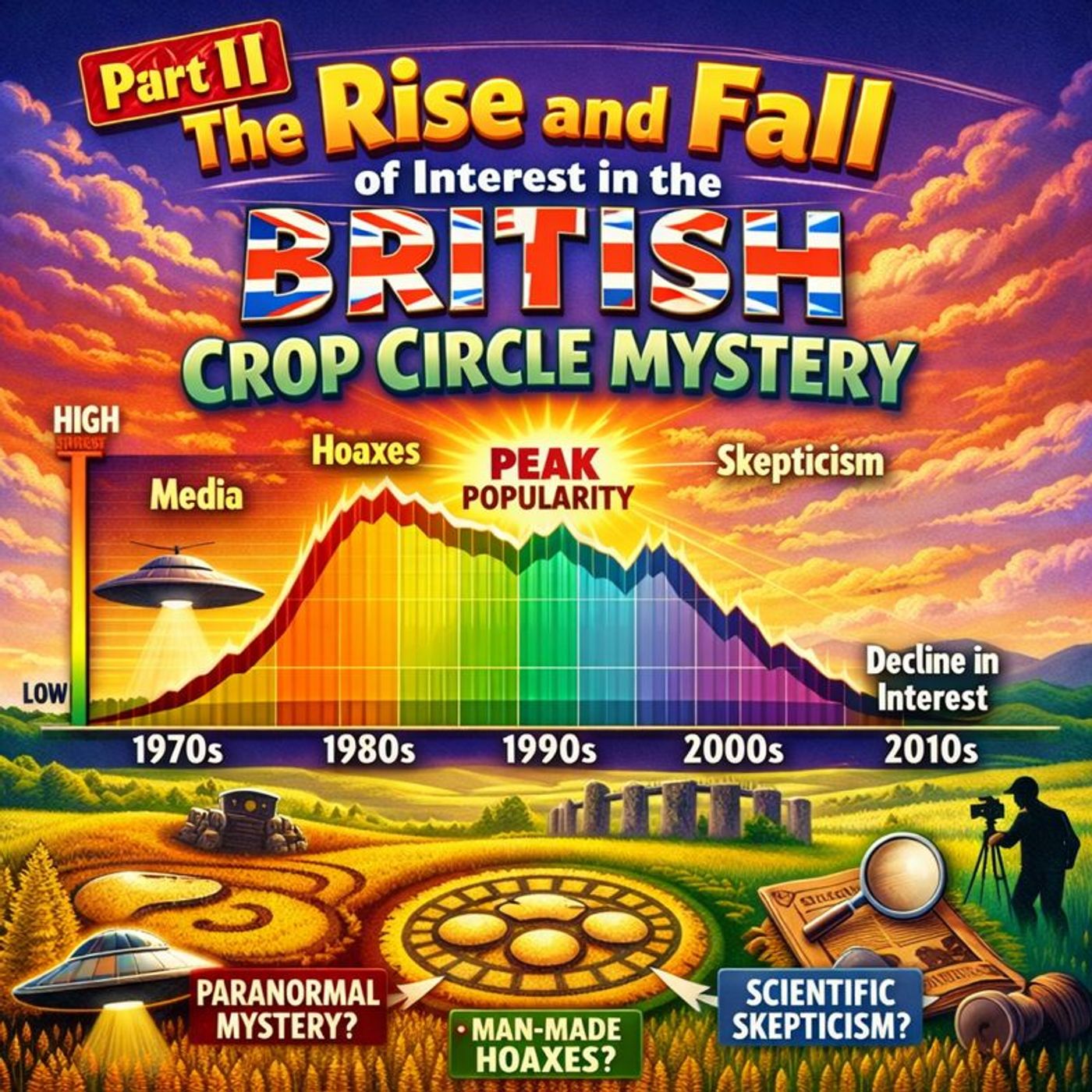
AudioBlog: PART II The Rise and Fall of Interest in the British Crop Circle Mystery
Episode Transcript
The Rise and fall of interest in the British Crop circle Mystery, Part two by Charles Lear.
In last week's blog, we looked at the beginning of the modern crop circle phenomenon that first got the attention of the media and UFO researchers in nineteen eighty.
This was described in the nineteen eighty six report compiled by Paul Fuller and Jenny Randalls, written by Randalls for the British UFO Research Association, titled Mystery of the Circles.
According to Randalls, the idea that UFOs had something to do with the mystery came from the fact that the first circles appeared in the West Country, in the area of Warminster, which had become famous in the sixties as a UFO hotspot.
When we left off, that idea was falling out of favor with the researchers, particularly Ian Mertzigott of the newly formed organization Probe, who was quoted from the March nineteen eighty two Volume two, number four Probe report even to suggest that the flattened circles were UFO landing nests.
His wildly speculative wishful thinking without any foundation.
After a lullent attention.
In nineteen eighty two, things picked up after eight sets of five circles appeared that were made up of one large circle surrounded by four smaller circles at equidistant locations.
Prior to this, there had only been single circles or two or three in a row.
Playing a large part in the media attention was the fact that the circles appeared in the summer, often called the silly season due to the fact that stories of a less than serious nature are used as filler in the midst of what is traditionally a slow news period, and it did get silly.
One example, presented by Randalls, his Daily Express columnist Gene Rook be sent to one of the sites to come up with a lovely poeticode to e t, a titular alien from the movie.
According to Randall's, Rook found physical evidence of his presence in the midst of one of the rings.
A poppy.
Randals emphasizes that serious UFO investigators refused to get involved and notes that she herself refused to appear on BBC and ITV television even though she had a new book to promote.
The Pennine UFO mystery.
According to Randall's, members of Probe took visitors out to see the five circles at Westbury and were shocked to see an identical set right next to them.
Somehow they had been missed by the media.
At this point, the group was looking out for hoaxers who might be encouraged by all the attention from the press, and Randal's notes that the fivring patterns looked remarkably symmetrical and artificial, throwing confusion into the mix.
It was found that the aerial photos taken by Now magazine for his story on the first circle reported in Westbury in nineteen eighty showed there were three smaller circles around it, with a hedgerow running through the position where a fourth circle would be.
Randalls seized this as supporting the possibility that the five circle patterns could be naturally formed.
What was odd about the second set at Westbury was that the circles were swirled counterclockwise, where as every circle previous had been swirled clockwise.
They were finally reported on in the August twenty ninth, nineteen eighty three Wiltshire Times and Francis Sheppard, son of the owner of the Westbury Field.
Alan Shepard said they had been possibly hoaxed because he and his family were able to create a circle themselves using rope in a chain.
Probe followed up and discovered that the Shepherds had created the entire second set.
The story that came out was that the Daily Mirror, not one of to be outdone by the Express, had paid the Shepherds to have Francis, his father, and some Mirror reporters create the circles.
They filmed the operation with a stop motion camera, and the whole process from arrival to departure took under an hour, with only twenty four minutes spent actually making the circles.
The idea was that the circles would be discovered and reported on, hopefully by the Express, and then the Mirror would step in and expose the hoax.
As it turned out, interest in the circles had already died down that season, and the only report covering the whole affair was in the volume four, number two October nineteen eighty three prob Report, which was the final issue before the organization folded.
Randalls describes Merciglod, a council member of behufora during this period, quitting eupology after becoming frustrated by people who did not want to know the facts.
The shepherds are said to have insisted that they were only responsible for the one set, and not for the other on their land or any of the others elsewhere.
According to Randall's Machine, bufora stuck to playing down the UFO connection when dealing with the media, the media played it up.
She cites the article Heally's Comet, named after Shadow Foreign Secretary Denis Hely, who took photos of a fivring pattern featured in the article in the August fourth, nineteen eighty four edition of The Daily Mail that mentions a giant spaceship and people being totally baffled.
She points out repeatedly that not a single UFO was reported in connection with any of the circles.
The report is broken up into five sections, and after a historical review of the Mystery Circles, the remaining four are facts about the Mystery Circles, theories, the weather, theory, and conclusions.
Randalls starts off the theory section, saying that the most popular theory is that the circles are hoaxes and other theories, all of which are presented along with their problems include helicopter downwash, hippies, marking areas for aerial drug drops, and ufoes.
The weather theory section is a detailed look at the work of meteorologists doctor Terence Meaden, who argued that the circles were caused by whirlwinds.
Finally, in conclusions, Randall's states that Bufora doesn't intend to offer a solution and that UFOs are low on the list of possible causes, as any one who is following the UFO subject in the late twentieth century is probably aware.
The report failed to make the mystery go away, and its association with UFOs, mostly in the press, continued.
In nineteen ninety, Bob Kingsley put out the first issue of The Circular, which is a compilation of articles, news clippings, and reports, and it is noteworthy that the only mention of UFOs are in the news clippings.
In one instance, where Kingsley includes euphology in a list of other ologies that might be of use in exploring the mystry, he provides the phone number of the information line of the Circle's Phenomenon Research Group, run by Pat Delgado and Colin Anders.
Since nineteen eighty four, but notes that he's not sure it will be set up for the next year's season.
At this point, the circles are more plentiful than elaborate, and Kingsley mentions in the introduction that hoaxers are making research more difficult.
The very next year, the media caught on to the hoaxing aspect when two landscape painters, David Chorley sixty two and Douglas Bowers sixty seven, came forward claiming they had been making circles since nineteen seventy eight and would make twenty five the thirty every season.
Kingsley teamed up with the Center for Crop Circle Studies, and starting with the Volume two, number one March nineteen ninety one issue, the Circular became that organization's quarterly journal, with Kingsley staying on as editor.
They kept publishing until two thousand five, and in the final issue it is announced that CCCS is shutting down.
Kingsley sums up the state of the phenomenon at that time as someone who has kept a watchful eye on the phenomenon and those involved with it since nineteen eighty eight.
I have been saddened to see the evident loss of its magic.
Over the years.
Both the hoaxers were self styled land artists aided and embedded by the media, and an increasing bandwagonism by so called croppies have sapped much of what was once a mystery and replaced it with a dull repetitiveness of pretty patterns, new age commercialism, and of often tiresome adages repeated at summer gatherings.
But this is not to say that the mystery the genuine crop formation has ceased, as numbers of most interesting an unusual events are continuing to be recorded, both in Britain and across Europe and America.
Charles Lear is the author of The Flying Saucer Investigators, available in its second edition at Amazon dot com.