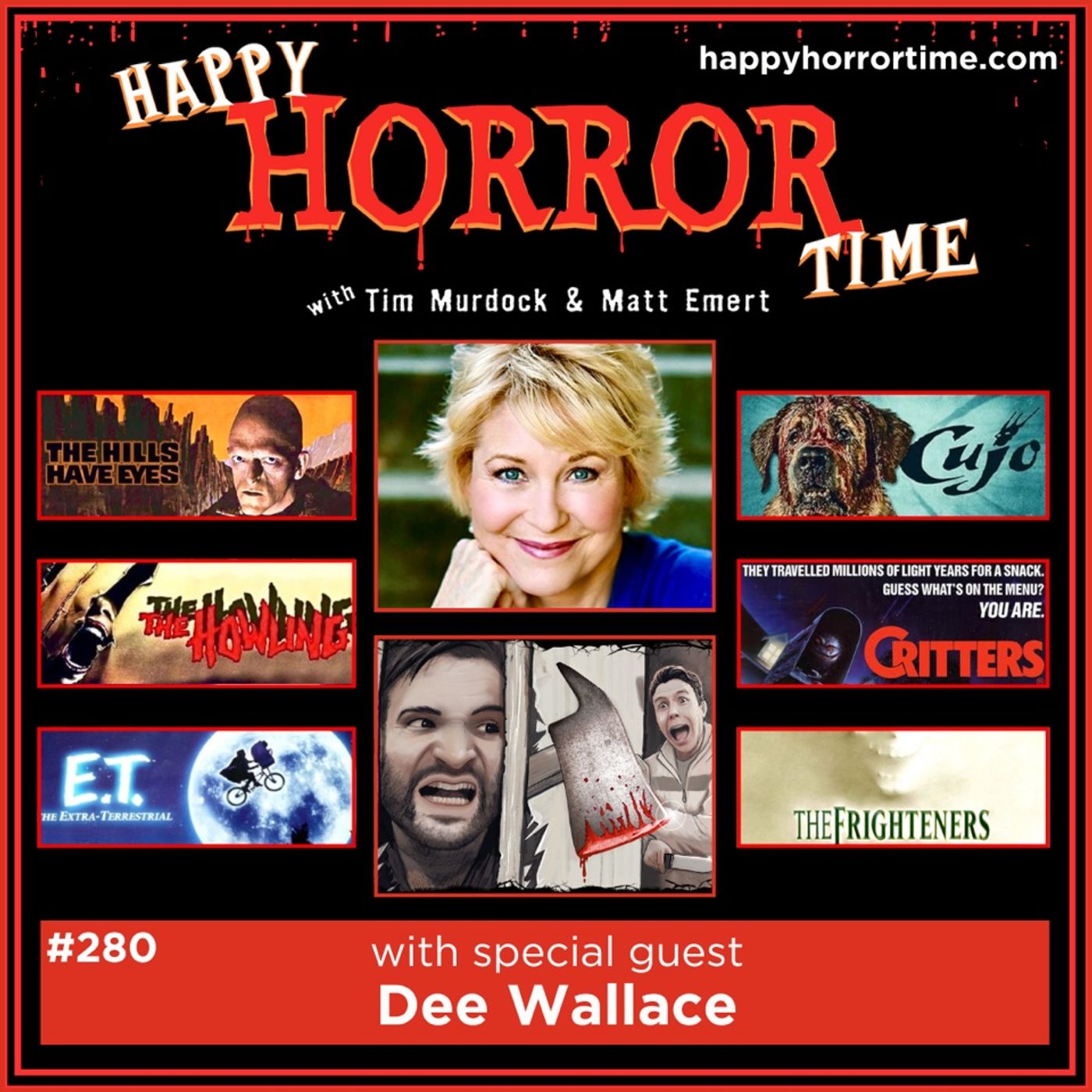
Ep 280: Interview w/Dee Wallace from “The Hills Have Eyes,” “The Howling,” “Cujo,” and many more
Episode Transcript
Hello, Welcome to Happy Hord Time.
My name is Tim Murdoch.
Speaker 2And my name is Matt Emmert.
Today's special guest may be best known for her role as Mary, the matriarch in Et the Extraterrestrial, but for horror fans, she's a true legend, with roles in the genre spanning five decades.
She was pursued by cannibals and Wes Craven's The Hills Have Eyes, battled a pack of werewolves in The Howling, fended off a rabid dog and Kujo, pulled a shotgun on a bunch of small furry aliens and critters, and even played one half of a serial killing duo in The Frighteners.
And she's still going strong in horror this year with roles in The Boy from Below, The Licked Hand, and Southern Scares.
In addition, she's a best selling author and a multinational respected authority on the art of self creation.
I mean, I am in awe of everything she's accomplished throughout her illustrious career.
We are so honored to welcome to the podcast.
D Wallace.
Speaker 3Hi, Gods boy, it sounds like I should be one hundred and fifty.
Speaker 2I mean, is it really is so remarkable everything you've accomplished.
It's crazy.
I don't know how you have time to sleep.
Speaker 3I don't either, but it's really important to me.
So I work it in.
Oh good, good, yeah, I do, you know.
I work my I hit the floor running and I run all day.
But at six o'clock, especially if I'm home, I quit.
I have dinner with my guy, we watch some shows, or go to a movie or you know.
Balance in our lives is really really important.
Yes, and Americans are not taught that.
Speaker 2No, and most places of employment don't teach that either.
They try to overwork their employees.
Not speaking from experience or anything.
But so we want to take it back to the beginning because we read that you're originally from Kansas City and your mom was involved in community theater.
So is that what inspired you to pursue acting or when did you first become interested in performing?
Speaker 3You know, I can't remember a time when I wasn't We were very poor when I was little, but my mom she worked as a secretary and then acted at night and on the weekends.
She also produced and directed all the religious plays at our church, and every Christmas in Easter would do a half hour what we would call monologue.
They called them readings back then, and people from four states would come to watch my mother do these readings.
And I remember I I was somewhere between six or eight years old, and we were sitting watching my mom do this, and I looked around and everybody was crying.
All these adults were crying, and I went, oh, this is what I want to do.
I want to move people like my mom.
You're good the DearS.
So I knew in that moment.
But even before that, they had me in modeling.
She traded secretary duties to get me dance classes.
You know, she just she just knew.
I was the Dell Comic Queen when I was little.
My dad worked for Dell Comic, so I had the little crown.
I welcomed Walt Disney.
I was the Imperial Margin and Princess.
Remember where the crawm goes pot.
No, you probably don't remember, y'all.
Speaker 2Yes, wait, wait, no, I've heard it.
Speaker 1Yes, I see.
I'm a little older than math.
Speaker 3Yeah, but you're not that old as me.
So you know, I kind of was in that world without really knowing why I was in that world.
I don't think my mom did it to make money, but I also never got an account that all that money was in.
So yeah, so I just I graduated from the University of Kansas in theater and English taught one year and thought, if I don't get out of here now, I ain't ever going to get out of here.
So I said, I'm gonna go be an actress.
I'm going to York.
And somebody laughed at me and said, you don't know anybody.
Nobody knows you stay in Kansas, where it's safe, and I went, thanks for sharing, Gonna go anyway, And in less than seven years I started et Oh my God and Hollywood story, isn't it?
Speaker 2Yeah?
Speaker 1And growing up in Kansas were horror films on your radar?
Did any Heaven?
Speaker 3Well, no, horror horror films were never on.
Let me tell you.
My older brother baby sat me one night and my mom said, don't you dare show her anything scary.
So of course he showed me Frankenstein's Wife or some stupid picture like that.
Well, my mom came home to a hysterical little girl, and I told her what happened, and she looked at my brother and she said, and she'll be sleeping with you in your bed until she's okay to go back to her room.
Speaker 2Oh my gosh, So you were traumatized by the bride of Frankenstein's Yeah, yeah, yeah.
Speaker 3I you know, I'm really good at doing him.
I'm I'm really woosy when to watch them.
Speaker 2We hear that a lot, yea, with many of the people we talked to.
Like, again, we say this all the time, but I'd say fifty to seventy five percent of the people we interview on the show who are in horror movies don't watch horror movies.
Speaker 1They don't like them.
Speaker 3You know.
I loved The Exorcist, It's my favorite horror movie.
I loved a quiet place, you know.
But these days we call them horror films and they're not.
They're slasher films.
And I don't do those at all, at at all.
I don't do them.
I don't watch them.
A real horror film takes time to develop the characters and there's a real story there that evolves those characters into something you care about.
In Kujo, you cared about that mother and son.
Yeah, right.
In the Hawling, you cared about the people that were trying to win over the light, right, that's what that film is really about, the light versus the dark.
Speaker 2Yeah.
I mean, so we're going to try to cover some of your most popular horror all right, the past before we get to the current ones.
We wanted to start with the nineteen seventy seven survival horror flick The Hills Have Eyes.
Now.
I know this was one of your first roles, So how did you get involved with that project and what were your thoughts at that time, so early in your career about doing a horror movie.
Speaker 3I got a job.
I got a job.
I got a job.
Yeah, that was That was about the extent of it.
Guys.
You know, when you're starting out, you don't judge any When I read it, I thought, oh, this gives me a lot to do.
This gives me a lot of great emotional stuff.
And I you know, I'm a good crier and I'm a good screamer.
So I think horror fans and the horror genre just went ooh, let's go after her.
She's a good screamer.
So no, I didn't go looking for them.
I auditioned.
I auditioned, and you know, okay, let me back up a minute.
So the very first film I ever did was a religious film called The Hills Have No Yeah No, called All the Kings Horses.
And I got that because my acting teacher, Charles Conrad, Thank you.
Charles, had a scene night and the casting director came and she loved me and thought I was perfect for that battered why in this religious film?
Grant Goody?
Do you remember Grant?
I'm from Aid It's enough?
Oh like yeah, he played my husband and really hit me one time.
Speaker 2Oh so.
Speaker 3I got that and it was a real tour to force role.
And I thought, I'm going to rent a little place where I can show that film, and I'm going to invite ten agents that I think I want to work with that would be at the level where they Again, everybody said, are you kidding me?
You're going to show a e f in religious film to Hollywood agents And I said, Hey, if they can't see my acting, I don't want him to wrept me anyway.
Do you know nine of them wanted me.
Wow.
Yeah.
So I'm saying to everybody out there, people that love you the most will try to limit you to keep you safe.
Go do it anyway.
Speaker 2That is good advice, and I've lived by it, you know, you talked about the Hills have Eyes.
It gave you a great role.
It's very intense, obviously, and spoiler alert, it's especially intense during your big fight scene with one of the cannibal's mars, because it culminates in you getting shot to death and it's incredibly jarring because you know you're just trying to protect your baby.
What was it like filming that brutal fight scene.
Speaker 3I know already they had me as a mother.
My first thing I was a mom.
Yeah, you know, it's interesting.
Sex and flight scenes become so technical when you do them that you really break everything down into components and it's not very scary at all.
You have to get it's all really about energy, and you have to get your energy very high.
And as my teacher, Charles Conrad taught me, you come in with absolutely no ideas.
Now that's the first time I had ever heard that in enacting technique.
Everybody else I studied with Uda Hogin Amazing, amazing teacher.
Not from my brain.
Jeff Corey, same thing.
But when I'm telling you, guys, I can come to the end of the road and go, Okay, there's the ocean and there's the mountains.
Well, I've got to go left.
It's always right.
If I try to figure it out, I'm screwed.
But if I go in and allow the character to take me over, they tell me what to do and it's always right.
I have so many stories to back that up.
Speaker 2No, I can imagine.
And so that kind of came into play in that scene in the Yeah.
Speaker 1And you worked with director Wes Craven, who became a horror master.
What was it like to work with him at this point in his career.
Speaker 3You know, he was quiet and intense and very kind and rather subdued, not the way you think of a horror director at all.
Speaker 2You never heard that.
Speaker 3Yeah, he started out as an English pastor.
Speaker 2That's so funny.
Yeah, yeah, you know.
Moving on to nineteen eighty one's The Howling, you play Karen White, a TV newscaster who trails a serial killer and ends up at a colony filled with were wolves.
Now, your performance in this movie was so impressive, and I was just wondering what kind of preparation did you do or do you remember doing for this role, because you had to portray like the trauma of surviving an attack, let alone having to battle wear wolves.
Did you do any specific type of preparation for this role?
Speaker 3Oh, okay, my preparation is not to prepare.
Speaker 2That's it.
I like that though, because, like you said, you let so you try to kind of go in the moment, like you said, and let the character take over while you're doing it.
Speaker 3Yeah.
Absolutely.
Like the dinner table scene in et m hm uh that laugh Noe peanuts Brett talking sit down, that was Mary, if I had figured it out from my head, I went, well, I'm a mom and that's bad language at the table and you know all that horse poop we do.
And then at the end he says, my husband's in Mexico with Sally.
I felt all these tears coming up, and Mary thought, oh, I can't let the kids see me cry.
So I got up and left.
Well, so Stephen when he cut, he came over and he said, indeed, that wasn't in the scene.
Why did you get up and leave?
And I explained to him what happened, and he looked at me and he turned to the crew.
He said, you've got thirty minutes.
Build me another wall to the kitchen with a sink with running water so he could take me over to the sink and bring me back into that.
It's stream club set where I say he hates Mexico.
Speaker 2Wow.
Speaker 3And that's you see, that's when the magic greedy happens when a director and an actor trust the character and what happens and expand it.
And I've got every major director I've ever worked with, stuff has happened like that on sets with us, every one of them.
Speaker 2I love.
I love hearing that that's how you approach things, because I don't think we've heard that specifically.
Speaker 1No, we talked to you know, actors, but you're like really talking about the craft, And like, I wish I had an audition coming up because I would feel so much more prepared.
Speaker 3Well, listen, it's it's so much about energy.
You get your energy and you train it to do this really really really high, and then you do what you call throwing your energy.
So I'm going to show you.
You'll be able to see it on screen.
So watch me.
So I'm talking to you, and it looks like I'm connecting with you right, I'm looking right at you now, I'm sending my energy to you while I talk to you.
Can you feel the difference I feel.
Speaker 2I do feel a little bit like, I don't know if I'm telling myself to feel, but I do feel different.
Speaker 3Yeah, And that's what a director sees when you tape an audition.
They see your energy coming out of that screen and connecting with them.
And that's why reviewers say, oh, they had so much chemistry, because they've got that energy going back and forth.
Speaker 2Yeah, you know, taking back to the Howling, there's so many impactful scenes in that, but at the very end, one of the most impactful scenes, I think is your transformation.
And I was just wondering what kind of makeup and prosthetics did you have to wear for that scene?
Speaker 3Not me?
Speaker 2It is it?
Speaker 3It's not me.
I never knew that I was up shooting Kujo, and for some reason, I had it in my contract that my character would never appear as a werewolf.
I guess it was important back then.
I don't know.
But Joe, my wonderful Joe Dante, our director, called me, and he said, d all the cards.
You know, the test audience they want to see Karen change.
I said, I don't care, Joe, but it's in your contract.
I don't care.
You have my permission, but can you make her just a little more vulnerable because she's fought so hard against it.
So he and Rob came up with this what I call my Bambi werewolf.
Speaker 1She's cute.
Speaker 2She is Wait, so they created that that's not you at all?
Speaker 3Not at all?
Speaker 2Wow?
How about Well then I have to ask your animatronic that is amazing during Eddie's big transformation scene because in the movie you're like front and center right next to him as that.
Speaker 3Huge has nothing to look at.
Speaker 2That's what I wanted to know.
So you were reacting to nothing.
Speaker 3Yeah, I'm reacting to Joe going Okay, he's getting bigger.
Now what's there?
Goes his ears?
Now his noses?
And so yeah, that's what the crew started doing.
And so finally I said cut.
I said, Joe, tell me the order and let me just imagine it, okay, because it was just too funny to hear somebody say it.
Yeah.
Speaker 1Yeah, And the most important question, did you get to keep that beautiful sketch of you that Eddie had drawn?
Speaker 2No, it was such a beautiful sketch.
Speaker 3Yeah, it would have been a great thing to sell at the cons.
Speaker 2Yeah, you know you you mentioned et And although E T is not a horror film, I think our audience would be really pissed if we didn't at least ask you a couple questions about this blockbuster.
What do you remember about the audition process for Mary?
In an audition you didn't.
Speaker 3This is just full of surprise.
Speaker 2About we knew Elliot.
Speaker 3I auditioned for used cars, but Steven works very far ahead, and he saw in me exactly the quality that he wanted from Mary, and so when Et came along, they just offered it to me.
And I had to drive to the studio behind locked doors to read the script because people were stealing ideas back then, so they didn't even let A Boy's Life, which was the working title, They wouldn't even let it off a lot.
So I went over and read it, and I remember exactly what I called my agent from a landline, and I said, you know, I don't think this is going to do a lot for me, but I think it's going to do a lot for the world, and I want to be a part of it.
Speaker 2You were right.
Oh my god.
It was the highest pressing film until Jurassic Park.
Speaker 3Apparently Dahn Paltergeist was supposed to be his big.
Speaker 2Film that year, you know, and I mean obviously we have to ask what is Steven Spielberg like as a director?
And do you guys still keep in touch at all?
Speaker 3Oh, every once in a while, you know, I'm I'm sure I'm not on Stephen's radar the email, But what was the original question?
Speaker 2What's he like as a director?
Yeah?
Speaker 3You know, he's like a little kid.
He gets so excited.
He just loves what he does, and especially when he works with kids.
You know.
I mean, I wouldn't have had a career if I hadn't worked with kids and dogs.
Speaker 1I was just about to ask you what was it like with Henry Thomas and Drew Barrymore.
Speaker 3Oh god, you know, sometimes I think I'd rather work with kids because they don't come in with a lot of ideas and they're always in the moment with you.
They're always in the moment.
And you know, Danny Pintaro and Kujo Dear God, I thank god every morning that I got that kid for that part.
But the kids in ET so professional, so much fun.
You know, Stephen would go out at lunchtime and do hoops with him.
Speaker 2That's awesome.
So he is like a kid at heart, or at least was then.
Speaker 3Yeah, Yeah, I mean that doesn't mean he's not a very savvy business man and knows exactly what he wants, but he also knows when to see the magic and expand on it.
And that's the sign of a great director.
Speaker 2Yeah, no, truly, So switching gears from the sweet, non threatening alien to the rabid, murderous dog.
Now, I read in a Fangoria interview that you said nineteen eighty three's Kujo was by far the most difficult thing you've done in your life.
So what made this movie so difficult for you?
Speaker 3Have you seen it?
Speaker 2Of course many many times, And I even know what your answer is going to be, but I want my our audience.
Speaker 3To hear because emotionally and energetically, I literally ripped my soul out and threw it on the screen.
You know, you're working with a dog and a kid, so when those two work, they printed, so you got to be on every single time, and you know you see it as a completed scene, which means we probably shot it with all the different angles in everything, fifteen or twenty times.
Speaker 1I mean as a kid, I mean when you're in the car with the child and the dogs outside, but the first hour, I mean, I'm a huge soap fan.
I love the love triangle between you and your husband and the guy you're having an affair with, and then when you're cleaning up the milk.
I feel like that scene is so powerful because like there's no words.
It's like, yeah, as a soap fan, I.
Speaker 2Just doesn't he just to tell me yes or no something and you say.
Speaker 1Yes, yeah, it is the dog stuff, but there's also the human side of it with you know, the old school fan.
Speaker 3Yeah, yeah, yeah, it's it's definitely a film about facing your greatest fears.
And by the way, the guy that played my lover was my husband.
Yes, yes, now I gotta tell you this story because most people don't know this story.
He played my husband in the Howling.
Speaker 2Yeah, yes, he got that.
Speaker 3On his own.
Dan Blatt, our producer, called me.
He said, d we've got a really great cast lined up to be with you.
We're just still looking for the guy to play your husband.
And I said, well, exactly what are you looking for and he said, well, he's got to be really virile but with a real sensitive side.
And I went, oh, I'm freaking engaged to him, and within five seconds I went, don't say that.
D he'll never get it.
And I said, you know, I did this this episode of Chips with Christopher Smith or Stone somes word, and they went out and found him and brought him in and he got in on his own.
So the next day, Dan Platt calls me and I pick up and he says d and I said, Hi Dan.
He said, Oh, this is weird.
I thought, I would you know that guy you told us about.
We really liked him and we hired him.
I thought I was calling his number, and I said, you are, so.
Speaker 2You pretend when you were even giving the name, you like, messed up the name like you didn't remember.
Speaker 1That's genius.
Speaker 3And so I hear this long silence and then I hear, oh shit, I said, don't worry.
You only have to get one trailer instead of too.
Speaker 2That's hilarious.
I love that.
You know you were talking about in Kujo.
Part of what made it tough obviously the working with dogs and they're have to get it right.
And I read that there were real dogs, mechanical dogs, and even a guy wearing a dog costumes.
Speaker 3Okay, there were thirteen real dogs that played Kujo.
Speaker 2Wow.
Speaker 3They did almost every single shot in the film.
Speaker 1Wow.
Speaker 3All trained to go after toys, so we had to tie their tails down with fish wire because they were wagging them all the time.
Yea, from here up they look ferocious.
Dig for that toy, dig for it.
The trainer, which is it Carl Miller, Oh my god, even slept in the barn with those dogs.
And then yes, we had a stuntman in a dog suit.
He did the big attack with me, and the stunt woman did it with the real dog in they intercut and he did part of the scene where he rms his head into the car because you can ask a man to do that, but you can't ask a dog to do that, you know.
So, but the real dogs did almost every shot in the movie.
Speaker 2That's incredible and I love knowing that it.
I mean, like you said, if you had to tie their tails down, at least they were it feels like having a good time.
Speaker 3Oh god, yeah, oh yeah.
Speaker 1And we heard that the hardest.
Speaker 3Part of Kujo for me, because I'm a huge animal lover, was I couldn't go love on him.
You can't have that contact because then they don't listen to the trainer.
Speaker 1Yeah, and we heard that you injured yourself breaking glass in the car.
What happened?
Speaker 3Oh my god?
Okay, so we get to that last scene where Danny's locked in the car and I have the baseball bat and I have to break the back glass.
And Lewis, our wonderful director, came up and he said, de we're gonna shoot this in slow motion, so you really really have to hit the glass hard.
We've treated it.
You can't break it.
Yeah, three hits and it broke.
So did I?
Now we had reheard the whole thing all the way through, so we wouldn't be locked into anything.
So did I hear cut?
Hell?
No, I'm sure everybody was standing there going, oh my god, she broke the glass, so everybody froze.
I didn't hear cut.
If an actor doesn't hear cut, you just keep going.
So I got in the car.
I picked Danny up.
I was supposed to drag him out, but this part of my brain was going, get the kid, get the kid.
This part of my brain was going, don't take him over the glass.
You've got to pick him up.
He'll get hurt.
So I picked him up and I do this stupid waddle out of the car.
I get out of the car.
Do I hear cut?
Speaker 1No.
Speaker 3So I keep running up, you know, to the window, to the door and fine, I hear kat and Dan runs up to the set, Oh my god, are you okay?
Are you okay?
And I went, I think so?
Why?
And he said, do your arm?
Well, I'd slipped my arm.
Speaker 2Was there blood everywhere?
Speaker 3Well there wasn't blood everywhere?
There was blood.
And Dan goes, oh god, I hate to ask you to do this.
Can we wrap it in an ace bandage?
Can you do one more take?
Speaker 1Oh my god?
Speaker 3So we wrapped it in an ace bandage and then we went to the hospital.
Am I a trooper?
Speaker 2What you are?
A trooper?
I love that.
It's like, ooh so sorry that you broke the glass?
Can we do that again?
Speaker 3Yes?
Yet get this?
Speaker 2Yeah?
You know a few years ago Stephen King, who we all know, wrote the novel to Kujo is based off of set and I quote D Wallace gave the best performance that I've ever seen in one of my movies.
And then he went on to say that you should have won an Academy Award for the performance.
How did it make you feel to hear such a high compliment from him?
Speaker 3Pretty damn awesome?
Speaker 2Because there have been a lot of movies based on his books.
Speaker 3Like, I'd like to do another one, Stephen.
Speaker 2You hear that, Stephen King.
No, I mean that there's so many, but like that is quite the compliment.
It's amazing.
Speaker 3Joe is by far my favorite film.
Speaker 1I love it too.
I love the school.
Speaker 3I just gave everything I had.
Speaker 2Yeah, no, it makes sense.
So a few years later, in nineteen eighty six, you start as Helen Brown, another matriarch figure in the original Critters.
Now I know that the actual Critters were mechanical puppets.
What was it like interacting with these puppets on set?
Speaker 3They were mechanical.
Speaker 2Well, that's why, frad.
Speaker 3What I remember is we would all get into the emotion of the scene right and then the directorture would go, okay, roll them in, and somebody would be off camera literally rolling them across the camera.
Now that being said, I didn't have as many in depth scenes with the Critters.
I love the scene where I'm gonna get to shoot the little slugger, but I didn't I know that Big one wasn't made.
And that's why you only see like this peeking through the upstairs window that I see you want to man the one that they do Critters attacks.
That's on sci Fi.
Oh my lord, that thing walked out.
My jaw dropped.
It's so incredible.
If you want, if you didn't know, there's another Critters, it's it's playing on sci Fi.
I'm sure still.
Speaker 2And you because yeah, we actually were going to ask you about that.
It was the twenty nineteen sequel and you but you're playing a character of a different name.
Speaker 3But so is it a d I don't know what it's some legal bs, but it.
Speaker 2Was basically your character from the first one, right, Oh yeah, yeah.
Speaker 3Yeah, find the same character but you have a different name.
Speaker 2Yeah, exactly.
You know, there's also a funny part in Critters where one of the critters takes a bite out of an Et doll, and so I've got to know was this put in because of your connection to Et?
Speaker 3Of course?
Of of course, you know that's what do you call them when they plant little things like that?
Speaker 1Easter eggs?
Speaker 3Yes, Easter eggs?
Speaker 2Right, it's so good.
Yeah.
And then one decade later, in nineteen ninety six, you start in The Frighteners as Patricia Bradley, a very different character from the ones you had previously.
Mad I just wanted to know, like, what was it like playing such a villainous character in this I had.
Speaker 3So much fun.
I had so much fun.
I thought, man, I've got to work for a foreign director in a foreign land to show people I don't always have to play mothers, you know.
And I went over to Universal and auditioned for Peter, whom I love more than life.
I've got to tell you, and I think I think Michael J.
Fox came in and watched it too.
They were at the back of the theater, and when I finished, I say, guys, please don't see me with this bright blonde hair, because that's not Patricia, you know, see me with long dark hair.
You know she's dowdy.
You think she's a victim.
Well, the next day I was hired.
Speaker 1Oh that's awesome, and which I just had.
Speaker 3A great time, just a great time.
Speaker 1Which do you prefer playing a heroin or a villain?
Speaker 3I prefer playing a good part.
Speaker 2Oh, good answer.
Speaker 3I don't want to be limited anywhere.
You know.
I have ten films coming out, guys.
Three of them are family films with comedy in them, and the rest are horror like bouncing back and forth and doing everything.
Speaker 1And speaking of comedy real quick.
I just want to get this out one of my favorite movies.
We're a horror focused podcast, but Secret admire you're so funny and Secret Admirer.
I just wanted to get that out.
Speaker 3Oh thank you.
We had so much fun doing that Fred and I car scene.
Speaker 1Yes, hilarious.
Speaker 3I said, I'm just gonna fall out a frame and let the audience decide what to go on.
The director said, oh my god, I love that, d So that's what we did.
We had so much fun.
Speaker 2I love that you're I mean, like, obviously we love that you embrace the horror genre so much.
But it's great that you get to be in a variety of things and still go for like the role over like a specific type of character.
I think that's great.
And you know you mentioned this, but a funny parallel between The Frighteners and Critters is that in both movies you get to wheeld a shotgun and go on a shooting spree.
So what was it like running around shooting a shot especially after Michael J.
Fox and getting to strangle him with that shotgun?
Speaker 3Uh, I'll tell you.
When my husband looked at Critters.
My my husband was an actor but he was also an ex marine and I see him go like this, and I go, what you don't like it?
He said, honey, I got to show you how to hold a gun.
I'm like this right, And I said, I'm a farm wife.
I'm not supposed to know how to hold a freaking rifle.
I shouldn't.
But and and so by the Frighteners, he had given me some pointers by then.
Speaker 2Oh so, okay, I just love that.
It's just so funny that these two big movies, you have these big shotgun scenes.
Speaker 3And you're the one in The Frighteners was so heavy they taped that big flashlight on.
Oh my lord, it was real.
And you know I lost Christopher during the fright News.
Yeah, so it was a real yin and yang experience for me.
I will love Peter Jackson till the day I died for taking care of me through all that.
And he first had a heart attack and I flew back and he was fine.
So I flew back five days later he died.
I flew back again, put his service on, grabbed my kid and my nanny and we all flew back and I said, well, how do I pay you for these flights?
They said, don't worry, D We'll settle up at the end.
I thought, well, this is going to be every cent on made on this movie, but you know, that's life.
So I went in at the end to settle up and hear him the tears, and the accountant said, Peter's just gonna take care of it all for you, D.
Speaker 2So sweet, very sweet.
Wow.
Speaker 3Yeah, he didn't have to do that, but that's who Peter is.
I watched.
There was never anybody too small, too insignificant on Peter's set, not for him not to sit down and address a problem with him.
Well, that speakes a lot to me.
Speaker 2Yeah.
Yeah, and that's amazing, especially with the sheer amount of movies TV shows that you've been in.
You know, obviously that stands out in your life, like I imagine as like a great experience with a director.
I can't imagine that every experience you had was as good.
Speaker 3You know, I have been very fortunate to work with wonderful, caring, lovely talented directors.
Speaker 2Yeah, that's really fortunate.
Speaker 3You know.
My motto is life is too long to work with the assholes.
Speaker 2I like that.
Speaker 3I just don't have any space for it in my life.
Speaker 1That's great.
Speaker 2Good.
You know you shouldn't and nobody should to be honest.
Speaker 3No, you know, if you think you have to rate me and mistreat me on a set to get the performance you want, not the actor for you.
Speaker 2I like that too.
I'm flashing forward to the present now.
First off, we read that you're approaching your three hundredth film and TV credit, which is unbelievable.
Congratulations.
And we also read, and you mentioned this, that you film multiple horror films that have either just premiered or are coming soon, one of which is The Boy from Below.
Now, this is my favorite type of horror film because it takes place on Halloween night.
Can you tell us a little bit more about this movie and your role in it.
Speaker 3I love Love Love Toy, the director.
I loved being on set with him.
I don't want to give anything away.
You know, the Boy from Below would be equivalent to the monster at the back of your closet when you're six.
Oh, now you're gonna take it that way.
Somebody else is going to take it that way, you know.
But it's a it's very psychologically frightening.
Speaker 2That sounds great.
Speaker 1I feel what you're saying.
You're saying, like, what is in someone's closet may not be in someone else's.
Speaker 2Yeah, it scares you.
What scares.
Speaker 3Exactly?
Yeah, the Exorcist is so scary to me because not being able to be in charge of who you are is the most frightening thing I can think of.
Yeah, and unfortunately we see it everywhere right now, people trying to make other people believe and act and react like they think they should.
Life has never worked that way.
We're put on this plane to practice free will.
So if you want to get the life you want, you better know what you want, otherwise you'll never create ith.
Speaker 2Agree, agree and not.
Speaker 1I mean in a different direction.
Speaker 2Also in dating, Yeah, in dating, Yeah that works.
Speaker 1Yeah.
Speaker 3The trick is do you know that a child's belief system is locked into their brain by eight years old?
Speaker 1I didn't know that.
Speaker 3Yeah.
So whatever you're taught verbally or whatever is modeled in front of you between conception and eight, that is the belief system that you have based your life on.
So if you want to see the wall you're hitting as an adult, go back to your childhood and see what you were taught or modeled.
Speaker 2That makes a lot of sense, Yeah, it totally does.
Speaker 3That's where the gold is guys for all of us.
Speaker 2Wow, I know.
Let me have to think about it.
Well, we also read that you're starring in The Licked Hand, a film based on an urban legend.
Now I have to ask, is this the creepy urban legend where the woman reaches under the bed get licked by your dog and it turns out to be a person.
Is it based on that?
Or God?
Speaker 3Yeah?
And when when they sent it to me, a DoD the director, and I said, uh, I need to talk to you before I accept this.
So we did a zoom call.
I said, look, everything in me wants to do this part.
It was literally like not in material, but in energy another kujo and I said, dude, I really want to do this.
I don't know if I can anymore.
And he said, de, we've got a stunt person.
I did most of my own not because of her.
She was great because that's just who I am and what I've always done, slitting my arm and all that.
So he said, we've got a stunt person.
We've got to stand in whatever you need, whenever you need a break.
I just want you to do this film.
And I said, well, I want to do this film.
Speaker 2That's great.
Speaker 3So we did the film and I haven't seen it yet, but the magic that happened on the set was pretty amazing.
Speaker 2I mean, it's such a creepy urban legend and I love it.
It's like you returning to working with a dog in another horror film.
Obviously, it's like a weird full circle moment, but like, can't wait for As soon as I saw this title, I was like, I've heard that story.
I can imagine it.
Speaker 3I'm glad to hear you say that, because I thought bits should change the title.
Speaker 1Oh, I knew instantly from the time.
Speaker 2Yeah, the title is actually yeah.
Speaker 3Okay, I'm thank pushing my argument.
Okay, good to know.
Speaker 2Well, and then we read you most recently finished shooting the upcoming Southern Scares, a horror film that was filmed in the tradition of Stephen King and is based on I guess existing folk learn ghost stories.
Is there anything you can tell us about this film or your character Myra.
Speaker 3It's it's it's so interesting.
The script is so well written, and it takes place in this old video store like Blockbuster, and she's watching different old videos.
My section, my character worked out and ran the opera house in the like eighteen hundreds, So I play a character from the eighteen hundreds, but all of the vignettes go together to feed the story of the evil presence that only the girl.
I'm giving away too much.
Speaker 1What was it like filming at the Springer Opera House in Georgia.
Speaker 3It's beautiful, really beautiful, and and a little eerie.
Speaker 2Yeah.
Speaker 3Plus, I mean you you could let your imagination run just five minutes and imagine ghosts there and things that have happened in the past.
Speaker 2And yeah, do you know of any idea of when any of these three recent horror films?
Oh they I was going to say, release dates.
I want to know when we can see them?
Thoh me too, me too.
Speaker 3No, I go in, I do my best, I give it my all, I say goodbye, I go on to the next one.
Speaker 1I love it.
Speaker 3Yeah, you know, because we don't have actors, don't have any control over stuff like that.
Speaker 2Yeah, I have to let go.
Speaker 3You know, the music, how they edited, how they decide to release it, and then it's all up to the audience.
Are they going to embrace what we did?
You know?
I mean, without the public, Et would not have ever been the biggest blockbuster of all time, you know, Yeah, we all come together to make that magical world.
Speaker 2Yeah.
Speaker 3True.
Speaker 2So just a few final questions before we wrap up.
This is kind of just a general question related to your career in this genre.
What do you enjoy most about doing horror films?
Speaker 3Oh?
Because it it gives me the best opportunity to play all the emotional lights that I love to play that I'm good at playing, and it allows me to play big arcs like look at Patricia and the Frighteners.
You think she's a simply little victim who turns out to be a mass murderer.
I mean, come on, who wouldn't want to play a part like that?
Who wouldn't want to be the mother of a kid trying to save him from a rabbit?
I mean, that's a tour to force opportunity, right, So, Yeah, it's the emotional arcs and the different colors they give me to play.
That's what I see.
How excited I get what I talked about.
Speaker 2We love that because I don't have to see his horror fans.
It's like, that's what's made me so irritated that, like the Academy Awards hasn't embraced horror war because just like you said, the amount of emotional the depth of emotions that people have to portray in horror films is so unbelievably, I would assume tough to do, and then they don't really get nominated for Academy Awards when I'm saying, oh my god, like it's from.
Speaker 1Level zero to tenen, Like, the emotions are like.
Speaker 2Whoa, yeah, from fear to yeah, from fear to grief to trauma to everything.
That's just you know, you don't see that in every movie.
Speaker 3Yeah, I know.
It's you know, goes back to the B movies of Frankenstein and Dracula and all that horror was a B movie period.
Speaker 2You know.
Speaker 3I think that's starting to change with A Quiet Place and some of the other really good, you know, horror based stuff that's now and the main actors that have come aboard to do them.
But it's a slow process.
Guys.
You know, we used to laugh before I was in the business.
My dad was looking at the reviews and go, well, the critics really loved this one, so we won't go to that.
Well, but it's true a.
Speaker 1Lot of the time, Oh I lived by it.
Speaker 2Yeah, that's true.
Another general question about your career in horror.
You've obviously filmed several death scenes throughout your career.
Two that stand out to me as like the most brutal or impactful where you're death in Rob Zombie's Halloween and also in last year's stream.
Of all the death scenes you've filmed, which has been your favorite, oh or which debbely probably Halloween.
Speaker 3So you know the first part of that scene, I slide down the bookcase while he's coming to stabbing right.
So three weeks later, I get a call from the producers.
We need you back.
I said, but I've already died.
They said, yeah, but Rob wants to kill you better.
So I went back and I crawled through the hallway and then we go into that room.
He throws the stut woman through the glass table and then offs me.
Speaker 1Finally, that was really tough on me to watch it.
Speaker 2I see that it's so brutal, and it's just so sad what happens to your character, you know.
Actually, here's a question.
Have you ever been in a movie where they want you to do a death scene and you're like, that's too brutal and just like putting your foot down.
Speaker 1If you could pick any type of horror film to start in next What would it be?
Speaker 3I don't know.
I can tell you I've always wanted to play and then that was challenging her beliefs.
But that's not a horror film.
Speaker 1No, not the one.
Speaker 3Horror film.
I you know, I'm not a writer.
I wish I were, but I gotta tell you I get some of the most original stories and scripts.
I did a little film call for Deborah Warriors, and when she sent it to me, I read, anyway, why has nobody thought of this story.
Speaker 2Before thirteen fanboy?
Yeah.
Speaker 3I mean, it's such an original story and nobody had ever I said, never, I have to do this.
It's just too original.
Oh my god.
We had so much fun.
Speaker 1Yeah, that was an original idea because I always thought about that too, Like when you're at a convention, if there is someone that's a little unhinged, that's gonna be a scary thing.
Speaker 2Yeah, and you got to start alongside most of the Friday the Thirteenth franchise of actings.
Speaker 1Which is your favorite Friday the thirteenth.
Speaker 3I'm not getting into this political card, but I can I can tell you horror actors don't take any of that shit off.
The screen.
You know, we say cut and we go okay, let's go dancing.
All right?
Are we going forward to right now?
Speaker 2You know you've got to or you'd go nuts pretty much.
Speaker 3And it took me years to learn to let go like that, so I didn't know how to do it when I did The Howling.
Speaker 2Oh God, that would be a lot to take on.
Speaker 3Yeah, many times Dan and Joe say thank God, Christopher Wola met set.
Speaker 2You know, looking back on your remarkable career in horror so far, what are you most proud of, Whether it's a role film or just something that you know happened throughout your liath.
Speaker 3Oh, what I'm most proud of is that I'm always real.
That's the most important thing to me is not to act.
And in horror films it's challenging sometimes.
You know, it was challenging in The Howling just to stand there and watch the were wolf the man turn into a were wolf, because part of you is going, well, this has got to be really dramatic.
I should be more emotional, you know, you want to you want to show it instead of being in the real moment where my god, I'd freeze if something happened like that.
In front of me, I'd freeze while I have the emotion going on and coming up.
And I think that's the biggest challenge for everybody.
You know, audiences are very savvy, and if you're in a whor scene and you go, we're gonna laugh, but you see it.
But if you go, they're not gonna laugh, you know they're with you because they're in the moment with you.
Oh God, that's just my whole body's going like this now.
Speaker 2But that's so true.
Like we I mean, we watch horror films all the time, and the biggest thing is that if we don't feel a genuine performance from the actors, we don't feel genuinely scared, you know.
And so that's so true.
And we can just tell that you've been so amazing in this interview and you're so down to earth and real and genuine, so I can only imagine, Like, I think that was the greatest answer to hear you say about what you're most proud of in your career, because you know, some people could say, oh, this award or this role or something.
So that was a really great, honest answer.
Thank you, genuine.
Speaker 3Oh that's true.
What you see is what you get boys.
Speaker 2And we love it's we have We have one final question from Okay, one final question and we asked us to everyone we interview you.
Ready, it's going to put you on the spot.
Okay, what is just one thing that you can tell us about your experience working on any of the films we've talked about today that you've never told any other interviewer, publication, convention, podcaster.
Just one thing about any of the films from your career that you've never told before.
Speaker 1It could be a new film too, that which we haven't seen.
Speaker 3Christopher and I would have great sex and our trailer in between shots on which film?
Speaker 2On which film?
The holla, I love that.
That may be our best answer to that.
Speaker 3I'm gonna hear about that now.
Speaker 2Oh was that great?
Again?
Speaker 3For ever ever ever said that to anybody else?
Speaker 1I feel so privileged.
Speaker 2Thank you, thank you so much.
That was talk about a genuine answer.
Speaker 3Wow.
Speaker 2Oh my god.
Well d thank you so so, so so so much for your time.
You've you've made our night, You've made everything.
Speaker 3It's been a lot of fun.
Guys.
Speaker 2Well great, well, we wish you all the best.
We'll definitely be in touch and thank you for your time.
Yes, have a great rest of your evening.
Okay you too, Okay, take.
Speaker 3Care everybody, yodbye bye.
Speaker 1Thanks for listening to another episode of Happy Horror Time.
Speaker 2If you'd like to support the podcast, please sign up to be a patron at www dot patreon dot com slash Happy Horror Time.
As a patron, you get access to all our bonus content, which now includes two new bonus episodes every month, a monthly after show mini episode, access to our Discord community so you can chat with us directly, and the chance to review a film with us in one of our bonus episodes.
Speaker 1Patrons also get all our regular episodes, ad free and a day early our monthly newsletter, the chance to vote in polls, and autographed Happy Horror Time stickers.
Speaker 2I'm Matt Emmerts and I'm Tim Murdoch, and we hope you have a Happy Horror Time.