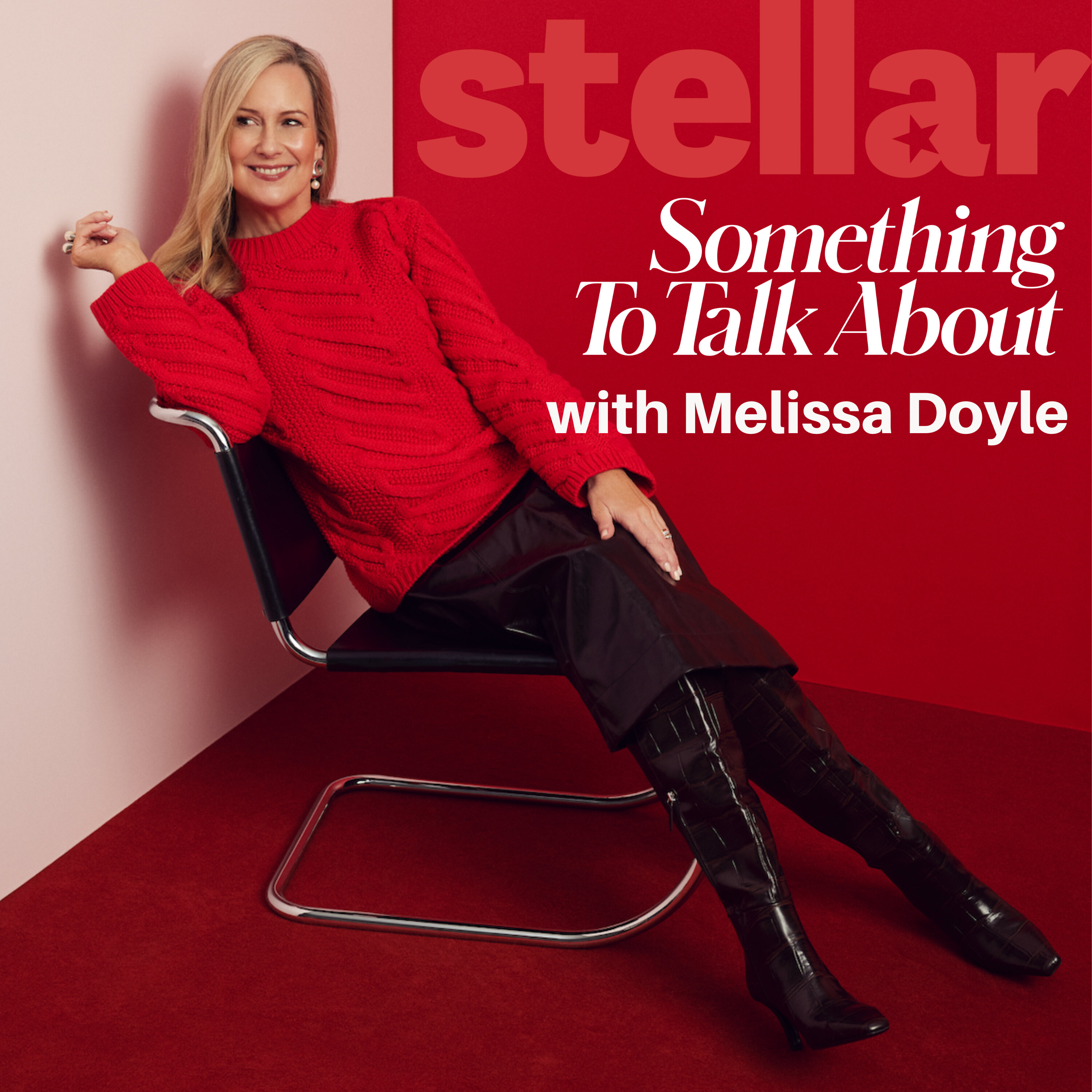
Melissa Doyle on the moment Oprah called
Episode Transcript
Hello, and welcome to Something to Talk About the Stella Podcast.
I'm Sarah Lamarquin, your host, and every week I sit down with some of the biggest names in the country because when Australian's celebrities are ready to talk, they come to Something to Talk About.
For more than two decades, Melissa Doyle was one of the most familiar faces on Australian screens, first as a co host of Sunrise alongside David Kosh, before moving on to a new role at Sunday Night in twenty thirteen.
Then in twenty twenty, she became one of many Australians who lost their job as a result of the pandemic, parting ways with her longtime employer Channel seven.
Suddenly, for the first time, Melissa found herself without the purpose and structure of a full time job.
Speaker 2But over the next few years.
Speaker 1She slowly built a portfolio career that included writing books, speeches, working in radio and hosting a podcast.
And then this year came the call that every presenter dreams of.
Melissa learned that another career defining opportunity was on its way.
Speaker 2She had been.
Speaker 1Chosen to sit down with Oprah Winfrey for a series of in conversations in an upcoming Australian tour.
Speaker 2Then I get a quick message saying she's going to jump online.
She wants to do it at a zoom in thirty minutes.
I'm like, oh my god, shit, John take the dog.
Had to quickly have a shower, wash my hair look a bit decent and presentable.
Speaker 1In today's episode of The Stellar Podcast, Melissa opens up about the status of her friendships with her former on air co hosts, whether she would ever consider a return to Breakfast TV, celebrating a milestone wedding anniversary, and how she's feeling about hitting the road with one of the most powerful women in the world.
Melissa Doyle.
Finally, welcome to the Stellar Podcast.
Speaker 2Thank you for having me.
It's so lovely to have you here.
Speaker 1You and I have never been in conversation before, but I have had the privilege of interviewing some amazing people, as have you.
But you know who hasn't been on the Stellar Podcast, Oprah Winfrey.
You Mel Doyle are about to sit down opposite Oprah interview her on stage when she is here in Australia.
Oprah in conversation with Mel Doyle.
It's kicking off in Sydney on December four, and then Adelaide, Brisbane and Melbourne.
Now Oprah announced this on her Instagram.
I mean, there's so many bucket list moments already, and of course, being Oprah, she didn't just say it, she sang it.
Speaker 3I'm so excited to let you know I will be joined onstage by the fabulous Melissa Doyle for my Australian shows.
Speaker 1Tell me about that moment for a start.
Speaker 2I think I definitely need to clip that up and use it as my voicemail.
Absolutely.
Look, it's an extraordinary ride so far, feeling that moment of being selected of the honor to interview somebody so iconic.
I think we all agree that, you know, what she's achieved as a woman in media, what she's achieved as a woman, what she has achieved as a business woman is phenomenal.
So to have the opportunity to sit down with her and picker brains, you know, ask her a million questions is phenomenal.
I'm really excited.
So yeah, when she announced it and I got the Melissa Doyle that was that was pretty exciting.
You know, I'm still pinching myself.
I'm really I'm hoping we're going to try to catch up the day before it all kicks off, so that we can actually meet in person and I can get all my you know, in a fifteen year old fangirling out of the way so that when we take to the stage, I can relax into it.
But it's certainly intimidating, you know, the pressure, the pressure I put on myself to make sure I do a good job.
You really want to impress Oprah Winfrey.
But I'm more than anything, I'm just really really excited.
I mean, what a phenomenal woman to have the opportunity to interview.
And I'm sure, like you, you know, you put up your hand to I'll talk to anybody.
Everybody's story fascinates me.
So I'm just really really intrigued to sit down and talk to her and ask her a million questions.
I think wrapping it up in time is going to be the hardest part.
Speaker 1Would you like to give us a little preview of any questions that you think you might want to put to her.
Is there anything in particular that you think has been unexplored in her well documented story that might resonate, particularly with the audiences and with Australian audiences.
Speaker 2I think it's more I've got the areas that I want to cover, but the specific questions will be on the night.
You know.
That's what makes a conversation rather than an interview.
I don't want to sit there reading my notes.
But there are certain touch points obviously talking about her phenomenal career, you know, from a girl in a poor family who started in at sixteen, became a newsreader, you know, gets dumped from the news reading position and they pop her in a talk show to run out her contract, and then it becomes the Oprah Winfrey Show for the next twenty five years, and you know the empire that she built around it.
So I think all of those things work.
I think the thing that I've most admired about her is her authenticity, you know, her purpose.
She's always stood for goodness.
I think she truly changed the face of television, that TV went from being this conduit for information to actually being able to do something good.
You know, she's so positive and inspiring and empowering and all of those words and all of those messages.
But she put that on television at a time where nobody else did.
And I think she really changed the face of the program she was doing and what she stood for.
So you know, definitely talk about that, why that matters to her, why that has been so important to her?
Yeah, her purpose.
You know, she's seventy one, she's still working hard, she's still building things, she's still creating things, she's still making things.
So how do you keep going?
How do you find and the next chapter in your life?
And you know, pivots so so many questions.
She's keen to talk about her health journey.
She's been very open about struggling with obesity all of her life and she has found the answer for her.
So she's big into hiking, so, you know, sharing some of those stories, which I'm sure there'll be many people in the audience who can relate so kind of everything and anything really, and then just seeing where the conversation goes.
Speaker 1Because there is so much, as you say, the biggest challenge will be trying to rein it in because you could be there for a whole week.
There are so many cultural moments that people connect with her.
There is the discussion around body image and weight that she was at a forefront of.
There's her experience as a woman now a woman at seventy one and still remaining so visible.
There is that evolution that you've talked about there in the media, everything that's changed from chat show through to she's done everything.
She was editing magazines, she of course a podcast, but also I think there's so many milestones you almost forget.
I was talking recently to somebody about the work that Oprah had done in really changing the conversation and educating people about how we understand sexual assault of children and particularly grooming.
What we now come to know is grooming.
And I remember when the allegations about Michael Jackson resurfaced again in light of a documentary about six years ago.
You may recall Oprah did another show about it where she had male survivors and she said, this was really my life's work.
And to think what she had been doing in the eighties and the nineties when there wasn't even a name for it.
Speaker 2Mel remember that image where they were all in the audience, the men in the audience of that show holding up the photo of themselves at the age where they were abused.
I mean that just sucker punch.
So I think definitely has had conversations in a way that is natural to her and she shares.
You know, she's been so incredibly open in an industry where you know, as a journalist, I don't share my stories like I don't like being on this side of the interview because it is my job to be the facilitator of someone else's storytelling somebody else's experiences.
So I think the fact that she did that, but she also walked that line where she gave so much of herself, and for that I really admire her.
Like you say, she talked about sexual abuse in a time where we weren't openly talking about it.
She talked about weight and her body issues at a time where you know, I remember watching the Victoria Beckham DOCCO when she talks about someone asked to Towagh herself when she'd just given birth.
I mean, seriously, the things that we did and the conversations that we had that were so inappropriate.
I think she's brought a lot of those issues into public focus at a time when we weren't, and she still is.
So I really admire that she shared so much of her own life.
She talked about her mother was dying in the fractured relationship that they had, and you know, the way she grew up and how and where, and yeah, I think that's a pretty brave thing to do.
Speaker 1And even what she has witnessed in her life, I mean the people she has met, the parts of the world she has traveled to, the thing she has lived through, that poverty stricken childhood, the abuse, than the you know, being with the most powerful people in the world.
Speaker 2Imagine the story she's got.
If I could just you know, give her a few wines and we could really tuck in.
But I feel like she's always been on my you know, when you have your fantasy dinner party list, she's been on mine.
Because it's the one degree of separation.
I feel like I couldn't get all of those people around the table, so I would have had Oprah Winfrey and Michael Parkinson because they've interviewed everybody.
Yes, and that's what fascinates me of who who stood out to them, who surprised them?
Who who did she come away from talking to feeling.
I mean, she won't tell us this because obviously, you know, you don't give everything up, But who left her cold?
You know, who really made her change her thinking, her trajectory, her next project.
You know, they're the moments that I think would interest all of us.
So I'm hoping she'll share some of those.
Speaker 1You know, she was on air at a time where you had people like Jerry Springer for instance, so and then Oprah really in the mid nineties did take a turn and start to canvas much more meaningful issues and really shaped what well.
I mean, you will establish that with her, but what would she call that?
Like the second act of her career, there was a real gear change, I think.
Speaker 2And using her platform for good.
You know, it's something I've always admired, whether it be somebody in media, whether it be somebody in Hollywood, politics, whatever, field sport, who has a platform and a profile and wants to do something with it that really can make the world a better place.
And I know that sounds very cliche, but I really think she was one who spoke positively, who was about inspiring others to live their best life, who was about encouraging you know, companies and brands and businesses.
You know, the opposite.
What's the opposite to being a gatekeeper?
You know, somebody who is very generous in her support of someone or something.
And I think she really radiated goodness and that wasn't always what was done on television pre her show.
We're seeing a lot more of it now, obviously in every form, whether it be podcasting or in print or on television.
But I think being able to recognize that she had this audience of people that wanted to be connected to something bigger and wanted to feel part of how do we make things better?
How do we do good in the world, How do we spread kindness and empathy and all of those factors, which, yeah, I truly think she was probably the first to do that.
Speaker 1So how do togo about She was on your like dream dinner party list, and the next thing you're getting the call she's announcing on Instagram that you will be the person I imagine being Oprah.
She was very intentional in selecting anyone, because, let's be honest, there would have been a lot of people that would happily have put their hand up for that gig.
Speaker 2I am sure she did her research, as did her team, but yeah, look, it's an honor.
I genuinely feel honored.
I think throughout my career interviewing, being the facilitator for somebody to tell their story has been the best part of my job.
You know, the biggest honor, the biggest responsibility, all of those factors, and to be able to have the opportunity to sit down with somebody as iconic as Oprah Winfrey and share her messaging, her story with the audience.
But I think, more than anything, just excited.
I'm a jono.
This is what I do.
You know, I'm I'm just so pumped to be able to sit down with one of the biggest names I can think of and tell her story.
And you know, look, every single story, I'm sure you're similar.
Every story that I've ever told, everybody that I've ever interviewed, has had an impact on me.
I've walked away with a little bit of something that they've said, or something that they've done, or the way that they've gone about whatever they might be navigating.
And I've taken a little tiny bit of that with me going forward.
And I hope it's made me a better journalist.
I hope it's made me a more empathetic person.
I hope it's made me a little, you know, grayer around the edges, less black and white in my thinking.
So I can't wait to learn from her.
What will the actual tour look like.
Speaker 1I mean, will you be traveling around together on like Oprah's private jet on a tour?
Speaker 2Don't it's so funny you mentioned the tour us.
So our very first conversation was a zoom chat.
So early in the morning.
I'm about to go and walk the dog and my husband was working from home that day, and I thought, oh, I thought it was a phone call with her team.
Anyway, then I get a quick message saying she's going to jump online.
She wants to do it over zoom in thirty minutes.
I'm like, oh my god, shit, John, take the dog, had to quickly have a shower, wash my hair, look a bit decent and presentable.
And so we just did a zoom chat and she just jumps on and Hi, Meil, how are you really excited?
Honestly, very cool, So just chatting.
So we've had a few conversations so far online and so as far as the tour goes, look, she'll be on her jet as one does when you're a billionaire, with her senior HRPO team.
I'll be traveling with all the rest of the production team.
We're going from city to city.
We've got four cities, and then we'll just you know, move along to the next spot and play it by ear.
Speaker 1Let me ask you then a little bit about your own career, because, like Oprah, your career has gone through different incarnations, and you worked for a long time for one network, Seven Network.
You were on Sunrise and then on Sunday Night, and then twenty twenty in the pandemic you I have the seven Network, and you have created what Angela Mollard described as a portfolio career when she interviewed you for Stella a few years ago.
Let me ask you a little bit about that portfolio career.
I know that you do some work on Smooth FM, You're co hosting House of Wellness, You've written two books, obviously, doing lots of mceing and events when you're not getting zoom calls from Oprah saying hey, mel what are you doing in early December?
What does a normal quote unquote day look for Melissa Doyle in late twenty twenty five.
Speaker 2So, luckily for me, there isn't a normal day, which is what I thrive on.
I love I think when Angela put that term to me, it clarified it in my head because I feel like I love creating, I like doing new things.
I like constantly learning.
I love taking on something that I've never done before and doing my best to see if I can achieve something else, and that, you know, I feel like I've always been my toughest critic.
I've always been the one that keeps driving me to or what can I do now?
What can I try next?
What can I create?
I feel really lucky at this point in my career that I can do things that I want to do, you know, things that resonate with me, things that have a meaning to where I am now at this point at you know, fifty five and having been in the media forever, you know what you do in your twenties and your priorities are really really different than they are two decades three decades on.
So I feel like I'm at that point where I'm able to say no to some things, which is such a luxury of which I'm so appreciative, and say yes to others that really light my fire.
You know.
I did the two books during COVID because they both came from a place where one was about aging women aging, and that was like, oh, well, I'm living this.
You know, I'm a journalist.
What do I do when I have questions I go get answers, so I'm not the only one.
Let's put it into a book and find out those answers.
The other one was a collection of stories of people who've been through extraordinary things and had come through the other side.
And I just felt that's what I wanted to read while we're all living in this weird pandemic world.
What are some of the things that I want to hear.
I want to hear from fabulously inspirational people that have just absolutely been nowed against the wall and come back from it.
So, you know, how do you tell those stories?
So they were two things that really came from an authentic, natural place for me to do.
I love smooth FM.
I'm saying it's a connection with an audience on a weekend.
You know, they're waking up and they're turning on the radio and wanting to listen to good music.
House of Wellness has just become so much fun, my gosh, a lot more fun than i'd anticipated.
As far as I thought it was going to be a program talking about health and wellness, you know, dead giveaway, but it's kind of morphed into this late night chat show.
We've got live music, we have a kitchen set up.
In one minute, we've got Jimmy Barnes in the kitchen doing an acoustic version of one of his best So that's become a really fun thing, which I'm loving.
So I feel very lucky to be able to pursue things that are just really exciting to me and where I'm at.
Speaker 1Was that something that you relaxed into quite soon?
No, no, okay, don't need much more preamble from me.
Speaker 2Well, I think there was that.
I feel like, when you've been somewhere for so long, you become a little bit I don't want to use the word institutionalized.
But I'd been at seven for twenty five years, so I always knew what I was doing the next day, where I was going to be, even if the stories were changing.
Sunday Night was, you know, the most fantastic highlight of my career.
And I never knew where I was going to be on any given day, but I always knew what I was doing, you know.
I had the program that we were working towards and telling those stories.
I had an office to go to, I had people around me that I loved and adored and respected, and we were doing this together.
And so when all of that ended, it took a little while for me to work out what was I going to do next?
I do today?
You know, I suddenly had days to myself where I could walk the dog at midday, and that threw me.
You know, I kind of didn't quite know what to do when I wasn't being busy, and so that took a bit of adjusting.
And for like a lot of people, it was smack in the middle of COVID, and so you know, I honestly took a while to find my feet, not only after what had happened to me personally, but also find my feet in this new world that we were trying to navigate.
So yeah, there was a lot of factors going on, and it was it was quite a period of transition.
I think anybody who changes jobs or whatever the circumstances might be, I would imagine probably struggle with some of those similar things.
And you know, people that always identified me as being with seven Network, or being on Sunday night or being on sunrise, and so suddenly I was no longer that person.
So who am I?
What am I going to do next?
And so in the beginning, there's a little bit of oh, how do I you know, what do I do?
But then once I settled into it, there was also that fabulous moment of going, oh my god, what an amazing opportunity of what am I going to do?
What do I want to do?
Speaker 1Now?
Speaker 2Who am I?
How am I different to who I used to be?
What are the things that really float my boat?
And what do I want to embrace and what do I want to let go of?
And that is so liberating, I think for anybody, let alone a woman in her fifties, almost like a bit of a life audit, a bit of a self audit, you know, of going well, these are the things that really matter to me, that I want to do, these are the things that don't so much.
Yeah, like I say, I feel really lucky I was able to do that.
But yeah, there was scary moments along the way.
I think anyone in the world of freelance has those moments of you know, am I going to be busy?
And I'd sort of had this attitude of I'll say yes to everything, everything that comes my way, every opportunity, grab it, even if it's a little bit different than what I wanted.
And then all of a sudden you know, the chickens came home to roost and I was suddenly really busy, and of having that moment of going, oh my god, what I didn't need to panic quite so much.
It's going to be okay.
Now let's be a little more mindful in our decision making.
Speaker 1And you sound like you found that sort of happy medium.
Now what to say?
Yes too?
Speaker 2I hope so yeah?
And what to say?
I mean, look at still ebbs and flows.
There are times where I'm madly busy and there are times where I'm not.
But I've learned to sit in the quiet times now just to make the most of it.
You know that list of to do things around the house that you're meaning to get to, Now I can do them.
You know there's a few rooms that need repainting.
Well, after touring with Oprah, I will have some downtime, so I'm going to paint the lounge room.
You know, things like that that I actually can do.
And I think learning to balance the hot and the cold of work life is something that has taken a little bit of time to do.
Speaker 1I just I love that when I'm finished touring with Oprah, I might have time to paint for the lounge room.
Speaker 2OK, No, I love it.
I think it's fantastic.
Speaker 1That's hashtag life goals there.
I think what you've spoken about there is just such a fabulous way to articulate any transformative experience in life which brings with it the best of times and the worst of times.
And I think you've conveyed that so well.
That there's trepidation and uncertainty, but then that liberation and that new opportunity.
That's something I think a lot of people would relate to.
Seems like there's always new challenges in the media industry.
Of course, we're coming towards the end of twenty twenty five.
The project, for instance, was Zax reportedly up to one hundred people they're lost their jobs.
Again, this is something that's happening in businesses all around the country, but in the sector that you and I both work in over at nine, you know, there's been a lot of high profile redundancies, and then in the case of people that are on air, you know they're being followed around by paparazzi as somebody that has had to deal with scrutiny when you've either left a job on your own terms or with your eventual departure from seven.
It was just an economic reality that was out of your hands.
That you've been so honest about coming out of the other side of that, but having to navigate that public scrutiny and that media intrusion.
What's your advice to other people and what are your reflections on that time now that you are at the other end of it in such a positive way.
Speaker 2I think every single industry is going through it, and everybody goes through it.
You cannot tell me that your listeners don't know somebody who has had a job transition, whether it be by their own choice or not.
We all go through it.
I think, you know, it's that old cliche.
If it's not what happens to you in life, it's how you handle it.
Yes, the paparazzi intrusion can be another layer for many who have a profile.
Unfortunately it goes with a job.
That's not to say that it's okay, but people are curious.
I think they want to know how other people handle these situations, and it just so happens that when you've got a job with a profile, be it media, be it politics, that somebody in an industry that doesn't have that sort of spotlight of scrutiny goes, well, how did they handle it, what did they do?
How did they move forward?
So maybe it is a chance for those of us that did have a profile, do have a profile, to say, well, it's okay, it's going to be okay.
Speaker 3You know.
Speaker 2I think for me, I had to take a moment and remind myself that I had been working really hard for a really long time.
I had built my reputation, I had honed my craft.
You know, always a long way to go, don't get me wrong, And may the day never come that I don't keep learning, but you know, i'd worked really hard and hopefully was getting better at my job, and having that moment of going, all right, it's got to have faith, you know, if you've been an extraordinary school teacher or your career and it changes, or you've been a nurser or a doctor or whatever it might be and things change, of just holding faith of you've done the work, you're good at what you do.
It will work out.
It might be different, The path might be different of where you thought you would be or what you would be doing, but you'll find something else and it will be probably as good if not even better, it's just different, and different's not bad.
You know, I always think we get very people get very set in their ways.
You know, there's a comfort attached to being in the same place and doing the same thing.
Sometimes shaking that up can be the best thing for you and to go, or maybe it's a completely different field, maybe it's a transition.
You know, we've got one crack at this life thing.
I've never wanted to be the person that work up every day doing the same thing, so that can be an exciting opportunity.
But yeah, I think it's a really hard thing to do, depending on the circumstances.
You know, I'm very grateful because I'm saying this from a place where I have a partner.
You know, we live in a nice home, We're both healthy and well, my kids are finished school.
You know, there's a lot of block is that I can tick.
That mean that I was able to breathe out a little bit, And I know that not everybody is in that same situation, and so you know, for them, my heart breaks.
If it is a struggle and you feel alone and you feel as though you don't have people around you to prop you up when you need propping up.
But it's having that faith of you know, you've done the work, what's the next opportunity coming up?
Speaker 1Mel recalls the extremely personal moment from behind the scenes on Sunrise that led to a lifelong friendship.
We could just go back a little bit to when you left Sunrise.
You've been there for a long time, over a decade, part of very famous double at Koshium Mel, and then you went to Sunday Night and you won a Walkley for your reward reporting on seven News well into the early hours of the morning, the afternoon and evening of the Link Cafe siege in twenty fourteen.
Let me ask you a bit about that identity because a lot of people have been like, oh, Mell, why you're not on Sunrise anymore?
But did you feel like, well, I'm actually doing things that I've always wanted to do.
But that was a bit at odds at some of the public perception, because that's another threat to this conversation.
Speaker 2I think I am forever grateful for the opportunities that Sunrise gave me because it lets me now be in the position that I am.
It lets me be able to step into that tubchair on stage and interview Oprah Winfrey.
You know, I had years and years of live news experience interviewing anybody anywhere, anytime, and it let me hone my craft.
To then move on to Sunday Night saying was a completely different learning experience.
So live TV is quite a beast.
You know, you can't have dead air and you've got to keep the show rolling and you use you know you really, you're a adrenaline is peaked for the entire three hours.
And then going to night was a whole different beast.
Where I was doing long form, slow steady, spending weeks researching stories, which I'd never taken that long to do anything in my life.
I had to learn how to slow down.
I had to learn how to do slow, gentle interviews.
It was a very different genre.
So that was a really cool thing to suddenly do something very very different.
So every step I've done, I think has given me more skills to take me to the point where I am now that lets me do some of the things that I'm doing now.
So I'm completely grateful for everyone, every one of them.
I also feel like, what a privilege to have been in people's living rooms every morning when they were getting up and they were getting their kids to school.
The number of women I still encounter who were pregnant at the same time I was, and their kids are the same age, and they remember being upfeeding their babies and watching the show.
Like what a lovely privilege that was.
I feel like we almost hadn't had a word it, but transcended the screen and that it became.
We built this community around us.
Of our viewers were just so loving and loyal, and when I had my children, they knitted blankets and they sent the most beautiful gifts, and so we built this incredible community that I still feel I am nurtured by today, and that is just so precious.
I'm really, really lucky, and I'm grateful, and so all the different things I've done along the way, I feel like they've come with me.
And hence why when I did the Age Against the Machine book, I just thought, these are all the women that used to watch me and that are still with me, and they're living the life I'm living now.
I'm going to do this book for me, but I'm doing it for them, and I feel, yeah, that's a pretty special gift to have in this industry.
Speaker 1I don't think it's too overblown to say that the revolution that happened in breakfast television in Australia in the early years of the millennium.
So you know, two thousand and one, two thousand and two, two thousand and three really shift, did it?
And that was you and David Kosh He's also been a previous guest of the Stellar podcast, co hosting Sunrise and really shifting into a bit of that community dynamic that probably now lives more on social media.
That's where people feel like they've got that parasocial relationship that people felt they had with you.
What do you think breakfast TV would look like if that had come into your career at this point as opposed to now.
Do you think there's still that same sense of community or do you think it serves a different purpose in people's lives now?
Speaker 2What we were able to create was a moment in time where we could shake up what had previously been done and we acknowledged that it was really different.
You know, just the fact that we were called Melanchoschi had to go all the way to the chairman, you know, Kerry Stokes had to ticket because nobody it was normally Melissa Doyle and David Cosh.
We read viewer emails on air.
We went into schools and built playgrounds, We reached it into the community.
We had a whiteboard with story ideas of people saying, you know, can you delve into X Y Z and we write it on what we called the roswell, and we would follow up stories on their behalf.
Like we really did things differently, so it was all It all felt very natural.
You know, I hate the term organic, but that's kind of what it was.
It just everything grew there.
Weren't most of our big decisions weren't necessarily strategic thinking.
They were, oh, let's do this, this feels right.
Oh let's start reading out emails or let's go here, or you know, sort of respond reading the room and responding to what people were giving us.
And that's where it grew.
Speaker 1As I say, David Kosh, Natalie Barr, Samantha Amitig.
Of course, people that were on the other side of the network divide, like Kyl Stefanovic, have all been guests here on the Stellar podcast.
So I have to start with Koshi and ask you about that, because, as I say, you were such a close on air duo and that was a friendship that you know, David Kosh had shared with our audience definitely spilled into real life now that your lives are so different and neither of you are there on Breakfast TV, which means hopefully you can both sleep in, although I'm not sure if you do.
Didn't sound like, gosh, you did too much.
Do you still keep in touch?
Speaker 2Absolutely?
Yeah, I mean gosh, we shared some extraordinary times and some really big moments, not just career wise, but personally.
You know, I had two babies during my time on Sunrise and raising them, and he was, you know, a step ahead, his children were a little bit older, but being that lovely figure in my life of you know, putting his hand up and let you know, giving me a reason to go home or I'll cover this for you.
You go home, You do, you be mum, You go and do what you need to do.
I do remember when I first came back after having Talia after doing a maternity leave, and we took the show on the road each week, each Friday to a different state for the first few weeks, which and I think back now, probably should have said no because I was still feeding and she was like, you know what.
Ten weeks old or something crazy.
But I remember being up in fun ofth Queensland and we're about to do the show.
And I'm probably over sharing now, but it was quarter to six.
You know, I've got to be on set any minute now, and because my baby wasn't with me, I had to express.
And I'm in my room and I'm trying to express the milk, and of course I'm panicking because I've got to be on air in a minute.
And the more you panic, the less it flows.
And I'm starting to cry, and there goes the makeup and the floor manager's outside yelling for me.
You know, you've got to be on set in five minutes.
And I remember Koshi coming bust the door and from the outside and you know, you okay in there, and I said, I'm trying to express milk and it's all fully apart.
They can't do it, and just hearing his thunderous voice to everybody saying, she'll be out when she's ready.
Let's get on with the show.
You know, he had my back, and we did lots of lots of traveling.
We covered many stories that were emotion challenging, and we had each other's back, and you can't share those times and then walk away and not have a friendship forever.
Speaker 1And another person that was on set there was Natalie Barker, was a newsreader throughout that time, and again she also had pregnancy on air, so similar.
You know, the two of you would often talk on air and off air about some of those shared experiences.
Speaker 2So she got her morning sickness, poor Nash.
And so when she was reading the news and Koshi and I are kind of on one side of the desk and she's at the end, and I would watch her like a hawk because I could see the telltale signs when she was starting to feel a bit nauseous, and so she had her crackers under the ipe.
I'm not giving away too many of NAT's secrets, but anyway, she had her crackers under the desk, and I'd be watching her every word, and I could see when she was like, oh, this is not good, and I would jump in and say that, and you know, we had each other's back.
We both were going through this extraordinary job, but having pregnancies, baby toddlers, you know, rocking up to work having had no sleep the night before because we were up all night with a one year old or a two year old, and I think, you know, unless you're going through that, you really don't know how hard it is to then rock up the next day and put on a face and smile and present for the next three hours.
And you know, we had not an ounce of sleep.
So yeah, that was a really precious and Sonya who did my hair and makeup through all of that time, who still does to this day.
She had three children similar ages, a little bit younger, and so saying, you know, she would nurture me when I was in the chair, pregnant and tired, and then it was her turn to have her babies.
So we had this beautiful supportive group around us of mothers and fathers who knew what we were going through.
Koshi Eberett's you know, they were dads.
We all looked after each other, which I think is what made the whole show so very special.
Speaker 1What a great gift in the workplace to have colleagues whatever industry, to have you back, but in the industry you're in, and we're in at that time of particular sector, it's a tough industry, and you know, to have people that have really got you back to the level that they're watching out with the Cracker is under the desk when the morning sickness strikes.
I mean, that's that's really special.
Speaker 2And even when I went to Sunday Night.
You know, there were many stories I told on that program that were absolutely heartbreaking, like gutted me.
But we had this We would travel as a group of four camermon, soundy, producer, journo, and we would debrief after a story.
You know, I always had this thing where after those I would very much.
I would try really hard to not take it home and to debrief while we were still together as a unit when we'd finished telling that story and filming and same.
There were so many times where I'm a bit of a crier, so I would just break down and let it all out, and we would sit there together and talk about it, and you know, we'd often go for walk for a walk as a team.
But having people around you, as you say, no matter what you do, no matter what field, it is to know that you've got a supportive team around you that will hold your hand and pick you up when you fall over.
And then there'll be another time where somebody else in the team would break it whatever it was that would get them so you know, you can't do those that job and see that intensity of human emotion, happiness and sadness and not be deeply affected.
And I don't think you can do that alone.
Speaker 1Absolutely, And I think also having that solidarity in a working team helps when our industry can be misunderstood, and as we've touched upon earlier, anyone in the spotlight or in a public facing industry can be subjected to a lot of criticism unkind things.
Even when social media wasn't so prevalent in the early years of Sunrise, there was still people will still find you, you know, with their hate mail.
And it's something that a lot of people have talked about on this But again, you know, thinking about Oprah and the conversation she's had, think about the way that what would have been said about her over the years, you would hope that that would not be said today.
I don't know.
Speaker 2I think it's still happening a lot.
I think some of the cruelty we see online is just ghastly.
I think people forget that there's a real person at the other end.
You know, maybe they think we don't see our social media or run it.
I don't know, or when they would write back in the day, they'd write letters into the network or they direct it to me.
Yeah, we're humans, and I know that.
People say, oh, it comes with a territory, but I don't actually think it should.
You know, and I said earlier, I think I've always been my harshest, toughest critic.
You know, I'm the first one to come away from doing something and think I could have I didn't really do my best in that, or that was okay, I did.
So there's always that, And I think you've always got to listen.
But you've just got to know the voices that you want to listen to, the ones that actually matter, the people whose opinions are they know what they're talking about and they mattered to you, and block out all of the other noise.
Speaker 1Just back to nap bar.
She's obviously when Samantha Armitage left the show a few years ago and that became co host, how did you feel about that?
Do you ever watch the show?
Do you ever send notes from home?
How do you navigate Melissa Doyle former co host of the show, as opposed to Melissa Doyle viewer from home or Melissa Doyle occasional guest on the show.
So if I go on, I'm just male guest.
You know, it's Nat and Chervo's show, and it's different to what it was when I left.
I mean, my gosh, I left in twenty thirteen, so we're talking, you know, twelve and a half years ago, nearly.
Speaker 2It was a long time ago, and there's been so many changes.
And I go in and there's a few key staff members who are still the same and have been there, but there's a hell of a lot of you know, these gorgeous young keen producers who I haven't met, and I'm excited to meet them and you know, watch them do their thing.
Yeah, look, it's I'm so happy for Nat.
I think when we when the show was growing, it was so our audience was so precious.
We did the show for them, We did the show for our viewers.
We did the show for the people who wrote in saying can you look into this?
We're going to pop this story on the roswell can you come and you know, build a playground in our school, whatever it might be.
And we felt this really tender love and protectiveness.
I think of our audience.
If they're the best words to use, I don't know.
It's hard for a journal I'm struggling for words here, but you know, we felt, we nurtured, we loved, we cared for them the way they cared for us.
You know, it was a really special, unique thing, and Nat loved and respected the audience in exactly the same way.
You know that Koshi and I did.
So to see her there and still feeling that way about our viewers, I'm really happy for us.
Speaker 1So will we never see you back on Breakfast TV?
The woman that was your successor with Samantha Amitid, she was recently on the Stellar podcast.
She's just been hosting Golden Bachelor over at nine and went on filled in a little bit on the Today Show last summer, and he's doing that again this summer, which asked her about that about you has got.
Speaker 2To be a little bit weird.
Would we ever see you.
Speaker 1Doing a summer feeling, do you think?
Speaker 2Or a winter filing or a year long feeling on one of the Breakfast TV show.
I've been there, done that.
You know, I had a great time.
I did fourteen extraordinary years.
I left on top.
I don't believe in going back.
I believe in what's next.
What's the next exciting thing to do?
How do I keep evolving as a human, as a woman, as a journalist.
You know, what can I what's my next challenge?
What can I learn?
What can I try?
And I think that for me and everybody is different, but for me, that's been my biggest driver continually of all my career of all.
Right, well, I might try this.
This is you want me to do that?
Okay, I've never done that.
I'm totally scared, but I'll give it a red hot crack.
What's the worst it can happen?
I think that's what keeps me active and engaged and busy and fulfilled and challenged and all of those things.
You know.
I'm curious.
I love exploring.
I want to know what's around the next corner.
I want to try something new and I want to see if I can do it, and if I can't, then I'll, you know, smile and walk away and do something else.
But that's who I am, which I know is not everybody.
So yeah, no, I loved it, but I've done it.
Speaker 1I want to ask you about your marriage.
Congratulations, Mel, you and your husband John have just celebrated your thirtieth thready anniversary.
Speaker 2I mean child bride say it must have been very young.
Honestly, yeah, thirty years.
I know it feels like it's just it sounds silly, but crept up upon us.
You know, we had a moment of going, oh my god, that's a long time.
How lucky we are, just how lucky.
It's probably pot luck, isn't it.
But yeah, I feel Look, I couldn't have done the job I did, the hours I did, getting up at three o'clock in the morning for sunrise, traveling every single week both here and around the world for Sunday night, doing all of those things without John holding the fort and stepping in when I was stepping out.
But it's gone both ways.
You know, there's been I've always likened it to there's times where he's got his foot to the floor and he's in a really intense job or time and doing something, and I'll pick up as many of the pieces around home that I can to support him to do that.
And then there's been other times where it's been me and he has supported me to do it.
So I think for us, look, we're not the couple that sits back and analyzes it.
I don't think I want to do that.
But I do think we've let each other be who we are.
You know, we're individuals who are doing pretty well together, but we're still individuals.
I've still got my things that I love to do, and you know, one of my biggest passions in life has been my involvement with World Vision and traveling to Africa.
That's not something that John is really overly interested in doing, and that's fine, so I'll go do that.
And then you know, he's sports mad.
He'll go to any golf tournament or race or anything where there's loud noises and sport.
You go do that, honey, you have a great time.
So I think you know, you've got to let each other be the individuals that we are.
But knowing when I say, hey, I really need your help on this, can you, you know, help me here and vice versa.
Speaker 1Well, I mean, I definitely won't ask you to overanalyze it.
But I think that sounds like a partnership in the true definition of the world.
Yeah, though, the sport anecdote is funny because I believe that that was part of how you first met.
Oh my god, working I think at a TV station in Canberra and he rang in and there was a challenge or an invitation to go swimming or something.
Speaker 2Working for Australian Swimming and I was a newsreader at Prime Television and he rang and asked me to go in a celebrity swim race, of which my immediate answer was a god no.
And then I thought I'd be polite and I said, look, no, but I'll sit on it and i'll call you back tomorrow.
And because you know, my grandmother is a stickler for manners, so I rang in the next day just to say definitely no.
And yeah, he said, I'll let you off if you buy me dinner.
And I'm like, I'm not going to buy a boy dinner.
I don't even know.
Anyway, he rang me the following week and asked me out to dinner and we went and yeah, here we are.
Speaker 1Can I ask you a little bit about your children, because your eldest, Nick is twenty four now and Talia known to a certain breakfast TV generation as Noodles.
Sorry, Tali's twenty one now, you part empty nesters because I know Nick traveled overseas and went to cold I think in the States for a while, so Batala's still there for now.
So how are the two of you navigating this as a couple and as a family.
Speaker 2Oh, when Nick first left it was twenty twenty and he went to college in Seattle, and that was, Yeah, that was a really hard moment as a family.
First of all, farewelling him during COVID and the borders were closed and he could only go because he had a student visa and knowing that we couldn't get to him was really really hard because you know, it was not the easiest transition for him.
Suddenly he's on the other side of the world, doesn't know anybody in there, in lockdown, and so we couldn't get to him.
We couldn't get him home.
Yeah, that was challenging.
But even just at home, the dynamics of you know, the dining room table where we all sat, we had to do a bit of rejigging, and you know, his room's empty, and we had to close the door because every time I walk passed him like, oh my gosh.
So that took a big adjustment.
So he was over in college for four years and then he's now back in Australia, which is super happy, and he's done Hambra, so he's been he's joined the Australian rowing team and he's based at the AIS and he's coxing so early starts.
Yeah, yeah, yeah, but I'm so proud of him for studying so hard.
He did really well and coxing has always been his passion since school days and he's now on the Australian rowing team, so you know, looking forward to see what the next few years will bring.
Canberra's three hours down the road, so I'm super happy, very cluge closer.
Talia is twenty one.
She finished a UNI end of last year.
She's still at home.
I told her she can never leave, but no, she's flourishing and working really hard.
And yeah, look, I'm so proud of them both.
They've worked really hard.
They're just really lovely human beings, which is what makes me the happiest.
Speaker 3You know.
Speaker 2They're both kind and they're funny and they're fun and I feel feel really lucky that if I had a choice of spending time with anyone in the world, that's who I want to spend time with.
And so yeah, where I'm very appreciative.
Speaker 1Well, I won't finish up by asking you what's next, because we know what's next.
When you finished heuring with Oprah you're going to, you know, do some painting around and then next step in the world domination.
But I would like to finish just by when you said earlier, how Oprah is seventy one, and I think with the work that you've done.
Your book was called Age Against the Machine, great title, by the way, and the visibility of women, You're only fifty five, like Oprah.
In twenty years, do you see yourself still being literally center stage and managing a portfolio career in this absolutely?
Speaker 2Hope.
Speaker 3So.
Speaker 2I love what I do.
I love evolving, I love media, I love storytelling.
I love sharing people's stories.
You know, being so said earlier that that being that facilitator, to have some body share their story with an audience in whatever format it might be, is such a privilege and that is what gets me up and about every single day, and that connection to an audience.
So yeah, I hope I'm still doing it at seventy.
I'm not good at sitting still.
I like being busy.
I've got a few other little ideas bubbling along that I want to do next year.
I want to keep making things.
I want to keep creating.
I want to keep having an impact on somebody in some form of how do we all stay all have these touch points and continue that connection together.
So yeah, look, I'll be a bit wrinklyer, but I'll still be here and fit and active and busy.
And I think, you know, never has there felt more of a time for when I say older women, maybe let's say mature to shine.
You know, just because you have a couple of crinkles around your eyes doesn't mean you can't do the job or do what it was that you did.
If anything, I think we're getting better at our roles and what we do, and I'd love to keep going.
Speaker 1I've got to say, at the risk of ending on a superficial note, mel you look younger now than you did when you were on Sunrise and we're talking.
Speaker 2I was getting haggard.
That was tough.
I get to sleep in now, so that certainly makes a difference.
And I've also got time, I feel, really, you know, it's nice to be able to take the time to start the day walking the dog or go to the gym, or being a little bit more conscious in what I'm doing and how I'm looking after myself.
I think you've got different priorities from your twenties to your thirties to the years when you've got kids that it's all about job and children and you know there's no other space, whereas now I've got a little more space for me and so I'm loving it well.
Speaker 1I have loved speaking to you and Oprah in Conversation with Melissa Doyle kicks off in Sydney on December four before heading to Adelaide, Brisbane and Melbourne.
Will have a link to that in our show notes.
I hope everything goes fabulously.
I'll have to come back and bilber Tea with Oprah's consent about how it went on the but mel lovely to speak to you.
Thanks so much for having me, Thank you for joining me today.
Speaker 2I hope you've enjoyed this episode.
Speaker 1If you have, we'd love it if you take a moment to leave us a review and of course make sure you're following us.
You can also watch this episode on YouTube.
You'll find a link to that in our show notes as well.
I'll be back in your ears next week.