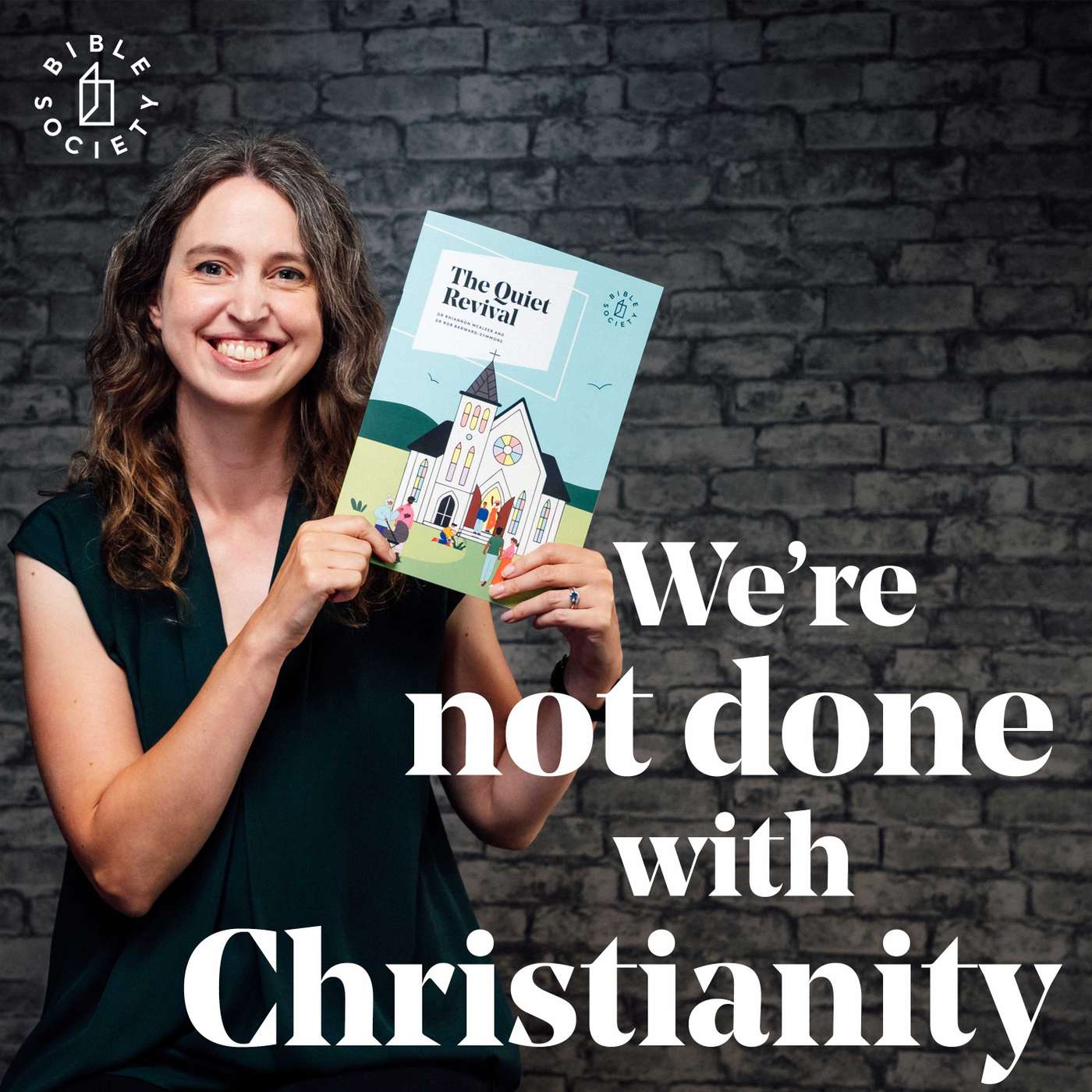
Is the Quiet Revival a new era for the Church?
Episode Transcript
Rhiannon McAleer (00:00)
this moment is not a return to what the church was
40 years ago, this is something new and we've got to understand the new landscape.
Andrew Ollerton (00:08)
one of the slight risks with the word 'revival' is it sounds like God's doing it all.
What we're actually want to say is there's everything to play for. people are spiritually open and
it's not automatically the case that that's all going to go in the right direction.
Rhiannon McAleer (00:21)
It really seems to have cut through into the national conversation.
the church is growing, that Gen Z are more engaged with the church. and I think it's telling us that we're not done with Christianity.
Andrew Ollerton (00:33)
is it all
young people, just desperately reaching out for something new in their life, but they're not actually encountering God? It's not a sort of serious faith.
Rhiannon McAleer (00:40)
It's linked with this overall vibe shift where Christianity and the Bible is not something to almost be ashamed of anymore.
heard from a few church leaders about people turning up kind of half-formed but the common thing
is people just turning up.
and early experience is so important
for building a strong faith in adulthood. So how do you help people who are coming in as adults really put those roots
Andrew Ollerton (01:05)
not like the quiet revival just says you're to walk down the street and bump into people asking you questions, but they are out there. People are searching and rather like Philip and the Ethiopian, you know, he had to be led by the Holy Spirit to sit alongside that man. It didn't just happen. He had to respond to God's call. So I want to encourage, leaders and everyone listening
Let's be asking God to lead us to those who are curious and seeking
Welcome to the Quiet Revival podcast. I'm Andrew Ollerton, author of the Bible course. I work with Bible Society and I'm delighted to be joined by my co-host, Dr. Rhiannon McAleer, who's kind of the brains behind the Quiet Revival and also director of research and impact at Bible Society.
Rhiannon McAleer (01:42)
Hello, yes, I am so excited that we're able to unpack the Quiet Revival a little bit more and chat with others about it too. We've learnt so much over last six months and we're really excited to share some of that with you. In this series, we're going to look at the opportunities and challenges around the Bible and Christianity in light of our Quiet Revival report released earlier in 2025. We're going to be unpacking some of the key stats from the research and work out what those mean for those on the ground so that we can really make the most
of this missional opportunity.
Andrew Ollerton (02:15)
Absolutely. going to do all of that and have some fun on the way. And we've got some brilliant guests coming on the show as well. So each time we'll be joined by someone else. And I'm looking forward to getting into conversation.
your life must have changed over the last six months, because unless someone's been an explorer in the Antarctica, I think they've heard about the quiet revival. It seems to have gone viral. So,
What's it been like for you to
in eye of the storm.
Rhiannon McAleer (02:37)
Yeah, it's certainly been an
I have spoken to more people from the media than I had in my entire life prior to this in about the last six months.
but I think what's been so interesting for us is how the story keeps running in the mainstream and secular media as well so it's been picked up around the world in major major newspapers and it keeps coming
up again. It really seems to have cut through into the national conversation. this idea that the church is growing, that Gen Z are more engaged with the church. And I think what's so interesting about it is what that tells us about the place of Christianity today, and I think it's telling us that we're not done with Christianity.
Andrew Ollerton (03:23)
Yeah, no, I think that resonance that it has with what's happening on the ground is the key, isn't it? And at the same time, just dig in a bit before we assume everyone knows what the quiet revival research projects included or involved. because I think some people might think that Bible Society did this research, you know, almost imagine
re-hanging out on the street with a clipboard asking people questions. But it really wasn't quite like that, was it? So fortunately, tell us a little bit about, know, was the research?
Rhiannon McAleer (03:48)
we started this project back in 2017, 2018 when we were trying to work out what does Britain or adults in England or Wales, what do they think about the Bible and Christianity today? And we wanted to ask everyone, not just Christians, because our work is for everyone we believe the Bible is for all. So we partnered with
a research agency called YouGov, who are one of Britain's largest and probably best well-known polling agencies. They're used by academics, the government, policymakers, people who make decisions, and they make decisions based on YouGov data. So it really is trusted and it really is and we commissioned them to run the first survey on their
panel. They've got a panel of about two million people I think at the moment and we drew a sample of 19,000 adults in England and Wales and that's a nationally representative sample so it looks like the general population.
Andrew Ollerton (04:45)
that is huge, isn't it? 19,000. I mean, I'm not a researcher, but from what I know, that's a big sample, not some sort of finger in the air, right?
Rhiannon McAleer (04:54)
Yeah, it's really big. your typical poll that you'll see quoted in the newspapers is between about 1000 and 3000 people. And that's fine. That's statistically credible and statistically useful. But at 19,000, you're really getting that full range of diversity of opinion. And you're able to break that sample down into quite small
small units, that's the real benefit of going to that size. So it's both research usefulness and also research robustness.
Andrew Ollerton (05:25)
Mm-hmm, okay. So 2018, we get the first sort of research project done through YouGov and roughly it tells us, I think, what we were expecting to hear, which is the church seems to be getting older. But then 2024 is what caused the kind of quiet revival phenomena because that's when the same questions were asked to another huge sample survey by YouGov again. And that was really, that's really what kicked off the quiet revival.
research, is that right?
Rhiannon McAleer (05:54)
Yeah, so we ran the full data set again in 2024. So it was the full survey. We tried to do it at the same time of year. We wanted to keep the conditions as close as possible. And we had worked in between the years. It's important to say we work with YouGov nearly every year and we'd been noticing stuff starting to happen. Sort of since particularly around 2020 onwards that maybe there's a bit more spiritual openness. But the 2024 data set was
Well, it was like a bomb going off. It showed a really dramatic picture of church going going up overall from 8 % of the population to 12, but particularly going up dramatically among young adults. Now we'd been hearing this for I would say about 18 months from people on the ground that there was something stirring. There was something happening. They were seeing more people who didn't have a church background coming in. And my sense was we might start to
it coming through in the data. But to see it come through so clearly and so dramatically was a little bit of a shock. I'm not going to lie and I think I've gone on record a few times saying that it gave me some sleepless nights when I first saw it. But as we worked out with YouGov, had anything methodological happened to cause it and they were absolutely clear it had not, so we could trust that data set and then we started to match it up with what we were hearing on the ground.
And it starts to feel like, yeah, this could be really picking up something genuine. And since then, a lot more has come out pointing in the same direction. So I'm really confident in the trend.
Andrew Ollerton (07:28)
A major shift in the spiritual landscape. Just give us like, I mean, well, I can give you the figures. This is the thing. It's gone to a point where people like myself who are not good with statistics, you know, it was 4 % of young people going to church once a month or more, self-declaring in 2018. That went up to 16%, am I right? Quadrupled in 2024. And for young men, it's 21%. So over a five-fold increase. I mean, that must have been...
Rhiannon McAleer (07:48)
Yes.
Andrew Ollerton (07:57)
I can understand now what you're saying that you almost looked twice at it and thought, surely not. need to, you know, so surely something's gone wrong. How does you feel when you saw those kinds of figures?
Rhiannon McAleer (08:06)
I think for researchers when we're doing and trend stuff, kind of have a sense of what will happen and we like it to do what we expect it to do. But once we were really confident that nothing methodological had happened to cause it, we've then got a really exciting situation on our hands, which is about trying to understand it. Like what is actually going on? And one of the really interesting things for myself and Rob, the other author of the report,
in the six months
months we've released it, we've spoken to so many people, from secular journalists to church leaders on the ground to young people who are part of the quiet revival phenomenon. And we have learnt so much and our understanding of this moment has deepened incredibly. But it's not just church going, that's the bit that grabbed the headlines. There is something else going on in our wider spiritual landscape, which is around more openness towards spirituality and including the Bible.
which is great among non churchgoers and again this looks a bit generational so it's more openness among young adults which is a really great opportunity and I think we'll unpack that through the series that we mustn't lose sight of the bigger picture in this so yeah church growth great something to celebrate and we have to be prepared for that but we mustn't lose sight of what else is is happening.
Andrew Ollerton (09:26)
And I think that word revival for that reason has caught obviously caught people's attention. was, you know, were you, was it yourself and Rob who sort of came up with the name and Clature that kind of let's call it this. Where did that quite revival phrase come from?
Rhiannon McAleer (09:40)
⁓
I have to say Rob gets all the credit for it. Rob named the report and has named a moment in history. And not only that, we're starting to see Quiet Revival used completely independently of anything. I think I saw an article, the Quiet Revival of vinyl or something. So yeah, it's really got into the national kind of conversation and it's deliberately in some ways provocative
Andrew Ollerton (09:57)
Yeah, okay.
Rhiannon McAleer (10:10)
and quiet is doing quite a lot of the heavy lifting around that. And I know some people disagree that it's a revival and that's kind of okay. If we can have good discussions about, what would that actually look like? Let's have those. But our sense was this is such a significant change, especially when we look at what has happened throughout the 20th and early 21st century, that it was worthy of such a strong
label if you like but it is different it's happening quietly it's happening across denominations and traditions it's not confined to specific areas like revivals in the past were but I think we are completely happy for people to debate the nature of the moment.
Andrew Ollerton (10:55)
It's not a geographical limited place, it's not a particular town or city, it's also not for one denomination because we noticed that the Catholic Church has seen a resurgence of growth in this period right round to churches that seem to be on the opposite end of the spectrum, Pentecostal churches for example. So across Christian denominations and traditions growth is happening. I think Justin Brierley who will have one in the next episode, he's used the analogy of the tide.
has gone out on faith in the UK through the rise of secularism and various factors and really asking the question in his brilliant work, the surprising rebirth of belief in God, is the tide coming back in? One of my reflections is when the tide comes in, if you ever go to a harbour and you see boats stuck in the sand, the tide's gone out. When the tide comes in, all the boats rise, right? There's a new landscape. so assuming a boat is seaworthy, it will rise with the tide. And I think
That's something of what I see going on is that assuming a church is committed to the truth of Jesus Christ, something's rising because the tide is coming back in. And that's true, whatever denomination or tradition people seem to be from. And there's more diversity as well, isn't there? Is that the other aspect of the report we're picking up?
Rhiannon McAleer (12:06)
Yes. ⁓
That came through very strongly in the data around a changing demographic profile of the church and again this is continuing trends that we've been seeing coming out for a number of years but one of the really key stats of the report is one in three churchgoers aged under 55 is from an ethnic minority and to give you some context for that the general population it's about 19 percent so the church is more diverse than the average
British population and that's really really important and I think in today's world where
people are trained to divide and splinter communities and society that we're really celebratory of our diversity and that we understand the church in all its incredible expressions. And as you say, it's also then reflected in denominational and traditional kind of profiles. where you've got ⁓ Pentecostalism is now the third biggest Christian expression ⁓ in England and Wales and the Catholic church certainly rising and more young church
more likely to be Catholic than they are to be
Andrew Ollerton (13:13)
You just mentioned the ethnic diversity, which triggers for me one of the objections I've heard to the quiet Revival. Can I just put you under the spotlight with some quick fires, quick fire responses to common things I've heard as to why we maybe this, you know, is it all immigration? That's the first one.
Rhiannon McAleer (13:23)
Good for it.
the short Answer is we don't believe so. the data set actually doesn't have country of origin within it. But what we certainly see is growth in the white population in our samples saying that they go to church regularly. I don't think that that can possibly all be white immigration. It just doesn't make sense on the numbers. So there's something happening, especially when we line it up with actual stories of people on the ground, that this is not just an immigration story.
But I guess I would also caution people to think quite carefully about why they're asking that question. I understand the intent behind it, but immigration is also an important part of church growth and it also affects us being a Christian country, even if that's coming in a good proportion from people joining the country from overseas. So again, let's hold that diversity as something to celebrate.
Andrew Ollerton (14:18)
Very good.
All right, Rhiannon, you persuaded me it's not all immigration and even the immigration we are seeing is something that will renew the church. is it all nominal? So that's the other thing. Are just young people, especially, just desperately reaching out for something new in their life, reaching out for something traditional, but they're not actually encountering God? It's not a sort of serious faith.
Rhiannon McAleer (14:36)
Well, everything in our dataset would suggest that it is a real and vibrant and genuine faith that they're expressing to us. So young adults are out there, so they are really engaged with the Bible. They're reading it regularly. They want to know better. They're talking about it. They've got a high belief in God. They think Christianity is a good thing. So it really doesn't look like they're just there for community, although that's there as well. And that's important. Let's not forget that.
it's not that it's just a belonging without believing, they are believing while belonging. But there is a bigger sort of theme to note here, which is what we would call nominal or cultural Christianity across our data sets does seem to be in decline. So if you are an older adult, you are more likely to say that you are Christian without practice than if you are a younger person. So in our survey, if you are a younger person,
who describes yourself as a Christian, it is more likely to mean something. And this is something we've been observing in other data sets like the census that young people are less likely to say they're Christian. But what it means is that being Christian now means something. And this is part of this active and vibrant church that we can build on going forward into the next decades.
Andrew Ollerton (15:53)
Hmm. So census Christianity, if you like, tick in a box is declining, but serious Christianity, people really wanting something in their life, God ultimately wanting hope. mean, and I resonate with that because you're all over the statistics and that is so being so powerful. And behind those statistics, really we're talking about stories, aren't we? Real people who, ⁓ whose lives maybe actually, are quite broken and pain. I'm thinking of, you know, stories I was hearing over the summer of, you know,
one young lady talking about having a dream in which she felt God, who she didn't really believe in in any active way until this moment, God told her to go to speak to someone who she didn't realize was a churchgoer about going to church with her. And she did. So, you know, the dreams thing seems to be coming, coming through in a way that some of us have thought that's the sort of thing that happens in other parts of the world. And actually in our own backyard, that's happening. And then I think, you know, other, another young man, you know, whose story really kept
caught my heart and I'm now connected with him, on a journey with him. you know, he came to a Christian event I was speaking at, the first event he'd ever been to. And when he told me his story, he'd reached a point of ending his life. That's where he was at. He was sat on top of a quarry about to jump off. And again, God spoke to him and ⁓ he heard a voice saying, this is not how your story ends. So he, with that hope, he walked down from the quarry, bought a Bible in W.H. Smith, he told me, and just started reading the Bible.
And I guess what I'm getting at here is, you know, that's hardly nominal Christianity. That is the most serious kind of Christianity where it's life or death and it's hope instead of despair. I, so I'm just emphasizing what I think I'm hearing. You know, I think that's why the word revival, even if it's a subtle or quiet revival, is actually important because God is doing something. I don't think it's just a social trend or a cultural pattern.
you know, I sense God is at work. Is that something you've picked up in what you've been hearing as well?
Rhiannon McAleer (17:47)
Yeah, and of course it's both and right? Like God can work through social situations. But one thing that I think has come out really clearly for me as I've been hearing stories is there's almost like this spontaneity of the exploration sometimes. So you've mentioned dreams. I've heard that come up a lot, which is just fascinating. And as you say, kind of unexpected and unusual, but it's pointing towards an openness or people might be dreaming that they should
go to church. I met a young guy who in some ways is kind of a quite revival archetype who had been doing work experience at his local primary school and they'd been praying in assembly and it just stirred something in him. He's not from a Christian background even and he thought I'd like to look into this more and he found a church and now he's very deep in his faith. But the other thing that has come up quite a bit is
this idea of online discipleship. So almost like the algorithm serving you up interesting content and you are interested so it gives you more and then you might start listening to a podcaster who's got interesting people on and then you find out that people who are interested in these ideas go to church and
heard from a few church leaders about people turning up kind of half-formed but the common thing in both of those like this spontaneous and the
the digital if you like, is people just turning up.
and I hear that over and over again. and one of the things I'm hoping we're going to unpack in this series is this is not, this moment is not a return right to what the church was
40 years ago, this is something new and we've got to understand the new landscape. including how people are coming in because that affects how then we respond. but there are other things at play as well and churches and church leaders need to be prepared for those.
Andrew Ollerton (19:44)
Well, assuming this is sort of the quiet revival, it's the first opportunity to see what that means in a digital age, isn't it? It's certainly in the UK. And I think that's part of what's going on, isn't it? As you say, digital discipleship. I've heard of several people who've come to faith really through TikTok videos. One lady, I spoke to in the summer and she said that she was into crystals and all kinds of Reiki and alternative healings until she met...
she saw someone on TikTok who used to be the guru in this that she was following, who said, I've converted to Christianity And that triggered her to buy a Bible, you know, find out what it's all about and go on a journey. So, and this young guy that I mentioned earlier, he's now sending me videos on TikTok or whatever saying, what do you think of this? Is this how I should pray? You know, cause it's absolutely no background. Doesn't know what prayer is. He me one of a guy walking and saying he could pray while he walks. And he said, is this, is this
legitimate is this prayer, know, to pray while you walk, to which I said, right, that's the only way I pray. I have to be on a move to concentrate. But anyway, the point is, you know, this digital discipleship, as you say, and such an important role the church has to play in mentoring and discipling that because all this content is unmanaged, unfiltered, and much of it unhelpful.
Rhiannon McAleer (20:39)
you
Andrew Ollerton (20:57)
And the church has to be there in the real relationships of life to walk alongside and steer and guide and nudge so that it becomes healthy and leads to to faith in Jesus, to biblical faith in Jesus. And I think, you you and I have talked and said, we, that one of the slight risks with the word 'revival' is it sounds like God's doing it all. It's all sorted now. There's a revival in the UK. I think
That's the opposite of what we're actually wanting to say to the church, isn't it? What we're actually want to say is there's everything to play for. This is, you know, people are spiritually open and curious on another level to what we've seen, but it's not automatically the case that that's all going to go in the right direction. I mean, what are your thoughts on that? I think you use the phrase, there's everything to play for. How is this contested, do you think?
Rhiannon McAleer (21:42)
Yeah, there are a lot of unknowns and this is part of that this is not a return, we're in a new landscape and we need to, all of us, not just researchers but practitioners, learn really quickly and share what's learning and what's working and build new ways of helping disciple people and meet spiritual openness. There is an interesting dimension of our data, particularly among our young Christians who
They are showing real Bible hunger, right? Like they are really enthusiastic. They're reading the Bible a lot. I hear on the ground, like, I want to know the Bible better. I want to get deep. Full fat Bible is a phrase that kind of came my way as well as full fat faith being a quite common way of people describing this. But young Christians are more likely than older Christians to say that
their confidence in the Bible is sometimes undermined by the media and British culture, that even they have less confidence in the Bible than they used to, that their faith can be undermined by it. Now we shouldn't over read these statements as like that they're lacking in Bible confidence, they're actually really quite Bible confident but...
There's something about helping people put down very deep roots, especially when they've got that enthusiasm. And the young Christians in our sample more likely than older Christians to say they find it challenging to find people to learn from and challenging to find appropriate resources about the Bible. So there is an unmet need. And what we know from wider sociology and religion is that childhood and early experience is so important
for building a strong faith in adulthood. So how do you help people who are coming in as adults really put those roots down? And there'll be a lot of learning from past experience, but also learning for this new generation as well. And that's, think what we'd be interested in hearing from practitioners, like how is it working in your churches? And are you doing mentoring? yeah, what's working well there? And Andrew, I'm interested that you
you've spent a lot of time out and about this summer, festivals, talking to people, and I've heard one of your phrases is the Bible is trending. So our data sets pointing to more openness around the Bible, more Bible reading in church, but what are you seeing in wider culture around the Bible?
Andrew Ollerton (24:03)
Well, I think that phrase is really picking up on the way that you're seeing the being positively presented by a lot of public intellectuals, celebrities as well. think so. think the Bible is trending is happening both at a sort of influencer level. know, Usain Bolt talking about it takes his Bible everywhere with him. Ballers in God. lot of our listeners may be familiar with that sort of massive football.
movement that's Christians in football effectively and so there's such a public confidence to talk about faith, the Bible. I love the fact I'm a rugby fan actually. love the fact that Maro Itoje who was chosen to be the captain of the British Lions, which is basically the highest accolade of anyone could get in British rugby anyway. And he was he delayed, I think, the call about that because he was going to a Bible study. And I just you know, I love that. I just think, you know, there's so many people. But there's also this important
Rhiannon McAleer (24:47)
wow
Andrew Ollerton (24:54)
And at a higher intellectual level, there's also, along with celebrity culture, you know, the likes of Tom Holland, the British historian, have just given a fresh intrigue to people to say, gosh, maybe we're more formed by the biblical story than we ever thought. And I've heard quite a lot of people, whereas some will pursue, be curious about faith for very personal reasons. I need hope. I need something solid in my life.
Others, it'll be more intellectual reasons, won't it? And I've certainly heard a few people who've bought Bibles on Amazon simply because they can't quite believe, but they want to investigate this claim that, you know, the values we hold today, so many of them come from the Judeo-Christian scriptures. So, you know, I think when we say the Bible is trending, it means all of those things at an intellectual level. The Jordan Peterson's of this world, the Joe Rogan podcast, you know, with the episodes he's had quite recently deep dives into the Bible.
The Bible is trending and a lot of these people are not looking at the Bible to slate it. This is what I think so many of us are used to, the kind of new atheism hostility, which is if anyone in the public domain has anything to say about the Bible, it's how to show what an outdated, unnecessary thing of a bygone era. And the likes of Jordan Peterson are actually saying, no, no, whether you agree with him politically or not, the Bible has a major role to play in finding meaning and hope in the face of malevolence and suffering.
And I think what this, you know, when public intellectuals and influencers when they show the Bible to be something of value and worth, it causes public perception to shift, doesn't it? So I just think a lot of people today, they would like to have a Bible, you know, just the simple offer of a Bible is perceived to be a gift, not a threat or something that's to be dismissed. And I'm seeing this, you know, our own children.
We've got teenagers. A couple of times my own sons have said, Dad, have you got a spare copy of the Bible? And I've been like, yeah, come on, son, I work for Bible Society. Of course I do. But why do you need that? he's like, well, one of my friends wants one. know, one of my boys wrapped up a copy of the New Testament in birthday paper to give as a birthday gift to a friend he plays football with because he knows he really wants one. and I find it, I have to get my head around this, to be honest, because that's not exactly what I was giving.
to my friends when I was 15 as a birthday gift. something, and I'm not saying that's across the board, but something's shifting, isn't it? And just one other, yeah, one other story that I heard recently as a friend who works in the military, actually, he's a military chaplain, and he was just saying that they normally, they always give to first, to young recruits, young soldiers in their complete first phase training, they offer them a Bible with the regiment's insignia on. And normally about half maybe would take one.
Um, and this time they had 170 recruits passing out from training and they, the box of Bibles came with 220. And so they made those available and he said all the Bibles went and they were like, well, where have the other 50 gotten, know, even if everyone took one, happened to the other 50? So they started asking around and rather sheepishly, some of the soldiers were like, Oh, I'm really sorry. I just, I wanted to take one for my girlfriend as well. Or I wanted my nan to have one. So, you know, this sense that the Bible is a gift.
That's new for us, isn't it? But is, definitely something shifting.
Rhiannon McAleer (28:05)
Yeah, absolutely. there's sales data, Bible sales have gone up as well as online searches around the Bible and Christianity. there's loads of data sets that are all pointing towards this trend.
mean, I can be known as being a bit of a cold water on people's enthusiasm. That's kind of part of the nature of my role. So think it is important for us to say it's not everywhere all the time, right? Like we were not going to be mobbed in the streets for a copy of the Bible and
majority of people are still not reading the Bible or that interested in it but what we have seen is that opening among a significant minority of the population and as you say it's It's linked with this overall vibe shift where Christianity and the Bible is not something to almost be ashamed of anymore. in a perhaps it way it was under the height of the new atheists and we'll be able to hopefully unpack that a little bit more when Justin joins us next week but yeah.
There
really is everything to play for at the moment, but I think everything we know at Bible Society is it's not just enough to get the Bible into the hand, is it? It's about equipping people to read it well and part of that's really good resourcing and obviously for you, you've been amazing in providing the Bible course and that's a fantastic resource that we know from our evidence base genuinely does raise Bible confidence as well as deepens people's faith through that.
Andrew Ollerton (29:13)
Thank
Rhiannon McAleer (29:31)
But it's also about, I think, coming alongside people and that mentoring and that reading and wrestling together and it's not about having all the answers. And what we do see in our research is those who are most Bible confident are usually those who are most able or willing to admit that they also do find the Bible disturbing in some places, but it's not damaging their faith.
So yeah, how can we help the church going forward to get to that sort of space?
Andrew Ollerton (30:01)
Well, I think what you just highlighted there is really important, it? That actually, you know, again, with the Bible is everything to play for because the difference between someone getting hold of a copy and making sense of it is enormous. And I think the story that's really been on my mind as we've been embracing what's going on is the story of Philip and the Ethiopian eunuch. And I think particularly because for one thing, this incredibly well-educated, elite black African VIP, the Ethiopian eunuch is
clearly on something of a spiritual journey because he's going home reading the Bible, reading the prophet Isaiah. But when Philip comes alongside him, he says, I cannot, you know, how can I make sense of this unless someone explains it to me? So that sense that there's everything to play for when it comes to the Bible as well, that yes, it's fantastic that people are buying Bibles in WH Smith and on Amazon and there's a new interest in it. Bible sales are up and it's fantastic. More people are coming to church. But in a sense, that in itself doesn't guarantee
that people will come to know Jesus, the ultimate goal of scripture and of the message of the church. And I've heard of a couple of, I was speaking to another young guy and he said to me that because of this renewed interest and other people he knows who've become Christians, said, I tried going to my local church. He said, then he said, but I didn't get it and I don't think they got me.
So I think, you say, what, what, what, what do we need to do as a church? Well, I think, you know, those, those points are some important lessons, don't they? When people come who are new, we've got to be ready to welcome them and make them feel like, I remember someone else actually saying that they'd had someone who came to the church doors and actually asked, am I allowed?
come in? You know, as in, I part of this? The church service was just about to begin. Am I allowed in? And I think even that question just shows how people will need to feel, yeah, you're in the right place. This is for you. Come on in. And that sense of a welcome. But as you've highlighted, then that's just the beginning of the journey, isn't it? And then I think the mentoring, the sitting alongside, the Philip and the Ethiopian saying, yeah, the Bible's got some tricky things in it. Let's talk about that together. What are your questions? What are you reading? Where do you want to start?
We've got to be ready to really make the most of this opportunity because there's everything to play for.
But one of the things I think about the Quiet Revival report itself, which by the way, if people haven't got it, you can download that for free. Just search Bible Society, the Quiet Revival, it's there. But what I found really helpful was actually the tail end of it, in that you both give a few statistics that actually show, yes, more people are buying Bibles and sales are up, but people are struggling with it as well. In other words, there was an alert to the fact that it's not all straightforward.
And then you also give sort of a couple of suggestions, I think both beginning with R. Just give us a couple of quick tips on how can the church, what does the church need to do in this moment to respond?
Rhiannon McAleer (32:50)
Yeah, well it's a much better wordsmiths than me who pointed out that what we're talking about is resources and relationships. So one thing that we call for in the report is really prioritizing intergenerational conversation and really helping new Christians to learn from those who've experienced faith over a lifetime really and it's highs and lows and that is both full faith but also
the Bible as well.
This moment in our society is one of fragmentation and isolation and what we see in our day set and in others is people really searching for community and searching for deep and meaningful relationships and these must be found in the church. exactly as you say about welcoming. But also really good resourcing to help people make sense of the Bible from heart, how it connects to God in your spiritual life, to head, whether you can understand it
navigating it, to hands, so how it informs your actions and your everyday life. These things are really key and they'll also have a wider impact as well because our data set suggests that while influences and celebrities are important when it comes to exploration among the Bible for non-churchgoers, it's relationships, it's family and friends that they're saying that would be more impactful for me in terms of me
to explore the Bible. So if we can get Christians more confident then they can also be equipped to meet this spiritual openness.
Andrew Ollerton (34:27)
So relationships and resources, two simple steps forward for the church, I think, for all of us. And I think, you know, what I'm feeling more and more every day really, I'm just feeling like we've got to wake up with that phrase before us, there's everything to play for. Because the quiet revival is not meaning anything's automatically guaranteed. It means there's a new curiosity, a new hunger, a new openness. I'm starting my day with a simple prayer, know, Lord, show me who I can bless today.
and lead me to someone who's curious. That's just my simple morning prayer because I think the reason I like that is because it's not like the quiet revival just says you're to walk down the street and bump into people asking you questions, but they are out there. People are searching and rather like Philip and the Ethiopian, you know, he had to be led by the Holy Spirit to sit alongside that man. It didn't just happen. He had to respond to God's call. So I want to encourage, you know, leaders and everyone listening that
Let's be asking God to lead us to those who are curious and seeking because for some people, like I said about that young man earlier, there's a lot at stake. There's a huge amount at stake in whether they find the truth about Jesus at the critical moment in their life. So let's be really on the road. Let's be really asking God to show us who we can share faith and share scripture with. And then in the church, I guess, you know, what I'm taking away is that we need to be welcoming. We need to have that really readiness, a readiness to
welcome people who maybe surprise us. And I think you said this, Rhiannon, that so often when church leaders and others are asked, you seeing the quiet revival, often the initial response is, no, I don't think we're seeing that. And then people pause and say, although we have baptized three young men this year, or we have seen a couple of young teenagers show up and we don't even really know why they're coming, but they're here. And it's almost like just being ready. This is...
This is what we're talking about. It's not a tidal wave, but it is a trickle of people who are investigating and exploring. So that welcome, that full fat faith, that full fat Bible, not being shy of raising the challenging stuff, asking difficult questions, giving people a deeper dive into faith. These are the things that I think help us respond to this moment that we're in when there is everything to play for.
Rhiannon McAleer (36:30)
absolutely. Thank you so much, Andrew. It a really helpful summary and we're going to be unpacking more of these themes over the coming weeks. And thank you for joining us on this first episode. Please do subscribe to the podcast. Give it a like and a share with those who you think will benefit from these conversations. Over the coming weeks, we're going to be discussing all the big themes around the quiet revival and the missional moment from what's going on with Gen Z,
to young men, to barriers, to the Bible and Christianity and we'll be talking all things Bible and how you can grow Bible confidence in your church and community. Next time we're going to have the amazing Justin Brierley with us so do keep a lookout for that episode coming soon.
Andrew Ollerton (37:15)
So looking forward to talking to him. He's been so key to calling out what's happening in its early days and making sense of how we respond to it more recently. So do keep an eye out for that episode In the meantime, if you haven't yet downloaded the proper full fat Quiet Revival report, go to biblesociety.org.uk forward slash quiet revival. And if you want to find out more about the brand new edition of the Bible course.
please do check out biblesociety.org.uk forward slash Bible course podcast. That is a great resource. We talked about relationships and resources the Bible course brings both together for seekers and for Christians. So check that out. Thanks so much. We'll see you soon.