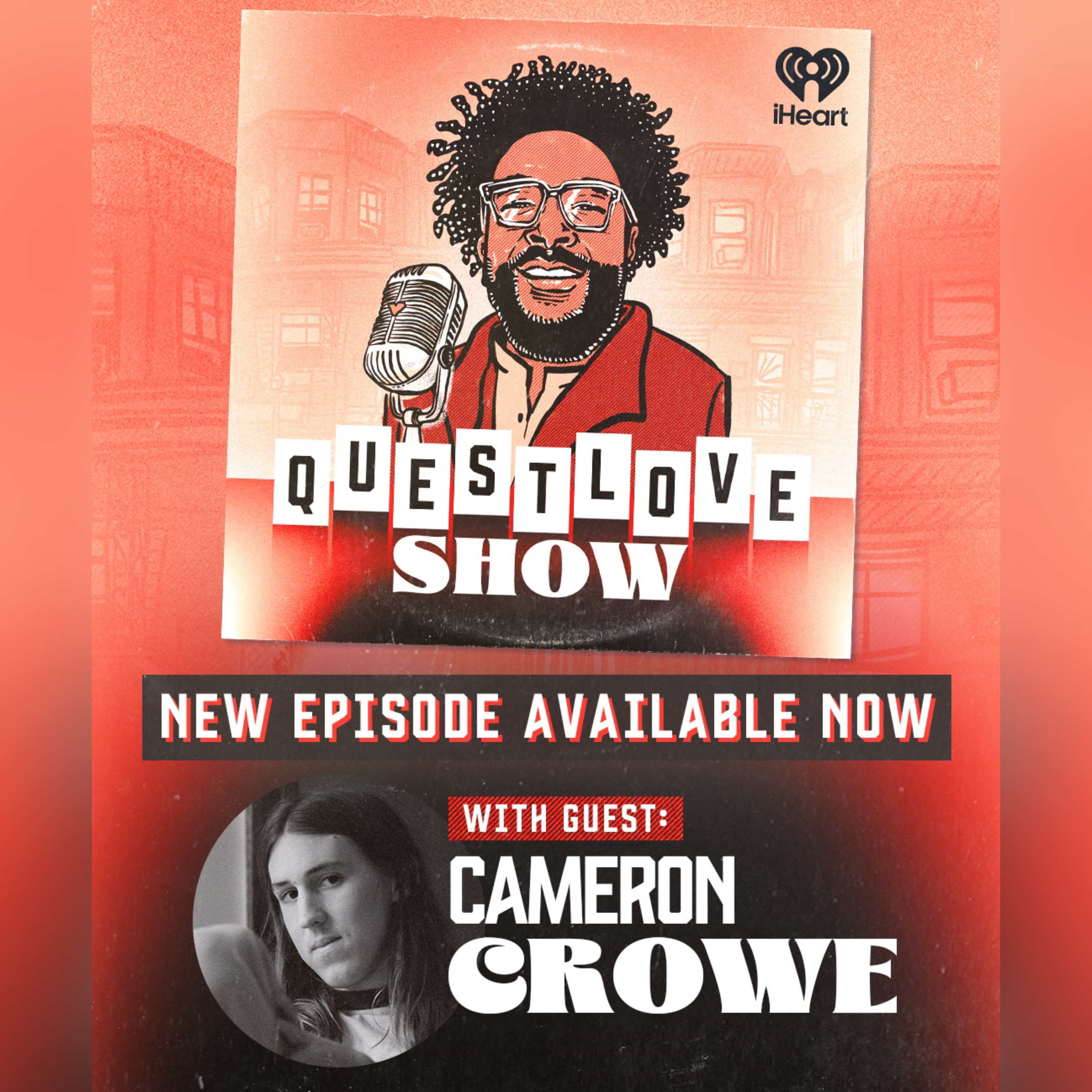
·S6 E13
Cameron Crowe
Episode Transcript
The Quest Loft Show is a production of iHeart Radio.
Ladies and gentlemen, Welcome to the Quest Loft Show.
What can I Say?
In nineteen seventy two, at the ripe age of fifteen, our guest today took my dream job.
But being as though I was just a year old and unable to read, or write or form sentences or thoughts, I'm willing to forgive him this one time only thank you.
But I will say during this period he will have conducted career defining both for him and the artist, career defining interviews at Rolling Stone Magazine with the likes of Bob Dylan, David Bowie, Elton, John Neil Young, Joni Mitchell, led Zapplin, The Eagles, Fleetwood, Mac, The Who, and.
Speaker 2So on and so on and so forth.
Speaker 1As a filmmaker, I mean, he's pretty much, I believe, given us the definitive movies of our day, be it A Fast Times of Richmond, High Say Anything, Singles, Jerry Maguire, Vanilla Sky, and for Almost Famous, of which he is an Academy Award recipient for Best Screenplay.
I mean, the list goes on and oning.
He's currently right now working on a film based on the life of Joni Mitchell.
Right now, he is promoting his memoir of his time as a music critic called The Uncool.
Please please welcome to the Quest Left Show QLs.
Cameron Crow, how you doing right now?
Speaker 3I'm good.
I'm psyched to be talking with you again.
It's one of my favorite things.
Speaker 1Thank you, thank you.
Yeah, I appreciate this.
So I had a situation last week.
I was hanging with John Mayer, and I believe that there's the idea of questlove, and then I also believe there's the actual quest love.
So one of the most disappointing true quirks about me, kind of in a Larry David way, is that I normally don't talk shop with my peers.
Of course, on social media and books and films everywhere.
Speaker 2My entire career is a.
Speaker 1Giant platform for me to spew out my unsolicited thoughts about music.
Speaker 2But I noticed that I.
Speaker 1Tend to back off and talking about music.
However, being as though this is our second conversation with each other.
He gave me the honor of doing a live Q and A with you some time ago, and when I walked away, I was like, wow, Like okay, So maybe I have to rewrite that narrative and say that I enjoy talking shop with other musicians.
Speaker 2It's just that sometimes, for instance.
Speaker 1Like I was at a party like three weeks ago, and then someone just came up to me and said.
Speaker 2Coust love real quick.
Speaker 1The most important line that Curtis Mayfield's Ever, you know, yeah, Ever.
Speaker 2Said, and I'm like eating shrimp.
Speaker 1I'm like, and I know that's my fault because I've led people to believe that I'm open to all music discussion.
Speaker 2But in this particular case.
Speaker 1I would imagine had I been born a decade and a half earlier, I would have probably wound up on your path or at some sort of level to that.
Speaker 3So it's the crime of you knowing so many different corners of culture.
Speaker 2You know.
Speaker 3It's like, yeah, they'll ask you about music.
They probably checked out what the gifts you were giving during COVID, which was very music centric.
But you're like a film guy beyond many, if not most, So your knowledge of film is so particular.
And also why it's I don't know, there are many avenues to take.
Speaker 1Well, I'll ask you because I'm using no format today, no notes or whatever, so I'll just we're just having a conversation.
Yeah, yeah, How did you know that you were a film guy?
Speaker 3Because I loved film always as a kid.
They my mom and sometimes my mom and dad would sneak me into R rated movies just because Mike Nichols.
I should know about Mike Nichols.
Stuff like that, you know, David Lean and all kinds of stuff.
It just seemed like no man's land in terms of a dream, Like I never went to film school obviously, maybe not obviously, but I never thought that that was accessible to a guy from San Diego who wasn't connected in it any way.
But for some reason I had no problem walking into a dressing room and asking a band that I loved, like the questions that I wanted answers to.
Maybe it's because rock was a little less huge then and film was always huge and still is huge.
But once I got a taste of it, you know, it's like it is.
It's a rush like no other.
And particularly when you show something that's been in your head for a long time and you've written it, you've edited it, you know this well when you finally put it in front of people, and the shit that they pick up on it's sometimes it's the smallest thing and they're all over it.
That's a thrill.
It's a different kind of thrill than writing rock writing particularly, But I don't know.
It's like collect as many experiences as you can was kind of my thing.
Speaker 1How long was it the lead up of you getting the green light to do Fast Times?
What was the seed that was Plannet that said, you know what, after this last article I turn in, Yeah, I'm going to pursue film.
Did you have any impostor syndrome or any of those things?
Like can I do this?
Speaker 3I started asking for film assignments from Rolling Stone towards the end of like a big run that I had from fifteen to twenty two.
I started asking for film stories.
Richard Dreyfus was the first one that I did.
And Dreyfus fantastic and so different from the musicians, you know, like just wondrously narcissistic and fun like he was at the peak of his kind of like Close Encounters phase and everything Jaws to Close Encounters, like Biggest Star going right, And he he said, you know, if I do the Rolling Stone interview, I'd like to do it differently, Like what if you ask a lot of people who've worked with me what they think of me, and then bring that back to me.
Speaker 2He wanted an oral history.
Speaker 3Yeah, but he was like, bring me the oral history of what people have said about me, and I'll respond to it, which was wild.
And so I talked to a whole bunch of people about Richard Dreyfuss and did this interview where I basically threw stuff to him about things people were about him, good or bad, and he was fucking ferocious about it.
It was amazing.
And the next assignment I got that was film centric was Sissy Spasic and that lit a fire because for daughter, it was it was before coal miner's daughter.
She had done Carrie and bad Lands and Three Women with Altman and you'll love this.
So they say, Annie Leebowitz is going to come with you to Equipment Texas.
You can see Sissy Equipment Texas where she's visiting her hometown and her mother.
And so I get there with Annie, who was, you know, a titan of photography.
So that was a big deal to be hanging with Annie in Texas and we show up to see Sissy and Sissy goes.
I got to ask you to come with me.
I got a little adventure I have to go on.
They're trying to get me to play Loretta Lynn in this movie called Coal Miner's Daughter, and I just I can't do it.
You know, I'm not gonna do it.
It's just it doesn't feel right to me.
But can you come with me to I think New Orleans maybe, And we're gonna go to a Loretta Lynn concert.
And it's gonna be a little rough for me because I'm gonna have to, you know, turn her down, but we'll go.
We'll get one to go with me.
And so we all went to Loretta show and Amir, I gotta tell you, Sissy boards the bus where Loretta is with her husband du brings Annie and me with her.
I think Loretta Lynn closed Sissy's basic in about twelve minutes.
She was so classic and big and a big character and so warm.
And then she goes on stage and starts doing this show and Cissy is like already putting the performance together, and so she left committing to the part that.
Speaker 2Night started back out of it and.
Speaker 3So excited and that rhythm of how it worked, and it was so hands on with material and discussing characters and all that stuff.
The fuse was lit.
And then I found somebody who I knew who was a rock manager, Art Linson.
I don't know if you ever met him.
He managed Nils Lofgren and Nils's group Grin and the label was called Spin Dizzy that Art ran, so I knew Art and Art started to be a presence in the movie business producing Jonathan Demi and they Universal like kind of picked up an option on Fast Times the book and gave it to like their resident rock ish guy.
Art and Art loved the book and said, you know what, I'm going to teach you how to write a screenplay.
You're the cheapest person we could find to do this, and if we make it cheaply, we might be able to sneak this movie through.
And that was Fast Times.
Wow, I know.
So it really was all because of rock journalism in a way that Art said, I'm gonna teach you.
Speaker 1I will say that Coal Miner's daughters probably it made an impression on me.
Speaker 2Like I didn't hear of Loretta Lynne.
Speaker 1But since that moment that I became very familiar with her and her music and all that stuff, and so to hear that you were there at the impetus of it then, I mean, you know, she was still at the height of Kerry and all that stuff.
But when you saw the end result like to make an impression on you as far as music films are concerned or big time.
Speaker 3I loved it and I thought Sissy deserved the Academy Award.
She's amazing in it.
She's not pushing, she's not trying, she just is it.
And I went back and checked that movie out not too long ago, just kind of wanting to look at the so called BIOPI biopic and that was definitely top five and Buddy Holly story and stuff, but check it out.
Check out Coal Miner's Daughter Sometime.
It is the slowest, easiest wade into telling the story.
It just is character.
It's time and place, which you crush in the Sly Lives.
Time and place is like so important.
And I saw it and I was just like, you know, the whole drive to have, like, my Josh, here's the person that you're gonna see the life of.
It's like, man, you don't need it with the right pace.
It's like an invisible gas that just pulls you in.
And that's Coal Miner's.
Speaker 2Daughter for you.
Speaker 1Though, with biopics and personally, I always thought there's a danger and telling the soup to nuts story of a life where it's hard to really cover it all.
And I always thought that, man, why doesn't someone just talk about a very very specific time period, Like when they were first talking about the James Brown biopic, I said, man, you could probably get the essence of who James Brown is if you talk about April fourth, nineteen sixty eight, which I would thinks this is on the fourth, It might be the fifth of the day after, but this is right after Martin Luther King has assassinated James Brown.
Fans know that there was a concert schedule in Boston, Massachusetts, and every city in America is in civil unrest and there's riots everywhere, and the mayor of Boston's like, mister Brown, if you give us permission to broadcast this on television, I think this will keep people in the house and watching.
Speaker 2You instead of destroying Boston.
Speaker 1And sure enough, James Brown say Boston because there were no riots that night, because everyone was in watching and you know, he yeah, his concerns too, Like wait a minute, so I got to give a twice as long performance.
You're broadcasting me, you're not paying me extra money, like he's the business part of James Brown's at work, Like I know, like what's in this for me?
Like I'm giving the the cow for free.
But I always thought, man, if you told the story, like very specific stories instead of the entire biopick.
Speaker 3Right when it's a history lesson, you lose me.
If it's characters that are not cut out human type, people that say things, you know, that are completely dealing with the Wikipedia issues of the artists, it's like, you lose me.
I don't know.
You can do soup to nuts if you have a reason to do soup to nuts.
As soon as they tell you soup to nuts can't be done, someone will pull it off.
But yeah, most of the time you at that sweet spot because it's filled with story and you don't need to You're right, I mean, James Brown in Boston, you get it all.
You get the music, you get time and place, you get it all.
I guess it's case by case.
Citizen Kane is Soup to Nuts?
Is it a biopic?
Kind of?
But it tells us a greater story than sit down.
I'm going to tell you about a life with Cepia toned glimpses of my childhood, you know.
Speaker 1But that's also like a first of its kind, so I could imagine I wanted to know, like if that were to come out in the mid Ausin, it would have just been the office, you know.
Speaker 4Yeah, yeah, yeah, Well, I mean that's funny.
Speaker 1Are you telling the entire story of Joni Mitchell?
Is this a very specific part of her life that you're focusing on.
Speaker 3It's chunks, it's not one slice, it's a couple, it's some slices, and it's in a context that I think it holds together for a bigger story.
To be slightly vague, but there's a way to tell her story, which is why I called up her place and just said, like, I have a take on this.
You know, whenever you're interested in anything like this, just come to me and well I'll pitch it out and see what you think.
And they're like, now get over here.
Speaker 1How easy was it to convince her?
Because right now, the most frustrating, frustrating part of this whole process that I'm in right now is conveying to my subjects or my dream subjects.
Yeah, the urgency of time running on the clock right now.
And for a lot of people sharing their story, rappers especially, you know, this means that oh, the second I start looking in the rear view mirror that now, that means my career is over.
This is not just with film, like trying to get rappers to do memoirs to keep a track a thing.
It's almost like there's this rule like if I look back, then I'm dead already, which I don't believe in just what I've learned and Slide and the Earth Wind and Fire doc is memory fades, you know for a lot of these.
Speaker 3Things, yes, and turns into anecdotes with cute little punchlines.
Speaker 1Right and there's the whole kind of revisionist history thing, like your version of how it happened.
And it's such a dangerous spot.
And I can't convey to people enough the importance of pictures, writing things down, saving posters.
Speaker 3Yes, you can taste it when you have that stuff from the day and it's souvenir from the day.
It's important.
Speaker 1So this wasn't a hard pitch to convince her, like now's the time to tell your story.
Speaker 3No, because there are a lot of people that had been coming before me with really bad ideas, and so I had the benefit of their failures in probably not knowing her well enough.
So if a few of them, I think came in not really knowing her history.
It's like the Barry Gordy thing.
You know, if you send me a letter and it's b A R R y.
You didn't take the time to know how my name was spelled, and I can't take the time to know what you want from me.
Goodbye?
You know, I love that.
This is what's interesting.
Tell me if you've run across this.
Success creates eight different viewpoints and people raising their hands and say it was me, it was me, it was me, it was me, And the memory does morph into a different thing, and it's everybody kind of disagrees because they're trying to take credit for a success a failed project.
The memories are perfect because they're all about who to blame for it.
Memories are dead on you know, there's not it's not Rashamon.
It's like they pretty much figure that it's one person and one decision, and they're really clear about it.
So success breeds all the conflicting accounts unless you have the stuff from the day, like.
Speaker 1Do you know when you're being talked to by someone well trained media that says the right things and whatnot, and like, how do you know.
Speaker 2You're getting the right story?
Speaker 1And was your young age a part of the dismantling or the putting my guard down and revealing to you because you know you're getting major stories out of these acts and you know who otherwise would probably be guarded with anyone else.
Speaker 3I never had the feeling that, like, oh, oh, it's a plus that I'm fifteen or sixteen.
I was always kind of like hoping I didn't get asked how old I was, and hoping that I could seem adult like but not in a precocious way.
Nobody really busted me on my age, no once, but to me, I had no choice in it.
I just had to do it.
I just couldn't not do it.
I loved some of the stories that I'd read.
I loved Ben Fong Torres doing these interviews with Marvin Gay, with David Crosby, and Joan Winner's interview with John Lennon.
It's like, Wow, this is really revealing and confessional, and that made me want to collect stories like that, Like I just wanted to be the person who could say the right thing and get people to talk like Dick Cavin on TV was one.
Speaker 2Of my favorite.
Speaker 3So I didn't have a choice.
I just did it.
And it wasn't until later that I kind of hit a wall and took on so many assignments that I just felt like I was starting to take a long time to turn stories in.
I started Chuck Young at Rolling Stone started doing these stories that I would have done really well in a first person way that was kind of gregarious and amazing, and he wrote about the sex pistols, and I just felt like, I'm washed up, you know, And that was when I went home and decided to start writing this story that ended up being Fast Times at Ridgemal hint.
Speaker 1At the age of twenty, you already felt that you were a veteran, A washed up veteran.
Speaker 3Yeah.
When I first came to Rolling Stone, there were people that were at the end of their run, and I remember what it looked like, I remember what it sounded like.
I remember there was one guy who had written epic stories, and the thing that they whispered about him behind his back was he's so fucked up on writer's block now he can't be in a room with a typewriter.
He starts melting down with anxiety.
I'm like, that'll never be me.
And then I never became that guy.
But I started to just freeze up about deadlines, which was very scary, and so it was time to kind of move on.
I know, the exact moment had happened.
There were two things that happened in one day.
There was a Neil Young cover story, and I'd gone on the bus with Neil Young and Joel Bernstein my Palle, the photographer.
We had toured with Neil and it was great stuff.
I mean, he canceled a three album set that had already been printed up and pressed and stuff.
And the Warner Brothers guys came out and said, you can't cancel decade and He's like, I can't.
I got new music that I'm doing with Emmy Lou Harris and stuff, and it's just I've moved on.
These guys are like it's gonna cost us half a million dollars.
He's like, I can't help it, man.
You know, it was like it was the greatest story.
And Elliott Roberts called up, his manager called me up and said, you know what, Neil doesn't want the story to come out.
He's not gonna pose for the cover.
And Neil, he just got into it.
He does, He's moved on.
It's like moved on.
It was ten days ago.
You know.
No, no, he's a different guy.
Speaker 2Now wait, can you give it backstory?
So this is what year is this?
Speaker 3It's seventy seven.
I know it's exactly seventy seven.
For a couple different reasons.
He had fallen in love with the Sweet Home Alabama, the Leonard skinnerd song that was kind of a call out supposedly, so it was anyway, amir, it was a great story.
He liked it, he loved it.
He gave me a cassette to give to them because I had written about them of three songs, Powderfinger, Captain Kennedy, and I forget the third one, but he gave me a cassette, which I gave to Leonard Skinnyard.
Speaker 2What was their response?
Speaker 3Fuck?
Yeah was their response?
They love to Neil, it was it was like, I don't know, it's like one of those kind of Jobiz feuds that was wasn't really true.
Speaker 2It was just it wasn't kids with Lamar.
Speaker 3I get it, Okay, it wasn't it wasn't like secretly crushing out on each other.
So I had that story and it was kind of like I knew I was gonna make that deadline and it would be good, and though I'd been missing deadlines lately at Rolling Stone.
So anyway, Elliott, the manager calls me up and says, cancel the story.
Neil wants it canceled, won't post with the cover, doesn't approve anything.
It's canceled.
And I'm like, I'm gonna get fired.
I'm gonna lose everything.
I'm gonna lose everything in Elliott Roberts, classic funny guy.
He had a line that I will never forget.
He's like, yeah, I know, I got to get rid of that kid.
And I'm like, you're fucking making jokes, and I was.
And he called back two days later and said, I talked to Neil, go ahead and go with the story.
He doesn't want you to get in trouble, which was cool of him.
But the other thing that happened on that first day was John Belushi called out of nowhere the Rolling Stone office and asked to talk to me.
And I had met him, I think twice.
Mitch Glazer took me to the blues bar, and I had met him there.
He told me an amazing drummer joke.
Who was It was like Buddy rib about Buddy Rich And I don't know.
He was very cool, right, but I hardly knew him.
And he said, look, hey man, I'm just calling you because like they're gonna put me on the cover of Rolling Stone.
And I asked for you to be the writer, and they said no, he takes too long, and so they gave it to Chuck Young.
But I just wanted you to know like I asked for you.
I was like, I'm washed up.
I'm washed up.
There they're telling artists that I'm not efficient with deadlines.
This is bad.
Speaker 1How common was accessibility to artists in the seventies, Like how often would you get unsolicited phone calls?
Speaker 3You'd get a phone call or too before the article was published, Like they would be up late staring at the ceiling and going why did I say this and that?
So you'd get calls to clarify, like I just want to can I redo my talk about Leonard Skinner?
You know, like you'd get that call, but then no calls after the story came out.
I mean, I think Sissy spacet called and said I liked this story you wrote.
But that was the only time that happened.
Sometimes you might run into them later and get a comment, but mostly that would happen only to like social calls from somebody who's in the sphere, the actual entertainment sphere.
I think Jan Wenner would get those calls because I remember sitting at the Rolling Stone office as a little guy, and it'd be like fucking John Lennon on one Jan and I'm like what And then you hear him going like John, how you doing?
Like what?
Oh?
Speaker 2So you go okay.
Speaker 1Would you often wonder what they thought about it, or even parts that you might have to keep in that could be seen as a problem in the future or anything like that.
Speaker 3It's a really good question.
Sometimes you have to fight for the thing that they made off the record, and if you're on the road for a couple days at least you know you're in these situations where you're not always just a guy in a hotel room with a pointing a microphone at them.
You're or sometimes in the back of a car or backstage and they're like, you know that guy that just came in, let me tell you about that guy, you know, and it's like an amazing story.
It's like, right, that's off the record.
Of course, you're like, of course, but then you could come back later and say, you know what that story you told me backstage.
Here's why I think it works because it's blah blah blah blah blah blah blah, and like eight times out of ten they'd say, Okay, you gotta use it.
But that collaboration doesn't happen so much anymore because you don't have the time with the person you do because you have a creative experience with I would imagine quite a few of your heroes.
That's a different thing.
This is a negotiation sometimes.
Speaker 1My obsession with Rolling Stone really stemmed from well one we had a subscription to the house.
Speaker 2I lived in a Billboard cash box.
Speaker 1Rolling Stone cream subscription household, like any music magazine, always came to my parents' crib.
Speaker 2You know.
Speaker 1For the most part, I would be fascinated with the lead review because I love the idea of like a illustration and then seeing the star rating and stuff.
And so I started adorning the walls in my house with those leeve reviews.
And you know, by the time I'm fifteen.
Yeah, I mean that's pretty much like how I know, you know, when you talk about past the original generation of Rolling Stone, like I'll say that his name.
Speaker 2Is kN Tucker, Yeah, kN Tucker.
Speaker 1So I knew besides Stevie Wonder's songs in the Key of Life, it was very rare to see a black live review and it was the police issue of Rolling Stone.
I believe that this is when Zennata Mindata came out and they had the cover.
kN Tucker gave Prince's Dirty Mind the Lee review in Rolling Stone, and at that time, Prince was just one of the artists that would adorn my older sister's walls.
So I kind of had Prince in the right on Team Beat thing.
Not that I knew the difference between like critical writing of music and fanzines, but even I knew that Team Beat and Ride On were like frothy articles and you weren't going to get anything deep as opposed to Rolling Stone.
And I remember, like, wait a minute, they're tweeting this guy like he's a real serious person.
Speaker 2You know.
Speaker 1At the time, I only knew like the singles, and it was because of the pun.
The pun was someday our prints will come Wow, which you know, even at nine, I was like, Wow, that's that's a hell of a reference.
And I had never even heard Dirty Mine or anything about it, but it made an impression on me, and suddenly I started getting obsessed with leave reviews only Wow, could you, at least during that time period, could you tell me what the modus operandi was in terms of how records were assigned to writers to review them, how long they had to sit with it, who assigns the stars, those things.
Speaker 3That I did not know a lot about.
There was some mystery to it.
I know that there were people that had DIBs on upcoming records, there were regular reviewers that would have DIBs on it, and features too, like Bob Dylan.
But when I first started, John Landau was still the music editor, and John Landau would make a lot of these decisions, and John Landau was a huge force at Rolling Stone.
When I was doing that on my brother's story, they said, you need to talk to the king because the King knows Phil Walden and Capricorn Records, and the King will just help you a little bit, knowing how the ropes go.
And I was like, who's the king?
They're like, John Landau, that's the king.
The Duke is Dave Marsh.
And I'm like, okay, a right, okay, so the King is Landel, the Duke is Dave Marsh.
So the king is just like, here's the call the king, here's his phone number.
Speaker 1So you weren't a you weren't a staff writer.
You were still freelancing.
Speaker 3I was freelancing, and I was coming into the feature division.
But John Landau even had you know, like even even had to say in some of the features and everything.
So it was almost like it was somewhere between a hazing and an education.
Because I called Landau and he was like, this is the king, Like okay, what do you what do you?
How does this work?
And he was like, well, you know, you got to dig deep and you gotta do this, and you got to do that.
You got to know that, like southern music is born and like this and otis Redding, and so that's what you're waiting into.
And Dwayne Almond, you know Dwayne, Dwayne worked with Blah blah blah, and so he was he was amazing and uh, you know this is pre Bruce and stuff.
So he was the King.
So he's still the King.
I think Bruce probably calls him John, but you know, maybe he calls him the king.
I just think Klubby.
And to answer your question is like John Landau protected the club that was the music reviews got it.
Speaker 1So I'm leaving this up to the old guards.
Disdain for led Zeppelin.
Yeah, clearly you were a fan of these guys, definitely, And of course I guess their hesitancy was like, well, you know, they're still in the blues from black artists and reserving it and washing it down and.
Speaker 2There's no integrity behind that.
Speaker 1Let me ask you, do you believe in the theory that fifty million Elvis fans can't be wrong?
Speaker 3No?
Speaker 2I think I mean, does take still matter?
Speaker 3Of course they can be wrong.
You know, it's like it's such a fluid thing.
Everything changes.
Like as you were talking about led Zeppelin, I wish it ran as deep as you know, misappropriation and all that stuff that all came later.
The big thing that they were against led Zeppelin for, I think was that they came out of a fad which was supergroups.
Blind Faith was a supergroup.
You know, it had Clapton and Stevie Winwood and stuff that had some integrity, but I think there was some cheesy, superficial supergroups, so called supergroups, that were around, and then here comes led Zeppelin, which is the guy from the Yardbirds and the other guys weren't that well known, but it was perceived as a supergroup and not taking that seriously.
I think it was the fans that said, no, this is a real group.
This is a real, real group.
By the time led Zeppelin two came out, it was you didn't hear that anymore.
It's a strange thing that I remember at the time.
And then it became about you know, the Lemon song and all that stuff, and like stealing a little bit and that they came after it, but mostly they just didn't take them seriously.
At the beginning, it was felt like a commercial venture by somebody who had done you know, more legit work elsewhere, like with the Yardbirds.
So you know, it's that caddy really and.
Speaker 2So we're supergroup seen as cheating if you will.
Speaker 3Or yeah, yeah, totally totally, like too easy.
It's like this is not born, you know, out of out of passion, heart and soul.
This is born out of a Petri dish for success.
Speaker 1Man, Come on, well, If that's the case, then did they take Band of Gypsies seriously?
Speaker 2Kind of not?
Speaker 1Is that why the Band of Gypsy's album really isn't considered in the Hendrix canon of.
Speaker 3Kind of is now but at the time less than now for sure.
For sure, it's like, oh, well, you missed the white hot cannonball.
That's over now.
It's like he's gonna go play jazz with Buddy Miles and this is not going to go anywhere.
Great.
It was kind of live of it.
Wow, I know, but it's like all of that stuff changes, people reinvent and all that stuff, and it's just fun to watch it all happen.
But when there were that many people focused on one of the few music outlets out there, you know, there's a lot of serious you're in, you're out of the club stuff going on.
They don't have a lot of power.
Cream even had a lot of power.
I love that you had a subscription to Cream.
Cream was fun.
Cream took fun into the sphere of music journalism much more than Rolling Stone.
Doesn't get enough credit.
Lisa Robinson was talking about, you know, el Agonza and making fun and you know, she was all, He's running around with these pink little notebooks that she got from the Beverly Hills Hotel.
She would only take notes on this pink Beverly Hills Hotel notebook.
And she was friends with all of these guys.
I remember she would, you know, George Harrison would show up at a led Zeppelin show and she'd be like, honey, can you believe Look?
Can we just dish?
And she was amazing.
She kind of brought fun into it, but it was all kind of getting a candy store for me because the byelines were coming to life all around me and it was the coolest, Like you, I mean, I was studying the byelines.
I love those byelines?
Speaker 2Okay.
Speaker 1Was Lester Bangs the epicenter of critical writing for music?
Because I also believe there's writers that write for each other as well.
Yeah, you know there's certain Pitchfork writers now that when they're going to roast an album, it's almost like, hey, I'll check what I'm about to do and they'll just and I could tell it's just almost like their version of the Aristocrats for community.
Speaker 3Yeah, totally totally, but it is is.
He was a court jester, Okay.
He was kind of the guy.
Lester was a little bit more of a heckler.
Then he became more he became more of an oracle, but he was kind of the heckler he'd gotten fired from Rolling Stone.
He was a big character.
And then the offshoot of Lester was Richard Meltzer, who was not as talented and kind of more of a legitimate pretender to the crown.
Speaker 1Did he truly love music or did he love the art of the takedown, the art of the snark.
Speaker 3Lester legitimately cared about the music.
And I know this because I read the unpublished stuff that he wrote on the back of record company bios and sent to my little underground newsp The Door, and much more.
Never had any assignments.
He just had written for The Door a little bit and wrote so much that he would just send them reviews and they didn't know what to do with it.
They just put it in this green file cabinet.
And when I first had a meeting at The Door, I was like Lester Banks.
I love Lester Banks.
He wrote for you guys, because the cartoonist guy who has looked like an R.
Crumb comic, I remember, oh my god, he won't stop writing for us.
He keeps sending all this stuff and it's like, we can't it's long, we can't publish it.
It's over in that green file cabinet.
Speaker 2And I was like, so you own his original writings.
Speaker 3I didn't take them foolishly.
I bet they got thrown away because I don't think they were even fully read.
But Amir, you would get like, I don't know, I don't have a bioish thing around here, but like it was coffee stained and beer stained, and it was single draft like xxx.
He would just do like backspace on the typewriter and it say XXXXX.
You could see what he didn't want us to publish.
Yeah, it was beautiful writing, and I don't know what happened to it, but it was this idea that like there's a guy in Birmingham, Michigan, kind of expelled from California and the rolling Stone culture, but he's like a vesuvious out there like writing about music, because he couldn't not write about music.
Speaker 2What was his outlet?
Speaker 1If there's not substack, cream, the cream would just take everything.
Speaker 3I think he wrote for the Village Voice too.
He wrote the thing about Elvis at the Village Voice dying.
That was amazing, so there he had outlets were starting to come up, maybe trouser press and stuff, but Lester's main thing was cream and a lot of his great stuff was in cream.
But a lot of his great stuff is nowhere now sadly.
And that was a real lesson to me.
That's like, you don't have to write to be published.
You can actually write to write, which I tried to emulate doing this book The un cool that was like that was for me.
That was my version of beer stained writing on the back of a bio.
It was just stuff for me, just because I loved writing and I was I felt kind of after the almost famous musical, I was like, God, I wasn't directing, I wasn't writing in my first language.
Like I got to go back to that thing that I love, which was you know, this stuff, yellow legal tablet stuff, and that was the lesser vibe to me.
Super Analog.
Then they invented the display writer, and they also did the IBM Selectric, which you could automatically backspace on, which is really good.
But then the display writer, John Hughes, got a display writer and he was working in the building where I was working, and so I saw like what he wrote on right, which was like, you know, the the NASA.
To me, that looked like the NASA stage at you know, right Houston.
He fucking doesn't write.
He like beams in a script from somewhere.
I don't know, as they're all beat up typewriter work.
Though you could tell.
Speaker 2What was your first musical memory.
Speaker 3It was my mom taken us to see Bob Dylan in nineteen sixty four, my sister and me in a gymnasium in Riverside, California.
And there was a long time before we were ever going to concerts, or that I was ever allowed to go to a concert.
But that was a protest movement thing for her.
It was like, there's a protest singer.
I'm going to take you to him because Republic they're going to burn down everything, and we liked the protest singers.
That was her thing.
The other thing was Elvis.
I wont tickets two things I'm going to over answer your question.
I figured I would win concert tickets and the thrill of victory would cause my parents to let me go to the shows.
So I won.
I had a trick way of winning be the third caller type contests on the radio, so I won those, Yeah, they were real, But I had two phones.
I would work it.
I'd be on the phone already dialing them, and then i'd have another phone all but one, you know, visit pressed.
It would be like they got would be like you're the first caller, and I'd be like, you're the second caller, You're the third callar, and I'm like hey, And I'd win these tickets, and I want tickets to go see the Buffalo Springfield and Iron Butterfly at the Coachella at what is now the Coachella Festival Fairgrounds.
It was actually the Indio Date Festival Fairgrounds, where nothing ever happened except once a year there was a you know, like a fair But anyway, I want tickets.
I went to see the Iron Butterfly they were headlining and Buffalo Springfield that was opening up.
And Buffalo Springfield were terrible because they'd already broken up.
Neil Young and Steven Still's were not the band.
It was the drummer and four other guys that hadn't even rehearsed.
It was terrible, but Iron Butterfly were coming on next and I was standing by the soundboard.
The guy at the soundboard who playing like the walk in or pre pre performance music puts on in a Gotta Davida before Iron Butterfly comes on, And this is my first taste of like a rock manager.
Some guy comes screaming down the aisle and comes to the guys like, take that fucking thing off.
You think they're gonna come on and they're gonna they're gonna duplicate that on stage.
That's never gonna happen.
Take that fucking thing off, you.
Speaker 2Idiot, and it'd be like, didn't even know, just.
Speaker 3Got fucking tripped off.
And then they came on and they were really great.
I thought they were great Iron Butterfly.
Speaker 1Sonically speaking, did you really get a satisfaction when you're going to these concerts?
Speaker 2Like when you're seeing Zeppelin in seventy three?
Does it sound like a.
Speaker 1Sports stadium sound where it's like the worst speakers ever?
And like James Brown when when I watched these nineteen sixty seven shows or whatever, it sounds like he's singing from a megaphone, almost like Yeah, have you ever witnessed a concert in the sixties and the seventies from the nosebleed?
Did the sound reach up there?
Speaker 3Yeah?
Speaker 2Not?
Speaker 3Well, a lot of it was born in like gymnasiums with no sound systems and a few amps and stuff, so like concerts, they were really tinny and didn't actually feel They felt like souvenirs more than performances like you get to breathe the air of Bobby Sherman or even the Jackson Five at the Forum.
I mean that record sounds much better than they founded live.
Speaker 1Yeah, So I was gonna say, like even when watching the Jackson's before him in the seventies and I'm like, wait with Ronnie and Johnny as their band and Tito and Jermaine, it sounds when I listen to live records like it sounds so sonically fool like.
Another example is James Brown live at the Apollo one, two and three on record, It's like wow, but somehow get the feeling that in concert they're not using like maybe the first twelve rods can really feel it.
Speaker 3And then I saw James Brown in the middle seventies and it was not that as the Apollo records.
Speaker 2It was not.
Speaker 3It was basically a tiny fan, you know, like a half gift.
Speaker 1So sound is coming from like the actual guitar amp, yes, yes, and not from the house speakers.
Speaker 3No, not that I remember.
Speaker 1Drums are coming live from the stage and not from absolutely.
Speaker 3Yes, yes, it's the answer to that.
And you know what, because there weren't a million concerts in San Diego, you're good with that.
You're breathing the same air.
It's like you're in the room with James Brown or BB King or Fleetwood Mac, you know, like the one of the early Fleetwood Macs, and it just incrementally got better.
So you mentioned Zeppelin.
Yeah, Zeppelin improved the sound.
Speaker 1Yeah, I was gonna say, what was the what was the first paradigm shift of concerts in which like it's like, whoa, it's loud in here.
Speaker 2And I think I've seen an article or two about them being so.
Speaker 1Loud that it caused a riot or something.
Speaker 2I barely remember it, but.
Speaker 3Yeah, that was one of my first concerts too, The Who, and I got nosebleed seats and like wandered down close to the floor from the bleachers, and then the lights came down when the Who were coming on, and I raced onto the floor and got sucked into like what would be twelve row type distance from the band.
But yes, the volume was immediately so loud, and they had those marshal stacks and stuff that everybody, you're right, that sound was a call to like recklessness and abandon and I got sucked into being almost pressed against the barrier when the Who came on, and I thought I was gonna get stampeded.
I couldn't breathe, and it was there like six feet away looking up and it was amazing.
And then I got pulled down and like spit out to the side.
But for like I can't explain, they were right in front of me and Keith Moon and just like I'll never forget it.
It was Townsend in a silver jumpsuit and he had a crown on his head and he said, what a pleasure it is to be here playing in your trash can, because the San Diego Sports Arena is like a trash can, you know, so like so he knows where he is right ripping on our arena, and they're fucking amazing.
And that was when I felt like, Okay, this is beyond sitting in a gymnasium and listening to like a tinny stereo.
Speaker 1Great question, do you miss the danger element of rock and roll or what it's supposed to represent?
Speaker 3Yeah, the sound was a call to violence.
The sound was a cault that said, you're with us, it's us, it's us now, it's just us now.
And that was like, fuck, yeah, that that feeling.
I haven't felt felt it in Seattle when everything was firing with Pearl Jam and I didn't see Nirvana ever live, but like Alison Chains and some of those bands like that had that feeling which had disappeared in La.
So being in Seattle, I was really excited about it, but that I haven't seen it a well, like I saw the Stones on the last tour.
It was super loud and it sounded really great, but it wasn't a call to It was a call to luxury really because it was the you know, the big stadium and the sound was great, and you know, it was a lifestyle experience and so but it was way different.
Speaker 1So I have a general theory, especially with music, that often when something arrives in hindsight, it's really the end of the sentence.
I would imagine that for those that had the Woodstock experience, that that was an arrival of our generation, our voices, and it turned out to be the end of it.
Some could say the mass success of Saturday Night Fever was all right, this is the truth flag planning, arrival of Disco, and it wound up being the end of it.
Right now, I probably am the only human being on earth that might have Thriller regrets.
You know, at the time, it seemed like, oh my god, this is the rival of Michael Jackson.
All the exciting things that my eleven year old self got to witness during that time period.
But now I could probably name forty things that Thriller has caused, including the end of Michael Jackson, that would make me if asked, did Thriller do more harm than good?
Speaker 2I might have some notes for you.
Speaker 3That's Elton John's theory the Thriller.
Speaker 1Ki At the end of the day, if there's one thing I can say about Thriller when we talked about Off the Wall, it was quality.
Yes, how great this record sounds.
Now there's a new Q word, quantity.
How many words did it do?
How much money he made, how many records he broke?
That's right, And when you start chasing that dragon, there's no place to go but leave, you know.
Speaker 3Because a lot of times the person who establishes who finds that kind of success that they sought for a long time, freezes at that moment.
And that's why the album after, which usually is huge because of the album that came before, and it's not the album for so they get a claim on the album that is not as good.
Michael was able to fucking really top off the wall.
Yeah.
Many artists would just do like a fucking.
Speaker 2A record of a record or what do you call it, departure album?
Speaker 3Yeah, yeah, yeah, yeah, and then and it would be huge, but it wouldn't be their best.
So that was an interesting thing that happened.
And yes it did.
It brought a lot of rain.
This is the best thing, I mean, to have a conversation like, this is the best.
That's the fan experience that you care enough to do it to have it.
Speaker 1Well, let me ask you, at the time when Runge is really planning its flag and making itself known and you know, all the groups, like everything that's happening in Seattle, did you at the time feel like, okay, like integrities, integrities back in rock and.
Speaker 2Roll and now we're here only to realize that.
Speaker 1Oh not only it wound up being the end of rock and roll.
Speaker 2In my opinion, that's.
Speaker 3A really valid theory when it gets to a certain size thriller size, or Vogue calls because they're going to do a grunge cover and stuff.
That's you know, that's the end.
You know that the end, And I think very few people are able to step back seeing that coming.
I really admire Harry Styles because Harry Styles reached a certain point and then pulled back.
You know, you don't hear about him so much, right mart He didn't over do the brew.
You know, it was like he was like, Okay, I'm gonna step back and try and keep it contained to a certain degree.
I think.
So I admire that, but that doesn't happen very often.
And yeah, it floats up into this like high end of the mainstream where everybody is a carnivore kind of for that thing, and then it's it's terrible.
Worse than terrible, it's over.
It's exactly what you're saying.
But it felt like an integrity flag had been planted for sure in Seattle at that time.
Speaker 1So what were your real time thoughts of the eighties, You know, what was it like to hear Neil Young's trans record.
Were you breathing a sigh of relief when Infidels came out after the Christian period, did you feel like a a stranger in a lost lane?
Speaker 3And I was excited.
I remember when when Don Kirshner's Rock Concert came out and a lot of bands were on that you could see bands playing.
That was the beginning of MTV.
Was really exciting because that's like one or eighty two, something like that, maybe eighty three, So that defines the eighties and it was really all of a sudden you couldn't just be Tom Petty making those great records.
You had to have like that incredible don't come around here, no more video, So you needed to add another superpower.
And that was interesting to see who failed and who made it, And I mean it's a point to be debated, like who was able to survive and who wasn't and how Craven was the MTV thing.
But for a long time I loved having that kind of access.
Then of course the hair bands kind of started to take over, and that seemed really cheesy in La To and that kind of spun me up to Seattle, where I loved hearing like the radio station up there that would combine like all kinds of genres and everything and yes, I did love Infidels.
That Pivot was really sweet and a great album cover.
But I didn't hate the eighties until the eighties started to hate itself, and then I was kind of ready to move on.
I mean, I liked Peter Gabriel, and I thought he used the Forum really well.
He was a great visual artist too, you could say David Byrne maybe too.
Speaker 1Speaking of Gabriel, of course, you know, it's impossible to you know, hear the Sow record or In Your Eyes without thinking of say anything.
But is it true that initially you guys were using a Fishbone song in place of.
Speaker 3The Yeah, I think it was in the boneyard, was like what he was playing when we yeah, yeah, yeah, he's wearing the shirt he's wearing a Fishbone shirt in the movie.
Yeah and yeah.
But when you look at that in the editing room, it truly does look like he's you know, stalking and heckling her with you know, and she doesn't look too entranced by it all either.
With the wrong music, it looks like she's just annoyed.
But In Your Eyes was the only song where you got like all the texture.
And then it was a quest to get you know that song, which was not easy.
Speaker 2So you had him play it live from that boombox.
Speaker 3He's playing Bonen in the boneyard when we film.
Speaker 1Oh, I thought you would have just done it and post and added the song later, but.
Speaker 3We we did add the song later, but he's actually we used music for music live and I always have music playing in the takes and stuff that I don't know.
I mean, Cusack really loved Fishbone and I believed that maybe that worked.
That's who he was, that's wh who he is, but it really didn't.
But Gabriel did.
And the problem was he didn't want to give anybody that song, so they were really oh man, there was a whole thing about He didn't even want to take the phone call and so he got talked to having a phone call with me by David Geffen.
And then when I talked to him, they said, you're going to get a phone call, like you're going to call him in Germany at such and such an hour early in the morning, and he's going to talk to you.
And so I talked to him and he in this really small voice, he told me the song was too personal, couldn't let us have it?
And we'd send him a video, you know, VHS to the movie, and I asked Tevi ray Vaughan to score say anything too.
I was really on a quest to get really good music in there.
But Gabriel said no.
Speaker 2How did you bend him?
Speaker 3Well, I was putting the phone down, and I was so heartbroken that I went fully junior high and I pulled the phone back up, not even knowing if he'd be on the phone still.
And I just said, but why and and he said, well, you know, I just didn't think it worked when he took the overdose.
And I'm like, took the overdose.
He goes, this isn't the John Belushi movie.
And I go, oh, my god, no no, and he goes, oh, this is the teenage movie.
And I go yeah, and he goes, I haven't watched that yet.
You're envisioning the John Belushi movie within your eyes playing when he od's he too?
For like thirty years, I've been haven't have.
Speaker 1Been weird, But okay, I'm dealing with a So I got my first major rejection like a week ago, and I don't know how to take it.
Like I'm taking it so personal, man, because this is a denial from a hero and.
Speaker 3It hurts, It hurts, It hurts, may not.
Speaker 1Be a dude on the real You and I are really a podcast, but maybe we should discuss that in the future, like do our conversations like Frost and Nixon or whatever.
Speaker 3We both have to be Frost right right, we Frost.
Speaker 1And Frost right in closing, And I know this is a tired question, but I'll ask your five non box set, non greatest hits, non live, five albums that you stand by as just definitive master works.
I'm not even giving you the Desert Island disc or this is all you can listen to the rest of your life for house is on Fire and this is all you can save.
Speaker 2Five records?
Speaker 3Okay, I'm gonna give you four, and then the fifth one is fluid.
I would say, what's going on?
Marvin, Joni, Mitchell, Hejira, Beach Boys, Pet Sounds, who Live It Leads and no Live but oyeah, okay, no live, no life, Okay, fuck, Okay.
Speaker 2I'll let that go.
It's a it's a great album.
Speaker 3Okay, thanks for that.
This week.
Like I told you when I saw you, I'm on such a tom Bell Spinners thing.
I would say, the first Spinner's album right now, really yeah, I just love that record with only Don't let the Green Grass Fool You is not a perfect song on that album, so it's not totally perfect, but it's really speaking to me now.
Speaker 2And that's the one you choose as the redheaded stepchild.
Speaker 3Red headed Stepchild, which always leaves you know that that chair gets occupied by many.
Speaker 2It gets played so much though like I wouldn't, I.
Speaker 3Would all hangs together.
Speaker 2I love it, I got it, okay.
Speaker 3I can't get you out of my mind.
I'm like, I'm owned.
It's I have it.
It's like I don't know, it's the happy sad thing.
Speaker 2For what's going on.
Speaker 1Do you see that as a total, a complete work from start to finish.
Like for me, though, Side one is song one, absolutely holy holy side song too, and I consider that a four song record.
I'm with you, and so for me there's side one the same with slies Fresh.
I consider that all of side one just one song.
And so but really, Hijeira more than hissing of the summer lawns.
Speaker 3Oh yeah.
His era is a journey.
His era takes you on the ride.
That was Prince's favorite.
Jony album too.
Speaker 2He put me on a hissing of the summer.
Speaker 3The summer LUNs.
Speaker 1Yeah, yeah, yeah, right, But for you, like, what is it about Hijira that speaks to you?
Speaker 3I like the story behind it.
I like how the package suits the music.
I like that it was she blew off a tour, took a journey on her own, and wrote those songs mostly those songs on that journey, and I just I love the whole adventure of it, and it's and it's present in the music.
Speaker 1So the backstory really does mean something like without the backstory of Nebraska, would you feel the.
Speaker 2Same way about it?
Speaker 1Or even a vonni Ver's album of him nursing a broken Heart with chicken Soup in Northern Exposure box setting.
Speaker 3Come on, I love that.
I love the whole story.
That's why kind of went out and did all these interviews, I think is to like, what's the story behind the story?
Speaker 2I love it, got it.
Speaker 3That's why you, you know, put those reviews on your wall.
Speaker 2It's like got it, liked.
Speaker 3Having it there.
The process of taking it and putting it on your wall, it's like all part of the same thing.
Speaker 1I will wait till the Joni pick comes out to nerd out on you some more humble that someone that I admire and respects so much much, from your writing as a journalist to your film.
Speaker 2Work and just your love of music.
Speaker 1Like you are one of my north stars in terms of having it both, like I love creating music, but I love absorbing it more and telling about it.
And I really owe that to you, And I thank you for everything, and.
Speaker 3I can say so much of that right back to you, and I will thank you so much, Thank you soon.
Speaker 1Quest Love Show is hosted by me Amir Quest Love Thompson.
The executive producers are Sean g Brian Calhoun and Me.
Produced by Britney Benjamin and Jake Payne.
Produced for iHeart by Noel Brown, Edited by Alex Conroyd.
iHeart Video support by Mark Canton, Logos Graphics and animation by Nick Aloe.
Additional support by Lance Coleman.
Special thanks to Kathy Brown, Special thanks to Sugar Steve Manzel.
Please subscribe, rate, review, and share The Quest Love Show.
Wherever you stream your podcast, make sure you follow us on socials That's at QLs.
Check out hundreds and hundreds of QLs episodes, including The Quest Love Supreme shows and our podcast archives.
Quest Love Show is a production of iHeartRadio.