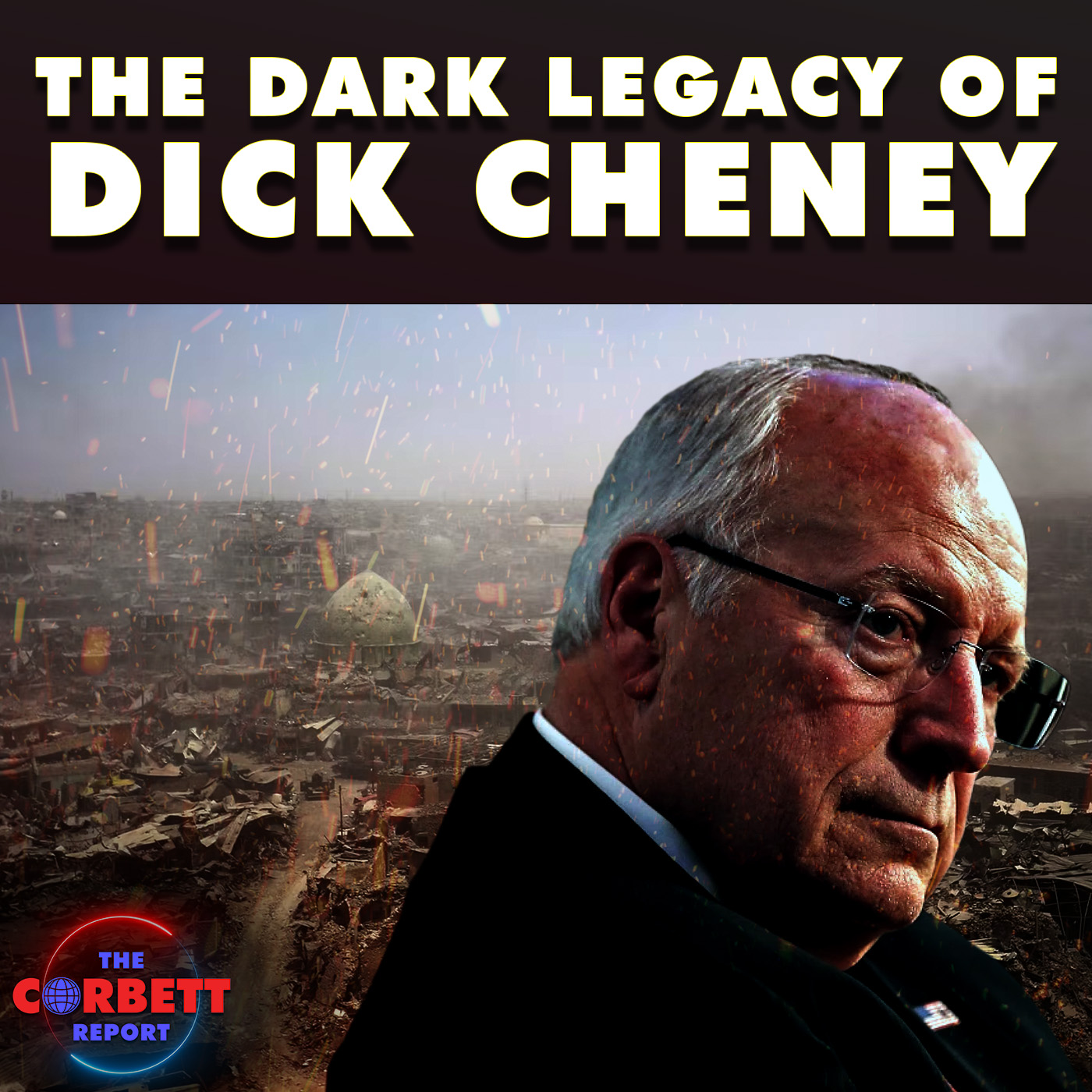
The Dark Legacy of Dick Cheney
Episode Transcript
Hey, remember back in 2003 when CNN accidentally revealed that they had pre-written obituaries on a number of people and we got to see Dick Cheney's obituary?
Well, if you don't remember, the internet remembers.
Yeah, back then, the fake news fraudsters at CNN got everyone's hopes up.
If only, many people said at the time.
Well, guess what?
That time has arrived.
Yes, the Grim Reaper comes for everyone.
And earlier this week, Dick Cheney, vice president of the United States under George W.
Bush, finally met his end.
So what does this actually mean?
Well, we can't rely on the dinosaur fake news fraudsters to tell us about that.
So let's roll up our sleeves and do it ourselves.
Welcome back, friends.
Welcome back to The Corbett Report.
I'm your host, James Corbett of CorbettReport.com, coming to you, as always, from the sunny climes of Western Japan here in November of 2025 with episode 485 of The Corbett Report podcast, The Dark Legacy of Dick Cheney.
Yeah, that's right.
You heard it here first, or maybe you didn't, but in case you didn't, Richard B.
Cheney, the former U.S.
Vice President, passed away peacefully on November 3rd, 2025 at the age of 84 due to complications from pneumonia and cardiac and vascular disease.
Well, there it is.
It's finally happened.
And although I'm sure that the fake news lying liars of the lying corporate press can be trusted at least to report those bare bones basic facts about the time, date and place and perhaps even the causes of Cheney's death, I'm sure that we can't trust them to tell us about Cheney's legacy.
This is a Fox News alert.
We have just learned as Carly was talking that Dick Cheney has died.
We're learning more information as we do.
We will continue to pass that along to you, of course.
We just literally got this information a few seconds ago.
Cheney's family says he died due to complications of pneumonia and cardiac and vascular disease.
Cheney was called the force behind President George W.
Bush, a notoriously silent but powerful vice president who became an outspoken defender of the Bush administration, arning critic of President Obama.
He was chief of staff under Gerald Ford.
He was former Secretary of Defense under George H.W.
Bush.
He went on to be vice president for two terms with George W.
Bush.
And is considered the conservatives conservative.
He faced challenges in and out of the White House, shooting a campaign contributor in the face during a 2006 quail hunt.
The Cheney family released a statement saying in part, Dick Cheney was a great and good man who taught his children and grandchildren to love our country and to live lives of courage, honor, love, kindness, and fly fishing.
Oh, yeah.
Do you remember that time that Dick Cheney shot his lawyer in the face by accident while out quail hunting?
I had almost forgotten about that incident.
So thank you, ABC News, for the reminder.
But yeah, other than that little tidbit, I think you're not going to learn about all of the details of Dark, Dark, Darth Cheney's dark legacy and his career from those fake news corporate media liars.
So in good old Corbett Report deep dive fashion, let's roll up our sleeves and do it ourselves.
And in that fashion, you will hopefully have a pen and paper ready for you with you, because there's going to be a data dump of information in this episode.
And as always, everything I talk about, everything I cite will be in the show notes at CorbettReport.com slash Chaney.
Having said that, let's let's get to it.
And let's start like every boring and predictable biography always does by noting dutifully the birth of its subject, specifically Richard Bruce Cheney, who was born in Lincoln, Nebraska in January of 1941, but was raised in Wyoming, had a typical American school child adolescence and ended up becoming the captain of his high school football team and meeting and dating the high school homecoming queen prom, whatever you call that in America, and eventually marrying her.
Dick Cheney's life of privilege started, really, when he got an admission to Yale.
He got a family friend, specifically Casper Oilman and Yale alumnus Tom Struke, to get him into Yale.
And as Bush later joked, a Yale degree is worth a lot, as I often remind Dick Cheney, who studied here but left a little early.
So now we know.
If you graduate from Yale, you become president.
If you drop out, you get to be vice president.
Yes, well, I wonder if Bush's membership in Skull and Bones had anything to do with his political career.
Oh, no, that's crazy conspiracy talk.
Anyway, so as a fresh dropout from Yale, with nothing in particular to engage himself with, Cheney was prime draft bait in the years of the draft for the Vietnam War.
Specifically from 1962 until 1967, Cheney was eligible to be drafted every single year.
And wouldn't you know it, somehow or other, every single year, he managed to successfully get a deferment on that draft.
Back in Wyoming, there were other things on Cheney's mind.
He took a job with a local power company.
He got arrested for drunk driving.
Even worse, he had lost his student draft deferment just as the U.S.
Was becoming embroiled in Vietnam.
The man who would eventually send Americans off to war wasn't enthusiastic about going to war himself.
In 1963, with thousands of G.I.s already in Southeast Asia, Cheney went back to college and got another student deferment.
In 1964, when Congress approved unlimited force in Vietnam, that student deferment was renewed, and he wed his high school sweetheart, Lin.
In 1965, when President Lyndon Johnson doubled the number of draftees, Cheney graduated.
He should have been prime draft bait, but he wasn't.
Because he was now a married man.
When the U.S.
announced it would start drafting married men without children, call it good luck or good timing, but nine months and two days later, the Cheney's first child was born.
Cheney was rewarded with a fifth and final exemption from military service.
At last, on his 26th birthday, he could relax.
He was officially too old to be drafted.
Now, instead of avoiding the U.S.
government, he set out to join us.
When Dick Cheney first arrived here in Washington from Wyoming, he went to work for a Republican congressman.
Ironically, the first project for the man who'd engineered a series of draft deferments to keep himself out of Vietnam was writing a law to punish colleges for allowing anti-war protests.
And Dick Cheney's career had only just begun.
That's right.
Like every good chicken hawk, Richard B.
Cheney was certainly a draft dodger himself.
Although he later, of course, went on to advocate that people send their sons and daughters off to die in foreign lands for wars for oil and other purposes.
So perhaps part of Dick Cheney's legacy is the legacy of the chicken hawk.
But there are other things that we will add to his list, much more ignoble besides.
So let's keep on rolling because eventually Cheney did land an interview for an important position.
Not necessarily the position itself was important, but the friendship that he made was an important one for him and his rise through the ranks in Washington.
Specifically, he went for an interview for the position of assistant to Donald Rumsfeld, who was then running for his fourth term as U.S.
Representative for Illinois.
He did not get that particular job, but when Rumsfeld was then brought into the Nixon administration as assistant to the president, Rumsfeld remembered and thought fondly of Cheney enough to invite him to become his assistant, essentially the presidential assistant's assistant.
And that is how the pair formed, and Rumsfeld and Cheney certainly formed a duopoly that continued to have reverberations on American politics for decades to come.
But the pair did get split up when Rumsfeld was appointed by Nixon to become the ambassador to NATO, so he went off to Europe.
But it wasn't too long before they were reunited again, specifically after Nixon was taken down by Watergate, and I'm sure there's much to be said about that particular intrigue.
But after that event and after Ford came in, well, that's when Rummy and Cheney ended up serving, Rummy and then Cheney ended up serving as Ford's chief of staff.
So what did they do while they were in that position?
Once again, close to the inner circle of power in the executive branch of the U.S.
Government, or should that be in one of the top spots from which deep state operatives can work their deep state machinations.
Oh, well, of course, that's exactly what they proceeded to do.
So we can take this, for example, from a report from the online journal from back in 2009, Cheney and Rumsfeld pressured CIA to mislead Congress in the 1970s, too.
And this goes on to state that the first time Dick Cheney and Donald Rumsfeld pressured the CIA to mislead Congress was in 1975 and 1976, when Cheney was chief of staff to President Gerald Ford, and Rumsfeld was Ford's Secretary of Defense.
It goes on to say the mission of the three men.
So they're talking about Cheney, Rumsfeld and George H.W.
Bush, who at that point was the head of the CIA, appointed out of nowhere.
I tell you he had no previous experience with the CIA for just for no particular reason.
Ford appointed him to be the director of the CIA.
Interesting.
Anyway, a lot more to say about that, as I'm sure many of my audience know.
But anyway, the mission of those particular three horsemen of the apocalypse was to protect the Ford presidency and some elements in the CIA from the church committee.
And I hope that my audience is familiar with the church committee, specifically responding to, of course, all of the political intrigue and conspiracy and craziness around Watergate that started to open the doors into some avenues and areas of exploration that the deep state probably wanted to keep shut.
And it is from those hearings that, for example, we know, for example, a little bit about Operation Mockingbird, as it has come to be called.
The implanting of intelligence assets in the media, the heart attack gun, for example, the dramatic revelation, other such things besides.
I have talked about the church committee hearings before, but again, that could probably be its own particular episode.
But it was in attempting to cover up some of the deep state family jewels and key secrets that Rumsfeld, Cheney, and Bush managed to withhold documents.
Specifically, this article goes on to state that reacting to public outrage over a series of abuses, including domestic surveillance exposed during Watergate, the Nixon impeachment, and the winding down of the Vietnam War.
In 1975, Congress authorized a special Senate committee chaired by Democrat Frank Church of Idaho to look into abuses of the intelligence agencies, primarily the CIA and FBI.
And so what did the three amigos do?
They, well, they took a massive amount of vital information and withheld it from the Senate's Church Committee, specifically the White House and top echelon of the CIA, withheld from the committee information about the CIA's manipulation of the news media, domestic spying, and material about Cuba, including JFK's plan to topple Fidel Castro on December 1st, 1963, the mafia's infiltration of the anti-Castro plan, and the CIA's unauthorized continuation of the agency plotting to use the mafia to assassinate Castro.
So it goes on to talk about their legacy of secrecy, and perhaps that is another legacy, part of the Cheney dark legacy that we can add, a legacy of secrecy, or more particularly cover-up and withholding information from Congress.
But of course, that was just the beginning.
This was by no means the nadir of the Cheney legacy.
So what else was he involved in with Rumsfeld during that time period?
Well, as we start to move into the 1980s and the Reagan era.
Cheney and Rumsfeld ended up heading something called the Armageddon Plan.
Of course, that was not an actual official title, but that That is the name of the Atlantic article on this subject that came out a decade or two ago, but started to open the kimono, but not all the way, on continuity of government operations planning.
For people who don't know what that is, well, let's take a look at some of this article.
It says, at least once a year during the 1980s, Dick Cheney and Donald Rumsfeld vanished.
Cheney was working diligently on Capitol Hill as a congressman at that time, rising through the ranks of the Republican leadership.
Yet, for periods of three or four days at a time, no one in Congress knew where Cheney was, nor could anyone at Searle, where Rumsfeld is working, locate Rumsfeld.
Even their wives were in the dark.
They were handed only a mysterious Washington phone number to use in case of emergency.
After leaving their day jobs, Cheney and Rumsfeld usually made their way to Andrews Air Force Base outside Washington.
From there, in the middle of the night, each man, joined by a team of 40 to 60 federal officials and one member of Ronald Reagan's cabinet, slipped away to some remote location in the United States, such as a disused military base or an underground bunker.
A convoy of lead-lined trucks carrying sophisticated communications equipment and other gear would head to each of the locations.
Rumsfeld and Cheney were principal actors in one of the most highly classified programs of the Reagan administration.
Under it, U.S.
Officials furtively carried out detailed planning exercises for keeping the federal government running during and after a nuclear war with the Soviet Union.
The program called for setting aside the legal rules for presidential succession in some circumstances in favor of a secret procedure for putting in place a new president and his staff.
The idea was to concentrate on speed, to preserve continuity of government, and to avoid cumbersome procedures.
You know, all this Congress stuff and getting approval for things out the window.
There's a new president in town.
You didn't vote for him.
You don't get a chance to vote for him.
This is continuity of government, guys.
So this is the plan that Cheney and Rumsfeld were working on diligently.
And yes, this plan will come back later on in our story.
Just a hint of it here.
The program is of particular interest today because it helps to explain the thinking and behavior of the second Bush administration in the hours, days, and months after the terrorist attack on September 11th, 2001, dot, dot, dot.
So yes, we will be coming back to this subject and in more detail, but suffice it to say right now, part of the money quote here, one of the awkward questions we faced, one participant in the planning of the program explains, was whether to reconstitute Congress after a nuclear attack.
It was decided that no, it would be easier to operate without them.
Anyway, as you can see, this article frames the continuity of government planning squarely and solely in the context of dealing with a nuclear strike by the Soviets, but even by the 80s, and certainly as it evolved in the 90s, it was no longer about a nuclear attack specifically.
It was any sufficiently large enough declared emergency that could threaten continuity of government.
Well, they had to have a plan in place for that, didn't they?
So in this case, it goes on to say that Cheney and Rumsfeld were, in a sense, a part of the permanent hidden national security apparatus of the United States, inhabitants of a world in which presidents come and go.
But America keeps on fighting.
Yes.
So permanent hidden national security apparatus is quite a circumlocution for a much simpler phrase that I think is more apt, the deep state.
So yes, Cheney as a key architect of the deep state that literally exists and literally convenes in bunkers to talk about continuity of government planning, etc.
That could be certainly part of dark Cheney.
I keep wanting to call him dark.
Dick Cheney's dark legacy.
But again, that was the 80s.
Man, you're living in the past if you're thinking about the 80s.
So what did he do after that point?
Well, after spending a decade as a congressman, then Cheney got back into the cabinet as George W.
Bush's, sorry, not George W.
Bush's, George H.
W.
Bush's Secretary of Defense, obviously during the first Bush administration.
And you'll never guess what he did from that position.
Oh, wait, you totally will.
He used that position to lie the U.S.
into war.
Tonight, the first pictures of the Iraqi invasion of Kuwait.
It was almost a decade and a half ago when Iraqi troops took control of Kuwait.
But what happened next is today eerily familiar.
Then, as recently, men named Bush and Cheney denounced Saddam Hussein as a threat to the world and claimed they had proof.
Top secret satellite photos from Cheney's Pentagon showing a quarter of a million Iraqi troops and 1,500 tanks massed along the border with Saudi Arabia, poised to invade.
There was no reason to believe that the administration wasn't being candid about what was there.
But we had a chance to find out, to test the theory and we took it.
Back in 1991, reporter Jean Heller was based in Washington.
Through a stroke of luck, she learned about another set of high-altitude photos of Kuwait taken by a Soviet satellite on the very same day the Pentagon said there showed a quarter of a million Iraqi troops and 1,500 tanks preparing to invade Saudi Arabia.
And what did that second set of images reveal?
It's what it didn't show.
It was more important.
What you would have expected to have seen were tanks on the border.
There were none that could be seen.
There was nothing behind the border that could have supported that kind of number of troops and tanks.
We've obtained copies of those Soviet satellite photos from September 1990.
With powerful magnification, the photographs are detailed enough for experts to identify vehicles around the Kuwaiti oil fields.
But in southern Kuwait, along the Saudi border, there are no Iraqi tanks to be seen whatsoever, let alone 1,500 of them.
Just sand and wind.
Not a sign of what Defense Secretary Cheney insisted were a quarter of a million Iraqi troops.
It became a critical issue because it was the administration convinced the Saudis they were in imminent danger and got the Saudis to invite the coalition to come in and defend them.
And that's how we got involved in Gulf War I.
Surprise!
Otherwise, yeah, everyone seems to think that the decision, obviously, for the Saudis to invite America onto their soil was some sort of just spontaneous thing that happened as a result of Saddam Hussein's mad gestures and his threatening.
No, it turns out Dick Cheney was the one who lied the Saudis into that decision.
Fateful decision and fateful, obviously, for people who know anything about, say, the history of the development of Alciedda and the development of the terror threat, the war of terror.
They will know that that is a foundational event along there for people who know anything about the Arabian Peninsula or the incredible importance of inviting foreign troops onto Arabian soil.
That was not a minor thing.
That was a very large thing.
And yes, it was deliberately due to the absolute knowing lying of Secretary of Defense, Richard B.
Cheney, back in the early 1990s.
So there you go.
That's another feather in the cap of part of the dark legacy of Cheney.
But it does not end there.
Of course, it goes on.
So another very important thing happened while Cheney was Secretary of defense that had reverberations for decades afterwards and to this very day.
What am I talking about?
Well, as I talked about in a report that I filed in 2012 on the announcement of Cheney's heart transplant, do you remember that?
Change of heart, the legacy of Darth Cheney.
I threw in this little factoid that I think is worth noting.
It says perhaps one of his most important acts during his tenure as George H.
W.
Bush's secretary of defense came after the Gulf War was over.
Under the pretense of downsizing the American military to implement George H.W.
Bush's post-Soviet New World Order, Cheney's Pentagon awarded a contract to KBR, a Halliburton subsidiary, to investigate the possibility of contracting out military services to private companies.
Unsurprisingly, KBR concluded that this would be a very good thing, and soon Halliburton and other private companies were receiving a larger and larger slice of the washington defense budget pie, Also, unsurprisingly, Cheney left his post as defense secretary at the end of the Bush administration and became, you'll never guess, oh, that's right, CEO of Halliburton.
And that's despite not having any relevant business experience up to that point.
They just spontaneously, out of the goodness of their hearts, because he just seemed like a guy with some pluck, decided to make him the CEO of Halliburton, which obviously had effects from that point on and into the Bush Jr.
Administration and obviously the Halliburton contracts in Iraq, etc.
As we hopefully all know about, but if not, this link here in this article links to a HalliburtonWatch.org article on the log cap military contract standing for the Logistics Civilian Augmentation Program.
Which was part of what Cheney was getting the KBR on behalf of the Pentagon to look into in 1992 there, right before becoming the CEO of Halliburton.
Anyway, the whole assorted story is here, links and documents, etc.
So please check that out, because it is another important event in the career of Dick Cheney.
But moving right along, that leads us, I think, quite nicely by way of Cheney's membership in something called the Project for a New American Century, that hopefully my listeners know about, to his next stint in a Bush administration, not the George H.W.
Bush administration, but the George W.
Bush administration, when he was appointed as vice president for Bush Jr., And that happened.
Well, obviously, they got inaugurated in 2001.
And what happened during that year, that first year of the Bush Jr.?
I think there was some sort of important event that happened, just as Cheney was assuming the vice president.
Ah, that's right.
That 9-11 thing.
And who was behind 9-11?
I've been told it was Osama bin Laden or KSM or someone like that, right?
Muhammad Atta or something.
But if you asked Michael Rupert, for example, at the time, he would have told you it was Cheney in the PEOC with P-TECH.
But one thing I am certain of, and I believe I have proven the case beyond a reasonable doubt in crossing the Rubicon, I am certain, I am absolutely certain that Richard Cheney was not only a planner in the attacks, but also that on the day of the attacks, he was running a completely separate command and control and communication system, which was superseding any orders being issued by the National Military Command Center, that's the Pentagon, or the White House Situation Room.
To accomplish that end, he relied on a redundant and superior communication system maintained by the United States Secret Service in or near the Presidential Emergency Operations Center, the bunker, to which he and National Security Advisor Condoleezza Rice were reportedly rushed sometime after Flight 175 struck the south town.
I will demonstrate that the Secret Service possessed radar screens which gave them and the Vice President, whose side they never left, real-time information as good or better than anything available to the Pentagon, the FAA, or anybody else, and that it was on the basis of that information that Cheney overrode and took complete operational control on September the 11th.
I have shown that in what are called national special security events.
I encourage you to all Google that on your computers.
The U.S.
Secret Service is the supreme U.S.
Agency for operational control with complete authority over the military and all civilian agencies.
I have established conclusively that in May 2001, by presidential order, Richard Cheney was put in direct command and control of all war game and field exercise training and scheduling through several agencies, especially FEMA.
This also extended to all of the conflicting and overlapping NORAD drills.
I will also demonstrate that the tripod exercise being set up on September 10th in Manhattan was directly connected to Cheney's role in number three above.
That, again, was veteran researcher Michael Rupert summarizing in a very, very truncated and brief fashion some of his voluminous research on the subject of 9-11 and specifically the actual who and how perpetration of that event.
And even that is really just scratching the surface of the surface of that topic, as I'm sure my listeners can appreciate.
But if you do want more on that, specifically the context of that clip, that was part of Michael Rupert's presentation to the 9-11 Citizens Commission, which took place in September of 2004, which was, I believe, right on the eve of the publication of his seminal work on the subject Crossing the Rubicon.
The decline of the American empire and at the end of the age of oil, which for whatever flaws may have existed in his analysis about peak oil, et cetera, and where he went in his research after that point, I think there was some very solid research in that book.
And I would specifically direct people to chapter 19, where he talks more about those war games that Dick Cheney was in charge of directing and scheduling in that time period of the opening months of the first Bush administration, all to coincide with September of 2001.
And for people who need more context on that, what on earth is P-TECH in the PEOC?
Well, you clearly need to watch or listen to episode 45 of the Corporate Report podcast on P-TECH and the 9-11 software, where all will be explained.
But yes, essentially, at least what Michael Rupert and Indira Singh's proposal for how a 9-11 an operation could have been actually perpetrated in real time on the computer systems, injecting fake radar blips, etc.
Well, you can find out all about that in that particular rabbit hole of an episode.
And then, of course, if you want to know more in more detail about what war games were running on and around 9-11 and how they impacted the events of that day, and thus by proxy, what Dick Cheney was doing as he was directing and literally in charge of emergency planning and operations put in charge by Bush shortly before those events took place.
Well, you can go to episode 346 on 9-11 War Games, where all will be explained.
Plenty of information there.
But you can keep going down this rabbit hole.
There are other things besides.
For example, do you know about CJCSI 3610.01A?
Probably not, but it is a chairman of the Joint Chiefs of Staff instruction that was issued in June of 2001.
Which amended previously operating instructions for specifically the event of aircraft piracy, hijacking, and destruction of derelict airborne objects, which was a longstanding instruction that had essentially was the military's protocols for how to deal with hijackings and hijacked jets and what to do and potential shoot down of such jets, etc.
Well, that was changed in June 2001 to specifically require Secretary of Defense approval.
DOD assistance to the FAA will be provided in accordance with reference D.
Specifically, they must forward requests for DOD assistance to the Secretary of Defense for approval.
So in June of 2001, this was changed suddenly for no particular reason that was ever proffered to specifically bring the Secretary of Defense, in this case, Donald Rumsfeld, into that loop and require his approval for DOD assistance in the event of a hijacking.
What a weird thing to change three months before the day that changed everything.
And, uh, as again, I'm sure my astute and informed listeners will know where was Rumsfeld for the first hour or two of the events of nine 11, completely out of touch.
Even his own staffers could not get to him, um, as he had been whisked out of a morning meeting and was, occupied in his office and uncount contactable, even by his own staff until he made his little PR appearance on the Pentagon lawn, picking up the pieces of whatever it was that was there on the on.
Interesting.
All right.
So that's an important piece of this puzzle, because as has been talked about, is this the stand down order?
Is essentially the changing of this long standing chairman of the Joint Chiefs of Staff instruction just months prior to the event, is this actually what affected that stand down that did happen, demonstrably did happen?
It has to do with also the war games and the taking of so many of the fighter jets in the Northeast air defense sector away from needs in the days and weeks prior to 9-11.
It's a big subject and there's a lot to dig into.
So I'll leave this link.
Again, you can start going down that rabbit hole.
And just as one more tidbit, we'll throw one more in.
Why not?
So I'm sure you've heard me talk about another 19 before, investigating legitimate 9-11 suspects by Kevin Ryan.
And I'll just leave this tidbit from his section on Rumsfeld and Cheney and their connections to 9-11.
Did you know, quote, in 1999, Dick Cheney and Donald Rumsfeld joined the advisory board of Salomon Smith Barney, SSB.
On September 11, 2001, that investment firm occupied all but 10 floors of WTC Building 7.
Oh, right.
Oh, yeah.
I'm sure if memory serves, doesn't Jane Stanley refer and the anchor that she's talking to, aren't they talking about the Salomon Brothers building?
As you can see, WTC7 standing behind her.
Yes, it went down.
And then 20 minutes later, it goes down.
Remember that?
Yeah.
And the Salomon Brothers?
Yeah, that Salomon Brothers, as in Salomon Smith Barney.
And oh, it just happens that Cheney and Rumsfeld were on their advisory board, although not at the time of 9-11.
No, of course, once they went into the Bush administration in January of 2001, they stepped down from the board.
Wouldn't want any conflicts of interest to come up.
So there you go.
Anyway, just one more little tidbit that we can throw in there with regards to 9-11.
But come on, people like Michael Rupert and others who have specifically talked about the ways that Cheney's fingerprints are literally all over the events of 9-11, the planning, the operation, etc.
What are you talking about?
The sitting U.S.
vice president involved in an attack on his own country.
Why?
What could he possibly stand to gain from participating in such an act?
In the seconds after the attack on the World Trade Center, the Bush administration went into an absolute tailspin of confusion and anarchy.
There were moments in this country where no one had any idea who was in control.
No one had any idea who had executive power, who was calling the shots.
The American people were completely in the dark.
Much of our national security apparatus and our political system was in the dark.
That information void expanded across most of the federal government and definitely across the population.
As the National Coordinator for Security, Richard Clarke is also in charge of the Continuity of Government program.
For the first time in the history of the continuity of government system, we activated it.
It's to ensure the security of the principles, the separation and the security of the President, the Vice President, and the Speaker of the House, that no matter what happened, one of them would be available to step into the Oval Office.
With no destination in mind, President Bush is rushed onto Air Force One and launched into the sky, the number one priority of the pilot, to get the plane as high as possible and as far away from anyone else as he could.
At that point, Washington was the combat zone.
We were literally still waiting for the combat aircraft from the Air Force to get up and to protect us in the White House.
The Secret Service Director and I and the Vice President all urged the President not to come back.
Throughout the Cold War, the plan had been to evacuate top government officials out to mountain bunkers in Raven Rock, Pennsylvania, and Mount Weather, Virginia.
The hope was that everyone could be evacuated in the first 15 minutes after an attack.
Over the course of that morning, though, none of that happened.
Most of the top people in the president's line of succession are unable to get to the bunkers or are never contacted.
Others are uncooperative.
Vice President Dick Cheney refuses to evacuate the White House.
At about 9.30 in the morning on 9-11, Vice President Cheney was bundled up by a secret service and moved to a basement next to the White House Situation Room.
I think within an hour or so, they moved him through a long tunnel and blast doors to a presidential emergency operations center beneath the east wing of the White House.
With Air Force One flying at 45,000 feet for extra security, communication becomes difficult.
And they don't even really know where to go.
They don't know really what to do.
They don't know whether more attacks are coming.
The Pentagon is a smoldering mess, and that's what the president is facing as he's flying in Air Force One.
George W.
Bush, in a strange turn of events, sort of became an observer to the tragedy and the spectacle, leaving Vice President Dick Cheney to basically take over the authority of the presidency and start to handle this burgeoning newborn war that America was finding itself in.
So it was a total, absolute collapse of authority.
Oh, that's right.
What did the U.S.
vice president have to gain from participating in, let alone planning or orchestrating such attacks?
Oh, well, just complete and total control of the government, which is what Cheney apparently had on the morning of 9-11 up until the evening, presumably, when Bush finally returned to the White House.
Do you remember as he went on his wild goose chase around America in Air Force One?
Being chased by phantom threats, Angel is next.
Remember all of that?
Well, again, there's another 9-11 rabbit hole for those who haven't discovered it yet.
But anyway, yes, someone was keeping Bush away.
And who was in charge during that time?
Well, it seemed to have been Cheney, or at least he was definitely part of the continuity of government that we know was enacted following the events of 9-11.
And we can take that from a number of sources, but probably the one that we want to go to is this comprehensive report that was filed at the Asia Pacific Journal back in November of 2010 by Peter Dale Scott, a researcher who I am sure my audience needs no introduction to.
But if you are unfamiliar with Peter Dale Scott, please familiarize yourself with him and his writings.
The progenitor of the term deep state, at least in the English language.
So someone who is probably worth your time and attention, especially so in this very comprehensive article, is the state of emergency superseding the U.S.
Constitution, continuity of government planning, war, and American society.
And this, as I say, is a thorough going through of the story of continuity of government operations and planning and what they were and how they were implemented on 9-11.
Lots and lots of very important details in here that we don't have time for, but just some of the things that happened as a result of this, implementation of continuity of government on 9-11.
The president established an office of Homeland Security within the presidential executive office.
They created a terrorism screening center to consolidate the government's approach to terrorism screening, which led to, of course, the no-fly list and the terrorist watch list.
You have the militarization of domestic United States law enforcement back in 2002 with the creation of NORTHCOM, which, amongst other things, also behind the scenes, operated in so-called fusion centers, fusing the military, the FBI, state police, along with private intelligence corporations like SAIC, S-A-I-C, another important player in the 9-11 events, maintain and analyze data to identify potential threats to those in power.
And finally, still in the 90-day shadow government period after 9-11, President Bush proclaimed two important emergencies that are still in force today, at least at the time of 2010, and one of them definitely still in force.
Specifically, proclamation 7463 declaration of national emergency by reason of certain terrorist attacks which is issued every september 14th 2001 which uh together with executive order 13223 ordering the ready reserve of the armed forces to active duty um presents an interesting double punch and you might, You might be familiar with the fact that me and James Evan Pallotto put this on record every single September, because every single September since 2001, whichever puppet is sitting in the Oval Office has signed their John Hancock to the renewal order for this never-ending declaration of emergency.
The emergency by reason of certain terrorist attacks.
It has been renewed by every single puppet every single year since 2001.
And yes, as we put on record earlier, just a month or two ago on New World Next Week, Donald Trump, of course, signed off on the renewal of the emergency for another year.
So this emergency order rule by emergency is still in effect.
And as Peter Dale Scott goes on to point out it was simply the declaration as it stood in 2001 for the first six years.
But after 2007, there was a significantly expanded scope for that proclamation.
We'll come to that in a minute.
But as he goes on to say, there is no way to determine how many of the constitutional changes since 9-11 can be traced to COG planning, continuity of government planning.
However, we do know that new COG planning measures were still being introduced in 2007 when President Bush issued National Security Presidential Directive 51.
The directive set out what FEMA later called a new vision to ensure the continuity of our government and was followed in August by a new National Continuity Policy Implementation Plan.
So for people who don't remember that, NSPD 51 was a substantial and important presidential directive that threatened to completely...
Break down the pretense of posse comitatus and all of that.
Well, anyway, that's, that's agent history by now.
But it was interesting that in 2007, there's that new national security presidential directive.
And from that point on, that declaration of emergency from the 9-11 events changed slightly.
As Peter Dale Scott goes on to write, quote, I mentioned earlier that the proclamation of a national emergency issued by Bush on September 14th, 2001, and since renewed annually to this day changed significantly in 2007, all previous annual renewals had enumerated the emergency measures that were being renewed.
For example, the measures taken on September 14th, 2001, November 16th, 2001, and January 16th, 2002.
After Bush issued NSBD 51 of 2007 with its new vision and its new classified COG annexes, the next renewal of the emergency proclamation replaced the previous specific enumerations with a more sweeping general sentence.
Because the terrorist threat continues, the national emergency declared on September 14th, 2001, last extended on September 5th, 2006, and the powers and authorities adopted to deal with that emergency must continue in effect beyond September 14th, 2007.
The powers and authorities adopted to deal with that emergency.
This language is so vague, it is hard to see how we could not cover the classified continuity annexes of NSPD 51 as well.
So anyway, that is the rule by emergency shadow secret government that I've been talking about and had an entire episode about rule by emergency.
This is the governing paradigm of the 21st century.
Know it or not, whatever you think about whatever legislative system you're living under and whatever you believe about Congress and Bill of Rights and Constitution and what have you, that was scrapped in the wake of 9-11.
And that emergency, which has enabled that scrapping, has been renewed every single year since.
America is still under a legally declared state of emergency from 9-11.
And oh, by the way, it invokes all this classified continuity of government planning that you're not allowed to know about.
Even people on the Homeland Security Committee, as he goes on to say.
DeFazio, at the request of 9-11 truth constituents, attempted to see what was in those annexes and was denied.
He even got the chairman of the Homeland Security Committee to make a request to see those hidden, private, secret documents and was denied again.
So you're not even allowed to know what the actual governing system of the United States of America is right now.
But it ain't it ain't the schoolhouse rock version about how to pass a bill or whatever you learned in school.
No, there is a declared state of emergency.
It stems from 9-11 and who had their finger on the trigger in the PEOC was Dick Cheney.
So there you go.
This is an incredibly important part of the dark legacy of Dick Cheney.
Not only coup planner, not only coup plotter, but active coup participant, who, as was universally acknowledged, became essentially the driving force of the Bush administration, at least for the first several years of that administration, driving the war of terror as it began to unfold.
And we didn't have to look very hard or wait very long to get a sense of what Dick Cheney's vision of that war of terror would entail.
You may or may not remember on September 16th, 9-16, just five days after 9-11.
Dick Cheney appeared on Meet the Press with Tim Russert.
Remember him when he asked about skull and bones to Cheney and Kerry?
He made a big joke about it.
Anyway, Cheney appeared on Meet the Press to talk about what steps, what strategies the Cheney administration, oh, I mean the Bush administration was going to use in the War of Terror.
I mean, we all remember when Cheney said that sometimes you have to work on the dark side.
I want to be careful here, Tim, because it clearly would be inappropriate for me to talk about operational matters, specific options or the kinds of activities we might undertake going forward.
We do indeed, though, have, obviously, the world's finest military.
They've got a broad range of capabilities, and they may well be given missions in connection with this overall task, strategy.
We also have to work, though, sort of the dark side, if you will.
We've got to spend time in the shadows in the intelligence world.
A lot of what needs to be done here will have to be done quietly, without any discussion, using sources and methods that are available to our intelligence agencies, if we're going to be successful.
That's the world these folks operate in.
And so it's going to be vital for us to use any means at our disposal, The disposal, basically, to achieve our objective.
Oh, perhaps we're reading too much into this.
I mean, the dark side, of course, as he goes on to explain.
That's just the intelligence world, you know, shadow stuff.
He doesn't mean anything by that.
Sources and methods.
I wonder what kind of sources and methods for this war of terror that he was helping to wage would include.
Oh, that's right.
Torture.
Of course.
Torture.
That's what he's talking about.
And not torture even for the ticking time bomb 24 scenario of the good guy that just has to torture someone to get the secrets about the next terror attack.
No, torture that was used to create, and fabricate the evidence that was needed, for example, to make KSM the mastermind of 9-11 from A to Z.
Just don't talk about his being waterboarded 83 times in a month or having his children subject to torture by insects in boxes and other things that he was being threatened with if he didn't say exactly what they wanted him to say, at which point he said everything that they wanted him to say, including things they could not possibly have done.
Again, I've talked about that before.
But yes, who was the one behind that?
Well, of course, it was Dick Cheney.
And we can get that, for example, from this Libertarian Institute article, an obituary of sorts for Mr.
Cheney.
Dick Cheney, war criminal and torturer, dead at 84, which goes on to state that best known for steering national security policy after the 9-11 attacks, Cheney became the dominant force behind a global war on terror that unleashed torture, preemptive war, and mass surveillance.
Amnesty International has described him as one of the principal architects of a program that amounted to torture, while the Brown University Costs of War Project attributes more than 900,000 deaths and trillions of dollars in spending to the post-9-11 wars he championed.
Dick Cheney's legacy is one of unprecedented destruction and the erosion of civil liberties.
Yes, let's add that to the list, the dark legacy of chicken hawking and coup d'etat planning and continuity of government and everything else.
Oh, also unprecedented destruction and the erosion of civil liberties.
This goes on to describe this in more detail, some of the specifics, naming names.
Cheney's longtime counsel, David Addington, and Justice Department lawyers, John Yu and Jay Bybee, drafted memos arguing that the Geneva Conventions did not apply to detainees captured in the global war on terror.
The State Department's legal advisor warned that claiming the president could suspend the Geneva Conventions was legally flawed and would reverse over a century of U.S.
policies.
Cheney pressed ahead, telling the Washington Times that he signed off on the CIA's secret detention and rendition program.
And as a principal participant in National Security Council meetings, he authorized the agency's interrogation program, including waterboarding.
In 2006, he called waterboarding a no-brainer.
And in 2009, he acknowledged knowing about the practice as a general policy that we had approved.
And it goes on to state, um amongst many other things you should read the whole article but it quotes colonel wilkinson um uh who was uh colin powell's advisor chief of staff he told abc news that cheney was president for all practical purposes during george w bush's first term and he feared being tried as a war criminal, The Washington Post dubbed Cheney the vice president for torture, and Wilkerson said his push to disregard the Geneva Conventions amounted to an international crime.
So there you go.
I mean, it's not weird fringe conspiracy theorists sitting in Japan who have correctly identified Dick Cheney as a war criminal.
It's people who were right there alongside him in the administration talking about it and calling him the real president, the president for all intents and purposes during the Bush administration.
So that was, of course, a key method, sources and methods of the intelligence community and specifically of the war of terror that Cheney helped champion.
But it wasn't just a war of terror.
It wasn't just the war on the abstract now.
And of course, there were the actual wars.
And yes, it should be put on record, although it will be no surprise to anyone in my audience that, yes, Cheney helped to lie the U.S.
into war.
We've seen in connection with the hijackers, of course, Mohamed Atta, who was the lead hijacker, did apparently travel to Prague on a number of occasions.
And on at least one occasion, we have reporting that places him in Prague with a senior Iraqi intelligence official a few months before the attack on the World Trade Center.
He now is trying, through his illicit procurement network, to acquire the equipment he needs to be able to enrich uranium.
Aluminum tubes.
Specifically aluminum tubes.
There's a story in the New York Times this morning.
In the case of Iraq, we have a regime that is busy enhancing its capabilities, in the field of chemical and biological agents and is, by all available evidence, speeding up its nuclear weapons program.
Simply stated, there is no doubt, that Saddam Hussein now has weapons of mass destruction.
There is no doubt that he is amassing them to use them against our friends, against our allies, and against us.
Things have gotten so bad inside Iraq from the standpoint of the Iraqi people, my belief is we will in fact be greeted as liberators.
Greeted as liberators.
Yeah, indeed.
I don't know what's more disgusting with regards to all of this, the fact that a cold psychopathic liar like Dick Cheney could lie straight on to the cameras like that without a hint of shame, or that he would years later double down, triple down, quadruple down on it by over and over repeating that the Iraq war was the right decision, he's glad he made it, and he would do it again in a heartbeat, or...
That apparently enough of the American public was fine enough with such blatant and outright lying that they are now willing to laud this patriotic American, or at least certain segments of the population are doing that.
But you know what?
We're not even done.
There are many, many things that we could add to our list if we're keeping this list of the dark legacy of Dick Cheney.
But the waning days of the Bush Jr.
Administration, when Cheney was still up to his plotting and tactics, when, of course, the Seven Countries in Five Years plan was still unfolding and they were still trying to get that done.
Cheney was the one who came up with the plan, the bold and brilliant plan to, I don't know, blow up Americans in order to get the U.S.
involved in a war in Iran.
There's a bit at the end of this latest article that you wrote that I found actually most interesting in the article.
It hasn't got that much attention, but I want to get your take on this.
And this relates to a story or an incident that happened a couple of months ago.
Many of you remember it.
It was in the Strait of Hormuz.
There was an incident where an American carrier almost blew a couple of Iranian speedboats out of the water and perhaps would have started the next war, a war against Iran or potentially a World War III.
And it was averted, thankfully, at the last second.
We later learned that there was really nothing to be terribly concerned about, that the incident was overblown, and that there was a vice-admiral in charge of the fleet in the Strait of Hormuz who said basically there was no concern there, that it was overblown.
Well, yeah, the second part, basically.
He was concerned, but it was overblown.
He was never threatened.
We were never threatened.
And you talk about this vice admiral's name is Kevin Cosgrove, and in your article you write, nonetheless, Cosgrove's demeanor angered Cheney.
According to the former senior intelligence official but a lesson was learned in the incident the public had supported the idea of retaliation and was even asking why the u.s didn't do more the former official said that a few weeks later a meeting took place in the vice president's office quote the subject was how to create a casus belli between tehran and washington he said what you're writing there is that Cheney there was a meeting in the White House where Cheney presided over looking to cook up the next war a false war based on false intelligence my oldest son is a lawyer and when I sent him the story before it was published basically in a final form just a day and he wrote back and he said you really buried the lead in this one but cost his belly um.
How many press are here anyway there was a meeting among the among the items, among the items considered and rejected which is why the New Yorker did not publish it on grounds that it wasn't accepted one of the items was why not every there was a dozen ideas profit out of how to trigger war the one that interested me the most was why don't we build we and our shipyard build four or five I rate boats that look like Iranian PT boats put Navy SEALs on them, with a lot of arms and the next time one of our boats goes through the Straits of Vermouths, start a shoot-up.
Might cost some lives and it was rejected because you can't have Americans killing Americans, but that's the kind of, that's the level of stuff we were talking about, provocation.
But that was rejected.
So I could understand the argument of not writing something that was rejected.
Maybe.
I basically, my attitude always towards editors is they're maestro need to be rats.
So, but, but you have to, you have to, you know, they're, but the point is, J.
June, if you know what that means, silly, maybe, but potentially very lethal, because one of the things they learned in the incident was the American public, if you get the American, if you get the right incident, the American public will support, you know, bang, bang, kiss, kiss, you know, we're into it.
And the public, although that was the other side that had issued that was important, what happened in the Gulf, in the Straits in early January, the President was just about to go to the Middle East for a visit.
So it was all, that was one reason they wanted to gin it up, get it going.
Look, is it high school?
Yeah.
Are we playing high school with, you know, five, five thousand nuclear warheads in our arsenal?
Yeah, we are.
We're playing, you know, who's the first guy to run off the highway with us in Iraq.
Operation Northwoods, anyone?
Yeah.
Why don't we just build an Iranian PT boat and then dress up American soldiers as Iranians and start shooting at Americans?
Why not?
Sure.
That's a good way to start a war.
Oh, maybe we can't do that.
Okay.
We won't do that.
Don't worry, guys.
We won't do a thing like that.
It's unbelievable unless you are tuned into reality.
And unfortunately, you will never get that from, as I say, the glazing of the corporate media, who has done nothing but sing the praises of this wonderful American patriot in recent days.
Whereas we can now see the real dark legacy of someone like Cheney.
Cover-up perpetrator, deep state facilitator, coup plotter, false flag executioner.
And that's just the beginning of this list.
So what was the fate of this arch enemy of humanity?
Was he subjected to war crimes prosecution?
Well, as you may or may not remember, I had this post up in March of 2012.
Who's afraid of war crimes prosecution?
Cheney cancels Toronto speaking event, which reported that former U.S.
Vice President Dick Cheney and his daughter Elizabeth have cancelled a planned speaking engagement at Toronto's Metro Convention Center next month, citing safety concerns.
According to the president of the promotion company that booked Cheney for the April 24th speech, he felt that in Canada, the risk of violent protest was simply too high.
Do you remember that?
You remember when the Cheneys, both Dick and Liz, were reprehensible.
Absolutely unredeemable exemplars of everything that the left seemed to hate and was pledged to be against?
And remember how now, all of a sudden, Liz Cheney, for speaking out against Trump, is just the greatest and the left embraces her.
And she's one of the good people on the right.
Funny how a decade or two can change things, isn't it?
Well, of course, there was good reason for Cheney and others to be concerned about their safety at such events at such a time because, well, you might remember, for example, just a few months after that incident, there was an actual delivery of a guilty verdict in a war crimes tribunal for Bush, Cheney, Rumsfeld, and five others.
They were found responsible for war crimes, specifically at the Kuala Lumpur War Crimes Tribunal that was taking place at that time.
It was, I believe, founded in 2007.
In 2012, it convicted Bush, Cheney, Rumsfeld and five others of war crimes.
You probably don't know about that conviction unless you watch the corporate report, but it did happen.
And of course, you don't know about it because the Kuala Lumpur War Crimes Tribunal, well, obviously the United States and other countries didn't recognize it.
And although that is on the record, it stands as a verdict.
Bush and, of course, Cheney were never actually arrested by any of the states that could have used this as a war crimes conviction, which would obligate them to actually arrest the war criminals.
Well, at any rate, it is on the record and it is an important part of the record because it at least shows that free humanity is not buying the corporate propaganda of wonderful patriot Dick Cheney that we now must mourn the loss of because he was such a great guy.
Well, again, where does that leave us now after Cheney's passing?
What does this all mean?
Well, you might remember as I reported in Change of Heart, the legacy of Darth Cheney, that report that I filed in the wake of Cheney's heart transplant there in those very hectic days of 2012.
I don't know what was going on in 2012, but a lot of Cheney news.
And as was reported at that time, Cheney had had a heart transplant.
But for the previous two years, from 2010 to 2012, Cheney was literally heartless, as in he literally did not have a pulse.
He was using a mechanical heart that functioned in a way to create a continuous flow of blood through the circulatory system.
So there was no pulse.
Cheney literally did not have a pulse.
He was literally a heartless mechanical Darth Vader for those two years before the heart transplant.
And maybe that's an apt way of describing Darth Chaney and his legacy.
If you are inclined to feel sorry, sorry for him, oh, that he had to go through all of that, and oh, poor man.
Well, don't worry.
His corporate media buddies who pretended to be his opposition always, always had his back.
Former Vice President Dick Cheney is reportedly feeling good and likely to leave George Washington University Hospital in D.C.
Within a day or two after he experienced a mild heart attack yesterday.
69 years old, Mr.
Cheney has now suffered five heart attacks in his lifetime.
Yesterday's led doctors to administer a stress test and a cardiac catheterization, which is something that examines blood flow to the heart and tests how well the heart is pumping.
It is not known if the former vice president underwent an angioplasty, which is a procedure to clear blockages in the heart.
Dick Cheney has, of course, said and done many things with which many people have taken angry issue, myself included.
but Dick Cheney is also a husband and a father and an American who has spent most of his life in public service, and we wish him a full and speedy, speedy recovery.
Sincerely.
I can only hope that Ms.
or Mr.
Maddow is taking this news okay.
I hope she's okay at this trying time for all of us.
Yes, Dick Cheney is dead, and unfortunately not at The Hague, as one headline that I saw recently put it.
But it's a comfortable death, surrounded by friends and family and lauded by the nation that mourns his loss.
So it is not victory at all.
I will repeat it here, as I repeated in the unauthorized biography of David Rockefeller and my remarks on the passing of Zbigniew Brzezinski and Henry Kissinger, etc.
Death is no victory.
This is not the way that we win, and nothing has been accomplished other than one more serviceable puppet for the deep state agenda, having shuffled off the mortal coil, to meet his rewards, or lack thereof, in the afterlife.
But that is no victory.
And, It is certainly no victory that we will never be able to haul someone like Cheney in front of a real 9-11 tribunal or commission to get on the record what really actually happened on that day.
That will now never happen, at least not from the mouth of Cheney himself.
But if there is any victory that we can take out of this, out of this ignoble legacy of this false flag Paul Potter and coup d'etat leader, it is that we can at the very least still try and convict someone like Cheney in the court of public opinion.
If the comments on every single corporate media story and post that I have seen talking about the legacy of this great American patriot are to be believed, the public already know that what Cheney's real legacy actually is.
There are many, many, many more people who understand what Cheney was and how he was operating than the corporate media would like you to know.
They would like you to think, oh, everyone's so broken up about this.
But then then go to the comment section.
Take a look at how many people are really tearing up over Cheney.
I think there has been, obviously, a monumental shift in public understanding of events like 9-11 and the role of people like Dick Cheney over the past two decades.
The problem is that that understanding, that shift in consciousness is never going to be reported.
The corporate media that is there to lie to you is not going to tell you about that cultural shift.
And if nobody sees it on their telescreens, it must not be real, right?
Don't believe it for a second.
We know who Dick Cheney really was.
We know what his legacy really is, and we will not stand for it.
Now, there's a lot of information in today's episode, and even just the 9-11 rabbit holes themselves no doubt deserve plenty more exploration.
So I will leave this episode here today, but I exhort you to go to the show notes at corbettreport.com slash Cheney and avail yourself of all of those links to all of those resources and start digging into this more.
The only way we lose here is if we do not remember and accurately reflect the history of someone like Cheney.
So I hope you will do your part in helping to spread the word about this real information.
Having said that, I'm going to end it here for today.
I, as always, appreciate your support at corporatereport.com and also at reportagebook.com, where you can get my book, Reportage Essays on the New World Order, now in paperback and hardcover and coming in the very near future audiobook form.
And hey, if you're a German speaker, the German version is already out.
And I hope people are putting their orders in for that on Romanian speakers.
There is a Romanian translation that is now available.
I will put the link in the show notes as well in case you want that.
But we're going to leave it here for today.
This is James Corbett of CorbettReport.com.
Thanking you for joining me for this exploration and looking forward to talking to you again in the near future.