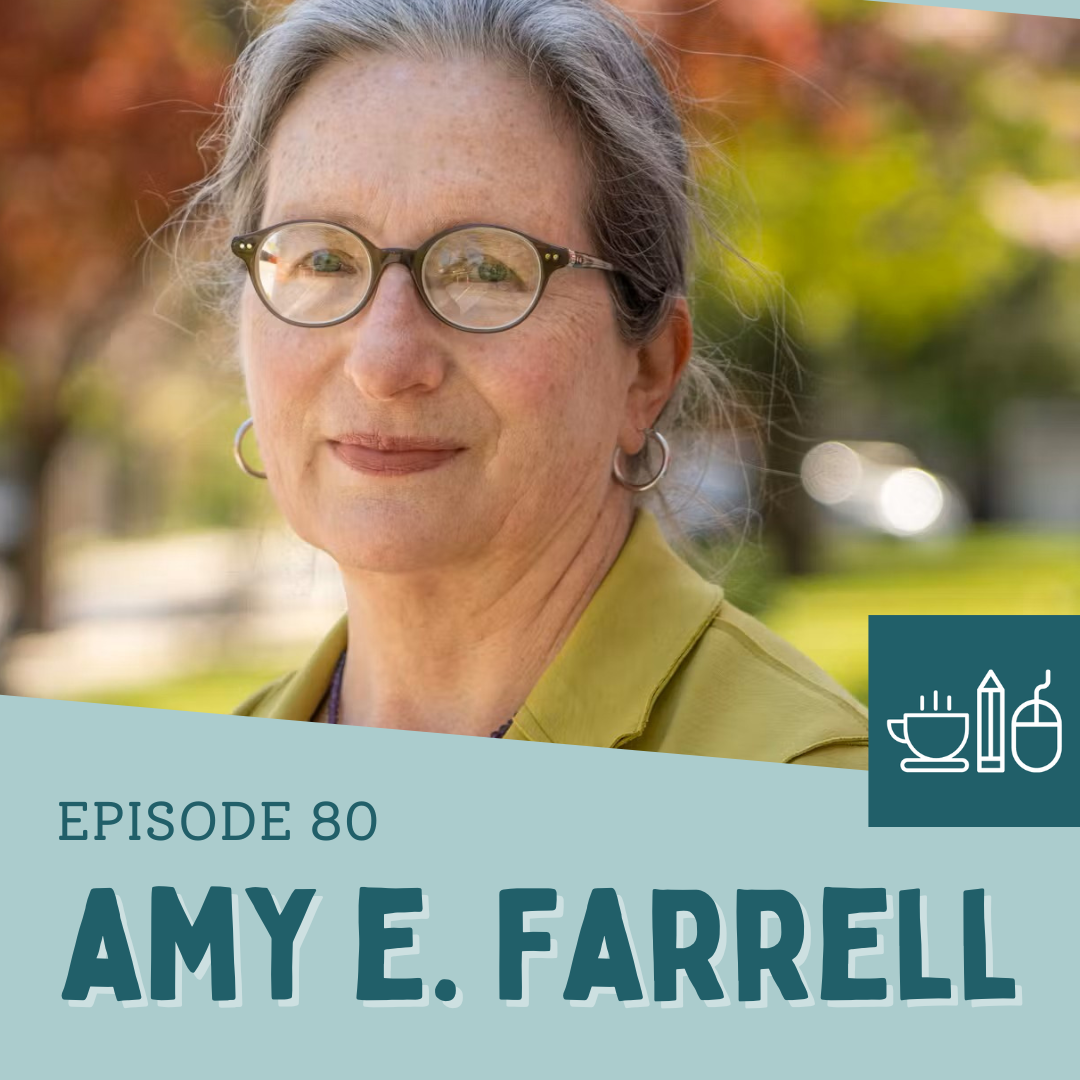
·S4 E80
Amy Erdman Farrell Leaps Into Something New
Episode Transcript
Kate Carpenter: Welcome back to Drafting the Past.
This is a show all about the craft of writing history, and I’m your host, Kate Carpenter.
I have a soft spot for historians who follow their curiosity through a range of subjects that might, at first glance, seem unrelated.
So I was especially delighted to get to interview today’s guest, Dr.
Amy Erdman Ferrell.
Amy Erdman FerrellAmy Erdman Ferrell: It's wonderful to be here.
Kate CarpenterKate Carpenter: Amy is a professor and endowed chair of American Studies and Women’s, Gender and Sexuality Studies at Dickinson College.
Her first book was Yours in Sisterhood: Ms.
Magazine and the Promise of Popular Feminism.
From there, she wrote a second book titled Fat Shame: Stigma and the Fat Body in American Culture, followed by an edited collection, The Contemporary Reader of Gender and Fat Studies.
For her newest book, out earlier this year, she turned her focus to an American institution: the Girl Scouts.
The book is called Intrepid Girls: The Complicated History of the Girl Scouts of the USA.
I was eager to talk more with Amy about how she has come to each of her books, how her publishing career has unfolded, and especially her decision to sign with an agent to represent her most recent book.
Here’s my conversation with Dr.
Amy Erdman Ferrell.
Amy Erdman FerrellAmy Erdman Ferrell: So I was in graduate school in the 1980s.
You know, actually, to be honest, in college and graduate school, I wrote a lot.
I wrote a journal, wrote many, many, many papers as an English major, and then American Studies and Feminist studies PhD, but I wasn't really imagining writing for an audience, and so that didn't really, I mean the audience of my class or my professor or something.
But that changed for me.
I finished my dissertation on Ms.
Magazine, and then I was able to have access to a much bigger archive to turn that project into my first book, Yours In Sisterhood.
That was my first experience as a writer.
To be honest, I didn't really follow that book, meaning like it went out in the world and it had its own life, which was fun to find out later.
But there was even pushback from people like Gloria Steinem about that book.
So I was just, I think I just moved on, do you know?
And though that's maybe for another conversation that I'm ready to have that conversation now, but I mean starting to think about that.
And then I turned my attention to really a different area that had come to my attention with working with a lot of students and thinking about body size, the history of anorexia.
And I started research on a project on the history of dieting, and and then I became less interested in that, because I realized it is all the same.
We've had a lot of diets for a long time that just repeat themselves.
And I became more interested in the history of fatness, and that turned into my project Fat Shame.
And that book I really could think about beyond that first project, that I had an audience of readers, and I was really, I think I've always it kind of comes more naturally to me to have a more accessible voice.
But I really worked diligently for that in that book, to make sure that I was trying to share the research and my argument in ways that could speak, could both speak to an academic audience, but also beyond it.
When I finished that project, I turned almost immediately back to really my roots in women's history, and started my project on the Girl Scouts.
And so that project I really from, its origins, I had a very particular, well multiple, but particular audiences in mind.
I really wanted to be speaking to Girl Scouts, to people who had had that experience, but also for anyone thinking about their own life experience in childhood, and how we are part of bigger processes.
That's really been my trajectory as a writer.
Along the way in there, I've been fortunate enough to be part of an amazing group of actually fat studies scholars.
So I edited the collection The Contemporary Reader of Gender and Fat Studies.
Really that was, to me, kind of a love project of bringing together so many of the scholars and artists whose work were so influential to me.
Kate CarpenterKate Carpenter: I'd love to just ask you some of the practical questions about writing, when and where do you like to do your writing?
Amy Erdman FerrellAmy Erdman Ferrell: I am pretty particular about where I write, as in it needs to be quiet and by myself.
I am not a writer who, you know, I see my son and daughter who are both artists and writers.
They love to go to a coffee shop and write, and I'm like, No, I'll grade papers there.
But even then, my attention will be not, not focused.
For me, writing needs to be in a quiet place and a place where I'm, for the most part, by myself.
I think there's something to me about the kind of protection that I feel in that space where I can I feel safe to express myself and also to be experimental, even with what I'm trying to do, but also in a certain way, getting kind of really into my own head in the best of ways of that, like almost into a kind of dream space of writing where I can really focus.
So sometimes I'll even turn on music to get myself focused.
But once I'm focused, it just needs to be quiet.
Is what I'm looking for, is quiet.
The only exception to that is I'm part of a writer's circle that's called the Slowdown Circle, that I have been part of for a couple of years, and we write together online, but even that, it's quiet, or there's this little background music that she plays for us, it's wonderful.
I would just encourage anyone to look into that, if they're interested.
Yeah, she does an amazing job with the Slowdown Circle, and with that, we kind of check in, but I've not even had that much great experience writing with other people, because I find we, we end up chatting a lot of the time.
So it's great experiences of chatting, but not of writing.
Kate CarpenterKate Carpenter: Do you have a routine?
Do you try to write every day?
Amy Erdman FerrellAmy Erdman Ferrell: When I have been working on these projects, like with Intrepid Girls, when I be on, for me, I teach at Dickinson College, which is a very, very teaching intensive institution, teaching and service, and so in that height of the semester, really, that's what my life is.
But I, because using the like this, the Slowdown Circle and some other means, I would make sure that a couple of times a week I would sit and write for a couple of hours, so that I would stay with my project, so that my brain would keep thinking about things even in the midst of extraordinary busyness, but when I would be on break, so like winter break, even a spring break, I really think of it as kind of I try to use my key daytime hours.
I started as a faculty member in 1991 when my son, Nick, was born.
He had just been, he was four weeks old when I started.
And so I think I always got into the habit that my work hours are really daytime hours.
Do you know?
Like I'm kind of, like, I do my best work between 10am and, like, now I extend it to 6pm or something.
But at that time, it would end by four or something, and I still am that way, like so when I would have breaks or sabbatical or a fellowship, I really, I basically went to work every day to write or do research or whatever.
It doesn't mean that the evening, sometimes we're reviewing something, just to keep my brain focused on it.
But really it was a it was a daily ness of the work.
Kate CarpenterKate Carpenter: How do you like to organize yourself?
Amy Erdman FerrellAmy Erdman Ferrell: Well, that's a funny question.
It's not a funny question.
I just laugh because I wish I would organize myself better.
Okay, with the Slowdown Circle that I was discussing before, she has a wonderful way of having us once a week, we would actually have a focused hour where we would review the previous week and then think about what was upcoming for the next week.
Extraordinarily helpful and actually allows me now that I can look at a task and know how long something's going to take, like, literally, that page that I'm writing about this particular thing is probably going to take me an hour, or will maybe just take me 20 minutes, or is probably going to take me, like, for a whole thing that's going to take a month of work in the summer.
I can kind of look at that, and although usually takes longer than that, so that's how I would organize my time, and that's been useful for me to have a sense of how much time something is going to take, not in a rigid way, because I know that it that changes.
It changes.
It often changes, and it usually takes longer, and the project might be changing along the way, but I do like to have some sense of, you know, just that within a 25 minute time period, I could probably get that paragraph written and that, and that helps me a lot.
When I'm feeling any kind of writer's block or just resistance to writing, I could just get this little bit written, do you know, and then, and then, usually it moves on from there, in terms of my notes and things I feel like I I wish I had a better way to do it.
Do you know?
I think I was trained in a day when we really got our materials in paper, and so you were limited when you went to an archive to get the materials that you could probably pay for, and someone would have to be making copies there.
So you knew you had a level of their patience that you couldn't you were butting up against.
And then I would actually take all of those papers and put them in, if, like I'm working on the chapter on Girl Scouting at Indian boarding schools, everything would go into that that folder, or maybe it would become a couple of folders once we start.
Doing the kind of taking pictures of a million archival sources, I have not found -- I find my ability to collect the materials gets beyond my ability to keep things carefully organized.
And so I have really worked down, worked out lately, like I ended up for this book.
I've literally, I maybe regret having to admit this, but I've printed out every single one of those sources because I didn't feel confident in my ability to organize and to see on the computer.
I think for those who were trained with using it digitally, I suspect that's not going to be the case for them, do you know?
But for me, it was really important to have it in both places.
And then it gets, it gets a little complicated, because you're keeping, I would try to keep all my materials carefully together from each archival source that I was using, because I'm using so many, but then to pull these extra copies together for, like for this chapter, this is what I'm using and so that I actually have them all there.
Kate CarpenterKate Carpenter: Where in your research process, do you like to start writing?
Amy Erdman FerrellAmy Erdman Ferrell: I actually start writing pretty quickly.
I have found that waiting too long as I just observe my fellow writers and so many students over the years can can actually serve as a kind of block, but that doesn't mean that I can be, I can't be wedded to that early writing, but I think it's wonderful, like, the one thing that I love about academic conferences is actually preparing very small pieces that can be shared.
So even for people who aren't you know necessarily in the academic world, I just think finding spaces where you can share small pieces to get yourself writing.
Because for me, the writing allows me to figure out, what are the questions that I'm asking, what am I, what am I seeing?
What are the patterns that I'm seeing already, what is just kind of something that's not particularly useful?
And I've been very lucky in my writing life.
For my Fat Shame book, I sent out an early set of materials.
Actually, NYU Press published that book, but I got the contract with early chapters and a kind of prospectus, and I had one reader who was so useful with actually two sentences that she said to me, it changed my whole book.
I didn't use any of that early material.
I've used lots of that early material for talks I've given, but they're not in my book at all because I realized, but I needed to go through that process.
Some people have said to me, that, was that just a waste, and it's like, no, not at all that was, I needed to write that much for her to notice, like, this was the most interesting thing you said in here, Amy.
And I was like, yeah, that's, that's my book.
And then I I changed that.
That really got me to thinking about fatness and concepts of civilization and race that were part of a story that was still somehow connected to that old project of dieting that I didn't really want to be doing anymore.
Having said that, I've had experiences where I've started to write too soon, do you know?
And I realized, usually, now I'm a little wiser.
I realized then, if I'm really feeling like I'm stuck, I don't know what I'm trying to say, I go back to my sources, to reading more, to get my brain.
It's like usually, then I've, I've started something somewhat prematurely, but I would say it's not a good idea to for me, but I would even observing it with other people.
The writing needs to start pretty early, even if it's not writing that's actually going to be published.
Kate CarpenterKate Carpenter: What does your revision process look like?
Amy Erdman FerrellAmy Erdman Ferrell: It's constant.
Usually when I, I would say, I go from the micro to the macro, back and forth all the time.
So when I would pick up something, say, if I'm working on something that I know actually is a chapter, or at least I think it's a chapter, because you never know my, many of my chapters, then you get broken up, or they get combined, or whatever.
I will start with what I wrote the day before, and usually do the kind of micro edits in that, like clean up those sentences, and that gets my brain loosened up for writing and thinking, and also makes me aware of what the argument was that I was trying to develop there, or where I was going next.
So there's that kind of revising, but then there's the really big revising, and that's what I when I refer back to the Fat Shame book with that, where all those chapters just went, they're just they're gone, you know?
I and then I and then I also think there's a lot of revision that actually just goes on in my head.
I remember being in the archive, working in New York one week, and walking on the street and just having to stop.
And it was very kind of, it felt like on a movie scene, like, had to, like, zip into some bakery, and literally buy something, against my usual need for quiet, and just start writing.
Because I thought, Oh, this is the point I'm trying to make.
I need to sit down and write this down before I forget it.
And then that will just go somewhere on some drafts that just, it's like the idea is just to keep going in my head.
Kate CarpenterKate Carpenter: For that bigger picture revision, I always have a much easier time wrapping my head around line editing.
You know, the smaller tweaking, but that bigger picture is harder to grapple with.
How do you approach that?
I mean, do you print out pages and cut them apart?
Do you do reverse outlines?
Do you have a strategy?
Amy Erdman FerrellAmy Erdman Ferrell: I don't actually -- early, early, early on in my writing, I literally would cut things apart, but that's because I was actually, I was actually using a typewriter, you know.
So that was why I did that.
I don't do that.
I think for me, though, it's part of that process of of needing to be in my own head, almost in a dream space where I can take what someone said to me and then just start thinking through what would be, either what is it I'm trying to say, or what's the organization here that I need?
So I remember talking to my editor for Intrepid Girls, and her telling me, like how she didn't something wasn't working for her in a chapter, and I just sort of took that in, and then I was like, Oh, I know what to do.
Like, I don't know what happened in my brain.
It's a kind of sweet spot of being attentive and reception, receptive to some feedback, including your my own feedback, but some feedback, but also relaxed.
Do you know?
So I find that my brain will do that work sometimes, but then it needs to be in the process of writing.
So maybe in the process of writing, I realized, Oh, actually, that's three ideas.
That's why this isn't working.
This, that's why these paragraphs aren't working.
Is because, actually, I'm trying to say this as one idea, but it's three ideas, and I need to break it apart.
Yeah.
And I do think a lot of revision probably is happening in my brain along the way.
You know, I work with beginner writers too.
Some of that, it's like some of that changes when you've had more experience writing, because you're going to start doing some of those revisions in your head, versus when you actually, literally need to put it all down on paper before any of that revising happens.
And the other thing I would just say, though, is, and it's hard sometimes, is just being able to let go when it's not working.
And that's hard.
Do you know, when it's like, but this was so beautiful, and now I'm like, it's just but it's just not working.
So I've just found for myself, I just cut it and I save it somewhere.
I probably never actually look at it again, but it allows me to do it without feeling, without feeling like I just wasted that time.
I know that I didn't really, but some some sentences that I just felt were so beautiful, it's hard to let them go.
Kate CarpenterKate Carpenter: You mentioned earlier that it's been really important to you to cultivate a writing voice that's accessible to readers.
How do you cultivate that voice?
Amy Erdman FerrellAmy Erdman Ferrell: Ironically, for me, I think part of it is that's what comes naturally.
So I you know, I was in graduate school in the 80s and early 90s, when talk about the kind of influx of very high theory.
For me, I was just like I always needed to put it into my own voice for it to make any sense.
Do you know, just reiterating that, always felt like it wasn't my voice.
I think for some people, that is their voice, but for me, it absolutely wasn't.
And so for me, putting it into my own voice was actually a thinking tool of, actually, what are, what are these ideas and what are, what am I trying to add to this conversation?
But now I also think through, I'm part of a lot of different communities, do you know?
And so I try to think through for my communities that are not strictly academic, or it's not just, I mean, I'm part of multiple academic communities as an interdisciplinary scholar, so that I know that people will not always be inside my world of whatever this my field is, but I also know there are people who are not academics.
And so I do try to back up a bit and think through if I weren't an academic, would this make sense?
Would this makes sense to my friends who I meet once a month, who are so interesting and wonderful, but they're not academics.
This isn't their language, necessarily.
So I really try to eliminate for my writing, because that's not my point.
Do you know?
I'm not trying to -- but having said that, I also have always wanted, and certainly for this, for this book, to to be able to work and speak to academics.
And I do know that maybe for some people, still, it's too dense.
There's too much information.
But I'm like, well, that that's just about trying to blend, blend different genres in a certain way.
Okay, so that that's what it is for me.
And I also like to sometimes get different readers in there who it's like, read this and, like, what, what doesn't make any sense?
I'll just even use family for that, or whatever.
Do you know, although lots of my family are academics now, but I'll use just someone who could be like, just in a completely different world, like read this or for this project too.
I was like, I really, I think a lot of people have written about sort of Girl Scouts and girl groups.
It's a small group of us, and you can start sort of talking to each other, and I didn't want that to be the case.
I wanted it to be relevant to that group of people.
But I didn't want us just talking to each other or talking as if, while my audience was Girl Scouts.
I wanted that to be like, really, for anyone who'd been involved in the Girl Scouts to really take a deep look at this.
I didn't want it to be limited to that.
Do you know?
So if you didn't know what something was, even what a badge was or something.
I wanted to give a quick like, here's what we're talking about.
Kate CarpenterKate Carpenter: I find that listeners are always really curious to know more about what the actual publishing process is like.
You are three books into a career.
Has your experience of publishing been different with each of those books?
Amy Erdman FerrellAmy Erdman Ferrell: It's been totally different, and including, then the edited collection, so four books, it's been it's been really different.
Yours in Sisterhood, my book on Ms.
was my diss.
It started as my dissertation, and I actually sent to University of North Carolina Press my dissertation.
I mean, I sent to a number of different presses, but they had that was sort of the prospectus, they looked at the dissertation.
I think I remember filling out some of the other like writing some other sheets that went with it.
But really it was a dissertation, and then that came back with those early readers' reports that then got me an advanced contract, but then the book went out for review again, once I actually had the book written, that gets a little complicated, because you're sending it to multiple places, and they know you're sending it to multiple places, but you're trying to figure out which press to go with.
Or I find that awkward, because there's no real rules.
I find it a very awkward process.
Do you know, it always feels like, probably we're, I'm doing something wrong.
I don't know.
Fat Shame, very different, because I had those first couple of chapters and and definitely a prospectus.
It went out to a number of different presses, and then I went with NYU Press.
I ended up going with NYU Press.
And so that was the, that was that process.
But I just, I think I had talked to a number of different editors when I was at conferences.
So they knew that, they knew that this was coming, and I knew that they were, in general, interested.
These weren't just totally cold.
They were never just totally cold sending something to someone.
The Contemporary Reader of Gender and Fat Studies, which came out with Routledge, was Routledge contacted me and asked me if I wanted to do a collection.
And they wanted me to do a collection about something else that I wasn't interested in or whatever.
I just didn't think it was my best fit for me.
But I said, you know, what I'd like to do is this other project.
And so that's how that happened.
And then Intrepid Girls was a bit different, because I actually had an agent for Intrepid Girls, and that book came about.
I was at the Radcliffe Institute.
At the Harvard Radcliffe Institute, and a number of people there had agents.
I it never even occurred to me, as an academic writer, to get an agent, but they discussed with all of us how you can especially find then a press that would reach a bigger audience, that would reach beyond an academic audience.
So at that point, what I did was I contacted agents who I had colleagues who said, I think my agent would probably be interested in talking talking to you.
I think they usually made the first like, Would you be interested in talking to Amy?
Do you know?
And so that doesn't mean, that's not a promise by any means.
But so I talked to three different, three different agents, and maybe I made a few cold contacts too, but those didn't.
No one responded to me from the cold contacts.
It was actually Tiya Miles connected me with Tanya McKinnon, who was a wonderful fit as an agent.
And then that's a different kind of process, because you work on a prospectus, then with your agent, which was really different.
Like it was not, I don't know, I'm using the word collaborative writing.
I don't know it wasn't collaborative, like I did all the writing, but it was more, you know, she really spent a long time trying to actually cultivate that individual voice too, and also speaking like why this is going to matter to a bigger audience, to be able to say that in an interesting way.
And a compelling way, and then it goes out for I don't, whatever they call it, I don't, it's an odd phrase.
And then I did.
I had three presses who were really interested at that point, and one was a very much a commercial press, but that was interesting, because I talked to that editor, and it just didn't seem like a good fit.
So I ended up going with UNC and their Ferris and Ferris imprint, which is sort of an in between space, because I really, I wanted it to be popular, but I knew, you know, I can develop a personal voice here, but I'm an I'm also an academic.
I'm not going to be writing in a way that that that's who I am.
And so I didn't want to be signing a contract with someone who I was not confident midway would find my voice not acceptable, or my style of writing, or my entire project in a certain way.
Kate CarpenterKate Carpenter: To take a closer look at the book that resulted from that effort, I asked Amy to read an excerpt from her new book.
This excerpt comes from the very end of chapter seven, which largely deals with race and the exclusion of Black girls and women from the Girl Scouts.
Here's Dr.
Amy Erdman Ferrell reading from Intrepid Girls.
Amy Erdman FerrellAmy Erdman Ferrell: “In the 1970s, my white Cadette troop made the pilgrimage to the Juliette Gordon Low Birthplace.
We had really worked hard for the trip, selling as many cookies as possible and taking part in endless car washes on the weekends to raise the funds.
We planned meticulously, calling bus companies to get financial estimates, writing to hotels in Savannah, making arrangements with a local camp, and scheduling a detailed itinerary.
Our leaders fostered tremendous independence in us in planning the trip, which still stands out to me today.
After an eleven-hour ride on our chartered bus, we stayed at a local hotel in Savannah.
The next morning we dressed in our uniforms and had our picture taken on the steps of the Birthplace, in a style very reminiscent of that original picture at the 1956 dedication ceremony.
I was so happy as that camera flashed.
Throughout the entire trip, we never learned about any discrimination at the Juliette Gordon Low Birthplace, we never discussed Jim Crow, and we certainly never learned about the exclusion of African American scouts.
I don’t remember seeing any African American girls at the Birthplace, and this absence prompted no discussion among us.
I keep a copy of that troop photo, now crumbling, close by as I think and write about the history of the Girl Scouts.
I think about the ways that the organization, when confronted with a choice between full inclusion and the demands of its white membership, acquiesced to the demands of white supremacists.
I think about the ways that African American girls and women fought for inclusion in Girl Scouts in general and at the Juliette Gordon Low Birthplace in particular.
I think about the ways the organization worked to school white girls like me in innocence, and the ways that it lied to Black girls and women as it deflected their inquiries about troop formation, camping opportunities, and the Birthplace itself.
I also think about what I didn’t know when I traveled to Savannah in 1975, both that the Girl Scouts had been under attack for being “too liberal,” communist even, and that the white hegemony of the Girl Scouts had begun to crumble by the 1960s under pressure both from outside the Girl Scouts and from the membership itself.”
Kate CarpenterKate Carpenter: What went into writing this passage?
Amy Erdman FerrellAmy Erdman Ferrell: I mean, I think there are a couple of things.
One, it's a moment where I stop again to talk about my own story.
I do that in one part, I start the book with my own story, and I have a whole chapter where I discuss, actually, that trip in more detail, in great detail, because I go into the whole history of the plantation, which was the camp where we stayed.
But I also, throughout the book, wanted there to be moments where I stopped and reminded the reader, in many ways, that that there's a writer here, and that I am interrogating my own past and placing myself as part of this bigger story of American history.
But then on a more, on another level, and all of those things are things that I -- those details were all details that were really relevant, because I wanted to illuminate this kind of building up in us of being intrepid, of courageous, all the things we learned.
But then to start highlighting all the things that the active education and forgetting is what I call it, the active education, ignorance, all the things that we didn't know.
So I wanted all that to be happening there, and another touchstone of for the readers to remember who I am writing this history, that there's someone who's shaping the story.
I also though was very cognizant as a writer to get down onto the writing level, that there's a whole chapter about this.
So I didn't want there to be anything that was going to be repetitious.
Do you know?
So I wanted these to be either details that would be come back in full formation and full ability for me to really explore, or, or that would be ones that were just sufficient to get people's interest piqued.
Here, I also, the book is interesting because, well, I hope it's interesting for people, but for me as a writer, it was interesting to be writing it because I was trying simultaneously to move us chronologically from the origins of the US Girl Scouts in 1912 but even that required me to look back in time, because we're looking at the history of the founder.
We're looking at the history of the founding of the Boy Scouts in Great Britain, but also moving continually moving in time.
So this, this passage also served as a bridge for me, moving to this discussion about communists, which otherwise might have felt a little bit like your start- you know, we're just discussing the exclusion of African American girls, and how much Black girls fought for inclusion of, Black women, especially, for inclusion for for girls in their own community.
And then it feels almost like a non sequitur that we're going on to communism.
So I wanted something to make us realize these things are connected, do you know, that all this is happening simultaneously, even as-- So, that the chapters are thematically oriented, but they're also, we're also moving through time.
So it was trying, that passage, I was trying to do all of those things at once.
Kate CarpenterKate Carpenter: It's pretty clear in this passage, and also elsewhere in the book, that the Girl Scouts was a really important part of your life and childhood.
You talk a lot about that in the introduction.
You also, though, take a really clear-eyed look at the history of the organization and its faults.
What was it like to research and write a book about something that had been so close to you?
Amy Erdman FerrellAmy Erdman Ferrell: You know, when I went into it, I wasn't necessarily thinking, this is an organization that I just love so much and that now I'm going to tear, tear the Band-aid off to look at something ugly that's underneath.
That was absolutely never my purpose, either way.
It was actually in the process of writing that I really came to an awareness of how important Girl Scouts were to me.
I always knew that, like I just, you know, as I wrote in the beginning, really one of my oldest and best friends was one of my Girl Scout friends.
You know, I always knew that, and I knew that I had dragged this stuff around with me, the Girl Scout sash and then that picture, but I hadn't really contemplated that.
And I also am a scholar of race and feminism, are the themes that run through all of my work, and so the fact that I would look at this organization that had been part of my life with those questions came very naturally.
I think it's more shocking sometimes to readers, do you know, that I could simultaneously say this organization really, really was important to me?
I was a bullied child.
And you know, we can use that word kind of flippantly, but for people experiencing that, it's not it's not just a flippant thing, and this provided a whole another community.
It also really taught me a lot about being competent, and I don't use that in a bad it's like that you can learn skills.
You can be an actor in the world.
And so I think that's part of the reason I carried that sash around with me, is sort of a sense of look at all those fun things, like, like fun, but accomplishments that I had.
So for me, though, to say that I'm going to look at that in a clear, in a more clear cut way.
It's the same way that we would look at US history or any you know, like that we are, we're part of something bigger, that we know that there's been deep seated racism, and that the country is founded on a bedrock of enslavement, you know, and of and of genocide of Native Americans.
So the fact that I found that in the Girl Scouts didn't shock me.
It was like I would have been shocked to not see it there, to be honest.
You know, I mean, it's like, I didn't know that there would be such explicit connections, necessarily always.
But I think it's more it's been more shocking--some readers, I think, are having a hard time with it, especially the readers who, some readers who maybe see me as disloyal to the organization.
My point was never loyalty to the organization.
Do you know, my point was honesty.
I'm not going to be dishonest about how important the organization was to me.
So I think because one could have written this without ever telling the story, even admitting that you're a Girl Scout, you could just have this secret history or say it was all bad, and that wasn't true, you know.
And I want, and I want to lay that out.
So for me, it felt like a really, really compelling inquiry into what has shaped us or what has shaped me, but in a not just in, not that it's just about me, though, but like, in a in a broader sense, what was this huge organization up to that was so, so important in my I mean, relatively speaking, small life, right?
Like, meaning, like, there's this whole world of people, and so, so important to me.
But what was this organization up to?
So for me, I would say the word would be compelling.
It was very compelling to be doing this, but I think for a lot of people that feels surprising, that didn't feel surprising to me, it felt compelling.
Kate CarpenterKate Carpenter: I really like you know, there are these few passages, this one included, the introduction, the chapter where you go to the birthplace, where you have included your experience as a Girl Scout.
And there are a few smaller moments too.
For example, in this same chapter, a little bit earlier, you're talking about how Black girls were often expected to demonstrate their camping abilities in order to be included.
And you pause to say, I certainly was never expected to do the same thing, I found these really helpful ways to ground the reader, and as you said earlier, to kind of remind us who's writing this book.
But I also think you do a really nice job of not just making it all about you, you know, that it's not just about this one experience as a writer.
How did you decide where to include yourself in the narrative, and where to pull back?
Amy Erdman FerrellAmy Erdman Ferrell: I didn't have like, I didn't go into it with an outline or a chart of how to do that.
I mean, I could, I mean that I use outlines in my work, but it's more they're kind of outlines that are useful at the moment, and then they're always changing.
Do you know?
So it felt like it was places where I felt like I wanted to, I felt like this thing in my head is so big, I want to pop back in and say this, because I, for instance, found that so audacious, these these extraordinary tests that they would have for African American girls and the troops that they had all these camping skills.
When I showed up where my parents had no interest in, like camping meant, like camping was not the Girl Scout camping we did.
And so there was no kind of expectation.
My good friend couldn't swim.
And so the expectation was, you learn to swim at Girl Scout camp.
And so there would be moments, but I did try, like, at that point, for instance, to not go on about myself, my point there was to kind of touchstone, remember, who's writing this, that there's a person here.
This isn't an omniscient like, there's a person here writing this.
So it's from my point of view.
So there you go.
Someone might have a different point of view, but also that's a point of comparison.
But I didn't want to stop at that point and just go on about the fact that, you know, my friend didn't know how to swim.
And I think just me saying that was sufficient to just let it go there.
So I really didn't want the book to be about me.
It's more like, I'm clear that I'm the one writing this, and I'm writing it from a particular point of view, and there's a moment where I stopped to say, Let's actually use this, like as a moment to really explore how this organization could shape our thinking.
So I would, it wasn't like I had an explicit plan, it was more where those moments emerged, so, and sometimes I don't know, like at one point, for instance, in that same chapter, also I came across, I think was in that chapter, a camp that we used to go to as a family.
And it was, it was the kind of camping my family did, which was kind of boozy camping for the adults, and just a cabin.
And I came across all these materials saying, Well, of course, there can't be any Black girls who are going to go there.
They, that that camp would never accept any Black people.
And it was like a Okay, that was the camp my family used to go to, do you know?
So I would, I would put that in there.
Sometimes I know that there, for some readers, that might be like, Whoa, but I'm like, There's a person writing here, and I'm also unearthing my own history, but it's not about me, but it's sort of like putting and I, and I'm hoping, actually, what I actually hope it works for for readers, is to put their own history next to this as well.
So for instance, I remember one time giving a talk, and an African American scholar raised her hand and said, I never knew why we always camped, why we always went to the camp so late in the season.
And it was like, oh, because there were these policies that that's when Black girls could go to the camps at the end of the season, or even after school had started, so like the end of summer, like I want, I want to encourage people to put their own stories next to this.
Kate CarpenterKate Carpenter: In the last bit of our time, I want to ask a little bit about your inspirations.
Are there other writers that you read as models or inspiration for writing?
Amy Erdman FerrellAmy Erdman Ferrell: I mean, I read a lot, so I don't, you know?
I mean, I'm always reading.
And I'm always reading different kinds of of works, from books on writing to non fiction to just tons of fiction.
And then at night, I always, I prefer a book that has, like a gentle murder in it that will get me to sleep, do you know, but also interesting and well written.
So anyone who has lists of those books that that those that's my favorite genre to go to bed with, which is weird.
But, but for this book, I have to say, Tiya Miles, all that she carried was an extraordinary inspiration for me.
I think I would say she gets into such a kind of, to me, dream space of trying to figure something out, but also a kind of honesty and trying to get into some of the possibilities of reading.
And so I especially use that as a model, both for the chapter on the plantation, for like you have fragments, can you learn more from these fragments of my own history, but also places where I didn't necessarily know what the evidence was telling me, and to help readers to imagine possibilities.
So for instance, in the chapter on Girl Scouting at the Japanese American incarceration camps.
When I write about the girls making these bricks and there being all these elements of like, criminal mischief that the administrators at the camps were talking about, like, putting forward the possibility that Girl Scouts may have been the ones doing that.
Do you know, like, we don't like, sort of like taking the evidence, but where there's empty spaces, imagining different possibilities.
And I feel like Tiya Miles was so just, is brilliant at that.
And so her work has been really important to me.
I mean, for this book too, probably Caroline Fraser's Prairie Fires, too, which, if you don't know it is on Laura Ingalls Wilder and sort of her history, and just in terms of thinking through a text that that did reach a bigger a kind of thinking about a bigger audience, but that was taking apart something beloved, too.
I found that probably pretty inspirational for me.
In terms of media lately, you know, what I've been really enjoying are Ann Patchett's little things that she does.
I don't know if you've been seeing those, her little her little clips from her bookstore.
That's been fun.
So there you go.
Kate CarpenterKate Carpenter: What's the most influential writing advice you've ever gotten?
Amy Erdman FerrellAmy Erdman Ferrell: It's just write every day.
And it's not that I write every day, all the time in my life.
I'm not that kind of writer, but when you're writing in a project, it's not waiting for the big moment of inspiration or waiting for the time when you have all the free time in the world to do this open space, but it's, let me put it more this way, a steadiness of writing.
So it doesn't matter if you don't write every day.
I didn't, you know, I don't mean, but it's a steadiness.
Of it, because without the steadiness, even if it's like I have this week to write, just to sit down, calm myself down.
You know, you have these dreams and aspirations of the kind of writer you're going to be, but in the end, what you need to do is just write.
And that is such mundane advice, but it's extraordinarily profound too, because it's saying, take your take your own abilities and do it, and then you can go from there with getting reactions, revising, rethinking, but nothing happens until you're in that space where you actually generate the writing, so a kind of steadiness of writing, even when you're under great deadline to write, then it's like, then it's still just the steadiness of, okay, in this half an hour, this is what I'm going to do.
Kate CarpenterKate Carpenter: I know that you are probably still deep in promoting Intrepid Girls.
Have you already turned to a new project?
Do you have something that you're thinking about you're up for talking about?
Amy Erdman FerrellAmy Erdman Ferrell: You know, I I don't, but I need to be.
I'm playing around with some really different ideas.
One is actually to return to a project I had started decades ago on migraines and madness, and that does have a certain level of pers- because I am someone who has migraines, and so I think I talk about a positionality in there, but that, to me, is so there's so many interesting ideas that might come from that.
So that is one possibility.
The other is more connected to clothing and mending, and the extent to which the clothing industry is such an extraordinary hurtful thing in terms of our climate right now and the destruction of our climate and environment and the whole world of people who are taking it upon themselves to mend I'm really interested in that, in in in those people, and in the work that they're doing, and they're actually, there's a book called Mendings actually by a woman by the name of Megan Sweeney.
That's a really beautiful auto ethnography on that.
I'm not myself, particularly a sewer, though I love to sew, but I'm not very I wouldn't call myself a sewer, but I think that whole world culturally could be more really explored, sort of like we've explored the slow food movement.
Is really think about what, what does slow fashion?
But I don't even like to use the word fashion really, but slow clothing world, what?
What would that even mean?
So those are my two ideas right now.
If you want to vote, go for it, because those are pretty different.
But that's actually been always my process.
You can see I'm like, well, I'll leap into something new.
Kate CarpenterKate Carpenter: Well, they're both very interesting to me, so I will unhelpfully say, please write both of them.
Dr.
Amy Erdman Ferrell, thank you so much for joining me and talking about your writing process on Drafting the Past.
Amy Erdman FerrellAmy Erdman Ferrell: It's been wonderful to be here.
Thank you for having me.
Kate CarpenterKate Carpenter: Thanks again to Amy for joining me for this episode, and to you for listening.
Head to draftingthepas.com to find links to Amy’s books and other show notes.
I’ll be back next week with a special year-end episode of the podcast featuring some of the best history books YOU read this year.
Until then, remember that friends don’t let friends write boring history.