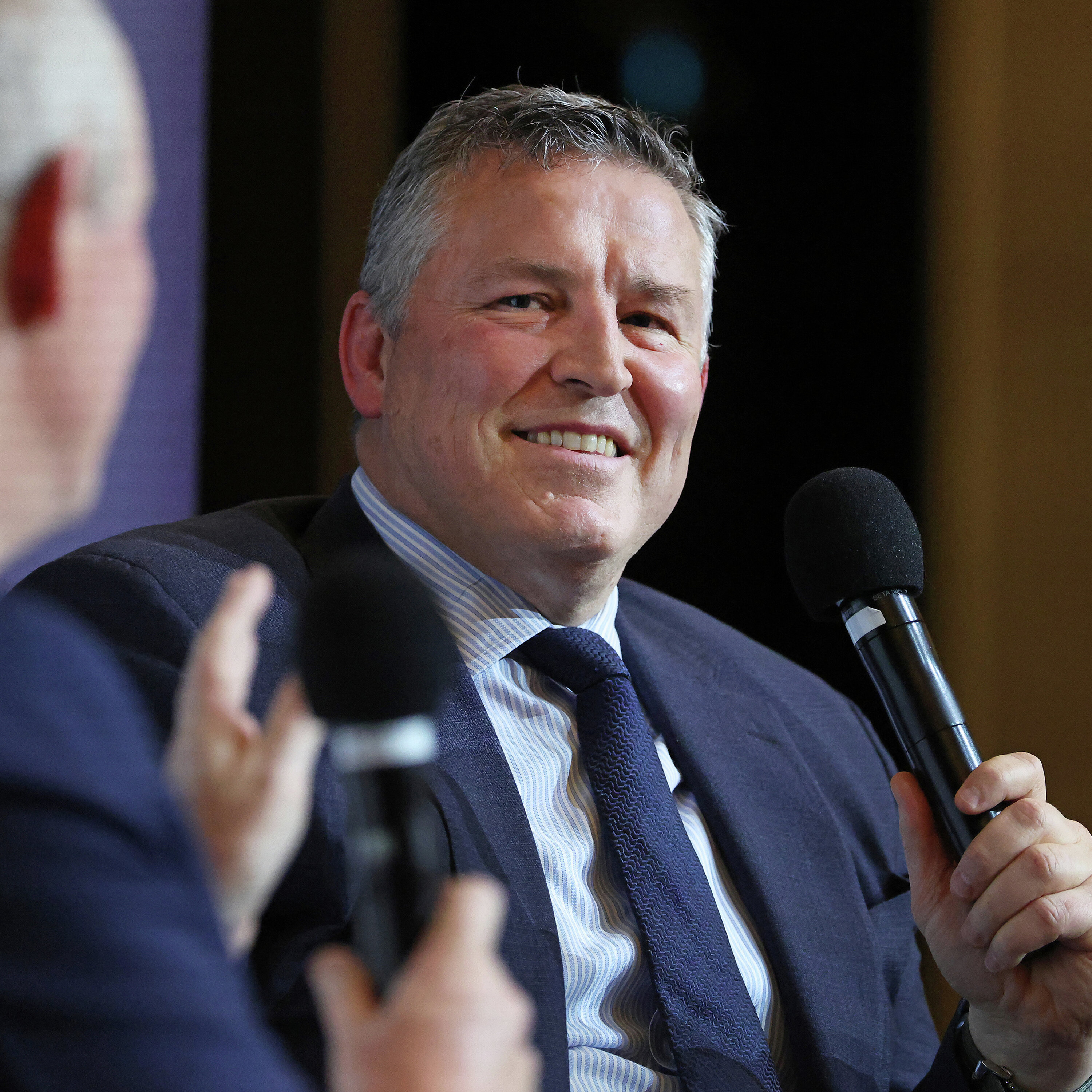
We Ask Westpac’s CEO About Interest Rates, AI and WFH
Episode Transcript
Hello.
I'm Rebecca Jones, and this is the Bloomberg Australia podcast, where every week we go behind the headlines and into the stories shaping Australia's place in global business.
Westpac published its full year numbers on Monday, and while not without headwinds, there are signs of stability and strategic momentum.
So how is Westpac navigating margin pressures, consumer sentiment and a very competitive landscape.
Bloomberg Finance editor Adam Haig is here with me now, and we're asking all of these questions to the person in charge, Westpac's Chief executive Officer, Anthony Miller.
Good day, Anthony, thank you for joining.
Speaker 2Us, Thanks for having me pleasure to be here.
Speaker 1So we're speaking right after you've released Westpac's full year numbers.
A full year for west Pack and a full year for you.
You started in this role in December twenty twenty four, Anthony, what's been the biggest challenge of this first year in the hot seat?
Speaker 2Look, I would say that there's certainly been challenges, but it's been so enjoyable and in many ways more enjoyable than I thought it would be in my first year.
So that's sort of one thing I'd like to share with you, I mean, the other thing that sort of has stood out to me is I spent a lot of the year really making sure I've got the leadership team in place and I've got the right people in the right seats to allow us to execute our plan over the next three to four years.
And so I was really satisfied with how that's come together this year.
And I think we've got a great team executive team and a great leadership team across the bank now, which she's really sort of exciting and quite invigrating, I mean.
And the only thing that sort of surprised me in the first year, and again I thought I'd thought this through properly and I had waited it appropriately, was how many demands would become at me and how much time I would spend outside of, if you will, day to day bank leadership, day to day bank management, in terms of listening to and engaging with external stakeholder you know, whether that be regulatory, whether that be community leaders, you know, clearly political leaders, etc.
It's amazing how many do want to engage with the bank.
And that's an important responsibility which I knew coming into the role.
I just didn't realize how much time I would end up spending on that.
So that's been a little bit of a surprise over the last twelve months.
Speaker 1And looking forward, you know, from where you see it, which parts of the economy is showing the strongest momentum right now, and where does Westpac see growth potential, say over the next year or two.
Speaker 2Yeah, certainly over the last twelve months, you know what we saw in terms of growth in our institutional business seventeen percent growth in the loan book there, in particular in infrastructure, natural resources, energy.
You know, the transition is large and is a real opportunity for the country and so we've been very active in that.
Were the largest renewables lender, certainly also in natural resources in terms of rare earths and critical minerals.
We've been quite excited by that potential and that opportunity and we've started to realize that in the last six months in particular, and there's a lot more I think going forward there.
And then the other I suppose area that's been really pleasing is our commercial bank, which is sort of, if you will, not the large institutional business in Australia, but sort of mid sized entities and some of the growth that we've seen there has been very exciting.
And in that space we have our agricultural business and so growth in the agricultural sector over the last twelve months has again been really positive.
And Australia's one of its real comparative advantages is the quality of its agricultural industry and cattle, sheep, dairy, wheat, etc.
All the grains.
We have a real comparative and advantage there as a country and we've been very actively supporting the growth in that space as well.
So that's been really encouraging.
There's certainly been some really pleasing growth in a few areas, small business areas, but that's been a little harder in the last twelve months.
You know, clearly it's still a difficult environment and we're only just starting to see small businesses emerge and be a little bit more active now.
Speaker 3And Anthony, what about for households.
It's a pretty tough environment for a lot of Australians.
Still, energy costs are going up, many families doing it tough.
Do you expect the Reserve Bank of Australia to put a pause on rates at this point?
And what are your expectations for how this impacts profitability at West back from here.
Speaker 2Yeah, look, I think certainly, you know, there's been a cost of living challenge in What we would say is that the data is telling us that the pig challenges and stress for consumer.
We saw that in sort of sort of June through to September in twenty twenty four.
Since then, all of those indicators of that stress and challenge have continued to improve.
So ninety day plus delinquencies in mortgages continues to reduce, stress levels in the book continue to reduce, and so the evidence is that that community, the consumer community has navigated it so far has not to be little or demean the fact that it's still hardgoing.
But we certainly are seeing more positive sentiment in the consumer sector.
And only recently, you know, our analytics team highlighted the increase in consumer spend on credit cards was up six point five percent, which was the highest lift we've seen for a couple of years, and so that was encouraging.
Having said that, sentiments, so if you will impacted by headlines, impacted by the outlooked for rates, and I think we just need to see how the next couple of months go in light of the fact that, in light of those inflation numbers we saw last week, it does feel unlikely that the Reserve Bank or cut interest rates in November, and so therefore, as a result, that might have a little bit of a negative impact on consumer of confidence and sentiment.
But we're also coming into that part of the year where there's a natural seasonal uplifting spend and behavior as people sort of try to enjoy the end of year environment.
So how will that play out is something that we're watching quite closely.
But you know, I would say that, you know, what also sort of continues to come through is the resilience and the sort of conservative and thoughtful way Australians navigate challenging situations.
Their resilience is quite remarkable, and so for example, eighty five percent of all the mortgages that the main people are ahead on their payments, so they've got buffer on their payments and so therefore they're in a good position if things were to return to a slightly more challenging setting.
But sort of wrap that My commentary up there on that is that it does and is looking a little bit more positive than their headlines.
But gee, it's month to month at the moment, and we'll see how things play out over the next three months.
Speaker 3And that certainly does sound, you know, with a positive undertone from you But within, are there any pressure points that we should just look out for where things are just a little bit poorer?
Speaker 2Look, I think, Look, there's always, there's always, you know, perhaps a region that's a little more challenged than than others, Certain sectors a little bit more challenged, you know, where we're certainly seen in the discretionary end in small business, you know, cafes, restaurants is a little harder than and than it has been for a while.
And so you know, we're just remaining vigilant on that.
I would like to think that you know, with the recent uplifting spin that that's indicating to us that people feel like the worst of it is behind them.
But there is no doubt that people are highly attuned to the interest rate outlook and the sentiment that follows from you know, an uncertainty about whether in straits will go up, stay the same, or go down is quite impactful.
So it's one that we remain I suppose vigilant on.
And then the only other you know, perhaps call out is that with the recent increase in private investment private sector activity, that's a little bit of a positive sign that at last, the private sector is going to take the lead on in driving investment in Australia, driving activity, which is really important because that's the right kind of growth we want if we are going to grow jobs and grow productivity, and hopefully that takes the lead and takes the burden away from the public sector in terms of driving growth going forward.
Only other thing I just call out against around you know what to keep an eye on is we are forecasting an increase in house prices over the next twelve months, and obviously that represents a challenge for people wanting to enter the market.
But it's also important to give weight to the following, which is two thirds of Australian households either own their house outright or are paying off their house and so therefore the wealth effect of an increase in their house price is impactful.
The sense that they are getting ahead and the sense that as they pay off their mortgage, the value and the wealth creation is going in the right direction for them with an increase in their house price is a very important signal and shouldn't be if you will deweighted when we think about, you know, what's happening in the Australian economy.
Speaker 3Now, Anthony.
And one other element is this working from home and the the discussion around around hy hybrid work and where things go from here.
We've seen your coeoper over and zad Nunomatos making some quite definitive moves to get staff back in the office more.
I mean the big four banks altogether in eloy tens of thousands of Australians.
But what have been your guiding principles around the decision of where your staff do they work?
Speaker 2Yeah, so look, our goal is to be the employer of choice, you know, where the best want to come and get a chance to be the best every day.
So that's sort of, you know, a starting premise.
The second point I'd like to sort of draw out is that you know, we've been very focused on making sure where is flexible, as practical, as flexible as possible that we can be.
And I would say that we think we've got the balance right.
Our policy is two to three days a week in the office we think is the right balance.
And I would say that actually what we then also really focus on is we want outcomes.
So if you're going to work at Westpac, what's really important is that you deliver outcomes.
And we can therefore be flexible and rational around what is the combination of work from home work in the office, But we do need to anchor it around the fact that we need outcomes, and I think everyone is really embraced that west Pac, and I'm really pleased with the engagement levels we've got from our employees, the engagement scores we're seeing, which highlight I think we're close to getting it right than not.
And so it's two to three days in the office is what we're working towards and challenging everyone to deliver on.
But everyone has to deliver outcomes no matter what arrangement they have.
And then the other other point I just sort of leave you with, which again comes back to something that I think is really important.
We want to when we think of ourselves at Westpac as a team, whether it be the executive team I'm working with, the leadership group, but the broader thirty five thousand people at west Pac and a number of our team and it's our magnificent branch staff.
They're in the office five days a week, they have to work Monday morning through to Friday afternoon in branch operations around the country, and their presence and their activity levels drive a lot of business into the bank.
And so therefore, if we are going to be one team, everyone needs to be sensitive that they can't just arrive with an expectation or a sense of entitlement that there only need to be in the office one or two or three days a week when we've got others who commit five days every week.
And so I'm working really hard and we're working really hard as a bank to make sure we get a balance that's right, because what we want to be is a team that delivers and delivers outcomes.
Speaker 1I want to change tech now and ask you a little bit about AI technologies, Anthony.
You know, it's not unique that businesses, you know, including of course banks, are using AI to better understand to service to target their customers' needs.
But you know one thing that's possibly more urgent than this mass adoption that we're seeing of AI is protection from it, especially when we're thinking about the increasing amount of financial scammers.
We know you've got Lewis Hujana, the former chief Digital officer from a Quarie starting in January on that how are you approaching this from a resourcing standpoint that you know that balance between wanting to leverage AI technology and being one step ahead of the bad guys.
Speaker 2Well, we delighted Lewis's joining us.
You know, I've had that privilege to get to know Lewis over the last few months, and he starts in generally very excited with what he is going to help us achieve.
That we's back the way we're thinking about AI sort of and just give me for sending a little bit of context here.
The use of artificial intelligence and tools such as machine learning, artificial intelligence and now generative AI moving into urgentic AI programs.
It's sort of a journey that we've been on in many companies have been on, and certainly we think it's it's got an exceptional amount of application that we think is going to make a big difference.
There is a lot of hype, though, and so the question for us is making sure that as we go about this, we do it in a way that we think delivers you delivers tangible outcomes for our customers, our employees, and for our shareholders.
And the way I set it up was I didn't think it was something that should stay within the technology division, that in fact, AI is a tool for every employee in the company, and in fact it is a way of thinking about how we do our job in the future differently, and so therefore it needs to be an enterprise wide approach.
And so therefore I appointed doctor Andrew McMahon, who's like global thought leader in the space, to look after digital data, data analytics and AI for the company reporting to me, because I want this to be an enterprise wide approach, and so therefore the way we're going about it is that this is a tool that in the hands of our people, if they're properly trained and properly invested in, can help them do their job better, faster, more consistently.
It can also take away from them the mundane and perhaps the less enjoyable aspects of their roles, but it also can ensure that they can be better and they can do more interesting things.
And so we're quite excited about that.
But it revolves us investing in AI, but also investing in people alongside it at the same time, in their training, in their development, in the investment in their leaders and how they If you will challenge their challenge their teams to use it.
And then the last thing I'd say about it is is that one of the real opportunities that things like a generative AI or an agentic AI program or opportunity throws at you is it asks you to think about how you do your job differently.
Is there a different way, a better way in which I can get the job done that I need to get done, And how is it then that I take a step back and think about can I change the process to allow an agentic program to do a lot of the steps for me and I interstep whatever it is needed at the start or in the middle at the end.
But more importantly, I'm not in the middle of everything as we progress a product or service to our customers.
So one of therefore the real challenges is to have a workforce that feels motivated, inspired, remunerated to think openly about can I do my job differently and can I use this tool to help me go about doing my job differently to drive faster, better, more consistent, more cheaper outcomes.
And then of course there's lots of things where we feel like the properly constructed agentic program can do a lot of high quality work, helping customers quickly get through a lot of the mundane tasks they need to get through and then arrive at that moment where they need to speak to or want to speak to one of our bankers.
But all of the mundane challenging, you know, just hard work has been sorted and therefore it's a much more constructive value added discussion between our banker and the customer at that particular point in time.
And so it's again something that helps us do it better for our employees or helps us do it better for our customers, is the way we're thinking about it.
Speaker 1And what about the more nefarious uses of AI?
Is the overarching goal of the training to skill Westpac staff to be critical of that as well, Like if something doesn't smell quite right, they'll know what to do.
Speaker 2That's exactly right.
I think that's formative for everybody at the moment.
Is how do we, if you will, train and coach our people in relation to this tool and its potential application for their various reasons.
We certainly in what I'd almost describe as an arms race in the financial crime landscape and the cyber security landscape where external challenges are coming at us, if you will, empowered by amplified by AI genteic otherwise programs in the hands of bad actors, and we're therefore having to invest in our defense mechanisms with similar tools and skills to be able to meet it.
And so it's effect be an arms raised in terms of AGENTIC or call a generative AI capability in terms of fraud and scams for example, and so we're using that to to help our Scams Center, you know, navigate challenges.
We're also using it to help us with our fraud and financial crime and if you want money laundering assessments.
It's really a powerful tool to help us get through a lot of information very quickly and process it very quickly, which allows us to keep up with the very high level and high frequency of activity that we see from obviously external characters.
Speaker 3And so, Anthony, as you head into your second year at the HELM, just reflecting on those comments at the start of this conversation about some of those surprises around what's taking up your time and some of those external commitments with regulators and politicians and other actors.
How do you see the next twelve months and what are you really excited about over the following.
Speaker 2Yeah, Yeah, I'm really excited about the fact that I've got the team together, and we've got an outstanding team.
We've got the right people in the right seats with the right skills, and we've got a clear plan of what we've got to go after over the next twelve months.
And so I'm quite invigorated by just getting into the execution of our plan and really getting after all the things that I know, if we deliver on, we'll just transform this bank, you liberate and really invigorate its performance.
So I'm quite energized by that.
And then also i'm far more if you will, reflective of, and I suppose honored by the role the bank plays in the community.
And so as I learned and engaged with all of those external stakeholders over the last twelve months, much more than I anticipated, I'm now much better and I think much more ready to really take on that responsibility and work with community, because the simple fact is is this bank's success is inextricably linked to us, this success and community success, and if you will, satisfaction with what we're doing, and so therefore working on that and working harder on that to make sure you know we deliver and people feel like we're listening and responding is a really important part of the role that I'm pretty pretty keen to make sure I deliver on in the next twelve months.
And I think I can deliver on with the pretty formidable team that I've now got around me.
Speaker 1Anthony Miller.
Thank you for joining us.
Speaker 2Thank you for having me.
Speaker 1If you found today's conversation insightful, be sure to follow the Bloomberg Australia Podcast wherever you listen, and check for more reading on Westpac Australia's banking sector and the latest reporting from Adam Hague on Bloomberg dot com.
This episode was recorded on the traditional lands of the Wandery and Gadigil people.
It was produced by Paul Allen and edited by Ainsley Chandler.
I'm Rebecca Jones and I'll see you next week.