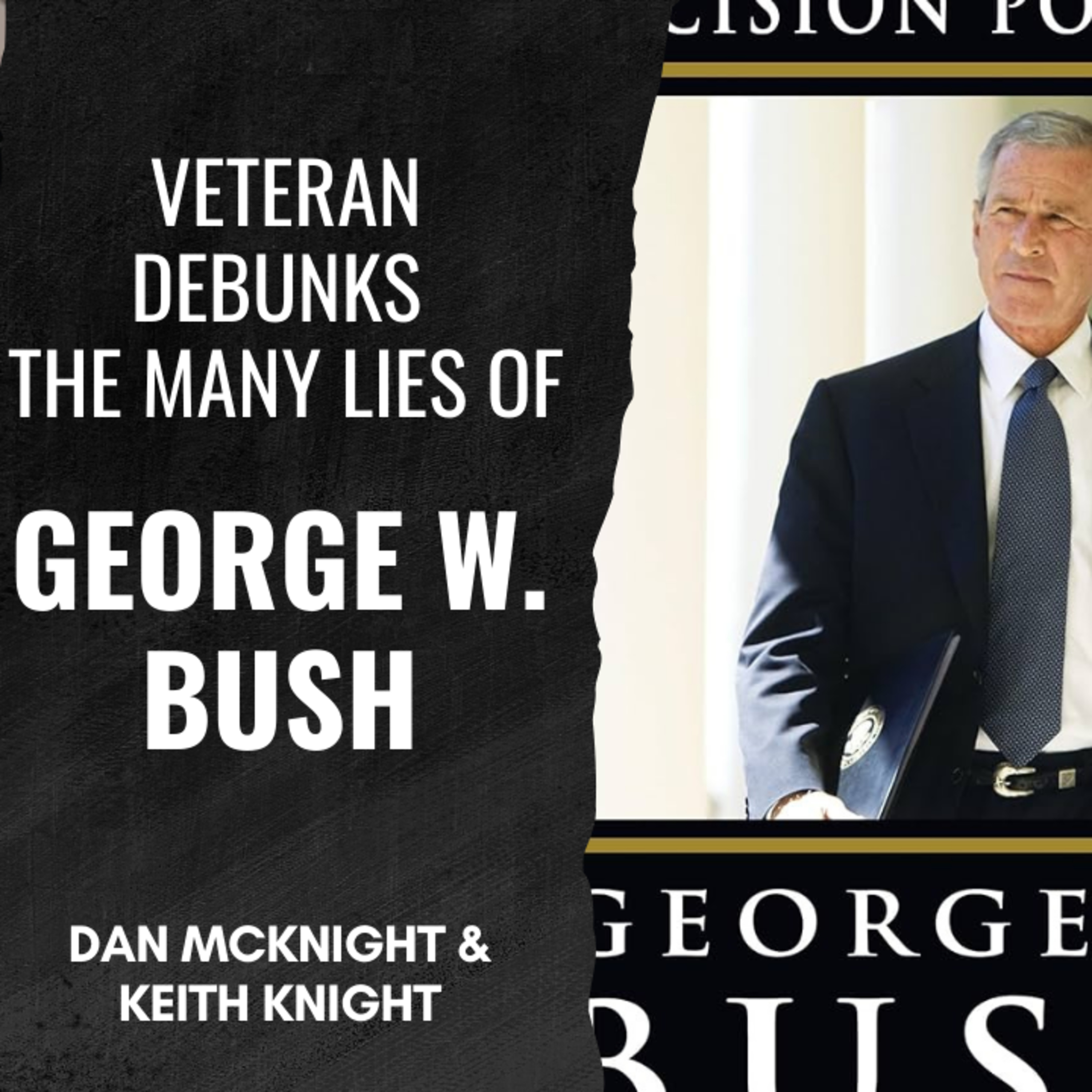
Even the War in Afghanistan Was Unnecessary. Dan McKnight & Keith Knight
Episode Transcript
Welcome to Keith Knight.
Don't try to on anyone and the Libertarian Institute.
Today I'm joined by Dan McKnight from Defend the Guard.
Mr.
McKnight, where is the best place for people to find the Defend the Guard project and what you're currently working on?
Absolutely www.defendtheguard.usisthewebsite where you can find out everything about the project.
But if you want real time updates it's at Troops Home US on Twitter.
I don't know about the other socials, that's the only one that really matters.
What is the primary goal or objective that Defend the Guard is seeking to implement?
Yeah.
So Defend the Guard is a a project of our organization called Bring Our Troops Home.
We are a group of Global War on Terror veterans who came home from the war disillusioned, pissed off and decided we were going to try and do something about it.
And we went to Washington, DC and tried to influence our legislators and our congressmen and our senators to just, I don't know, give peace a chance.
And they laughed us out of the room.
And so we returned to the states to fight a more favorable ground where we could.
We could fight in Boise instead of DC or Bismarck instead of the swamps around Northern Virginia.
And we came up with this idea that we found it was actually had been out there for a while.
We modified it and grew it called Defend the Guard.
And the National Guard makes up about 50% of the United States military's total fighting force.
And we thought if we could find a way for the states individually to be able to restrict their National Guard from being called into federal service, if the purpose is to fight in overseas undeclared wars, that would be a better fight than going to Washington, DC, and trying to fight against all the military industrial complex lobby money.
And so the bill essentially says that if the law were to pass in Tennessee, but the Tennessee National Guard would not be released in the federal service unless Congress declared war, if the purpose was to go overseas for combat.
And surprisingly, after studying this and getting really deep into it and talking to constitutional scholars and attorneys, it's already the law of the land.
It's already the federal law.
It's already the Constitution already says these things, but they ignore it.
So instead of trying to get them to enforce and follow federal law that's already there, we were given the states a cudgel, a a club, a a wedge, a time out.
It just says, hey, before you take our sons and daughters to go to Syria, like the Iowa National Guard dealt with this weekend, you're going to declare war or you're not taking them.
And that's what the bill is.
That is an excellent check and balance.
I want to get to some of your personal background and ideological background.
I was hoping we could do this by me referencing the general narrative that 3 presidents who have dealt with the War on Terror or military conflicts in the Middle East, I'm going to read a section from their memoirs and you give me your general response.
Here is here is President Clinton in 1998, he said the Middle East move toward crisis as Prime Minister netanyahu's government, which still had not completed the overdue opening of the Gaza airport or provided safe passage between Gaza and the West Bank, put the entire peace process in danger by voting to keep control of the West Bank indefinitely.
The United States was the full, with the full integration with NATO of Estonia, Lithuania and Latvia into NATO and other multilateral institutions.
So I, I had to cut some parts out there.
But the main thing Clinton's working on issues with peace in the Middle East regarding Netanyahu's government even at the time in 1998 and NATO expansion.
When it comes to these issues, how is it that you analyze them?
What are the costs and benefits?
Why is it that for 30 years we've been dealing with the issues in the Israeli government?
Why is there such there seems to be such a stranglehold on U.S.
Politicians Thoughts on Clinton's administration with regard to the Middle East and NATO expansion.
Boy, I love it.
You just threw the third rail right out there in the front.
So let's let's address it.
Our, our organization is non political.
However, we believe in an America first foreign policy.
And so I'm going to answer both questions about NATO and Israel with the same answer, that we do not believe in entangling alliances.
We think that America should look inward first.
We should be a shining example to the world.
We should be friends with all.
We should wish all well.
And we should not interfere in their business, just like we wouldn't want them to interfere in ours.
So around the turn of the century, after World War One, there was a group of senators called the Incorrigibles and they they fought United States entry into the League of Nations.
That's us.
That's what we believe.
We believe that we should be defending our borders, protecting our interests, protecting American lives and anything that's going on in the Middle East, we recognize that if we break it, we own it.
So let's just stay out of there.
Let's just deal with American issues 1st.
And that keeps us out of all the political narratives.
You know, the Israel fight.
No matter what you say, no matter what side you come down on, no matter how reasoned you are, no matter how principled you are, half of your base is gone as soon as you open your mouth on it.
And because we are a nonpartisan organization, we work with far left and far right and mainstream.
We try to stay out of the issues that are most divisive by being principled.
We have held Trump accountable.
We held Biden accountable.
We held Obama accountable.
And we think George W Bush is the most evil man ever to serve in the president of the United States.
So we we come down on all sides, but our core principles are the same.
No entangled alliances.
America First.
And by the way, America First dominates MAGA all day long.
They're not even the same.
MAGA is a domestic issue.
America First is outward looking in.
We believe that if it doesn't benefit America First, we shouldn't be involved.
And glad you set me up for the President Bush section of this talk, he said in his book Decision Points.
Removing Al Qaeda safe haven in Afghanistan was essential to protecting the American people.
We had planned the mission carefully.
We were acting out of necessity and self-defense, not revenge.
History can debate the decisions I made, the policies I chose, and the tools I left behind, but there can be no debate about 1 fact.
After the nightmare of September 11th, America went 7 1/2 years without another successful terrorist attack on our soil.
If I had to summarize my most meaningful accomplishment as President in one sentence, that would be it.
Response to President Bush.
President Bush's most meaningful contribution to United States was his cultural reference when he was portrayed on Saturday Night Live.
With things like strategory.
That's the best thing he ever gave us.
President George W Bush lied us into war with his sidekick.
Let me change that.
Dick Cheney lied us into war with his sidekick George W Bush, right there carrying his water.
Afghanistan.
We went there for four purposes.
Congress gave authorization, which is a, a vague, vague term to the president to capture or kill anybody that attacked us on 9/11, capture or kill anybody that aided or planned the attacks, to destroy the terror training camps and to find Osama bin Laden and cut his head off.
All of those things were done or would have been done by February of 2002.
And by 2003, we were already looking at another war.
They tied Iraq to Afghanistan.
They tied Afghanistan to 911.
Therefore, ipso facto, Iraq equals 911.
And the American public bought into it hook, line and sinker.
And so I think that George W Bush, he he's so wrong when he says his greatest contribution was his decision to protect America, because in 2003, he asked in a briefing with the Department of Defense who's in charge in Afghanistan.
And when they told him that it was General McNeil, he said, who the Hell's that?
He didn't even know who his commanding general was in Afghanistan.
And if you don't believe me, it's in the Afghanistan papers that the Washington Post broke loose about five years ago.
George W Bush had no idea what was going on.
He was not a foreign policy guy.
He was not a thinker, which is why he had to have Dick Cheney, which is why he had to have Doug Addington and why he had to have the Office of Special Planning.
And all those things had to be there parallel next to him, because George W Bush knew nothing of foreign policy.
Was this a case of the original war aims deviating from what the goal eventually became?
In other words, was it we're going there to go after al Qaeda and then after some time it was, well, we're actually here to make sure that girls can go to school and we actually need regime change against the Taliban, who were Al Qaeda's landlords.
Was this a bait and switch or was it Taliban regime change from the get go?
I'll tell you when I, I was there in 2005, 2006 and 2007 in the in that 18 month span that I was there, we went from these are the strategies that we, we, we were fell under shock and awe.
I think we all remember that one.
That was the big headline shock, and we're going to bomb the hell out of them, put them back in the Stone Age to winning hearts and minds, to provincial Reconstruction, to securing free and fair elections, to counterinsurgency, the Building Schools, roads and wells, to winning the hearts and minds.
Again, that was in the 18 months I was there.
So yes, it was a bait and switch, but not because I think President Bush had this idea that we needed to keep changing these things because nobody was responsible for it, nobody owned it.
When you give an authorization of use of military force to the president, you're taking the decision of war out of the hands of the people.
We're supposed to have it, which is Congress.
They're there with our authority, the authority of the people.
And when you give him the ability to go to war for any length of time, for any purpose against any enemy he declares as a threat, this is what happens.
Because all of a sudden Afghanistan seems like it's under control.
Hey, let's get back to daddy's war.
Let's focus on Iraq because everybody in his cabinet wanted Iraq.
They wanted the March to Baghdad since 1990, and they were going to get it one way or another.
And they tied al Qaeda in Afghanistan to Saddam Hussein in Iraq.
Poland.
Powell went to the UN and lied about it, and America bought it.
And we went into war in Iraq based on false pretenses.
So yeah, I think it was bait and switch, but it wasn't intentional on the president's part because he he's not smart enough to have that kind of intention.
When was it that President Bush was asked by, I believe, a member of the press, you know, what is the update on the operation to kidnap bin Laden, bring him to trial or have him executed?
And Bush said something to the effect that he wasn't really concerned about bin Laden.
I'm sorry.
This is just coming to me now.
I would have gotten the exact quote ahead of time.
Do you remember this?
If So, what were your thoughts at the time and what was the general feeling in the military?
You know, I, I, it was during that same period that I was in Afghanistan.
And when we first got there, we participate in this Operation Mountain Lion.
It was a massive offensive operation designed to drive the Taliban to the Pakistani border where we would swoop them all up and kill them all.
We had Osama bin Laden, we knew it.
We could hear his telephone transmissions.
We could hear his radio.
We knew where he was at.
And there's a great story that's told in a book called Jawbreaker by Bernstein.
I can't remember his first name.
He was the CIA commander on the ground.
He said, we've got him, we've got him on the run.
We know where he's at.
I just need 100 Rangers, 100 Rangers who blocked the the the border and the Pentagon.
Instead of sending 100 Rangers, they sent 100 local Afghan military men.
And if you've seen the videos of the Afghan military trying to do jumping jacks or do physical training, they're not the best fighters in the world.
Some are loyal, some aren't, Some can be bought, some can't.
But he sent them to secure the border and have the back end in the side flank.
And somehow Osama bin Laden just walked through unmolested.
So was he worried about getting Osama bin Laden?
I think it was purposeful.
I think it was intentional.
Because if you got Osama bin Laden, there's no justification for the war to continue.
And if the war doesn't continue in Afghanistan, the White House didn't have the moral clarity.
They didn't have the the the presence that they needed for the American people to cover for the war in Iraq.
You had to have the moral war to fight the immoral 1.
And killing Osama bin Laden would have ended that.
Bush talks about the meeting that he had with George Tennant with Paul Wolfowitz and Dick Cheney.
Here are some excerpts from his memoirs.
George Tennant warned that right after 911.
George Tennant warned that a retaliatory strike on our homeland was likely.
Quote, we can't deter them if they've already planned a second round.
I expect they have some chemical and biological weapons, he added.
Dick Cheney worried that the war could spill over into Pakistan, causing the government to lose control of the country and potentially its nuclear arsenal.
Deputy Secretary of Deputy Defense Secretary Paul Wolfowitz suggested that we consider confronting Iraq as well as the Taliban.
Before 9/11, Saddam Hussein's brutal dictatorship was widely considered the most dangerous country in the world.
The regime had a long record of supporting terrorism, including paying the families of Palestinian suicide bombers.
Donald Rumsfeld said dealing with Iraq would show a major commitment to anti terrorism.
Colon cautioned against it.
Going after Iraq now would be viewed as a bait and switch.
George Tennant agreed.
Don't hit now, it would be a mistake.
He said the first targets need to be al Qaeda.
Dick Cheney understood the threat of Saddam Hussein and believed we had to address it.
Quote.
But now is not a good time to do it.
We would lose our momentum.
Right now people have to choose between the United States and the bad guys.
Why did they end up going into Iraq?
What was the motive?
Well, Wolfowitz was a busy bee from 1991 until 2003.
That man wanted Iraq more than anybody else in the world.
And Dick Cheney was right there along with him.
See, Dick Cheney and Wolfowitz and Bolton and all of the that cast of characters, they came up together.
They came through the Ford administration.
They thought that the president had been weakened by the Church Committee hearings by Iran Contra.
They thought that all matters of National Defense and and war making should be in the executive branch exclusively.
And they spent time, they created the the PNAC of the the period for New American.
I'm drawing a blank here, sorry.
Project for a new American.
Century, thank you.
They created them as a way to be a think tank, to write policy papers to promote this unitary executive theory that the president is absolute.
The president has all the authority, all of the power, all the control when it comes to war making and defense.
And so I think Wolfowitz, in fact, we know this.
On Wolfowitz, the afternoon of 911, he was already already bringing up Iraq as a possible target after the attacks on 9/11.
At 2:40 in the afternoon, six hours after the first plane hit Dom Rumsfeld, Secretary of Defense Donald Rumsfeld, who by the way was Cheney's mentor in the Ford administration, scribbles in his notes, Is this good enough to hit SH Saddam Hussein as well as UBL 6 hours after the planes hit the tower?
They were planning Iraq long before the towers.
And I'm not going to get into some wild conspiracy theory thinking that Dick Cheney and Don Rumsfeld caused 911 or planned 911 or secretly had a hand in.
I'm not going to even go down that path.
But the fact that they used it as a catapult to push us into Iraq is bad enough.
And that alone should make every American's blood boil.
So I don't think it was Wolfowitz or anybody that just woke up on 9/11 and they were converted into this America defense.
We have to be this empire that has to go crush terrorism around the world.
No, they were just looking for a reason.
This was the new Pearl Harbor that they needed, that they wrote about in their last policy paper that they released before PNAC was disbanded.
How did Rumsfeld know at 2:40 PM that day that it was bin Laden that was behind this?
I, I, I, that's a good question.
You know, I don't even know how that came out.
I know that for the 1st 8 hours, President Bush was in a plane flying around, bouncing from military base to military base, hiding from the next threat, while Dick Cheney was in the, the bunker underneath the White House leading the country.
And he was there with Wolfowitz, he was there with Rumsfeld, he was there with Colin Powell, he was there with Condi Rice.
While George W Bush was being hidden from public.
Dick Cheney was already putting things together, putting things in place, been giving them an order to shoot down US domestic aircraft.
Dick Cheney already wanted Iraq, they already wanted Saddam Hussein.
They knew that Osama bin Laden was the bad guy, that everybody knew because of the World Trade Center towers of the bombing that had happened in the early 90s.
I think it was an easy sell.
I think it was an assumption.
I think intelligence already knew that Osama bin Laden was involved.
But how they knew specifically, I I haven't dug that deep into it.
I think it was just a foregone conclusion.
Well, I suspect it was very convenient because in, gosh, I want to say 96 or maybe 99, Bin Laden was interviewed by CNN and he explicitly said, yeah, This is why we're at war with Americans.
They're colluding with King Fahd in Saudi Arabia to occupy the land of the two sanctuaries.
They're supporting the Israelis when they kill innocent people in Lebanon.
They've sanctioned Iraq.
And so it they had that as a potential outlet, but I was just curious as to what evidence did they have at the time, because maybe it was Muhammad Atta just going rogue and he was just the commander in chief of an operation that was never greenlit by bin Laden.
I'm sure if you want to keep these things under wraps, you can't exactly be telling everyone every aspect of the operation.
So I was curious, if you just knew, how did they know it was Bin Laden the day of, but suppliers?
Anyway, got to remember when the towers collapsed, the CIA mysteriously found a passport at the bottom of the rubble pile, right?
Everybody else burned up.
The metal was so hot it melted, but a passport happened to be laying there unharmed.
So again, we're going to get into my, my favorite place to go, which is the tinfoil hats.
But I can't put them on right now because I am so focused on the mission that I can't go down those paths.
It's bad enough the stuff that we can prove.
And if we focus on that, America would never let this happen again.
We would never give up our control and our authority to people like Dick Cheney, George W Bush, Bill Clinton, Barack Obama.
We can go down the list on and on and on.
So Bush ends the Afghanistan section by saying I laid out an ultimatum to the Taliban.
They will hand over the terrorists or they will share their fate.
We have little hope that Afghanistan's leaders would heed it, but exposing their defiance to the world would firm up our justification for a military strike.
Do you think the war in Afghanistan could have been avoided?
Sure.
I think the Taliban offered to hand over every al Qaeda member that they had in their control.
They begged us not to come.
They begged us.
They said we'll give you everybody, Osama bin Laden, the whole crew.
You can have them all.
They didn't want them because they were naturally not compliant.
They were naturally not allies.
It could have been avoided.
That's if you look at it from
99:11 until 10/17 or 10/7 when we actually invaded.
But if you look before 9/11, it could have been avoided by simply minding our own damn business and staying home and focusing on America first and staying out of other people's business.
Staying out of these entangled alliances.
But building the empire we were.
We were spreading our military in over 100 countries with 700 bases.
Blame them for being a little upset at us.
I'm not going to blame America for 911, but I get it.
I understand the rationale.
We could have done a lot better if we just stayed home and taking care of the homeless guy that's on the subway when I get off in Washington, DC, walking to the Capitol building that I have to step over.
Let's take care of things at home and we'll worry about the outside later.
But the short answer to that is, yeah, it could have been avoided.
Yeah, when I see things like attempts to justify, you know, intervention in Syria, Libya, Yemen, Somalia, those don't really hit home.
But the average person thinks, well, everyone knows we had to go into Afghanistan after 911, but Iraq was the mistake.
If it turns out, as Scott Horton, you know, shows almost conclusively in Fool's Errant time to end the war in Afghanistan, it the crown jewel of the War on Terror, the Afghanistan war, the necessary war.
Turns out that this one could have been avoided also because Bush's whole thing, part of the official story of 911 is Bush coming out September 20th, 2001 and saying Americans are asking why they hate us.
They hate what they see in this chamber right here, a democratically elected government.
Their leaders are self appointed.
They hate our freedom to vote, our freedom of speech, and our freedom to disagree with each other.
That indicates that the official story of 911 is based on a complete lie.
When the president lies about the motives behind the attacks, that's part of the official record.
That means the official story is a lie.
Anything else?
That there's one Iraq section that I want to go after.
Anything else on Afghanistan?
The necessary war that everyone agrees we had to go fight him.
I think, I think George W Bush, in addition to that comment you made about his address to the to Congress in September of 2001, I think the, the, the line that sticks in everybody's head that set the stage, created the buy in, poured the kool-aid, shoved it down our throat for Iraq was either you're with us or you're with the terrorists.
And that was an Afghanistan line that was used to qualify Iraq.
That was the theme of America.
Hey, we're bound together.
We are now Americans.
They attacked us and we're going to go get all of those brown people in the Middle East.
And that was kind of the the emphasis that President Bush used, thinking his rationale.
It wasn't deep.
It was just connect the dots.
And all the dots happened to be in one section of the world.
And so we connected them all with his crayon.
And off we go to fight these wars without any authorization.
That's the danger of putting the decision to go to war in the hands of a dunce.
We we screwed up.
And it's our fault as the citizens of this country that we allowed our congressmen and our senators to willingly abdicate the responsibility for 70 years.
It's on us.
I forget who I'm stealing this line from, but I apologize in advance.
It was someone who said, you know, there's an important connection between Iraq, Iran and North Korea.
They all have nothing to do with al Qaeda.
Other than that, there's no connection between these.
Threats.
I've heard Dave Smith repeat it, but I don't know if it's his line originally or not.
So Bush attempts to summarize the justification for Iraq.
It's under the umbrella of his historical worldview that in retrospect, you can't really judge things accurately.
You have to look at the information you had at the time, he says.
The moment hit me.
For more than a year, I had tried to address the threat from Saddam Hussein without war.
We had rallied an international coalition to pressure him to come clean about his weapons of mass destructions program.
We had obtained a unanimous United Nations Security Council resolution making it clear there would be serious consequences for continued defiance.
We had reached out to Arab nations about taking Saddam into exile.
I had given Saddam and his sons 48 hours to avoid the war.
The dictator rejected every opportunity.
The only logical conclusion was that he had something to hide, something so important that he was willing to go to war for it.
That's the steel man for going to war in Iraq.
How do you respond?
Well, first of all, Saddam Hussein didn't do everything he could to to push the war.
He opened his borders to inspectors.
He complied with the UN.
Was it 1441, the resolution 1441?
They, they called for additional sanctions and, and inspections.
But beyond that, let's go back to what Don Rumsfeld said leading up to the war.
He said when somebody asked him, is, is it true that there's no connection between al Qaeda and the terrorists?
He said there's known, there's things that we know that we know.
There's things that we know that we don't know.
And then there's things that we don't know that we don't know.
And it's that last part that things that we don't know, that we don't know.
That's our justification for going to war because it's the hardest to prove.
And the absence of proof is the is not the, excuse me, the absence of evidence is not the evidence of absence.
What kind of an argument is that?
That that is saying that the negative now proves the point.
We didn't find weapons of mass destruction.
That means they're very clever, right?
He didn't, We didn't find any evidence that he was supporting the terrorists, that that means that he's really smart out covering his tracks.
We gave Don Rumsfeld, gave the America the old switcheroo and use a negative to to enforce and to prove a positive.
There's not a whole lot of love lost for me and anybody in that Bush administration except for a few people like Wilkerson, who was the chief of Stafford Cheney that said, you know what, this is all a bunch of horse crap.
I wish I was never involved in this.
It was the low light of my career.
I feel bad for people like Colin Powell, who traded in all of his gravitas, all of his credit, all of his his honor to sell a lie because he didn't know how to get out of the situation.
I, I almost felt bad for George Tenet at one point because he said the intelligence isn't good enough, but he signed off on it anyway because instead of asking if the intelligence was true, he was asked, can we sell this to the American people?
And he said yes, slam dunk, right?
So he didn't, nobody asked him if it was true or accurate.
They asked him if it could be sold.
So there's people in there that have these flashes of conscience, but the rest of the administration generally, I'd say is probably some of the most evil people of the last century.
Well, Cheney said.
I want to say on Meet the Press that it's been pretty well confirmed that Mohammed Atta met with a senior intelligence official of the Iraqi military in Prague.
It seems like there's just such carelessness when it comes to reporting these things.
There's the sixteen word controversy, which George Bush calls it in his book.
He said.
All I said totally innocently was British intelligence has discovered a transfer of purchasing of yellow cake from, you know, Niger from a country in Iraq to from a country in Africa to Iraq.
I'm sorry, I'm just thinking, trying to remember this, but but it's called the 16 words And Cheney discusses this and he goes.
Unfortunately, it turns out that that was incorrect.
But President Bush didn't lie.
It was true that there was a report that came out from British intelligence.
To that extent, it's like you would think if the justification was so justified that they wouldn't have all these surrounding lies attempting to be used as a buttress to hold up this fraudulent war.
What's funny about the yellow cake in the 16 words is it was a report from British intelligence.
Page two of the same report says.
However, the source that's giving this information to us named Curve.
Curveball, I think was his code name is a drunk.
He's unreliable.
It's most certainly a lie.
We even sent a diplomat to Niger to to inspect and to investigate this themselves.
I'm forgetting who it was.
It was a Great American States and I can't remember who it was, but he went to to Nigeria.
Wilson, it was Joe Wilson.
He came back and said it's absolutely false.
We cannot believe this, but Niger and the yellow cake became one of the four reasons we went into Iraq.
The other one being the aluminum tubes.
Remember the aluminum tube scandal?
They're buying these aluminum tubes.
They must be for centrifuges, except our own Department of Energy said those are not centrifuge aluminum tubes.
They look more like irrigation, which is kind of a funny statement.
And then the other one, of course, was WMDS, poison gas and all the other reasons.
But those two Niger yellow cake and the aluminum tubes, it was just more of the same.
They picked and chose the things they wanted.
Office of Special Planning, they massaged it.
Wolfowitz was the one that kind of pushed the narrative.
Addington created the legal cover by changing the way that we we view the executive powers in the, in the separation of powers.
And the whole thing was baked into the recipe from from the moment that first plane hit the towers it was baked in.
So I was only four years old during the presidential election between Bush and Gore.
But I've seen clips of Bush saying, you know, we shouldn't be about nation building.
Is it?
Would you say it's accurate to say that President Bush ran on a less interventionist foreign policy than Al Gore in 2000?
You know, the yes, I would say he did, although I hadn't even remembered that until you brought it up, because the choices were John McCain or George Bush in the primaries.
And I think Libby Dole was the third candidate.
And I remember the, I would say the more isolationist wing of the Republican Party saying we can't have John McCain.
That guy.
There's never been a war that that guy would didn't love.
And if you think about it, I think actually the choice probably was a lot safer to choose George, George W Bush if you're if foreign policy is your big issue, because Can you imagine a Dick Cheney, John McCain ticket?
Oh my goodness, we have been marching to Moscow on on January 20th.
So all right, we vote for the less interventionist, allegedly president, and of course we get the opposite.
And then in 2008, the American people tend to do the same.
Well, the sections I have that I want to quote Obama from are a little later.
Did President Obama escalate the number of troops in Afghanistan when he came into office?
Was that were those significant amounts or was it just something he was throwing to the military industrial interests?
I think the first Obama surge, I think they more than doubled the numbers.
If I remember right, we went from 28,000 to 58,000 or something like that.
I might have that number wrong and eventually got up to over 150,000.
So yeah, he, he surged twice and he did it on the back of, of the way he ran.
Do you remember?
We're going to end the wars.
America's we're, we're, we're a peaceful nation.
I'm going to be the most peace friendly president ever to it was all garbage because soon as he got into power, he had the authority to do all of it.
And he just did one thing.
He just drone striked Americans and bombed more people than any of the other presidents that we've had in the global War on Terror.
You know, there, there is no peace president.
There isn't 1.
And I'm saying that in light of what's happening today, there is no peace president.
The last chance we had would have been maybe Buchanan and and Ron Paul.
Since then, there has not been even a peace candidate.
Tulsi Gabbard maybe, but I wouldn't say there's another one.
Yeah, it's pretty wild to think that NATO's first ever declaration of war was this operation in Afghanistan.
And now after 20 years, when the Taliban took over, how long was it between the withdrawal and the Taliban taking Kabul?
Like 10 or 11 days?
I don't.
Even think, yeah, it might have been for call, it might have been 11 days.
That's the result of NATO's first ever declaration of war and to which they say, you know what, let's let's provoke a war with Russia.
I think that's probably a good idea.
So all right, Obama talks about Syria.
In Syria, the March 2011 arrest and torture of 15 school boys who had sprayed anti government graffiti on city walls set off major protests against the Alawite Shiite dominated regime of President Bashar al-Assad in many of the countries predominantly Sunni communities.
After tear gas, water cannons, beatings and mass arrests failed to call the demonstrations, Assad's security forces went on to launch a full scale military operation across several cities, complete with live fire, tanks and house to house searches.
Was US involvement in Syria something that was justified?
I don't, I don't know how it possibly could be.
If you Fast forward just a little bit about 18 months from that point right there in the story, Obama does something honorable and we should probably stop and pause and think about this for a second.
He went to Congress and asked for Congress's permission to take the United States military into Syria.
Congress debated it.
America was war weary.
We retired after 11-12 years of war in Afghanistan and 10 years in Iraq.
And the American people said not only no, but they said hell no.
So Congress refused to give him authorization and Obama went.
He left anyone anyway.
So his moment of greatness of going to Congress and trying to do it the right way lasted for about a minute, right, just for a second.
And then he took the United States military into Syria and we've been there ever since.
And so while there is that moment of of, of, of, of spark of, of proper democracy, it it, it was fleeting.
But America, if you Fast forward even a little bit further, we fought on every side of that love triangle there in Syria, right?
We were supporting the regime.
We were supporting the rebels against the machine, machine, machine.
And we were supporting the outside interests that hated the rebels.
The CIA was shooting American dollars at American lives and it was just a a Turkey shoot.
And so, yeah, I think our involvement definitely complicated matters there.
And if you Fast forward even to the fall of, of al-Assad, all of a sudden now the people we were fighting Afghanistan, we're now leading the country of, of, of Syria and they're invited into the White House with a president who claimed to have destroyed ISIS and al Qaeda all together.
So yes, our involvement is a mess in there.
We shouldn't be there because we don't understand the culture, we don't understand the history, we don't understand the beef.
And all we do is get in on the side where the prevailing winds are AT and we just flame the fire, fuel the fire.
Yeah.
Does that count as defeating a movement if after 24 years the movement has its own country and is an official head of state and.
And they're at the White House taking pictures of the president.
And Ahmed al Shara was interviewed by David Petraeus.
And Petraeus was like, we have a lot of fans of yours and I'm one of them.
We're worried, you know, are you getting enough sleep?
Are you having time to think?
It was a crazy softball interview.
Imagine this just telling someone half the story in 2001 be like, we're going to war with al Qaeda.
But Ahmed Abu Muhammad al Jilani is going to fight on behalf of al Qaeda in Iraq.
And after, you know, a lot of time, he's going to be control of his own state in Syria.
He's going to be the monopoly on violence in Syria.
There will be no more Assad.
You would think that, oh, my gosh, this is going to lead to potential nuclear exchange between, you know, maybe the US and whoever's on the side of the Syrian regime.
It's like, actually, no, we're, we're friends with him.
So I don't really believe we can't talk to Putin, we can't talk to Xi Jinping.
But al Qaeda members, they're actually, they could change, you know, there they, they could be really nice guys.
Shows you the whole fraudulence behind.
The whole it does, if you think about that, just on one more level too.
A United States sitting congresswoman went to Syria to talk to al-Assad to figure out what it's going to take to calm the tensions.
She comes home and is called a traitor and the biggest threat to the United States of America, Tulsi Gabbard just went there not because she was a fan of al-Assad.
She went there because she was a fan of peace.
And she came home and Hillary Clinton, what did she call her?
A traitor and the biggest threat to American democracy.
So yeah, the rest of that story, even the peripheral, is just unbelievable.
Do you think it's likely that the motivation behind removing Assad was, I mean, maybe I could see from 1 angle the anti Russians in the establishment didn't want, you know, Putin to have, you know, an ally who's in charge of a country.
But also, it seems like the regime in Israel was very hostile to Bashar al-Assad.
Could that be a potential motive for the desire to have regime change in Syria?
Well, I'll tell you, Netanyahu has not been quiet about al-Assad.
He's he's talked about him quite a lot.
You know, he wants a stable neighbor.
He wants a stable nation.
But he's doing everything he can to keep that stability from happening.
This is another one of those areas with Israel where, you know, no matter what we say, we're going to be wrong with half the country.
But if Israel would just mind their own business and treat their neighbors the way that they demand to be treated, a lot of problems would go away.
And if America, Big Uncle Sam, quit rushing to their aid to do everything that they asked us to do in their foreign policy, it would be very beneficial for our country as well.
So whether Israel has any any hand in the instability there or not, if you look in the region and you look at all the countries that are touching the borders of Syria, you kind of have to point to to a couple of them, right?
They are surrogates for a lot of the Russian forces, of the more more traditional Russian forces.
They're surrogates for a lot of the Chechens.
They're surrogates for all kinds of different factions.
And they go to Syria because it's kind of a Wild West shootout.
Nobody knew who was going to take control that country, but everybody knew that the regime was going to fall, who was going to be there to pick it up.
That was that was the game, that was the contest and everybody had their player there.
And United States, we, we hedged our bets and we put our money on all three sides.
On to Libya, Obama says.
In a promised land, we had to try to prevent a massacre in Libya while minimizing the risks and burdens on an already overstretched to U.S.
military.
I was ready to take a meaningful stance against Gaddafi and to give the Libyan people an opportunity to engineer a new government.
He then goes on to summarize the results of this operation, which he is so proud of.
March ended without a single US casualty in Libya and for an approximate cost of $550 million, not much more than we spent per day on military operations in Iraq and Afghanistan.
We had accomplished our objective of saving Benghazi and its neighboring cities and perhaps 10s of thousands of lives.
According to Samantha Powers, it was the quickest international military intervention to prevent a mass atrocity in modern history.
What would happen with regard to Libya government remained unclear.
With Gaddafi ordering further attacks even in the face of NATO bombing operations and with the opposition fueled by a loose coalition of rebel militias, My team and I worried about the prospect of prolonged civil war.
According to U.S.
diplomat, Hillary had sent to Benghazi to act as a liaison to the emerging governing council there.
The opposition was at least saying all the right things about what a post Gaddafi Libya would look like, emphasizing the importance of free and fair elections, human rights and rule of law.
But with no democratic traditions or institutions to draw on, the counselors had their work cut out for them and with Gaddafi's police force no longer in place, faced the security situation in Benghazi and other rebel areas now had a Wild West aspect.
Was the US justified in going into Libya?
Maybe you could say it was right at the time that was wrong the way they did it.
We've learned, and we're going to do it better next time.
What are your thoughts on Libya?
Well, if you go back to what was going on in Libya before we decided to put our nose in their business, everybody had a home.
And I'm not going to justify Libya, Gaddafi, none of it.
I'm just going to say let's just compare what it was to what it is.
Everybody had a home.
They had one of the most complicated and sophisticated irrigation systems in the entire world.
They had healthcare.
They had secondary education, right?
The quality of life was probably higher in their country on a fiscal basis than anywhere else in the region.
What's it like today?
There's more death and destruction and uncertainty.
And when they talk about we didn't have a plan, we didn't know who was going to take over the government.
We, there was no security, there was no democratic institutions, there was nothing in place.
Well, what it did is it, it generated 8 long years of an actual civil war crisis in that country where there's starvation now, there's human rights violations, there's mass migration, there's, there's just more destruction than ever before.
It wasn't our place.
Our job is not to spread democracy and baseball and apple pie, right?
Our job is to be an example to the world, to be friends with all, to trade with them, to wish them well and to stay out of their damn business.
But we can't do it because when we feel like we are the moral superiority, moral morally superior force in the entire world, we feel like we have to project that morality.
We have to project that wholesomeness, that goodness.
And it just it, it's not, it's not ours to do.
And so.
I think Obama is very calloused when he says, oh, it was a bargain.
It was $550 million, It was the cheapest regime change ever.
He didn't say those words.
He said it was the cheapest avoidance of civil war and mass destruction.
I think is what the words he used.
It's just it's a fallacy.
It's a farce.
It just shows you how disconnected the political elite class is from reality.
Yeah, it's quite amazing that we had like, it felt like half the country it might not have been.
A lot of people in America were literally ready to maybe consider going to war with Russia over a non existent election interference in 2016.
And then they tried playing it again in 2020, the same exact script.
And it's like OK well if fake non existent election interference is worthy of you getting so angry about, what about the actual interference that the US government gives in other countries?
You think that makes us somewhat of a pariah state to other countries in the world, let alone the countries that are victims of this aggression?
It's just completely wild that this contradiction is said and it's like they they seldom even try to rationalize it.
I think that the, if you could define the American political class with, with one characteristic, I would say it's the lack of self-awareness.
That's probably it more than anything else, not arrogance, because I, I think a lot of people that serve are, are at their core good people.
I think they have a lack of awareness.
They don't understand what they're doing and they do it wildly.
They do it dangerously because they, they think that the power is theirs and that what they think is, is is good.
And what Sean Hannity tells them is good on Fox News is what they're going to do with their the authority of their office.
So without that self-awareness, we do become a very dangerous pariah state, as you put it, because we're always interfering in somebody else's business.
One final quote from these books.
Obama talks about the situation between the United States and President Putin.
Putin helped the United States secure air bases in Kyrgyzstan and Uzbekistan for the Afghan campaign.
He'd even offered Russia's help in handling Saddam Hussein.
And where had it gotten him?
Rather than heat his warnings, he said Bush had gone ahead and invaded Iraq, destabilizing the entire Middle East.
The US decision seven years earlier to pull out of the Anti Ballistic Missile Treaty and its plans to house missile defense systems on Russia's border continue to be a source of strategic instability.
The admission of former war saw packed countries into NATO during both the Clinton and Bush administrations had steadily encroached on Russia's sphere of influence, while the US support for the color revolutions in Georgia, Ukraine and Kyrgyzstan under the specious guise of democracy promotion had turned Russia's once friendly neighbors into governments hostile to Moscow.
So it's important to know that that when the elites are publishing books they assume will only be read by the policy making class, they know that a war is being provoked.
A potential nuclear war is being provoked with Russia for completely unjustifiable reasons.
What does what do Americans need to know about the potential conflict with Russia?
Well, I think this one's easy.
And we just go back to, I think it was, it was James Baker that said net means net, right?
We cannot go one inch further to the east.
We cannot expand NATO into Russia's closer to Russia's border.
Imagine just for one second, just imagine that China enters into an alliance with Mexico and they have bases in Mexico City all the way to the South of the country, but they decide that Jalisco needs to have a Chinese base.
What would America do?
Every one of my hillbilly redneck friends, we would have our rifles and our pickup trucks and we'd be going to the border to fight a war.
We would be going because we were being encroached on by a nuclear superpower pushing against our border.
We should not be involved in the expansion of NATO or the promise of security or any of those things for non NATO states.
The fact that we've expanded NATO to I don't know how many countless countries now I if I'm Russia, I'm feeling the heat, I'm feeling the pressure, right?
We are, as our friend Scott Horton puts it, we are provoking a another war, another another clash within superpower.
But this one is going to be another gratuitous quote is going to be hotter than the sun.
Because when 2 nuclear powers face off, something's going to happen.
We're all going to have our faces melted off.
Yeah, it's like that.
They don't even consider what this conflict is over.
If, you know, they act like, you know, Putin is saying, I want 25 of the 50 States of America under my control.
It's like, well, it's about a few 1000 miles off.
He wants, what, four or five provinces in eastern Ukraine?
That by any reasonable metric, if there was a referendum held today, they'd probably vote to join the Russian Federation.
Isn't that amazing?
The lovers of democracy won't even say we don't know what the people of the Don Bass want.
We support a referendum to find out.
They just said no, borders cannot change.
They were not, you know, made-up by bureaucrats.
These borders were put down by God himself.
If they ever change, it's so bad we got to risk a potential nuclear exchange.
But I just don't see the consistent principle by which they could declare these wars.
Taiwan must be independent or else will go to war.
Also, the Donbass cannot declare its independence from the regime in Kiev and make its decision to join the Russian Federation.
There's not even a principle that they pretend to have behind provoking these mass murder.
Not none at all.
And and if if we were look at what what could have happened about a year ago, we could have that war could have ended.
If just the Donbass region had remained uncommitted, neutral, neither Russian nor Ukrainian, that would have been the end of the war.
I think that we could have gotten it done.
But right now, like you said, we don't care about what the people in the region want, even though they are 90% ethnic Russians and they would vote to go that way if they could.
Once again, this is America putting our nose where it doesn't belong.
We, we don't have a place in the East, in Eastern Europe dealing with this type of a conflict.
It's not for us to do.
And I love what's happening right now in Congress.
You know, Tom Massey put put forth the resolution to get America out of NATO last week.
And it is just catching all kinds of Flack.
But I think he's right.
NATO's a dinosaur.
Trump even said NATO was a dinosaur.
But now he's changed his tune a little bit because he's, you know, I don't know, he's into this empire building stage.
You know, he's a builder after all.
He'll tell you all about it.
I just think that America's Got to do a better job of staying home, rejecting our greatness on our own country, taking care of our own, following the principles of Constitution, allowing me, allowing you to find ways to financially benefit without being burdened by a criminal tax code.
Take care of America.
Let us be the shining city on the hill and we won't want to expand into the Middle East, into Eastern Europe.
We'll want to stay home and take care of our beautiful coast in California or the prairies across the Midwest.
We are blessed to have this nation that we have, but we can't even take care of what we've got.
We want to go destroy everything else.
With the way these psychos talk, you would think that there were basically no problems in America.
No poverty, No, there's no divorce rate.
We don't even know what that word means.
There's no misery.
There's no violence.
We have it so good that there's so few problems that we're going to go help out the places 3000 miles away in their border disputes in in the Donbass region.
Right, because we're angels.
We're angels.
Look at us.
Could it could be the result of this is more or less my thesis with Franklin Roosevelt that they're engaging in a diversionary foreign policy.
So when Trump says I'm going to bring back the golden age and whatnot, and Obama says I'm going to make sure everyone has healthcare, they probably don't know how to do those things because they don't understand that capitalism and mass production is what creates mass consumption and actual wealth.
So when they get in there, they actually don't know what to do, but they know how to blow up some Venezuelan boats.
They know how to get to Fordeaux with the military.
So it's this diversionary foreign policy of I can't actually fix the things you care about.
So instead I'm going to sensationalize other issues, create a conflict, solve the conflict, and then tell you to thank me and put up statues of me everywhere.
You think diversionary foreign policy is real?
Or is this something the 29 year old naive brain inside my head is?
No, you're spot on.
And there was a great movie that came out and I think I don't know the late 90s or early 2000s called Wag the Dog.
I don't know if you've seen it or not.
But hey, when it, when it, when the political class doesn't know what to do, they create a diversion.
That's what they do.
Don't look over here, look over there.
And I, I do think that the diversionary foreign policy is a real thing.
And you're right, because I don't think any president knows how to bring down the cost of eggs.
I don't know if they know really how to bring down the cost of fuel.
I think, I think Trump's got some pretty good instincts, but even though he knows how to do it, he can't just unilaterally do it without violating the principles and about the separations of power.
So he has to go do the one thing in the one place that he knows that he can be supported through quasi legal doctrine and possibly the courts.
And if you frame it just right and you close your eyes and you just wink and you look through like one of those eclipse boxes, the Constitution actually says he can do the things he's doing.
But you got to.
You got to hold your tongue just right.
You do, but and Trump could even try, you know, in his free time, he knows how to access Twitter and Truth Social.
He can say, look, computers increased in quality and went down in cost because of competition, the profit motive, mass production and freedom of exchange.
That's how we're going to get housing under control and healthcare.
But it's like he's he just tweeted today about like some sick Rob Reiner reference.
And it's like, you know, man, this is totally worthless.
You got $6.2 trillion a year at your disposal.
And I'm just not very impressed with the with the what with the outcome.
Interesting.
I was reading Eisenhowers memoirs the other day.
He's talking about how the Soviets are trying to get into our sphere of influence in Guatemala.
I can't let that happen.
And then, of course, the famous example of Kennedy saying that Khrushchev's missiles will not be allowed in Cuba.
So this whole fake thing with Russia is what both Democratic and Republican presidents have said.
Of course, fears of influence are legitimate.
You know, we're facing that.
Just aimed at me.
Yeah, we're, you know, we're facing the the Monroe 2 point O right now, right.
Only this time it's not about the Western Hemisphere, It's about the entire hemisphere.
As Donald Trump put it in a tweet the other day, it's not the Western Hemisphere, it's the entire hemisphere.
I'm sorry, let's just go back to some basic geography and talk about what a hemisphere is.
Hemi half two.
But it's the whole hemisphere.
We call it a globe, my friend.
All right, I am a Democrat.
I see the world through a lens that says to find the person in a vulnerable position and help them.
This is my worldview.
Why should I support Defend the Guard?
Hey, that's a great question.
So if you believe in endless wars that are fought with your name, with your son, your daughter, your neighbor, your friends, your citizen soldiers do nothing.
That's fine.
But if you think that we should restrain our ability to go to war, that we should never allow one man, whether it be Joe Biden or Donald Trump or Barack Obama or George W Bush or Hillary Clinton or God forbid, Kamala Harris.
If you think we should not let one person have the ability to take our nation into war, then you need to do something.
You need to go to defend the guard.
dot US and sign our petition to get on our mail list.
We'll deliver those petitions.
We always do and follow what we do.
Get involved because if we could take away 50 percent, 50% of the military fighting force and make them just do one thing, get permission from our representatives before they go to war, that one thing alone will stop.
More of these endless wars, these foreign entanglements, these undeclared endless adventures overseas than anything else that's been done in the last 125 years.
This is the movement, this is the effort.
It's being led by combat veterans who went there, who saw that, who paid with flesh and blood.
We nobody can stand up and tell us we don't know what we're talking about because we've been there.
We've seen the abuse, we've seen the the misuse of of American soldiers and what we saw this last weekend with the Iowa National Guard getting killed in Syria and all of a sudden people are saying, what's the National Guard doing in Syria?
My friends, where have you been since 2019 when we started this movement?
We've been saying the same thing for six years.
Welcome to the conversation.
This is a movement that spread from one state in 2019 / 30 states last year.
The bill is pushing through.
It's going to pass in Idaho.
It's going to pass in Arizona this year through both the Senate and the House.
And we're going to put on the governor's desk.
But we can't do it without support from our friends from across the political spectrum.
Go to defend the guard.
dot US.
Sign the petition.
If you can chip in a few bucks man, it would sure help.
Because we are a volunteer organization.
I have two paid people that are full time and we are fighting in over 30 states.
It's a tough lift and someday I'd like to hire a few more people that can do more of what my guys do and be able to pay the rent.
Because right now, saving the world isn't putting food on the table.
Is there any different message that you would have if you were talking to Republicans?
I might think of how over expansion in the First World War led to the fall of Kaiser's empire, the Austro Hungarian empire, the Czar Nicholas's empire.
That over expansion can actually hurt that you're not being so cool and tough when you want to spread the military, the military so thin.
Mr.
Graham and Senator Rubio So.
But is there anything else different that you would say if you were talking to a Republican audience who tends to see the world through a civilization verse barbarian lens where they want a strong appreciation for the past and hopes for it to influence our decisions in the present?
Sure.
It depends on the crowd, you know, because in the, in the Republican Party, there's those that understand the neo con movement where it came from and those that don't, there's there's no in between.
So the neo con movement, the John McCain's, the John Bolton's that, you know, the people that came from that faction, they are not conservative Republicans, never were, don't even pretend to be.
They are Trotskyites who left the left and came to the right because they found a place where they could trade in their their socialist views or world domination views, right.
So if you're talking to people that understand that you can approach it from that angle.
But the majority of the Republican Party, we appeal to them on their constitutional principles.
We are the party of the Constitution.
We explain the Constitution, we explain how it's been abused.
And then we go, this is what we do in the Republican Party.
We go from state to state to state and change the Republican Party platform and get our mission, defend the Guard written into the party rules, into their platform as a plank of as a belief.
And then we just simply sit back and be like, you're Republican, that's your Bible.
You not believe in that.
And once you make that connection, the scales fall off their eyes and there's no turning back.
But you have to get them past the George W Bush era, the yellow ribbons tied to the tree.
We support our troops.
And if you question what they're doing, you're a traitor.
You got to get past that mindset.
And it's easy to do when you lean on the Constitution for the right and you lean on lean on human decency and fairness and and stopping violence on the left.
Because the left used to be the anti war party.
If you ask them, I don't know if they were, I think they were the anti Vietnam party, not the anti war party.
But if you lean on those principles, you got to know who you're who you're dealing in.
This is going to be the last, I hope, reference to Scott Horton in this interview.
You attack the left from the left and you attack the right from the right.
It's the Horton principle.
And we embody that.
We teach it and we use it every single day because it's the only way you can move the center out to the to the edges.
Thanks to everyone for watching Keith and I don't tread on anyone in the Libertarian Institute.
Dan McKnight, thank you for your time.
Thanks, Keith.
Appreciate it.