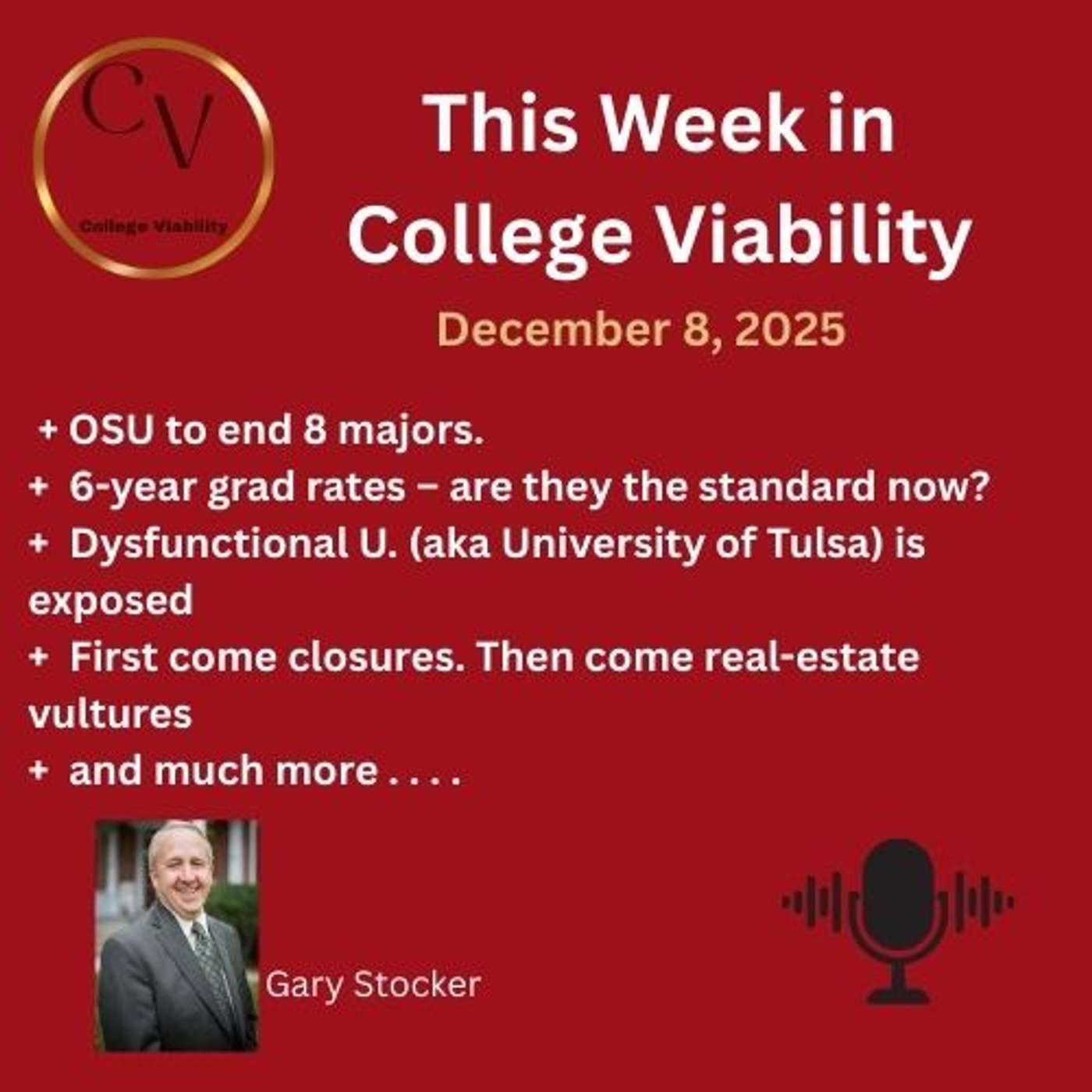
This Week In College Viability (TWICV) for December 8, 2025
Episode Transcript
Gary D Stocker (00:01.422)
It is Monday, December 8th, 2025. Yes, time again for another podcast episode of This Week in College, Viability, News and Commentary. It is, of course, the holiday season. And sitting here in front of the blue yeti microphone, have to wonder how many college leadership scrooges are out there. The yeti microphone and I look at college finances constantly. It is
Almost certain, almost certain that even during this holiday season, there are colleges on the brink of announcing they cannot continue. We'll find out early in the new year. And on that happy note, this is a podcast that talks about the financial health and viability of public and private colleges with data and with details and with perspectives offered nowhere else. Make sure to share.
podcast link with your friends, family, neighbors, college students, college faculty, community leaders, community leaders and elsewhere this week. Closures, cutbacks, and exigency requests. Ohio State to end eight majors. This is continuing the recent trend that colleges cannot be everything to everybody. And six-year undergraduate graduation rates. Are they the standard now? I'm going to talk about that. I already posted to social media on that. dis-
Dysfunctional U, I made that up. Dysfunctional U, also known as the University of Tulsa, is exposed in an excellent piece by Megan Zanies in the December 2nd issue of The Chronicle of Higher Education. And first come closures, and we've talked about that many times over the years. Then come real estate vultures. I've got a brief story on that. And two...
college employees, one faculty and one administrator, wine, W-H-I-N-E in social media. Now that happens all the time. These two just caught my attention, of course, much, much, much more on the podcast this week. The University of Lynchburg, layoffs and cutbacks. The University of Lynchburg offers faculty buyouts to address finances. This kind of headline is becoming boring.
Gary D Stocker (02:21.408)
And I wouldn't include them except it continues to show what a challenge this industry is. This is Jeff Bossert had the story on WVTF radio on December 1st, Radio IQ. Wonder what that is. And he writes the buyouts and this is the University of Lynchburg. The buyouts were first offered to tenure and tenure track back on November 6th as the University, Lynchburg University.
worked to recover from a deficit that was as high as $12 million in 2022. The deficit was trimmed to roughly 2.6 million last fiscal year and the budget is now balanced, so reads the story. Sarcasm alert. Well, so is mine. My budget is balanced. If all of the revenue comes in and the expenses don't go up,
I've said this before, I'm going to say it again as many times as I need to. I see an increasing number of college pronouncers pushing the budget is balanced so we are fine argument. Absolute poppycock. Absolute poppycock. Budgets are no more than informed dartboard exercises. Internal informed dartboard exercises.
If you want to tell us that you have recovered, show us your audited financial statements, not for one year, but for four years or five years. Show us the trend. This budget is balanced. We are fixed up. It's just educational garbage. So the vice president and chief of staff to the president's office, Daniel Hall said the buyouts are one part of a plan to control costs. This is one piece of a broader strategy.
Mr. Hall explains there are a couple dozen tactics. All right. I'd to see that list. There are a dozen tactics and strategies we are putting in place, both on the revenue generation side as well as the expense management side. And none of them are being looked at in isolation, says Vice President and Chief of Staff to the president's office, Daniel Hall. OK, guys, there is no revenue side.
Gary D Stocker (04:36.884)
In this declining, deteriorating market, there is no reasonable way to look at the revenue side. It may happen in rare instances that somebody stumbles across something that works well. And you can't say the budget is balanced and advanced. I just talked about that. You don't know what the revenue side will be, even without new stuff proposed. And you're guessing at the expenses. They're informed guesses. I will grant you that. But that's all it is.
and Albright College and Webster University and Rider University. They're all recent examples where colleges are pronouncing themselves cured, fixed, financially healthy, based only on internal projections. I take you back one more time to the great Matt Hendricks observation. One bad, only one bad enrollment year requires at least four to five years to catch up.
And Lynchburg, full-time enrollment, full-time equivalent enrollment is down in three of the past four years. So guys, Mr. Hall, don't tell me you can fix your financial challenges in a year. The only way to do that is to cut and cut and cut some more. Something colleges have exhibited little interest or capacity or capability in doing to that scale.
They are always nibbling around the budget edges and have the audacity to say they have fixed things. I'm going with double-jish on that. Here's what we know about Calvin University in Michigan. Their 12.5 % faculty reduction and program cuts. This is Michigan Live. Danielle James had the story on December 2nd. Over the next two years, Calvin will reduce 12.5 % of faculty positions. They'll eliminate and consolidate multiple academic programs. What else is new?
John Zimmerman, associate director of public relations, so the official pronouncer for Calvin noted a 25 % Mr. Zimmerman noted a 25 % increase in enrollment since 2020. Well, all right, I'm the data guy on this end of the microphone. I don't see that in the data. Now he's probably qualified that with something total enrollment, part-time enrollment. I have no idea. I don't see it. I don't see that 25 % increase.
Gary D Stocker (07:03.054)
And of course, since this is nothing more than more regurgitation reporting by this news outlet, the reporter didn't bother to check. I show an FTE enrollment decrease. iPad shows FTE enrollment full-time equivalent enrollment of 2,914 in 2020 and 2,739 in 2024. Do the math. If you're using a non-Calvin University calculator, that shows a 6%.
decrease. I'm sure they qualified it with some strange set of numbers they're using to justify that. Operating revenues are up 6 % at Calvin, but operating expenses are up more than twice that, 13%. Thus, the cutbacks and layoffs. full disclosure, a quick glance at the college financial compass shows Calvin University to be in decent financial shape. They're trying to get ahead of the game. I can get that. It doesn't happen much.
They're kind of spinning the numbers, who doesn't? And so give them credit if they're trying to get ahead of the game, but they... Guys, throw numbers out there, but if the story comes across my feeds and I have lots of them and they look strange, I'm going to look at them. I'm going to call you on them. The University of Providence, not the one in New Jersey. Is that right? But the one in Montana asks the board to allow financial exigency. This is a story from NBC Great Falls, Montana, Sadie Rison.
Rycyn, R-I-S-O-N on November 26th. Carolyn Goulet, interim president for the University of Providence, always a negative indicator when the term interim is used. But our focus is on maintaining student experience throughout all of this and academic excellence. You know, I forgot to check the enrollment for your graduation rates on these folks. I have to do that. they always, colleges always say our focus is maintaining the student experience while we cut back. And that begs all sorts of questions.
Why didn't they cut back sooner? But how can you maintain the same student experience when you're cutting stuff? It's incongruent at best. And the rest of the story, as the late great Paul Harvey would say, the University of Providence, also in Montana, sorry, the university, received financial support from Providence Health, a healthcare organization in that area, for about 10 years, helping the university pay for buildings and programs and part of its annual budget.
Gary D Stocker (09:31.502)
So the interim president, Carolyn Goulet, says, for the past few years, our budget has always included Providence Health support. So we would do our revenue, our operations, plus their support. So we always had a balanced budget that was depending on the support of $8 $8.5 million, sometimes more per year.
Gary D Stocker (09:57.551)
I guess the good folks at Providence Health caught up and says, hey, no more. In the most recent agreement, Providence Health says, made it clear that the university must become financially independent by December of 2027, two years out, and that it will no longer cover its deficits. This ain't good. To the data we go, the net income margin negative in five of the past six years. Endowment is averaging less than $20 million over the last six reported years. That's not much more than college couch money.
adjusted for student, adjusted for inflation, student revenue, that's net tuition revenue and auxiliary revenues are down 20 % since 2016. The unrestricted net assets are falling overall and their investment in infrastructure, buildings, hardware, software is really, really low. So Ms. Gullay, Dr. Gullay, whoever that is, says, we are running about an 8 million deficit. We talked about that. When I became interim president in July,
I looked at our runway.
Gary D Stocker (11:00.974)
I'm going to push through on this. I looked at our runway and I decided if we can cut half of the deficit this fiscal year and another half next fiscal year will be golden is the term that Dr. Galei-Mescalay used. Well, maybe.
Gary D Stocker (11:21.014)
Maybe there is some magical financial wand these interim college leaders can wave. But what about the previous deficits? Ms. Galay, Dr. Galay, there's no reason to believe this subsidized college has the leadership chutzpah to cut stuff, period. And I expect the next story, like we always see with cutbacks, the next story will be faculty and student protest. Page two, Ohio State.
likely to end eight majors.
and over 350 courses and a Senate compliance activity. This is from Katie Millard, Fox 8 News on November 26th. Ohio State ending eight majors, hazing out more than 360 courses. And I bring this up and then more details in the story. And as always, I will have the link in the show notes. I bring this up as a public service and continuing reminder.
The market is moving to force colleges to quit trying to be everything. You know what I'm going to say next? Everything to everybody. Ohio and Indiana and Texas are states that have recently enacted mandatory numbers.
mandatory minimum numbers for majors completions and many other public and private colleges are doing likewise on their own. Many more are not and should be.
Gary D Stocker (12:51.758)
U.S. six-year college graduation rate stays at 61 percent.
December 7th by Robert Farrington at the collegeinvestor.com. Let me read from his story. The latest national data on college completion shows a stark picture. The cohort of students who started college in 2000, in the fall of 2019, only 61%, 61.1 % earned a degree or certificate within six years.
notes that figure has hovered between 6.1 and 61.1 and 61.4 % since the 2016 cohort. So that's three years worth of data. And I've got this highlighted in my notes. While the patterns of stability shows a trend, Mr. Farrington writes, it is also a reminder that one in three college students never finish.
And the findings from this story come from the latest yearly progress and completion report, which tracks all first-time students. All right, I'm going do it again, second time for this show. Sarcasm alert. Wasn't, correct me if I'm wrong, wasn't there, real sarcasm alert, wasn't there a time when college students were supposed to graduate in four years?
Gary D Stocker (14:25.198)
Four years, that was my standard. That was my expectation. Didn't even think anything else. I believe that to be the case for my children. And now, after six years, barely more than six in 10 undergraduates graduate in six years. Folks, I've said it before and again to the microphone it goes, this is a national catastrophe that colleges are working hard to hide from their students.
and their families, but not here at College Viability, a new product announcement. In the next few weeks, we will be releasing and promoting a student and family college viability app. Among the many parameters it will track will be both four and six year graduation rates. We'll do them both. It will also track five year trends in enrollment, financial outcomes for students, and the financial health or lack thereof for now private colleges. And trust me,
I've been at this since 2019. We are going to create an awareness market for colleges. The app will let users customize, select their own colleges for comparison, call it a reverse FAFSA, or call it kind of the Kelly Blue Book equivalent for colleges, whatever you want. Students and their families will have easy and inexpensive access to data to help them make a more informed decision about their college options and colleges.
If you're among the hundreds watching your final dollars circle the financial drain, we're going to help future students, current students and their families identify you and compare you. We're not going to say which colleges are going to close. my job. You heard me say that before. My job, our job is to say, hey, be careful of college A. College B looks a little bit better. College C is financially healthy. That's the role that we play.
on the retail end for students and families here at College Viability. Page three, the headline reads, The Ambition Trap. And this is an article by Megan Zanies on December 2nd in the Chronicle for Higher Education. The Ambition Trap, how the University of Tulsa chased enrollment and prestige, but chiefly grew its deficit instead.
Gary D Stocker (16:50.466)
This is a well-researched well-written story about a college that just hasn't exhibited any capacity to work well and play well with others' Or, maybe part of it, or they have a chronic inability to find good leaders, it could go either way. Now, off the top, the University of Tulsa is not going anywhere. They have a billion dollar plus endowment. The recent challenges seem to be on their series of college presidents,
three or four, inability to manage expenses in relationship to revenues. And even with that, this college has a financial health profile that is solid on the business side, solid on the business side, even while it exhibits an ugly inability to provide strong and financially aware leadership. Zanies writes, a 2018 accreditation report taking stock of Tulsa's performance over the past decade,
noted that the university, and in quotes, operated under a de facto, build it and they will come philosophy and has not systematically engaged in program review. All right. So be it.
According to an internal document, leaving its academic cost structure unsustainable for its size and breadth of current programs. I'm not sure I buy that, but I haven't looked into it. So I looked at their majors completions. I did. I've got that access. And the 2026 version of the college majors completion app will be out with somewhere in center of 150 majors in January sometime. Just like most colleges, offer the good folks at Tulsa offer a low number, a low enrolled majors.
There's no question that University of Tulsa is a management and organizational mess. And Megan Zanies does a good job describing that. Excellent job. It's just good reporting period. But they have the resources, maybe not the leadership capacity, to survive and thrive in relatively short order, providing the board can find a way to hire somebody who can get the job done. And Lord knows there are leaders out there that can do that. They're just over, over finding one to be able to lead.
Gary D Stocker (19:01.214)
University of Tulsa. I really, the reason I included this story in the podcast today is I want to look at this from a different angle. There are countless other colleges without Tulsa's financial resources that think, that believe, that would like us to believe that they are big name research capable entities. Their endowments are not much more than college couch money, unlike Tulsa, which is a billion plus. They're watching their last dollars circle the financial drain. Many won't survive.
Tulsa will survive, at least for many years. There is a general, but not necessarily universal industry and cultural mindset in colleges and universities that they all want to be like the University of Tulsa, of course, minus the human and leadership drama.
Megan Zaney's story is about one college. It is good to great reporting, unlike the regurgitation reporting that I talk about way too often from way too many reporters. And while it focuses on one apparently, not apparently, obviously dysfunctional private college, it is also a story about the delusion that too many colleges in this country operate with. In this day and age, I'm going to say it again.
In this day and age, colleges cannot and will not, cannot and will not be able to continue to be all things to all students.
Gary D Stocker (20:33.934)
We've talked about colleges, we've talked about bankrupt colleges, closing colleges many times over the years. And there was an article in something called thesis driven, Brad Hargraves, in September 2025. The headline reads, the opportunity in bankrupt colleges. And all I want to point out on this is the real estate vultures are circling, and probably have been for a while. He notes that with all the colleges in financial distress, there are going to be many, many, many,
especially in rural areas, real estate opportunities. So while you're pondering that, the market, the sophistication of the higher education market is evolving so that now commercial real estate professionals are recognizing an opportunity to acquire colleges that close and do whatever they will with them. So the opportunity in bankrupt colleges from Brad Hargraves at thesis driven. All right, time for some whining, not mine, because of course I never whine.
There was a LinkedIn post from a Dr. Crystal E. Garcia, who's an associate professor of educational administration at the University of Nebraska. Lincoln, she posted this, I think it's on December 5th, it might have been earlier than that. And this is not the same as drill, baby drill, we've heard from political folks. This is not the same as drill, baby drill, but it has its own category of wine, baby wine. Dr. Garcia in this post is effectively saying, don't cut my stuff. All right, she can do that.
I can understand the trauma. talk about that in a minute. University of Nebraska had issues. I've had them in the podcast here recently. They have issues or cutting back stuff. And so of course, here at College Viability, the first thing we do is the check the four year undergraduate graduation rates. University of Nebraska-Lincoln, I believe they're a R1 research. I'm pretty sure they are. Four year undergraduate graduation rates, 2016, 2024. I'm going to read the numbers. University of Nebraska-Lincoln, 33%, 33%.
36%, 37%, 39%, 41%, 42%, and 46 % over the last eight reported years. The 2024 data should be out shortly. Now, I noted, I note a consistent increase in the graduation rates. Kudos. They're doing something right in that area. Yet, this big time R1, I believe, institution still doesn't graduate 50 % of its students in four years. All right.
Gary D Stocker (23:01.76)
I understand we're talking doctoral programs. That was the essence of Dr. Garcia's complaints. And I did, I looked at the numbers, completion numbers for the programs that will soon to be cut. And indeed she was right that the University of Nebraska-Lincoln was graduating a decent number of students in these soon to be closed programs. And I don't even doubt for a millisecond that politics was a motivator, is a partial motivator for this decision.
But colleges, again, the theme is consistent. What we talk about here, consistent stuff all the time, different details. Colleges cannot continue to be everything to everybody. Have I said that before? This is probably not the overt reason for this decision at the University of Nebraska-Lincoln, but it's a valid economic and business mindset. And I understand that Dr. Garcia's rant is at the loss of educational doctoral programs.
That was one of programs I presume she's a part of.
Yet even, I can make a logical argument, the data I'm a little light on, even the educators that have gone through the doctoral program at the University of Nebraska are clearly not preparing high school students for completing college curriculum based on those four-year graduation numbers, undergraduate graduation numbers I just shared with you.
Dr. Garcia, I'd love to hear your response on that. You can reach out to me on LinkedIn if you'd like. And again, you're right on many points and the whining is understandable. I lost two jobs over the years on short notice. It is of course no fun. Millions of other Americans have lost their jobs. Their trauma is no different than those facing layoffs at the University of Nebraska-Lincoln or any other college or any other business. It's an economic reality. Wine if you must.
Gary D Stocker (24:58.328)
Wine if you must. And wine number two, W. Kent Barnes is executive vice president for strategy and innovation and vice president of enrollment and communication. That's gotta be one heck of a business card. December 5th on LinkedIn. I'm gonna read his quote.
This is again, Dr. Kent Barnes, B-A-R-N-D-S. I am so sick and tired of the headlines about the public's lack of confidence in higher education and the media piling on disgusts me even more. He goes on to say, as a parent, I am seeing firsthand that college works as I witnessed my kids, his own kids, hitting the right development stages that I hope will ensure the success in life. A college education, he continues.
is not as a headline suggested earlier this week, like investing in junk bonds. And he's right on that. Well, first of all, changing the media is like changing the weather. You can't do it. And second, absolutely college works. Dr. Barnes, I presume that's case, Dr. Barnes.
My own college viability manifesto starts off with, college is good, go if you can. Millions of Americans gain great value from their college education. Myself, my siblings, and most of our children have gained great value from their college experience.
Gary D Stocker (26:31.822)
What this short-sighted generalization misses is that it doesn't work for everybody,
Gary D Stocker (26:44.664)
Colleges, again, another consistent theme, colleges focus on enrolling students even when they are not academically capable or financially able. These other millions of Americans, of our fellow Americans that end up with debt that impacts their lives and livelihoods for a long period of time. So for them, the lack of confidence is justified. We've got two audiences, sir.
the one for whom college works, which there are millions, and the one for which colleges, higher education, this industry is taking advantage of those, they call it access, that's not, I don't buy that, taking advantage of students who can't possibly be expected to successfully complete a four-year undergraduate degree for the reasons I mentioned above. So in this case, whining is fine, it's America, we can whine. But sir, maybe spend a few minutes, a few more minutes thinking about the big picture.
I did note interesting that there were a few dozen, I three dozen or so comments to his post. Some of them really did address the big picture. So that was good to see as well. Page four, how about a wrap? I've had this kind of story before and Josh Moody had the story on December 5th and Inside Higher Education. Further negative projections for higher education. It's not a new story, but Fitch, Standard & Poor's and Moody's all rate higher education.
as unfavorable or negative for 2026. The S &P analysis cited some of the concerns, intense competition for students, rising operating costs for the sector. And there ahead, our sector view is negative. As we expect, colleges and universities will struggle to navigate through mounting operating pressures and uncertainty that will require budgetary and programmatic adjustments. That was from S &P.
So I guess for those trying to tweak their colleges, their departments, their businesses, for those trying to tweak their colleges on the marginal edges, your efforts may be substantive. They may be. That's I see tons, many, many, many of those, not tons, many, many, many of those ideas on how to improve a process. Go for it.
Gary D Stocker (29:06.99)
On the other hand, as Tevyev said, they may not produce any appreciable value at all. This is an industry in decline. I know it's the holiday season. Call me a Scrooge. Take me off your Christmas card list. This is an industry in decline with no clear path or even a timeline to recover. And yeah, I'm not talking about every college. There are some we have, I've had on this show, Matt Hendricks and I have on the College Financial Hall Show.
But I am referencing the of private and some public colleges who are effectively, tuition collection agencies. They enroll marginal students and have no systems or processes in place to get even half of those students through.
to graduation. Hey, let's do it again next week. Next week will be Monday, December the 15th? Halfway through December already. I'll be back with more on this week in college viability. As always, thanks for making time to listen to the podcast. Make sure to share with friends, family, relatives, and neighbors. Take care. We'll talk soon.