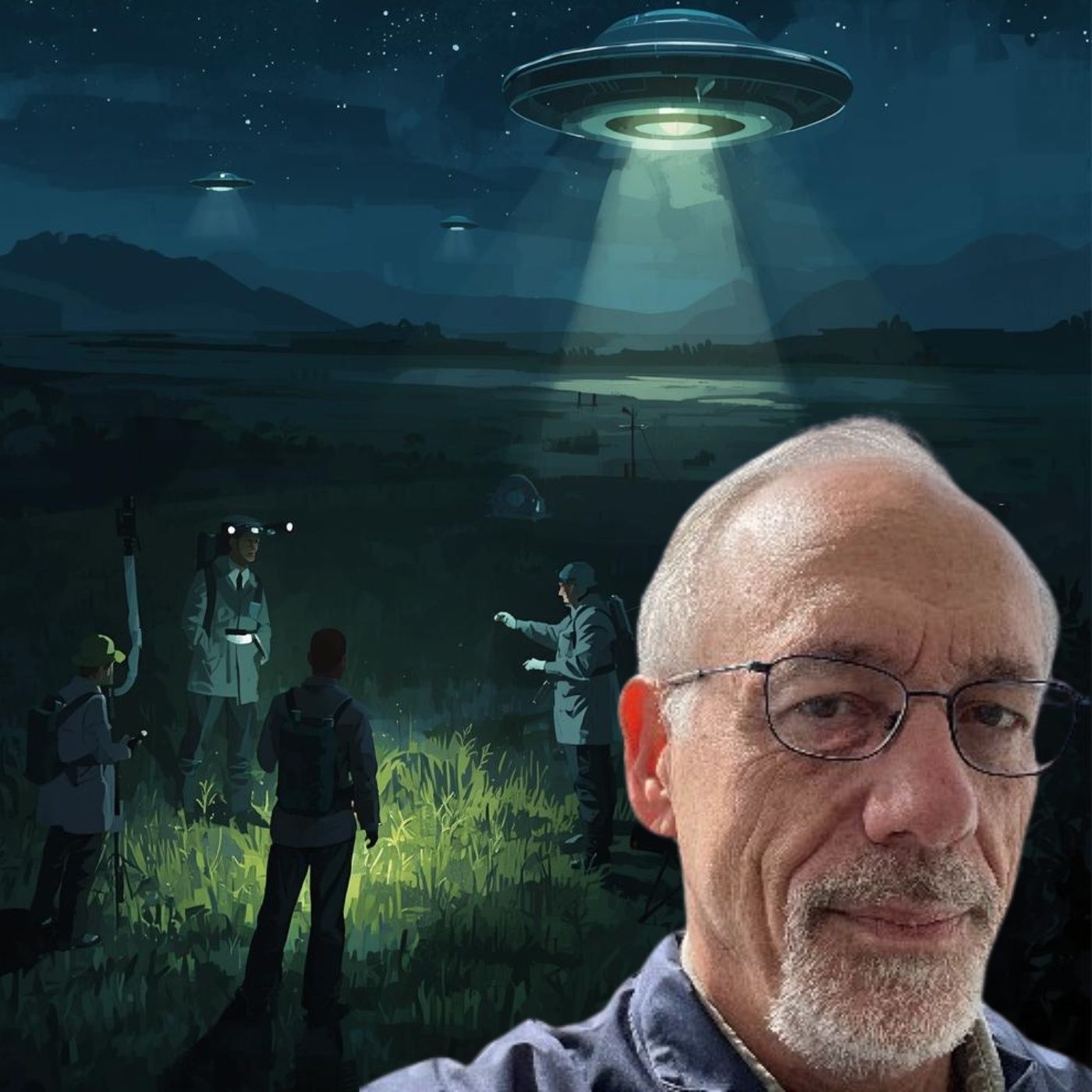
Ep. #869: Robert Powell – A Scientific Case for UFOs
Episode Transcript
Five four three two one.
Speaker 2We interrupt our program to bring you this important message.
Speaker 3A confirmed attack is taking place against the United States.
Aliens from an unknown location have been reported in multiple states.
Speaker 4We are controlling transmission.
Speaker 2There is another world that awaits, far beyond what we can see and feel, a place that's anything but ordinary.
Speaker 4Would you believe I not.
Speaker 3Step into the song how the first time?
Speaker 5No failure, Take.
Speaker 4The aspiracies and cover to the pair read not a weego.
Speaker 2We go with Jeremy Scoff.
Speaker 3The light saw.
It's showtime somewhere between the paranormal and the abnormal.
I'm Jeremy Scott's Welcome to the program once again.
I am honored that you would choose any moment of time to listen to this program.
Thank you to those of you who continue to make it a nightly ritual.
If you know me, I love talking about anything under the umbrella of the paranormal and the abnormal.
Hence into the pairubnormal the name of the program, and that's the number one question we get is what's the pair abnormal?
Well, it's not always paranormal.
It can sometimes be abnormal.
And that about sums it up on a nightly basis, my favorite subject has anything to do with UFO's extraterrestrial life.
There's so many different angles to this.
Somebody who was followed this for well more than half my life now that would be more than twenty years.
I have seen the evolution of this subject go from something that should never have been talked about for fear of retribution or ridicule, and now people are openly talking about it on the Internet and other platforms.
Some are very very outspoken about this, and no matter what evidence you put in front of them, nothing will ever be good enough for them.
I'm sure you've seen the comment nothing burger floating around the Internet.
I don't know, probably on almost any UFO story, someone has or could comment nothing burger, sometimes quicker than you know it would take them to actually have read the information.
They're already comment.
It's as if their mind is already made up.
But can you really blame them for that thinking.
They have been manipulated to believe that there is nothing to this, And we've been manipulated for many, many years now by the powers that be.
They've pushed our buttons and manipulated us so well that we would believe there's no possibility any of this is real, and anything that is presented as evidence should all automatically be not believed.
That's what they want you to believe.
And so these comments on the internet, they crack me up.
Anything that could be considered a revelation or progress towards disclosure.
You know, some yeah, we'll obviously make much more about this than it should be.
But then there are those who don't give it any credit at all.
And I'm kind of in the middle, especially when it's something that I'm just hearing about could be Maybe that's kind of where I'm at.
I don't automatically go to yes or no.
Maybe that's a radical way of thinking, it seems to be.
We like to label everything.
We like to put everything in a box.
We like to judge a book by its cover.
We think we know or profess that we know, whether or not we know or not, something about a situation, about a person, about people from a certain walk of life, whatever the case happens to be.
Just look around.
I'm sure maybe you do it and your friends do it, and we're not saying that or perfect, and we don't judge each other.
I think every single one of us probably has those biases towards someone or some people, right or wrong.
The same happens, you know with news.
We are automatically judging the material before we have really digested it or had a chance to verify it.
The fact is, we all want it now.
We want the revelation, we want the disclosure, We want it all, and we want it now.
We don't want to wait.
I'm with you, I wanted it yesterday, I wanted it twenty years ago.
Although if that was the case, what would we talk about for the next twenty or thirty years.
Because I plan to be here right along with you for that many years and maybe even more.
Maybe we can make it another forty years together, God willing, I would want to give that a try if I possibly could in our lifetimes.
Will this happen?
It remains to be seen.
But sometimes we've got to take a step back and realize why that is not possible, why we can't have it all, why we can't have it now, and that disclosure is really a trickle process, and to realize how far we've come is really to look back at how we got here.
We don't have the time for that tonight.
We're not going to go down that road.
But we may have progressed farther than you know.
And that's okay.
If you haven't been paying attention, maybe there's more important things in your life.
Why is this important, though, Well, it's for one simple reason.
It is still happening.
These UFOs are still being witnessed and reported by people all over the world, ordinary people.
Yes, they are still seeing the extraordinary.
Reports are coming in daily to organizations like mofon, the Mutual UFO Network, and New Fork, which is the National UFO Reporting Center.
Just go look at their databases.
You'll see reports from all over the world, all different times of the day and night, all different kinds of craft, etc.
These are encounters that happen in cities.
They take place out in the country past these city limits sign can you name that tune?
But also in restricted airspace, near sensitive sites, commercial flight paths as well.
People from all walks of life, including credible trained observers, are encountering objects with capabilities beyond our known technology, yet progress in understanding them has stalled.
This is despite congressional hearings and even whistleblower testimony.
Besides the stonewalling, though, some experts say that the main obstacle is the difficulty, cost, and lingering stigma associated with conducting rigorous scientific research on unidentified anomalous phenomena.
Perhaps the field needs a shift from anecdotal reports towards long term, instrument based observations, including standardized scientific methods.
The delay, though, primarily is due to the expense of building and operating reliable sensor networks radar systems as newforks.
Peter Davenport has proposed, and we've done an episode about truly understanding these UFOs for the masses will require years of systematic observation, better data sharing, and significant investment.
Are we ready and willing to take that next step?
It certainly seems like we need to head there in order to really solve the UFO mystery.
I'm Jeremy Scott.
Somewhere between the paranormal and the abnormal.
We'll have much more of our conversation just getting under way tonight.
Speaker 5Stick with us.
Speaker 2Into the pair of normal, pair of.
Speaker 3I'm Jeremy Scott, Somewhere between the paranormal and the abnormal.
Into the pair abnormal.
You know, either the government possesses definitive proof of extraterrestrial craft or the witnesses, many of them.
They're mistaken, they've been deceived, they're dishonest.
Maybe it's a little bit of both.
We know that there's disinformation.
We know there's misinformation when it comes to the UFO topic, and much of the narrative has been shaped by decades of official disinformation.
It's been well documented, often originating in the US Air Force.
There have been historical examples including hazing rituals, deliberate deception to protect classified technology, doctored photos, staged experiences that would lead military personnel and officers to believe that they had encounter extraterrestrial craft.
And entrenched institutions have long controlled and suppressed the UAP narrative.
They continue to do so through measures like the dilution of the disclosure legislation that they've tried to pass, the work of Arrow, which could be considered a joke.
Really it's a modern equivalent to passed efforts to dismiss or downplay the issue.
I mean, look at the previous efforts and how those investigations were conducted.
It's a troubled history.
Despite that, UFOs I would argue remain worth investigating.
Unlike some of the reports and the calls by some out there, including the finding from what was it the Condon Report, we should not spend another single dime on this.
I think that's hogwash.
Even if you don't believe that these are extraterrestrial craft, what about the national security aspect to this?
It definitely deserves attention, our utmost attention from a scientific and a national security issue rather than a conspiracy.
It should not be looked at as a subject we should put into the box of oh from the tinfoil hat crowd.
Tonight, we're going to talk with a scientist who presents his case that some UAP, some not all, represent intelligently controlled non terrestrial craft, and that's seventy five years of limited progress demands a fundamental paradigm shift in how the UFO phenomenon is studied.
He's Robert Powell, founding board member the Scientific Coalition for UAP Studies, with over fifteen years of experience investigating UFOs.
He has a BS degree in chemistry with twenty eight years of experience in engineering management in the semiconductor industry.
He's a co holder of four patents related to nanotechnology.
Robert was the former director of research at Muffon from two thousand and seven to twenty seventeen.
Created MUFON's Science Review Board in twenty twelve.
He's a member of the Society for Scientific Exploration, the UFO Data Project, and the National Space Society.
He also co authored the book UFOs and Government to Historical Inquiry in twenty twelve.
His latest work, though, is UFOs a Scientist explains what we know and don't know.
Robert Powell, Welcome into the pair Abnormal.
How are you hi, Jeremy.
It's good to be on your show.
My pleasure to have you.
You in your new book make the point that we need dare I call it a paradigm shift, or maybe you would refer to it as a paradigm shift is needed scientifically really to get us to the next stage of you a foe disclosure?
Is that accurate?
Speaker 4Yes, that's right.
Speaker 6I think science needs to realize that the subject needs to be investigated in a scientific.
Speaker 3Manner, and of course then we figure out how we best investigate it scientifically at getting some of the best in the brightest minds together.
But one of the criticisms has been regarding the cost of this.
Is that going to be a problem?
Speaker 4Oh?
Yeah, The cost is definitely an issue.
Speaker 6So one thing that myself and within SCU that SCU stands for the Scientific Coalition for UAP Studies, One thing that we always bring up is that Congress needs to appropriate funding.
Speaker 4For the work to be done on this subject.
Speaker 6So they just like they appropriate funding, for example, for global warming, same type of funding needs to be done for the subject of UAP.
Speaker 3Seems like that could be a bit problematic considering the government will not admit that this phenomenon exists and that it's worthy of investigation.
Speaker 6Well, the you know, Congress spends all of this time bringing witnesses up before it right to talk about it, and you know, Congress pushes the executive body to you know, be more transparent.
Speaker 4Well, so what we're asking is.
Speaker 6That, you know, than just bringing more witnesses up, which is just repetition, you know, devote money to the field so that it can be scientifically investigated.
Speaker 3And so this would obviously then be a select group of individuals.
Do you have any idea who might be a good candidate to us serve on that committee or whatever we wanted to call them, Well.
Speaker 6It wouldn't be like a select group.
I mean, Congress would basically say okay, we're allocating fifty million dollars this fiscal year for the study of UAP, and the National Science Foundation will a portion that money.
And so what happens is professors at university student you know, graduate students at universities or scientific organizations, they apply for the grant money, and then the National Science Foundation would say, okay, we will give a grant x amount of dollars you know, to this university or to this scientific organization.
Speaker 3So you wouldn't hopefully like not another Condon Report situation.
Speaker 4No, No, not like that at all, because the Condon Report, right, that was driven by the Air Force and the CIA, and it had a specific ulterior motive.
In this kind of situation, what we would each university right makes their argument for what they're going to use money for in terms of the study of.
Speaker 3UAP interesting, and then eventually these findings would be presented to Congress.
Speaker 4Well, just like any other type of financial grant that's given to scientists through the National Science Foundation, you write a paper in the paper published in an academic journal.
Speaker 3And so that would get us some progress.
Speaker 4Yeah, for example, if Congress were to allocate that kind of funding SCU would apply for that funding to establish a system of automated camera systems that could be that we're standardized, calibrated, and characterized in place those cameras throughout various locations in the country.
Speaker 3And your organization already has some of these individuals as part of your team, and you would be ready to deploy on that mission if exactly Yeah, properly we've got that.
Speaker 2Can do that.
Speaker 4We just need the funding.
Speaker 3Yeah, And that has been the main sticking point.
Would you argue that this is worth spending the money?
Speaker 4Oh?
Absolutely.
Speaker 6I mean the same type of system that we would develop that could detect u AP, right, that same type system can be used to detect drones or other other type craft in.
Speaker 4The ATMOS rphere.
Speaker 3Let's find out what kind of system that might be.
I wonder if it's passive radar or something of the kind.
Kind of talked about that a little bit earlier.
Our guest tonight on the program is Robert poll, executive board member of the Scientific Coalition for You AP Studies, author of UFO's a Scientist explains what we know and don't know.
I'm Jeremy Scott somewhere between the paranormal and the abnormal into the pair ofbnormal.
Speaker 1Pair ofnormal news.
I'm George Henry.
The world's largest and most powerful particle accelerator is shutting down for several years, and it'll be much more powerful when it fires back up.
CERN's Large Hadron Collider, deep underground near the Switzerland and France border, will go offline for major upgrades starting in June.
The LHC has gone offline before for maintenance, but this will be the biggest overhaul yet.
Engineers will spend the next five years upgrading the particle accelerator to the high luminosity Large Hadron Collider, which is designed to produce ten times as many particle collisions and capture even more data, perhaps like the discovery which led to the Higgs Boson particle in twenty twelve.
The new Director General of CERN says there are still vast amounts of data to be analyzed during the shutdown.
Here pair abnormal news every hour on into the pair ofbnormal.
Speaker 3Unidentified anomal As phenomena or UAP.
What is that can be identified as an aircraft or no natural occurrence?
Speaker 4And hundreds of people have seen these things, sometimes all at the same time.
Speaker 1A major fighting where there's stuff flying over military installations and no one knows what it is, and it is an.
Speaker 4Hour in the US is in possession of UAP technologies, as are some of our aficers.
This is a real event.
It is the most important event in the history of mankind.
Speaker 2Into the pair abnormal with Jeremy Scott somewhere between the pair of normal and the abnormal and out.
Speaker 3It is a scientific case for UFOs.
Tonight from a scientific coalition for UAP studies, Robert Powell is with US tonight, and Robert, you were describing the type of system that might be deployed if your organization was given some of the goods funding appropriated by Congress to seriously investigate FOES.
What would that look like.
Speaker 6Well, you would have a system that would ideally have some type of radar on it, potentially passive radar, an optical lens as well as an infrared lens, and audio and the ability to detect audio also and ideally the ability to detect across the electromagnetic spectrum, so such that you could detect frequencies down as low as one.
Speaker 4Hundred megahertz to as high as ten gigahertz.
Speaker 3So would we say sensors, is that what we would be installing to detect.
Speaker 4Right right, Sensors that that also have soft AI type software that allows the camera system to discriminate between a known object and an unknown object, and so whenever in doubt, the camera captures that information and then it coordinates with other cameras in that area, so that if you have one camera and another one, let's say half a mile away, both cameras would be observing the object, and that would allow you to triangulate and actually casselate speed and acceleration.
Speaker 3You would be able to do that triangulation, which is so crucial to the evidence right.
Speaker 6Right, because you know, when we talk about UAP or if it's whether it's terrestrial or non terrestrial, a key parameter to look at is acceleration, right because we know what our capabilities are in the area.
Speaker 4Of accelerating accelerating an object through our atmosphere, and that's a a good place to be able to separate something created terrestrially and non terrestrial.
Speaker 3Interesting.
So you would then be able to come up with a data set, as you've sort of described here to compare these different objects against each other correct, which would then I allow you to categorize gets some statistics on the type of objects that are being tracked and the characteristics and see if there's some similarities or whatnot.
Speaker 4Yes, that's correct.
Speaker 3And so how massive of a system are we talking about?
How many of these sensors would you need?
Potentially, how much would each of them cost?
And then where would you want to put them.
Speaker 6Each individual system, depending on.
Speaker 7You know, how elaborate you make, it would cost somewhere around five to ten thousand dollars and you would need, you know, roughly several hundred of these systems.
Speaker 6Now in the beginning, you would start out with a smaller number, right, But the reason you need the larger number is because.
Speaker 4UAP don't show up every day.
Speaker 6So you need enough of these systems to have a reasonable likelihood of capturing a UAP, you know, with multiple systems.
Speaker 3Right, and you would want those in different areas, maybe different countries, different states, that's that type of thing, right.
Speaker 6Yeah, you would put them in certain areas of the United States that are a little bit more of a hot bed than other areas.
Speaker 4And in doing that, you also.
Speaker 6You know in terms of costs that you asked about, Uh, it's fairly expensive.
You're talking about many millionllions of dollars in order to have enough systems to do this properly.
Like the Galileo Project, for example, has a cup two or three systems.
Speaker 4And they spend a lot more than that on each of those systems.
But the odds of them.
Speaker 6You know, recording a UAP are extremely small with only three systems.
Speaker 3Is it a guarantee that you will actually find UFOs with this equipment or no trial and error here because it's not been done before to this level.
Speaker 6Right, Right, there's never a guarantee, right, but there have been we know the there are a lot of UAP reports, So the odds are sooner or later we would capture one.
Speaker 3Yeah, and maybe this could be the smoking gun that everybody is waiting for.
Speaker 6Right And by smoking gun, it's basically sufficient evidence that it convinces the scientific community that even more study needs to be done, right, because it's a it's a process of continuing to.
Speaker 4Collect more and more data on the on the subject of UAP.
Speaker 3So it would take millions of dollars to get a system like this up up and active.
Speaker 6Absolutely right, Yeah, because you got you really need to pay people to be operating these systems and maintaining them, going out in the field and fixing them when they break down, et cetera.
Speaker 3Would that have to be a yearly investment, Yes, I.
Speaker 4Would say it would cost several million every year.
Speaker 3To make How many years should we I guess put on that.
Should we be for five years or ten years from the outset or what?
Speaker 6It really depends on the number of systems that you can put out in the field.
Speaker 4But if it's say, if you had a thousand systems out in the field, then I don't think you would need to wait more than two or three years.
Speaker 3Could we open source this stuff so we could put them perhaps on the internet and enlist citizens scientists who might want to review some of this data watch the cameras.
Speaker 4Yeah, potentially you could.
But the you know, a ty with this is that you're having to triangulate with the camera systems and you have to make sure that a citizen scientist knows how how to set the camera up and make sure it's calibrated, and it becomes it becomes a little difficult.
It would be a little.
Speaker 3Could we put these all on the internet?
Is what I'm getting at so where everybody could access these Oh.
Speaker 4Yes, yes, I mean you could.
Speaker 6You could have these systems, and these systems would be connected through the Internet, and you could give people access to the systems so that they could.
Speaker 4Okay, well look at the information.
Speaker 3I'll chip in my part, whatever my part is, And if everybody chips in their part, we may not even need Congress.
It seems like that may be a sticking point.
Could it be privately funded?
Could we get this done without Congress?
I'm Jeremy Scott.
Somewhere between the paranormal and the.
Speaker 5Abnormal to the parabnormal pear.
Speaker 3Of I'm Jeremy.
It's got somewhere between the paranormal and the abnormal.
Making a scientific case for UFOs it may require you and I chipping in.
How do you feel about that?
I mean, we want disclosure, We want it now.
We hope that it will be Congress, a president or somebody who comes through and actually provides disclosure at some point in time.
That may be more of a of a dream than an actual thing that would happen.
And so if we can bypass Congress, because maybe the price tag is a little too steep, and there will be some resistance to that, saying, well, we haven't found any conclusive evidence in all of these years.
Why would we even think about spending this much money, let alone this much money on an annual basis to keep the program going.
Or maybe we get an initial funding and Congress, you know, kicks in something to give this project a boost, but then it's privately funded.
We're talking with Robert All of the Scientific Coalition for UAP Studies.
Is that even feasible, Yeah, it's feasible to privately fund it.
It's really not an extreme amount of money for the government at all, because I'm sure Errow's budget is ten to twenty million dollars per year, and that's okay, Well, I can support that.
I can support taking some money from Arrow and giving it to this endeavor, because I don't think Arrow deserves all that money.
They haven't shown that they're worth their weight in salt.
Speaker 6And the other way to finance it would if you had one hundred thousand people each put up one hundred dollars each annually.
Speaker 4That gives you ten million dollars a year.
Speaker 3And I could access the cameras at some particular point in the future on the Internet, and I could sit here and geek out and watch for UFOs.
Speaker 6I'm in yeah, yeah, we just need ninety ninety nine more.
Speaker 3Okay, So where do they go?
I mean, is there an information about your organization available?
There has to be.
You have to have a website.
It is the twenty first century.
Speaker 4That's right.
Speaker 6It's Our website is explore SCU dot.
Speaker 3Org and that's for the Scientific Coalition for UAP Studies.
Tell us about the organization that you've assembled.
Some of these men and women you have a part of the organization, and what the mission is.
Speaker 6Right, So the mission of the organizations the Scientific Study of UAP.
We were founded in twenty seventeen.
We're a nonprofit today.
We have four hundred and fifteen members.
Of those members, thirty three percent at PhDs.
Over half have either a PhD or a master's.
The most common degree is in either physics or engineering.
So that that kind of gives you a little feel about the organization.
Speaker 4We have a conference we put on every year.
Uh this year it will be in Toronto, Canada.
Speaker 6We you know, we interact with ARROW, We interact with the FBI at times, we interact with you know, various government agencies and what and we interact with universities.
Our main purpose is you know, pushing the scientific study of the subject.
Speaker 4So that's what we try try to do with all of our interactions.
Speaker 3Right, have you met resistance in that mission?
Speaker 4Uh?
Speaker 6The main resistance that we run into sometimes, right is just the stigma that goes with the subject.
So most of that resistance is more in the academic world.
But we've made headway in the eight years that we've been in existence, So we now have papers and various journals.
Other UAP science based organizations have also gotten.
Speaker 4Papers into journals.
Speaker 6And the more we do that, the more the next generation of scientists coming out of the universities can read these papers, and it strengthens the need for scientific investigation of it.
Speaker 4Is people read our.
Speaker 3Papers because the bottom line is we want to understand how these vehicles operate, right.
Speaker 6Right, Yeah, the bottom line is, you know, first we would like to try to determine are these terrestrial or not?
And if they're not terrestrial, you know, can we communicate, you know, can we make attempts to communicate?
Speaker 4And yeah, ideally, how do these craft travel through the atmosphere without very much interaction with the atmosphere.
Speaker 3And So what does your gut tell you?
Are these not terrestrial or extraterrestrial some of them if not all?
Speaker 6Yeah, I mean, my gut feel after studying this subject for almost twenty years is they are most likely extraterrestrial, probably from another star system, simply because there are six thousand extrasolar planets we already know about, so that makes the odds higher that that would be the origin.
And you know, that's that's kind of my feel after I feel about the subject after studying it for twenty years.
Speaker 3So have you talked with contact ease?
Speaker 4I have talked to people on occasion, but there's that's very difficult to establish proof, right.
And it's difficult enough to get the scientific community just to study UAP, whether or not it's a physical object.
You to get them to study the issue of contact these is even harder, one more step too far.
Speaker 3Right, because that takes people to a level that they may not be comfortable with contact with beings and everything that goes on with that, as opposed to you know, just seeing something in the sky.
Speaker 6Right, right, And it's it's easier to try to scientifically establish that the object in the sky is real, right than it is to establish that an individual had contact with a super intelligence from somewhere, right, the only way to establish that is you know, you scratched the uh, you know, whatever it is that you've had contact with and were able to test the DNA and establish that you you know, you had DNA under your fingernails that was non.
Speaker 4That doesn't match anything on this planet.
Speaker 3Sure, So would you be interested?
Would you have the capacity, if ever, you came into the possession of something that might not be from here craft to be able to reverse engineer it within your organization.
Speaker 4We have the capacity to determine if trace material is extraterrestrial or not.
Speaker 2Right, they're.
Speaker 6Chemical and physical tests that can be done to look at isotope race shows, So we could do that.
Reverse engineering is a totally different question.
And my personal view is that no one, the government included, would be capable of reverse engineering.
Speaker 4A craft that came from another star system, for example.
Speaker 3So even if we had a place where we've tried to reverse engineer this stuff, you don't think that we could feasibly actually accomplish that.
Speaker 6No, Because sciences, like our science rights, it's based on bricklayer after bricklayer of the next level of science right, and all the components that go in into science.
So I could give you an example, Jeremy, I could give the schematics to a modern laptop to the world of thirty years ago, and there is no way they could build that laptop because the microprocessors chips that are in that laptop, they could not make them because they don't have the science just thirty years ago of all the components necessary to create that computer chip.
And that's our science thirty years ago.
Imagine trying to recreate.
Speaker 4The science of another civilization that may be based on different fundamental concepts.
Speaker 3Interesting.
We will pause, take a break, and over in the next hour continue our conversation with Powell of the Scientific Coalition for u AP Studies, author of UFOs, A scientific scientist explains what we know and don't know.
I'm Jeremy Scott's into the paraproblem.
Speaker 1You handle another hour somewhere between the pair of normal and abnormal into the pair ofnormal with Jeremy Scott.
Speaker 2We'll be right back.
Speaker 4There's a parallel universe.
Speaker 7Will the separation.
Speaker 5While we perceived seriality.
Speaker 1Over the game, Let the Jeremy no small than.
Speaker 5Into the para no.
Speaker 2Into the paved into the par When the lights go down, the strange comes out into the par abnormal.
Speaker 3Talking about whether UFOs are deserving of a scientific investigation, a true scientific investigation, one in the area of millions of dollars a year, which would staff a system of these stations that would capture all sorts of evidence on UFOs and maybe conclusive evidence to prove that we are not alone.
Talking with Robert Powell, executive board member of the Scientific Coalition for UAP Studies and author of UFOs, a scientist explains what we know and don't know.
Robert, are there certain characteristics to UFO activity and or call them the observables if you'd like, That would be best, might have the best chance if we investigated them scientifically to actually be able to find something well.
Speaker 4As I mentioned earlier, velocity and acceleration are a measurable quantity that we could detect.
Another one is lack of interaction with the atmosphere.
So, in other words, an object that makes no sound as it moves through the atmosphere, there's no friction, it does not heat up is it move through the atmosphere.
Those are both characteristics that we are not able to duplicate.
Speaker 3Are we seeing those characteristics in multiple UFO reports?
Speaker 6Yes, there have been multiple times that that has been reported.
Probably the most the most common to your listeners would be the two thousand and four incident involving a US Navy task force and several Navy pilots where an object was on radar and according to the Navy radar operator, moved from eighty thousand plus feet down to near the ocean surface in less than a second.
So that's both philosophy and acceleration that we could not mimic.
And then the pilots when they intercepted the object indicated when it departed within two seconds, it had disappeared from sight, and we have nothing that will disappear from site in two seconds, So that's also an indicator of extreme acceleration.
And that's the most recent event similar to that, but there are dozens of incidents just like that in history that have been reported, and every once in a while you get some type of tangible evidence.
In October of nineteen sixty eight, there was a case over my Not Air Force Bace where a B fifty two bomber that was coming into land saw a UFO and picked it up on radar and the radar images are captured and these exist in Project blue Book, and you can see the unknown on radar and you can see that it moved from one radar image to the next, and the speed and acceleration that would have been required was around two hundred g forces.
Speaker 3Yeah, the ones are fascinating that are picked up on radar because it does prove that there is something there, but also the ones that are not seen on radar do that as well, because they prove there is something there that is fooling even the most experienced pilot, right.
And so what do you think about the ability for these craft to conceal themselves from radar?
Must they have the technology to do so?
Speaker 4Well?
I mean, we can can our craft.
Speaker 6We have aircraft right that can conceal themselves from radar to a certain extent.
And you know, they may be intentionally concealing themselves sometimes or it could just be an artifact of their propulsion mechanism.
Speaker 4So, for example, if you have.
Speaker 6A craft in the atmosphere and there's a plasma around it, then you're it's going to be very difficult for a radar system to detect it because as the radar beam hits the object in the plasma sheath that's all around it, it's going to get distorted and it's going to be difficult to detect that object on radar.
Speaker 3So what would be some of the more I guess interesting UFO sightings in your opinion, Well.
Speaker 6I think the most interesting ones the two that I just mentioned.
There was a case in the nineteen seventies involving a helicopter that was manned by I believe that believe these guys were army, retired army guys that were in a helicopter in Ohio that they were flying back.
Speaker 4They saw a light approaching them, and the colonel took over control of the helicopter from his subordinate because he thought that this was an airplane it was about to crash into their helicopter, so he took control.
And then all of a sudden, this light that was far off but heading towards them, was suddenly in front of them, and it was a cigar shaped object that went from being far away to suddenly in front of the helicopter.
It bathed the inside of the helicopter in a green light according to all four of the occupants, and.
Speaker 6That went on for a few seconds and then the object disappeared as quickly as it had come.
Speaker 4So I think that's a really good case.
Speaker 6There was also a case in nineteen fifty seven that involved what today we call an a wax jet that has all of your latest electronic equipment.
And this was an RB forty seven and it was traveling from New Orleans to Kansas City and it was followed by a UFO.
Speaker 4For several hours.
They detected it on their radar, and they also visually saw the object, and supposedly the object object sent them a transponder code, which is what an aircraft has, right, And so that what they don't know is was that just an accidental reflection of a transponder code from another aircraft or was add an intentional signal potentially like an attempt to communicate.
Speaker 3Interesting And then there's been some videos that are still out there that the public has not seen from some of these other incidents that have been revealed, like additional videos from those incidents like the USS Roosevelt and others.
Speaker 4Yeah, actually the USS Roosevelt was the incident.
I was going to tell you.
Speaker 6The videos that have been seen from those are the one that's called the go Fast and the one that's called the gimbal.
Speaker 4But my understanding is there are three other videos that were taken during that same incident, so there's actually a total of five, but only two of those five were released.
In one of those five videos is a video of the object approaching the F eighteen on a collision course and then just before it gets to the F eighteen break suddenly ninety degrees and to avoid collision.
Speaker 3Luckily the pilot didn't crash.
The human pilot that is just out of a fear.
Can you imagine something like that flying right at you.
I'm the open air, Robert Powell with us tonight, I'm Jeremy Scott into the pair of.
Speaker 2Normal, into the pair of normal, pair of.
Speaker 3I'm Jeremy Scott with Robert Powell tonight to the Scientific Coalition for UAP studies.
So as far as that scenario that we had just before the break, a near encounter, a close miss, however, you'd like to refer to it as out there in the wide open air, and yet this aircraft coming at this pilot does a maneuver that seemingly shouldn't be able to be done with the technology that we know of.
So what does that tell you?
It could have been something otherworldly?
It could have been I hate to think about it.
Our own military involved putting our own pilots at risk by like testing some top secret aircraft.
But I guess anything is possible.
Speaker 6Well, yeah, the problem is, and this is what you can do with camera systems that you triangulate.
We have no Let's just assume it was only going three hundred miles an hour, which is not very fast.
We have nothing that could move three hundred miles an hour and make a sudden, instantaneous ninety degree turn that involves acceleration forces of thousands of G forces.
I mean, any aircraft would just be torn apart trying to do that.
So if you see something do that, you don't have to worry that it's anything that we have, or that the Russians have or the Chinese have.
Speaker 3So what does that leave on the table.
Speaker 6It leaves it has to be something that's much more intelligent than us, and so that you know, then you have to just guess where it came from.
Speaker 4And like I said, my best guess is it probably came from another star system.
Speaker 3You have any idea where that may be.
Speaker 4No I mean it could be anywhere.
Speaker 3Infinite possibilities in that story.
Right, Well, then what about I know you have detailed some other reports within the Scientific Coalition for UAP studies.
Have you taken on specific cases, done in any case studies or come to any conclusions?
Speaker 4Right?
Yeah.
Speaker 6We we actually put out a it's about a two hundred page report.
Speaker 4On the two thousand and four nimics incident, and that that one my conclusion is that you know that there's no way you can explain it with any terrestrial craft we have.
There's also a report we did on the AUGWOODEA video of twenty thirteen.
Speaker 3Oh at Puerto Rico, the right that the government said, uh was not anomylous.
Speaker 6Right, And in that the one explanation people try to say is it's say balloon a Chinese lantern, right, So basically a balloon with the light in it.
And there are multiple problems with that theory, because the wind that day was moving it around xmum speeds at thirteen miles an hour, And even if you assume that it's a Chinese lantern, right, it would have to be moving at a minimum speed of upwards of twenty miles an hour.
To fit with the geometries involved can make that explanation, and the winds were not that high that day, so there's no way you can explain it in that manner.
Plus, the object goes into the water, and the explanation that the balloon theories give is that it did not really go into the water.
It just looks like it went into the water in the camera lost its ability to see the object properly, So that's the argument they make.
But that's an argument without any proof that that would happen with the camera.
It's clear that did not happen because if you look at that video, as you're looking at the object disappear, you can still see the ocean waves, right, So there's no way a camera is able to see the difference in temperature of the ocean waves, yet it can't see the difference in temperature between the object and the ocean.
Speaker 3Interesting, speaking of the ocean, there is a history of these underwater objects as well, in addition to those that operate to see in the air or make crash, and that is a that brings on a new paradigm as far as being able to study something like that.
Speaker 4Yeah, what's interesting about a USO, right, is that it's.
Speaker 6Hard to misidentify an object that's moving under the water or into the water, is compared to an object moving through the atmosphere like a UFO, right, Because a USO is that it's not like you're going to misidentify an airplane being out in the sky, right.
Speaker 4And so that's what makes a USO an interesting.
And we've actually looked at usos and the two areas that have the most USO reports in the world are off Catalina Island, which is near where the November two thousand and four uss Mnemics incident occurred, and the other place is Puerto Rico.
Those two areas have the most reports of underwater objects interesting.
Speaker 3So what are your thoughts on some of the other videos that have been released you mentioned like the tic TAC and others, But what about the ones that have come out through Hongress, say the one that they were saying was hit by a hellfire missile recently.
Speaker 4That one's a little more difficult to tell.
Speaker 6There's really not enough information to draw a conclusion on that one.
It's possible that could just be a balloon that it hits.
You really need more information than what's given in the video.
And that's really the problem with videos that are released and you can't talk to the witness right.
Like in the case of the Nimetz incident, we were able to talk to the witnesses as well as see the video.
But when all you have is a video and you can't talk to the humans that took the video right and get their take on everything, it makes it very difficult to draw a conclusion.
Speaker 3And therefore not everything can be scientifically studied.
That's the but you don't always have enough data to do that study right.
Speaker 4And that's one thing that's important for people to realize.
Speaker 6Your human eye is a sensor system, just as you know a camera system or a radar system is.
And the nice thing about the human sensors that your brain gives it a gives additional information of what was happening at the time right now.
The downside is our memories change sometimes, but our memories don't change too much on something that drastically happens, right like in a car wreck.
You might not remember exactly the color of the car that hit you, but you will definitely remember that you were in a car wreck.
Speaker 3Yeah, definitely.
It's so one of those long lasting memories, and hopefully nobody has one of those while they're listening to the program.
Hopefully you're safely pulled over right right.
Speaker 4But it's the same thing with the UAP.
Speaker 6You may not remember the exact information about that UAP that you saw, but you won't forget that you saw one, especially if it's up close.
Speaker 3Now, Robert, have you ever seen a UFO?
Speaker 2No?
Speaker 4I never have.
I always tell people that aliens don't like me.
Speaker 3Maybe there's certain things that we shouldn't wish for, right unless we're willing to face the music.
It was a great talking with you tonight, Robert.
Speaker 4Yeah, same here, Jeremy.
Speaker 3What's the organization and your website.
Speaker 6It's SCU and the website is explore SCU dot org.
Speaker 3Fantastic.
Look forward to another time when we can talk more.
All right, absolutely, Robert Powell with us tonight.
Friends.
As we always say when we're talking about UFOs, you gotta look up if you're gonna see this stuff, right, and if you do capture a good picture or maybe the northern lights over the coming evenings, just send that to me.
Jeremy at pairodnormalradio dot com would love to hear from you.
We wrapped up another week together.
Good Night everyone, and God bless