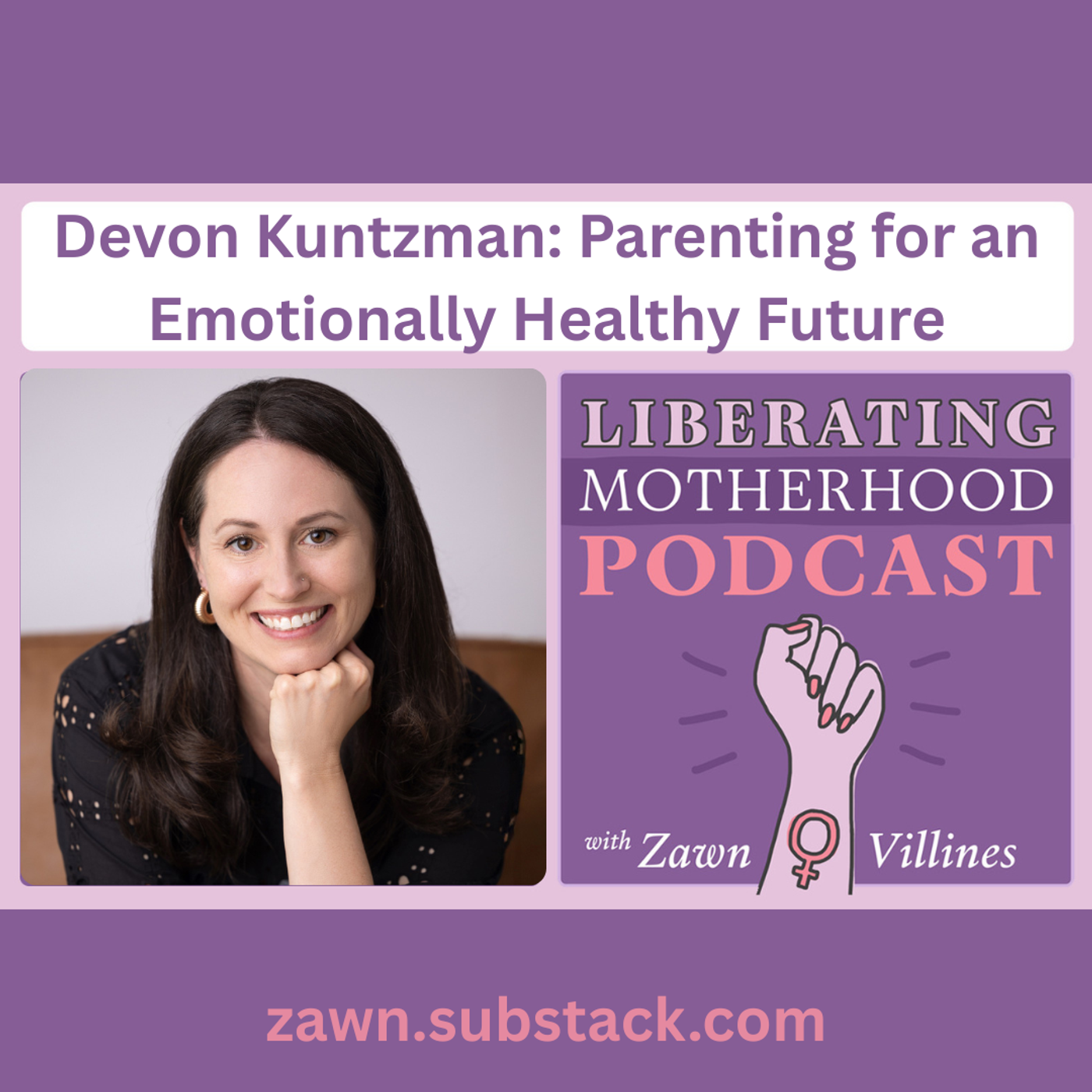
Liberating Motherhood
·S2 E19
S2 Ep19: Devon Kuntzman: Parenting for an Emotionally Healthy Future
Episode Transcript
(00:00:01):
The elephant in the parenting room is male laziness and the misogyny that birthed it.
(00:00:06):
It doesn't matter how many parenting books I read,
(00:00:08):
how diligently I learned to control my emotions,
(00:00:11):
how zealously I regulate my nervous system.
(00:00:14):
It doesn't matter how often I do the right thing if all my husband does is undermine it.
(00:00:18):
I can patiently wade my way through her tantrums,
(00:00:21):
but as soon as this man-child arrives on the scene,
(00:00:24):
he either caves in and gives her what she wants,
(00:00:26):
or starts screaming,
(00:00:27):
yelling,
(00:00:27):
and spanking.
(00:00:29):
And then,
(00:00:29):
no matter what he does,
(00:00:31):
he turns on me next,
(00:00:32):
yelling at me about what a bad parent I am in front of her.
(00:00:36):
This is the reality of literally every woman friend I have.
(00:00:39):
Can we please talk about this reality when we talk about parenting advice?
(00:00:44):
Hi.
(00:00:45):
I'm Zonva Lines,
(00:00:46):
and this is the Liberating Motherhood Podcast,
(00:00:49):
and today we are going to be talking about this reality as well as the more mundane
(00:00:54):
realities of parenting toddlers and preschools who are notoriously difficult,
(00:00:59):
except that our guest today does not think so.
(00:01:03):
We're here today with my guest, Devin Koontzman.
(00:01:05):
Hi, Devin.
(00:01:07):
Hi.
(00:01:07):
Thank you so much for having me.
(00:01:09):
I'm so thrilled to have you here.
(00:01:11):
I was really excited when you reached out to me.
(00:01:13):
And the thing that I love about Devin's work is that there are so many people who
(00:01:19):
claim to be practicing gentle or respectful or authoritative parenting,
(00:01:25):
except they're not gentle or respectful or authoritative with their audience.
(00:01:29):
They're condescending, they're shame-based, and they're often incredibly misogynistic.
(00:01:35):
And I found Devin's work to be a breath of fresh air where that's
(00:01:39):
really not happening.
(00:01:40):
So thank you for creating that space, Devin.
(00:01:42):
Thank you.
(00:01:43):
Thank you for seeing that in my work.
(00:01:46):
So before we get started, I'm going to tell everyone a little bit about Devin.
(00:01:49):
Devin Kunzman,
(00:01:50):
PCC,
(00:01:51):
is the founder of Transforming Toddlerhood,
(00:01:53):
a certified coach,
(00:01:54):
and a mom to a three-year-old.
(00:01:56):
She's on a mission to rewrite the narrative on the terrible twos and beyond,
(00:02:00):
helping parents see toddlerhood as a once-in-a-lifetime opportunity to build
(00:02:04):
social,
(00:02:05):
emotional,
(00:02:05):
and relationship skills.
(00:02:07):
As the original toddler parenting coach on Instagram,
(00:02:10):
with a background in psychology and child development,
(00:02:13):
Devin has guided tens of thousands of families worldwide to parent with more calm,
(00:02:17):
confidence,
(00:02:17):
and joy.
(00:02:19):
Her new book,
(00:02:20):
Transforming Toddlerhood,
(00:02:21):
is designed to support not guilt parents,
(00:02:24):
offering tools,
(00:02:25):
encouragement,
(00:02:26):
and a fresh perspective to turn this challenging season into one of the most
(00:02:29):
meaningful chapters of the parenting journey.
(00:02:31):
And her book will be out October 21st.
(00:02:34):
I will put it in the Liberating Motherhood bookshop,
(00:02:37):
but it's also available wherever you want to buy a book,
(00:02:39):
so you should definitely get it.
(00:02:40):
And Devin, I'm just so grateful that you're here.
(00:02:43):
Thank you so much for having me.
(00:02:44):
I'm so excited to talk to you about this topic.
(00:02:47):
So we're doing something a little bit different for this podcast.
(00:02:50):
I sometimes do a Q&A, and that's how we're going to do it today.
(00:02:53):
I asked you all to give me your questions about parenting toddlers and
(00:02:57):
preschoolers,
(00:02:58):
and you did not disappoint.
(00:03:00):
So I'm going to present them to Devin,
(00:03:04):
not to put her at all on the spot,
(00:03:06):
and we'll see what she comes up with for your real-world parenting challenges.
(00:03:10):
And I think she and I will also talk about how there's
(00:03:14):
always a larger social context for these challenges a little bit.
(00:03:18):
So before we do get started,
(00:03:19):
I want to acknowledge a lot of what our opening vignette nodded to,
(00:03:24):
which is that parenting advice in some ways always involves telling parents,
(00:03:28):
and let's be honest,
(00:03:29):
mothers,
(00:03:29):
that what they're doing is wrong.
(00:03:31):
That's a message we get constantly in our culture.
(00:03:34):
We aspire to perfection.
(00:03:36):
And for many of us,
(00:03:38):
the men around us think they can just show up and yell or show up and do nothing.
(00:03:42):
It's maddening.
(00:03:43):
So if you're in a bad situation with your relationship,
(00:03:46):
as statistically most women are,
(00:03:49):
if you're with someone who undermines your parenting,
(00:03:51):
I want you to know that you are not ruining your children.
(00:03:53):
And I think that's one of Devin's messages is that you don't have to be perfect.
(00:03:57):
This is not your fault.
(00:03:59):
I hope you'll take what is helpful here.
(00:04:00):
And anything that's not, just discard it.
(00:04:03):
All we can do is the best we can with the tools we have.
(00:04:05):
And our goal here today is to offer you a few more tools,
(00:04:09):
not to make you feel worse or more alone or like you're doing it wrong.
(00:04:15):
So with that,
(00:04:15):
Devon,
(00:04:16):
before we get started with specific questions,
(00:04:18):
for readers who are not familiar with you,
(00:04:21):
I wanted to ask you a bit about your general parenting philosophy.
(00:04:25):
I find that it's really easy for parents,
(00:04:27):
myself included,
(00:04:28):
to get caught up in using like a specific script or in parenting in a very
(00:04:33):
aesthetic way or a very specific style.
(00:04:36):
But that's not really what good parenting is about.
(00:04:38):
And we have to be able to be flexible as we learn about our kids' needs.
(00:04:41):
And I like that you are open to that and talk about that.
(00:04:45):
So what would you say is your style?
(00:04:48):
And what would you say are the core principles of good parenting?
(00:04:50):
Yeah.
(00:04:51):
Yeah, thank you so much for asking that.
(00:04:53):
So when it comes to these scripts,
(00:04:55):
it's a double-edged sword because people want to learn a new way of parenting and a
(00:05:01):
new way of speaking with their children and scripts are helpful,
(00:05:05):
but then sometimes we take it too far and feel like it's the only way.
(00:05:09):
And so I love that you mentioned this flexibility because there's many ways to get
(00:05:15):
to the same outcome.
(00:05:17):
And so here at Transforming Toddlerhood,
(00:05:19):
What I'm really focused on is empowering parents to create confidence in their
(00:05:23):
parenting skills whilst dispelling the myth that toddlerhood is terrible because
(00:05:29):
yes,
(00:05:29):
toddlerhood is a very challenging developmental period.
(00:05:33):
And there are times where it is just downright grueling and we feel like we just
(00:05:38):
can't take another day.
(00:05:40):
And at the same time,
(00:05:41):
it's a very critical developmental period that supports your child's brain
(00:05:46):
development and sets the stage and the foundation for the rest of their lives.
(00:05:50):
So how do we balance knowing how important this developmental period is with how
(00:05:55):
challenging it is?
(00:05:57):
So some of our main principles here at Transforming Toddlerhood are that we want to
(00:06:02):
work with development,
(00:06:03):
not against it.
(00:06:05):
So I teach parents how to decode their toddler's behavior and understand what
(00:06:09):
behavior is communicating.
(00:06:11):
So then we can work on addressing not the behavior we see on the surface,
(00:06:16):
but what it actually means or is communicating.
(00:06:19):
And that's how we create transformation.
(00:06:21):
Another core tenant is that practice makes progress, not perfection.
(00:06:26):
It's about the willingness to show up every day and to practice something new,
(00:06:31):
to fall down sometimes,
(00:06:32):
to make mistakes and to try again,
(00:06:35):
knowing that you don't have to be a perfect parent to be a good parent.
(00:06:40):
And I'd say the last principle and the thing that I really want people to take away
(00:06:44):
from the book is this idea that we're all human beings.
(00:06:47):
that you are a human being with feelings, emotions, and needs doing your best every day.
(00:06:52):
And so is your child.
(00:06:54):
So those moments where you feel like your child is having bad behavior,
(00:06:58):
or you feel like that you're failing,
(00:07:00):
these are just our feelings and feelings are signals.
(00:07:04):
They let us know what's happening on the inside, but they definitely are not facts.
(00:07:08):
And so just knowing that you are a human being that's doing their best.
(00:07:13):
And so is your child can go a long way.
(00:07:16):
in working together to have things go differently.
(00:07:19):
I love that.
(00:07:21):
I think that's lovely advice.
(00:07:22):
I think one of the principles I learned early in parenting is I had very good parents.
(00:07:28):
And when I was pregnant, I truly believed that I could be a perfect parent.
(00:07:33):
I remember telling my husband,
(00:07:34):
I can get through all 18 years and I will never yell at our kids because
(00:07:38):
And then, of course, the real children that you have to parent come along.
(00:07:42):
And it turns out that it's very challenging.
(00:07:44):
And the thing that I've reminded myself a lot is that it's good for them to see
(00:07:48):
that I'm human because it shows them how they're affecting other humans.
(00:07:52):
Right.
(00:07:54):
Absolutely.
(00:07:55):
And this is the thing that is really interesting to understand is that parenting is
(00:08:00):
a relationship.
(00:08:01):
It's one type of many relationships that we're in,
(00:08:04):
in our lives and that we definitely impact our children and our children impact us.
(00:08:11):
And this is why we don't really need to,
(00:08:15):
or want to be perfect parents because all of the messy moments or challenging
(00:08:19):
moments that
(00:08:20):
we might look like as problems that need to be fixed are actually opportunities for
(00:08:25):
learning and growth.
(00:08:26):
And in those moments when you're actively working to ground yourself,
(00:08:32):
when you're feeling like you're getting frustrated or triggered,
(00:08:35):
or those moments of taking ownership and repairing the relationship after you yell,
(00:08:41):
those moments of saying out loud what you want to do next time and practicing it,
(00:08:46):
Those moments that you're teaching your toddler new skills,
(00:08:50):
all of these things are showing your child that we don't need to be perfect to be
(00:08:57):
good people.
(00:08:58):
And it's teaching them the skills that they need to be successful in life,
(00:09:01):
the emotional skills,
(00:09:02):
the social skills,
(00:09:03):
the relationship skills,
(00:09:05):
all of the skills that they're going to need to have later in life.
(00:09:08):
And whenever we come at this from a place of perfection,
(00:09:12):
like just pretend,
(00:09:13):
what if we were like robots,
(00:09:14):
right?
(00:09:15):
and did everything perfectly.
(00:09:16):
What kind of standard would we be setting for our children?
(00:09:19):
And how would our children be able to learn all of these skills?
(00:09:24):
Because modeling is one of the most powerful ways that we can teach.
(00:09:28):
Yes, absolutely.
(00:09:29):
All right.
(00:09:29):
So here is our first question, speaking of perfectionism and dealing with challenging behaviors.
(00:09:36):
My daughter is two years and four months and
(00:09:39):
She's borderline autistic,
(00:09:40):
and then she clarifies that what she means by this is that her testing is
(00:09:44):
borderline.
(00:09:45):
Regular parenting advice isn't working to stop her hitting, kicking, and biting.
(00:09:50):
When she hits, kicks, or bites, it is very much a part of communication.
(00:09:53):
It happens when she has appropriately asked for something and then been told no.
(00:09:58):
She might ask a few times in a row before lashing out.
(00:10:01):
If I will do my best to react calmly with a we don't X,
(00:10:04):
then put her on the floor away from me or get up.
(00:10:06):
I've done this so many times, but the behavior continues.
(00:10:09):
It's predictable, and I'm usually able to dodge the bite.
(00:10:13):
How do I get her to stop trying to bite me and beating up on me?
(00:10:17):
I solo parent most of the time with a neglectful,
(00:10:20):
angry,
(00:10:20):
loves-weaponized incompetence husband that I am working on leaving.
(00:10:24):
I wonder if the behavior stems from his lack of consistency with her.
(00:10:31):
That's such a great question.
(00:10:32):
And that's such a hard situation to be in when you feel like you're doing all the
(00:10:36):
things and you've tried all the things and it's just things aren't changing.
(00:10:41):
So I have a lot of empathy for this mama.
(00:10:45):
Whenever I think about
(00:10:48):
discipline and the challenges right because when we it's typical for toddlers to
(00:10:53):
have all these behaviors right to hit kick bite especially whenever they come up
(00:10:57):
against the limit because we're when children come up against the limit they have
(00:11:01):
to work to accept it and they have feelings of disappointment frustration because
(00:11:06):
in toddlerhood they're trying to become their own person and they have their own
(00:11:10):
agenda so when we stop them from executing their agenda by telling them no
(00:11:14):
They get frustrated.
(00:11:16):
And at this age,
(00:11:16):
the best way that they can communicate that is physically through their behavior.
(00:11:21):
And I hear this mama doing so many great things, setting that limit, following through on it.
(00:11:27):
but the behaviors still keep happening.
(00:11:30):
One thing that can be supportive here is getting to the full,
(00:11:37):
what I like to call the full recipe for effective discipline.
(00:11:40):
So focusing on the communication, the connection aspect.
(00:11:45):
And focusing on the teaching skills aspect.
(00:11:50):
So the recipe for healthy,
(00:11:53):
effective discipline is creating connection,
(00:11:55):
setting limits and following through and teaching skills.
(00:11:58):
So one thing that children need a lot of support with, and especially kids who are
(00:12:03):
are testing borderline with autism and on the spectrum is that need a lot of work
(00:12:12):
with skills,
(00:12:13):
sensory regulating skills,
(00:12:14):
emotional regulation skills.
(00:12:17):
And these happen in the calm moments.
(00:12:19):
So reading books about big emotions, practicing different activities that promote
(00:12:26):
breathing,
(00:12:27):
like blowing bubbles,
(00:12:28):
pretending to blow out a candle,
(00:12:30):
belly breaths,
(00:12:31):
listening to short meditations together,
(00:12:34):
starting to introduce these concepts in the calm moments is what's going to help
(00:12:38):
kids.
(00:12:39):
Um,
(00:12:41):
move toward this place of regulation.
(00:12:44):
And when you have a child who's very,
(00:12:46):
very physical with biting and kicking,
(00:12:49):
oftentimes when we want them to jump to just being calm,
(00:12:52):
it's too big of a leap for them,
(00:12:53):
especially at this age and especially kids that might have extra needs.
(00:12:57):
So we,
(00:12:58):
Helping them go from an inappropriate physical outlet to an appropriate physical
(00:13:04):
outlet can be a really great first step.
(00:13:07):
So talking about afterwards, next time you feel this way, what can you do?
(00:13:12):
I won't let you hit me.
(00:13:14):
You can't hit mama.
(00:13:15):
Hitting hurts.
(00:13:16):
You can hit this pillow.
(00:13:18):
You can bite this silicone teether.
(00:13:22):
Giving a
(00:13:23):
a replacement way that's appropriate to get the physical behavior out is a great
(00:13:28):
stepping stone to bridge the gap as you teach more of these coping skills and
(00:13:33):
sometimes getting the support of an occupational therapist that specializes in the
(00:13:37):
sensory system can be extremely supportive of as well in these situations.
(00:13:43):
I love this advice.
(00:13:44):
And I especially love that you mentioned the sensory bit.
(00:13:47):
Um,
(00:13:48):
you know,
(00:13:48):
when I first started learning about sensory needs,
(00:13:51):
I have to admit that I was like kind of dismissive about it.
(00:13:53):
I thought,
(00:13:54):
well,
(00:13:54):
you know,
(00:13:54):
there are other things that come before this and,
(00:13:56):
you know,
(00:13:57):
it's emotional connection and all of that.
(00:13:58):
And it really took a long time for me to understand how prominently this sensory
(00:14:03):
stuff figures,
(00:14:05):
I think to some extent with all children,
(00:14:07):
but especially with some neurodivergent kids.
(00:14:10):
So I love the alternative of giving like a pillow or a sensory chew or something.
(00:14:14):
And I just want to
(00:14:16):
add too, and you touched on this a little bit, Devin, this is a really young kid.
(00:14:21):
This is effectively a baby.
(00:14:23):
And I think in parenting,
(00:14:25):
we have so many expectations and so much pressure placed on us that I often wonder
(00:14:31):
if our problems with our kids are really problems of
(00:14:35):
External worries.
(00:14:37):
What's going to happen if she keeps doing this?
(00:14:39):
What are people going to think of me?
(00:14:41):
So two years and four months fighting.
(00:14:43):
This is just like a thing little people do.
(00:14:47):
Doesn't mean you have to accept it,
(00:14:48):
but it doesn't necessarily mean that there's anything wrong with her or with you.
(00:14:53):
Absolutely.
(00:14:54):
I think that is so beautifully said because we get so wrapped up in the what ifs.
(00:14:59):
What if this continues?
(00:15:01):
What if this escalates?
(00:15:02):
What if this never goes away?
(00:15:04):
And then it creates this false sense of urgency to, quote unquote, fix a problem.
(00:15:10):
And that's why...
(00:15:11):
In my book, Transforming Toddlerhood, I spent a lot of time talking about the sensory system.
(00:15:17):
I have a whole chapter dedicated to the sensory system and behavior red flags
(00:15:21):
throughout the book to help parents understand what is typical behavior and what is
(00:15:26):
behavior that may be outside the typical realm and how to also use sensory
(00:15:32):
strategies and
(00:15:33):
in different situations to support a child because a child can be emotionally
(00:15:38):
overwhelmed and they can also be sensorily overwhelmed.
(00:15:41):
And toddlers at this age, their sensory system is still developing.
(00:15:46):
And so there's a lot of things that the sensory system can cause an impact,
(00:15:53):
even if you do have a neurotypical child.
(00:15:56):
All right.
(00:15:58):
Our next one is this.
(00:16:01):
My four-year-old curls up in a ball and moves away from me when she's upset.
(00:16:06):
She will shout at me that she doesn't want to hug or for me to say anything or to
(00:16:09):
touch her or anything.
(00:16:11):
But of course, I'm also not allowed to leave her.
(00:16:14):
She says nothing will help her and sobs and sobs.
(00:16:17):
It makes me sad in the moment that I can't work out how to help her,
(00:16:20):
but I'm also worried for the future.
(00:16:22):
How can I help her accept help or love when she's upset or angry at someone?
(00:16:27):
I don't discount her feelings,
(00:16:29):
and we can have good conversations about what she was feeling at a later time.
(00:16:33):
I found the book How to Talk So Kids Will Listen a great start,
(00:16:36):
and the suggestions have worked really well for my other two kids,
(00:16:39):
but I haven't been able to work through this particular challenge with this child
(00:16:42):
yet.
(00:16:44):
Yeah, this is such a great question.
(00:16:47):
So a lot of times children between the ages one and four have competing needs.
(00:16:53):
So they want to be left alone because they're trying to be an independent
(00:16:58):
individual,
(00:16:59):
but they also want you nearby.
(00:17:01):
And these competing needs can be really frustrating and confusing for both kids and
(00:17:06):
their parents.
(00:17:07):
And so this is why sometimes you see children pushing us away and
(00:17:12):
and also wanting us nearby.
(00:17:14):
At the same time,
(00:17:15):
when you have a highly sensitive child,
(00:17:17):
sometimes there can be a lot of shame and embarrassment around big feelings.
(00:17:22):
There's a lot of self-judgment and things of this nature that tends to happen when
(00:17:28):
children are more highly sensitive.
(00:17:31):
And so that could be part of what's happening there as well.
(00:17:34):
But I think that the most important thing is, is that
(00:17:39):
Validating your child's feelings and emotions and saying, you feel like nothing will help.
(00:17:45):
I hear you because sometimes kids just need us to see them and to hear them.
(00:17:51):
And to let them fully release all of those feelings and emotions,
(00:17:55):
even though for us,
(00:17:57):
it can be so hard to hold space for the full spectrum of emotions,
(00:18:01):
so hard to see our children upset.
(00:18:04):
And when we give the space for the full emotional release without making it right
(00:18:09):
or wrong or trying to fix the problem,
(00:18:11):
I'm using air quotes here,
(00:18:13):
you know,
(00:18:14):
fix a problem,
(00:18:15):
then
(00:18:16):
something beautiful can really start to happen there.
(00:18:19):
And absolutely, this mama is having these conversations in the calm moment.
(00:18:24):
So continue working on skills,
(00:18:27):
having conversations about feelings and emotions,
(00:18:31):
and reading books about big feelings and emotions in the calm moments,
(00:18:35):
because this is how we increase emotional resilience and learn skills.
(00:18:41):
This is great.
(00:18:42):
So I was a child like this.
(00:18:43):
I was an, you know, I hate you don't leave me sort of child.
(00:18:47):
And I definitely agree.
(00:18:48):
I think there's a lot of shame.
(00:18:49):
I think there's a sensitivity component there and just getting overwhelmed.
(00:18:53):
You know,
(00:18:54):
the other thing I would say is I think it's so great that you're able to talk
(00:18:58):
through her,
(00:18:58):
through this with her outside of those moments.
(00:19:01):
You know, our kids don't have to react in the textbook way.
(00:19:05):
And there's no rule that you have to talk about
(00:19:08):
the things she's upset about when it's happening and what she's showing you is she
(00:19:12):
can't talk about it yet.
(00:19:14):
I think it seems to me like this mom is already handling this great and it's just
(00:19:19):
worried that she's not doing enough,
(00:19:20):
but I think she's doing wonderfully.
(00:19:23):
Absolutely.
(00:19:23):
It's all a lot of parenting is about recalibrating our expectations.
(00:19:28):
Yeah, absolutely.
(00:19:31):
All right.
(00:19:31):
Let's see.
(00:19:32):
I, I think this is from the same mom that,
(00:19:35):
as the first question, because it's a lot of similar details.
(00:19:38):
Here's what she says.
(00:19:39):
I am self-employed working from home with my daughter,
(00:19:42):
two years,
(00:19:42):
four months in early headstart for six hours a day,
(00:19:45):
four to five days a week.
(00:19:47):
I only get a few hours to work because of the travel time to and from her school.
(00:19:52):
I do my best to only work in the evenings after she is asleep,
(00:19:55):
but sometimes she doesn't go to sleep until it is my bedtime.
(00:19:57):
Oh God, poor thing.
(00:19:59):
Sometimes she is off Fridays or Mondays,
(00:20:01):
and sometimes I have to finish projects over the weekend.
(00:20:03):
When I have to work,
(00:20:04):
I use Miss Rachel and several other similar programs in English and Spanish to keep
(00:20:08):
her from continually interrupting me.
(00:20:11):
Is TV time really that bad?
(00:20:13):
She is hitting all of her milestones and is ahead of most her age.
(00:20:16):
She can even count to 20 in English, 10 plus in Spanish, and knows most of her letters.
(00:20:21):
She does have symptoms of autism.
(00:20:23):
I see all the time that TV is so bad, but am I really harming her?
(00:20:28):
Such a great question.
(00:20:30):
I think screen time is one of the biggest challenges that we have to navigate as
(00:20:34):
parents in today's world.
(00:20:36):
And it's often really emotionally charged and can bring up a lot of feelings of guilt.
(00:20:42):
I talk a lot about screen time in my book and have a chapter dedicated to it
(00:20:45):
because it's such an important topic where I present a lot of research.
(00:20:49):
And it's amazing that this little one's hitting all of her milestones.
(00:20:52):
And the thing is, is that
(00:20:55):
What I like to talk about is creating healthy screen time habits,
(00:20:59):
which is going to look different for every family because every child is unique.
(00:21:04):
Some children are going to be more sensitive to screens than others.
(00:21:08):
Definitely the younger a child is.
(00:21:12):
less screen time is better because there's more than a million neuropathways and
(00:21:16):
connections being made every second in the first three years of life.
(00:21:20):
And the pathways that are used the most are the ones that get wired and the ones
(00:21:24):
that are used less,
(00:21:25):
um,
(00:21:26):
are being used less.
(00:21:28):
And so they get pruned away.
(00:21:31):
And we know that screens can stimulate the reward pathways in the brain.
(00:21:35):
Um,
(00:21:36):
That being said,
(00:21:37):
though,
(00:21:37):
that sometimes it's not about hitting milestones,
(00:21:40):
like being able to,
(00:21:42):
you know,
(00:21:43):
hit your speech milestones and things like that.
(00:21:45):
Sometimes there is a sensory component where screens just are overstimulating for
(00:21:50):
some kids and can cause more power struggles,
(00:21:53):
tantrums and meltdowns throughout the day.
(00:21:56):
And it's a cumulative effect.
(00:21:57):
And parents don't realize that that's what's happening until they take screen time
(00:22:01):
away for a few weeks.
(00:22:02):
and then see a drastic change in their child's behavior.
(00:22:05):
So again,
(00:22:06):
what you want to do is look at your unique child and see what,
(00:22:10):
and get curious about what is the impact here,
(00:22:13):
what's happening with screens.
(00:22:14):
And then also whenever you're deciding to use screens,
(00:22:17):
it's also about balancing it out with other activities.
(00:22:21):
How much time is your kiddo getting to spend like outside in nature?
(00:22:25):
How much time are you spending reading together?
(00:22:27):
And so make sure that you can do other activities at times that help counterbalance
(00:22:32):
being on screens.
(00:22:33):
And also one other thing is that some kids with sensory challenges have
(00:22:39):
actually find screens very calming at the same time.
(00:22:43):
So that's why there's no right one size fits all approach for screens for children.
(00:22:49):
We have to take the research and then we have to look at our unique child to
(00:22:53):
understand the impact and create healthy habits for our families.
(00:22:58):
I agree with this.
(00:22:59):
They're individuals.
(00:23:00):
They're people just like us.
(00:23:01):
Shocking.
(00:23:01):
I know.
(00:23:04):
Imagine that.
(00:23:05):
Imagine.
(00:23:06):
So I will say we were, my husband and I, we actually didn't have a TV for years.
(00:23:11):
We were diehard anti-TV for all children for years.
(00:23:17):
And then we sort of started experimenting with screens.
(00:23:20):
And what we found is that we have one child who really benefits from watching TV
(00:23:25):
and watching larger quantities of TV than I would have ever been comfortable with.
(00:23:30):
It's soothing for her.
(00:23:31):
She does other interesting things while she's doing it.
(00:23:34):
And then we have another child who turns into Satan if she watches any television at all.
(00:23:39):
So, you know, a little hard to manage in the same house, but you just have to kind of see.
(00:23:46):
I also think,
(00:23:47):
you know,
(00:23:47):
like so many of these parenting questions,
(00:23:50):
there's kind of some other hidden problems here.
(00:23:52):
And one is the childcare piece.
(00:23:55):
Um,
(00:23:56):
you know,
(00:23:57):
I have seen with mothers,
(00:24:00):
first of all,
(00:24:00):
child care is inaccessible to many and unaffordable to many and all of that.
(00:24:05):
So if that's what's going on here, you know, that's what's going on.
(00:24:08):
And there may not be anything you can do about it,
(00:24:10):
but you may want to explore like trading out with a neighbor,
(00:24:14):
you know,
(00:24:14):
seeing if you can do kind of like a co-op thing with friends,
(00:24:17):
whatever you can do to get some child care.
(00:24:19):
But then I also know moms who just feel so guilty about using child care and they
(00:24:24):
think that they
(00:24:25):
have to be with their child every second that they're able to be.
(00:24:29):
And, you know, no one ever expects dads to work without child care.
(00:24:34):
So I would look into the child care piece.
(00:24:37):
And I would also say that like some parenting is harm reduction.
(00:24:41):
So even let's say we decide for this particular child that screens are not great.
(00:24:47):
That doesn't necessarily mean we have to have an absolute no on screens because
(00:24:51):
she's got a mother who has to work.
(00:24:53):
And like working and making money is a need too.
(00:24:56):
So I feel like I am sensing some like ambivalence about work and childcare wrapped
(00:25:03):
up in this question.
(00:25:05):
Yeah, absolutely.
(00:25:06):
I really probably should just correct myself and rephrase is that child care is
(00:25:11):
probably one of the biggest challenges we're going to face as parents of young
(00:25:16):
children.
(00:25:17):
Screen time and screens in general are probably the largest challenge we'll face
(00:25:23):
over the lifespan of being a parent.
(00:25:25):
But definitely child care in the early years.
(00:25:28):
And I've even had my fair share of
(00:25:30):
of childcare challenges and also the guilt associated with using, um, childcare.
(00:25:37):
And so I can really,
(00:25:39):
really empathize,
(00:25:41):
um,
(00:25:41):
with parents in these,
(00:25:43):
in these situations and in these moments.
(00:25:45):
And I think one big concept to keep in mind when it comes to parenting is what we
(00:25:51):
want to do is work on meeting our child's needs within our boundaries,
(00:25:56):
but for something to be working and
(00:25:59):
We need to,
(00:26:00):
it needs to be working for our child and to be working for us,
(00:26:04):
but that doesn't mean it has to be perfect.
(00:26:06):
So that might mean that there's times when we use a screen because we need to meet our needs.
(00:26:13):
But then there's other times where we go outside or read books because we're
(00:26:17):
meeting our child's needs and that,
(00:26:20):
you know,
(00:26:20):
a lot of parenting is balancing everyone's needs and everyone's needs might not
(00:26:25):
always be perfectly met.
(00:26:27):
every moment.
(00:26:28):
And that's part of that.
(00:26:30):
Finding that balance is just knowing that sometimes one person's needs have to be
(00:26:35):
prioritized over the others.
(00:26:37):
Totally.
(00:26:38):
All right.
(00:26:38):
This one made me laugh out loud because this question is like the story of my
(00:26:42):
entire life as a parent and like every other parent I know.
(00:26:46):
Here's what she says.
(00:26:48):
My toddler does something I've begun to think of as the Hunger Games.
(00:26:52):
She gets a snack, eats a bite,
(00:26:54):
says she's not hungry anymore, then five minutes later, she wants another snack.
(00:26:58):
This can go on for hours.
(00:27:01):
I understand the rules about parents offering food and kids deciding what to eat
(00:27:04):
and not using foods as rewards and all of that,
(00:27:07):
but this is taking up so much of my life.
(00:27:10):
It's a huge demand on my time,
(00:27:11):
a huge amount of intellectual labor,
(00:27:13):
and to me feels like setting her up for really disordered eating.
(00:27:17):
I never knew how angry the phrase, I'm still hungry, could make me.
(00:27:22):
What should I do?
(00:27:25):
It's so challenging.
(00:27:27):
Whenever,
(00:27:28):
whenever it comes to kiddos,
(00:27:31):
and,
(00:27:32):
you know,
(00:27:33):
their food preferences and picky eating and all of the things,
(00:27:37):
there's so many emotions.
(00:27:39):
in our own stories tied up into food and what we feed our children.
(00:27:44):
In situations like this, there's a couple of things that we can do.
(00:27:47):
It might be that there needs to be a little more structure around meals and snacks.
(00:27:53):
So maybe it is like implementing some type of structure,
(00:27:57):
which will be hard at first because children don't like change.
(00:28:00):
Quite frankly, no one really likes change, right?
(00:28:03):
We all kind of like
(00:28:04):
You know, changes is part of the unknown and the unknown can feel scary sometimes.
(00:28:09):
So oftentimes when toddlers meet a limit in an area that there previously wasn't a
(00:28:15):
limit,
(00:28:15):
they're going to have a pretty big reaction,
(00:28:17):
whether it's crying,
(00:28:18):
screaming,
(00:28:19):
yelling,
(00:28:19):
kicking,
(00:28:20):
hitting,
(00:28:20):
whatever it might be,
(00:28:22):
because they're releasing their emotions about it.
(00:28:24):
And there's a little bit of hope that the outburst might change things.
(00:28:28):
So the number one rule with setting limits is only set the limits you're willing to
(00:28:32):
follow through on.
(00:28:34):
So I wanna recognize that if you decide to start setting limits around snacks,
(00:28:38):
which might be setting out the snacks for the day in the morning and your child
(00:28:44):
choosing to eat them whenever she wants and then learning to like regulate herself
(00:28:48):
with like these are the snacks or whether that is in the morning waking up,
(00:28:53):
choosing what the morning snack it will be in the afternoon snack.
(00:28:57):
And then letting those snacks be the snacks and not bringing out more snacks until
(00:29:02):
those ones are gone and have been eaten.
(00:29:05):
Same thing with a meal.
(00:29:06):
Like if my child sits down to a meal and he eats like two bites and says he's not
(00:29:11):
hungry,
(00:29:11):
I got him down from the table.
(00:29:14):
But then...
(00:29:16):
15 minutes later, when he says he's hungry, I say, oh, good.
(00:29:18):
I'm so glad you're hungry.
(00:29:20):
Your food's still at the table for you.
(00:29:22):
First couple of times, there was, you know, a lot of pushback.
(00:29:26):
The other day, we had a 10-minute meltdown because he didn't eat his lunch.
(00:29:29):
It was 3 p.m.
(00:29:31):
And I served him his lunch again.
(00:29:32):
And he really wanted snacks.
(00:29:34):
And after the 10-minute meltdown,
(00:29:36):
he ate the rest of his lunch,
(00:29:37):
not all of it,
(00:29:38):
said his belly was full and forgot he even asked for a snack.
(00:29:40):
Yeah.
(00:29:41):
Um, he's three years and two months.
(00:29:44):
So anyways,
(00:29:46):
it can be challenging to get over the hump of setting those first limits and
(00:29:50):
creating that first structure because there will be pushback,
(00:29:53):
but then life gets immensely easier once the structure is in place and everyone
(00:29:58):
understands the structure.
(00:30:00):
So I,
(00:30:01):
I love it that you mentioned structure because I have become sort of a structure
(00:30:06):
zealot in recent years.
(00:30:08):
And I,
(00:30:09):
I kind of want to talk to you a little bit about this and get your thoughts because
(00:30:14):
I've come to believe that all children just really do better with structure.
(00:30:18):
And the harder it is for a family to implement structure, kind of the more they need it.
(00:30:24):
I often find that my neurodivergent friends say,
(00:30:29):
well,
(00:30:29):
you know,
(00:30:29):
my kid really doesn't do well with structure.
(00:30:31):
And what they really mean is that it's really hard for them to implement structure.
(00:30:35):
And there's also kind of this notion that like structure means rigidity.
(00:30:39):
It means being punitive and aggressive and mean, but it's not.
(00:30:43):
It's just like helping kids know what to expect throughout the day.
(00:30:46):
So can you talk a little bit more about this structure component and kind of
(00:30:51):
setting up like the infrastructure of your family for success?
(00:30:54):
Yeah, well, structure is very important because especially the younger a child is.
(00:31:00):
But of course, structure is really important also for older children, too.
(00:31:04):
But it creates a sense of safety and security, just like limits do.
(00:31:09):
Because if there's not a limit,
(00:31:12):
if there's not structure,
(00:31:13):
sometimes that gives kids too much power.
(00:31:16):
And yes, kids crave a sense of control.
(00:31:20):
They crave having power,
(00:31:22):
but when they're too powerful,
(00:31:23):
behaviors tend to snowball because they're looking for that limit or they're
(00:31:27):
looking to come up against that structure.
(00:31:29):
So what I like to say in terms of structure is that
(00:31:35):
you want to have freedom within boundaries.
(00:31:37):
You want to let your child say you have a strong willed child,
(00:31:40):
you need to set the boundaries,
(00:31:41):
but then give them option and choices within those boundaries.
(00:31:45):
So then they have a sense of control, but you've created the boundary for it.
(00:31:50):
Or whenever it comes to your day,
(00:31:53):
like the way your day goes,
(00:31:55):
instead of thinking of a rigid schedule,
(00:31:57):
it's more of like a daily rhythm.
(00:31:59):
That one thing follows the next thing within a general timeframe.
(00:32:04):
Because remember, it doesn't have to be perfect.
(00:32:08):
It doesn't have to be like military precision.
(00:32:11):
It needs to be predictable.
(00:32:14):
More often than not, it's predictable that you're going to respond in a certain way.
(00:32:19):
more often than not, it's predictable that something's going to happen.
(00:32:23):
It doesn't have to be perfect.
(00:32:24):
There's always room for spontaneity and surprises.
(00:32:29):
And of course, life's curve balls as they always come.
(00:32:32):
Um,
(00:32:33):
so some places that we can implement structure is in different routines,
(00:32:37):
like morning routines,
(00:32:39):
evening routines,
(00:32:41):
um,
(00:32:43):
structure around food and meals,
(00:32:46):
structure around daily tasks or chores that we do in the home together as a family.
(00:32:54):
Even structure around things like who's putting the kids to bed,
(00:33:00):
who's,
(00:33:00):
you know,
(00:33:01):
like maybe parents might rotate and there's a structure for that,
(00:33:04):
or who's going to choose the movie for movie night.
(00:33:08):
And then it's rotating and there's a structure there.
(00:33:10):
So there's a lot of different opportunities and
(00:33:12):
to create structure but again structure um means that something is predictable it's
(00:33:19):
not necessarily rigid yeah i think that's i think that's wonderful all right i
(00:33:25):
actually dealt with this myself this week so i'm eager to hear what you think um
(00:33:30):
what tips tricks and child honoring perspectives do you have about helping littles
(00:33:34):
take medicine i'm all about body autonomy so for the most part we just skip it if
(00:33:39):
she says no
(00:33:40):
Fortunately,
(00:33:41):
the time we had antibiotics,
(00:33:42):
it miraculously went pretty smoothly most of the time.
(00:33:46):
But now she's recently been sick with a fever of upwards of 104,
(00:33:49):
and none of us got decent sleep for a few nights in a row when she refused to take
(00:33:53):
any medicine,
(00:33:54):
poor kid.
(00:33:55):
Do you have any special strategies or sanity-saving mantras for parents?
(00:34:00):
Oh, well, sanity-saving mantras.
(00:34:03):
So we have to understand that no matter what we think or our brains try to trick us
(00:34:10):
into thinking,
(00:34:11):
control is an illusion.
(00:34:14):
We cannot control another individual.
(00:34:17):
And we spend a lot of parenting fighting against that and trying to control our
(00:34:23):
child,
(00:34:24):
trying to control our parenting partner.
(00:34:27):
When really the only person we can control is ourselves.
(00:34:30):
And quite frankly, that's challenging at times, right?
(00:34:34):
So that controls an illusion would be my first mantra.
(00:34:38):
Second,
(00:34:40):
when it comes to medicine,
(00:34:42):
it can be challenging,
(00:34:43):
especially if you have a highly sensitive child.
(00:34:46):
Some, and especially in toddlerhood, when kids push back against the things that we think.
(00:34:50):
So I'm going to give some quick tips here.
(00:34:53):
The first is, if your child refuses the medicine once, don't give up, try again.
(00:34:59):
There are some like a chewable medicine for when my son is sick.
(00:35:05):
That he refused.
(00:35:06):
And I thought, oh my gosh, he's never gonna take this.
(00:35:09):
Two months later, he got sick again.
(00:35:10):
I gave it to him.
(00:35:11):
Now he thinks it's like candy.
(00:35:13):
He like thinks it's the best thing ever.
(00:35:15):
And he's asking for it now that he's better.
(00:35:17):
And I would have never thought in a million years he'd ever accept to chew this medicine.
(00:35:21):
So just because your child rejects it once,
(00:35:24):
doesn't mean that they're always going to reject it.
(00:35:27):
So just like with new foods, exposure counts.
(00:35:30):
And sometimes we need lots of exposures, 20 plus exposures before a child will say yes.
(00:35:36):
And then try to make it, try to reduce the pressure.
(00:35:40):
So put the medicine out, but then like walk away.
(00:35:45):
Go get involved in something else and see if your child gets curious and comes back to it.
(00:35:50):
Do your best to hide it in something else.
(00:35:52):
Even if it's something you might not typically give your child,
(00:35:55):
like potentially,
(00:35:57):
I'm trying to think of something that might have a stronger flavor,
(00:36:00):
like chocolate pudding.
(00:36:02):
My child does not like chocolate, so that would not work for us.
(00:36:05):
But something that has like a stronger flavor that your child might be enticed to eat or drink.
(00:36:12):
And then I would say in the end,
(00:36:15):
bodily autonomy is so important and it's our job to keep our kids healthy and safe.
(00:36:22):
So sometimes we have to cross our child's bodily autonomy.
(00:36:26):
for things like proper use of antibiotics per se,
(00:36:30):
like,
(00:36:30):
because you don't want to create antibiotic resistance,
(00:36:33):
right?
(00:36:34):
But maybe when it comes to something like a fever,
(00:36:36):
and if the fever,
(00:36:39):
you know,
(00:36:39):
isn't too high and not,
(00:36:41):
you know,
(00:36:42):
causing seizures or something like this,
(00:36:44):
maybe you can use some other
(00:36:46):
home remedies to try to reduce the fever,
(00:36:49):
such as,
(00:36:50):
you know,
(00:36:50):
a cool washcloth,
(00:36:52):
different things like that,
(00:36:53):
that can help reduce the fever until your child's willing to accept it.
(00:36:58):
So as parents,
(00:36:59):
these are some of the tough decisions that we have to make in terms of when is it
(00:37:05):
absolutely necessary to cross our child's bodily autonomy to keep them safe and
(00:37:10):
healthy.
(00:37:11):
Yeah, I think that's I think that's great advice.
(00:37:13):
You know,
(00:37:15):
I think here again,
(00:37:16):
we see that sometimes needs are in conflict and sometimes you both want to respect
(00:37:20):
your child's bodily autonomy and maybe they have a serious infection and we also
(00:37:25):
want to respect their continuing to live.
(00:37:27):
So it comes down to, you know, which is the higher value right now?
(00:37:34):
Absolutely.
(00:37:34):
And maybe it's also changing the format.
(00:37:37):
Some parents might have trouble giving like a liquid suspension,
(00:37:41):
but if you can get a pill and crush it up and hide it in something that might go
(00:37:45):
down better.
(00:37:46):
And I think that doctors and pharmacists automatically assume that
(00:37:50):
that a flavored liquid is like what kids will want.
(00:37:53):
But sometimes a flavored liquid is way harder to hide in something than a crushed up pill.
(00:37:58):
So always ask about your options as well,
(00:38:00):
because sometimes there's options there that we didn't know about.
(00:38:05):
And until we ask.
(00:38:07):
I also really like your advice about exposures and to keep trying.
(00:38:11):
And I feel like this is something I do as a parent,
(00:38:14):
but I've never really thought very consciously about it.
(00:38:17):
But I
(00:38:17):
I do feel like I see a lot of people say,
(00:38:19):
well,
(00:38:19):
he said no one time and that's like a no forever.
(00:38:23):
But I've got a kid who will,
(00:38:25):
you know,
(00:38:25):
say that something is a hell no and,
(00:38:27):
you know,
(00:38:28):
that she's going to get us if we make her do it.
(00:38:31):
And then like the next time we offer it, she's totally fine.
(00:38:34):
So you just, you never know what you're going to get.
(00:38:36):
Yeah.
(00:38:37):
Because a lot of our children's reaction has to do with,
(00:38:41):
you know,
(00:38:42):
how,
(00:38:43):
how are they doing in that moment?
(00:38:46):
How are their emotions doing?
(00:38:48):
How are their basic needs going?
(00:38:50):
Are they hungry?
(00:38:51):
Are they tired?
(00:38:52):
How's their sensory system doing in their sensory needs?
(00:38:55):
Um, how are their developmental needs going right now?
(00:38:58):
Have they felt empowered today?
(00:39:00):
Have they felt a sense of control or have they felt like everything's happening to
(00:39:04):
them and they haven't had any control over their lives that day?
(00:39:07):
So that a lot of, um,
(00:39:10):
Those things factor into how our child responds in any given moment.
(00:39:15):
But you could ask the same thing sometimes five minutes later and get a completely
(00:39:19):
different answer.
(00:39:20):
Or you just leave something out where your child is like, no, no, no.
(00:39:24):
You walk away and then they're doing the thing they just said no to because it's
(00:39:28):
like almost like they need to reserve the right to say no.
(00:39:31):
And once they know their voice has been seen and heard, then they're fine doing the thing.
(00:39:35):
Yeah, I think that's great.
(00:39:36):
All right.
(00:39:38):
The next one.
(00:39:39):
All she says is how can I support my son with his fears about being dead?
(00:39:45):
Yes.
(00:39:46):
Well,
(00:39:46):
it's challenging for me to answer that question without knowing an age,
(00:39:49):
because there are different.
(00:39:54):
When we talk about death, we want to talk about death in a way that's concrete and
(00:39:59):
with young children,
(00:40:00):
but we don't want to give more details than what they can handle or that is
(00:40:07):
developmentally appropriate.
(00:40:09):
And so it would be helpful to know the child's age.
(00:40:11):
But what I would say is that the biggest thing is getting curious with any
(00:40:17):
challenging conversation.
(00:40:19):
Any of those conversations that were like, oh my gosh, how do we talk about this?
(00:40:22):
What are we going to do?
(00:40:23):
Those things that feel really big and heavy, getting curious.
(00:40:28):
Where did you hear this?
(00:40:29):
What do you think about that?
(00:40:31):
How does that make you feel?
(00:40:34):
Tell me more.
(00:40:35):
I'd love to understand this,
(00:40:37):
you know,
(00:40:38):
so just like getting curious,
(00:40:40):
but then getting curious and curious and curious because sometimes we got it.
(00:40:44):
It's like peeling back the layers of an onion, right?
(00:40:46):
Like we got,
(00:40:47):
we can't just get curious once we've got to like continue the conversation to kind
(00:40:51):
of get in there.
(00:40:53):
And then from there,
(00:40:55):
that can help us understand where our child's head is at,
(00:40:59):
what they're thinking and feeling,
(00:41:01):
and then better equipped to address what's happening.
(00:41:04):
But typically kids need a lot of love and reassurance in these moments.
(00:41:09):
However, some kids can have anxiety and
(00:41:14):
and can have other challenges.
(00:41:15):
And so then they'll get stuck on something and start to ruminate on it.
(00:41:19):
And this is when it's supportive to get the support of a child therapist to support
(00:41:28):
because sometimes it's actually something more that's happening that is beyond what
(00:41:34):
we may have the capacity to fully support and resolve on our own as parents.
(00:41:38):
And there's never any shame in asking for support.
(00:41:43):
I love that.
(00:41:43):
I think that's great advice.
(00:41:46):
We've had to deal with this a lot in our family because we've had a lot of death in our family.
(00:41:51):
Our second daughter died a year to the day before my mom died.
(00:41:56):
And so our oldest was plagued with all kinds of anxieties and fears about death.
(00:42:02):
And, you know, it left us with some ideas about how to address it.
(00:42:06):
So what I would say is that, you know,
(00:42:09):
I think part of why it's hard for us to talk to our children about death is that
(00:42:12):
it's hard for us as adults to think about death.
(00:42:16):
And I think maybe getting clear about your own values and your own attitudes and
(00:42:20):
making sure that you don't bring your own panic about death into those
(00:42:24):
conversations.
(00:42:26):
You know,
(00:42:26):
I know a lot of people find it's easy to fall back on their spiritual beliefs and
(00:42:31):
there's
(00:42:32):
You know, nothing inherently wrong with that.
(00:42:34):
But if that's your sole source of comfort,
(00:42:37):
it can become a problem if your child rejects those beliefs because then they also
(00:42:41):
will not get any of the comfort those beliefs offer.
(00:42:45):
So for us, what we have done is we offer a lot of reassurance.
(00:42:50):
We try to understand what our kids are feeling.
(00:42:53):
And I've been asking my kids to think about life before birth.
(00:42:56):
That wasn't that bad, right?
(00:42:57):
We don't remember anything terrible about that.
(00:43:00):
Well, as far as we know, being dead is about the same.
(00:43:02):
And that seems to have been really helpful to them.
(00:43:05):
You know, your mileage may vary.
(00:43:07):
Every child is different.
(00:43:09):
And I would just also add that, you know, fears of death are usually really fears of separation.
(00:43:15):
They're fears of being away from their parents, from people they love, of the unknown.
(00:43:20):
So I make sure to reassure my kids about this and to tell them that my love and the
(00:43:25):
things that I have taught them will always be with them and that the people who
(00:43:29):
love them are doing everything they can to be with them.
(00:43:32):
And we talk a little bit about legacy too,
(00:43:34):
that,
(00:43:35):
you know,
(00:43:35):
legacy is what we build and how we live on through the good things that we do.
(00:43:39):
This isn't going to work with a two-year-old,
(00:43:41):
but it will often work really well with a four or five-year-old.
(00:43:44):
So you just got to scale up or scale down based on your kids' needs.
(00:43:47):
And no, your kid talking about death, don't let it panic you.
(00:43:51):
Because I think as soon as kids start talking about being dead,
(00:43:54):
parents start picturing their kids being dead.
(00:43:56):
And it becomes very hard for us to think rationally about how to respond.
(00:44:00):
Yeah.
(00:44:02):
Absolutely.
(00:44:03):
It,
(00:44:04):
because there's a lot of our own fears wrapped up in this and there's going to be
(00:44:09):
things that happen,
(00:44:10):
whether it's your pet dying or even a friend's pet.
(00:44:14):
Oftentimes there's always opportunities to have these conversations and start
(00:44:20):
bridging this topic.
(00:44:21):
And often I, you know,
(00:44:23):
recommend,
(00:44:25):
you know,
(00:44:26):
it's not that you necessarily want to put ideas into your child's head,
(00:44:29):
but also talking about things when they happen and not avoiding it because you're
(00:44:34):
afraid.
(00:44:35):
It's actually best because just because a child doesn't ask a question when they hear about
(00:44:44):
maybe like a pet dying or a family member dying or a miscarriage or something like
(00:44:48):
this,
(00:44:49):
just because they don't voice their thoughts and questions doesn't mean they don't
(00:44:54):
have thoughts and questions and feelings about it.
(00:44:56):
Yeah.
(00:44:57):
The avoidance bit, I think is really important.
(00:45:00):
We had an experience when my oldest was in kindergarten where her teacher's child died and the
(00:45:08):
Obviously, horrifically tragic for the teacher.
(00:45:12):
But none of the parents told their children what had happened except for us.
(00:45:16):
And none of them went to the funeral.
(00:45:18):
And I thought, this is a pretty safe exposure to death.
(00:45:22):
This is someone that they don't know.
(00:45:23):
It's someone who's, you know, the teacher's child, but not an actual child.
(00:45:28):
And,
(00:45:28):
you know,
(00:45:28):
this is a good introduction into how we can show up to support grieving people and
(00:45:33):
how we can talk about these things.
(00:45:36):
And,
(00:45:36):
you know,
(00:45:37):
instead,
(00:45:37):
the lesson that these kids learned is,
(00:45:39):
you know,
(00:45:39):
you just hide from it and you don't show up to support the person.
(00:45:42):
And I just I thought that was terrible.
(00:45:43):
Mm hmm.
(00:45:45):
Yeah, absolutely.
(00:45:47):
And I think I was actually just at a funeral the other day and there were a lot of
(00:45:52):
one and two year olds there.
(00:45:54):
It was their great grandfather who passed away.
(00:45:56):
And I was so excited to see all of those kiddos there because,
(00:46:01):
you know,
(00:46:02):
I think we want to protect our kids,
(00:46:04):
but somehow the best protection is talking about the elephant in the room.
(00:46:09):
Yeah.
(00:46:10):
And preparing them for the things that are tough because eventually they're going to be exposed.
(00:46:15):
And do we want it to be when they're five and we're there to support them or when,
(00:46:19):
you know,
(00:46:20):
they're 50 and they've had no practice?
(00:46:24):
Absolutely.
(00:46:25):
I love this next question as our last question.
(00:46:28):
Here's what she says.
(00:46:29):
Devin,
(00:46:30):
I started following your work several years ago,
(00:46:32):
and I really appreciated so much of your wisdom.
(00:46:34):
Yes, practice makes progress.
(00:46:37):
That's true for me as much as it is for my kid.
(00:46:40):
And I have your reasons to love the toddler years printed out and posted at home.
(00:46:44):
Thinking about how your work intersects with Zahn's,
(00:46:47):
I would love to hear your advice about one of the biggest challenges I have been
(00:46:50):
dealing with.
(00:46:51):
How can I approach disagreements or outright arguments between me and my co-parent
(00:46:55):
that arise in front of my kid?
(00:46:57):
Conflict avoidance and suffering and silence were the main models I had as a child.
(00:47:02):
So I would love to model constructive conflict management for her,
(00:47:06):
but we do not manage conflict constructively 99% of the time.
(00:47:11):
It's so challenging.
(00:47:13):
This is such a great question.
(00:47:15):
And what I want to say is this starts – there's several levels of what you can do here.
(00:47:23):
And one great place to start is to talk to your parenting partner and to see if you
(00:47:28):
can come to an agreement to when someone is getting escalated in front of the
(00:47:35):
children,
(00:47:36):
if it's okay if the other person says –
(00:47:39):
Can we pause and talk about this later?
(00:47:43):
Or can we hit pause?
(00:47:44):
Something like this.
(00:47:45):
And kind of like agree on a phrase that can be said when one person notices the
(00:47:52):
other person getting escalated.
(00:47:54):
This is ideal if you and your parenting partner can come to an agreement around this.
(00:47:59):
Um,
(00:48:00):
if not,
(00:48:00):
that might not always be possible,
(00:48:02):
but if it is,
(00:48:02):
it can be really helpful because it's a great way to interrupt the cycle,
(00:48:06):
um,
(00:48:07):
to kind of end the conflict in front of your child at the same time that when we
(00:48:12):
talk about repairing the relationship,
(00:48:14):
um,
(00:48:14):
whenever we lose it and yell,
(00:48:17):
it's great to like put on loud speaker and help children understand what they've
(00:48:23):
heard or witnessed.
(00:48:24):
So saying something like mommy and daddy, um,
(00:48:28):
or mommy and mommy or daddy and daddy, we didn't agree here.
(00:48:35):
And we started to feel frustrated and raise our voices.
(00:48:40):
And we shouldn't have done that.
(00:48:41):
Sometimes it's really hard not to yell whenever you feel frustrated.
(00:48:47):
And I'm sorry that you had to hear that.
(00:48:50):
It's not about you.
(00:48:52):
We just didn't agree.
(00:48:54):
And we're going to work it out.
(00:48:55):
And next time we don't agree, we're going to try blank, blank, blank, you know?
(00:48:59):
So just kind of like walking your child through it,
(00:49:02):
putting on loudspeaker what happened and kind of working through it.
(00:49:08):
As I said previously, we can't control our parenting partners.
(00:49:12):
We can only control ourselves.
(00:49:13):
But what we can do is talk to our children about what they witness,
(00:49:18):
about what they hear and help them make sense of it and help give them a narrative
(00:49:25):
and
(00:49:25):
to work through it.
(00:49:27):
And that's probably the biggest power that we have and that we can use not only
(00:49:32):
with like whenever we fight or have a disagreement with our parenting partner,
(00:49:36):
but our children are going to see all kinds of things,
(00:49:39):
right?
(00:49:39):
They might go to school and have a disagreement with a friend,
(00:49:41):
or they might witness a coach,
(00:49:44):
you know,
(00:49:44):
a sports coach,
(00:49:45):
like,
(00:49:46):
you know,
(00:49:46):
being like inappropriately tough or saying something.
(00:49:49):
Right.
(00:49:50):
And so
(00:49:51):
again,
(00:49:51):
we can't control all the other people that our children are around,
(00:49:54):
but we can help them make sense of their experiences.
(00:49:57):
Yeah, I think that's true.
(00:49:58):
And I like the emphasis on not controlling your parenting partner.
(00:50:03):
There's a whole range of ways these conflicts unfold and ranging from you're both
(00:50:09):
behaving inappropriately to you're actively being abused.
(00:50:14):
And what I would encourage is if you're not
(00:50:17):
necessarily actively being abused um to think about what you can do to control your
(00:50:23):
own behavior in the moment because if you can control your own behavior you
(00:50:27):
actually still can model healthy conflict resolution if your partner's coming at
(00:50:32):
you and going nuts what you can model is saying whoa i'm not going to talk about
(00:50:37):
this like that right now and and that is that is healthy conflict management and
(00:50:41):
it's boundaries assertion and it's all kinds of stuff that kids need to see um
(00:50:46):
Another thing that we do with our kids that they love and that has been really
(00:50:50):
helpful and we start doing like as soon as they can talk is something we call the
(00:50:54):
tricky situation game where we'll present them with a scenario where someone's
(00:51:00):
doing something wholly unreasonable.
(00:51:02):
And what do you do in this situation?
(00:51:04):
And they love it when we keep adding layers upon layers.
(00:51:07):
So it starts with, you know, this kid.
(00:51:10):
It's yelling at this other kid at school.
(00:51:12):
What do you think you should do?
(00:51:14):
And then we'll add,
(00:51:14):
and then another person on a bike rides by and throws garbage at you and make it
(00:51:18):
more and more absurd,
(00:51:19):
but also more and more conflict to get them used to the idea of like,
(00:51:23):
what would I do in this situation that I might encounter?
(00:51:29):
You know,
(00:51:29):
it's not perfect and it doesn't necessarily prepare their nervous systems for the
(00:51:32):
reality of those situations,
(00:51:34):
but it does get their brains thinking about how they might like to handle them.
(00:51:39):
I love this.
(00:51:40):
And there's also a really great toy company called Eboo, E-E-B-O-O.
(00:51:46):
And they make these really great card sets.
(00:51:48):
Like, I heard your feelings.
(00:51:51):
What do I do?
(00:51:52):
And what's going on here?
(00:51:54):
And there are scenarios, like you're talking about, that you play in this game.
(00:51:59):
And it has...
(00:52:01):
you know,
(00:52:02):
some guidelines so you can really support your child in navigating social
(00:52:07):
expectations,
(00:52:08):
reading the emotions of different situations,
(00:52:12):
social and logical inference,
(00:52:14):
all of these things.
(00:52:15):
It is a really, really amazing resource if you need like some guidelines to do that.
(00:52:22):
And I also have an entire chapter in my book
(00:52:26):
called Parenting Together,
(00:52:27):
which is essentially how to bridge the gap between you and your parenting partner
(00:52:33):
when you don't agree or you feel unsupported.
(00:52:36):
And I have a lot of different tools,
(00:52:38):
especially my conversation for bridging the gap and a lot of tips in there as well.
(00:52:46):
I love the Ibu.
(00:52:48):
I've never heard of them, so I'm going to have to look them up.
(00:52:50):
That sounds spectacular.
(00:52:51):
They're amazing.
(00:52:52):
Yeah.
(00:52:53):
Devin,
(00:52:53):
thank you so much for your work to take the terror out of toddlerhood and to
(00:52:57):
support parents to be the parents we want to be.
(00:53:00):
You are making a difference.
(00:53:01):
And more importantly,
(00:53:03):
I believe that this parenting style is really going to protect the next generation,
(00:53:08):
make them less vulnerable to abuse,
(00:53:10):
make them into the world changers we know that they can be.
(00:53:14):
Thank you so much.
(00:53:16):
I believe the same.
(00:53:16):
And that's why I'm out here every day doing this work.
(00:53:19):
And I just want to thank everyone for being here and listening to this conversation.
(00:53:24):
Awesome.
(00:53:25):
I will put all of Devin's information, including her new book, in the show notes.
(00:53:30):
And I will be back next week.
(00:53:31):
Thank you so much for listening.