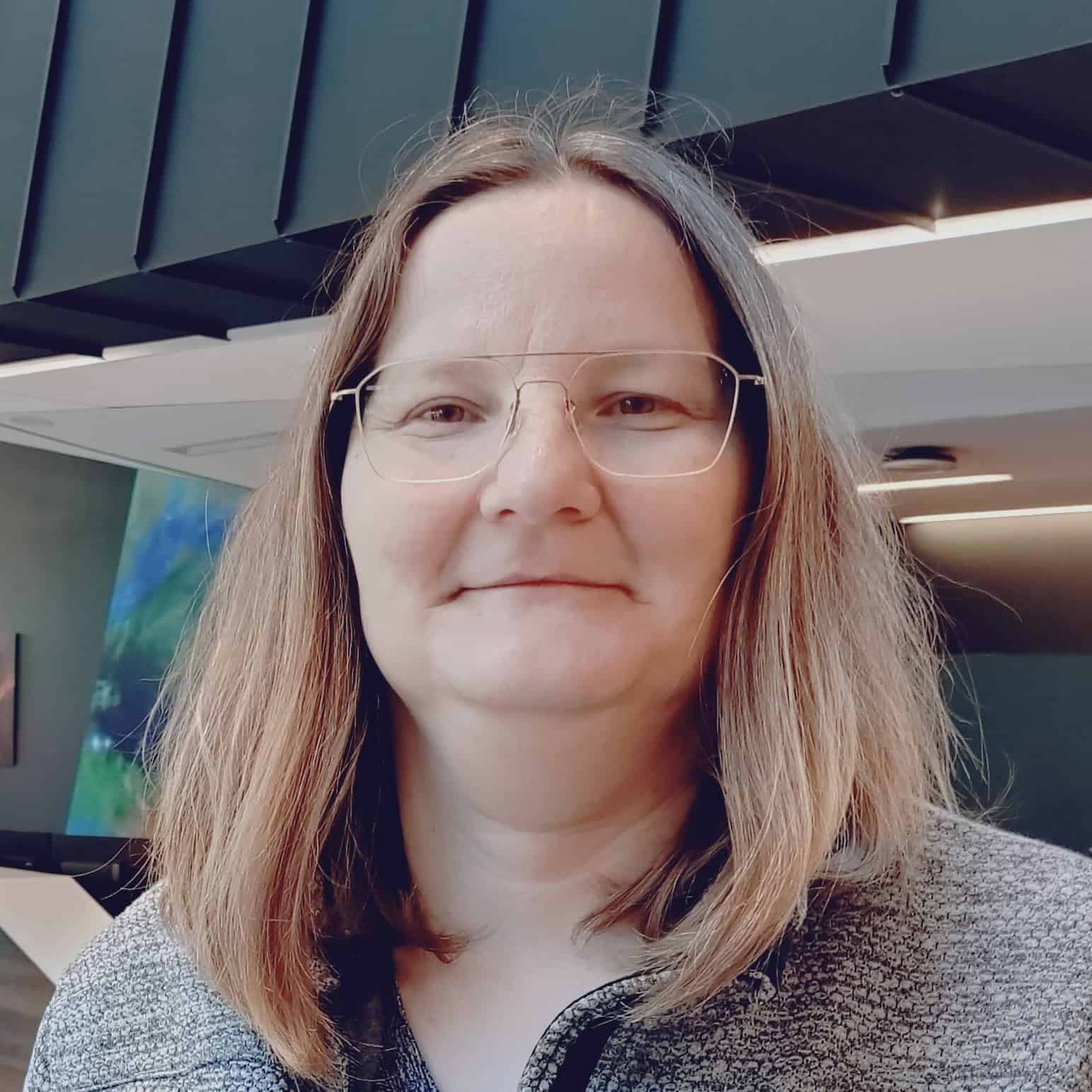
Quantum gravity: we explore spin foams and other potential solutions to this enduring challenge
Episode Transcript
Hello, and welcome to the Physics World weekly podcast.
I'm Hamish Johnston.
Earlier this autumn, I had the pleasure of visiting the Perimeter Institute for Theoretical Physics in Waterloo, Canada, where I interviewed four physicists about their research.
This is the second of those conversations to appear on the podcast, and it's with Bianca Dietrich, whose research focuses on quantum gravity.
Our chat is coming up after this message from IOP publishing, which brings you Physics World.
Discover cutting edge science in minutes.
IOP publishing's new progress in series Research Highlights website offers quick, accessible summaries of top papers from leading journals, like reports on progress in physics and progress in energy.
Whether you're short on time or just want the essentials, these highlights help you expand your knowledge on leading topics.
Perfect for busy researchers, curious minds, and anyone who wants to stay informed without the deep dive.
To start reading, just type progress in series research highlights into your favorite search engine, or follow the link in the notes for this podcast.
Albert Einstein's general theory of relativity does a great job at explaining gravity, but it is thought to be incomplete because it is incompatible with quantum mechanics, which itself is widely considered to be one of science's most successful theories.
Developing a theory of quantum gravity is a crucial goal in physics, but it's proving to be extremely difficult.
We discuss the challenges and the possible ways forward in this podcast.
I'm at the Perimeter Institute in Waterloo, Ontario, and I'm very pleased to be joined by Bianca Dietrich.
Hi, Bianca.
Welcome to the podcast.
Hi, Amish.
Very nice talking to you.
And, Bianca, we're going to talk about quantum gravity, which I have to admit is probably the one thing in physics that I know very little about.
So you have you probably have to be very patient with me about this.
So quantum gravity is is a very important field of research, particularly because we don't have a theory of quantum gravity, do we?
So why don't we have one?
Is why is it so difficult?
Yeah.
So that's correct.
We possibly don't have a theory of quantum gravity that, you know, enough people are happy with.
I don't know.
And so there's a well, there's a number of reasons you might have to stop me.
Gravity turns out is, is very different from the three other interactions.
We know of the strong, interaction, the weak interaction, and the electromagnetic interaction.
I mean, one big reason is that it has a much larger and more complicated, symmetry group.
There's a, independence of, choice of coordinates or diffeomorphism group, compared to, you know, just kind of Poincare asymmetries and, and, gauge series gauge symmetries of particle physics.
And, indeed, gravity conceptually is according to Einstein's theory about the geometry of space and time.
And it turns out because of this kind of invariance and the coordinates, you know, which is not asymmetry the other interactions do have.
So usually, we quantize them on a fixed space and time background.
But in the case of gravity, we don't have a fixed space and time background.
It's a dynamical entity.
And so there are many deep conceptual questions.
And in fact, it's that if we do have a quantum theory of of gravity, we do also expect that we will have a quantization of space and time.
And so that would kind of completely change our notion of order space and time.
It also shows us that we possibly well, we need possibly new quantization techniques.
And in fact, we could not apply many of the techniques which are which we rely very heavily on in the case of standard quantum field theory, so for the other interactions.
To give you some examples, we know that if we, you know, perturbative quantum field theories that was used for a long time to treat particle physics, This field, in the case of gravity, for for some technical reasons, usually is expressed as not renormalizable.
Another example is that, what what we also use a lot for particle physics or for condensed matter is a a very, a trick which is very useful, and that's that we, rotate the time in, in the complex plane, the so called rotation.
And that allows us, you know, that turns series where we have complex amplitudes in the sense of, amplitudes with the phase where we have interference and so on to turn into statistical amplitudes.
And, that allows us to do Monte Carlo simulations.
And, you know, QCD, well, is is more nonperturbative than, say, electromagnetisms, but to understand QCD, what do we do?
Latest simulations versus Monte Carlo simulations.
If you do not have access to to these, Monte Carlo simulations, for instance, we kind of get into problems which are also hard to solve in the case of QCD, which is kind of, if you if you do want to do real time simulations.
So that is also a big issue in condensed matter and and QCD or the sign problem in QCD.
And it is part of the problem also that we don't have experimental data.
You can't test your theory by doing an experiment like you can in I mean, on one side matter or particle physics.
You know, on one side, we have lots of experimental data because we know that's a road exists.
I will come to that.
But we don't have so much new input, which we cannot explain by the standard series.
So it's really astonishing that, like, standard cosmology, you know, which, to some degree is is based on, linearized quantum field theory on curves based.
We can explain lots of our observations in cosmology and that, even so we know, okay, there's a big bang and and, but we would need to go to higher order and perturbation theory, for instance, to to see effects from quantum gravity.
So this is certainly true, but one example is that we have actually already observations, in the kind of Planck regime where we do where where some series, for instance, predicted that something could happen, in particular with regard to kind of Lorentz breaking and possible Lorentz deformation.
And so there were kind of results from looking at gamma ray bursts, which are like gamma rays coming from sources which are very far away.
And so there you have these gamma photons, which travel very long distances.
And so the idea is there because they travel long distances, they have a long time to accumulate effects which come from having some, for instance, quantum space time.
But the simplest models were basically ruled out.
I mean, the kind of but the regime was indeed basically that they could already test planck scale physics.
So that's certainly well, I mean, if you would have more of an experimental input, yeah, we possibly, that would reduce, the space of possibilities.
And, I guess human fantasy is very large, so it's kind of many possibilities are explored.
But I want to also express that, you know, quantum gravity is not useless.
So I think first quantization attempts go back to the nineteen twenties.
But an enormous part of what have became standard techniques in in modern physics has has started with the motivation of gravity or quantum gravity.
You know, general relativity was the first example of a gauge theory.
And so, like, techniques for the quantization of gauge theories were developed with, with motivation to do quantum gravity.
The Newton Newton developed her formalism, the Newton serum, because she was asked by Herbert about gravity.
So there are lots of examples.
A more recent one is a topological phases in condensed matter.
So first topological model was written down in 1968 by Pozano and Reggi as a mode, you know, as a model for, two plus one dimensional quantum gravity.
And this kind of in recent years, well, variance of this model have become very popular in, in condensed matter.
So there's lots of, ideas which were developed in the push to understand quantum gravity, which have become completely standard and, and and standard tools.
And so I think I've worked for quantum gravity, but it's been a boon for physics.
For, you know, for the for the larger physics community.
And, indeed, you know, even me personally, I developed, like, tensor network tools, and we see the, like, also the difficulties in doing quantum gravity.
So we try to understand it somewhat similar to condensed matter model.
However, different from condensed matter, we would have to, bridge an enormous amount of scales that's kind of from the Planck scale, which is 10 to the minus 35 meters, which we do indeed do not have so much experimental access to to kind of the cosmos.
So, basically, the idea would be to have a theory which is valid over all scales, which, you know, usually we don't have and which is a very hard problem.
And there are many condensed matter models even in two dimensions, which we cannot solve.
Like, the quantum gravity models we have, you know, they are far more complicated than con condensed matter models, like, four dimensions.
We have to do them in real time.
We cannot do the recoitation.
So computationally, it's also an extremely hard problem.
Mhmm.
Yeah.
We're kind of we don't have too many tools to do real time simulations, and we would need enormous computational power.
And so maybe that will be in our future.
Maybe we have quantum simulations, but these are some of the reasons.
You know?
So but then there's a push to develop computational tools, which was part of my research, and, you know, these are also useful for as a a port, like, just for condensed matter, for instance.
And, Bianca, I wanted to ask you about your research here at the Perimeter Institute.
You lead the from discretum to continuum initiative.
What are the goals of this initiative?
Yeah.
So, the the discretum comes from the fact that, part of my research is about, nonperturbative models of quantum gravity, which often have discrete aspects.
So they're either you start directly with kind of discrete building blocks.
Then if it comes to spin forms or loop quantum gravity, it's in fact that discreteness is a kind of derived.
It comes to the forms of formalism that, certain geometric quantities of discrete spectra.
And so, in fact, you have also discrete building blocks.
And then the big question is, well, it's it's very similar to to condensed matter, you know, where you have atoms or your your fundamental particles, and you try to understand the screw the interaction, you know, what is the material or who if you have water, eventually, you want to derive the flow equations for water.
How does it behave?
And so to get to the continuum limit to show that you get, well, space time as we know it, looking somewhat smooth and continuous.
And so that is a is a aim of the initiative.
That was in particular to to develop numerical methods, and we made progress there.
But we made also recent progress in actually showing that, the spin forms which are mentioned there do indeed seem to have, a suitable continuum limits.
Yeah.
I wanted to ask you, Bianca, about spin foams.
They sound intriguing.
What what is a spin foam model, and, how could it provide insights into quantum gravity?
So, yeah, spin forms come from an approach where we really take, Einstein's theory of general relativity as describing the gravitational interaction or the gravitational force as a property of space and time or the geometry of space and time.
So we take this geometry of space and time as our dynamical field, and, this geometry is then quantized.
And as a result of this procedure, it turns out that, indeed, as I mentioned, for instance, areas and volumes appear in in discrete this discrete spectra.
So they kind of come all in little chunks.
So that's the foam bit, the the little chunks?
That's a foam bit.
So the the the little chunks.
And, basically, what the spin form model provides is an kind of a quantum amplitude for this chunk.
More specifically, what is the geometry of this chunk?
So probability amplitudes for how big this chunk is.
And so that's one of these, aspects that, it's like how big and what is the scale of this chunk.
But it's a dynamic variable, whereas usually in physics and all other quantum field series, it's something which we kind of, dial in from the outset.
And so that's one of these interesting aspects which make it a bit challenging.
But we have these amplitudes of each chunk, and the key difficulties then is to show that if we kind of consider lots and lots and lots and lots of these chunks, we do get something, you know, like a smooth space time with gravitational waves.
So there is a kind of computational or as a, the the well, the key aim to to show and then to show also what would be effect effects behind having gravitational waves.
I see.
And you you're originally from Germany, but you've been associated with the Perimeter Institute for twenty two of its twenty five years.
What initially attracted you to the institute, and and what does it offer physicists who, who are interested in quantum gravity?
You can use this as a recruitment pitch for hiring new colleagues if you'd like.
I I, you know, I came the first time as a as a PhD student, but with my supervisor, it's always good to be kind of spatially near to your supervisor.
So, but I also heard at that point, Perimeter Institute was a very new institute, and, it was doing, you know, really research in quantum gravity, which well, certainly around 2003, I guess, was done only at very few places.
And, well, even being quite young, I was already, like, very interesting people there in quantum in quantum gravity research.
And so that also then motivated me, you know, to come back as a postdoc and to come back as a faculty.
I mean, first of all, kind of, we have a we we are excellent in quantum gravity research.
We have have a large group, excellent people.
And, historically, indeed, from from 2001 on, since since the institute was founded, we produced, like, lots of postdocs, which went on to be faculty in other places.
So kind of, it's really center for quantum gravity research.
But beyond that, we have lots of other theoretical physics directions.
For instance, you know, in trying to develop numerical methods, I was interacting with condensed matter people here.
There's strong gravity, which also there's lots of close interactions with quantum gravity or cosmology.
So it's great to have all these different fields, because, you know, very interesting things happens happened at these intersections.
I see.
I mean, your your responsibilities here, do you I mean, primarily, you you do research.
But do you do you do any teaching, you know, for example, at the University of Waterloo, or is is it mostly a a research position?
Yeah.
I'm research faculty, so, well, I don't kind of have to do teaching.
I did I did talk in in the in the outside master course, also at some point at AIMS in Africa.
So I, I did it a couple of times.
Currently, I'm also faculty chair, so kind of busy with There's lots of administration.
It was administration things.
And so yeah.
So there's kind of some teaching we do on, on on particular master on a master basis and PhD level basis.
But, otherwise, it's very focused on on research.
And and finally, we talked a bit about the difficulty of getting data, experimental data on quantum gravity.
You mentioned the Planck scale and, you know, having to think about photons travelling across the universe to Yep.
But to maybe see something.
Does that discourage you sometimes when you're when you're doing your theoretical work?
Or do you do you I suppose you have to have faith in the mathematics.
Do you?
Is that Yeah.
I guess it depends.
It's it's possibly, you know, different generations have different expectations.
So, I'm possibly coming from a generation which is possibly okay.
It takes a long time to kind of do quantum gravity, maybe, like, twenty years before me.
People are expecting the solve it in ten years.
Well, there's certainly always a certain level of excitement, about upcoming experiments.
So as I mentioned, indeed, where there's kind of a number of proposals to, to measure things.
Are are there any upcoming experiments that you're really excited about, or or have you been involved in any proposals?
I well, I have not been so I mean, I've coming from a more theoretical, directional sense of, for spin for models, a key aspect for us was to show that, you know, we get to, a smooth space time, which, you know, actually well, if I can say why why would that be a key He said it is, that this was tried very often with various models, but most models use this idea of a weak quotation, so so called Euclidean models.
And also, you start with four dimensional building blocks.
It turned out if you try to glue them together into simulations, statistical simulations, most of the resulting structures you saw at larger scales didn't look at all like smooth manifolds.
So they looked like fractals, for instance.
So we actually, technically, they're called like polymers.
And so that's happened for for twenty years.
So it was only recently we we see, we have one model where this does not happen.
So it's kind of, what be a key aspect to show non perturbatively that we get a smooth space time.
However, I made a particular progress with spin forms in a more perturbative approach, so kind of, and we could show that we get, a gravitational waves.
Assuming that we get a smooth space time, we do get we can show that we have gravitational waves, and we get also corrections to the dynamics compared to general relativity.
So I'm kind of in the process indeed to think about experiments.
No.
That's it.
So so are those those deviations, are they something that could be seen by LIGO or maybe a future experiment?
To do the calculations.
Right.
But that would be a you know, that would be, interest some some things to to explore.
It's actually also turns out that, you know, spin forms are technically kind of it's in principle, is a penalty violating theory if a certain parameter is not has not a very particular value.
And so this is something which could provide more of an experimental signature because everything else is not penalty violating.
So, on the other hand, it's very constraining, so I can see that.
But there's, of course, many other ideas and and and proposals of of experimental signatures that, are always seem to be very promising.
And, so, and that indeed includes gravitational waves or probing, probing's a big bang via cosmology.
So has that I mean, with the, you know, discovery of gravitational waves and also, yeah, I suppose the information that we have, you know, from the cosmic microwave background, etcetera, You know, the I suppose these really amazing measurements Mhmm.
Are they I mean, is that something that peep people who work on quantum gravity are very excited about?
Is this possibly opening up a new view on the universe that could be very useful to you?
I mean, it's certainly certainly that's what we hope.
You know, on the technical side, and the, you know, the gravitational wave observations are also highly technical in itself.
So there needs to be, well, some people which bridge, like, the theoretical chronology side to the observational side because there are many questions about about noise.
No.
But, physically, you know, there's this idea where, yeah, for instance, with a cosmological microwave background, so the elect electromagnetic radiation with electromagnetic electromagnetic radiation, we can probe early universe cosmology only so far because we need well, it's only after, you know, electromagnetic radiation decoupled from everything else.
Whereas this, kind of if we could, like, gravitational wave background, that goes much further to the towards the Oh, I see.
Yeah.
The big bang.
So you would expect to see much deeper to towards the beginning of the universe, the beginning of time.
And so would that take you into a regime where quantum gravity was significant in terms of the evolution More of the universe.
Certainly more significant.
Right.
So kind of yeah.
So and, yeah, certainly more significant and, with, this kind of now also microwave measurements, which hopefully at some point, we could see nonlinear effects.
And also for the nonlinear effects, we would see the quantum gravity would play more of a role than form of the linear linear things.
And, there are also predictions of kind of predictions of, yeah, deviations for the linear theory, like the tilt of the spectrum and, which currently my understanding, you know, we cannot distinguish these effects, but, hopefully, in the future, we will.
Oh, wow.
So that well, that's really exciting then.
I, I mean, I suppose my view of quantum gravity has always been, well, they'll never get any experimental data.
I mean, it sounds like there could be lots coming through the pipeline.
Yeah.
So so we you always hope that this people will always predict some things.
Yeah.
Well, that Yeah.
That's great.
Thanks so much for explaining that to us, Bianca.
And, best of luck with your research in the future.
Thank you.
It was nice to talk to you.
That was Bianca Dietrich who spoke to me at the Perimeter Institute for Theoretical Physics.
Thanks to Bianca for a fascinating conversation about quantum gravity.
And a special thanks to our producer Fred Ailes.
We'll be back again next week.
See you then.