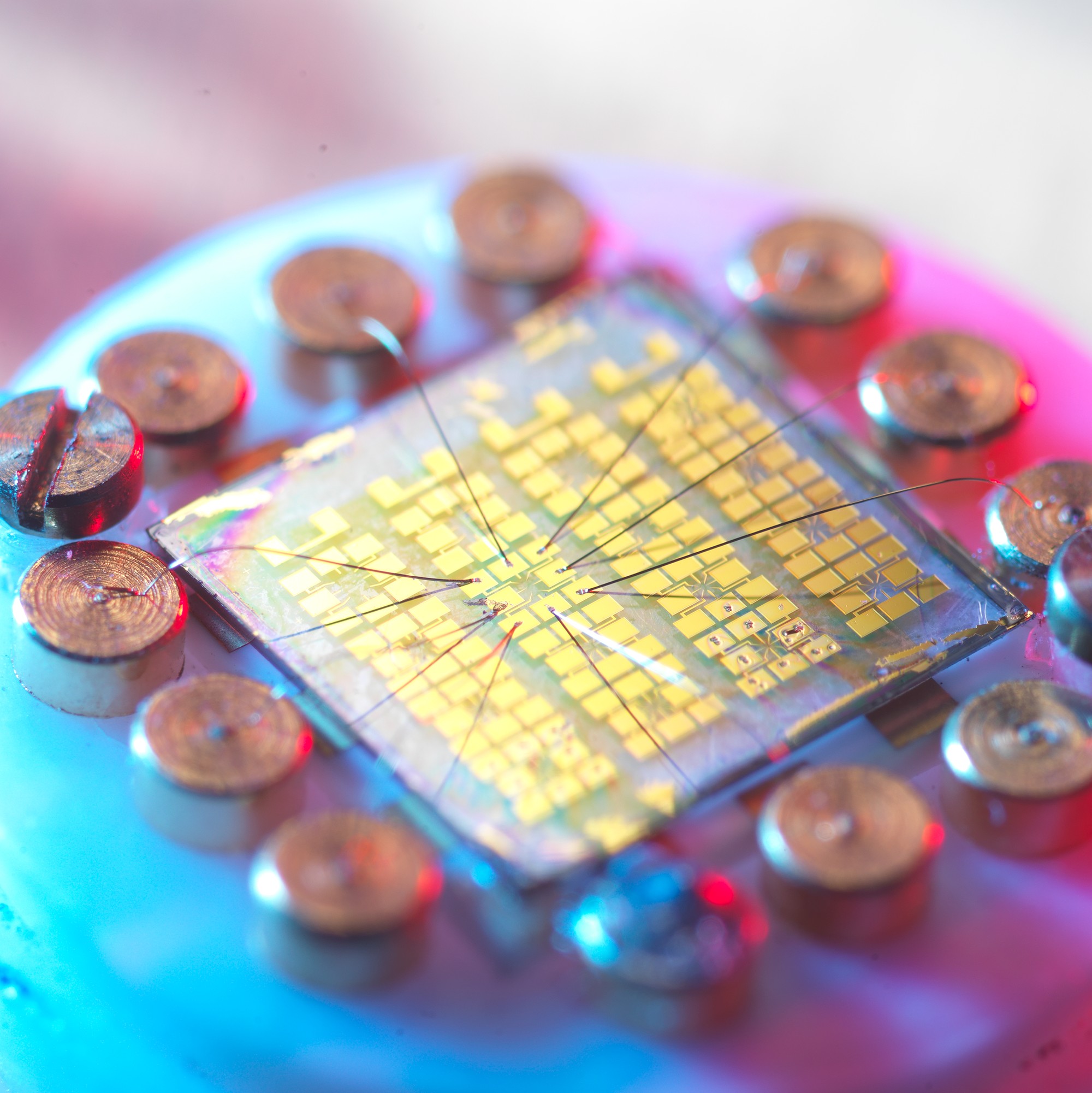
Quantum metrology at NPL: we explore the challenges and opportunities
Episode Transcript
Hello, and welcome to this episode of the Physics World Weekly Podcast, which is sponsored by the National Physical Laboratory.
I'm Hamish Johnston.
The National Physical Laboratory or NPL is The UK's National Metrology Institute.
It provides cutting edge measurement science, engineering, and technology to underpin prosperity and quality of life in The UK.
NPL bridges the gap between research and industry by providing the measurement science, facilities, and expertise needed to accelerate innovation from lab to market across various sectors.
One of those sectors is quantum, which we're going to dive into today.
I'm joined by Tim Pryor, who is quantum program manager at NPL, and by John Devaney, who is NPL's quantum standards manager.
Hi, Tim and John.
Welcome to the podcast.
Hi there.
Great to be here.
Hi.
Pleased to meet you again.
So, Tim, in October, NPL became a founding member of NMIQ, which is a global initiative to standardize metrology standards for quantum technologies.
What is NMIQ, and why does NPL see it as crucial to the success of the quantum industry?
So NMIQ is a, an initiative, between some of the world's leading national maturity institutes to work on prestandardization research leading to standards in the future.
So quantum is often very complicated and has huge scope of application.
This makes it, really difficult to understand the technologies sufficiently well to able to just standardize things.
Faced with this problem, we work closely with The US first and then grant you with the other g seven, members and Australia to develop a framework that we can work together on standardization where there's a common strategic interest.
The thing is because quantum is so broad and so difficult, no one country could do it all.
So we have to work together on these sorts of issues.
And, Tim, NPL has very, very strong connections with industry.
What is industry telling you about what it wants from quantum standards?
It's a that's a very interesting question.
Industry tells us that you really need to work differently nowadays with standards.
So emerging technologies traditionally have, had standards evolve gradually, probably in a serious type of effect.
In reality now with the world being so global, information is shared almost instantly amongst everyone, and so everyone wants the answers right now.
So if you want to make sure that your technology is part of the standardization process, which leads to adoption and use, then you've got to be working in this area in parallel to the innovation being developed.
The thing is that innovators are usually so busy doing things, you know, like building the things they're trying to get standardized, so they don't always want to get involved.
And this is where organizations like MPO can actually help them in the by expressing what they need to happen, we could look after them for that.
In The UK, we've gone a bit further than that, and we've been running a pilot, for, DCIT, called the UK Quantum Standards Network.
And that is about bringing together all the government agencies that were interested in in in standardization of quantum technologies and sort of find make a more coordinated approach, making it easier for industry to get information, and making it easy for us to actually work together for a common interest.
It it must be really difficult though, Tim, because quantum technology is evolving so quickly.
What are the challenges of defining standards, for the quantum industry in such a fast paced environment?
It's it's very, very challenging.
And, actually, a lot of the work we do in MPL is to talk to people outside to try and understand what their future requirements are going to be so that we can do the research necessary to make those standards in the future.
And, of course, this comes back to the NMIQ thing.
We can't do it all alone.
And so we speak to all our sister organizations around the world to get there and and to put onto, how this might work and what we need to work on.
But it's it's it's an amazing thing, really.
So in metrology, we use quantum technologies for doing exquisite measurements, and that's turned around on its head now.
So the ability to do that means that we can really truly input into the evolving quantum technologies.
And that knowledge now that we've developed over decades of use is now becoming incredibly relevant to people in helping people understand what they have and how you compare something.
I mean, some really interesting examples is, you know, if we think about the application everyone talks about, quantum computing, and people say, how do you compare one computer to another?
That's an incredibly difficult question.
There are so many different types of quantum computers, all in theory there to do things in slightly different ways.
If you can find a methodology for, characterizing one computer, that might not be very good for another type.
So it's incredibly difficult, and it's a real big challenge.
Hence, you have to work together collaboratively to come up with these answers.
And I suppose it's particularly difficult with quantum computing because we don't know which type of qubit will ultimately be used in, you know, sort of quantum computers of the future.
And indeed, it might be more than one type of qubit.
So it must be very difficult to, well, I suppose keep up with the development of qubit technologies and and come up with with ways of evaluating them.
Very much so.
It's, you know, the the question of which qubit is best or how do you compare different qubit modalities is a really, really difficult question, and it can keep, metrologists talking in a pub for days and arguing about it.
But in reality, what we do is we take it right back to the fundamentals of the physics side of it and try to truly understand the mechanism of how these things are working.
And then we try to give that information to the people who are using these qubits, in a way that's useful for them to understand how they might want to, for example, control material quality, which could affect how a qubit, work.
But this again, with MPL does quite a lot of work in qubit technologies, but not in every type of qubit.
So then we collaborate with, you know, The US, Japan, Germany, etcetera to get their input so that The UK can access that knowledge, and then our collaborators get the knowledge from The UK as well.
And and John, I wanted to bring you in, and talk about quantum sensors, which, they they seem to be a fairly advanced, quantum technology with some commercial products available today.
What metrology and standards are required to create high quality quantum sensors?
Yeah.
You're right.
That there there are products on the market already, which are using quantum phenomena.
But on that question of what standards are required, there are two sides to that.
One is that quantum sensors are more sensitive, more accurate, and more useful than existing sensors.
For example, magnetometers for monitoring brain function, drive emitters for mapping underground resources, spectroscopic photodetectors for assessing gas leaks.
And what matters to those buying the sensor is its performance, not that it's quantum.
And in that it's in that sense, standards are needed to extend, the the standard standards range that already exists down into the end of these, finer and finer details.
But on the other hand, quantum sensors can only be built with components and subsystems that are themselves tested and found ideal for the task.
Iron traps, diamond substrates with nitrogen vacancies, NV centers, superconducting quantum interference devices, SQUIDs.
These also need standards.
So we are approaching it from both directions.
We are helping characterize the the quantum devices and the quantum characteristics, And we're helping work out how it is that you actually, measure some assess something that is measuring something more accurately than anything else can, where there's nothing to compare it against.
And, NMI is like NPL are are doing things like working out how how to characterize single photon detectors.
The the only single photon detectors can detect single photons.
And I I wanted to ask you about, single photon detectors and sources, in light of quantum cryptography, which is another quantum technology that, I mean, I I suppose you can say it's fairly mature.
There are commercial systems available.
And in those in that technology, it's really important to have photon sources and detectors that are high quality and secure.
So how is NPL supporting the development of quantum cryptography?
Yeah.
So sources and detectors in themselves are are not secure.
It's the way the system is built around it that that creates that security.
And that is one of the, one of the aspects of the performance of a QKD system that is potentially vulnerable, to outside attack.
We've, led the way in characterizing QKD systems, the boxes that are, as you say, are already on the market.
QKD, just to elaborate, is a way of generating cryptographic keys that are unbreakable because they're intrinsically random.
They use the randomness of of quantum physics.
They do it by generating pairs of photons that are randomly coded.
So there's two levels of randomness going on, usually by polarization.
And then the process can't be intercepted if they are single photons without destroying that information, without the two the sender and receiver knowing that there's someone trying to break in.
So like you say, the sources, but even most of the detectors, are a are a point of vulnerability because you can you can blind, the, the detector by by shining a put a brighter source into it and then use your own source to, to spoof the system.
That's only one.
There's other vulnerabilities like, they don't actually use single photons.
And at this point, they tend to be small bundles of photons.
But if they use too many, it's possible to split enough of them off and and, and join in on the the key, key reception.
So we went through all the potential vulnerabilities.
I say we, not me personally.
I'm not allowed in the lab.
We went through all the potential vulnerabilities that had been identified in QKD, and we tested we tested existing systems against them.
And we and we worked out as the the sort of criteria that would be needed in the standard, And we took that into Etsy, for the building of their QKD sis standards family.
And and, John, Tim's already touched a little bit on the need to develop performance metrics and benchmarking for quantum computers.
And I understand that NPL is leading, an initiative, in that direction.
Why do we need these metrics, and and what are the challenges in creating them?
There's there is more than one initiative underway.
And the one that I I closest to is the way that it's been brought into the standards world.
It's too early for, full standardization, but there is a there is a there's a real demand from the potential buyers of quantum computers to know what it is, what are their strengths, and how do they compare one against the other.
But that is far from a a simple question.
It's not a simple question with conventional computers, but it's even more difficult when we have no universal error corrected quantum computer.
As Tim said, there are a a number of platforms, including superconducting qubits, ion traps, that are under consideration.
In the early days of attempting to benchmark them, it was suggested that you could simply count the number of qubits and people will still put up graphs and say, my computer has 48 or a 150 cubits in it.
And when it was it was realized that in terms of computing power, that wasn't enough.
They moved to gate depth.
How many how many gates, how many processes could your quantum processor go through before it lost the information?
That too is too simplistic.
And so, we're beginning to look at, at at more multidimensional aspects to hardware benchmarking.
And at the same time, I'm trying to answer the question, if performance is what matters, surely, it's how quickly and how effectively your quantum processor can do a particular task.
That, it turns out, isn't as simple a question as you might think either, partly because quantum processors are part of a stack in in a similar way to telecoms, and the error correction is happening in a multitude of different ways.
But we're we're attacking that one as well, and and we're bringing the answers to these, these researches into the standards, particularly in SanSan, like the European standards bodies, and I see IEC ISO, the global standards bodies, where they're doing early stage standards.
They're doing technical reports on the benchmarking systems that people have have come up with already.
So so John and Tim, I I did my PhD many, many, many years ago, and I became a science journalist.
But I often think about, you know, sort of an alternative universe where I could have done something else.
And one thing that I've always found appealing is the idea of working at a place like NPL.
I mean, it just sounds like, well, it doesn't sound like it.
I know that people there are doing a vast, you know, sort of variety of really interesting research and working with industry and developing lots of, of of new technologies.
So, you know, if if there's somebody out there who's just finished a PhD, How would you advise them in terms of, pursuing a career at NPL?
What's available?
So I think one of the things to first say is that measurement metrology underpins almost everything everybody does.
So there are lots and lots of fields of interest that you can you can work within.
And as I mentioned, at the beginning, we've been using quantum for doing really, really amazing measurements for a long time.
So we called that quantum metrology.
And that knowledge has led us to be able to do metrology for quantum.
So this is basic fundamental science.
So if that's what drives people, there is in these emerging technologies, there's a requirement to do fundamental physics.
But as you develop that, you get to play with all the applying, uses of that of that technology.
So we get to work in lots and lots of fields, really help to enable things to actually really, really happen.
So exposure to lots of brilliant people around the country, around the world, it's an it's an amazing opportunity for people.
I would add.
One of the things about coming here to NPL so like like you, Hamish, I did my PhD, and then I went off and, I actually worked, for the, Institute of Physics Publishing.
That's my that's my first foray into, public publishing.
And it suited me down to the ground.
I really liked my time there, and it suited my way of working.
Coming to NPL, having been there and having been in the standards world for twenty years, that what Tim's talking about, working on metrology, it really suits people who not just do proof of principle, which is largely what doing the PhD is, but love getting things down to that nth degree of of precision, which which is a is a very different mindset from you'll find almost anywhere else in the world.
But that doesn't mean that's everyone at NPL because I they wouldn't have employed me otherwise.
There there there's lots of different roles, within NPL other than working on metrology itself.
And I'm I'm pleased that I've been taken on as a standards expert rather than as a an experimental physicist.
And and I I should say that I'm guessing that it's it's not only people with PhDs in physics that you're looking for.
Yeah.
We're we're we're we're looking for all all people.
And in fact, we have apprenticeship schemes where, you know, we we take people in and develop their skills.
Engineers are really important.
These people are sometimes more difficult to find than the PhD people.
So there's lots of opportunities, but you need the support around it as well.
Need the, people who need to understand intellectual property.
The people who manage these highly complex, projects, especially when there are a lot of partners, etcetera.
But I think the I mean, it's now quite recognized that you need to invest in this sort of infrastructure, you know, this measurement capability in order to actually allow these things to come to market, to give The UK the opportunity to have both growth in the GDP, but also look after its, security.
And it's really good because The UK's national strategy quantum actually recognizes this and talks about it as a really important mechanism.
And I think that's something that's really important because metrology institutes have been the unsung heroes behind the scenes for decades and decade developing capability that enables trade, enables safety, enables so many things.
But because it happens seamlessly, usually, then it's just invisible to most people.
But now people recognize with these very complex technologies coming to market that for those to happen, you have to have good metrology.
And Tim, we we've spoken a bit about NPL's connections with industry, but I would assume that you have very strong, connections with the academic world, in physics and and other related, subjects.
Is that right?
Yeah.
I mean, we again, we have we're a reasonably big laboratory, but the amount of questions we get asked, you couldn't answer them all yourself.
And so MPL doesn't go out there to try and reinvent what other people have done.
It goes out there to try and collaborate with the best people around the country.
In, in the quantum side, that will be with the quantum hubs, but people outside that, international, academia, etcetera.
We've tried to identify where we have gaps in our knowledge or The UK has gaps in its knowledge, and then we try to collaborate with the people who have those skills.
And I just wanna ask both of you, what, you know, what do you find most exciting about working in quantum metrology?
Is it is it the the the pace of change and, you you know, the always having to keep up with the latest research?
Or is it just the novelty that, you know, these these esoteric concepts of quantum physics can be turned into technologies?
What, you know, what what gets you guys up, in the morning?
I'd go with the first one.
It's, it it's remarkable.
I mean, I've my background was in optoelectronics and communications.
And back in the nineties, you would go to conferences every year, and they would be making promises which were slightly better than previously.
But there was no there was nothing groundbreaking about it.
The physics was well known, and and they were really just solving engineering and manufacturing problems, which isn't easy, which is why I don't do it.
That either.
But now the the real progress and when one of the areas within quantum where progress has been massive in just the last two or three years is in, distributed entanglement where the the the test three years ago, the the first tests that you could send an entangled photon out over, say, 15 kilometers of fiber and and measurably still be entangled had just been done.
And now there are test networks all over the world, which are getting ready for product to make to use quantum entanglement in in in networks at scale.
That that sort of pace of change is, quite exciting, really.
And what about you, Tim?
So for me, I mean, it's it's truly a privilege to be part of working with so many talented people either at NPL or in academia and industry in The UK or international.
You get to see so many different people.
You get to see so many brilliant technologies.
Last week, I was at CERN.
You know, you get exposed to the things that you you know, when you're at university, you only ever dreamt about getting involved in.
And yet through metrology and through working with a an organization that's very international, it's amazing what you can get involved in.
Well, that's great.
Thanks.
Thanks, Tim and John, for coming on the podcast, today.
No worries.
Thanks, Janesh.
That was NPL's Tim Pryor and John Devaney.
Thanks to both of them for a fascinating conversation.
I'm Hamish Johnston, and our producer is Fred Isles.
This podcast is sponsored by the National Physical Laboratory, which retains copyright on this episode.
NPL is The UK's National Metrology Institute.
It provides cutting edge measurement science, engineering, and technology to underpin prosperity and quality of life in The UK.
NPL bridges the gap between research and industry by providing the measurement science, facilities, and expertise needed to accelerate innovation from lab to market across various sectors, including quantum.