Quantum steampunk: we explore the art and science
Episode Transcript
Hello, and welcome to the Physics World Weekly Podcast.
I'm Hamish Johnston.
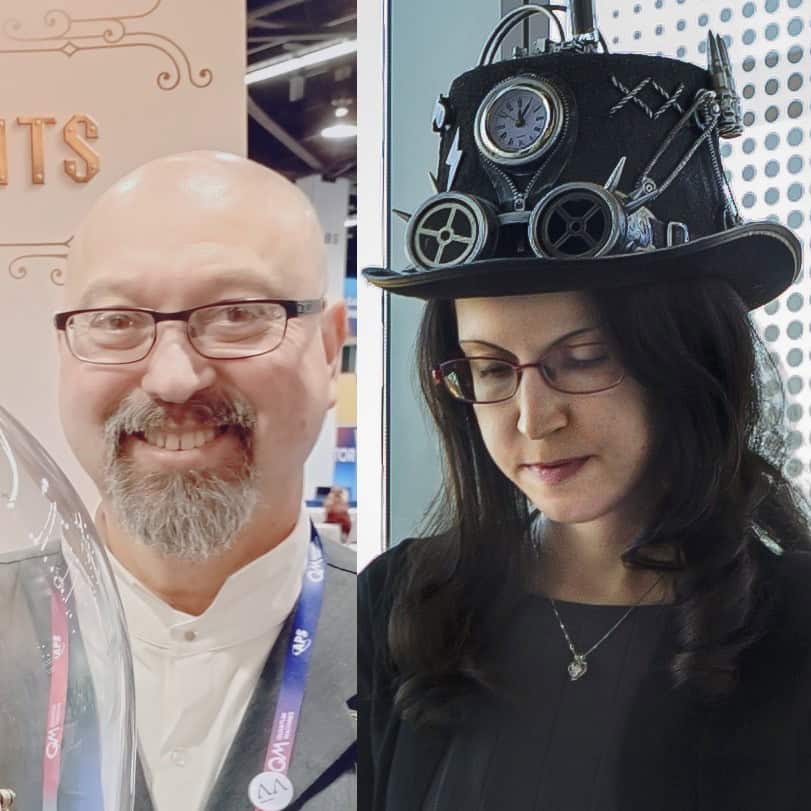
Today, I'm going to explore the science and art of quantum steampunk with a theoretical physicist and a sculptor.
But first, I'd like to thank Atlas Technologies for their generous support of this episode.
This episode is supported by Atlas Technologies.
Atlas custom aluminum and titanium vacuum chambers and hermetically sealed bonded bimetal components are used in quantum applications, physics labs, and semiconductor fabs.
And they're built in a fully integrated facility with on-site design, development, and manufacturing capabilities.
Let Atlas help you solve your next engineering challenge.
Learn more at atlasuhv.com.
Earlier this year, I had the pleasure of attending the Global Physics Summit of the American Physical Society, which attracted about 14,000 physicists to a huge convention center in Anaheim, California.
That's where I met the steampunk artist, Bruce Rosenbaum, who is exhibiting his beautiful sculpture of a quantum engine.
It was created in collaboration with physicists, including Nicole Junger Halpern, who pioneered the scientific field of quantum steampunk.
I was so taken by the art and science of quantum steampunk that I promised Bruce that I would have him and Nicole on the podcast.
And here we are.
Nicole joins me from Maryland and Bruce from Massachusetts.
Welcome to both of you to the podcast.
Thanks very much for having us.
Yes.
Thanks for having us.
So Bruce, can we start with you?
Can you give us an idea of what steampunk is?
Sure.
Well, it it sounds like a simple question.
What is steampunk?
But I think, you have 10 people in a room.
You ask that question, you're gonna get 10 different answers.
And there's probably even a difference between Nicole and I in terms of exactly what steampunk is.
But for me, it's it it has its roots in science fiction.
AW Jeter, science fiction author, in the nineteen eighties actually came up with the, the term statement.
And, really, it's, I kind of look at it, in in a science fiction type of realm where it's this what if scenario, kind of this reimagined history.
So it's what if during the Victorian period or the industrial age, that's, you know, roughly eighteen fifties to the nineteen hundreds.
What if the people of that time, the the engineers, the, the inventors, the innovators, what if they had knowledge on modern or futuristic technology?
How that would have changed anything.
It's it's almost imagining if the computer was invented a hundred years before it actually was, invented, how that would have changed everything.
And just to kinda give you a quick, story, a real story that, that could have been that scenario, if people are familiar with Charles Babbage, a mathematician, scientist, from England, I think it was in the late eighteen hundreds, he actually came up with a mechanical computer, basically, called the difference engine or the analytical engine.
And he actually drew it.
He came up with the design, which was very complicated.
And like a lot of inventors, you know, they're they're looking for funding or money to actually build thing, and he couldn't find funding.
And, it wasn't until, I think, in the early two thousands, there was a museum in England that actually built it, this mechanical computer based on this design, and it actually worked.
So people ask, well, what if we actually did get funding?
How could have brought our modern computer, you know, in much earlier.
And even, you know, maybe we would have our quantum computer right now if if that would have happened.
So, but to to kind of put it in in in almost elementary or kind of math terms, I really think that, steampunk, is this fusion of history, art, and So that so that's Babbage's folly that that you're referring to.
And I, I mean, I I was under the impression that it I mean, it really fits in with your definition of steampunk punk because wasn't part of the problem that the the the components that Babbage required in his calculating machine couldn't be machined to the to to the exacting tolerances back then, and it was it it it was only really with modern machining tools that, that that we could actually make one that wouldn't, you know, sort of immediately jam up because of imprecision.
I mean, maybe that's apocryphal.
Maybe that's my view of it.
But I I do remember reading that somewhere, maybe when when his machine was was finally built.
Yeah.
I think he was ahead of his time in terms of actually, you know, fabricating it.
But, I think that the tough part was just convincing people because it was so complicated.
Like, people would be looking at it and, like, how is this thing gonna actually work and and think?
You know?
So so it wasn't till later, but but this is, you know, I think with with a lot of inventions, it is a confluence of different, technologies that need to come together to make it happen.
So the timing of of these creations are always kind of dependent on what's going on in the world.
And, Bruce, I met you, back in March at the Global Physics Summit in California.
And you were exhibiting a a wonderful sculpture of a of a quantum engine.
And I think it really cut caught the imagination of a lot of physicists, at the conference.
Can you can you describe that work?
Sure.
So just a kinda little bit of background too on how I got connected to Nicole.
I'm always looking for collaborations, and not with just other artists, but because I think steampunk is history plus art plus technology, I'm connecting with scientists and, other people in the STEM STEAM fields.
And, I have this I set up a Google alert that basically gives me any links to anything that comes out about steampunk.
And one day, what pops up?
Quantum Steampunk.
And I look closer, and it's Nicole's.
She has a presentation.
She has a book.
And I'm, like, going, wow.
This is, like, you know, something that, I'm really interested in looking into.
We spoke to Nicole, and she was actually looking, potentially for an artist to help create kind of an educating and entertaining kind of, device, in installation that could teach people on, how classical thermodynamics could translate and build into quantum thermodynamics or or basically being able to control an an atom.
And so, so we just we were kind of going back and forth.
Like, there is no steampunk quantum engine right now, but what could it look like?
And, I always loved the armillary stair, which is a representation of our solar system with kind of the sun in the middle and the planets going around it, almost like an atom too, what's going on going on inside.
And so we kinda came up with this, the structure of what it could look like, and then was able to provide, the science, the real science behind it, in terms of what elements could, make sense in terms of creating this this engine.
And so we just went back and forth and created a really cool illustration.
And if you've seen Nicole in her presentation, she usually has it as her as her background, and this was the inspiration for actually, fabricating.
And part of the steampunk ethos also is, you know, we wanted to engage.
So how do we do that?
We do that through movement, through lighting, through sound.
So that was an important part of the way that we were going to actually build this.
So we worked with a group near me in Massachusetts, empire, and they, were able to CAD it.
We actually put it, you know, in a computer drawing, and, Nicole and I kinda went back and forth and, you know, wanted to make sure that the elements not only look good but make sense, in terms of its functionality.
And, and part of it was that we created, you know, from classical thermodynamics, we had these these classical, engines with pistons and, you know, cycles and all that.
So that was surrounding the sphere, and it was those elements that actually powered, the, the appearance of lasers that would go into a chamber, for trapped ions.
And I'm I'll let Nicole talk more about, you know, how this all works.
But having the movement and having the lasers kind of pop on, and and then also being able to, have a sound profile to it.
So what does it sound for an engine to, you know, to develop, for it to turn on lasers to to ignite these, these ions?
So we had fun with that too in terms of how that would do.
And then so you would come up, you hit the the button, and it comes alive.
It's about a sixty second cycle.
And it was it was really fantastic being at the at the summit because I had physicists coming and thinking this was, like, real, that we were actually dropping ions and, like, you know, making making this this, steam engine.
But, again, an artist representation, with this kind of brainchild of of an artist in a in a quantum theoretical fist.
Yeah.
It is, I mean, it's a very beautiful object.
And the thing that that struck me is that, you know, just a a few yards away in the sort of main exhibition, there were companies, that were selling stuff that looked a lot like your sculpture, which, you know, I I thought that was fantastic.
So, Nicole, you worked with Bruce, to create this sculpture.
And I I suppose it's obvious looking at the sculpture that that a physicist was involved.
What sort of ideas did you contribute?
The first was the overall notion of quantum steampunk as Bruce described.
One contribution was writing the grant proposal.
It turns out that art, like science, involves a lot of just grinding logistics, including applying for funding.
The kind of core notion is that of a quantum engine.
Quantum engines have been theorized about since 1959 and 1967.
The first proposal for a quantum engine was put forth then.
They've been realized experimentally on a variety of platforms.
We chose a trapped ion platform in part because I'm based at the University of Maryland, and Maryland has a lot of work on trapped ions and is partially known for that.
So the we can get into later what a quantum engine is.
But one reason why the center of the sculpture, which has the ion trap, looks so realistic is I have the good fortune to be friends with an ion trapper in Maryland, Elena Green, and she very kindly let me ask her a whole bunch of questions about how to make this piece look particularly realistic.
Also, Bruce mentioned the armillary sphere, which is, an old time instrument and a very beautiful object that evokes steampunk or clock punk.
The the this so there is a sphere that bounds the sculpture very beautifully, I think.
It evokes the armillary sphere.
And on the other hand, it evokes the Bloch sphere.
So the Bloch sphere represents the possible states of a qubit, the basic unit of quantum information.
We also included a an arrow that represents a Bloch vector.
So suppose that we have some qubits, a basic unit of quantum information, may be represented by within a trapped ion.
This trapped ion is in some quantum state, which is represented geometrically by a point on or in the Bloch sphere.
And when we do physics or do quantum computation, we often will represent the state of the qubits with an arrow that points from the center of the sphere out to the point that represents that that really is a solid representation of the state.
Bruce found a beautiful arrow that was, fabricated in the early nineteen hundreds to serve as our block vector.
The sculpture also has a representation of a battery that might be charged by the engines in the sculpture, and it has a representation of a clock that would time an engine cycle.
Also, the sculpture has representations of hot and cold reservoirs, which play key roles in the functioning of a heat engine.
I see.
And I I wanted to ask you, Nicole, about the phrase quantum steampunk, which which you've coined.
I mean, it it, you know, it sounds like a fun idea, but it it it's a physics concept, isn't it?
The this, is it the idea of quantum steampunk?
Can can you talk a bit about the physics of quantum steampunk?
Sure.
Quantum steampunk is in part another term that I use for and in part a term for the spirit and aesthetic of the field of quantum thermodynamics.
The quantum thermodynamics is a subfield of quantum physics that has been around for many decades, but it started booming within the past fifteen years.
What is quantum thermodynamics?
Well, first, what is ordinary thermodynamics?
The thermodynamics is the study of energy.
It was inspired by the Industrial Revolution.
So it was inspired by the historical setting that Bruce alluded to when defining steampunk.
During this era, during the eighteen hundreds, people were realizing engines on a large scale for the first time to drive factories.
So naturally, people wanted to understand how efficiently these engines could operate.
Thermodynamics helps us understand what are the limitations on engines, what are heat and work, how do we quantify them, what are the relationships amongst them.
In, this theory of thermodynamics was inspired by large classical systems, but there are quantum systems to which work and heat and efficiency are relevant as well.
For instance, for most systems to exhibit quantum phenomena, they have to be cooled to very low temperatures, and cooling is a thermodynamic process.
So in quantum thermodynamics, in part, well, I see us as addressing three main questions.
First, we ask, how can the laws of thermodynamics be extended so that we can see how exactly they apply to small and quantum systems, so even systems that can entangle with each other?
And sometimes we can use tools from quantum information theory to prove more detailed, more refined versions of the laws of thermodynamics.
Second, we know from quantum information processing that quantum phenomena such as entanglement can enhance information processing tasks such as computation.
Just as there are information processing tasks, there are thermodynamic tasks such as extracting work and powering batteries.
So we ask, how can quantum phenomena enhance thermodynamic tasks?
And finally, we can look at a system that is processing energy and ask, what behaviors can this system exhibit if it's quantum and not if it's classical?
So we use thermodynamics to understand better what divides the classical realm from the quantum realm.
So I see quantum thermodynamics as combining the Victorian setting of thermodynamics with the cutting edge and partially futuristic technology of quantum information science.
I see steampunk or I see quantum thermodynamics as the real world version of steampunk.
And to emphasize that fact, I use the term quantum steampunk, so partially to refer to the field of quantum thermodynamics and partially to refer to its aesthetic.
I see.
And one thing I wanted to ask you, Nicole, is, you know, I can remember many, many years ago when I was a physics undergraduate.
We studied, quantum statistical mechanics where, you know, it's very important whether the components, of a system were fermions or bosons and, you know, we sort of added up all the degrees of freedom, etcetera, etcetera.
Is I mean, is that different to quantum thermodynamics?
Or is is that a part of quantum thermodynamics?
Because, you know, that's what I thought of immediately, the sort of statistical mechanics of it.
But, I mean, it sounds like there's something more, I don't know, fundamental with quantum thermodynamics.
Is that right?
Or are they I suppose they're related.
Yes.
I definitely say that they're related.
I actually wrote a blog post exactly about your question because someone else asked it of me a while ago.
One of the main points of that blog post is that thermodynamics is an operational theory.
When we use an operational theory, often we think about an agent who is trying to perform some task given certain resources.
We ask how efficiently the agent can perform this task.
For instance, in thermodynamics, we might say, suppose we have a hot reservoir and a cold reservoir, how efficiently can we extract work from this set of reservoirs?
Information theory two is an operational theory.
For instance, we will often think about an Alice who wants to send information down a channel to Bob, and we ask how many bits of information, how many basic units of information can she squeeze her message into.
So how efficiently can she send her information down the channel?
That's a reason why it makes a lot of sense to apply quantum information theory to thermodynamics to get quantum thermodynamics.
Oh, statistical mechanics definitely plays a role in thermodynamics.
Just the focus tends to be a little different.
When we're doing statistical mechanics, usually, we are calculating a partition function.
Whereas when we're doing thermodynamics, we're thinking more about tasks, resources, efficiencies, and how we can break down the analysis of these efficiencies in quantities such as heat and work.
Right.
I see.
So so I I can see the you know, there's a complete analogy, isn't there, to the to the Victorian engineers who really weren't interested in the microscopic nature of their systems.
They just wanted a more efficient steam engine or a better a better pump.
And and I suppose we want we want to be able to process quantum information in in a better way.
Yes.
So they had very particular goals.
They had very particular tasks in mind, and they were limited to certain resources.
Nowadays, since we know about quantum theory and we use density matrices all over our calculations, I think that maybe the traditional boundary between statistical mechanics and thermodynamics is breaking down a little bit.
So one will often hear that if one is using probability distributions over microstates classically or density matrices when using a quantum model, then one is doing statistical mechanics rather than thermodynamics, which deals only with macroscopic properties.
I think that view might not be the most relevant to today's world and to quantum thermodynamics because it is useful to use the apparatus of microscopic quantum theory and quantum thermodynamics.
Just when we do quantum thermodynamics, we can use, say, the density matrix in order to calculate quantities like work and heat and derive more detailed versions of the second law of thermodynamics and reason about quantities like heat and work.
I see.
And, Bruce, I'd like to to to bring you back in.
You're, you're not a physicist.
You don't I don't think you have a a background in physics, but you've really embraced the concept of quantum steampunk, in your art.
Did you have to learn some basic quantum physics in order to create, the sculpture?
Well, it's, I jokingly tell people that, I'm not a physicist, but I play one on TV.
I I have, you know, knowledge of basic concepts.
I'm I'm I'm a curious person, and so I love technology.
I love, you know, what's next, and I watch documentaries.
I actually listen to Nicole's quantum steampunk presentation and and read her book, and and she she lays it out in a really great way layperson's way, you know, to make it understandable.
So I I really when I'm, embarking on these, creation of these art installations, I I need to do my due diligence and research and and just kinda get a broad understanding, on what, you know, what this is, so we can that can be represented in the, in the sculpture.
And, really, it's it's this, you know, putting my head in the past, the present, and the future.
That's kind of what we're trying to represent here to make a timeless type of sculpture, that, again, both educates and entertains.
So, so that's kind of, you know, my approach with every project, you know, if it's quantum physics or or anything else that, has this combination of history, art, and terminology.
And, Nicole, do do you have a background in art?
I don't have a background in visual arts.
I have a background in writing that I've gotten through, say, writing a community column for a local newspaper when I was in high school.
I also blog for Quantum Frontiers, Caltech's Quantum Blog once a month.
And I consider writing to be an art, but I did not have experience with visual art before working with Bruce.
Oh, right.
And and how did you find that as a as a as a a scientist?
Were you did did did you have a problem with maybe being too lit literal, if you see what I mean, in terms of expressing ideas?
Or or did did you slot right in immediately and sort of understand, how Bruce was was working?
I think we achieved a good balance of sufficient representation of reality and also aesthetics that extend beyond a mere accurate representation.
We certainly went back and forth a great deal.
I actually, this was a part of the process that, to me, was a little different from what I experienced in science.
As a scientist, I go back and forth with my collaborators until everybody is satisfied.
This might take days or weeks or months.
And similarly, Bruce would go back and forth with me a great deal until we were satisfied with the look of something and also the representation of science.
However, Bruce hires people like an illustrator or a design engineering team, and their time is very much on the clock.
So I could not go back and forth with them just ad infinitum.
So that was the, I think, the main difference between my experience with art and my experience with science that surprised me.
But I think that we did manage to come up with a really great balance.
So so how did it compare to, you know, let's say you you you you've got a great idea for a paper and you're collaborating with some people and, you know, you're you're perfecting your craft, you're you're working very hard to get things right and to to make it understandable.
Was it was it a a process that was comparable to that, or was it was it very different?
I'd say probably there were fewer rounds of back and forth in the context of art because we were working with people whose time was very limited, and we had limited budgets.
And those two resources need to match up needed to match up with each other.
But, occasionally, there was a little wiggle room so we could get in a few extra tweaks here and there.
Okay, Nicole.
We're we're getting towards the end of our conversation, but, I I just have to ask you about a bit more physics, seeing as this is the Physics World Weekly podcast.
Can you can you talk a bit about the physics of quantum heat engines?
What is a quantum heat engine, and why is it important to study them?
Sure.
I'll start with a basic heat engine.
A heat engine is a device that takes any heat from a hot environment and expel some of that heat to a colder environment.
The rest of the heats, the engine transforms into work.
So more correlated or rather more organized energy that can be directly harnessed to do something like power a factory or charge a battery.
A quantum heat engine is an object that essentially does the same thing.
It takes in heat from a hot environment.
It expels some of that heat to a cold environment, and the rest of the heat, it transforms into more organized work.
An early question in quantum thermodynamics was, is it even possible for a quantum system to act like a heat engine?
This was a this is a foundational question and I think a question of just basic curiosity.
But this is the question that I alluded to that was addressed in the nineteen fifties and nineteen sixties.
Folks argued that a single atom can function as a heat engine when it's working as a maser.
A maser, as some listeners will know is the same thing as a laser, just emits microwave radiation.
That's what they happen to be studying.
Quantum heat engines now form a sandbox for exploring questions within quantum thermodynamics.
Since lots of quantum heat engines have been designed and some have been realized experimentally, we can play with them to ask, for example, do quantum systems obey the same thermodynamic laws as classical ones?
What is the right way mathematically to represent those laws of thermodynamics for quantum systems?
And can quantum systems outperform classical counterparts in thermodynamic tasks?
And exactly how and exactly what quantum resources do those engines need.
I see.
And so I'm I'm I'm just trying to come up with an example in my head.
I mean, I I'm I don't know.
Are you are you are you talking about a system?
I don't know.
That maybe comprises of lots of different spins that can interact with each other?
And, the the quantum heat engine can sort of chug away and cause all those spins to align in a ferromagnetic way.
And then, I don't know, maybe you could make a measurement of a magnetic field from that or I don't know.
I'm I'm just trying to make sort sort of make it real.
Yes.
The recently people have begun designing many body quantum engines, which is what you described.
The quantum engines that were analyzed originally and early on, and the simplest quantum engines consist of just a single particle each, like the the quantum engine identified in those papers from the 1950s and 1960s.
Those quantum engines consisted of just one atom each.
And our sculpture depicts a quantum engine formed from one trapped ion.
We're used to from undergraduate statistical physics classes thinking in many cases about engines that undergo four stroke cycles.
For example, the CARTO cycle is a four stroke cycle.
The auto cycle that operates in many cars is a four stroke cycle.
But we can put together a four stroke cycle to which we can subject an ion or an atom so that during two strokes, the atom or ion is interacting with an environment that might have a hot a high temperature or a low temperature.
This bath might consist of radiation.
During the other two strokes, we tune the Hamiltonian.
So we, in the context of a trapped ion, could change the trapping potential.
If we're tuning a parameter in a Hamiltonian, then we're tuning a control parameter.
And work is energy that is controlled.
It is directed.
So when we perform tuning strokes, we tend to have the engine perform work.
Whereas during the thermalization strokes, the engine is taking in or spitting out heat.
And that's what an engine does.
So a heat engine, or at least a conventional heat engine undergoing a four stroke cycle, will interact with heat baths during two strokes and have some of one of its parameters tuned during the other two strokes during which the engine can perform work.
So a quantum engine can undergo these strokes like a classical heat engine.
Just which parameters we tune are different in the quantum case than in the classical case, and the physical nature of the heat baths might be different in the quantum and classical cases.
I see.
Okay.
And and, Bruce, are you, are you hooked on quantum steampunk now?
Are you are you going to be working with Nicole or or maybe, other physicists in, creating more art based on the, on the thermodynamics of the quantum world?
Yes.
So, so a couple of things.
When we first were talking about creating a steampunk quantum engine together, we were actually thinking bigger.
We were thinking about a sculpture that could be eight foot route, you know, armillary sphere, something that you could literally walk into and, you know, be a part of.
But, of course, the the size, the complexity, the scale, you know, we're we're talking about, you know, larger amounts of funding.
Nicole was able to to, get this wonderful $10,000 grant to build the sculpture that we did, but we still have in mind that we'd like to build something bigger, better, more interactive, more sci fi, you know, in a way.
So, so we're still kind of out there.
And if your listeners, would like to, you know, touch base with us, you can they can actually go to quantumsteampunk.org is the website and contact Nicole or I in terms of, you know, maybe helping us out with this this bigger sculpture.
But, the other thing too is because, Nicole is at the University of Maryland, they have a whole kind of quantum campus there, the Discovery District, and we're talking with folks there.
We're part we're trying to get part of of these quantum initiatives to do, statement pieces, quantum, art installations for that campus.
So we're we're excited that we're working together and that we have all these connections now, and we really see that this is starting to to take hold and that we we'll we'll be able to do more together.
That's great.
And and what about you, Nicole?
Are you has there been any sort of feedback from from your work in art back into physics?
Is has working with Bruce, has that helped you consolidate ideas within your research?
I find that engaging in art or writing helps me understand the physics better.
Maybe it makes me read in details papers that I had just heard about.
For example, what I have in mind, one engine paper that I read in detail for the sake of the sculpture.
An example of a project that benefited my research because of engagement with arts actually came out of my book, which is closely related to the sculpture.
So when I was writing my book, I had to write about what comes next for quantum thermodynamics in the epilogue.
And I thought it would be useful for quantum thermodynamics to start to be useful, to be practical, kind of the way that thermodynamics originally went hand in hand with the Industrial Revolution.
So shortly after writing that epilogue, I came across an experimentalist who asked me what experiments would be interesting to do in quantum thermodynamics.
I told him of my desire for practicality for quantum thermodynamics, and we came up with a project that led to a whole line of research on autonomous quantum machines.
So far, I don't have a whole line of research inspired by quantum stink buck artwork, but I am definitely open to the possibility.
Oh, that's great.
That's great news.
It sounds like it's been a very fruitful collaboration so far, and and long may it last.
Bruce and Nicole, thanks so much for coming on the podcast.
Thank you for hosting us.
It's been a pleasure.
Thanks.
Yes.
It was a pleasure.
I'm afraid that's all the time we have for this week's podcast, which is supported generously by Atlas Technologies.
Thanks to Nicole Junger Halpern and Bruce Rosenbaum for joining me today, and a special thanks to our producer, Fred Ailes.
We'll be back again next week.
See you then.
Atlas Technologies is happy to support this episode and the exciting work being done in quantum science.
Atlas helps solve engineering challenges everywhere, particle colliders, space missions, quantum cryogenics, and more.
Custom vacuum chambers and bimetal flanges and fittings are built in Atlas's fully integrated facility with on-site design, development, and manufacturing capabilities.
Learn more at atlasuhv.com.