Better coffee, easier parking and more: the fascinating physics of daily life
Episode Transcript
Hello, and welcome to the Physics World weekly podcast.
I'm Hamish Johnston.
It's book week here at Physics World.
And over the course of three days, we're presenting conversations with the authors of three fascinating and fun books about physics.
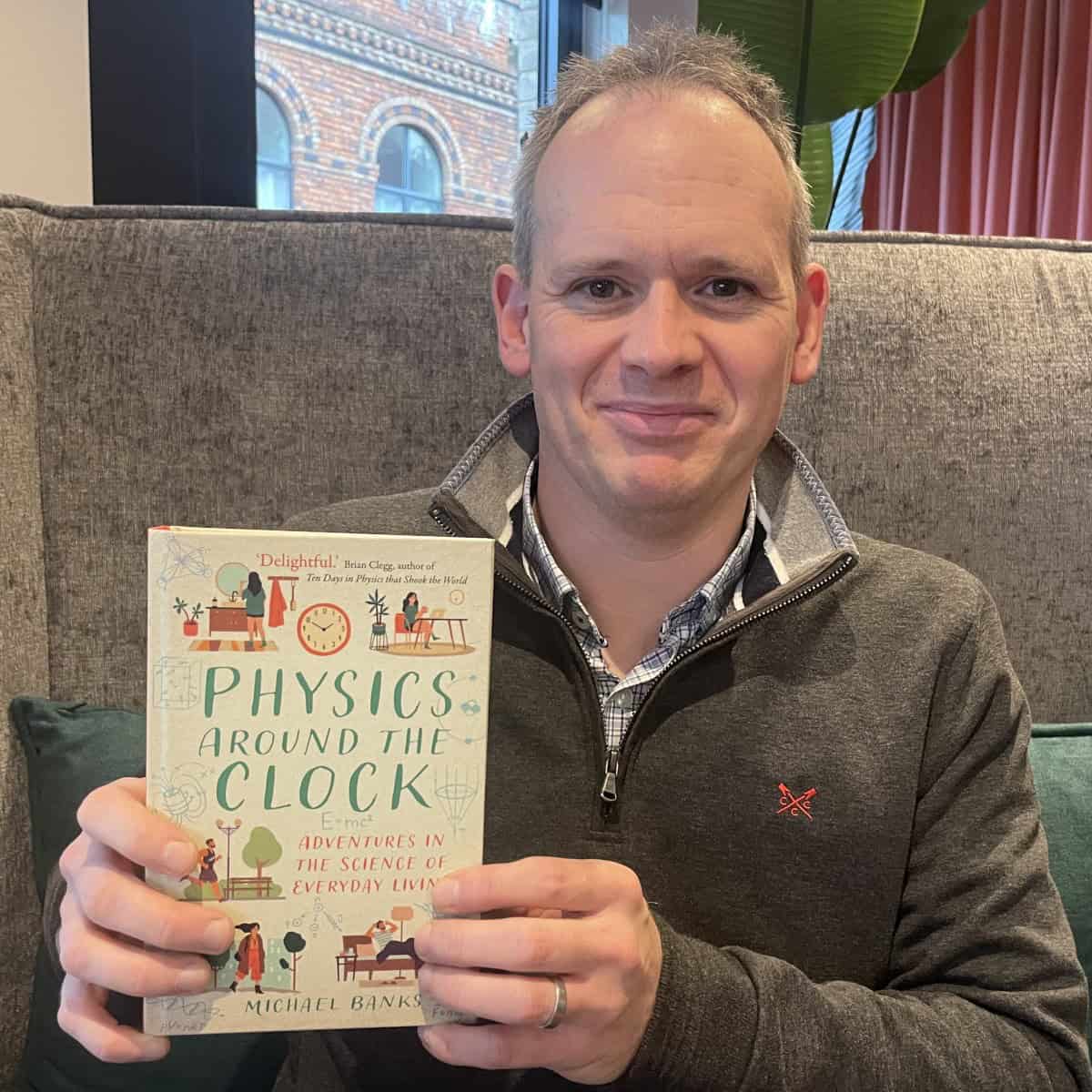
First up is my Physics World colleague, Michael Banks, whose book Physics Around the Clock, Adventures in the Science of Everyday Living, starts with your morning coffee and ends with a formula for making your evening television viewing more satisfying.
This episode is supported by the APS Global Physics Summit, which takes place on March 2026 in Denver, Colorado and online.
At the largest physics meeting in the world, you can join thousands of physicists, students, and policy leaders for a week of connection and collaboration.
Immerse yourself in the cutting edge science that's shaping our shared future, and be a part of the global physics community driving innovation forward.
Explore the meeting at summit.aps.org.
Why do Cheerios tend to stick together when floating in a bowl of milk?
Why does a runner's ponytail swing back and forth rather than up and down?
These might not be the most pressing questions in physics, but getting to the answers is both fun and provides insights into important scientific concepts.
These are just two examples of everyday physics that Michael Banks explores in his new book, And he joins me here in the Physics World studio.
Hi, Michael.
Welcome to the podcast.
Hi, Hamish.
So, Michael, before we explore your book, and some of the amazing anecdotes, physics anecdotes that you've got in there, I thought I'd ask you about, the the the book itself.
What motivated you?
What inspired you to write the book?
Yeah.
So the book is about the the physics of everyday life.
So this is kind of physics you might come across in your daily routine, you know, starting off, you know, breakfast, all the way to bed.
And I've always enjoyed writing about topics that you might call everyday science.
You know, this is, research about topics that you kind of might come across, whether it's a Cheerios effect at breakfast or the dribbling teapot or things like that.
And so those kind of topics have always kind of excited me and I've enjoyed writing about.
And actually regular readers of Physics World, will may well recognize the regular column called Quanta, you know, which features these kind of, research stories, you know, about everyday life.
Yeah.
I thought some of them looked very familiar.
That's right.
Yeah.
The actual the book itself is organized into 12 chapters, and that takes you all the way from breakfast to breakfast itself when you look at things like, you know, how the physics of even the physics of eggs, cooking, as I mentioned, the Cheerios effect, the Brazil nut effect, Physics of Coffee as well.
You know, coffee is a favourite of, physicists, definitely a physicist's favourite beverage.
So it starts off with the morning routine looking at, you know, you take your dog out for a walk, when it gets wet and it carries out a wet dog shake, you know, how it manages to expel all that water and, you know, help itself dry off.
Then it moves into the daytime, so certain kind of daytime activities you might carry out.
So say, you know, physics of you might come across in the garden.
If you're playing sports, for example, you know, things like the Magnus effect or spinning balls.
And then it kind of finishes off then into the evening.
So looking at some of the physics that you, come across, your favorite takeaways, like pizzas, physics of pasta.
Pastas are definitely a big, another big area of research that physicists, work on.
Physics of champagne, that might not be a daily occurrence of champagne, but, you know, the physics of, bubbles in certain beverages, there's a lot of interesting physics that goes on there.
And then, yeah, so then it basically goes, you know, from breakfast to bed all the way across.
And it was really, you know, interesting.
And also, you know, writing the book, it was, a lot I had a lot of fun writing it because there's a lot of, like, fun anecdotes in there about researchers who come across all these different different ideas, in their daily research.
Yeah.
I mean, it really sort of, touched a note with me.
I mean, right from the beginning because, you know, like a lot of people, I'm pretty useless in the morning, without my first cup of coffee.
Well, actually, without my first two cups of coffee.
You know, as you pointed out, coffee is is is a fascinating thing.
You know, there's some it's it's a granular material, and you're you're sort of forcing hot water or steam through it.
There's a lot of physics there.
I've got a steam kettle at home, and I think you touch on, on the physics of of the whistles in a in a steam kettle, which I thought was very interesting.
But so so of all the things that you've written about quite a few aspects of of the physics of coffee, what what do you think is the most interesting little tidbit that you've got in the book about coffee?
One of the interesting aspects is actually when you grind coffee.
Some some of us, if we have, you know, like a bean bean to cup type of machinery, you'll kind of put the beans in, they'll grind, and then the hot water presses through.
I've got some people just like to grind beans anyway.
But one interesting thing though is about, the static electricity that's produced during the grinding process itself.
So, actually, some researchers studied this in in details.
There's a, Christopher Hendon, a researcher, a geochemist in The US.
He was doing demonstrations at his university.
And, some volcanologists, so people who study volcanoes, were kind of intrigued by this demonstration of, coffee grinding that he was doing.
And they kind of asked him, oh, yeah.
What do you what do you think about, you know, teaming up to to look at what happens when you actually grind the coffee beans themselves, what's what the process that's, occurring there.
So we teamed up with these, researchers and they they actually discovered that there's actually a lot of static electricity that was produced during the process itself.
That's, like, kind of, the metal blade grinding up the beans at, you know, incredibly high speed.
And what this actually happens then is basically the coffee actually clumps together.
So you kind of, you get the, obviously, the very little kind of minuscule grains, but then you also get kind of bigger clumps due to this kind of static electricity.
But the actual implication of that is that then the water doesn't pass fully through the grinds properly because of this clumping.
And that actually results in a weaker brew.
So basically, by this static electricity from happening, the water's kind of like looking for an easy escape route through the beans, which or through the through the grounds, which it then can manage to do if lots of it is clumped together.
So one technique actually, which is happens in the coffee industry itself, is to add a little bit of just a little touch of water to the beans themselves.
And when they're in then being ground, they don't clump so much.
So then it kind of, like, can negate the statics in some way.
So Hendon and colleagues, they then carried out experiments where they added some water to it and then to then measure the resulting static, and they found, yeah, there wasn't very much static at all.
But actually, when they then looked at how much kind of coffee, kind of dissolved into the into the water itself, they found actually there was much more consistent and a lot stronger brew than that resulted.
So so if you do actually manage to, grind your beans at home, if you just add a little kind of splash, just a drop or so of water, you know, you may find that, that, you know, that the coffee is much more consistent as a result.
And of course, like coffee is it is a very experimental beverage.
You know, there's lots of different parameters you can change.
You know, you can change the size of the coffee grounds, the amount of water, the temperature.
There's lots of different things you can, change.
So actually when I had a chat with, Christopher Hendon, about, you know, about how to improve your coffee extracting technique.
You know, he was saying that it's very difficult because there are so many parameters to change.
That basically is a way of just, you know, you kind of almost have to test it out yourself, you know, you change one of the parameters, see what the resulting brew is like, the output is like, you know, and then if it is something to your taste, then, you know, maybe you can tweak something else.
You know, so it's kind of about playing around a little bit.
Yeah.
Yeah.
I mean, one interesting thing about coffee, and I suppose you allude to it in the book, is that there's also different types of coffee makers, isn't there?
And they all seem to work in in different ways.
You know, for example, I'm a big fan of the, you know, the classic Melita filter, where you stick the filter on top of the cup and you pour in your boiling water, and you get your coffee.
And I think I think I read somewhere that that's how, you know, professional coffee tasters, that's how they judge a coffee.
They use, like a traditional paper filter.
But then you've got, you know, you've got your your the the sort of espresso maker that you have at a cafe where the the steam is forced downwards into the coffee.
But then you've got the, you know, the the classic stovetop.
Is it called a mocha?
Moka pot.
Moka pot.
Where the steam comes up.
And, you know, it's and then you've got other well, the press and all these other sort of crazy ways of making coffee.
And, I mean, it sounds to me like, you know, in a sense, if I know how I like the coffee, I'm not I'm not sort of being fusty or frumpy or picky about how I make it because there's so many different variables that I know how I like it, and I know the coffee that I use, and the the filter gives me the best coffee possible.
Yeah.
That's right.
I mean, actually, Christopher Hendon, he actually uses the, filter as well.
That was his actually preferred way of, so maybe there is something in that.
But when you talk about the yeah.
The moka pot is an interesting one because it's actually quite the physics that happens in a moka pot is actually really complex, because you have this kind of different, you got the temperature of the water, but then you got the the steam the pre the pressure of the steam, kind of the vapor pressure of the steam pushing the water up.
But then it actually changes that kind of the granular nature of the coffee bed itself.
So, actually, researchers have also studied, the moka pot in in various detail.
One interesting thing about it was that when they so when they put cold water in the in the bottom compartment and then put it on the stove, then heated it, and then, obviously what kind of the output was, when they actually took the temperature of the the output, it was only about the output water as a coffee.
It was actually on it wasn't actually very high in terms of the actual temperature itself.
And then they reflect on that that maybe it wasn't extracting as much of the coffee as it could have done.
So instead, what they did was they heated the temperature, the initial temperature.
So instead of putting cold water in, they put kind of, you know, temperature water of about 40 degrees or so.
And then they actually found that a lot more coffee was dissolved if they did it that way.
So one tip could be to actually don't use cold water in a mock up, but actually use, you know, like lukewarm water or something like that.
I I could find it very difficult to convince some people about that.
Actually, you know, moving right along to tea.
And of course, you know, I think, a lot of people would be outraged if you put hot water into your kettle to make a cup of tea.
You you also look at the teapot effect, which is sort of a dribble of of liquid that comes down the spout and, you know, annoyingly goes onto your countertop or tablecloth or or whatever.
And and one of the takeaways from from that anecdote is that gravity is not a factor in the production of this dribble, and it would happen in outer space.
I suppose, you know, the the the English, astronaut Tim Peake, when he has his cup of tea, would, would produce a dribble.
And and so so why is I I I find it difficult hard to understand why gravity isn't involved in this dribbling process.
Apparently, with the teapot effect, the way gravity actually affects the teapot effect is where it actually detaches from the the spout itself.
So it's not effect it's not an effect of actually the teapot effect in terms of dribbling down.
It's more about where it might detach from the underside of the spout and then dribble down.
But, yeah, the teapot effect is something I think it was like the nineteen fifties where researchers started working on that.
And they discovered then it was various effects such as, like, surface tension, etcetera, that was behind it.
But it's only anti in recent years, I think in the February where, I remember seeing the paper itself actually when it was released where it said researchers have come up with an ideal version of the teapot effect where they've solved it at last.
And basically that what they found was this the teapot effect is not so much about gravity, but it's more about surface tension, actually the capillary effect as well, like another way.
But, actually, the physics of the teapot effect is actually quite complicated, and it's, quite involved in terms of what the actual process processes are going on.
But the but that that they effectively found that this was a a universal theorem of the teapot effect and now the, teapot effect is solved.
But as you mentioned before about, you know, the kettles, one of the one of the interesting aspects of the the the noise the kettle whistle.
So the noise that's produced during the boiling during a kettle, which is quite an interesting area.
And that was, that was a a researcher in Cambridge, actually, who just who who found out that basically no one had really ever studied how the noise in the teapot whistle was produced.
You know, it was like one of these things that, you know, people just heard have heard it for decades, but no one really knew how it was actually produced.
So he looked at it in great detail with, you know, various, microphones and cameras, etcetera.
And what they discovered actually was that basically when this this kind of stream of steam goes through the teapot whistle, It enters the first so the teapot whistle is basically two plates with a small circular hole in each of the plate.
So that kind of steam initially goes through that little hole, and then it kind of enters into a jet basically when he goes through this first hole.
But that's not actually the the actual sound that's produced that you hear isn't produced in that cavity.
What they actually found is that that when the steam then goes through the second hole, it kind of then turns into vortices.
So this kind of jet powers out of the second hole, produces these kind of vortices, and that is actually where the noise is actually produced.
And that's a technique called vortex shedding.
So it's actually the same physics that happens when you have, like, telegraph wires in the wind.
They're kind of, like, moving in the wind, and they might be, like, producing a noise.
Oh, yeah.
So I checked exactly the same effect as what's happening in the teapot, whistle.
And it's the same thing that you might hear, like, you know, if you're driving a little motorway and you have roof bars on top of your car, and it produces that characteristic whistling noise from the roof bars.
It's the same, like vortex shedding.
So where this kind of kind of wind is passing over a certain object and they're producing these kind of vortices that produce a noise.
But it's, yeah, it's just really fascinating kind of research.
You know, that's kind of a classic example of this kind of everyday, you know, phenomena.
And then you kind of, like, find new things about, you know, how to build things like that.
And and sort of moving on, into I suppose you've had your breakfast and, you know, you're moving on to shave.
I don't know.
Either your face or your legs or both.
And you've got something about razors.
And I I can remember when this story, appeared, on the Physics World website, so it made me laugh to see it again.
And, basically, the question is, well, you know, a razor is made out of a very hard piece of steel.
And so how on earth do fairly soft whiskers or hairs dull the razor?
And I I can remember when this story went up on the on the on the website.
And at that time, we had comments on the website.
We don't anymore.
But, you know, I remember this story went up, and it gave this wonderful explanation.
And somebody wrote in and said, oh, you're you're being dozy.
The reason they get dull is so they can sell more razors.
Exactly.
And I thought, okay.
I can't argue with that.
So, yeah, I suppose there might be some truth to that.
But why why on earth does a a very, very sharp, and and, hard piece of metal get dulled by, you know, a fairly soft piece of hair?
Yeah.
So that's what another one of these life's mysteries, isn't it?
Yes.
A razor blade's, mostly made of steel.
And, of course, the actual hairs on your face, they're around 50 times softer than the materials of razor blade itself.
So you might think, how on earth does something that's 50 times softer end up blunting, you know, something that's so hard such as a razor blade?
And that's what these researchers at at MIT, in The US, were very keen to understand.
So they actually, carried out a number of experiments, in which, you know, kind, students plucked individual hers from their face, and then they got this blade basically to cut, just a single or very few, you know, very few strands of of hair itself.
And they looked under that at that process under a microscope, you know, very powerful microscope.
But they were amazed to discover that even single hairs like that could actually end up, chipping, the blades themselves when you look under, you know, very, you know, very, powerful microscope.
So that kind of really surprised them about how on earth, you know, what is the process that's happening to, you know, such that a hair can actually blunt a blade.
So they looked at it in much more detail.
They got, did a lot more experiments on it.
And they actually discovered there was kind of three different types, of process that was happening when a when a hair was being cut.
So one example is, where the hair basically there's like, there may be small imperfections in the blade itself during the manufacturing process where you have little cracks, so it's kind of really unavoidable that you've got these kind of small imperfections.
So if a hair kind of then slightly hits one was a crack, it's like kind of slightly hits one side of it, that is enough to eventually kind of chip the blade if it hits if it is a side of a crack.
Another possibility is that in the angle itself, so if a if the blade is kind of perpendicular to the hair, it should generally avoid cracking or chipping.
But if the angle is actually an if the, blade is an angle to the hair itself, then that can actually that also could they found it could also result in in chipping.
And another, the third option, that they that they discovered was actually kind of, inconsistencies in the material itself.
So in in homogeneities basically where the material was kind of softer, say, in one part than it was in the other.
So if, again, if the hair was then if the hair hit that softer part, it would then basically end up chipping, the blade.
So that's what they discovered.
They discovered these three, these three kind of processes that are happening.
But when it comes to, as you mentioned before about, you know, does the actual industry want this to kind of happen, one way of getting around it is to have is to produce a material that's more much more consistent.
So it doesn't have those certain kind of softer and harder regions.
You know, it's more, more, I mean, homogeneous, so that the that those kind of chips won't happen.
But in terms of actually for, you know, stopping the chips altogether, it's gonna be very difficult because you will always have these kind of little cracks in the material itself, which will then even be even, you know, hers can end up chipping, you know, end up chipping those blades.
But actually the researchers at MIT are actually at the moment, they're they're developing new materials, which are, you know, more more consistent, in the blade.
And I think, from what I heard, anyway, is that they, you know, they are looking at developing products where, you know, blades could be more consistent, and that may end up, you know, increasing the lifetime of certain blades.
Right.
But but, of course, that was kind of, like, you know, disposables, etcetera.
I mean, you could you could use a blade where you sharpen it.
That's one option of getting around it, where you would purposely sharpen the blade.
Like an old fashioned straight razor.
Exactly.
An old fashioned straight razor would get around that problem because it would then end up, you know, making it much more sharper each time.
But yeah, that was quite an interesting, discovery actually, but there's kind of different ways of of firing us.
And the same goes for things like cutting a cutting a knife through cheese.
It's just exactly the same process, though, where effectively cheese itself could blunt a knife.
And it's the same very same things, but these kind of small imperfections can result in, you know, a failure of, even something so hard as a a steel knife.
And and sort of staying on the, on the subject of hair, you you you also look at, runners' ponytails.
And I think, you you know, if you've seen someone with a ponytail running, normally the ponytail sort of swings back and forth.
And if you think about it, a runner is sort of going up and down.
So why isn't their ponytail oscillating in the horizontal direction rather than the the vertical direction?
But the clearly, there's some sort of coupling going on between, those two degrees of freedom.
So what what's happening there, Michael?
Why do runners' ponytails go side to side rather than up and down?
Yes.
It's actually not only I mean, ponytails is one possibility, but also, like, if you have flight if you find you have, like, a hoodie on sale, which has got tassels, you'll find exactly the same thing.
So if you walk at a at a brisk pace, you might find as you're walking, the tassels on your hoodie are not swinging off, like, you know, back and forth, but actually swinging from side to side.
So you're kind of thinking exactly as you said, how on earth, when when your head is, you know, head is moving up and down, you know, why why is your your body moving forward, and why are the tassels moving from from side to side?
And it's actually a bit of a strange story behind it, but it was, it was someone who was actually working on the kind of three body problem in terms of the, in terms of astronomy and kind of the relationship between the sun, the earth, and the moon.
And it was, various kind of equations that they produce from that.
And somehow that could actually then be used in terms of the physics of how a ponytail moves.
And it's to do with a couple as you mentioned, the couplings between the the kind of what's swinging and then what's its kind of anchor point.
So they discovered that if there's kind of a, the frequency is a doubling.
So say if you're walking, you've got a certain frequency that your head is moving up and down, your, your body's moving up and down.
If there's kind of a relationship between the between that length and actually the length of the ponytail itself, then basically, if it's if it's if it's a double wing, then basically any small deviation between that up and down movement and side to side, basically then it it expands, basically.
So if you've got a very tiny deviation that you're slightly going to the side, what happens is that basically then expands exponentially.
So that's what you see then, basically, is because, you have this kind of, coupling in your stride length and your between the actual coupling of the of the ponytail itself, it's basically then it expands and you get this kind of, exponential increase in the swinging from side to side.
It's only a very small thing that then results results in something that you actually kind of see.
And so is there any up and down motion in the ponytail?
Or is it only moving side to side?
Or is it there's is it much more complicated than just going side to side?
It's sort of going well, it is going up and down.
Right?
Because your head's going up.
Yeah.
Exactly.
Because your head yeah.
Yeah.
Because your head's going up and down, not the link.
So the ponytail is going, yeah, up and down and side to side.
Yeah.
But it's only that because you have that very small, tweak in it going side to side that it kind of expands and ends up going way, you know, really far side to side because of that kind of doubling relationship between, the frequency of the head movement and the and and the lens of the ponytail.
So, yeah, it's kind of all in the mass of that.
But, yeah, it's quite interesting that yeah.
Something that you see when you see someone walking around and they're or or going for a run, you see their ponytail wafting around.
It's, you know, it is all because of those it came from the mathematics of working out those relationships between, the sun and the moon.
And sort of moving on from running to to driving a car, I mean, I think one thing that's really fascinated physicists for for years, I suppose, ever since the first traffic jam occurred, I think physicists have been fascinated as to why why they occur.
And then, you know, there's a particular kind of traffic jam that I think any driver is familiar with.
You're driving along, and the traffic suddenly comes to a halt for no good reason.
There's no obstruction on the road, the speed limit hasn't changed, and then the traffic jam breaks up and you move along for, I don't know, half a mile, and you slow down again.
And there doesn't seem to be any rhyme or reason to this.
And I think when the physicist looks at this, I think they're seeing some sort of emergent behavior, some sort of there's gotta be a phase transition in here and, you know, lots of interesting mathematics.
And, I think you look at some of that in the book, don't you?
Yeah.
That's right.
So one of one of the issues is about, you know, the annoyance that you have on daily life of coming up against traffic jams, whether it's on the motorway or even just, you know, out and about in town.
And, but one of the, yeah, one of the interesting aspects is how traffic jams can occur.
Even when even in the absence of, you know, anything that you may expect can cause a traffic jam, such as, you know, roadworks, a broken down car, for example.
You know, traffic jams can seemingly just occur for no reason.
And the kind of reason for it is because, you know, even if a driver kind of just takes her eye off the road for a split second, for example, you know, and then just kind of a lack of concentration, what what can basically happen is that that that then has a kind of a spillover effect.
So you have someone who, say they lack a bit of lack of concentration, might veer off a little bit to the road, they break, then the person coming behind them then has to react to that, they break, you know, the person behind and it's basically a domino effect where you then you're effectively creating, kind of a wave within the traffic itself of people just breaking and then accelerating off.
So yeah, physicists have studied these kinds of waves and the physicists call these waves, jamitons.
So basically, they just kind of happen happen for no reason.
And that was kind of the theory about how, you know, waves could actually form.
But there were these researchers, in Japan actually, who did an actual experiment.
Basically, they got, a number of cars on a circular road, just kind of a few 100 clump a few 100 metres, in circumference.
And they put all they told the drivers is said, look.
Just drive along the circular road and just keep going round, you know, as many times as you want.
Just keep going.
And they actually discovered that traffic jams just occurred naturally.
So, you know, people would just drive along, and then they just, Basically, they probably just, you know, they just, some kind of something caught their eye and they just became distracted.
They then broke and then basically they saw this exact kind of jamaton wave form.
Even during a very, such a simple experiment as that way, you have basically circular road and cars on it.
So that was basically the idea that, you know, it doesn't take traffic, it doesn't take a car to break down or, road works or anything like that.
But even on a road where there's kind of a number once you get a certain density of cars on the road, then you can get these, jamaton waves forming.
And, you know, that's basically, you know, how these waves can actually form.
And it's, it's quite interesting research, but there's also, like, a lot of different aspects about driving around the city, that are interesting.
There's one one particular interesting point that's been, covered in the book where I talk about the physics of parking a car on a one I mean, it's on a one dimensional road, which is, you know, a classic your classic physicist, you know, taking a problem down to its bare minimum.
But then they look at, you know, how how you what strategy you could come up against.
Well, if you have a one, one basically a single road and you want to get, you want to park in the best spot to get to a destination at the end of the road, you know, what is a certain strategy to do that?
So they looked at three possibilities.
One was, the so called meek strategy, where you basically just go and park in the first spot, end of you know, but the issue with that is that you park in the first spot, but then you have to then walk to the destination.
So that takes time.
Another option was a prudent strategy where you ignore that first spot.
You then see a group of cars, in front of you, and maybe there's a spot there.
Then you go into that spot.
That's called the so called prudent strategy.
And then a third strategy was called an optimistic one, where you basically drive all the way down to the, end of the road, turn back on yourself, and then go in the first spot.
So you kind of think, well, surely the optimistic strategy is the best because you basically get it's guaranteed that you're gonna get the best spot.
But when the researchers run through the various simulations, etcetera, they actually discovered that the prudent strategy was a better one, because that got you in a spot that maybe not was is maybe up the furthest away, but it's some kind of, you know, nearer to the destination, then you can walk to it.
And that actually has links with, the secretary problem in mathematics.
But it's kind of the optimal, how many how much do you kind of ignore before you then, park?
So, yeah, if you're ever on a, basically, if you're ever on a one dimensional street, then the optimal solution to it is to kind of ignore about half the spaces and then park in the next in the next one.
Right.
Then you've kind of got about a 25 to 30% chance that you'll actually end in the best spot possible.
Gotcha.
Yeah.
And now I'm trying to imagine how to make a u-turn on a one dimensional road, but I'm guessing that they don't, they don't they probably reverse bike, all the way.
And then you've also looked at, at other modes of of transportation.
And, you you know, you've got that classic thing, the boarding of aircraft, which I think, you know, I've been I I suppose I've been I I've I've flown on aircraft for the last, I don't know, four forty five years.
And I think, you know, definitely the strategies that the airlines take have changed over the ages, and maybe they've refined them.
Or, and and so you have a look at the at the various different strategies.
And then there is a twist in the tale, isn't there?
There's a surprise, at the end about, a technique that you might as well use because it's it's almost as good as, as the actual best technique for boarding an aircraft.
So what what what have people found when they've looked done research into, into boarding aircraft?
Yeah.
I think they can the basically the bottom line is, the kind of the current method of boarding an aircraft, you know, usually it's kind of back to front boarding where you get all the people on the back and then they altogether unload, and then you get the next next batch in.
So you, you know, you board it all the way to the front.
That kind of in terms of the speed of boarding isn't the kind of ideal, way.
Actually, one one possibility that is actually quite quick is actually one that you might not think, which is basically random.
That's right.
Where you basically just randomise people boarding and that actually in the simulations, that people have carried out, that actually is, quicker than the current, than the current method.
But there is a there is a one that a researcher, came came up with, which was, the kind of the best tech best technique.
And that's kind of like splitting up the roles itself.
So you would, you know, you go in one one, say 12, and but then you don't board the next row 11, you kind of skip skip one.
So it's a bit more kind of involved than the the way that airlines do at the moment.
But that was actually found to be the quickest way.
And they actually the researchers themselves actually carried out an experiment where they got a mock aircraft, an actual life-sized mock aircraft, and they tested out all these various strategies, including the, completely random one.
And then they discovered that basically, you know, this, this way of kind of splitting up roles, you know, 10, to what say, row twelve, ten, eight, was actually quick.
But, it seems like airlines actually are beginning to look at the, the procedures for for doing that.
I think there was something about United Airlines, in October 2023.
So they they they announced that they would start boarding, economy class passengers on, this method called Wilmer, which is kind of a way of just, you know, splitting up people in different in different roles.
So, yeah, maybe, you know, maybe in future, we won't be boarding just from the back to the front, but we'll actually be using these different different ways of boarding.
You know, because I guess, you know, at the end of the day, you know, time is money, isn't it?
You know?
So if you can get people onto an aircraft quicker, you can get away quicker, you know?
So it does have financial implications.
So you would think that airlines would be more interested in, you know, changing those boarding methods.
I mean, the interesting thing about when you compare the, let's say, the Wilma to the random, is that I mean, is there really a big difference between those two strategies?
Because when you think about it, if you're doing it randomly, if it is random, then if I get on the plane, chances are the person in front of me and the person behind me are going to be separated from me on the plane.
So we'll all have enough space to pack our stuff away and quickly get into our seats.
So is I mean, is there is there really any benefit between Wilma and the random?
Because I think I think in the book, you say that random is almost as Is it almost as good as Wilma?
That's right.
It's almost as effective.
Yeah.
That's right.
You would think in that sense that it probably is better just to go just to go random.
Yeah.
Because, I mean, Wilma seems very complicated and, you know, how you you know what it's like.
I mean, I just flew back from Toronto and, you know, you always get the situation where, you know, people who are last to board stand at the front of the queue and basically block everybody else from getting on, you know, which is very annoying.
Actually, once, I I took a flight.
It was from Toronto as well.
And, one of the gate staff actually stood there and berated people and said, you, what what group are you in?
Five.
Oh, no.
No.
No.
This is three.
Get out of here.
Right?
You know, I was thinking, this is great.
You know?
Unfortunately, the the last flight, they they didn't have somebody doing that.
But, but, yeah, that is and, you know, it is interesting because when I tell people, I say, well, you know, physics says that random boarding is is actually a pretty good way of doing it.
Nobody believes you.
But, I mean, I I I don't know if it's maybe it's because I'm a physicist.
I have a I sort of have a great, you know, I think randomness can be very useful.
I mean, a classic one, is stuffing a sleeping bag into a sack.
Right?
Now you'd be very tempted to think the the most efficient way to do that is to roll up the sleeping bag.
But the problem with rolling it up is that you're introducing a preferred direction.
Right?
And if you don't get the the length of that roll correct, it you're gonna have a hell of a time getting it into the sack.
Whereas if you just stuff it in, it's random.
And, you know, the sleeping bag can randomly fill the space.
It's a bit like a glass, right, I suppose.
Anyway, that's how I think of it.
But, yeah, maybe it's one of those perfect things where randomness is.
Because you wouldn't It's your friend.
You wouldn't exactly.
You would not expect a random boarding process to be.
You'd think it'd be chaotic.
You just need to be absolutely not.
But, yeah, you know, the experiments say otherwise, and it is actually one of the best ways to do it.
So And the the the there's a few you you you talk about health, in your book.
And, it's interesting that a lot of the the things that you mentioned were were things that came up during the COVID nineteen pandemic, where we were obviously very, very, very concerned about the spread of, virus particles.
And the the the one thing that you looked at, and, you know, I have to say it's made me think of toilets in a different way ever since, is how toilets are actually very good at spreading aerosol particles.
So what what what exactly happens there?
This is when you flush the toilet, I assume.
That's right.
Yeah.
So it's when you when you flush the toilet.
And and, yeah, this research was one of those ones that basically came out purely from the COVID, pan you know, pandemic where, some researchers researchers contacted this, a researcher in The US who was an expert in kind of imaging, aerosols and, you know, the spread of aerosols.
And they were interested in, you know, looking at the aerosol that's created when you flush a toilet.
So there had been before then, there had been some theoretical work done, which showed that when you basically flush a toilet, you know, the the water pours in.
It's quite energetic process, and it flows into the cistern.
And then it can basically create like a jet where, it can basically just fling particles out of this chaotic vortex like jet in the toilet in the toilet bowl.
But that was all of that just kind of, theoretical work.
So these researchers, were really wanting to find out whether this is the case in terms of doing actual experiments.
So they, basically filmed this toilet set up, when they have all this kind of green laser light around, so they could basically visualise the plume that's created without actually disturbing it.
It's quite important that you don't disturb the plume itself when you're actually looking at it.
And what they found, you know, they told me, you know, wrote about it in the book, you know, really startled them, that they literally found this kind of these particles just shooting out, like a rocket, basically, where you know, and they were going basically about a couple of meters high.
Where presumably you could breathe them in.
Well, exactly.
Contained COVID, COVID nineteen virus particles or some other nasty Exactly.
Basically, head height for most people, they they could actually reach.
So, yeah, basically, by the process of flushing itself is so you know, energetic that it can create it can throw particles out, but it also can create this kind of aerosol, basically.
You know, a bunch of particles that then can kind of spread around as well because they kind of move around in the air.
So that's actually another another piece of work as well looked at, you know, where this aerosol could could kind of how far it could travel.
And they seeded the toilet itself actually with kind of bacteria, e coli, etcetera.
And then they flushed the toilet, and then they took swabs, swabs around the room.
So they kind of took samples around and they found basically that the, that the process of flushing an open toilet just basically put, you know, put stuff e coli everywhere, basically around is on the walls, on the ceiling, it was on the floors.
So you might think because the result's that, you might think, well, that's obvious.
You just close the lid.
That's an obvious solution.
You know?
What what could go wrong?
But when they actually then decided to do that and did the experiments, they actually found that, you know, it didn't help at all.
Basically more material was put on the floor, but it even reached the walls and the ceiling itself.
So basically there is no, there's no real way to get around that except, you know, of course, from disinfecting your toilet quite quite often.
It's probably the best way of getting around it.
But the researcher who did that way, you know, they said, they gave me a funny quote where they basically said that after they did that research, you know, they basically flush the toilet and run.
That's and also a bit and also to not put your toothbrush anywhere near, the toilet because basically, you know, that aerosol is basically just going all over it.
But Right.
On that note, let let let's move on to something much more cheery, and that's the physics of champagne.
And, one little tidbit.
I mean, I suppose I should have known this is is the incredible pressure that, champagne is under when, inside a bottle.
It's what was it twice the the pressure of a a car tire?
Yeah.
Something like that.
Car tire is around two bar.
And, yeah, the pressure in a champagne so the in the neck of the champagne bottle can be around, yeah, around five bar or so.
So quite and, of course, the pressure increases with the temperature.
So you have a chilled bottle and the temperature's a bit lower, but it's a warmer bottle and it's a bit higher.
So it can be quite, actually, yeah, opening a champagne bottle can be quite a lethal process because, you know, if you've got all that pressure just in that headspace, and then it'll, you know, impact on the cork, and the cork can and actually, during holiday season, holiday periods, and you have a lot of injuries, where people, you know, hit cork.
Cork to the eye.
Conte.
Exactly.
A cork to the eye.
Yeah.
Yeah.
Which you can can be actually very dangerous.
It's, you know, it's a lot of, you know, it's a lot of pressure that's kind of, you know, producing that high speed cork.
Yeah.
Yeah.
I'm sure if it went in the wrong direction, it could, you know, smash a window or take take out your your your favorite, knickknack, over the fireplace.
And and one thing that you you talk about is the that sound of the pop, that characteristic pop.
And am I writing in thinking it's a bit like the a sonic boom, or maybe it is a sonic boom?
Yeah.
That's right.
So, when you open a bottle of champagne, basically, it's the the pressure, drop that happens.
Basically, I have a huge kind of temperature drop that happens when the champagne opens itself, opens.
And then basically what can happen though is you have the creation of, like, these MAC discs in the due to this huge temperature pressure drop.
In temperature up, you have this, creation of MAC discs.
So, basically, each time you are opening a champagne bottle, you are actually kind of breaking the soundbar in some sense by, you know, the creation of these.
It tends to be just a single MAC disc up produced and then basically kind of then kind of moves up into high you know, people have done various high speed imagery on it.
Moves up and then it kind of moves back down into the into the bottle itself.
But there's been various yeah.
Lots of kind of experimental work and actually theoretical work on it as well where, you know, people, have calculated that.
You should actually be able to see a few Mach disks created.
It's not just one.
Similar to what you see in a jet fighter plane, where you see the creation of, Mach disks and then Mach diamonds as well in the exhaust plume.
A similar thing is kind of via the physics of it.
It's very similar to what's happening when you open a bottle of champagne.
We have the creation of these Mach disks due to that, you know, incredible kind of pressure drop that happens.
And the the other thing you look at is, bubbles and the bubbles that, champagne is famous for.
And the the thing that that sort of fascinates me about beverage bubbles is that they can vary.
You know, a a a champagne will have these tiny bubbles.
And, I don't know, probably get in trouble for saying this, but, you know, a a lesser wine like, Prosecco, you know, the bubbles will be a bit bigger.
And by the time you get to a fizzy drink, you know, like, Coca Cola or something, the the bubbles are huge.
And, you you know, you think, well, this is just liquid with carbon dioxide.
Why are the bubbles so different in size?
And, you know, why do we associate a high quality beverage with small bubbles and, you know, pop with with large bubbles?
That's something that's always fascinated me about about carbonated drinks.
Yeah.
Because with champagne, for example, it tends to be, you know, a sign of the quality.
It's kind of the little kind of bubbles that you kind of feel on your mouth or your tongue when you're kind of, you know, when you're drinking it.
But one one interesting thing about the the bubbles that's create that you that you see in champagne as compared to, as you say, different beverages like beer or Coke, for example.
One interesting effect with champagne is you get these kind of bubble trains.
So you get literally lines of bubbles, whereas in, Coke, for example, you'll get them kind of moving around.
You know, they'll just be wavering your own to the top.
So, yeah, you know, people have done research about what why does champagne have these bubble trains and other drinks don't.
And that actually all comes down to, the kind of molecular makeup of the champagne itself, and it kind of contains, surfactants in the champagne.
And people have done various experiments where they've kind of produced bubbles, and then they've kind of adjusted the amount of surfactant in the in the drink itself.
And, basically, it's a result of champagne having more of the surfactant molecules inside it.
That basically then is quite complicated, you know, bubble physics, but, basically, that results in all these bubbles magically kind of forming a train and coming one after the other.
Whereas other drinks, terra- nagal.
Also has something to do with the size of the bubbles as well.
Yeah.
Mhmm.
That's right.
Yeah.
So that's all too, with that surface tension and all and all those things.
But, yeah, whereas diff other drinks don't have that level of surfactant in it, which then, you know, results in the kind of bubbles moving a bit more kind of in a wavy way.
But, yeah, the bubbles is also where all the a lot of the flavor and the taste comes from, in champagne.
So we've got some popping of those bubbles is what gives that kind of magic flavour, to champagne.
And and finally, Michael, I wanted to talk about, I mean, this is, I suppose, an all time classic in terms of, the, you know, the physics of the real world, and that's the the broken spaghetti problem.
And essentially, the idea here is that if you take a piece of spaghetti, dried spaghetti, and you hold it at either end, and you bend it until it breaks, it almost always will break into three pieces.
No.
That's right.
Three or three or more.
Yeah.
That's right.
Into never two.
Well, yeah.
Very rarely two.
And I think, you know, when when physics students are told this, you know, the first thing they do is they go home and they get out the spaghetti, and they just keep trying and trying to break it into two pieces.
And, it's very, very difficult to do.
So why is that?
Why does why does spaghetti break into three or more pieces and not two?
Do we know?
Yeah.
I mean, this is actually a question that even flummoxed Richard Feynman.
He was, he I think along with his friend, William Hillis, they spent apparently, they spent hours, just in the kitchen breaking spaghetti and, you know, to desperately try and get it into two pieces.
But, you know, they always found that it ended up breaking into three or more.
But they never kind of come up with an explanation of what why that kind of happened.
But then actually some researchers, at MIT, they decided to look into the into that process in a bit more detail.
And then they they came up with this kind of elaborate setup where they had, one end they had a spaghetti strand, one end that was fixed.
And then it would then basically move into another end.
So it'd be basically just slowly bend.
And they found actually that there is a way of doing it, that to create just two pieces, and that's if you just do it very, very slowly.
It sometimes can actually break into just two pieces.
So rather than just, like, you know, getting it, but I'm just snapping it.
You just do it very slowly.
But the ultimate way of doing it actually is to, kind of slightly twist the spaghetti strand.
So the explanation they come with was to do with all these kind of twisting waves that happen that basically dampen the effect of, of the spaghetti wanting to break further.
So these kind of torsional waves, by twisting it, these torsional waves stop the spaghetti breaking.
So it only tends to break in two.
So they found that, actually, if you twist the spaghetti on the one end, I think it was around about two seventy degrees, so not quite a full revolution, but, you know, not not far off.
And then they actually did the same experiment twisted.
It always more or less broke in two pieces.
And the reason for that is it is because the creation of these when it breaks, these torsional waves then dampen the effect of further, breakages.
And and do do they actually know why it breaks into three or more pieces?
The because I suppose, you know, when you think about it naively, you think, well, you're gonna bend it, and it will break somewhere first.
And then why would it break again?
Or why would it what what are the odds of it breaking in two places at the same time?
You know, both of those things seem unphysical.
So are they do neither of those things happen?
Is it something different?
So So I think what happens what they say is that when so when you when you bend a spaghetti strand, it creates these when they call them bending waves, basically.
And these propagate when it when it's bent, when it snaps, these bending waves then propagate down the strand, and then it kind of re results in more, breakages because of these kind of these waves are produced.
But that's then what the that these kind of these twisting waves or the torsional waves actually counteract the bending waves.
So that's the way then to get around it is because, the bending waves are dampened by this torsional waves.
Yeah.
It's on, but, Well, that would yeah.
Yeah.
That's interesting because, you know, it just popped into my mind that, if you actually take a big bunch of spaghetti and break it, it will break into two.
Every almost every strand will break into two.
So I suppose when you're grabbing the spaghetti and, sort of squeezing it together, you're probably dampening You're probably dampening those those breakages.
Yeah.
That's that's yeah.
That's probably the case, actually.
Yeah.
So yeah.
That's one way you're getting around it, maybe.
Get the whole packet and, bend it.
Yeah.
Yeah.
Well, that's I mean, I you know, I have to say I'm I'm sure this is, I've I've I've I've probably insulted the Italian nation again by saying that when I do cook spaghetti, I do break it in half and cook it.
Yeah, I've said I I was planning on going to Italy next year, but maybe Maybe not anymore.
My visa will not be granted.
Yeah.
Well, thanks thanks, Michael.
Thanks so much.
And, actually, there's more about, Italian cuisine in, in your book because you've got a wonderful section about pizza as well and how to cook a perfect pizza.
But, you know, I'm afraid we we just don't have time to cover that.
So Michael's book is called Physics Around the Clock, and it's out now.
Is that right, Michael?
Yeah.
I suppose it's out in The UK, now, and it will be published in The US in April 2026.
Okay.
And I'll put a link, at least to the to The UK version in the notes for the podcast.
Thanks a lot for coming on and talking about, some wonderful physics, Michael.
Thanks, Hamish.
That was Physics World's Michael Banks.
His latest book is Physics Around the Clock, Adventures in the Science of Everyday Living, and it's published by the History Press.
I'll put a link to the book in the podcast notes.
Thanks to Michael for joining me today and to our producer Fred Ailes.
And thank you for listening to this podcast, which is supported by the APS Global Physics Summit.
To continue advancing physics beyond this podcast, participate in the APS Global Physics Summit on March 2026 in Denver, Colorado, and online.
Experience high impact scientific sessions, networking opportunities, workshops, and community building events designed for every career stage.
Learn how you can attend and shape the future of physics at summit.aps.org.