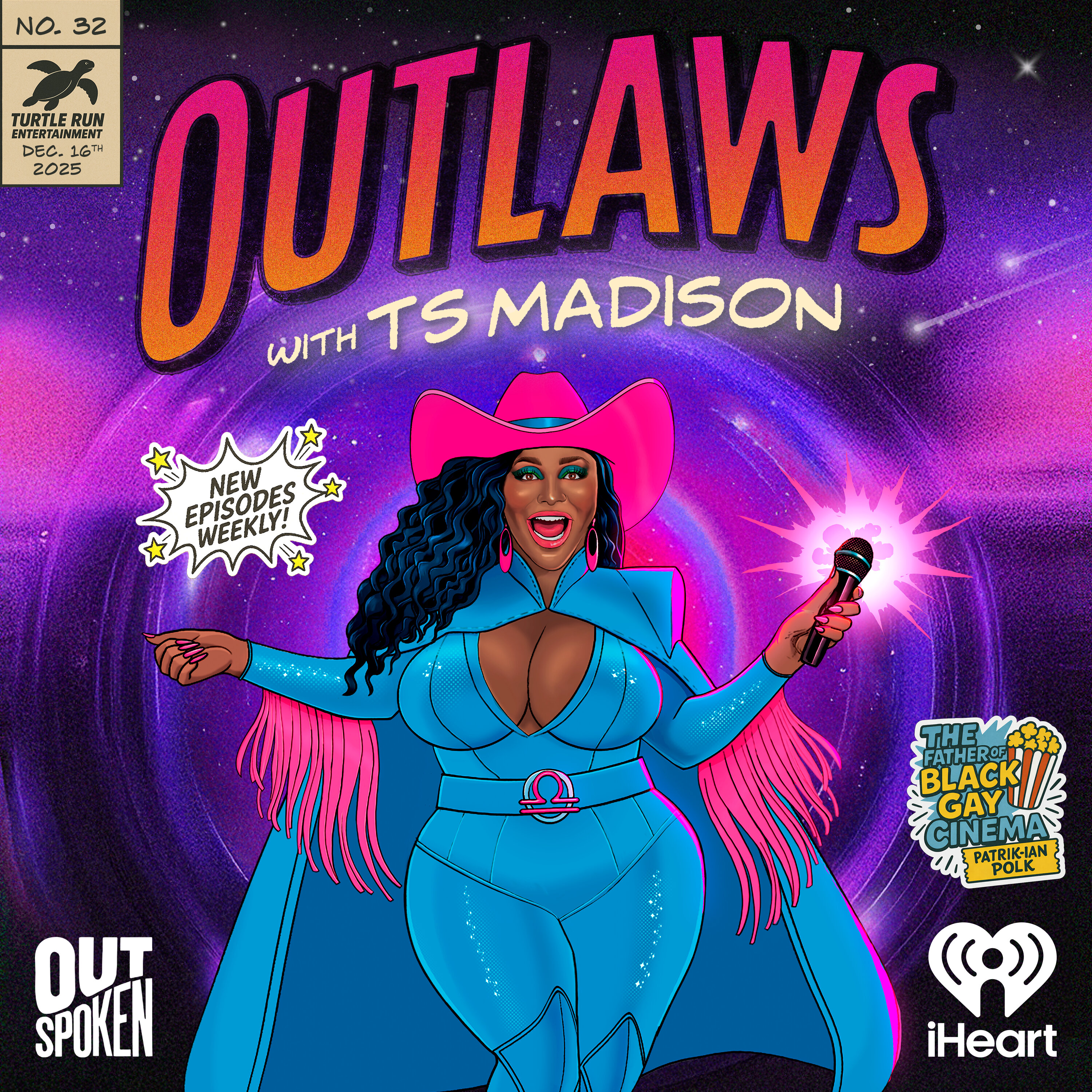
·S1 E32
Patrik-Ian Polk: The Father of Black Gay Cinema
Episode Transcript
Every time I open up my mouth up and goes foul.
Don't wait, no win twenty two inches b b d b d bed bo yourself is get a job?
Oh ricking honey, rick couldn't pure.
Speaker 2He chasing it all.
I'm black like that.
Speaker 1About living.
It's colored easy.
This is Outlaws, but cheers medicine.
Is it on?
Speaker 2Honey?
Speaker 1Is it on?
Is this thing recorded?
What's the YouTube?
Blend twit the land, all the mother lands, across the land?
Godamn it.
This is me ts Medisine coming to you, live, live and always and forever in color from the Outlaws podcast.
Now listen.
What y'all gotta know about me is I'm always and forever bringing you people, iconic, legendary groundbreakers, a trail, a Blazers, torch bearers.
I'm always bringing you people that you need to be familiar with.
If you're not familiar with, but you need to be familiar and if you offer me with we get naked.
Here, we take off all of our clothes, even though we leave them on.
We take off all of our clothes and we have a good time with each other.
Because I like to have conversations where I can sit down with people that I admire that I love, that I that I revere, that I look up to, that I respect.
But I just want to see how they' all naked, you know, because everybody's seen me naked.
I mean, I don't even see how y'all got y'all vision backed, but you got it, Ladies and gentlemen, Today I am joined by producer, director, writer, creator, trailblazer, torch bearer, innovator Patrick Impolpe.
Speaker 2Hello, Patrick, do.
Speaker 1You know I'm so happy to have you here on the show.
I'm happy to have you here on the show, I think because you and I have our personal conversations, but I really don't get an opportunity to like really flower you like like I should.
I need you to understand, there's a segment of our show it's called talk your Shit, And on this segment of the show, this is the time that you get the opportunity to talk your shit, tell us who you are, what you do, what you're proud of.
And in this segment, I don't want you to be modest.
I don't want no modesty.
I don't want no humility.
I don't want none of that.
I don't want you listen to none of that shit.
To the motherfucking people done told you about.
Oh well you know you black and gay and buy and whatever it is.
Speaker 2Or be humble.
Speaker 1I don't want hear none of that shit today because I want a motherfucker out there that's watching the show or listening to the show to know who you are, what you have done, how you have you know, that's the transformer sound.
How you have transformed the queer community and put in and most importantly the black queer community for a very very long time.
You know, because we know, we know people like my good Judy Lee Daniels and Tyler Perry, like we know these names, we know the Titans, but you are part of that of that Titan legacy too.
So please, in this moment, I need you to talk to your ship who I'm sitting across from.
Speaker 2No humble.
I can't be humble.
Speaker 1I want you, I want no humility that Well, my name is.
Speaker 2My name is Patrick y and Polk, and I am the father of Black gay cinema.
Come on, daddy right And you know that's the title.
It was given to me some years ago in a magazine article, and at first I used to laugh at it and think, oh, it's just a joke.
It's a joke with the older I get.
I'm in my fifties now now I'm like, you know what, I will take that title because I have worked hard for it.
Twenty five years ago, my very first film was released called Punks.
It is the first black gay feature film American feature film.
It is a black gay waiting to exhale in many ways.
It's a precursor to the groundbreaking television series I created a few years later, Noah's Arc, which is celebrating its twentieth anniversary this year.
We've done two seasons of a TV show and now two feature films, including the most recent Noah's Ark, the movie just released this summer.
I've got other gay black films, The Skinny Blackbird.
Do you did Blackbird?
I did Blackbird with Monique.
With Monique I wrote and directed, Oh yeah, that was you, that was me, shot in my hometown, Hattisburg, Mississippi.
Blackbird, Yes I did.
I was so mad at Monique for that.
Speaker 1I'm sorry.
I didn't want to step in, but I didn't notice you did Blackbird?
Speaker 2Oh yeah, yep.
So I have made a career of making film and television projects that increased representation for the black LGBTQ community.
I worked on some very popular TV shows.
Being Mary Jane, I worked on I wrote the two hour series finale of Being Mary Jane when She Got married.
I worked on The Shy with Lena Waite, writer producer.
Obviously, I worked on Pa Valley as co executive producer and writer.
Won an Image Award for Pa Valley, my first Image Award out of seven nominations, and was involved with with creating and writing for gay characters on all of those shows.
I introduced gay characters on Being Mary Jane, we introduced gay characters on The Shy.
Obviously, we have Uncle Clifford and gay characters on Pea Valley.
So my entire career has been dedicated to this work.
So I feel I have earned the title father of black a father father of black gay cinema.
Yeah, well you know, I didn't know that.
Speaker 1See, and this is why it's important and people, when you watch the show The Outlaws and when you listen to the podcast, it is important that I have that segment called talking shit because even with all my knowing, I didn't know that.
And I watched Blackbird.
I'm so mad at Monique about that.
I wanted to tell her when she was here, like, girl, if I would have remembered it, and now we should have hit you because I'm like, bitch, I ain't like you in Blackbird.
But you created the Uncle Clifford.
Speaker 2I did not no, no, no, no, get it going now, Okay, the wonderful, the legendary Katori Hall Hall Yeah, created Pa Valley based on her play and the series, So she created Uncle Clifford.
But you know, Katori is also from the South.
She's from you know, Memphisippi, North Mississippi and Memphis, and so we have that connection.
And the show is set in Mississippi, so of course I was able to bring a lot of my mississippisms to that show and as well.
Speaker 1So but you, but you, but you created uh, you created Alex And.
Speaker 2Thank you.
That's that thank you.
Speaker 1I said thank you because you know, queer representation is something that's so important.
I know that we're we're faced with so many things in the media with with with straits feeling like that.
It's when you get one character on a TV show that you know, oh it's.
Speaker 2Too much, it's an agenda.
Speaker 1Oh god, it's too much.
Oh God, help my vision.
Because it's too much.
Speaker 2That we're looking at you, Snoop Dogg, Yeah, and others, others, because his voice echoed many many that sat back and was like, yeah, I gotta watch, I gotta make sure, I gotta How am I gonna explain this to babies?
Have two mothers?
Speaker 1What about the child?
What about the chill tract?
It's those are the things that I get so disgusted with.
What about the children?
But you're not thinking about your kids?
When when when you're doing your daily activities, because your daily activities, you know, don't include us, right, so the moment that something includes us, now it's not.
Now you need safety for your kids, and and and black people, you motherfucking niggas, You motherfucking niggas do something to my soul.
White people didn't want us on TV.
You didn't.
You don't understand that the same talking points that you're using to queer people, I'm talking to my other folks is gonna watch the show.
The same talking points that you're using to queer to your black queer children, your black queer siblings.
You're black, weeer count you know people.
White people were saying, how are we gonna explain this nigger on TV.
Yeah, so again, thank you, thank you for pushing the needle, thank you for pushing the mark.
Thank you for doing that, because if if it wasn't for people like yourself, we'd beat the We beat it.
The head of McDaniel over there in the corner, sweeping up the sweep.
Speaker 2Maybe maybe she could sweep out the kaboos.
Speaker 1You know, not only did you create iconic characters, You've created characters.
You've written stories around characters who the straits pulled from sure, continuously pulled from.
Speaker 2Yeah, but yet they can't explain what we're doing in the space right, and now our vernacular has become has been completely co opted.
Everyone's doing this.
Everyone's saying yes, yes.
Speaker 1Yes, queen, yes, God, what's this?
Speaker 2Either?
Speaker 1You can can you explain where you got that from to your kids?
Speaker 2Right?
Exactly?
Speaker 1Can you explain where you got that from?
This the sassy right?
Can you explain to your kids where all of the vernacular comes from?
Speaker 2Yep, it comes from us.
Speaker 1Yeah, how did you get started?
Speaker 2I grew up in Hattiesburg, Mississippi, you know, born in the seventies.
Uh, just post segregation, you know.
I went to the first we had like eleven elementary schools in my city, and I went to the first integrated one that happened to kind of be right by the railroad tracks that separated the black side of town and the white side of town.
So that's where I came from.
And you know, I always kind of from a very young age, I knew that I was different.
I figured out at some point, you know, what my sexuality was.
But I also knew instinctively this was something not to be shared, something to keep quiet, something that you know, you hope no one would kind of figure out.
I remember when I find you know you eventually you kind of gravitate like finds like and you find your little queer click.
And one of we were terrified that anyone would clock us as gay.
That was like the worst thing that could happen to you is for someone to kind of accuse you or suspect that you were.
And you know, that's kind of a it's a common thing I think for gay people.
You know, we kind of have to hide who we are until we get to a place where we can feel safe to express that.
And I remember when I left Mississippi because I knew from a very young age I was not going to stay in Mississippi.
I knew I was going to go to college somewhere far away.
And I remember being on the airplane flying out of Jackson, Mississippi, heading to Boston to start college.
And I remember looking out the window as the city of Jackson got smaller and smaller, and I said to myself, these literal words, when you set foot off this plane, every person that you meet from this day forward will know that you are gay.
And that was it.
And when I got off the plane, that's what I did.
I didn't hide it, it was just it was what it was.
And you know, I always had this desire to tell stories.
I was writing from a very young age, writing, you know, stories of my little spiral notebooks.
And then and eventually my mother gave me Spike Lee's first book, She's got to have It, where he talked about how he made that film, how he raised the money, how he used his grandmother's credit cards, how he went to film school at NYU.
And that was the first time I could really put a name and a face and everything on this thing that I wanted to do.
Okay, filmmaker, that's what I'm going to be.
This is what I'm gonna do.
I'm gonna follow Spike Lee's footsteps.
So I went to film school and I did my thing, and I didn't look back.
And you know, I always wanted to tell stories that mattered to me, So that's why I told the stories that I told.
It really was.
It was a selfish kind of thing.
I just wanted to see myself.
I wanted to see my friends, people that I knew, because I knew our lives were rich and interesting and fun, and you didn't see that anywhere.
You didn't see us anywhere in media at all.
When I grew up, there was nothing gay.
Blackbird was the first gay piece of artwork that I actually consumed.
As a freshman in college, I found this book on the shelf randomly because I could see black skin in the illustration on the spine, the only one, and it changed my life.
It was this coming of age story about this young black gay boy.
And then years later I would make it into a movie starring Monique, but it was just important to me.
These were the stories I wanted to tell.
I feel like, as an artist, you know, you can tell any story, but if it doesn't mean something to you, then chances are it's not going to be very good, and so I just knew I was going to tell these stories by hook or by.
Speaker 1Crook, by you said, by hook, by hook or by crook.
Speaker 2And that is what it was going to be.
Speaker 1So, so, what has been like your biggest pushback in telling these stories?
Like, because as a as a as a producer, writer, director, how hard is it to actually get these stories out and get these stories in a mainstream place?
How is it?
How hard is it to make them see the vision?
Jeffery's side, Sat.
Speaker 2It's incredibly hard and it's still hard, you know.
I Punks happened.
You know, I went to graduate film school at USCNLA top film school in the country, and then I started working.
I got a job right out of film school.
I was a young execu at MTV in the film division.
We were making movies, so I was learning how movies got made inside the system.
And after that I went and got hired by Babyface and his wife Tracy Edmonds to work at their production company.
Speaker 1And they knew you were gay.
Speaker 2They knew that I was gay because I was, you know, I was open.
At that point was a wrap and I had written the script for Punks but I didn't expect that anybody would make this movie.
But I knew I wanted to make films.
I was like, oh, you got to do something.
So I was going to do a short film version of Punks.
And I asked Babyface and Tracy for some of the money to make the movie, and they were kind of like, well, you said it's based on a feature, a full length, Like why not just make the movie the whole movie, Like it sounds like, it sounds funny.
And I was like, I don't know how the money didn't make the movie and they were like, well, we kind of.
I'm like, yeah, you're no, Yeah, we'd rather just make the movie.
I was like okay, So I gave them the script.
They went on a vacation.
I think they were cruising around Greece or something with the whole family, and I just thought, this is not gonna happen.
They're going to come back and be like, anyway, we're making this gay ass shit.
You know, Babyface could not be more mainstream Black America.
And they came back and everyone had read the script, all the family members, the mother, the brother, the cousins, everyone.
They loved it.
They thought it was the funniest thing, and we made the movie.
They paid for it, they produced it, and that's how Punks got made.
So it really was about sort of rebels, you know, with vision and money to put behind that vision, because that's all it takes.
So the Straights ain't always that bad.
They straights are not always that bad.
In fact, some of them are pretty damn good, amazing, you know.
And then but here's the thing that happened.
We got into Sundance, which was a huge deal.
Very few films get in, you know, and crickets, oh, no distributors, nobody wanted to pick up the film, you know, And that's kind of been a problem that has plagued the work that I've done, is mainstream Hollywood is not giving us any play, yeah, not picking us up, not putting it, not distributing us.
So it's just always had to be this independent thing.
So Punks was released independently, still got you know, award nominations, Independent Spirit Award nominations.
And so a few years after that, I came up with the idea to do Noah's Ark, and having had that experience with Punks, I knew I wasn't even going to pitch it to Hollywood.
I was not going to waste my time knocking on doors because nobody's gonna make this, which I intended to be even gayer than Punks, because Punks is DC punks.
It's tame.
It's very very tame.
There's like one little kiss at the end that was all the controversy.
But when I said I'm gonna do Noah's ark like, I'm not tamping anything down.
I've got to do this independently anyway, so I might as well literally go balls to the wall.
So from the beginning, from the first thing, it's gonna be on and popping.
Speaker 1I want you to hold that out.
I don't want to cut it because it's burning in the front of my head.
How much did it cost which punks back then?
About seven hundred and fifty thousand.
Oh yeah, yeah, Because you're gonna have some young listeners out there that are thinking, like, well, I want to do what you did.
Speaker 2Well, I will tell you we back then we didn't have all the digital the digital advancements had not happened yet, so we were still shooting on thirty five millimeter film, which is very expensive and cumbersome.
It's not like video where you could shoot as much as you want because you know, so it wasn't as easy.
If I were making the same film today, with the technology, I could could have done it for much less.
It probably would have cost a fraction of that, a third of that maybe, you know.
So the beautiful thing today is that people can literally with your phone create, You can create and make something, you know.
So it's a lot easier now, thankfully, But back then there was nothing.
So your first project was seven hundred and fifty thousand, and it got really good independent reviews and awards and stuff like that, but nobody wanted to put their hands on it, and none of the mainstream distributors with Bob bart Itt or picked it up or released didn't.
Speaker 1Now, so did you guys make any of that money back?
Speaker 2Very little, very little.
But I think ultimately for them it was about, you know, they were mavericks, you know, soul food, and they were really like maverick producers in Hollywood.
They had this big success and baby Face had this big success in music, and Tracy had the vision, you know, to start this film company and started making black films.
And so I think ultimately, no, it didn't make that money back, but you know, but it's an important film.
Speaker 1It didn't make the money bag, but it made the impact that it needed to catapult you into the next project.
Yes, which did become a cult classic, not just a cult classic, but it started to it brought I think Punks was the wound that gave birth to Noah's art, you know what I'm saying.
And you needed that.
You needed that to happen, whether it was whether they recouped seven hundred and fifty thousand dollars or five million dollars back, whatever, you needed that incubation period to birth Norse Arc, which changed a lot of trajectory on a lot of stuff.
I want you to explain that, but I want to tell you where I was when I first saw Norse Ark.
I was moving here to Atlanta.
I didn't have anything.
I was broke.
I didn't have a car, I didn't have a place to live.
I lived with my best friend who we were who Logo TV.
Didn't have any stuff except what.
Speaker 2Was it was?
Speaker 1Was it out during drag Race?
Was drag Racer?
Speaker 2No, no, no, drag Race wasn't.
Speaker 1This was way before drag Race.
So I remember looking at this and I was like, wait, I rem pausing said wait, like are these are and like are they gonna care?
You know, my first thing was I didn't gonna kids, So we're gonna get to see them kids, and we're gonna get to actually see romance or intimacy like normal shit, shit, that's normal to the like straight people, like we see that ship all the time.
It's like girl, oh, but then when you see she's like, Okay, this.
Speaker 2Is normal to me.
Speaker 1So I remember me sitting on the floor and I was just like I was excited for episode one, like there was so many different character.
I did say I ain't gonna tell you no, I did say.
Speaker 2What a girl did?
Speaker 1Where is the girls?
Y'all got everything on here but the girls?
Speaker 2Where we got some of the girls in in the fourth, fifth, fourth episode, the drag episode.
Speaker 1We did got some of the girls, and then you Addison Dragon, But where was where's the where's the girls?
But I was happy to see the first move.
And I don't think that people give you the grace that you give you the accolade that you need.
Ryan Murphy, you would have never been able to hold Poles down had the girls not already been prepared.
That was the preparation period for the things that happened because we didn't see that.
My emotions were were up and down.
Wade be in the trade.
You know what I'm saying Noah is is that she's the she's the she's the pussy cunt fish and then all her girlfriends they got the educated chance over there.
It was it was the girl.
She's too much, She's too girl, She's she's too stuck up.
And you know that was explain to me, how did this happen?
How did how did you?
How did you birth these?
I mean, because I know Punks was a was a part of it, But how did you say, Okay, let me make these characters right here, let me go in a different because Punks was a little bit different.
Mm hm how you did that?
Speaker 2So?
Oh?
I, Like I said, it was a few years after Punks had come out, and I had decided that when Punks was released, I was gonna stop my executive career and just become a filmmaker full time.
And I just wasn't getting any traction with anything.
And then it was Black Gay Pride and Weekend LA Weekend July fourth weekend in two thousand and three, I think, and I went to the opening night party at the l Ray Theater.
It was called Boy Trade, and I walked in.
I was looking for my friends, including I think Rodney Chester.
We had become friends because he was in Punks.
Speaker 1And.
Speaker 2I remember I just was struck with this idea, like, this is a whole ballroom full of people.
They've traveled from all over the country.
They're renting cars and hotel rooms and all this stuff.
This is a viable audience.
No one's making programming for us, So I'm going to make a show.
This is literally black gay sex in the city.
I'm not going to pitch it to Hollywood because no one's going to buy it, But whatever, how are I'm going to do it.
One year from this day this show will exist.
You said that I spoke it.
I spoke it.
I spoke it.
This was a Friday night, Sunday.
I put casting notices in backstage west.
I came up with some character archetypes.
I hadn't even written the script.
Monday I started writing My little the first short film script.
We cast it.
A friend of mine was working Rodney was working at a dance agency.
We used their offices to cast it.
You know, had saw about eighty different actors, and I just started putting this thing together with no money.
We shot the first short film we shot in my apartment, put it on the internet.
Broke the internet because the first short is like really sexy.
It's like knowing Wade have been dating, and this is they haven't had sex yet and this is the first time they're coming back and they're finally going to have sex.
And then the condom break and this is the whole thing, and Noah calls his friends, what is I d You know, it's all of that, but it's very sexy from the beginning, but all shot in my apartment, you know, no money.
But the response was crazy, like the website kept crashing, We kept having to add more room and all this stuff.
Then I quickly shot another short where the characters kind of talked to the camera and tell you who they are.
My name is Noah and I'm doing this and I'm chances and blah blah blah.
And then again it just kept growing and growing, and then I just started raising money because I had attended a conference that the Black As Institute had held in that spring where they brought together black gay men from business, medicine, education, entertainment, all these different industries to think tank about how we could help their fight against HIV in the black community.
So I just had this experience of meeting all these successful black gay men that I didn't really realize there was this network of people that had money and all this stuff, and so I wrote to that mailing list.
I hit up those I got eighteen different people to donate money.
I raised about ninety thousand dollars and shot the whole Noah's Art pilot, and in April of the next year, we premiered the pilot.
So I actually beat my one year deadline by about two or three months.
Speaker 1So there's a thing that I have that I'm that I stick by.
I don't know when, I don't know how, but I know, and in knowing, you have to say that this is going to transpire, I'm going to do this and what I'm learning about because I manifested a lot of things, but what I'm learning about working in manifestations, you got to end it with now or you got to end it with a date.
By twenty twenty seven, my network is going to be thirty million dollars.
I'm saying that straight up.
I've been saying, my twin two said, my network is gonna be thirty million dollars.
I don't know, we don't know how, but I know that's what it's gonna be.
But you didn't just know.
You put action to it.
He said, Okay, I know it's gonna be this, but I know it ain't gonna just fall out the fucking sky.
So I gotta get people with me.
That's gonna We're gonna shoot the shit for free.
We're gonna use my apartment, We're gonna pitch it to whatever.
Fuck Hollywood, fuck it.
I'm gonna go do this shit on my own.
So many people that are successful from Lee Daniels Taller pair, like, so many of the Titans that are successful have those same have that same movement, Like I'm not finna ask nobody to give me a motherfucking thing.
I'm gonna say what it's gonna be, and then I'm gonna move in a direction for it to be that because I've seen it.
I've seen it, So how did the logo get it?
Speaker 2So you're absolutely right, like you really do have to be You kind of have to know And I don't know where this came from.
My tribute to my mother kind of raising me, indulging my curiosities and whims.
When I came home at six and wanted to play the cello because my little best friend in school with this little white girl who's followed with a doctor, and every Tuesday and Thursday she went off to music lessons and I came home saying I wanted to play the cello.
My mother didn't say, nigga, what you what?
You better take your ass.
No, she went to the music store and she got a cello.
For having much of a month, she had to pay for it.
And so I had this sense that I could do what I wanted to do, and I had the brains to kind of, you know, do it.
But it's important that you have to be clear about what you want to do.
I'm listening now to Mariah Carey's autobiography.
If you have not get the audiobook, it is in fucking credible.
But the one thing that she's so clear about is she always knew and she was always very focused about where she was going.
All the turmoil and poverty and everything that she experienced as a child, she was always clear about where she was going.
It is so important what happened is.
We started screenings all over the country, Black Gay Pride, gay film festivals, Human Rights Campaign.
I was working with this publicist, Jasminkanic, the wonderful black lesbian political activist in LA.
She's amazing.
Shout out to Jasmine.
I don't think it would have happened without her.
She was holding She was in talks with HRC Human Rights Campaign, the wealthiest gay organization in the country, holding their feet to the fire because they were being criticized for not doing anything with the Black gay community.
And so she guilted those white people into sponsoring a twenty two city tour where myself and cast members we went all over the country.
Like I said, screening screening.
Thousands of people were seeing this thing.
We started getting pressed.
Next thing I knew, I get a phone call.
MTV was launching this new gay network, and so I get a call from logo.
We're reading about this show.
We want to meet, And I met and they were like, we want to do it.
We don't have the money.
They didn't have the money to develop, because it costs a lot of money and time to develop.
But I'd already made out or created the show, so they were like, yeah, we want to do it.
So this thing that I never thought would be on TV, never thought anybody would ever be checking for to be on TV.
I was prepared to start raising money for the next episode and to sell it in you know, DVDs, and all that ended up on TV.
So it's a real testament to like really follow in your dreams, be clear about your purpose, and the the world will catch up.
Speaker 1Yeah.
You know you sitting in the prisence of a person.
Speaker 2That's the entirety of my life, you know.
Yeah, be your authentic self, show up as who you are, do the work.
Yeah.
Speaker 1That that's the entirety of my whole life.
Like I don't nobody can't put you can't cage me.
I am a wild bird.
You can't put me in a cage.
And you can't tell me I can't fly in this airspace over here.
Bit you're crazy.
It's air Why I can't fly over there?
Exactly?
My one of my my favorite word is no, yeah, tell me no.
Speaker 2Yeah.
I'm the best lateral thinker.
If I had a brick wall, I'm gonna figure out left right, I'm gonna figure out way to make it.
Speaker 1Happen you left right.
Oh, I'm going through this bitch right.
Speaker 2Whitney Houston has a song on her Just Whitney album, tell me no and I'll show you.
I can so tell me.
Oh I can't.
Yeah, you know I'm a Whitney fan.
Oh honey, I heard you screaming, right.
I was like, yes, oh, I love me.
I'm the Whitney, the original.
Speaker 1Yeah yeah, stop it.
But because we have so many ideas and so many things that I never shoot down, Like like my team, my people around me, like we need to do this, I don't ever shoot it down.
I'm like, girl, let's do it.
Speaker 2Shit.
Speaker 1We ain't got no money.
We ain't got no money.
You sitting here on the Outlaws podcast.
This is This podcast was pitched so many different ways as a TV show.
Everybody's like, we're gonna get a golden globe.
Speaker 2Watch it.
Speaker 1Watch us, We're gonna get a golden globe.
I don't know, and I don't know how, but I know we're gonna get We're gonna get it work.
Because when people come here and they sit, they get they they're comfortable here.
They're comfortable with talking their shit.
They're comfortable with telling me they're ups and downs.
They're comfortable with telling me that the ship that has happened that they don't tell nobody else, because I'm telling you I don't have some fucked up shit happened to me.
I'm still having fucked tho stuff happen to me, but ain't nobody gonna stop me?
Speaker 2Right.
Speaker 1So you just recently released Noah's Ark the movie again, and I'm in that movie.
Yes you are, Lady Genevieve, that's me.
But you released this movie because I remember you did Jump in the Broom and I remember going down there to the little theater in Atlanta when you first released it in Atlanta.
My star was still was growing.
I remember us piling up in there and all of us so emo like.
We were so emotional like because we were so happy to see it come come back.
And you know how many seasons did you have?
On four?
Speaker 2Two two.
Speaker 1Two seasons on logo?
Why did it seem like four?
Speaker 2I guess because there was nothing else like it, but yeah, we only had two seasons.
It was so good, like the Tears the soundtrack, like Tjer Moses is on that, and I love Tjer Moses.
Speaker 1That's my girl.
I'm gonna have her on here too.
Speaker 2I should I just ran into her.
We were promoting.
We were on the Image Awards red carpet and T Drew was there or BT Awards I think, and tjer We ran her on the red carpet and she was like, oh my god, my being in Noah's Ark has like I have so many fans because of back to that.
Speaker 1You know what I'm saying, Yeah, you know, Oh my god.
So what is your biggest I know you got all these trumps.
What is something that you regret in any of this?
And it's okay if you say nothing.
Speaker 2No, there's always with some regrets.
You know, you have general regrets, like I know, you can always have worked harder, you could always have done more and pushed and done this.
But I think I meany regrets probably probably my worst experience creatively.
Fine you want it, madam.
I do the Skinny And and I've watched it recently because there was a screening somebody did.
We did a screening in Provincetown I went to and I was booked to do and I hadn't seen it in a while.
I was like, Fuck, this movie's actually really good.
It's actually kind of like I think it might be one of it might even be my best one out of all of these, maybe, but personally it was a tumultuous time for me, and so there's some things I'm not necessarily as proud of with that movie.
Specifically, I made it after so after the Noah's Ark movie came out Jumping in the Room and was big hit, surprise hit.
Logo had agreed to do the movie, I think as a consolation because they knew they were canceling the show prematurely, but they didn't have the budgets to keep making screen up the TV.
So they were just gonna make this movie to placate the fans.
And it blew up.
It was number one on the Independent Box Office, three Image Award nominations, Best Film, Writer, Director, all this stuff, won the Glad Award for Best Film.
So they were like, oh, let's develop something new, you know, let's do a spinoff.
Knowing Way moved.
I said, okay, Knowing Way moved to New York, spent a year working on this, and then they were like, oh, we still don't have the budgets.
We're not going to descript it.
So I was like, fuck Hollywood, yet again, here we go.
What am I going to do?
So I had saved some money from the show, and I used that money.
I wrote quickly, wrote the Skinny, and I was going to make this film, but I didn't have enough money to shoot the whole film.
I only had enough money to shoot for three days.
And it was Gay Pride weekend in New York, and I knew I had gay men's health crisis.
I could shoot in their offices because I knew the head of that.
I could shoot on their float in the parade.
I could shoot at Harlem Pride.
So we were gonna film for three days, all this great stuff.
And then I put this clip together and went to log and said, will you guys pre buy the TV window for this so I can finish this film.
You know what I can do.
You see my work.
And they said, okay, we'll do it.
And we were only down for like maybe four days, and then we came back and we finished the film.
But personally it was just so hard because it was all my money, it was all my time.
I was doing everything.
I was producing it.
I wrote it, I wrote the music, I did the soundtrack.
I sang all the songs.
Speaker 1It was like a lot.
Speaker 2And then personally there was just some personal dramas because I had a personal relationship with someone in the film that I won't go into that further complicated things.
And it's just so some of the stuff business wise, I'm not necessarily as proud of, you know, because we couldn't necessarily pay everybody what we were supposed to pay them, and stuff like that.
And it's an unfortunate side effect sometimes of doing this independent you know, work where you don't have big support behind you, and you just kind of make it work however you can, and you kind of hope that all the artists involved will appreciate the situation.
But at the same time, you jo so I just it was It's a time that I look back on not as fondly because of that.
Speaker 1I tell y'all hoses about letting me in coming in and fuck up the thing.
You know, you gotta take me in out of your situation and stay focused.
Now you ain't even have to tell me the whole thing was going on when you told me it was a nigga somewhere in that bitch the niggas at your Bennit.
Speaker 2Listen, I'm not villainizing anyone.
We all make choices and stuff, you know, listen, love is hard.
Sometimes love is hard.
That movie almost sent me to the the looney bend.
I almost went crazy under that movie.
Speaker 1Because you, because it was a part of you, which brings me to the last segment of my show.
It's called bannitt Bitch.
Speaker 2Yes, let's do it.
Speaker 1It's time for my favorite segment, bandit bitch.
Some people are out here banning drag shows, LBGTQ, plus books and even our very existence.
But we're flipping the script.
Now, what's something you would ban if you ran the world.
Here's how it works.
We each get one minute to make our case for what needs to go.
Let me kick it off to show you how it's done.
My name is TS Madison, and if I ran the world, I would ban relationships on set.
I would ban motherfucking give your your heart, chakra and your heart, asshole, dick booty.
Everything that you use is lead that shit to the side or to the project that's done, and even after the project is finished, put that.
Speaker 2Shit to the side.
Speaker 1I want y'all holes to stop putting these niggas to the center of your luck or they will fuck out the thing.
I ban any motherfucking any god damn relationship relations anything, have sex with that bitch to absorb his energy and put that shit into work and throw that nigga outside.
I'm tired of you men coming in here and women's folk fucking up the thing when we all we got to do is finish a good project, put good ship on there.
Y'all come with this fucked up energy and throwing the ship out.
I bet all you.
Speaker 2Okay, my turn?
Speaker 1Yeah?
Speaker 2What would I ban.
Speaker 1Ooh, you know, gon piggyback off me.
Speaker 2I mean, I don't know that would I think?
Listen, workplace romance is always, you know, it's a that's a minefield to navigate.
It's always best to not ship where you eat.
Speaker 1But it can be good if you if you have boundaries within it.
Speaker 2Boundaries, it could, but it's it's tough.
I discourage it absolutely, And if you're gonna get involved, you better keep that ship on the low until the ship's over, the project is over, and you can go do whatever.
I guess I would ban.
I certainly would ban transphobia.
Yeah, I would ban transphobia.
It's just like it's crazy to me to see the extent of it, and it's such a you know, for such a small community.
To be ganged up on like this.
It's just so unfortunate.
And it's interesting because I've got friends and young male friends who are navigating this world you know, kind of sis heat men, but who like also like trans women, and so they're navigating this world of like, I like sis het women, but I also like trans women and what is that?
And it's interesting, like that conversation you were having with Nini, who have also had the pleasure of working with developing a series.
Speaker 1Is it working?
What we'll talk about that after you.
Speaker 2Ban, you know, I thought, but I thought that was a great conversation to have, as a lot of people were critical of Nini and that, but I think she was representing a feeling of a lot of straight black women, straight women who don't necessarily have the vision to understand that there's not that big of a difference between trans women and cis hat women.
When you're when you're talking about a man looking at who he's attracted to, you know, yes, there might be a a little difference down in the pants, but everything else you're presenting as woman is woman, and so it's not that there's not a big divide there.
And I think those are important conversations to keep having and I want to band transphobia.
I'm sick of it.
The dolls are amazing, and yeah, don't come from leave them alone.
Speaker 1And there's that's the minute.
We did it?
Did we do it in the contral room?
We did it all right?
So Patrick, we've come to the end.
We've done banned it.
Yes, what's next?
Are you going to develop this series about banning transphobia?
Are you going to develop the series around around the difference?
What's the difference?
That's what you should what's the difference.
Speaker 2What's next is I'm working on an adaptation of Elin Harris Invisible Life.
Really yes, Tracy Edmonds is producing, very excited about it.
The script is amazing.
I just finished the script earlier this year, so very very excited about that.
We're looking for financial backing.
So anybody with the coins Tyler Perry, where you at?
My idol, Tyler Perry?
Where you at?
Tyler?
I do too.
Two.
I'm just praying I get to work with this man one day.
I'm like, we shot the first season of Pea Valley.
We shot on that hit his studio.
We were like the first production to shoot there.
It was empty, it was beautiful.
It was like, Oh, anyway.
Speaker 1You can make it happen.
You made stuff happen before, we.
Speaker 2Want to make it happen.
We're going to make it happen.
I've not made my pitch to mister Perry yet, but I'm going to.
I'm going to make my official pitch to him one day soon, so that's next.
And then again just figuring out.
You know, I think we've had all these wonderful advancements.
There are all these amazing black queer artists that are working now, making amazing work.
Jeremiel Harris, just In Sime and Terrell McCraney, Lena Waite, et cetera, all these people who all of them were, you know, inspired by me, and they tell me so it's true.
I really appreciate that more than anything because as a legacy, because I don't have millions in the bank yet, but when I look at all of the work that's out there, the artists that are out there who were inspired by Noah's ark in my work, that is an incredible legacy that I really hold to dearly.
But I just want to keep pushing the envelope, pushing the boundaries even further because it is amazing to me that twenty years on, we have still not had anything even close to resembling Noah's Arc.
It is amazing to me that ninety nine times out of one hundred, when you see a black gay character, black gay male character on TV and anything or films, they never have a black partner.
Never.
You could list them all and they all have it's white or other.
And we need more.
We need more representation.
We need to see that black gay love is real and exists.
So I'm interested in that.
I'm interested exploring more trans trans stories.
So I'm bringing it.
Speaker 1And I'm interested to see how you bring it to life.
Speaker 2Yeah again, and I want to see you acting more because you were incredible in the movie.
Speaker 1Thank you for giving me that chance to do that.
Speaker 2When you busted you the first first line in the club, yes got, I was like, yes, y'all holds me.
Speaker 1Let me ask you this, what's next for Noah's Ark?
Speaker 2What's next for Noah's Ark?
So the movie came out.
It's on Paramount Plus, along with all the episodes of the series and the first movie, Jumping the Broom, So go stream it multiple times.
Those views matter.
The new movie called Noah's Ark.
The movie came out in June.
It is one of the most watched movies on that platform in like sin in it since it was started.
And we need Now that the dust has settled on this corporate sale of Paramount to sky Dance and all this stuff, and we kind of know who all the executives are going to be.
My hope is that we will get a reboot.
I'm looking for my overall deal.
I think I have proven myself.
If y'all got a billion and a half dollars for Matt and Trey at the South Park creators, who I know from way back when I was working at MTV back in the day, then I think you got some a few million, you know, for us to bring back this show that has a legacy, that has an audience, that has much more story to tell.
You've seen what we can do in this movie that just came out.
It is time, so sky Dans Paramount plus Showtime.
We are ready for our reboot.
We are ready to go.
And that is what is next for Noah's Ark.
I am claiming it.
It is going to happen.
Speaker 1Yeah, you don't know when, you don't know how, but you know I know you know all right, y'all, hondad, this has been Patrick y poh, Patrick, thank you, thank you, thank you for all.
Thank you, thank you, thank you.
I hope I ain't proud too deep in your business, you know, no, no, still you still leaving here with some dignits.
Speaker 2Yes, thank goodness, thank you so much.
I am just so proud of you, everything that you're doing.
I'm so proud of you.
I love you.
Speaker 1I love you, and I'm gonna be Lady Genevieve on that series.
Yes, totally absolutely watch it, bitch.
Speaker 2Yes, bye, y'all, Thank you, thank you.
Speaker 1So did you learn something from the try?
Speaker 3Outlaws is a production of The Outspoken Network from iHeart Podcasts and Turtle Run Entertainment, co created by Tyler Rabinowitz and Olivia Piece.
I'm your host Tias Madison.
Speaker 1We are executive produced by Tyler Rabinowitz, Maya Howard and Tias Madison.
Our supervising producer is Jessica Krinchicch, and our producers are Joey pat and Common Moral.
Our video editor is Tyler Rabinowitz, and our sound editor is just Crimechicch.
Our associate producer is Trent high Tower.
Special thanks to our producers assistant Daniel Rabinowitz.
Our theme song is composed by Wazi Merritt.
Our show art is by Pablo Martini.
Got You Next Week, Honey,