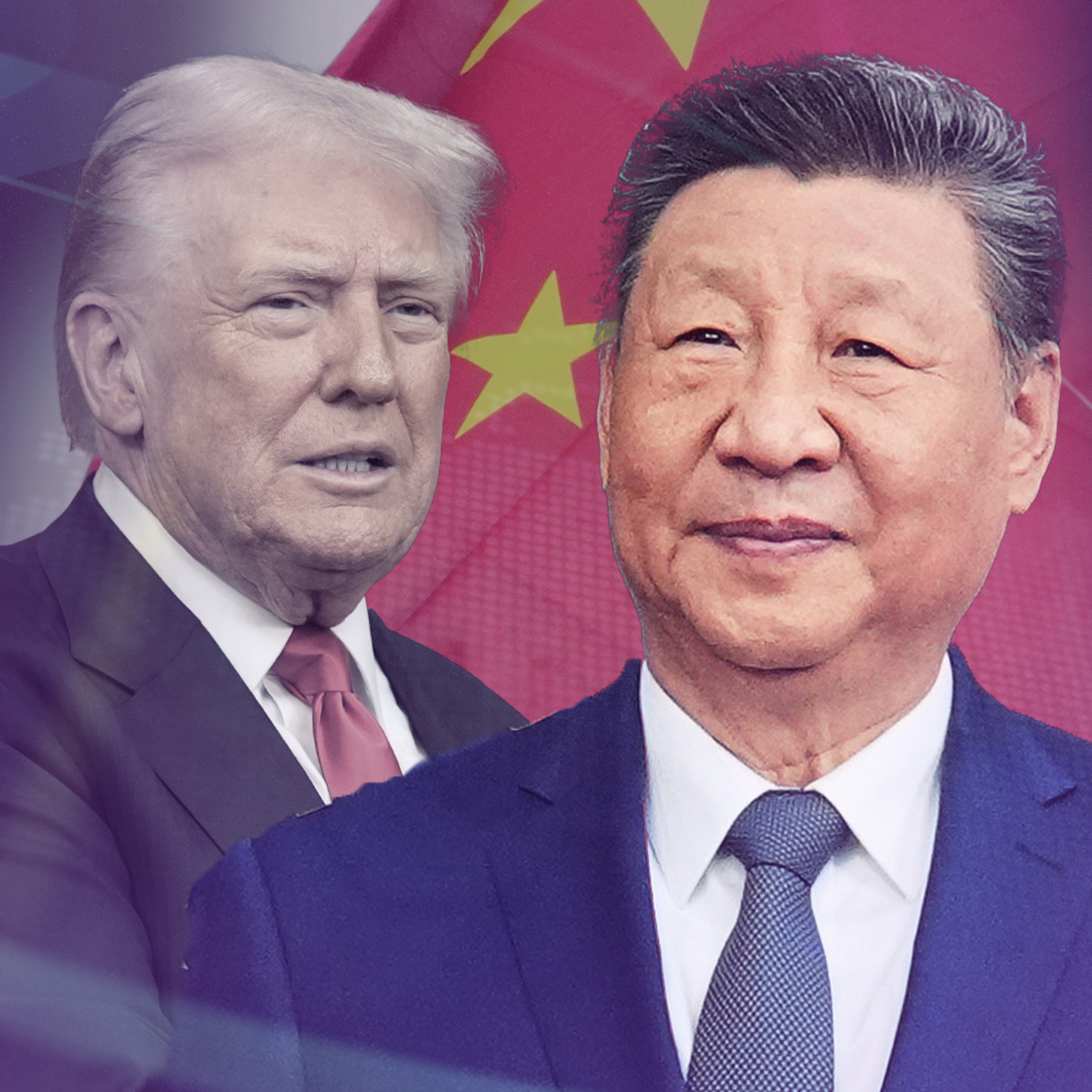
How China could beat America in tech war
Episode Transcript
The weaponry that the Americans are developing is more advanced, but of course the People's Liberation Army is massive and the Chinese are building up a huge fleet.
That is the next thing we are going to get into and that I think is really scary because we're into high tech warfare.
Given that China is building up militarily in the way that Germany did, you know, at the end of the 19th century, is this a military buildup with the idea that that military power will be used at some stage or just, you know, this is Our Calling card.
We are powerful.
We're here to be reckoned with.
Well, calling cards only work if you're willing to play it.
Hello and welcome to the forecast.
China is in an age of breakneck technological development.
AI, robots, drones, electrical vehicles, you name it.
But at the same time, the young people are resisting progression, or many of them at least.
They call it tongue ping lying flat.
Our international editor, Lindsay Hilsum, has returned from her first China trip since she was Channel 4 News correspondent there in the late 2000s.
But also she was there again in 2013.
She was wowed by technological progress, but also found a generation exhausted and overwhelmed by overwork, depression and, of course, political pressure.
Joining Lindsay me to discuss today's China is economist Dan Wong, author of Breakneck, who argues that China's system has unique strengths and dangerous weaknesses in the race for technological supremacy.
Welcome to you both.
Hi, Lindsay, Let me start with you.
So you hadn't been there for over a decade?
Yep.
What was the thing that surprised you most?
Well, obviously going up in a pilotless drone, an air taxi above Guangzhou by myself alone in this in this vehicle looking down on the the city.
Terrified or overjoyed?
I wasn't that scared because I thought they wouldn't let me do it if it was really dangerous, but it was impressive.
I mean, and they they talk about the low altitude economy, the idea that these air taxes will take people to the airport and obviously that is impressive.
I suppose also the air is much cleaner.
All these electric vehicles, EVs that weren't around when I was there, and high speed rail.
I went from Hangzhou to Beijing, that's 1200 kilometres in 4 1/2 hours.
So all of those things, I had to be impressed by that.
But then also, you know, all those shopping malls, the sort of Japanification of China.
And I had to really look for the China which I had grown to love when I was there, a sort of old China.
I wondered if they were ripping the soul out of the planet.
Is that you speaking as a nostalgia kind of obsessed foreigner?
Maybe.
Or is it you know, Or is it, are you genuine about the soul being ripped out of China?
I'm genuine about the soul because as you know, you've just said, you know, a lot of young people are are depressed and don't feel that this progress necessarily is going to to benefit them.
There's a sort of lackadaisical generation.
But I think that if everything is about progress, technology, you know, the white speed of it all, then I wonder, you know, what is left of identity.
I don't know what what do you think that?
I agree with you very much about the soul.
I describe China in part as a the modern Beijing, as engineers of the soul, which is a term from Marshall Joseph Stalin that Xi Jinping decided to repeat a few years ago.
And so I think that China is absolutely losing a lot.
At the same time, it is gaining a lot when you have new bridges, being able to connect people to bigger markets, at the same time as you're getting new subway systems as well as new parks, while many people are creatively exhausted by everything happening undersea.
Before we talk about the social engineering and the exhaustion, I just want to, you know, home in on the, the technological progress because we in the West like to think of China as the world's factory, but it turns out it's the world's factory and the world's laboratory, isn't it?
I mean, they're, they're just inventing stuff that might be invented in Silicon Valley on parts of the US, but probably not in Europe anymore.
So tell us about that transition from a country that makes stuff to a country that invents stuff.
I think that China is very much both a laboratory and a factory at this point.
So if we think about something that the US invented, something like solar photovoltaic panels or even something like semiconductors, that is something that was created by the Americans that the Americans are no longer very good at making.
And when I'm in Silicon Valley, when I'm in the United States, I'm constantly challenging Americans to ask them, but what is the greater glory to be able to claim in the history books that you invented something like the first solar photovoltaic cell or to actually own the industry in the present day?
And so China has very much blurred these practices because factories are often cutting edge laboratories and themselves people are able to work on cutting edge things.
They're on the bleeding edge and they're able to figure out where the technology is going next.
And the people who invent this stuff, I guess many of whom were educated in the United States, are they inventing this stuff in order to make money for the greater good of China or maybe a little bit of both to beat the United States at their at their own game?
I think the answer is yes, that it is an element of both, that I think that what is really distinguishing Chinese entrepreneurs as well as American entrepreneurs is that they have a lot of appetite to make doughnuts now.
They're really big hustlers.
They're really interested in making a big bucks.
At the same time, I think there is an element of nationalism that exists more within Chinese society for having felt that they were behind for too long, that they really want to catch up, and now they want to surpass the US as well as the UKI.
Think also one of the things which really struck me when I was in Shenzhen is about, you know, the supply chain and the system.
So if you take E VS electric vehicles.
So yes, China controls the rare earths and the rare earths go into the batteries and the batteries are in the electric vehicles and a company like BYD, they, they're controlling all of that supply chain.
There's none of that kind of fragmentation which you get in Western capitalism now.
And you know, I went to, I was, you know, you go around Shenzhen with it's nice clean air and you look at all the, the green number plates on the cars.
And then I was in a charging station and battery change station.
You drive in, you go to the place where it's like a carport and the ground open up beneath you.
The battery drops out.
It's taken away on one side, the new battery comes in, up it is and off you go.
So in 3 minutes you have changed the battery in your car and the largest BYD vehicle that goes 620 kilometres on one charge or you can charge it up, you know, and that takes you an hour.
And so the system actually works because it's tied up together.
Whereas when it comes to electric vehicles, certainly in the UK and I think in America as well, it isn't all tied up together like that.
And so it's much harder to make it work.
One of the interesting things I read up on recently was that in America in the early noughties, they had rare earth metals mines, I think in New Mexico and Arizona.
And basically these mines kept going bust.
So they decided to, it was much easier just to buy the stuff from China.
In China, What is the thinking?
Is it that industrial policy kicks in and the Chinese government says we need rare earth mines, we need the best batteries in the world for our cars.
You know, we need the best AI and we're going to basically help the companies to get there.
And the ones that fail, they can fail.
And the ones that succeed, we shall support.
And we want some of that money for ourselves.
Like how does it work?
They simply have the hunger to make a lot of these things.
You know, Matt, I was the.
Government and the engineers.
The government and the engineers, the entire civil society, the entire system.
A month ago I visited America's only rare earth magnet factory in Fort Worth, TX, and it is coming up with new batteries as well as the the rare earth magnets themselves.
They have access to a mine in around Nevada and California's border, a little bit outside of Las Vegas, which really feels like one of the most naturally blessed mines in the world.
It's just all of the rare earths are really on the surface.
But what do the Chinese bring to the table?
Well, they had a hunger to make a lot of these minerals which they own in on the home soil, but also these red mining rare earths is so energy intensive and so polluting that only the Chinese have the stomach for doing something like this.
And so they have they're willing to pay these costs in order to win technological supremacy.
And if we go down and look throughout the supply chain, as Lindsay says, it's not just one thing.
They really think about everything.
It's so much more systems wide thinking over there.
Also, can I just add because I went to a rare earth mine in Inner Mongolia in 2011 and it was unbelievably polluting.
It was horrendous and I presume that the processes have improved since then.
But what struck me then was again, this long term thinking.
So back then they were already thinking, right, we are going to dominate the rare earth market worldwide.
And they set about doing that.
And you can talk about they and they is the government.
So the government will, you know, sponsor and support the companies which are going to to do that.
Whereas in America, you know, the rarer thing, as you said, Matt, you know, it sort of comes and goes.
Molly Corp in California, it goes bust, doesn't get government support.
This.
The system in China is designed to make everything work together.
Right.
But one of the other reasons why, you know, rare earth metal mines fail in America is because there are lawsuits from environmentalists that shut them down or, or the the cost is too expensive to keep them open.
So, you know, in in your book, you have this wonderful analogy, you know, a country of lawyers, America versus a country of engineers, China.
I mean, there's a reason why America is a country of lawyers because it's, it was founded by, you know, a bunch of lawyers and philosophers and it was founded on ideas.
And the idea of America, I guess, is that you start from the bottom and you go up.
Whereas in China, it seems to be the other way around.
And I mean, this is we should really ask this at the end of the podcast.
I'll ask it now, which is the more durable system do you think?
I think both are durable, both have strengths and weaknesses.
I will say a word of defence for the lawyers I'm coming from that's.
That's a rare thing to hear.
That the lawyerly society has some.
For the lawyers, come on.
Dad, you got you got you got me on the record saying this now, but there is something special about the United States.
I'm coming to you from the West Coast.
And the West Coast is the only region in the world that has not only created a company worth over a trillion dollars, has created several companies worth over several trillions of dollars.
The rich feel comfortable to create their businesses in America.
They feel protected to do something like that.
And that is not something that the Chinese have been able to do very well either.
But so the rich feel comfortable to invent stuff and make money from it in America?
How does it work in China then?
I think that there is still quite a lot of hunger to be rich.
You can see this sort of pulsing through everywhere.
There's a lot of petty entrepreneurialism.
People really want to make doughnuts, and that is true for both the Americans as well as the Chinese.
But there is kind of this overbearing hand at the government that sometimes helps out, that sometimes offers very useful industrial subsidies, which sometimes decides to smack around a lot of tech founders like Jack Ma, who got a little bit big for his speeches.
And so that is kind of this precarity of living in the engineering state.
Things might go very well if the government decides to build your factory, but what if they decide to take it all away?
Yeah.
Well, Donald Trump is trying to do something rather similar.
You could argue that if you get too big for your boots or you don't kiss his ring, you might also be in trouble.
Absolutely.
But you know what, it's baked into the system in China.
And certainly, I mean, Dan would know much more about this than I would in China, that some of the most senior and the richest people have ended up, they've sort of gone abroad, haven't they, because.
They to London.
Yeah, because they don't feel secure.
But having said that, I did meet quite a lot of entrepreneurs, particularly in Hangzhou, which is like the sort of seen as the Silicon Valley of of China, a lot of young people who had AI startups.
And you have the six little Dragons there, including DeepSeek, which is of course the the AI large language model, which surprised the world back in January.
By making something really great for very little money compared to its American competition.
Exactly.
And then there's, you know, video, you know, computer games, game sciences there with a very, very popular game based on Chinese myth and legend and one which had AI glasses, which I, which I tried on.
And what was interesting to me was quite a few of the people I met were Chinese who had been in Silicon Valley, didn't feel that they had had enough opportunity there and had gone back to China and were getting government support or looking for government support, but found a conducive environment there for their startups and said that they could be creative there.
And they felt that there was more opportunity there than they had found in America.
Do you think that the market is more cruel than the Chinese government?
The American market is more cruel than the Chinese government when it comes to supporting new.
Businesses certainly there is competition red in tooth and claw over in China that there is the, I think the, the, the rule of thumb that we have is that a Japanese, German, American automaker takes about 6 years to conceptualize a new auto model and then release it in the market.
In China it's much closer to 18 months or two years, which is.
Astonishing isn't?
It they're moving three times faster and no one is hypnotizing the Americans to just move very slowly, that is because the Chinese are just so darn competitive.
It is a ruthless market logic over there.
And describe that competitiveness.
And I want to hear from you what, you know, whether you say that, because we're going to talk about the lying down generation, but that competitiveness, what does it look like at, you know, the university level, at the professional level?
One of the core facts about China is that you are sorted in all of these quite challenging competitions starting from a very young age.
Many Chinese students will have awful memories of being labeled at the bottom half the bottom quintile of class, and some people might still be very proud of having the.
Opposite to We're all winners.
Yes, that's right.
All shall have prizes.
All shall have prizes.
And in China it is very clear that the top five people have prizes and everyone else is not going to be very well regarded by the parents.
And so this sort of ruthless logic exists throughout the formal system in China.
But then the business logic is if anything far more demanding because if you release products, if you release taxis and in the air that collapse pretty quickly afterwards, you're not going to be very competitive in the market for very long and.
You can make that money.
You can write to to the top of that tree and you can thrive and keep your money and live a beautiful lifestyle as long as you don't challenge the government.
And that is very challenging because you don't know where what might be challenging the government.
Jack Moss certainly didn't know where all the lines were at the time that he would try to move things around.
And so things are always shifting.
The winds are always changing in China.
But I think there's can I come up with something here?
Because I think the other thing about, you know, going from conception to manufacture in 18 months, that's also about the seamlessness of the system.
So in Shenzhen, you go to that huge electronics market in the middle of the city, which you will know very well.
So if you, you know, if I have an idea for some kind of widget or AI something and I, and I, I try, it doesn't quite work.
I can just go to that market and I can find 10 different parts and I can try each of them and within a day or a week I can work out this works and this doesn't work and so on.
But if I'm American, I probably have to order those parts from China.
And so there's there's a very practical way in which you can do trial and error and see whether your product is going to work.
And that speeds up the whole process.
Which is extraordinary.
So just to describe this a little bit more.
So there's literally like a shopping now for.
It's a shopping mall.
It's five, it's five stories.
I can't remember.
It's you know, it's more than AI think.
It's three square kilometres.
It's absolutely.
Like an industrial park.
Yes, it's absolutely massive and you can find people there who are just, you know, trying to buy a new pair of Airpods or a knock off pair of Airpods or you can find all sorts of semiconductors.
But then that's the thing, because of course on semiconductors, America still has the edge on chips.
America and obviously Taiwan, TSMC, which is the, the big semiconductor manufacturer in the world and their chips are far in advance of the Chinese chips.
Now I was told that, you know, you could find the very advanced NVIDIA chips there, that they're smuggled in via Japan and Hong Kong.
And of course, a chip is a very small thing.
So, you know, under the, under the, the, the counter you, you can find them.
So you can buy almost anything there, but when it comes to that very, very high tech, the Americans still are ahead.
When I was walking through some of that market about almost a decade ago now, and I went to buy a little cell phone case with a white whale because my favorite novel is Moby Dick.
Yes, the people ask me, do you want one or 1000?
How about 1000?
And I said one is enough.
Thank you.
And why is NVIDIA still able to produce better microchips than any Chinese equivalent company?
I think that the Chinese are still relatively weak on two big technological sectors.
The first is semiconductors, the second is aviation.
And so there is still something quite challenging about the integration of many different scientific disciplines when it comes to semiconductors.
That's the integration of computer science and chemistry and electrical engineering.
When it comes to aviation, the reason that Rolls Royce still has this edge is that it is really good at integrating mechanical engineering and aerodynamics, material science.
The Chinese are still catching up in anything where the science is relatively mature but the manufacturing is quite settled.
The Chinese are by measure ahead, but where the science is still challenged, I think they're still quite behind.
So to Lindsays point, right, So it's the integration of a new idea and the way that it's manufactured and then the kind of various, you know, manufacturing lines and and distribution lines that you need around it.
That's right.
But they are getting better.
And so Chinese universities are rising through the ranks in all sorts of ways.
China is doing more science and I expect that they will be doing getting more Nobel Prizes as well as other recognition sometime soon.
And do the Chinese have a bankruptcy law that if you try something out and it doesn't work, that you didn't get bailed out?
I mean it it rather like in America you can do Chapter 11 and have another life.
And there is still some of that, although it is much less forgiving.
If you get into personal bankruptcy, it's possible that you can't book and fancy a hotel, you can't take vacations anymore, You can't really go on the airplane.
Sometimes you have to go on the trains instead.
And so and.
You can't go shocking forward.
The high.
Speed train.
Listen, going on the high speed train, I'd choose out over the plane any day.
I mean, you know, I'm sure the words bus replacement service I never heard in China.
They're very common in this country.
So, OK, let's go to the social side of this then.
So with all this competition that you've described down from an early age on, and as you know, your excellent piece from China, Lindsay, you know, one of them was all about those people who decided to do a bit of Tan Ping or just they just, they kind of checked out.
Is that a, is that their form of rebellion?
They can't do politics, but what they can do is apathy.
Well, it's so interesting because when I lived in China in the mid 2000s, you know, the the younger generation were very aware of being privileged, you know, that their grandparents had survived the Great Leap Forward, their parents had survived the Cultural Revolution.
And now they were a very lucky generation and they were going for it.
But this next generation, Gen.
Z, which seems to have problems all over the world, they're like Nah.
And so one of the concepts which I learnt when I was there.
Was their generation.
Yeah, it was, it was this American concept of garbage time.
So garbage time is the end of an American football or basketball game when it's it's a foregone conclusion which side is going to win.
And So what is the point of the last five or 10 minutes?
And so it was a young woman who I met in a cafe.
I just learnt about this concept.
And I, yeah, I just asked her a completely different question.
She said, oh, have you heard about garbage time?
She said.
I said, yes.
She said, this is garbage time in Chinese history.
And what they feel is that there's no point in trying.
And there's a huge graduate unemployment problem.
You've got 12 million graduates every year.
And you know if you if you order your meal from May Twin, which is the equivalent to Deliveroo.
Chances are it's going to be a graduate delivering it.
At least 30% of the people working there are graduates because they just aren't graduate level jobs.
And this is causing a huge amount of of disillusion.
And so, you know, there's a sort of mental, I suppose you could call it a mental health crisis.
I don't know, Dan, how would you see it?
A.
Civilizational crisis, perhaps civilization.
I would go that this is that it is.
I think it is an indictment that people in China, as well as most of the rest of East Asia, don't want to have kids, not in part because their TFR is so low, in part because there is.
They're living through this garbage time.
They don't have great hopes for the future and I think that this is an indictment for them.
And this is despite, you know, supposedly family values, you know, all these sort of traditional Chinese values which may or may not still exist or.
May or may not still exist, because I think a lot of women in particular are a little bit distressed about being told and being asked all the time when they plan to have children.
I think that's something like a Lunar New Year is a distressing time for many women because there's only one question they can expect from their extended aunts and uncles and grandmothers, which is when are you going to marry to the single and when are you having kids to the childless?
And that seems like that is all their value.
And there's more than that because of course, you had the one child policy.
And so Chinese women were told one child only for all of these years.
And then suddenly the party says, actually, you're supposed to have two children.
And now suddenly you're supposed to have three children.
Excuse me, Is this not our business?
Well, apparently not.
I was told a young Chinese woman who I met there said, oh, you know, sometimes the party, you know, the local party authorities will ring you up and ask, have you had your period this month?
Seriously.
I mean, yes, that level of intrusion into women's lives.
And you know what?
Women don't like that.
Yeah.
And are they rebelling against it?
They're not picking up the phone or they're lying or they're, well, they're giving the wrong answer.
Whatever.
They're not having children, No, because they're because they're not interested and they don't see why they should be pushed into it, either by their parents or by their aunties or by the local party secretary.
So these are the limits of social engineering.
Yeah, I can't imagine what's more scary, the the aunties or the local party secretaries.
Both are pretty frightening, aren't they?
Does the does the party know, does the government know that it's got a problem with social engineering or do they not get it?
I think they get it and they're willing to pay the costs.
I think that they have consistently decided that's the one child policy was something that they needed to pursue that 0 COVID was something that they needed to pursue.
Look at these plans, the numbers right there in the name.
There's no ambiguity about what these things could possibly mean.
And they're thinking that by pressuring women that they are able to produce some sort of coerced copulation.
Now, I don't believe that is the sort of thing that makes more children, but I think that they they feel like this the only thing they can do.
And I mean, what are they going to do?
What's the government going to do about the lying down?
How will they infuse people again?
Well, I think that by inciting a lot of Xi Jinping thought at them, which I also believe is not going to that's.
Going to make you fall fast asleep isn't?
It that that makes me fall fast asleep.
Very, very much so.
You know, Xi Jinping is not a very humorous guy.
I don't love listening to him.
And so when he denounces the people for we're not going to give them too much more money, that might create welfarism, that might make them be very lazy.
That's something that's those are words that he has used.
He sounds a little bit like Ronald Reagan to me.
But I think there is another thing though, and this one I found very interesting, which is that there was a survey done recently, which is that that between 83 and 87% of Chinese people are very enthusiastic about artificial intelligence, about AI, which is very different from here in the West where we're rather afraid of it.
And I did find in Liangju, which was a kind of sort of Silicon Valley area.
I mean, my young woman who, you know, told me about garbage time.
She was developing an AI app for depressed young people.
And then I found these other young entrepreneurs.
One of them had a new app, which was called Second Me, where your AI avatar meets somebody else's AI avatar.
I mean for.
People, how is that working?
I'm not quite.
Sure, maybe they'll have kids, but I don't think they'll have real kids.
Exactly.
That's right.
They'll have Avatar kids.
But but there, there is an interest in technology and particularly in AI amongst young people, even those who are a bit apathetic.
And so I think that there is some hope in the party that this is a technology which might infuse young people.
I don't know whether that's likely or not.
Well, I think that's something that is unites both the Chinese as well as the Americans is that at least the broader population are interested in growth.
I think that they have an interest in making doughnuts and I think that the elites are also very interested.
Interesting growth.
When I look across at much of the European Union, much of Europe, much of the UK, it doesn't even seem like people aren't necessarily very interested in growth anymore.
And so that is something that it's pretty similar about.
But it's a difference between, you know, our young generation and Chinese young generation is that in, you know, here we worry about or young people worry about AI replacing the jobs that they thought they were going to do.
Is the case in China that AI might do all these jobs.
And young Chinese people are saying, go for it, go for a computer, do that job for me, and I'll do something else.
I'll play a video game or watch a movie.
Well, one of the things that's very challenging for US manufacturing is that might hope that AI and automation is going to solve all of America's manufacturing problems.
The challenge is that the Chinese are much more automated already.
They're much better at the algorithms.
They're much better at using robots.
And so it doesn't even seem like they are that much against using AI to do all their critical tasks.
And, and just do you think think that this lying down generation phenomena will continue or will there be a kind of natural entrance at some stage when even young people get bored of lying down and they will just panic And now that there'll be a political eruption or there'll be, or they'll try and get back into the job market.
I think it's hard.
Obviously, you know, I can't predict the future.
One of the things I think is really interesting to see, you cannot oppose the government politically.
You know, if you talk about human rights, LGBTQ rights, women's rights, then you're in prison.
You know, your head's chopped off.
That's it.
It's not going to happen.
But if you talk about mental health and happiness, well, that's a different thing.
And the Chinese Communist Party has said it is by us to seek happiness for the Chinese people.
So in that sense, you know, saying that you're unhappy is a is a form of, of rebellion and the language of human rights, I think has morphed into the language of well-being and, and mental health.
So I think the real question is when and if the party sees this generation as a new kind of challenge or threat.
I mean, Gentlemen Square is quite obvious.
There's a bloke standing there with his plastic bag in front of a tank lying down is its own form of resistance.
And at some point I fear that the the Chinese government will try and do something about it.
And that of course could be more repression, that could be even more repressive.
I don't know.
What do you?
Think I wonder the how about the the opportunities available to young people.
There's no job opportunities, but there are excellent phone opportunities for them to keep themselves very entertained.
When Xi Jinping denounced TikTok as spiritual opium a couple of years ago, I think he's right.
He's absolutely right.
These things are spiritual opium.
And if all of us are going to be hanging out with our AI friends because they always text you back and they will always provide you some cheer, I'm a little bit worried that many of them will just choose to lie forever.
Dan, do you think the Chinese government is more afraid of its own people than it is of anything else?
I think that is the scariest thing to the Chinese government, and This is why you can see that China's domestic budget for security spending is even greater than its military spending for the People's Liberation Army, that there is so much constructed in China to make sure that the people don't rebel and that there is still so much repressiveness, really to try to keep a lid on social tensions.
I.
Remember when I was in Beijing when they got the Olympics in the year 2000, They celebrated and there were armored vehicles on the streets of Beijing.
And I said to my Chinese, fix a minder, what's going on here?
He said the government is afraid of people even when they're, you know, in the spirit of jubilation, you know, for the greater good of the nation, They just distrust large numbers of people showing up with any kind of show of emotion.
This is something that they feel they have to control right now.
China is in a big tiff with the country of Japan, which they are spend this kind of totally insane spat that the two countries are going.
And I think that they have to be a little bit nervous about the sort of nationalism that they release because if they fan up the national flames against Tokyo, who knows if that might spread someday to Beijing.
OK, couple.
Of things to end on getting back to the kind of race between the state of engineers and the state of lawyers, Who is winning that race at the moment?
No one is winning and I think that the race will not be won.
There is no gold medal at the end that there is no because we don't know what it's like to win.
That it's not going to be quite like the Cold War, in which, as President George HW Bush declared, the end state is that we win, they lose.
And I think we don't know what winning the AI race will look like.
I think that we don't know what winning the broader race will look like.
What I want is for the US and China just to be the best versions of themselves, the level more for the people.
To me, that is winning.
But when Chinese, you know, government officials, scholars, students, engineers are looking over the water to America, they see a government that is taking down the the great institutions of American learning is cutting the funding, you know, of technological, you know, citadels of excellence.
I mean, what are they thinking is happening?
You know, are they saying this can't be true?
The Chinese are helping us out here.
I mean, the Americans are doing the, you know, our work for them.
To some extent, yes, And I think that is a viewpoint from Beijing.
But I think also the young people are seeing that the Americans are still building up all sorts of great tech companies, that there is still tremendous liberty available to people in the US And that is still why many young Chinese want to move away, that they want to move to the US, they want to move to the UK, they want to move to Chiang Mai to smoke trucks that would be legal in the state of California because they find that there's still a little bit too much exhaustion in XI Jinping's China.
Did you find young people who said to you any chance of coming back with you to the UK or or moving to America?
No, I didn't.
The young people I saw were the ones who tended to be the ones who had gone from America back to to China.
But on the race, I think that there's two things.
I mean, obviously the Donald Trump is sort of obsessed with manufacture and he's not in time entirely wrong.
You know when you.
Look, but he's a century out you.
Could say he's a century out, but I think that where he he has a point is on the issue of robotics.
You know, I went to a car factory, a Gili factory in Ningbo, which is pretty much automated now that's not going to something like that will not bring jobs back to America.
But you know that kind of manufacture you know it is important for a country to to do that.
It's important for China, and I can see why you would want that, why America would.
I can see why this country would want that too.
I mean, we're always trying to get car factories here from the Japanese or whatever.
But the real issue, I think on tech is going to be when it comes to the military.
And this is where, you know, the the very advanced chips are important because those are used in precision weapons.
And that means that the weaponry that the Americans are developing is more advanced.
But of course, the People's Liberation Army is massive and the Chinese are building up a huge fleet of, you know, for their, their naval fleet.
And so that is the next thing we are going to get into.
And that I think is really scary because we're into high tech warfare.
And.
Reluctant to quote Stalin again, but quantity is a quality all its own, is something that Stalin said.
And this is something that, you know, when the Chinese are building right now around 1500 ships, the Americans are building something like 3.
We get these giant disparities.
And I think that that is going to be benefiting the engineering state.
But this is the final question then.
You know, given that China's building up militarily in the way that, you know, Germany did, you know, the end of the 19th century, the way that Britain did just before that, the way that America's done, you know, right about the Second World War, You know, is this a military buildup with the idea that that military power will be used kinetically, as they like to say, in the Pentagon at some stage?
Or just, you know, this is Our Calling card, We are powerful.
We had to be reckoned with.
Well, calling cards only work if you're willing to play it.
And so I think that they are they want to be able to deter the Americans from doing anything they don't like around the island of Taiwan.
And so I think that this is something that the Americans also had to feel like they developed their own calling cards to be able to deter the Chinese.
And let's just hope that things do not go kinetic and on neither country place they're calling cards.
Lindsay, when you were there, did you did Did anyone, whether they were young or old, did they, did you get the impression that they thought they were on a kind of path towards some kind of civilizational clash with the West, with America?
I got the feeling that they thought that they were on a technological roll.
But you know that in the Politburo, you know the decline and fall of the Roman Empire.
Everybody has to read it, and certainly in the party.
Is that true?
They.
Yeah, they always read that.
They always, they're always fascinated by the decline of they're.
Not reading it in Trump's white.
House.
No, they're not they.
Should be maybe?
And that's the point because certainly within the party, they believe that there is an inevitability that America is in decline and China is on the rise again, as it was, you know, centuries ago.
And that is how they see history unfolding.
I suspect that it will take long enough that, well, maybe Dan will be here to see it.
I don't know if you and I will.
Be but never underestimate lawyers.
No.
OK.
Dan Lindsay Hilson, thank you very much to both of you for coming in.
That's it for the forecast.
I hope you enjoyed it.
We'll see you next time.