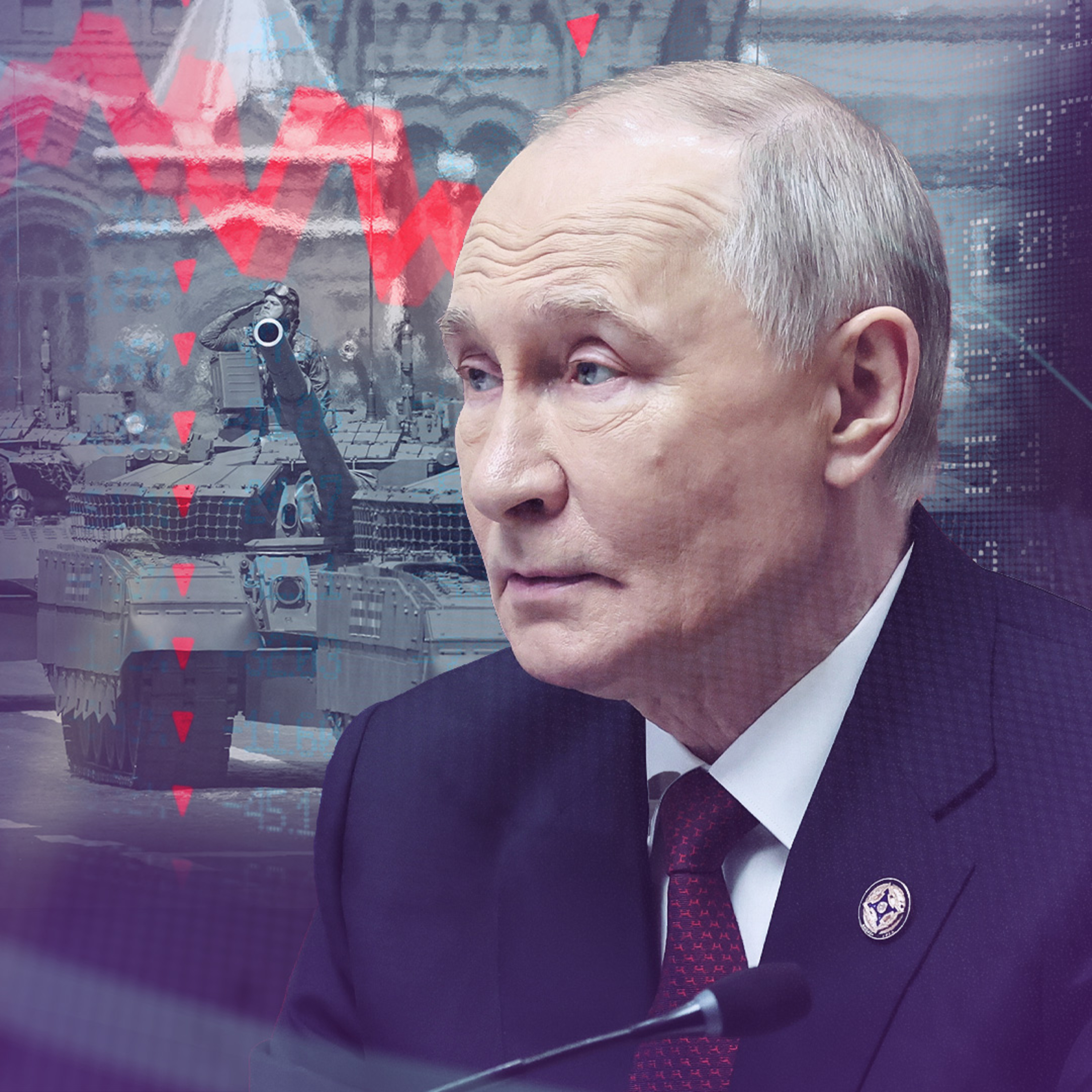
Booming or breaking? The truth about Russia’s war economy
Episode Transcript
A lot of people got it wrong in the first years of the war that Russian economy would collapse.
And now I think the pendulum swung the other way.
You could ask, you know, is Putin running out of money?
Well, he's already run out of.
Money.
It is now almost like a bubble of the war economy.
So the only sectors that they have recovered to the pre crisis levels and actually have grown some are the sectors related to the war economy.
Is there an argument that Putin needs the war to go on because of the way that the Russian economy has now been oriented?
Hello and welcome to the forecast.
For months after Putin's invasion of Ukraine, Western leaders said Russia was on the brink of collapse under sanctions.
And yet it didn't.
It transformed into a wartime economy fuelled by military production, redirected trade routes and deeper ties with China and India.
But now there are signs this may be changing, with industrial output slowing, inflation rising and severe labour shortages as hundreds of thousands of working age men have either died, emigrated or been mobilized.
And Western leaders are once again questioning how long Putin can bankroll his war machine.
So is Russia's economy finally starting to buckle or is this still wishful thinking from Ukraine's allies?
With me today, Arkady Ostrovsky, Russia editor at The Economist, and Elina Ribakova, one of the world's leading experts on sanctions and Russian macro economics.
Let's begin with the sort of the simple question, if you like, of whether Putin really wants a deal right now, Arkady, I mean, is he under economic pressure that is pushing him towards wanting an end?
I don't think he wants to suddenly leave Ukraine alone.
I don't think he suddenly wants to stop, stop his bigger offensive against Europe and against transatlantic security system which he he is set to, you know, he wants to undermine.
So I don't think we should look at the deal sort of separately.
Now, is he under pressure?
Yes, he is under some pressure.
Does that mean that the war is going to end?
That doesn't necessarily follow.
Alina what would?
You say, I would say indeed, I fully agree with our career that we need to separate the two and I think that's where the biggest mistake we in Europe and in the West make.
Visiting Russia, they have separated the two at the very beginning of the 2022 invasion.
They went into this head on understanding what kind of sanctions can be implemented.
There were some surprises, but not not many.
They prepared for the sanctions since 2014 and they were willing to take the cost.
However, what they didn't plan for, for the fact that it would take so long.
And it is indeed incredible that size matters, you know, economy, number of people, but yet Ukraine still holds four years on, right?
Russia wasn't entirely prepared for that.
They were hoping for either blitzkrieg of maybe 2 days or maybe a couple of years.
And now we're in the situation where instead of producing more tanks, tanks got more expensive.
And therefore we've seen the central Bank of Russia trying to slow down the economy.
And that is also affecting the production of the military industrial complex.
Right.
So, so, So what extent is Russia's economy dependent on the war, and to what extent is the war dependent on the economy?
I think it goes both ways indeed, right.
It is now almost like a bubble of the war economy.
So the only sectors that they have recovered to the pre crisis levels and actually have grown, some other sectors related to the war economy, they have slowed down recently, but not really fully to negative territory.
Most of other sectors have not recovered their losses.
So it is almost like pricking the bubble, right?
We talked a lot about it before the global financial crisis that it is very hard to do politically and economically.
At the same time, it is also giving opportunities for people that have not had a social lift in decades.
You know, weaker regions, you know, they're getting contractual payments for participation in the war or regions where there is military production.
So this is on the one hand.
On the other hand, of course, for Russia to be able to continue at this pace is challenging.
And that's where they're looking for new sources of investment.
And that's what they're trying to negotiate, whether with the US or with countries in Asia, for some sort of sort of blink for less forceful enforcement of sanctions.
Katie, do you think the West misunderstood this at the beginning?
I think the West did misunderstand it.
I think the West misunderstood a lot of things and I think the West continues to make a lot of mistakes towards Russia.
We can talk about it in terms of public opinion and the links between public opinion, economy and politics of it.
But in terms of economy, yes, as you said rightly, everybody was expecting Russia to collapse.
It did not.
But the pressures are catching on.
The divide between the civil economy and the military economy, part of the economy is growing.
Now this the source of, you know, income for Russia is shrinking, which is why Russia has the biggest budget deficit I think it's had in modern history.
And you know, and very high inflation and 40% of Russian budget goes towards the military, towards the war, both in terms of production of weapons and in payments of of contracts and the payout death payouts.
So I think the pressures are building up.
I think the West misunderstood at the time when they expected it to to collapse.
I think it's misunderstanding what game Putin is playing now and actually how complicated that relationship between the economy and the society and the politics really is.
Yes.
I mean, I again, I think at the beginning there was this assumption or a lot of commentary that this would not be sustainable for long, that the impact of the war would be felt by ordinary Russians and that this would dramatically affect the popularity of Putin.
Why hasn't that happened?
He made it a commercial war.
It's most extraordinary things.
You know, people don't talk about war, but partly because of that and partly to great degree is because of repression.
I mean, Russia is highly repressive, almost a totalitarian regime where speaking out will will land you in jail.
So you have a certain living standard which is maintained across the population.
You have the army, which is most people think, OK, well that, you know, they're getting paid so we don't need to feel sorry for them.
And you have a repressive system which basically punishes speaking, speaking out against the war.
And that creates a false idea of homogeneous support.
And that is, I think the biggest mistake the West has made in in recent months is basically completely accepting and embracing Putin's propaganda that all Russians support the war or the majority of Russians support the war.
And the picture is much more nuanced.
But the the the Western policy towards Russia and the Western rhetoric towards Russia has reinforced Putin's propaganda rather than confronted it.
Right.
But I mean, accepting the fact that he's commercialized the war and the people are not being dragged off against their will, the numbers surely at this point are so enormous that everybody must be touched by it.
You're right.
I mean, the numbers are huge.
I mean Russia's losses are in dead and wounded.
You know, some say, you know, it's it's a million around 1,000,000, which is, which is enormous.
And yes, it is contractual.
And I wouldn't say it's all, you know, there is a lot of deception.
There is a lot of pressure.
You know, to what extent it's voluntary, it's another matter.
I don't think it is.
You know, a lot of it is not voluntary.
A lot of it is actually people who are drafted into the Army by law and then pressured to sign contracts.
So there is lots of lots of deception.
But yes, you're right, ultimately everybody now knows that the, the losses are, are huge and people see it and they're the cities and towns and the villages because the, the size of cemeteries is growing and everybody particularly in a small place where you know, people have been taken from mostly it's not large cities like Moscow and Saint Petersburg.
It's disadvantaged economically.
Poorer regions of, of Russia.
Of course people see it.
It is having an impact.
If you ask people what they would like, they say they want the stop of the war, they don't want mobilization, they do not want to participate in it, and they want 60% want improvement in the relationship with the West.
Interestingly, the argument you hear a lot is that, well, none of it matters because public opinion in Russia doesn't matter because people don't have any agency.
But actually it does not in the direct way that everybody expects that people will just come out in the streets and overthrow Putin.
People can't do that if there are tanks and people with guns.
But in terms of the why the Kremlin cares about public opinion and it does, it measures it all the time, is that it creates a merely in which it can operate.
It needs to have this picture.
Putin from the very beginning, from the moment he came to power, he came out with this idea of super majority of people supporting him.
That is the source of legitimacy.
Let's let's turn to the economy.
To what extent did sanctions backfire and and how much was Russia able to turn itself towards China, towards India and adapt?
Well, you know, I think first we need to think about objectives of sanctions.
Sanctions do not create World Peace.
You know, they don't change regimes.
They don't resolve your educational reform at home, right?
I think we're just loaded too many things on this magic tool that is supposed to be like a magic wand and then Putin disappears and will live happily ever after.
So I think first we needed to have realistic expectations.
In terms of realistic expectations, should we give foreign exchange to Russia in exchange for their oil?
Probably not Should we sell the missile and components of missiles?
Probably not, right.
This is the extent of sanctions that I would like to see with clear targets and clear measurable objectives to to check against them, right.
So this is first whether Russians get luxury goods or not, frankly, I don't really care, right?
And most people in Ukraine that getting their Shahid's to their house also don't really care.
So this is the first part.
In terms of what backfired, I think what backfired is our poor enforcement and implementation of sanctions.
We gave the huge window for China to drive through with the truck and more than 90% of various sanctions evasion schemes happen via China.
It may be Western produced the Western owned goods that ship through China or maybe are produced in joint venture ventures in China or licensing and then go to Russia.
Of course, other border states are also at fault and I think that's has created a special relationship and it's also allowing China to test drive sanctions evasion techniques for against possible sanctions that they might experience in the future.
So.
So are you saying that pretty much everything gets through anyway?
Not everything gets through.
Things spend longer time travelling to Russia, they're more expensive, but a lot of things still get through.
And we can see that from the disassembled components, parts that the Ukrainian authorities are disassembling and putting online.
You can see that Russia still acts has access to Western components, albeit more expensively and with the longest production times.
What about the the US administration's approach to trying to to tackle this?
I mean, they've been terribly fierce on India, but not terribly fierce towards China.
Well, there is this panda in the room that they're very afraid of addressing, right.
And I think it is also characteristic to this administration as well as the previous one.
If you look at the statistics, China started supplying this components already in autumn 2022 and it's almost sort of went to the pre war levels, the volumes thanks to China.
And we sort of closed the blind into that and we try to have behind the closed door conversations with China and didn't quite really work out right.
So I think here the current administration seems to be following the same strategy.
Maybe they would like to have a grand deal on trade and they do not want to have the the pesky Russia, Ukraine war issue getting in the way of that.
In specifically in terms of India, I would like to see more the decisive action.
Yes, they've been some good announcements, but let's see if there will be enforcement.
Right.
But how does how is all this fed through to Russia's domestic economy and to what extent is it under pressure?
I mean, you know, the question kind of feels, is there an argument that Putin needs the war to go on because of the way that the Russian economy has now been orientated?
Once you have driven into the bubble, you know, and we all remember, Greenspan, that nobody likes to prick the bubble, right?
It's very hard for you to stop to stop that.
And we've seen all this musical chairs let them continue from the bankers, you know, before the global financial crisis.
And there is something very similar here because Russia has been writing five year plans of diversification from commodities of productivity growth improvements.
And at some point they just started rewriting the same plan because they struggled to find the new sort of results that hope or productivity growth apart from just being a commodity economy.
And this war economy has given this temporarily boost.
And I think that is very hard to stop.
You know, even as Arkady was describing even an autocratic regime, people still worry about the opinion of the people.
And specifically in autocratic regimes, the regime change is more painful than in a democratic economy, I think.
That's absolutely right what Lena is saying.
And I I think we should be slightly humble in that we got it.
I mean, a lot of people got it wrong in the first months and, you know, years of the war that Russian economy would collapse.
And now I think the pendulum swung the other way is, oh, no, it's fine.
You know, it's so resilient.
It will, you know, nothing will actually happen and, and Putin can carry on for three, 5-7 years.
The truth is we don't know.
We haven't been to this position.
I mean, Lenny is absolutely right that it's very hard.
Even if the world were, even if the war was to freeze, let's say, even if you imagine, which is very hard to imagine, some of the sanctions would get lifted.
Basically, I can't see any sources of growth or investment in Russia.
I can't see Russian economy getting back, getting back on track.
So in a way, the deterioration, the degradation of Russian economy will continue.
How people will respond, how the politics will respond, we simply don't know.
But we do know that in a way you could ask, you know, is Putin running out of money?
Well, he's already run out of money.
If he didn't run out of money, there wouldn't be a budget deficit, which is five times I think, or Lenny will correct me larger than that what what they forecast.
So in that sense, he's already run out of money.
And so the fact that the economy will, you know, suffer is already suffering, is under pressure that doesn't necessarily again mean that that Putin will stop.
So we are we're in uncharted territory.
We simply don't know how things are going to to form.
And it will be a function of many things of where the war is going or where the economy is going, whether there are any black Swans, what the, you know, what would if the war was to freeze, what would happen to the soldiers who return home?
What would happen to the levels of violence and aggression.
There are just too many factors which we have to be, as I said, humble and so, so.
Alina, to what extent is sanctions relief, you know, needed by Russia and attractive in the peace process?
You know, how much of A priority will it be?
I think we've seen already from the person whom I call the sanctions lifting envoy Dmitriev, that sanctions are a priority in this negotiations.
Why are they priority, As I kind of exactly explained, not because it's going to boost the economy dramatically, but it's going to think change things on the margin.
And let's think about investors domestically, third country investors and then Western investors.
Russia doesn't necessarily hold or need the Western investors to come back.
They need to have this sort of multiple equilibrium domestic to be resolved where domestic investors was extra cash or maybe third country investors feel, oh, wait a second, this is maybe a normalising situation.
I'm more ready to invest at this levels into Russia.
And I think this is a critical moment for Russia.
The signalling of normalisation would give them space to invest more.
And the question is whether they invest more in something productive for civilian use or something more military related.
And the big risk, it will be something that is definitely military related.
Yes, and and why would anybody trust that Russia won't get into further entanglements in the future when it's it, it's whole foreign policy approach seems to be based on that?
Well, I can comment on the macroeconomic side of it is we have done a lot of studies at the Kiev School of Economics where we're trying to use data to track supply chains and the shipments among different parts of the Russian industrial base, military industrial base.
And we're seeing production of some of the types of weaponry that is not currently needed in Ukraine.
So we've seen that activity, whether it's naval warfare related or maybe the airplanes.
And that raises questions, what are they using that output for?
What are they planning to use it for?
Akadi.
Yeah, I think there is also one very big factor in all of this, which Elena mentioned the a few minutes ago, which is China.
Russia would not have been able to conduct this war economically without China's lifeline.
Now China's got deep pockets.
It's not going anything away for free.
We know that Chinese actually investment in Russian economy and the private economy is very low.
But China needs Russia to be stable with the biggest mistake I think the West has made at the beginning of the war.
And it was sort of almost contemptuous to think that you could isolate Russia simply by imposing Western sanctions.
The world is bigger than the worst.
You know, if you have India, if you have China, if you have global S which do not isolate Russia, you cannot isolate its com.
You cannot cut the sources of revenue.
The Indian companies, Chinese companies will buy Russian oil.
Physically restricting Russian volumes of oil export is probably the best thing.
And and the best thing of all would be take bringing down the oil price.
And I think that is actually the probably the biggest unknown factor is you know, there are predictions in the market out there.
Ilina probably knows more that you know, the oil is already $50 a barrel that it will get to $30, it will get to $30 a dollars a barrel by by the end of 2027.
Now Russia is going next year is going to be the hardest year economically Russia has had.
If the oil price continues to go down, that's a very different dynamic.
You know, Russian cost of extraction I from the top of my mind, I think is about $2025 a barrel.
So you only get $5.
I mean that you can't conduct a big war, you can't continue to pay those contracts given that your army is contractual at $30 a barrel of the same.
And keep the the army of the same size.
So it just becomes impractical.
It just he, Putin will stop when either he has stopped or when he's unable to go any further in terms of his intentions.
The intentions are not going to change.
The capacity and capability could change.
And Alina, are Russian consumers happy to be this reliance on China in the future?
And I suppose in terms of labour force, you know the increasing number of imported workers from Africa and you know where, where else, wherever else they may be coming.
Well, on China, I think the consumer is definitely sort of getting concerned, but it's a bit too early days.
Let's look at the car imports.
Russia actually imposed tariffs on its big friend China for car imports because they realized that the Western producers used to put some of the production domestically and it led to some positive spillovers and agglomeration effects in the economy, while China just aggressively dumping the oversupply into Russia.
And that has allowed China to continue one of the biggest producers in the world in cars because they were dumping into Russia.
So Russia actually put in a tariff on that, right.
So you see already some of the concerns, but I think also the big concern or maybe embarrassment is the big flip in terms of Russia's export to China.
Russia used to export to China mostly manufacturing products, more complex machinery sometime in 2000.
Now 80% is energy and metals, you know, so it's truly like a pump, you know, that is that is sending goods to China.
And it's definitely not a good look for Russian authorities or the consumer.
OK.
And what about Labour just going on into the future?
I mean, you know, if Russia has lost quarter of a million dead or somewhere between that and a million, that's enough to have quite an effect, isn't it?
Yes, I mean we see it already in unemployment numbers.
The unemployment numbers are around 2%.
You know, this is an emerging market, right?
In any emerging market there are more frictions that would keep your natural rate of unemployment, meaning non inflation generating rate of unemployment somewhat elevated.
This is not even a normal rate for UK or the US, right.
So that's one of the reasons why the central bank was forced to hike rates.
So this employment issue will be very sort of unemployed or employment or labour force issue will be pervasive.
For now, it seems that the, the, the, the block of secure security block has won out, especially after the terrorist attack on, on I think in Crocus City Mall where they are not letting a lot of migrant workers to come back.
On top of that, you had some of the racism nation issues and also not adding to the willingness of this work is to come back.
And then finally, you mentioned some of them African countries sort of coming, including from South Africa and others being lured to Russia.
And the issue is there that integration is very hard.
And also many of them have to come under pretense of working.
And then the end of the day, they end up either on the highly toxic, poisonous production or the some of them end up on the frontline.
And then of course, they let their people home know that, well, this is not a great way to to, to earn your money.
So finally, Arkady, I mean, it doesn't sound like you think the economy is is going to force Putin into anything imminently.
I think so.
I don't think there is anything to force, unfortunately, there is anything to force Putin into into any sort of a deal.
Now that is not to say that he doesn't have pressures.
There are pressures in terms of the expenditure.
There is pressures on the economy.
There is a pressure, you know, he can't obviously, you know, they've been fighting for four years in January.
This war will be longer than than the Soviet participation in the Second World War, the in the Great Patriotic War.
So the the pressures are building up.
Russia is not in a, you know, in a healthy position at all.
But remember, it's, you know, in a war, it's always about the other side as well.
It's who's got more resources.
That's why the war of attrition is so dangerous.
You know, he's he can't deal with sort of a military final military blow to Ukraine.
But if he ties Ukraine to degree that the number of desertions is, you know, is very, very high now, you know, Russia spends 8% on, on, on, on the war on the military.
Ukraine spends 30% of the military, you know, corruption scandals, everything else.
You know, it only needs to be it doesn't need to be strong.
It only needs to be slightly stronger than Ukraine talked about mistakes in the West.
But the fact that, you know, four years into this war, European military production is nowhere near the fact that that Europe still has not passed the frozen assets to Ukraine.
And it's still, you know, there is more talk than action.
I think that's the biggest LED down for Ukrainians.
And they know this.
I mean, you know, the, the opinion in Ukraine is already becoming very resentful of certainly of America and now will be towards Europe because they feel LED down because all this talk about, you know, for as long as it takes, whatever it takes is the talk.
And, and, and finally to you, Alina, I mean, if you were an economic adviser to Putin, might you be tempted to say the lesson of the Ukraine war is that this works for Russian growth and that Russia has shown that it can, it can pivot to this kind of existence and that in the medium term, it suits us to keep agitating at Europe because it works for us too.
If I were a great cardinal in Kremlin administration, I would definitely say that it's gives us the social lift for many people in the regions that would wouldn't have it otherwise.
It keeps people calm.
We also don't want to have this people back at home trying to reintegrate into the society after being at war.
And some of them are also criminals, right?
That also creates a lot of challenges.
I would probably advise to find ways to freeze the contract conflict, the war temporarily to be able to invest and rearm more skilfully and then think what kind of levers will have vis A vis Europe if we can put more pressure on Europe.
So that would be unfortunately my advice for if I were great Cardinal in Putin's administration.
Elina Arcadi, thank you so much indeed for your time.
It's been fascinating talking to you both.
That's the forecast.
Until next time, bye bye.