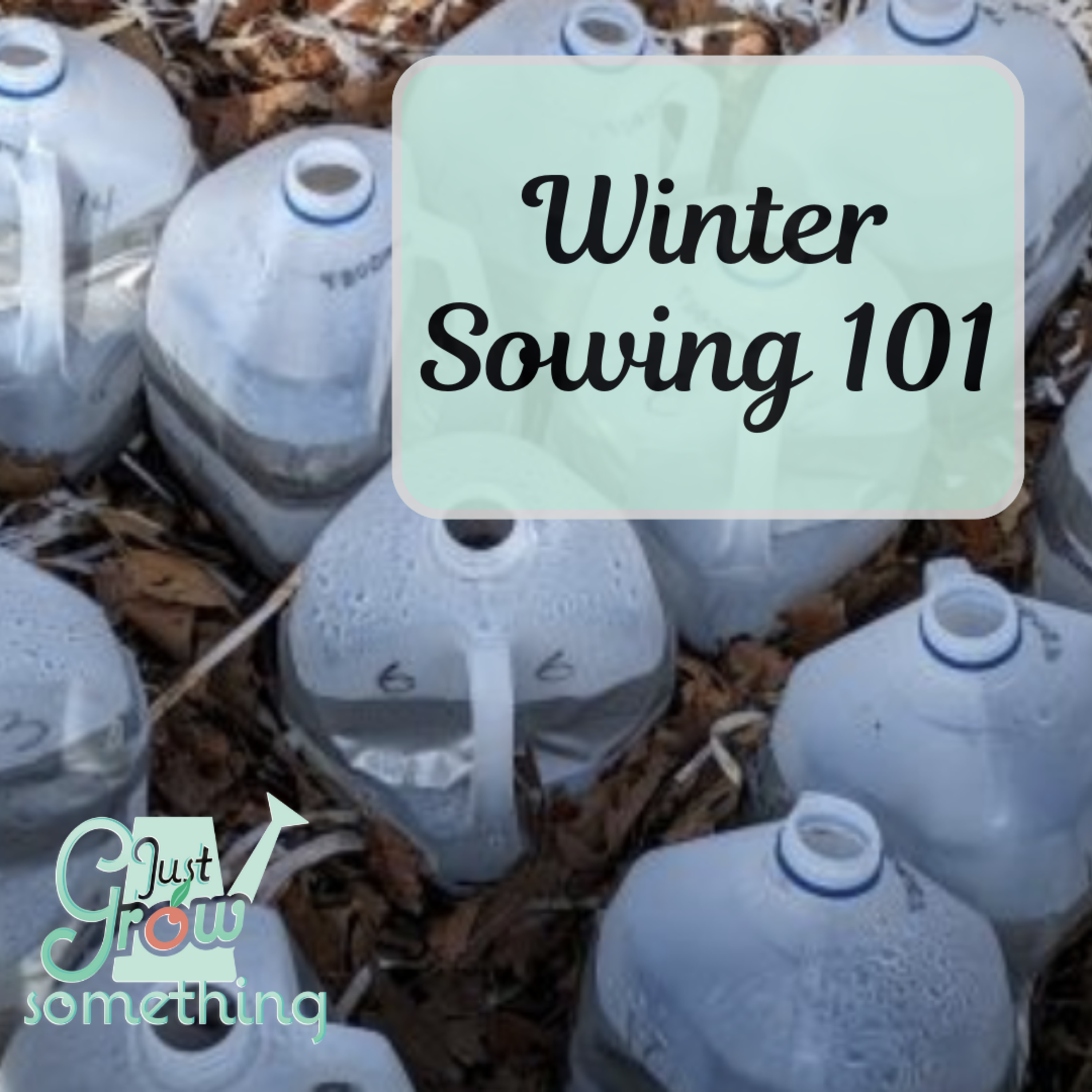
Winter Sowing 101 - Ep. 279
Episode Transcript
So I had someone reach out a few weeks ago asking for an update on my winter sewing adventures from two seasons ago, and I realized I had never given an update on my success or my failure with that method.
If you're not sure what I'm talking about, winter sowing is a seed starting method.
That sounds a little bit wild the first time you hear it, but it absolutely makes sense if you think about it from a horticultural standpoint.
Basically, you are sowing seeds in a recycled container like a milk jug and then placing them outside in the winter as a very hands off way of starting your spring garden.
So if you've ever run out of space under your grow lights, or you've been frustrated by leggy indoor seedlings, or maybe you just feel like you don't have the time or the money or the inclination for a full seed starting setup, then winter sowing might just be your new favorite technique.
So today on Just Grow Something, we're going to walk through what winter sowing actually is, how it works, and the science behind it.
Which veggies, herbs and flowers are good candidates?
When to winter sow Depending in your climate and exactly how to set up your little mini greenhouses and how to care for them throughout the winter, By the end, you'll be able to grab a handful of recycled containers, a bag of potting mix, a packet of seeds, and confidently start part of your spring garden outdoors in the middle of the winter.
Let's dig in.
Hey, I'm Karen and what started as a small backyard garden 20 years ago turned into a lifelong passion for growing food.
Now as a market farmer and horticulturist, I want to help you do the same.
On this podcast, I am your friend in the garden teaching evidence based techniques to help you grow your favorites and build confidence in your own garden space.
So grab your garden journal and a cup of coffee and get ready to just grow something.
So what exactly is winter sowing?
In simple terms, winter sowing is the process of sowing seeds outdoors in covered containers during the cold months and then leaving them outside to experience the natural winter conditions until they germinate as the weather warms.
So the containers act like little mini greenhouses.
They protect the seeds and the seedlings from like wind and critters, they let in rain and snow for moisture, and they trap enough warmth and humidity as spring approaches to encourage germination.
So instead of us trying to mimic spring indoors with lights and heat mats and very careful watering, we're basically letting nature handle the timing.
So this is a low maintenance way to start Hardy seeds outdoors in the winter for transplanting in the spring.
And we're taking advantage of the natural cold and the day length queues.
So traditionally, you know, winter sewing, you're using translucent gallon milk jugs or clear juice or water jugs, clear plastic tubs with lids on them.
So think the giant, the salad containers that you get from like Costco or even like storage containers or basically any other recycled plastic container that can hold at least three to four inches of soil with room for the plant to grow above that and can admit light.
So we're going to focus mostly on milk jugs because they're usually pretty easy to find and they're easy to carry.
And that curved top just naturally sheds the snow and the rain while still letting the light in.
But first, let's talk about why this works because it can feel kind of counterintuitive when we've been told, you know, oh, don't plant outside until, you know, after your your last frost date in the spring or relative to the last frost date in your spring.
A lot of plants, especially perennial flowers or native plants and some of the cool season crops have seeds that are programmed to delay germination until after they they've experienced a period of cold and moisture.
We call this cold stratification.
So if we think about what happens in nature, seeds are going to drop from the plant in the late summer or the fall and they're going to land on the soil and just sort of sit there or work their way down into the soil from, you know, rain and freeze thaw cycles, OK.
Throughout the winter, they experience cold temperatures and moisture, and that continued freeze thaw cycle O overtime, that combination of all of those changes actually breaks down the chemical inhibitors on that seed and it softens the seed coat.
So when the temperatures start to warm and the days lengthen in the spring, the seed is finally ready to sprout.
Essentially, this is like a survival strategy.
It prevents the seeds from germinating during some random warm spell in the fall or even in the middle of the winter, only to be killed by the actual winter arriving, right?
And so this keeps them from premature germination.
So what we do with winter sowing is we basically package that natural process into containers.
The jugs sit outside and experience the same winter conditions as the seeds would in the soil.
And so the seeds go through like the cold and the moisture, just like they would if they were in the ground.
And as spring approaches, the sun warms the air and the soil side the jug.
And then when the seed conditions are right or the temperature conditions are right, then the seeds we're going to sprout basically on their own schedule because all of this happens outside.
The seedlings get natural light from day one.
So this means sturdier, stockier growth compared to seedlings that might be under our indoor lights.
It doesn't require that attention from us to make sure that the light level is strong enough or that we've got the lights close enough to the seedlings, right?
They're getting that full spectrum light because they are outside.
This also kind of gives us a bonus too in terms of hardening off.
Seedlings that germinate in those outdoor containers are already used to the cooler temperatures and the fluctuating conditions.
So when it's time to transplant, hardening off is usually much easier and faster.
Really all we have to do at that point is get them used to like the wind conditions because obviously they've been in a little protected container prior to that, right?
So instead of like fighting the plant biology with artificial conditions, the winter sowing is working with that biology.
I think it's important to note that not every seed is a good candidate for winter sowing, but a surprising number R And if you, if you want, you know a lot of good details about this, you can actually go if you're a Facebook person, there are several winter sowing groups on Facebook where you can go and you can get the the straight scoop.
I am also going to link to my original winter sewing episode in the show notes that talks about how it was started, who started it, and all those types of things.
But if you go by like university extension services and master gardener groups, they generally recommend plants starting with plants that are naturally cold Hardy and or plants that are known to benefit or that actually require cold stratification.
So we can split this into a few different groups.
The first one would be like our cool season vegetables.
These are great choices for winter sowing.
So think about all of your brassicas, cabbage, broccoli, cauliflower, kale, Brussels sprouts, kohlrabi, collards.
All of these are really good for winter sowing your leafy greens.
So a lot of your lettuces mesh or corn salad, mustard green, tatsoy, bok choy, any of your Asian greens.
Spinach could technically fall into this category, although I tend to see that spinach doesn't love being transplanted as much.
But it can work if you kind of do it in a mass planting and you're doing it for baby spinach, so you can throw spinach in there too.
And then any of your alliums, you know, bunching onions, leeks, chives, all of your cold Hardy greens and brassic heads are well documented as tolerating frosts and even some freezing temperatures.
And a lot of them actually improve in flavor when they're grown in those cooler conditions.
They don't mind cold soil.
They will happily germinate on the early side as the jug starts to warm up in the late winter.
So these are great candidates for starting out with winter sowing.
There are also some herbs that do well with winter sowing, especially those that are naturally perennial or biennial or they are Hardy in cooler climates.
So parsley, chives, oregano, thyme, some of the mints if you really want to plant mints right, Cilantro is another option in some climates.
It prefers cooler weather and it often self so sows outdoors anyway and it can handle those frosts too.
So it just depends on you know, how adventurous you want to be.
I think I might try cilantro this year.
I haven't done it before but I intend to this year.
And then we also have like perennial flowers and natives.
So this is where winter sowing really shines.
If you are trying to get more flowers into your garden, like I have said all season that I am trying to do, then this is where winter sowing can really come in clutch.
A lot of native perennials and ornamental perennials need that cold stratification or can at least benefit from it.
So echinacea or cone flowers, rudbeckia or Black Eyed susans, milkweeds, bee balm, coreopsis, lupines, a lot of the woodland and the Prairie species.
So a lot of times when you're growing these, you're told to like bag them up and put them in the fridge for several weeks before you plant them outside.
You can actually skip that step if you are using winter sowing.
You can let them stratify naturally in those winter sowing containers.
Now, there are some seeds that generally aren't going to do as well with winter sowing, especially in colder climates.
And really this is all of our tender, warm season crops that do not do well in cold soil and they do not perform well in low temperatures.
So think things like your tomatoes, Peppers, eggplant, basil, cucumbers, squashes, melons, all of our summer stuff and then any of those really fast warm loving annuals in terms of our flowers that germinate best in like a warm soil.
Now this doesn't mean that you can't do these things.
And you know, somebody who is experienced in doing winter showing absolutely could still use this method for tomatoes and similar crops by sewing them late in the winter.
So maybe closer to spring.
The timing is key on that 1.
So it's a little bit less hands off, I think, than trying to do this with some of your cooler weather crops.
Because with these warm weather ones, you don't want them to spend as long in the deep cold.
And they you really don't want them to germinate too early during an unexpected warm spell when you're nowhere near your last frost date.
And then you can lose all of those little seedlings.
They are not as good at that whole, you know, they don't need any cold stratification basically.
So they don't have that protective coating on them that tells them, hey, it's too early for you to sprout.
So as a beginner, you're likely going to get the best results by sticking to the hearty vegetables and herbs and perennials first.
And then once we get the hang of it and you've been successful a couple of times and you figure out, oh, you can look at the calendar or you can look at your weather conditions and then figure out when you might want to try to experiment with those tender warm season crops.
So one of the biggest questions with winter sewing is when do I actually put these jugs outside?
OK.
So if we look at like the extension resources, they tend to give a range rather than a single date because it really does depend on your climates.
The key to this is that the containers should experience a meaningful period of cold before spring.
And what I've seen in a lot of the winter sewing groups is the recommendation that you start on or after the winter solstice, which is what I have done.
So, you know, the, the general timing really would be if you're in colder climates, you can start, you know, as early as late December through anytime in mid February if you're in a moderate climate.
So like zone 6 and seven, you might start in January or February.
And then in milder climates, if you're in zones 8 or warmer, you might need to adjust, you might need to sew later in the winter and choose only like the most cold tolerant species so that they don't germinate too soon since your soil temperatures don't tend to stay that cold, right?
You know, again, you can make it.
You know, I'll do it on the winter solstice.
But really anytime in mid to late winter, as long as the nights are still consistently cold is a good idea.
And so, you know, in order of operation, basically you would want to start with your perennials and the natives that actually need that cold stratification first.
Those are the ones that should go out first during the coldest part of your winter.
So they get those conditions that they need to actually sprout.
Following that, then you would do like your hearty annuals and your cool season veggies.
And then if there's anything that's borderline hearty or you're wanting to try those warmer loving plants, then do those last and do those closer to spring.
So you might actually find that you are sowing these seeds maybe 3 times and putting them out in stages, right?
So if you're listening to this like in December or January, you are likely right on time to start planning or even start sewing depending on your zone.
Again, I generally wait until after the winter solstice and I start going from there.
So let's talk about what you actually need to winter.
So in milk jugs, the first thing is translucent plastic containers of some sort.
So again, gallon milk jugs or water jugs are your classic.
You could also use like a clear juice jug or any type of a similar container.
Just keep in mind that opaque or solid color containers are not going to allow enough light.
So you know, those gallon milk jugs that are just sort of hazy are OK.
Anything clearer than that is fine.
The only concern that you ever have about them being totally clear is if you have them in the full sun and it getting too hot.
We will talk about that here in our troubleshooting section in a minute.
But you know, you don't want anything more blocking more of the light than that.
The next thing you need is a sharp tool for cutting and poking holes.
So a utility knife, a pair of heavy scissors, even a garden knife is fine.
Something like a screwdriver or a drill for doing the drainage holes.
Depending on what you're using as your plastic, you're going to want some seed starting or high quality potting mix.
Something that is loosely textured, well draining, you know, peat or core based is fine.
We are not.
Once again, we are not using heavy garden soil.
OK, Anytime we are working with containers, we are not using garden soil.
It's going to compact and is going to drain poorly.
Next, pick your seeds, you know, your Hardy veggies, your herbs, your perennials.
Like we talked about, make sure that they are within their viability window.
So if you have any question about their fertility, go ahead and do a test and then make sure that you've got labels and a permanent marker.
We want something here that's going to be weatherproof in terms of our plant tags.
So, you know, old plastic blinds are fine, nursery labels are good, but you need to make sure that you have a marker that resists the sun and the moisture as much as possible.
So we are not going to want to use, you know, wooden tongue depressors and a, you know, a pencil or something to mark this with, right?
We want a permanent marker or something that is weatherproof.
Often times I will use the duct tape and I will tape it onto the outside of the jug and then I will also use a plant take on the inside of the jug just to make sure that, you know, if one gets wiped away for some reason, then I still have the other one as backup.
Speaking of tape, that's another thing that you need.
You need duct tape or packing tape because we're going to reseal these jugs after we've cut them open.
And then you're going to need a water source of some sort just for your initial moisture.
So just a watering can or a gentle hose spray or I don't know, even some snow if that's that's what's happening in your area right now, right?
Nothing fancy.
Most of this is either already in your house or it's easy to grab at any given time.
So step by step, basically to prepare the containers, you just want to make sure that they're clean and you remove any of the extra labels and stuff if possible so that you can get more light into these containers.
And then we want to leave the cap off.
This is going to be your air vent and it's also going to allow for some moisture to exchange.
Then you just take your knife or your heavy scissors and you are going to cut horizontally across the jug, starting on one side and going almost all the way around about 3 to 4 inches up from the bottom.
So we want enough room in the bottom of the container to hold our 3 to 4 inches of soil and then allow for the plants to sprout above that cut line so they're easy to get out when it's time to transplant.
Basically, you are leaving a small hinge of plastic attached under the handle so the top and the bottom stay connected like a clamshell.
So you should now be able to open the jug like a little door on the top.
Okay.
And then next you make the drainage hole.
So poke several holes in the bottom.
For a gallon jug, you probably want about four to six of these holes.
If you live somewhere where your winter season is very wet, maybe that's your rainy season, Then you might also want to add a few holes just above the soil line on the sides for extra drainage.
Good drainage here is actually pretty crucial because we don't want the seeds to just sit in a waterlogged mix because then they're going to rot instead of sprouting, right?
Once you have this kind of cut and set up, then you want to fill the bottom part of your jug with about 3 to 4 inches of that moistened seed starting mix.
The mix should be damp like a rung out sponge, not dripping wet.
And if it's dry when you take it out of the bag, then put it in a different container and pre moisten it all together in that larger container and then add it to the jugs because that way we're sure that we're getting that consistent moisture throughout the soil.
And it's not like really wet in some spots and dry in others.
OK, Next thing is just to sow your seeds.
So put them on the surface basically according to whatever the general depth is on the packet.
So for really tiny seeds, usually just have to kind of press them into the surface or cover them with a very light dusting of the mix.
You got medium sized seeds.
They're usually about two to three times as deep as they as the seed is wide.
And then if you've got, you know, larger seeds, you obviously are going to plant them a little bit deeper.
Just make sure you're following, you know, whatever the instructions say on the packet for depth.
You do not need to space these as carefully as you would for direct sewing out into a garden bed or even when you're doing like indoor seeds starting.
We don't want to dump the whole packet into one tiny space.
But being in like small clusters or just kind of reasonably even spacing throughout the surface is great because we're going to separate these seedlings later.
So you know you're going to tease them apart.
But this is again, another way that this type of seed starting is very space saving because we can do a whole bunch of plants in one little spot.
So once you get them planted, just miss them or gently water the surface to settle, settle everything in place.
And then make sure that you label these.
OK again, you know, winter weather fading ink, having multiple jugs, this can make things really confusing.
So again, a label on the inside of the jug pushed down into the soil so it's kind of protected from the sun.
And then a label on the outside of the jug, preferably written with something that is, you know, UV resistance, some sort of UV resistant marker if you can.
Right, the crop and the variety and the date that you did this sewing so that you have an idea of what it is that you're working for.
We're working with you.
Trust me.
You're not going to recognize all of these when they start to sprout.
So make sure that you are doing labeling.
I I have screwed this up, trust me.
Then once you've got this all done, you're going to close and tape the jug.
So you close the top of the jug back over the bottom and you use duct tape or that packing tape to secure that cut seam all the way around.
But remember to leave the cap off of the jug.
We always want that open vent at the top.
This is very important.
It's going to let moisture in from rain or snow or whatever you're getting.
It also is going to help prevent that jug from overheating on a sunny day.
That's it.
That's all you have to do.
Now, you're going to take your finished jugs and you're going to put them outside and you're put them in a spot where they'll get, you know, at least a half a day of sun, preferably full sun in the winter months because again, the days are shorter.
You also want to put them where they are not likely to blow over.
So if you can put them up against a fence or a wall or someplace fairly protected, that's great.
And you want it to be someplace convenient so that you can check on them periodically.
This is a mistake that I have made, Yes.
If you have a S facing location for that early season warmth, that's great.
And then if you can move them later on, so as spring starts to kind of kick in and you're getting more and more sunlight, you might be able to move them to an east or West exposure.
So you should prevent overheating.
This really depends on where you are and what you're doing.
If you live in a really windy location, you can cluster these jugs together, like in a crate or something.
Or you can, you know, wedge them between bricks or boards or even, I mean, if you've got snowfall, you can kind of push them slightly into a snow bank.
Just something that gives them some stability, right?
And that's it, You're done.
You're done planting.
At this point your main job is just to walk away and let winter do its thing.
So once the jugs are outside, the question is do you have to do anything?
The answer is not much, but a little bit of monitoring does help.
So during the winter time, the snow and the rain is usually going to provide enough moisture through that open top and any of the vent holes.
But if you are in a region with a very dry winters or really long stretches without precipitation, you may need to water.
So on days when it's above freezing, you can go and open the jug if you need to and kind of poke a finger into the mix.
If it feels totally dry well below the surface, then you can give it a gentle watering and then close it up again.
Do not over water, OK?
Evaporation is slower during colder conditions, so it's very easy to over water if you do this too frequently.
So you shouldn't have to do it that frequently.
Just check when you've had a really long dry stretch, stretch.
The second thing would be temperature swings.
So the jugs are going to freeze and thaw along with the outdoor conditions.
That is normal.
That is actually part of the process, especially if they need that cold stratification.
You do not need to bring them into the garage just because it's going to be very cold.
Just leave them Unless you are working with scenes that are only marginally Hardy, then you might want to bring them in.
But that really does kind of defeat the purpose.
So if that is the case, then you might just want to adjust the timing of when you planted those seeds.
But in most typical winter sowing scenarios, a container stay outside the entire time.
OK.
And then as the days lengthen and the temperature start to rise towards like late winter or early spring, we're going to start checking those jugs more frequently, like every few days, just kind of look through the plastic for signs of green.
Once seedlings appear, they start behaving like any other container grown seedlings.
OK, But they just have two extra considerations here and that is ventilation and moisture.
So as the seedlings start to emerge, then our job shifts from ignoring them to don't let them cook and don't let them dry out.
So on really sunny, you know, late winter or early spring days, it can get very, very warm inside those jugs, even if the air temperature is still chilly.
This is again, a little mini greenhouse.
It's trapping all that heat.
So you might need to open or vent the containers more as spring moves forward just to avoid overheating.
So you can either prop the lid open during the day, or you can cut some extra vent slits near the top to vent that extra hot air.
And if you're you're past the worst freezing risk, you might just remove the tape and open the containers fully during the day and then closing them up again at night if you need to.
But if your your seedlings start to look pale or floppy or scorched, then think about the types of things that we're looking for when like we're hardening off our indoor plants, right?
So think about whether they're getting too much heat or maybe not enough ventilation.
And then once the seedlings are up and growing, then we want to check that moisture pretty regularly.
We want to water them gently whenever like the top 2 inches of that mix feels dry.
We don't want them to sit bone dry, but we again, don't want to keep them sopping wet.
We want a consistent moderate moisture level and then we get to transplant.
So when those seedlings have a couple of sets of true leaves and the outdoor conditions are appropriate for that crop.
So you know, if you're transplanting brassicas, it's still cool, but it's not brutally cold.
Or if it's reliably frost free for things that you're worried about frost with, then it's time to go ahead and transplant, right?
Your soil in your garden should be workable by this point and now it's time to go.
So all you need to do is open that jug completely full fully is it is a full jug, but you're going to open it fully and gently loosen up that block of soil and just kind of break apart this block of seedlings.
You're going to tease those seedlings apart, just trying to preserve as much root as possible and then plant them at the appropriate spacing in your garden bed or your containers or wherever you're growing them.
Water them in.
Great.
The only thing that you have to worry about at this point is maybe providing some light shade or row cover for first the first few days if you are moving them from an area where they haven't been getting full, full sun.
The other than that, you know, they don't need much more in the way of hardening off.
They they've been outdoors all along, so they're going to need very minimal hardening off.
But again, if you're moving them from a very sheltered spot to like an exposed windy bed, then easing them in with a little bit of protection is still helpful.
So let's walk through some of the most common what went wrong questions that we can have with winter showing.
The first thing would be maybe nothing germinated.
OK?
So a couple of possible causes for this either was the seed viability, so it was old seed, or they were in poor storage conditions.
And that obviously can dramatically reduce our germination, the timing.
So some seeds need a really long cold period, so they may simply not be ready yet.
You might have to give them some more time.
Or if the soil was too dry, if the medium got completely dried out for longer periods of time, then stratification and germination can fail.
So every time we go to plant, we want to make sure that we're double checking the seed age and the storage and be patient.
You know, with with perennials, some of them can take months to go through the cold stratification, you know, process.
And so if it's late spring and you still have nothing, well, then you can try resewing or you can switch to another method for that crop.
The second concern might be that everything molded.
So, you know, a bit of like surface algae or mold is pretty common because you're going to be, again, a cool, enclosed, very damp environment.
But if you have really heavy mold growth, that generally means that you've just got poor air circulation, likely combined with an overly wet medium.
So you might need to add some extra vent holes near the top.
Let the surface of the soil dry out slightly between waterings.
If the mold is really thick, you can kind of scrape off the worst of it and then top it with a fresh, really thin layer of your potting mix and continue on from there.
Another problem is you know your seedlings might get fried on a really warm day.
This usually happens like in late winter or early spring when the angle of the sun starts to get stronger.
But we are still mentally like in winter mode.
So if your seedlings have suddenly wilted or bleached or collapsed, especially the ones that are near the top of the container, then likely they basically just got cooked.
So we need to start checking those jugs more often as the days lengthen.
Open or vent the jugs on those sunny days, especially if the temperatures are above freezing.
And this is the period where you might consider shifting them to like an east or West facing location where they're either only getting morning sun or they're only getting afternoon sun, but they're not getting like intense all day exposure.
And then the last one might be your seedlings being spindly or weak.
You know, this is a lot less common in winter sowing than it is with like indoor seeds starting, but it can still happen if your containers are in too much shade.
You know, and this can happen sometimes more so as we as we move from like winter into spring.
If the spot that you have them is full sun during the winter time because your trees have been defoliated, right?
But then in the spring, all the leaves start to grow back in the trees and now suddenly that area is in the shade.
So this is just an indication that you need to kind of pay attention to what's going on with that area and make sure that you move them when that starts to happen.
This can also happen too, if you've packed way too many seedlings in there and they're all competing for light and nutrients.
So you might need that, you know, to thin out some of those seedlings and remove the weaker ones to give the other ones more space and then just transplanting them out right away as soon as the conditions allow.
And to answer that question of how well winter sowing worked for me, it was great until it wasn't.
I got over ambitious as usual, and I planted a whole slew of jugs and other sort of random containers and I put them out in what I thought would be the perfect spot.
But after a few weeks I promptly forgot about them, and when I finally remembered what I had done, it was already spring.
They had clearly sprouted beautifully and then dried out and died.
So I had one jug of bok choy that was still viable.
So I very quickly pulled those and I transplanted them and they did great.
So that was proof of concept for me and also proof that the gardener was absolutely to blame for the failure of the rest of them.
So I didn't do any winter sowing last year, but I absolutely have plans on starting some of my hardiest greens this year to save space in my seed starting setup basically.
So Kale and Collards, Bok Choy and Robbie are all my early contenders for this year, so wish me luck that something shiny doesn't grab my attention so much that I forget about them again.
Fingers crossed.
Until next time, my gardening friends, keep on cultivating that dream garden, and we'll talk again soon.