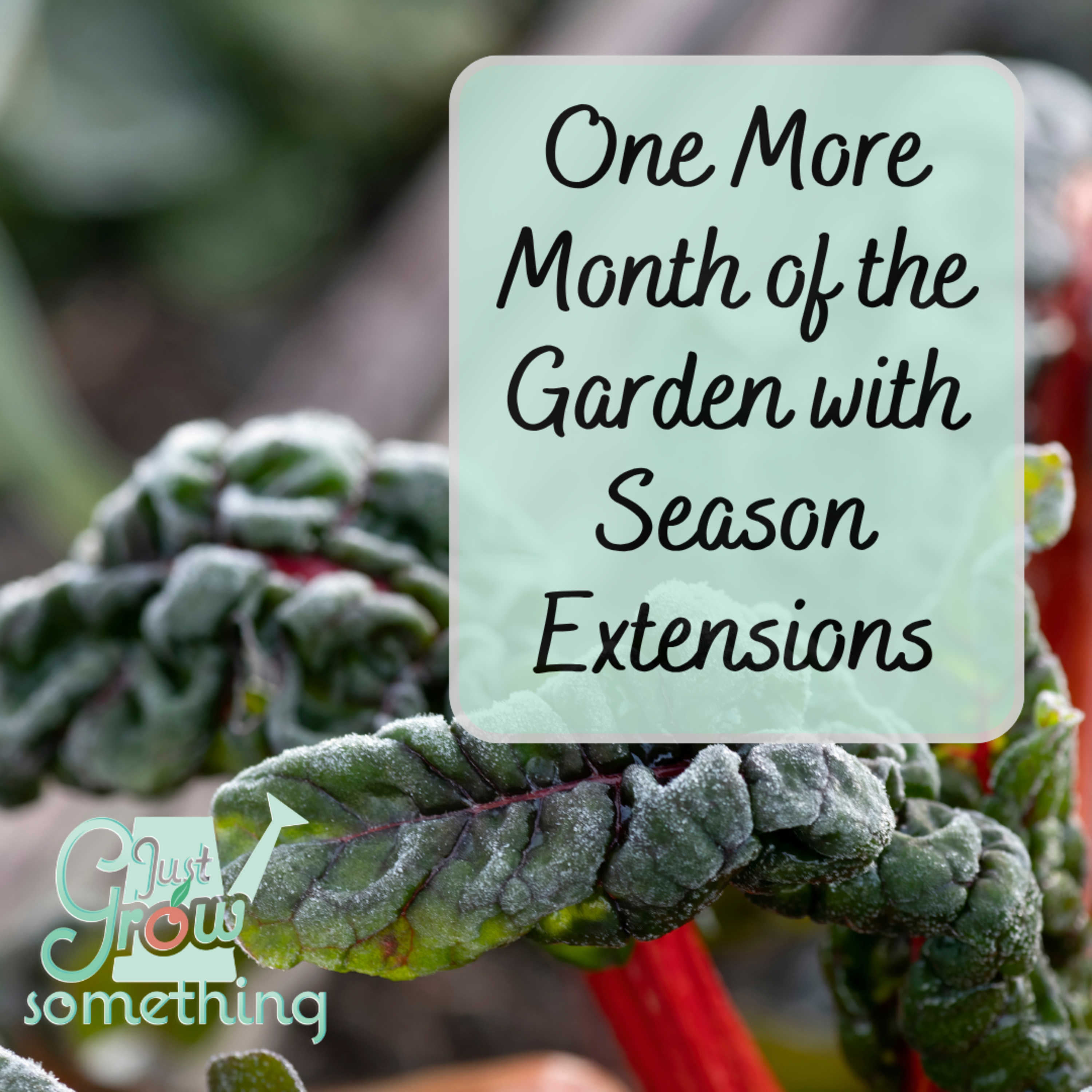
One More Month of Harvests - Ep. 274
Episode Transcript
Normally at this time of the year I am neck deep in fall salad greens and I'm preparing carrots and beets for long term storage in the soil.
But this year I didn't do a fall garden.
That was a very last minute decision on my part and I am honestly kind of regretting it right now.
We just now had our first true frost.
We skirted with those temperatures like midweek last week, but the last of my summer tomatoes and Peppers were still hanging on out there, and this would usually be my sign to cover up my sensitive greens and hunker everything down for at least another month of fall gardening.
If your forecast is flirting with frost and you do still have all of those lovely greens and root veggies out there, or maybe your first frost has hit but everything still looks great, don't panic.
Be prepared.
Today I'll just grow something.
We're talking row cover and low tunnels.
What to buy, how to get it set up fast, how to vent it so you don't cook those greens, and exactly which fabrics and plastics can squeeze out.
Like one more month of salads and herbs and even some late summer crops like beans or peas.
We'll talk about using fabric versus plastic, floating row covers versus things like building a low tunnel, how to vent them, how to anchor, and how to avoid diseases.
By the end, you'll have an emergency plan in place, even if you get a sudden frost warning that you weren't quite prepared for.
Let's dig in.
Hey, I'm Karen and what started as a small backyard garden 20 years ago turned into a lifelong passion for growing food.
Now as a market farmer and horticulturist, I want to help you do the same.
On this podcast, I am your friend in the garden teaching evidence based techniques to help you grow your favorites and build confidence in your own garden.
Space, so grab your.
Garden journal and a cup of coffee and get ready to just grow something.
So when we hear about season extension, sometimes we might immediately think, oh, a greenhouse or a high tunnel of some sort.
But season extension really is just about creating a friendlier microclimate for the crops that are out in our gardens.
We want to block the wind, we want to bump the temperatures up a few degrees, and we want to moderate those sort of temperature swings back and forth between really warm and really cold.
Just that little bit of modification is enough to keep the tender leaves of a lot of our leafy greens unfrozen during a really light frost, and it can dramatically speed up that cool crop growth on our really sunny days.
It's very simple.
If you cover your crops, it's going to reduce that radiative heat loss at night and so it's going to help hold some of that daytime warmth and that's going to buy you extra time at the end of the season.
I think one of the mistakes that I made early, early on when I was trying to protect some of these, like late fall crops, was I grabbed some plastic sheeting and I threw it over the top.
And that was a really bad idea because where that plastic was in contact with those greens, it just immediately froze.
And so when we think about season extension, the first thing that we want to think about is what we call a floating row cover.
This is usually spun bonded polyester or polypropylene.
It is permeable to the air and the rain, so it lets the crops breathe.
It also lets the moisture in.
It's really easy to just kind of throw out there over top of whatever crops it is that we're trying to protect.
It's really great for greens and it's very lightweight.
It also gives about a 70 to 85% light transmission in most instances.
So you're getting the air, you're getting the light, but you're also buffering against frost because it's going to give you about four to 6°F of frost protection.
Now you do have heavier weight versions of this.
They let in less of the light, so you're looking at maybe 30 to 50% light transmission, but they also give you closer to about 8 to 10°F of protection.
So this is really what you would be using if you wanted to overwinter your crops.
If you want something that does both, you can buy that lightweight fabric and use that for just extending the season by a month or so and and giving yourself that little, you know, frost buffer.
But if there are things out there that you're interested in extending well into the winter, then just double up on that lightweight cover.
You don't have to go and buy a separate heavyweight frost cloth.
You can just layer on that lighter weight 1.
So all you're doing is giving it that extra protection.
When we would want to use plastic is when we're putting it over top of hoops.
So when I talk about a floating row cover, what I mean is you're taking that lightweight fabric and it's literally floating on top of those crops.
There is no, you know, supports that are holding that up.
When we use plastic, we absolutely need to use like hoops of some sort or some sort of structure that's going to lift it up off the crops.
That is where I made my mistake the very first time I tried this.
The thing about this plastic is it really does trap in the heat, but it is also clear plastic.
So when you have a very sunny day, it is going to heat up under there very, very quickly.
So it needs to be vented not just to keep those plants from overheating, because that absolutely will happen, but also we're doing this to prevent disease build up.
You know, it can get very, very humid in there.
And even though even if you're in like a dry period of the year or you're in a dry area, that humidity can build up under there.
Those plants are still respirating, right?
And so all that moisture is getting trapped in there.
And that's a great way for fungal diseases to start even in the late fall when it's not normally going to be something that you would see happening out in your garden.
So this is is definitely something that you want to vent.
It also sheds the rain, so you might actually have to do a little bit in terms of that moisture control.
You might need to open it occasionally to let the rain in or you might actually have to water.
What really the plastic is good for is sort of stacking over top of the fabric.
So if you are using the row covers, oftentimes that's going to be enough depending on where you are and how long you were trying to extend the season.
But if you really want to keep things going, then you might use the a lightweight row cover.
You might put an extra layer on top to make it more of a heavyweight row cover.
And then you might build yourself a quick low tunnel, cover it with clear plastic, keep it protected, and then open it when you need it to kind of breathe.
So really you want to use fabric for sort of routine frost protection where you do need the airflow and then use the plastic when you need like a really strong night time buffer.
But we need to vent it.
And we'll talk about venting specifics here in a minute.
So if you do want to do something like a low tunnel, what do you do?
You know, there are a lot of different materials out there that you can buy that are going to allow you to elevate that plastic up off of the ground or up off of the the crops themselves.
You know, conduit or wire hoops or PVC are all really accessible things that you can use and often, and these are reusable.
So it's the type of thing where you know you can get PVC pipe and you can heat it up.
If you build yourself, you know something where it's going to give you the curve that you want depending on how tall you want these, you just sort of heat up that PVC a little bit and bend it to the shape where you want and then you can just jam it right down into the ground.
You can build as many of these as you need and then you can pick them up and store them away during the warm season when you don't need them.
These are also really good though if you have heavy insect pest pressure to keep those hoops out and actually use insect netting over top.
So if you put these in place in your beds and you use, you know, floating, floating row covers on the crops and then plastic over top on these hoops, and then in the summertime you're removing all of that, but you're replacing it with insect netting.
It's it becomes something that can stay permanently in your bed.
And in most instances, you know, the PVC is UV resistant too.
But also, you know, wire hoops you can use, you can do wire with this.
You can get really creative actually with some of these.
I tend to like the the ones that sort of like bend over like an actual hoop, but I have seen where you can do them almost in a in a square.
I guess it's not really a square.
It's a 3 sided, you know, square.
So it's straight up and down on the sides and straight across to be able to to put things to top.
I just like the curved look.
It's easier to mess with.
In terms of the plastic, you want to look for something that is a 4 to 6mm UV resistant Poly cover.
If you do a search and look for, you know, you row cover or you search for like greenhouse plastic, it essentially is a greenhouse plastic, but you're looking at something that's only going to be about 10 to 15 feet wide versus what you would use on a greenhouse.
That's like, you know, a 20 foot wide or a 40 foot wide greenhouse.
Obviously you don't need that much plastic, right?
Sometimes if you don't need this to last for an extended period of time, you can use things like the clear plastic paint covers.
I'm not sure if that's, that's not what they're called.
They're they're protectors that you put down when you're painting the walls, right?
You're covering your furniture or the floor with it.
That can be used in the short term if it's the only thing that you have available to you.
So any kind of clear plastic, preferably something that is UV resistant if you're going to use this for a long period of time.
And then you need something to anchor that plastic.
And you're also going to need something to clip the plastic to the to the hoops and also for clamping down on the ends.
So in terms of anchors, these could be sandbags, they could be boards that are weighed down, they could be bricks.
You can you can berm up the soil.
That also helps to hold this plastic down.
You can clip the plastic to your hoops, which is kind of my preferred way to do it because I can clip it down at the bottom.
It keeps it all in place.
It also makes it easy for me to be able to open it to vent it.
That way I'm not having to uncover like soil berms or something to be able to lift this plastic up on the side.
You do want to be able to clamp it down on the ends so that you can close up those ends for airflow.
I mean, so you don't want the cold air coming in there and be able to open it back up again.
So then when you're putting these together, the first thing that you want to do is you want to do the fabric first.
You want to put that down on top of your crops.
Those you also do need to somehow weigh down.
I like to use fabric staples, landscape fabric staples.
They're super easy just to plop down in the soil and to pull back up when you're not needing them if you need to undrape that fabric.
But again, you can also do this with soil.
You can put boards on the edge, you can use sandbags, whatever, especially depending on how windy your area is so that it's not going to blow these covers off.
And then when you have colder snaps, you want to put the hoops in place.
You want to add the clear plastic over top of the fabric and then secure it at the edges with either your weights or your clips and then close up during at the ends, right.
But we, we mentioned already that these covers don't just keep your crops warm.
They also increase humidity.
And that is a lovely gift for our greens because most of our greens really do like those more humid conditions.
But without air exchange, you can get condensation in there.
Mildew can start to form and then also you have the possibility of overheating on those sunny days.
So if you're just using fabric, and I failed to mention too, if you're using fabric, you don't necessarily have to have it as a floating row cover directly on your crops.
If you want to put the fabric on those hoops, you can absolutely do that too.
So this makes it to where it's not in contact, it's not weighing down, especially if you get that frost, you know, you know, frost will gather on top of the fabric and sort of weigh down on the plants that you're trying to protect.
So if you put that, that fabric over top, then that is going to help.
I, I like to have it in contact because for me it seems like it does a better job of sort of breaking up what would happen on the surface of the plants.
That might just be mental in my head, I don't know.
So it's perfectly acceptable to just put these directly onto those hoops.
And then if you need additional protection, you can put the plastic directly over top of it.
If you're just using fabric, you really don't generally need to do any kind of venting.
They should do just fine.
They should be breathable enough that you don't have to worry about it.
If it gets really, really warm, then you might just kind of lift up a corner and see if the leaves are feeling damp, if it feels really warm under there.
If you are using a heavyweight fabric, this is more likely to happen because again, it's going to be thicker, it's not going to vent as well.
So you absolutely can uncover these things during the day and then cover them back up.
But again, at night, if you've got the plastic over top, then you definitely want to, you know, at least crack the end of those rows or at least or lift 1 long edge up by a few inches because we don't want the temperatures underneath there pushing past about 70°F for those cool weather crops.
And then you just have to go back out there and make sure that you're covering that back up again before the sun starts to go down.
So this regular venting is going to keep the leaves dry.
It's going to reduce that foliar disease pressure.
Really what this is determined by is what time of the year it is right now in my garden.
If I were doing this, I likely wouldn't have to have the plastic on at all.
It's not cold enough yet.
We've only just now seen our first frost and you know, maybe a freeze.
I think it got down to 30 Fahrenheit here last night.
So a simple floating Rd.
cover would be just fine.
And then over the next week it's going to be 70° again during the day.
So I would actually go back out there and uncover all of those plants and just leave them uncovered until the next time I saw that it was starting to get back down closer to frost or freeze and then cover it back up again.
As we get into the season, maybe mid November, late November, then it might be time to say, OK, now I have to leave that floating row cover on all the time and then keep an eye out for the days when it's going to be really warm and just go out and uncover them just for the day if I need to.
And then once we start getting into maybe mid-december, it might be time to say, OK, now it's time to put the plastic over top of everything and just make sure that I'm going out there and venting them on the days where it really does get warm.
Again, this all depends on your garden, how cold it already is in your area.
If you are one of my more northern gardeners here in the Northern Hemisphere, and it's already, you know, well below, you know, 50° during the day as you're high, maybe even 40°, then, yeah, you're probably going to want to leave those frost clothes on all the time.
But if you're one of my more southern gardeners, you know, if you're just just South of me, like in Arkansas, you likely aren't even worrying about this yet.
So you just kind of have to play it by ear.
And the more you do this, more frequently that you're doing this, you know, the more experience you get of how to manage this, not just in terms of when it needs to be covered, but also when it needs to be uncovered.
OK, so again, how much protection can you expect from these things?
If you are using a light, very, very light fabric, you might only get like 2 to 4° of a buffer.
A more medium weight 1 is going to be about four to six degrees.
We're talking Fahrenheit here.
And then a really heavy covered one could be 6 to 10°F.
But remember, the heavier it is, the more that light is being reduced.
Now, for some of these crops, it's going to be OK if you are overwintering things like kale or spinach that do just fine out there in even really heavy frosts and really are going to just get to maturity and sort of sit there all winter.
Because none of these things are actively going to grow in most areas because there's just not enough hours of daylight.
But it's going to sit there in a mature state and you're just trying to protect it while you harvest it and then allow it to bump back up in the spring.
So you may not necessarily need, you know, this, this real heavy, heavy cover on all of these things, but you also may not necessarily need that light either.
If it's just kind of sitting in stasis and it's not growing, keeping that heavy cover on there is going to reduce the light, but it's not really going to affect the plant very much.
OK.
A lot of these real cover, you know, setups are going to keep those crops pretty happy down to about 24 to 28°F without much of a problem.
And then once we start to get down below that, that's when we want to add that plastic layer over top of the fabric to keep it protected for, you know, colder temperatures.
So which greens maybe can be just fabric by itself and then which things might be, you know, more conducive to using that plastic.
Lettuce is fine with just the cover, the fabric cover until we really start to get down into, you know, like the upper 20s Fahrenheit.
And then we might need to give it some extra.
Same with arugula, but our spinach and our kale, Those types of hardier greens are really just going to be super happy with just having the fabric cover alone pretty much through the entire winter if you're in an area like mine.
I am zone 6B so our average coldest temperatures are usually I think around -15 Fahrenheit.
And I have had spinach and kale do just fine out there with a very light frost cloth and they have survived those temperatures with no problem.
Parsley also, by the way, does pretty well with just a light to medium fabric being plenty protection up into like the high 20s Fahrenheit.
So we had that that freeze and then I went out and immediately harvested the flat leaf parsley out of my garden to make a really good chimichurri last night.
So parsley is usually pretty Hardy with that too.
The things also that are in the soil, so your root crops like carrots and and beets and parsnips and and turnips, they're really not going to need a whole lot of protection if you're kind of keeping them out in the garden to sort of store in in place basically.
And we'll talk a little bit more about that next week or the week after.
But you know, you if you're wanting to harvest the greens and stuff off of those, those the beet tops or, or off of the turnips, or if you're just trying to keep them from being super damaged, then yeah, you can just throw some fabric over top of them and and they'll be fine.
If you're trying to keep them out there sort of storing in place for much longer beyond when the ground starts to really freeze, then you might be adding a really heavy layer of straw and then adding some frost protection in terms of a fabric row cover and then adding the plastic over top.
It's not really necessary though, if you plan to eventually harvest those before the ground freezes solid.
Your young brassica.
Same thing if you're trying to squeeze like late beans or peas or anything else kind of across the finish line, like it was a really late crop and and you know, you just try to get it to where it matures so you can get that last harvest in.
You might also consider that plastic over fabric technique when the night start to get really cold because those will not handle a really hard freeze.
So those double covers are going to do better for you and then of course those double covers are also going to help carry the more Hardy, you know, greens through the entire winter in a lot of climates.
Obviously, if we have, you know, crops that are, are fruiting, then you know, if like if you have late tomatoes out there or something that you're really trying to protect, which I have done, I have done, you know, tomatoes that have been out there really, really late and I have covered them with the frost cloth and then I have done a plastic sheet as well.
You just have to remember you also still need pollinators out there, so you'd have to uncover them.
But at that stage of the game, you know, we're not worried about pollination.
We're just trying to get them to finish.
So it's really not something that we have to worry about.
In my area.
If you are an area where you get dipped out of the cold and then you have weeks to continue, you know, working on some of these crops, then maybe you do need to worry about pollinators.
And that's fine.
You just have to remember to uncover that stuff.
Usually you want to use your average first frost date as like a planning tool, keeping in mind that most of those dates are only about 30% accurate.
But this is when you should start getting your stuff sort of prepared right?
You know, if you start to see things in the forecast that are dipping you down into, you know, 40°F or so, you're like, OK, there might be an idea that maybe some things are on the way and it's time to start gathering all of these supplies.
If you wait until you start to see forecasted numbers in the overnights that are in the 30s, then it's like, uh oh, you know, what do we do?
Well, if you kind of have, you know, an emergency case of, oh gosh, we're going to get a frost and I am not ready for this.
The first thing is to water earlier in the day.
And the reason we do this is because we want the soil to release that heat overnight.
So if the soil is damp, it has been watered and it's going to harness a lot of those those rays from the sun and it's going to hold on to that heat.
So then as the sun goes down and it starts to cool off, it's going to release that heat back out again.
There is also something to be said for the plants being able to take up that water and having their cells completely plump and full so that there is less of a chance of that water freezing solid within those cells.
And then, you know, those shards of ice poking out and breaking those cells.
That's what happens that we know.
We get that, that foliage that starts to be destroyed.
So the more plump those cells are with water, the better off they are going to be.
It's going to be easier for them to resist the frost at that point.
You want to drape fabric by about late afternoon.
So if you haven't gotten frost cloth, what can you use?
Just about any fabric is going to do the job for you.
It's not something you're going to leave on long term because you know, a fabric tablecloth or you know, an old bed sheet is not going to have the same breathability as some of these, you know, actual frostcloths are.
But it's going to help protect from frost.
So absolutely you can.
I have used fabric shower curtains and just grabbed them and thrown them and draped them over top of plants when I got caught off guard by a frost coming.
OK.
Just make sure that it's weighted down so you don't have a wind come through and knock them off.
If those temperatures look like they're going to be below like 28°F, well then you might want to do a couple of layers of fabric.
And then if you do have something that's plastic you can put over top of those, then that is going to help get you through until you can actually get the proper supplies and be prepared for your next frosty vents.
OK, so some pitfalls that we might sometimes see with this.
If you forget to vent the plastic on the sunny days, you likely are going to see some very wilted greens.
Just make sure that you're cracking the ends or you're lifting up the side and then button it back up again before dusk hits.
These fabric row covers should float OK.
That's why it's called a floating row cover.
It shouldn't be mashing down the crops.
So once these leaves, you know, start to get really tall or the canopy of the plant starts to get tall, then maybe you want to go ahead and put up those supports so that they're not laying directly on the plants.
Also, don't skimp on those weights or those anchors.
Making sure that stuff is is staying in place is going to prevent wind damage.
It's also going to prevent the cold airs from leaking in.
So, you know, again, boards or sandbags are perfect for this.
If you're using fabric, I love those landscape fabric staples.
They're super easy to work with.
But just about anything that you can do to weigh things down to keep the wind from #1 throwing those covers off, but also sneaking in underneath and wind damaging those plants.
And then, you know, even with protection, again, the growth is going to slow on these plants because the daylight is dropping, especially once that day length drops under 10 hours per day.
So you just kind of have to plan accordingly.
Understand that you are extending the season at this point.
You're not actually creating a whole new season.
So these are plants that are going to be harvested sparingly or you've gotten them to mature state where you can kind of harvest off of them until they're down to a very, very small size.
And then you leave them be and wait for them to come back up again and, you know, start their growth again in the spring.
For greens, you really can just leave these covers on weeks to even months with just occasionally lifting them up to harvest and and check for moisture depending on where it is that you're that you're living.
So anything, again, any breathable fabric is going to buy you a few degrees.
But if you can upgrade to like a true row cover, they are definitely more durable and you get more light transmission.
So that's going to help to keep the plants healthier.
Just remember not to do this too early so you know, if in your area you aren't even really seeing a ton of cool air or your you haven't even seen your first frost yet, then just wait to do this OK?
Because especially if you plan on using plastic, it is very easy to overheat those things if you start this too early in the season.
Again, this is going to take some practice.
It's going to take some experience before you really learn when it's a good time to go ahead and start adding these things, how long they can be out there for, when you need to vent them, when not.
And it sounds like it's a lot of effort, but it really isn't.
If you just go out there once a day and you kind of check on things at the same time that you're planning on harvesting greens and stuff for, you know, your salads for dinner, then you get used to just kind of going, oh, OK, yeah, it needs to be vented.
Or, you know, if it's super sunny out, maybe something needs to happen.
So I hope that this kind of encourages you to continue with the Fall Garden.
Hang on to the last of what's out there.
You don't have regrets like I do right now that I don't have any salad greens out there that I can be going out and picking because I wouldn't mind being out there and covering things right now and keeping them vented.
So that's it.
You just bought yourself a whole other month of of harvesting off of these leafy greens and hopefully that will give you a sense of satisfaction that I am not getting right now.
Until next time, my gardening friends, keep on cultivating that dream garden, and we'll talk again soon.